Gate control of the spin mobility through the modification of the spin-orbit interaction in two-dimensional systems
M. Luengo-Kovac, F. C. D. Moraes, G. J. Ferreira, A. S. L. Ribeiro, G., M. Gusev, A. K. Bakarov, V. Sih, and F. G. G. Hernandez

TL;DR
This paper demonstrates gate-tunable spin mobility in a two-dimensional electron system by controlling spin-orbit interactions, advancing the development of spin transistors with enhanced control over spin transport.
Contribution
It introduces a two-subband system with a large Rashba tuning range and provides experimental evidence of spin mobility control via spin-orbit coupling, supported by a random walk model.
Findings
Large Rashba tuning with gate voltage.
Significant spin mobility anisotropy.
Agreement between model and experimental data.
Abstract
Spin drag measurements were performed in a two-dimensional electron system set close to the crossed spin helix regime and coupled by strong intersubband scattering. In a sample with uncommon combination of long spin lifetime and high charge mobility, the drift transport allows us to determine the spin-orbit field and the spin mobility anisotropies. We used a random walk model to describe the system dynamics and found excellent agreement for the Rashba and Dresselhaus couplings. The proposed two-subband system displays a large tuning lever arm for the Rashba constant with gate voltage, which provides a new path towards a spin transistor. Furthermore, the data shows large spin mobility controlled by the spin-orbit constants setting the field along the direction perpendicular to the drift velocity. This work directly reveals the resistance experienced in the transport of a spin-polarized…
Click any figure to enlarge with its caption.
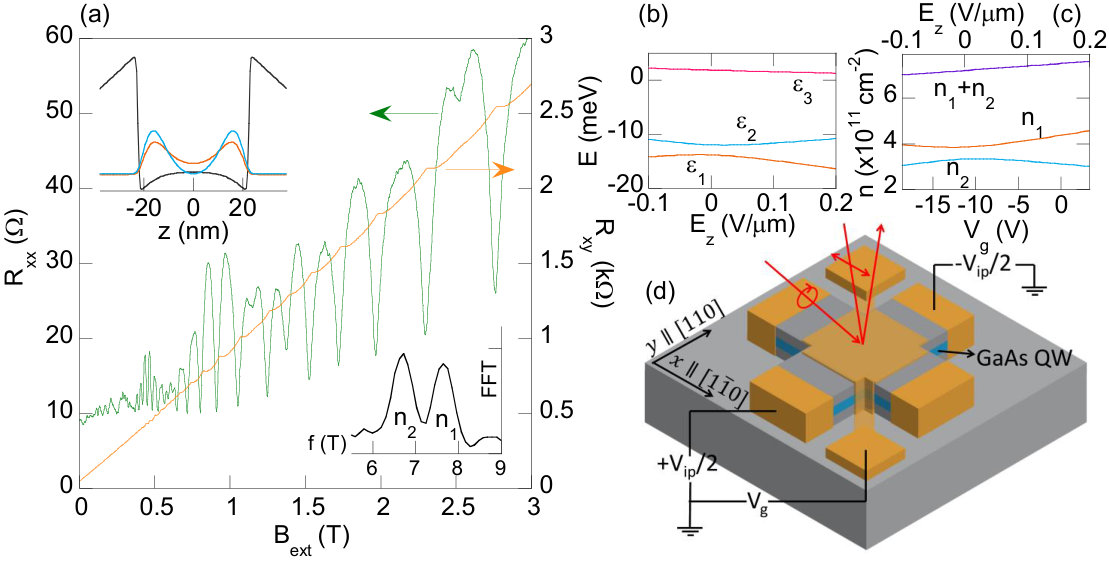 Figure 1
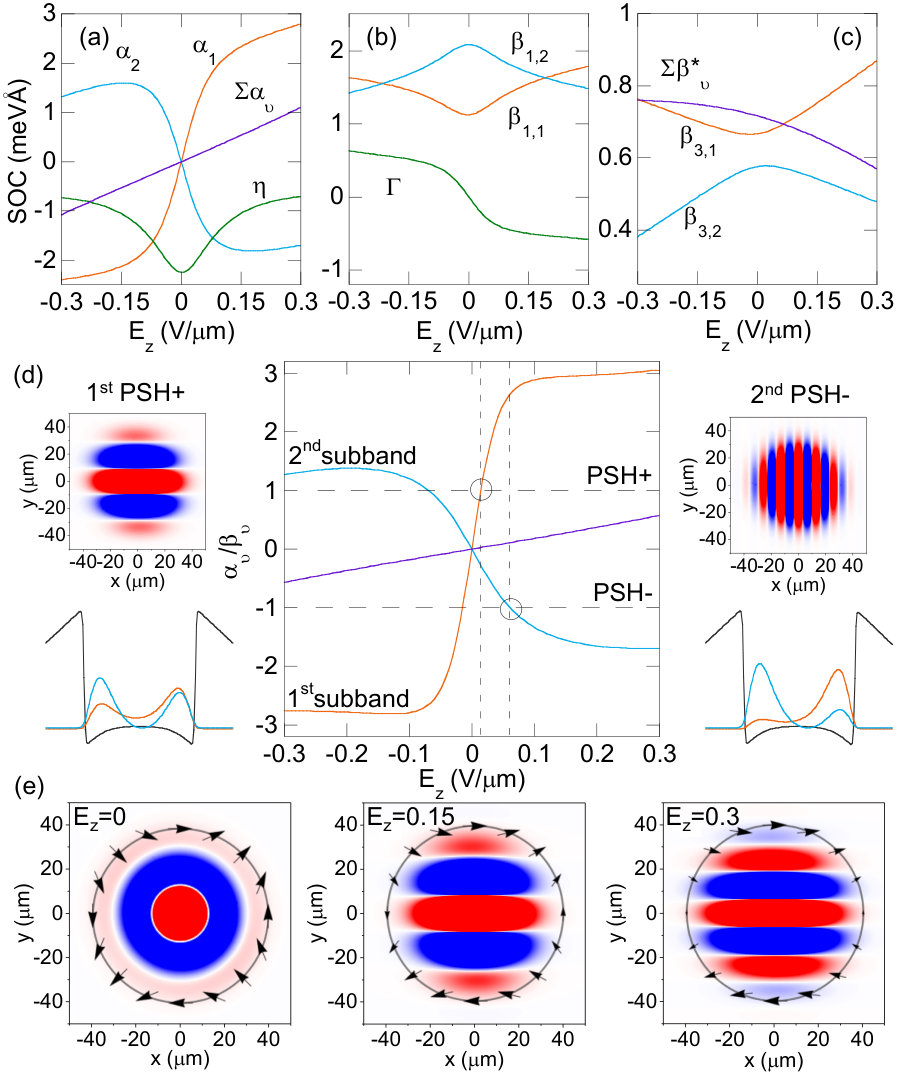 Figure 2
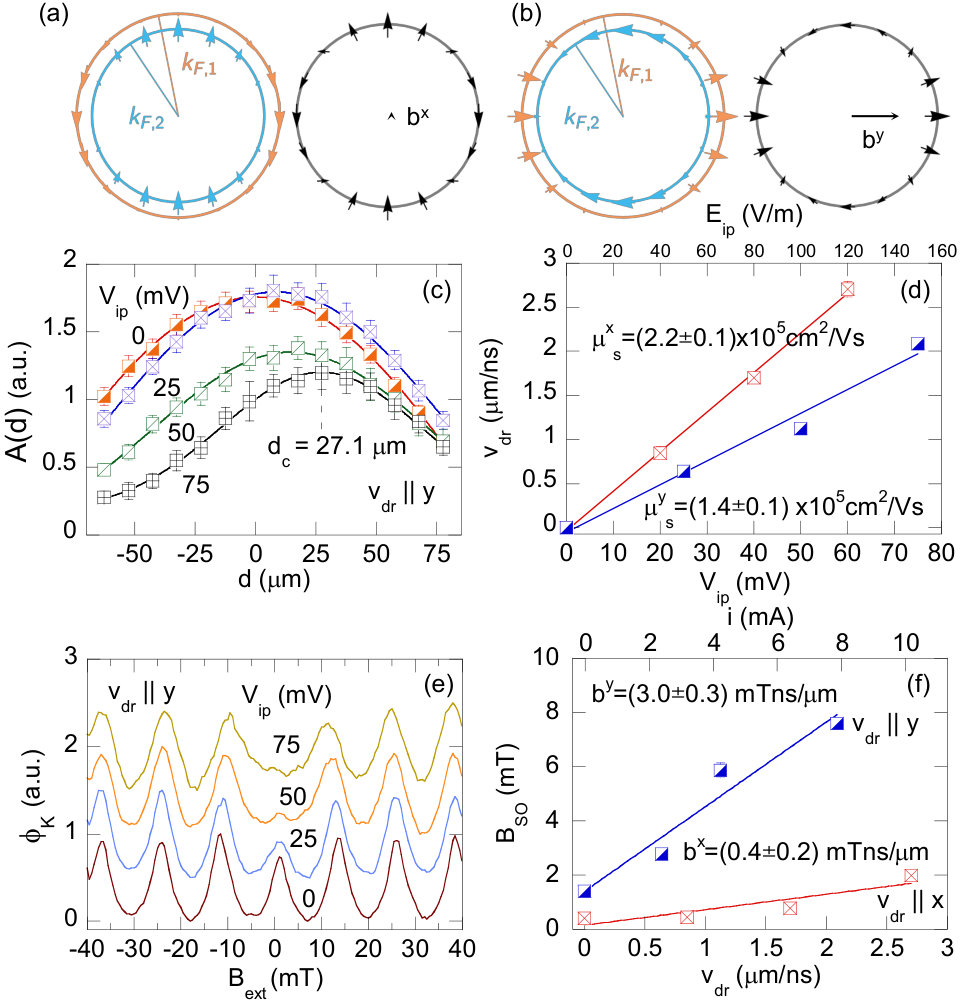 Figure 3
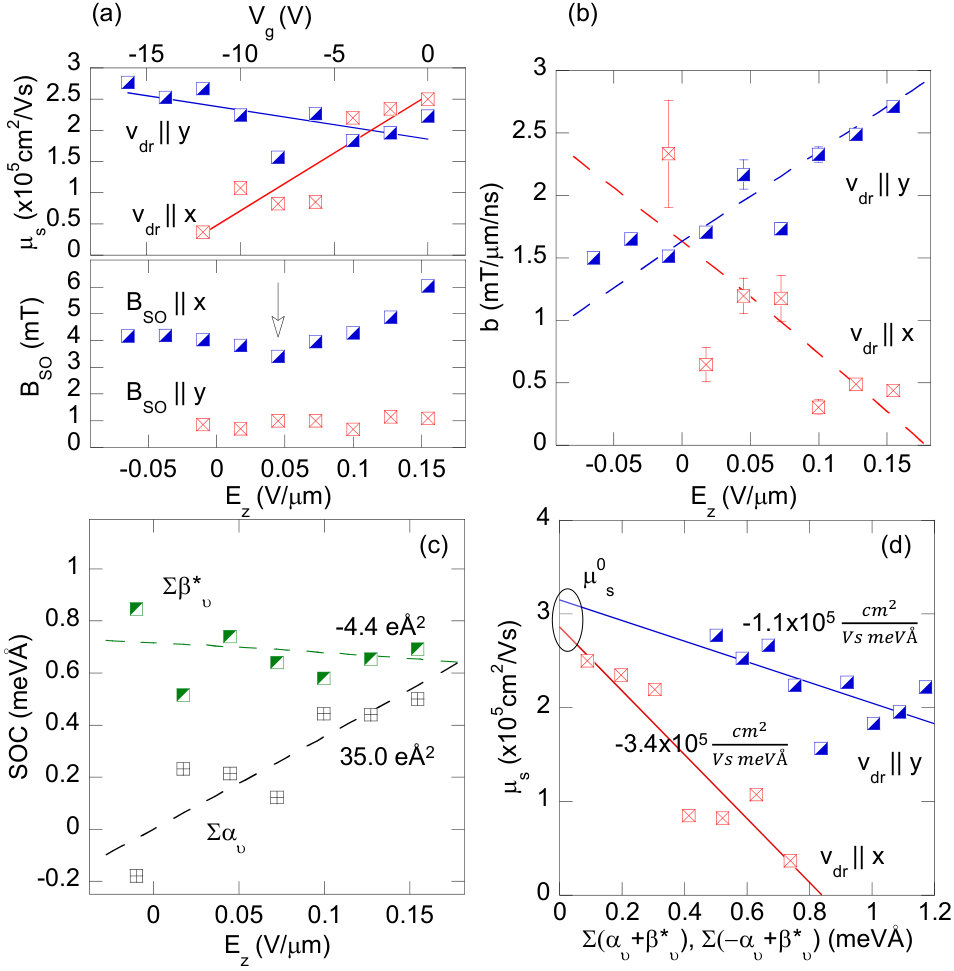 Figure 4
Peer Reviews
No public reviews on file for this paper yet. If you reviewed it on a platform where reviews are public (OpenReview, ICLR, NeurIPS, ICML), you can paste yours below so the community can read it here.
Videos
No videos yet. Explain this paper in a talk, walkthrough, or lecture? Add one.
Gate control of the spin mobility through the modification of
the spin-orbit interaction in two-dimensional systems
M. Luengo-Kovac
Department of Physics, University of Michigan, Ann Arbor, Michigan 48109, United States
F. C. D. Moraes
Instituto de Física, Universidade de São Paulo, São Paulo, SP 05508-090, Brazil
G. J. Ferreira
Instituto de Física, Universidade Federal de Uberlândia, Uberlândia, MG 38400-902, Brazil
A. S. L. Ribeiro
Instituto de Física, Universidade de São Paulo, São Paulo, SP 05508-090, Brazil
G. M. Gusev
Instituto de Física, Universidade de São Paulo, São Paulo, SP 05508-090, Brazil
A. K. Bakarov
Institute of Semiconductor Physics and Novosibirsk State University, Novosibirsk 630090, Russia
V. Sih
Department of Physics, University of Michigan, Ann Arbor, Michigan 48109, United States
F. G. G. Hernandez
Instituto de Física, Universidade de São Paulo, São Paulo, SP 05508-090, Brazil
Abstract
Spin drag measurements were performed in a two-dimensional electron system set close to the crossed spin helix regime and coupled by strong intersubband scattering. In a sample with uncommon combination of long spin lifetime and high charge mobility, the drift transport allows us to determine the spin-orbit field and the spin mobility anisotropies. We used a random walk model to describe the system dynamics and found excellent agreement for the Rashba and Dresselhaus couplings. The proposed two-subband system displays a large tuning lever arm for the Rashba constant with gate voltage, which provides a new path towards a spin transistor. Furthermore, the data shows large spin mobility controlled by the spin-orbit constants setting the field along the direction perpendicular to the drift velocity. This work directly reveals the resistance experienced in the transport of a spin-polarized packet as a function of the strength of anisotropic spin-orbit fields.
The pursuit for a new active electronic component based on flow of spin, rather than that of charge, strongly motivates research in semiconductor spintronics wolf ; zutic ; awschalom ; wunderlich ; egues0 . Since the Datta-Das proposal for a ballistic spin transistor, full electrical control of the spin state was suggested using the gate-tunable Rashba spin-orbit interaction (SOI) rashba ; datta ; nitta ; lechner ; chuang . Further studies, including the Dresselhaus SOI dresselhaus , were made to assure a nonballistic transistor robust against spin-independent scattering schliemann1 ; ohno ; kunihashi0 . For example, it has been demonstrated that SU(2) spin rotation symmetry, preserving the spin polarization, can be obtained in the persistent spin helix (PSH) formed when the strengths of the Rashba and Dresselhaus SOI are equal () bernevig ; koralek ; walser ; schliemann ; khoda . This is possible because the uniaxial alignment of the spin-orbit field suppresses the relaxation mechanism when the spins precess about this field while experiencing momentum scattering dyakonov . Gate control of this symmetry point was experimentally observed khoda2 ; ishihara ; eguesarxiv and allowed to produce a transition to the PSH- () in the same subband ipsh . Drift in those systems showed surprising properties yang0 ; kunihashi such as the current-control of the temporal spin-precession frequency altmann . Although the helical spin-density texture could be even transported without dissipation under certain conditions bernevig , the spin transport suffers additional resistance from the spin Coulomb drag amico1 ; amico2 ; tse ; weber ; yang . These frictional forces appear as a lower mobility for spins than for charge and studies in new systems are still necessary to understand this important constraint for future devices.
A two-dimensional electron gas (2DEG) hosted in a quantum well (QW) with two occupied subbands offers unexplored opportunities for the study of spin transport fggh1 ; fggh2 . Theoretically, the inter- and intra-subband spin-orbit couplings (SOCs) have been extensively studied egues ; egues1 ; egues2 ; egues3 . In terms of a random walk model (RWM) yangwalk , the spin drift and diffusion was recently developed for these systems displaying two possible scenarios regarding the intersubband scattering (ISS) rate ferreira . The interplay between the two subbands may introduce new features to the PSH dynamics, for example, a crossed persistent spin helix eguesprl may arise when the subbands are set to orthogonal PSHs (i.e., and ) in the weak ISS limit. In this report, we experimentally study spin drag in a system with the two-subbands individually set close to the PSH+ and PSH-, but with strong ISS, where the dynamics is given by the averaged SOCs of both subbands. The combination of long spin lifetime and high charge mobility allows us to determine the spin mobility and the spin-orbit field anisotropies with the application of an accelerating in-plane voltage. We are able to control the SOCs in both subbands and to show a linear dependence for the sum of the Rashba constants with gate voltage. Finally, we determine an inverse relation for the spin mobility dependence on the SOCs directly revealing the resistance experienced in the transport of a spin-polarized packet as a function of the strength of anisotropic spin-orbit fields.
The sample consists of a single 45 nm wide GaAs QW grown in the [001] () direction and symmetrically doped. Due to the Coulomb repulsion of the electrons, the charge distribution experiences a soft barrier inside the well. Figure 1(a) shows the calculated QW band profile and charge density for both subbands. The electronic system has a configuration with symmetric and antisymmetric wave functions for the two lowest subbands with subband separation of = 2 meV. The subband density (n1= 3.7, n2= 3.31011 cm*-2*) was obtained from the Shubnikov-de Hass (SdH) oscillations as shown in Fig. 1(a) and the low-temperature charge mobility was 2.2106 cm2/Vs bykov . A device was fabricated in a cross-shaped configuration with width of =270 m and channels along the [10] (x) and [110] (y) directions. Lateral Ohmic contacts deposited =500 m apart were used to apply an in-plane voltage () in order to induce drift transport. For the fine tuning of the subband SOCs, a semitransparent contact on top of the mesa structure () was used to modify structural symmetry and subband occupation. The effect of on the subband energy levels ( and densities () is shown in Fig. 1(b) and (c) as a function of the out-of-plane electric field (). Note that the total density changes linearly with and that =0 corresponds to a built-in electric field of 0.15 V/m. Figure 1(d) displays the experimental scheme with the connection of and vip .
To describe the magnetization dynamics and the measured SO fields for our two-subband system, we combine the calculated SOCs with RWM yangwalk ; ferreira ; mamani . For a [001] GaAs 2DEG, the x and y components of the SO fields for each subband are
[TABLE]
plus corrections due to the intersubband SOCs eguesprl ; egues1 ; egues ; egues2 ; eguesarxiv ; egues3 . Above, is the electron g-factor for GaAs and is the Bohr magneton. The SOCs are the usual Rashba and linear and cubic Dresselhaus terms. Considering the strong intersubband scattering (ISS) regime of the RWM ferreira , the randomization of the momenta (within the Fermi circle ) and subband is much faster than the spin precession. Consequently, the dynamics is governed by an averaged SOC field transverse to the drift velocity Namely, the field components read
[TABLE]
where , and is the effective electron mass for GaAs and is Planck’s constant. Since , it is convenient to analyze the linear coefficients , which are given by the terms between square brackets above.
The intra- and intersubband SOCs are calculated within the self-consistent Hartree approximation egues1 ; egues ; egues2 ; egues3 for GaAs quantum wells tilted by . The chemical potential is set to return the density cm*-2* for , while it varies linearly for finite in Fig. 1(c). The SOCs are defined from the matrix elements and , where is the eigenket for subband , Å2 and Å2 are bulk coefficients egues1 ; egues ; egues2 ; egues3 ; winkler , and are the derivatives of the heterostructure and Hartree potentials along , eVÅ3 is the bulk Dresselhaus constant, and is the z-component of the momentum. The usual intrasubband Rashba and linear Dresselhaus SOCs are and . The non-diagonal terms are the intersubband SOCs and . The calculated SOCs, plotted in Fig. 2(a)-(c) as a function of , show agreement with previous studies studer ; meier . The high-density makes the cubic Dresselhaus comparable with , strongly affecting the PSH tuning walser , with .
Near V/m, the SOCs reach almost simultaneously the balanced condition for the PSH+ in the first subband () and for the PSH- in the second subband (), as shown by the ratio in Fig. 2(d). The expected magnetization patterns for the single-subband PSH is shown in the inset of Fig. 2(d). The PSH- shows more stripes than the PSH+ due to the higher value of , which grows quickly within the range. However, the ratio of the averaged SOCs approaches the PSH regimes only for V/m. As we will see next, the experimental data matches well the strong ISS regime of the RWM, therefore the dynamics is governed by the averaged SOCs. In this case, the expected magnetization patterns are shown in Fig. 2(e). With increasing the system transitions from isotropic () to uniaxial ( V/m), as indicated by the formation of stripes and the orientation of the first harmonic component of the total field [arrows in Fig. 2(e)].
We are interested in the determination of the anisotropy for the coefficients bx(y), estimated in one order of magnitude in Fig. 3(a) and (b). We measured the spin polarization using time-resolved Kerr rotation as function of the space and time separation of pump and probe beams. All optical measurements were performed at 10 K. A mode-locked Ti:Sapphire laser with a repetition rate of 76 MHz tuned to 816.73 nm was split into pump and probe pulses. The polarization of the pump beam was controlled by a photoelastic modulator and the intensity of the probe beam was modulated by an optical chopper for cascaded lock-in detection. An electromagnet was used to apply an external magnetic field in the plane of the QW. The spatial positioning of the pump relative to the probe (d) was controlled using a scanning mirror. We defined the spin injection point to be x=y=0 at t=0. The application of an in-plane electric field (Eip=Vip/), in the x or y-oriented channel, adds a drift velocity to the 2DEG electrons and allows us to determine the spin mobility and the spin-orbit field components kikkawa ; kato ; norman .
The sample was rotated such that each channel under study was oriented parallel to the external magnetic field \text{\bf{B}}_{ext}$$\parallel$$\text{\bf{v}}_{dr} for all measurements reported here. From the SOI form in k-space, we expected \text{\bf{B}}_{SO}$$\perpvdr implying that the observable direction will be \text{\bf{B}}_{SO}$$\perp$$\text{\bf{B}}_{ext}. Considering this orientation, we can model the Kerr rotation signal as with the precession frequency given by , where A(d) is the amplitude at a given pump-probe spatial separation and BSO is the internal SO field component perpendicular to (and to ).
Figure 3 shows the results of the spin drag experiment with the gate contact open. Scanning the pump-probe separation in space at fixed long time delay (13 ns), we determined the central position dc of the spin packet amplitude for several Vip in a given crystal orientation. From the values of dc in Fig. 3(c), we calculated the drift velocity as vdr=dc/t and plotted it as a function of Vip in Fig. 3(d). The slope of the linear fit give us spin mobilities () in the range of 105 cm2/Vs. Values in the same order of magnitude have been measured by Doppler velocimetry for the transport in single subband samples yang . Nevertheless, in those systems the spin lifetimes were restricted to the picosecond range and the transport was limited to the nanometer scale.
Following the drifting spin packet in space, Fig. 3(e) displays a Bext scan from where changes in the amplitude of zeroth resonance determined BSO strength at dc. As explained above, the data confirmed the perpendicular orientation between and and did not show a component parallel to within the experimental resolution kalevich . From the Lorenztian shape of the Bext scan dzhioev ; crooker , we evaluated a spin lifetime of 7 ns at Vip=0. This experiment was only possible due to the nanosecond spin lifetime in our sample that extends the spin transport to several tens of micrometers JAP ; fggh3 .
Figure 3(f) shows the fitted values of BSO for several Vip applied along x and y. We observed highly anisotropic spin-orbit fields in the range of several mT as expected from Fig 3(a) and (b). The BSO orientation was aligned primary with the x axis in agreement with the simulation in Fig 2(e). The slopes bx(y)=B/v give the strength of the SOCs that generate the field according to Eqs. 2 and 3. For this condition of the sample as-grown, we found = 0.57 meVÅ and = 0.75 meVÅ.
Note the inverse behaviour on Vip for the mobility and for BSO strength in perpendicular directions. In Fig. 3(c) and (d), the axis with the largest mobility is also the axis with smaller spin-orbit field in the perpendicular direction. This result may be related to the spin Coulomb drag observed previously in the transport of spin-polarized electrons weber ; yang . Next, we demonstrate the direct control of the spin mobility through the gate modification of the subband SOCs.
Figure 4(a) shows that the magnitude and the orientation with the largest can be tuned by Ez. BSO displays anisotropic components with B being larger in all the studied range, which confirms the preferential alignment towards the PSH+ in Fig. 2(e). The variation of B has a minimum (indicated by an arrow) close to position when the second subband attains the PSH- (with along y). Dividing Fig. 4(a) panels, the values for b are plotted in Fig. 4(b). The lines plotted together with the data are the expected values using Eq. 2 and 3 with the SOCs from Fig. 2(a)-(c). When the QW approaches the symmetric condition (Ez=0), bx(y) decreases removing the anisotropy of BSO as simulated in Fig. 2(e). The addition and subtraction of and give the sum of the Rashba and Dressselhaus SOCs displayed in Fig. 4(c). Dashed lines corresponding to the purple curves in Fig.2(a) and (c) are plotted together displaying excellent agreement. The slope for the Rashba SOI indicates a tuning lever arm of 35 eÅ2. This value is considerably larger than those reported in recent studies for single subband samples, typically below 10 eÅ2 eguesarxiv ; walser . Finally, Fig. 4(d) presents [from (a)] against the SOCs defining B: and , respectively. This last plot illustrates the inverse dependence, with negative slope, for the spin mobility and strength of the SOCs perpendicular to the drift direction. The different slopes for x and y channels give us a hint that this effect depends not only on how BSO changes with vdr (given by the SOCs) but also in the magnitude of the fields. A common maximum value =3cm2/Vs was found independent of orientation.
In conclusion, we have studied a 2DEG system with two subbands set close to the crossed PSH regime under strong intersubband scattering and successfully described it using a random walk model. In the spin transport with nanosecond lifetimes over micrometer distances, we demonstrate the control of the subbands spin-orbit couplings with gate voltage and observed spin mobilities in the range of cm2/Vs. Specifically, the sum of the Rashba SOCs presents a linear behaviour with remarkably large tunability lever arm with gate voltage. We tailored the spin mobility by controlling the strength of the spin-orbit interaction in the direction perpendicular to the drift velocity. Our findings provided evidence of the rich physical phenomena behind multisubband systems and experimentally demonstrated relevant properties required for the implementation of a nonballistic spin transistor.
This work is a result of the collaboration initiative SPRINT No. 2016/50018-1 of the São Paulo Research Foundation (FAPESP) and the University of Michigan. F.G.G.H also acknowledges financial support from FAPESP Grants No. 2009/15007-5, No. 2013/03450-7, and No. 2014/25981-7 and 2015/16191-5. G.J.F. acknowledges the financial support from CNPq and FAPEMIG. The work at the University of Michigan is supported by the National Science Foundation under Grant No. DMR-1607779.
The reference list from the paper itself. Each links out to its DOI / PubMed record.
- 1(1) S. A. Wolf, D. D. Awschalom, R. A. Buhrman, J. M. Daughton, S. von Molnár, M. L. Roukes, A. Y. Chtchelkanova, and D. M. Treger, Science 294 , 1488 (2001).
- 2(2) I. Ẑutić, J. Fabian, and S. Das Sarma, Rev. Mod. Phys. 76 , 323 (2004).
- 3(3) D. D. Awschalom and M. E. Flatté, Nat. Phys. 3 , 153 (2007).
- 4(4) J. Wunderlich, B.-G. Park, A. C. Irvine, L. P. Zârbo, E. Rozkotová, P. Nemec, V. Novák, J. Sinova, and T. Jungwirth, Science 330 , 1801 (2010).
- 5(5) J. C. Egues, G. Burkard, and D. Loss, Appl. Phys. Lett. 82 , 2658 (2003).
- 6(6) E. I. Rashba, Sov. Phys. Solid State 2 , 1109 (1960); Y. A. Bychkov and E. I. Rashba, J. Phys. C 17 , 6039 (1984); JETP Lett. 39 , 78 (1984).
- 7(7) S. Datta and B. Das, Appl. Phys. Lett. 56 , 665 (1990).
- 8(8) J. Nitta, T. Akazaki, H. Takayanagi, and T. Enoki, Phys. Rev. Lett. 78 , 1335 (1997).