Spin-polarized local density of states in the vortex state of helical p-wave superconductors
Kenta K. Tanaka, Masanori Ichioka, Seiichiro Onari

TL;DR
This study investigates the vortex state properties of helical p-wave superconductors using quasi-classical theory, revealing spin-polarized local density of states and the effects of vorticity and chirality coupling.
Contribution
It demonstrates the instability of the helical p-wave state at high fields and characterizes the spin-polarized local density of states in vortex states, providing new insights into their spectral features.
Findings
Spin-polarized local density of states appears without change in Knight shift.
Helical p-wave state becomes unstable at high magnetic fields.
Vorticity couples to chirality, affecting local density of states.
Abstract
Properties of the vortex state in helical p-wave superconductor are studied by the quasi-classical Eilenberger theory. We confirm the instability of the helical p-wave state at high fields and that the spin-polarized local density of states M(E,r) appears even when Knight shift does not change. This is because the vorticity couples to the chirality of up-spin pair or down-spin pair of the helical state. In order to identify the helical p-wave state at low fields, we investigate the structure of the zero-energy M (E = 0, r) in the vortex states, and also the energy spectra of M (E, r).
Click any figure to enlarge with its caption.
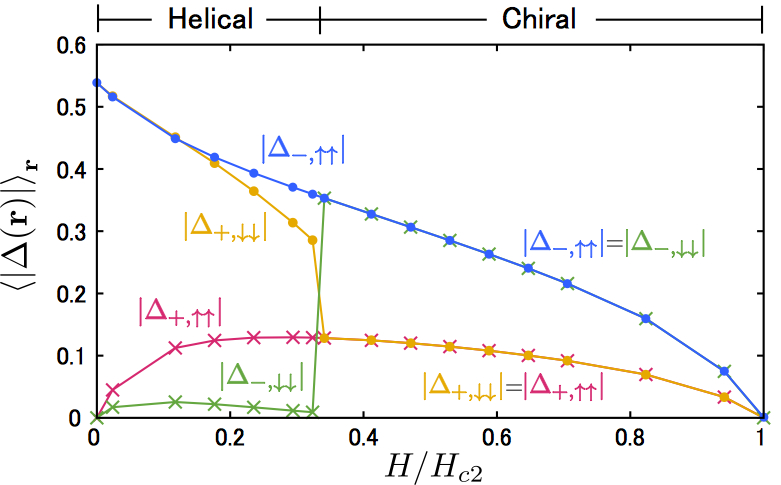 Figure 1
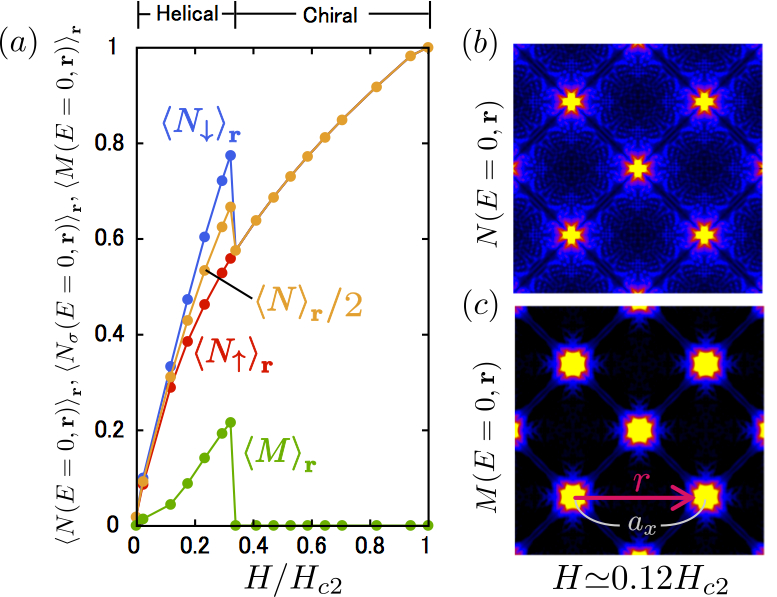 Figure 2
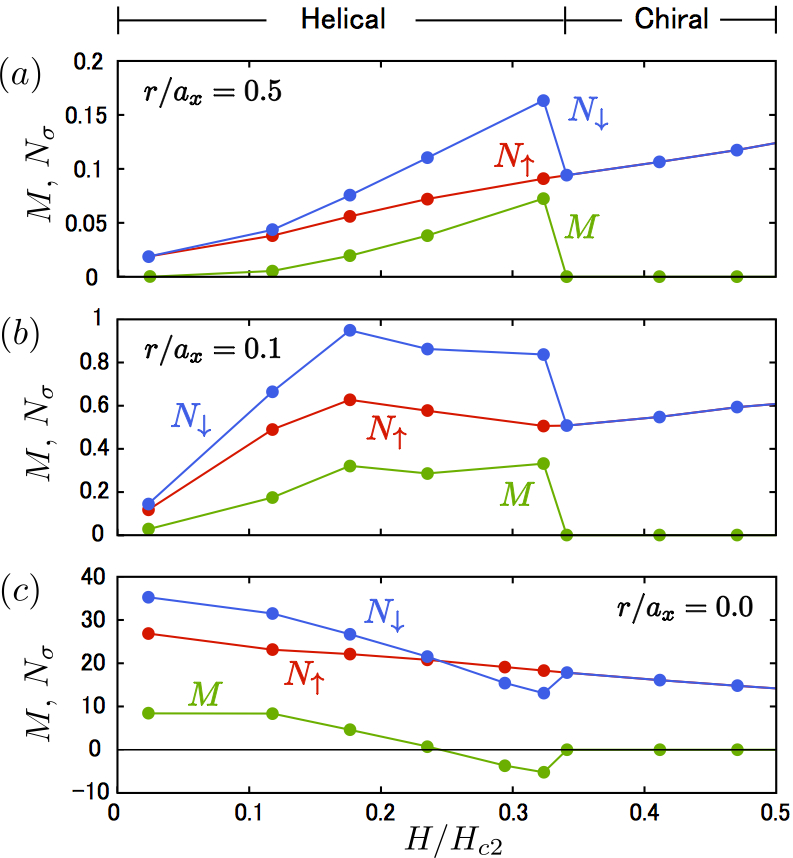 Figure 3
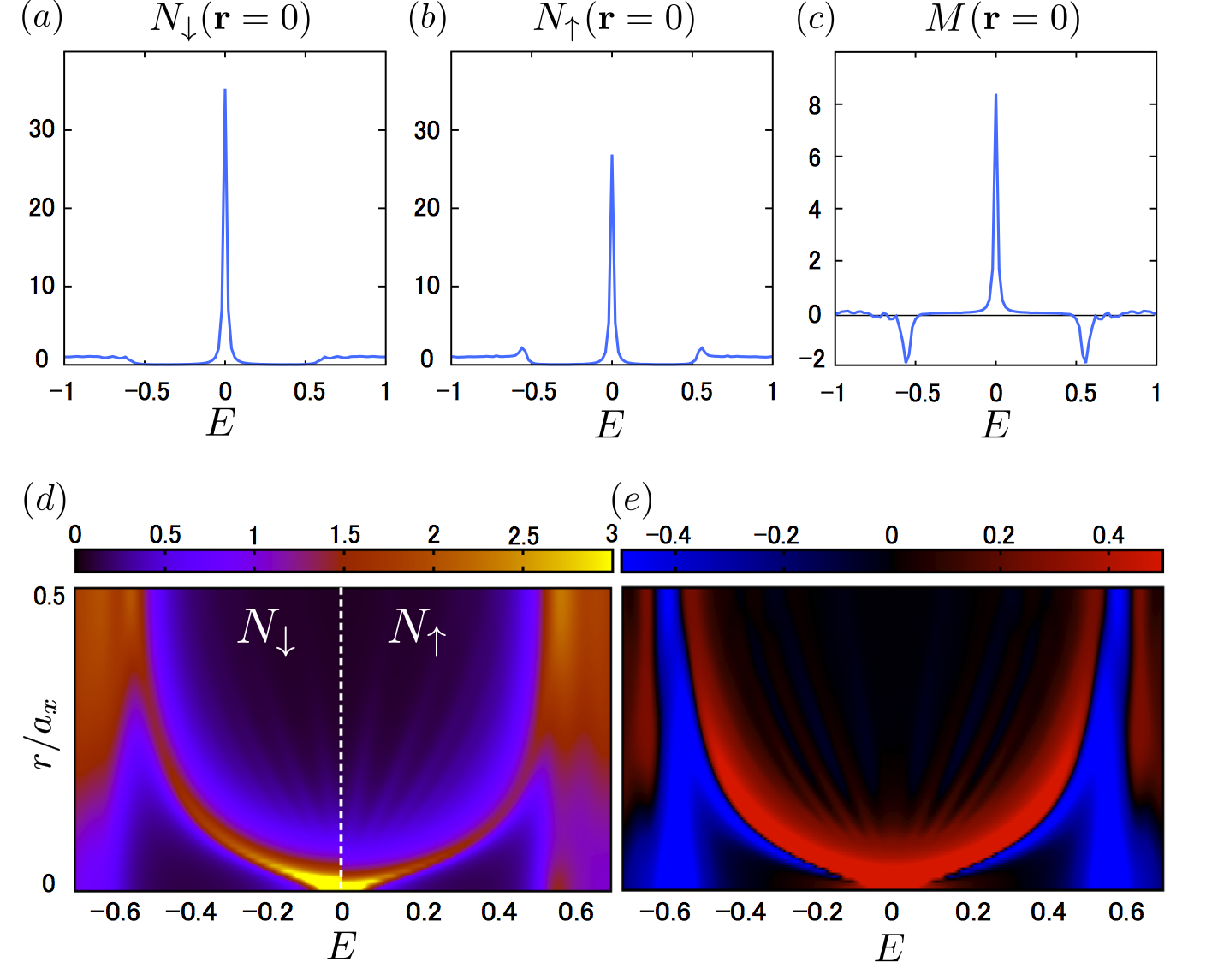 Figure 4
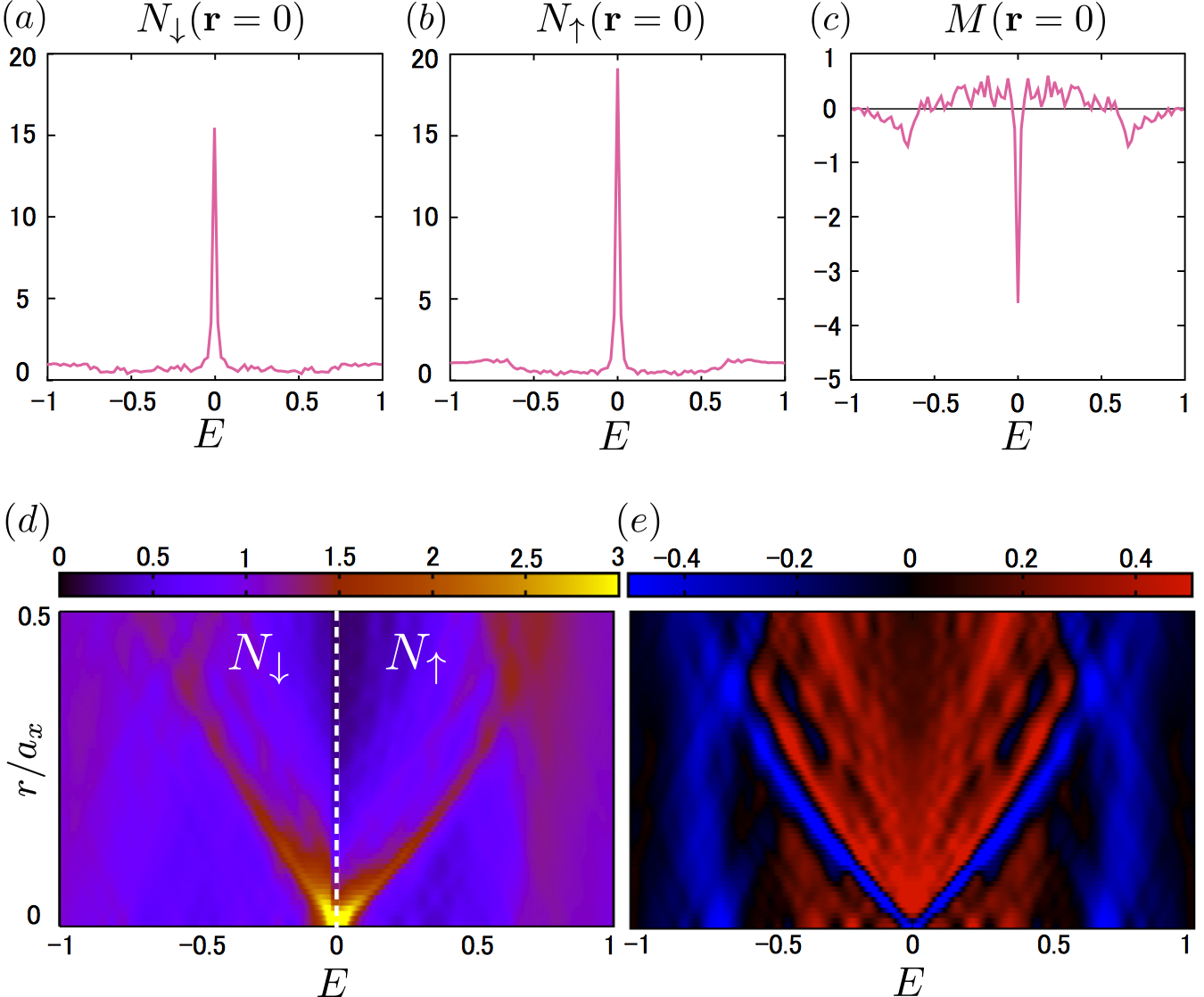 Figure 5
Peer Reviews
No public reviews on file for this paper yet. If you reviewed it on a platform where reviews are public (OpenReview, ICLR, NeurIPS, ICML), you can paste yours below so the community can read it here.
Videos
No videos yet. Explain this paper in a talk, walkthrough, or lecture? Add one.
Spin-polarized local density of states
in the vortex state of helical -wave superconductors
Kenta K. Tanaka
Department of Physics, Okayama University, Okayama 700-8530, JAPAN
Masanori Ichioka
Department of Physics, Okayama University, Okayama 700-8530, JAPAN
Research Institute for Interdisciplinary Science, Okayama University, Okayama 700-8530, JAPAN
Seiichiro Onari
Department of Physics, Okayama University, Okayama 700-8530, JAPAN
Research Institute for Interdisciplinary Science, Okayama University, Okayama 700-8530, JAPAN
Abstract
Properties of the vortex state in helical -wave superconductor are studied by the quasi-classical Eilenberger theory. We confirm the instability of the helical -wave state at high fields and that the spin-polarized local density of states appears even when Knight shift does not change. This is because the vorticity couples to the chirality of up-spin pair or down-spin pair of the helical state. In order to identify the helical -wave state at low fields, we investigate the structure of the zero-energy in the vortex states, and also the energy spectra of .
I Introduction
The superconductor (SC) has attracted much attention as a topological SC, since exotic quantum states such as a Majorana state are expected in the vortex and surface states. A lot of experimental and theoretical studies support that is a spin-triplet chiral -wave SC Sr2RuO4-1 ; Sr2RuO4-2 . On the other hand, the helical -wave state also has been suggested as another scenario Rice-Sigrist ; Takamatsu_GL ; Scaffidi . This is because the detailed structure of -vector in remains unclear. In addition, the difference of condensation energy between chiral and helical states is very small compared to the transition temperature Tsuchiizu . Therefore, we need methods to distinguish between chiral and helical states in experiments for or other candidate materials for spin-triplet SC. For the purpose, it is necessary that we study a unique behavior of physical quantity depending on the symmetry of -vector.
In the bulk state of chiral SC, the time-reversal symmetry is broken because of the angular momentum of Cooper pair . The chirality of chiral -wave state, i.e., can be distinguished via coherence effect in the vortex state. In fact, previous theories suggested that the impurity effects on the local density of states (LDOS) and local NMR relaxation rate show different behaviors between and states Kato-Hayashi ; Tanuma ; Kurosawa ; Hayashi-NMR ; K.Tanaka3 . This chirality dependence is caused by the interaction between the chirality and the vorticity, depending on whether the chirality is parallel () or anti-parallel () to the vorticity Ichioka-chiral ; Heeb . On the other hand, in the bulk state of helical -wave SC, the time-reversal-invariant superconductivity appears since are quenched with the degeneracy between up-spin and down-spin pairs. The up-spin (down-spin) pair’s order-parameter characterized by has chirality so that the bulk condition Rice-Sigrist . Therefore, in the vortex state of helical -wave SC, spin states of low-energy excitations may show a unique behavior, reflecting the vorticity coupling to the chirality of or .
The scanning tunneling microscopy and spectroscopy (STM/STS) measurement can directly detect the LDOS via excitations in the vortex state Hess ; Fischer . Recently, the STM/STS measurement in the vortex state of topological insulator-superconductor heterostructure has performed STM_Majonara1 , and theoretical studies for the measurement have supported the existence of Majorana zero-energy mode in the vortex core Hetero-theory ; STM_Majonara2 . Moreover, spin polarization of Majorana zero-energy modes are investigated by the spin-polarized STM/STS measurement, which can selectively detect the spin-dependent conductance SPSTM . The spin polarization in the vortex state of topological SC is also theoretically studied Nagai .
In this paper, we study properties of the helical -wave SC, and focus on the spin-polarized LDOS in the vortex lattice state, in order to reveal a unique behavior of the helical state. In particular, we calculate the structure of the zero-energy spin-polarized LDOS at low fields, and also the energy spectra. These results help to investigate the vortex state of helical -wave SC and Majorana zero-energy state by spin-polarized STM/STS measurement.
This paper is organized as follows. After the introduction, we describe our formulation of the quasi-classical Eilenberger equation in the vortex lattice state and the calculation method for the spin-resolved LDOS in Sec. II. In Sec. III, we investigate the -dependence of order-parameter, and examine the instability of the helical state at high fields. In Sec. IV, we show the -dependence of the zero-energy spin-polarized DOS and LDOS. The -dependence of the spin-polarized LDOS is presented in Sec. V. The last section is devoted to the summary.
II Formulation
We calculate the spatial structure of vortices in the vortex lattice state by quasi-classical Eilenberger theory. The quasi-classical theory is valid when the atomic scale is small enough compared to the superconducting coherence length. For many SCs including , the quasi-classical condition is well satisfied Sr2RuO4-1 ; Sr2RuO4-2 . Moreover, since our calculations are performed in the vortex lattice state, we can obtain the structure of LDOS quantitatively.
For simplicity, we consider the helical -wave pairing on the two-dimensional cylindrical Fermi surface, , and the Fermi velocity . In the following, the symbol of hat indicates the matrix in spin space and the symbol of check indicates the matrix in particle-hole and spin spaces.
To obtain quasi-classical Green’s functions in the vortex lattice state, we solve Riccati equation derived from Eilenberger equation Tsutsumi
[TABLE]
in the clean limit, where is the center-of-mass coordinate of the pair, , is the Pauli matrix, and with Matsubara frequency . The quasi-classical Green’s function and order parameter are described by
[TABLE]
where . The spin spaces of and are defined by the matrix elements and where (up-spin) or (down-spin), and is -component of -vector. In addition, the matrix elements of order-parameter are defined by
[TABLE]
with the order-parameter and pairing function for -state. Length, temperature, and magnetic field are, respectively, measured in unit of , , and . Here, , with the flux quantum . is superconducting transition temperature at a zero magnetic field. The energy , pair potential and are in unit of . In the following, we set . In this study, our calculations are performed at .
We set the magnetic field along the axis. The vector potential in the symmetric gauge. is a uniform flux density, and is related to the internal field . The unit cell of the vortex lattice is set as square lattice Sr2RuO4-1 .
To determine the pair potential and the quasi-classical Green’s functions selfconsistently, we calculate the order-parameter by the gap equation
[TABLE]
where indicates Fermi surface average, , and we use . In Eq. (9), -wave pairing interaction is isotropic in spin space. For the selfconsistent calculation of the vector potential for the internal field , we use the current equation with the Ginzburg-Landau parameter . In our calculations, we use appropriate to as a candidate material for the chiral or helical -wave SC. We iterate calculations of Eqs. (1)-(9) for until we obtain the selfconsistent results of , and the quasi-classical Green’s functions in the vortex lattice state.
In the helical -wave SCs, -vector is given by in uniform state at a zero field, with . Thus, when we iterate calculations of Eq.(1)-(9), the initial value of -vector is set to be where is Abrikosov vortex lattice solution.
Next, using the selfconsistently obtained and , we calculate for real energy by solving Eilenberger eq. (1) with . is a small parameter, and we use in this paper except for the calculations of distribution in Figs. 4(d) and 4(e), and Figs. 5(d) and 5(e). The spin-resolved LDOS is given by
[TABLE]
We define the LDOS , and spin-polarized LDOS .
III -dependence of order-parameter
In order to examine the instability of helical -wave state at high , we show the -dependence of spatial average of the order-parameter amplitude, defined by Eq. (8) in Fig. 1. Using the initial state of helical states, and components do not appear in the selfconsistent calculations of our model. In the vortex state of helical -wave SC at , up-spin pair has a form with sub component . The main component has chirality , anti-parallel to vorticity as . The sub component is induced around the vortex core. Since the local winding number can be a value other than in the induced components, the sub component with has inverse winding number to satisfy the conservation of . K.Tanaka3 According to the previous studies for the vortex state of chiral -wave SC Ichioka-chiral ; Heeb , the anti-parallel vortex state () is stable compared with the parallel vortex state () by the interaction between the chirality and the vorticity. Therefore, the -dependence of and show same behavior to those for anti-parallel case in a chiral -wave SC Ichioka-chiral , and the amplitude survives until .
On the other hand, down-spin pair has a form at low fields, with sub component . Since the chirality of main is parallel to vorticity as , is rapidly suppressed as a function of , as shown in Fig. 1. In addition, at , we find the change of chirality in , where changes to be main part of from the sub component. At , is equal to as main components and is equal to as sub components, so that the order-parameter is chiral form. Even in this chiral state, so that . Therefore, the helical -wave state becomes unstable at high fields by the effect of vorticity coupling to the chirality, and changes to a chiral state.
In our model, we assume that the helical state can appear in the Meissner state , since condensation energy of the helical state is the same as chiral state. The helical state can be more stable than the chiral state, if we consider additional mechanism such as weak spin-orbit coupling effect Takamatsu_GL . Even when very small number of vortices penetrate to the helical -wave SC, we expect that the helical state can be sustained at the low fields. With increasing , it becomes metastable state, and finally show instability to the chiral state. The instability field can be shifted from our estimation of Fig. 1.
IV -dependence of zero-energy spin-polarized DOS and LDOS
In this section, to find difference of observed quantities between helical and chiral states, we investigate the characteristic behavior of helical state under the assumption that the helical -wave state is sustained at low .
First, we study the -dependence of the zero-energy DOS , the zero-energy spin-resolved DOS and the zero-energy spin-polarized DOS . As shown in Fig. 2(a), the -dependence of shows the typical behavior, which is same behavior in the anti-parallel vortex state of chiral -wave SC Ichioka-chiral . On the other hand, the -dependence of at is larger than . At , since and have same chirality, =. Here, contributions of the Zeeman effect are absent since . As a result, the -dependence of DOS shows a jump when the helical state becomes unstable in Fig. 2(a). The jump behavior may be observed by the low temperature specific heat measurement. When the instability field shifts into high (low) , the jump of specific heat becomes larger (smaller).
The -dependence of at low fields has a finite value and shows increasing behavior, reflecting the behavior in Fig. 2(a). And, it jumps to zero when the helical state becomes unstable. At high fields as the vortex state of chiral -wave SC, where , vanishes. This -dependence of is the unique behavior of the helical -wave state. In addition, Figs. 2(b) and 2(c) show the LDOS and spin-polarized LDOS distributions at a low field , which have large amplitudes around the vortex core. Since the zero energy state localized around the vortex core is Majorana state in the chiral and helical SCs, Fig. 2(c) shows that the Majorana state is spin-polarized in the helical -wave SCs. This is another type of spin-polarized zero energy state than that supposed in STM_Majonara2 or Nagai .
Next, we present the structure of spin-polarized LDOS at low fields to study the properties of the vortex state of helical -wave SC. Figure 3 presents the -dependence of and at some positions on a line between next-nearest-neighbor (NNN) vortices at . At which is midpoint of between NNN vortices, and their magnitudes are small and monotonically increase as a function of . On the other hand, at the vortex core region in Figs. 3(b) and 3(c), shows a large amplitude at some fields in the helical state. In particular, at the vortex center in Fig. 3(c), at 0.02 shows much larger value than the normal state DOS(), while it monotonically decrease with raising . These large values of may be observed by the spin-polarized STM measurement.
V -dependence of spin-polarized LDOS
Finally, we study the - and -dependences of and in order to investigate the behavior of LDOS spectrum of spin-polarized STM/STS measurement. When is compared with at a low field , shown in Figs. 4(a)-(c), the height of zero-energy peak in is smaller, and instead the gap edges at have small peak. Thus, is positive at , and negative at . These weights cancel each other, so that total spin polarization . This condition can be extended to finite as with Fermi distribution function since is even function of . The absence of total spin polarization corresponds to the fact that Knight shift is invariant in the helical -wave state, where . To observe the spin-polarized LDOS in the helical state, we have to perform -resolved observation such as spin-polarized STM/STS. The -dependence of spectra and are presented in Figs. 4(d) and 4(e), respectively. When we focus on the dispersion curve of brighter region in Fig. 4(d), the zero-energy peak at evolves toward the gap-edge with increasing . Since the zero-energy vortex bound state connects with the gap-edge state at smaller for than , the effective vortex core radius is smaller for . Therefore, in , the peaks of the gap edge () outside vortices can extend until the vortex center, as shown in Fig. 4(b). In Fig. 4(e), we see that the spin-polarized state appears near the dispersion curve of vortex bound state extending from the Majorana zero mode, in addition to gap edges.
Moreover, we show the - and -dependences of and at a higher field , considering that the helical -wave state is still sustained at higher . In Figs. 5(a)-(c), the hight of zero-energy peak of is larger than , resulted in negative . To compensate negative value at and at the gap edge, becomes positive for in-gap states for . As shown in Figs. 5(d) and 5(e), since the down-spin’s in-gap states have a larger value compared with the up-spin states, has finite distributions at even far from dispersion curve of bound state.
VI Summary
We studied the vortex state of helical -wave SCs based on the quasi-classical Eilenberger theory. We confirmed the instability of the helical -wave state at high fields and that the spin-polarized LDOS appears even when Knight shift does not change. This is because the vorticity couples to the chirality of up- or down-spin pair of helical state. In addition, we found that the magnetic field dependence of zero-energy DOS shows a jump when the helical state becomes unstable. This jump behavior may be observed by the low temperature specific heat measurement. In order to identify the helical -wave state at low fields, we investigated the structure of the zero-energy in the vortex states. In particular, at the vortex center, the value of at a low field 0.02 shows much larger value than the normal state DOS, while it monotonically decrease with raising field. Moreover, we present the - and -dependences of the spin-resolved LDOS , and in the vortex state. We hope that these theoretical calculation results of spin-polarized LDOS will be examined, and will be used for detecting the spin-polarized Majorana zero-energy modes by the spin-polarized STM/STS measurement.
Acknowledgements.
This work was supported by JSPS KAKENHI Grant Number JP16J05824.
The reference list from the paper itself. Each links out to its DOI / PubMed record.
- 1(1) A. P. Mackenzie and Y. Maeno, Rev. Mod. Phys. 75 , 657 (2003).
- 2(2) Y. Maeno, S. Kittaka, T. Nomura, S. Yonezawa, and K. Ishida, J. Phys. Soc. Jpn. 81 , 011009 (2012).
- 3(3) T. M. Rice and M. Sigrist, J. Phys.: Condens. Matter 7 , L 643 (1995).
- 4(4) S. Takamatsu and Y. Yanase, J. Phys. Soc. Jpn. 82 , 063706 (2013).
- 5(5) T. Scaffidi, J. C. Romers, and S. H. Simon, Phys. Rev. B 89 , 220510(R) (2014).
- 6(6) M. Tsuchiizu, Y. Yamakawa, S. Onari, Y. Ohno, and H. Kontani, Phys. Rev. B 91 , 155103 (2015).
- 7(7) Y. Kato and N. Hayashi, Physica C 388 , 519 (2003).
- 8(8) Y. Tanuma, N. Hayashi, Y. Tanaka, and A. A. Golubov, Phys. Rev. Lett. 102 , 117003 (2009).