Algebraic properties of toric rings of graphs
Selvi Kara, Huy Tai Ha, Augustine O'Keefe

TL;DR
This paper studies algebraic properties of toric rings derived from graphs, focusing on Cohen-Macaulayness and invariants like regularity and projective dimension, by analyzing induced subgraphs.
Contribution
It introduces methods to relate algebraic invariants of the toric ring of a graph to those of its induced subgraphs, advancing understanding of their algebraic structure.
Findings
Established connections between invariants of $k[G]$ and induced subgraphs.
Provided criteria for Cohen-Macaulayness of toric rings of graphs.
Analyzed bounds for Castelnuovo-Mumford regularity and projective dimension.
Abstract
Let be a simple graph. We investigate the Cohen-Macaulayness and algebraic invariants, such as the Castelnuovo-Mumford regularity and the projective dimension, of the toric ring via those of toric rings associated to induced subgraphs of .
Click any figure to enlarge with its caption.
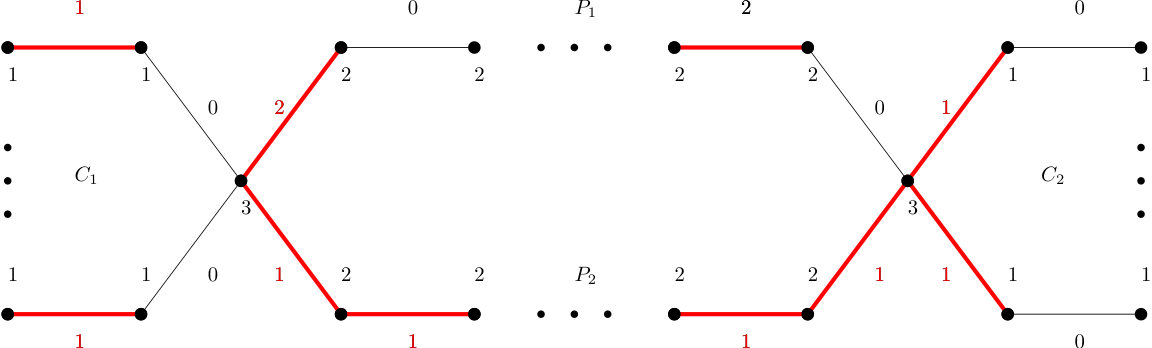 Figure 1
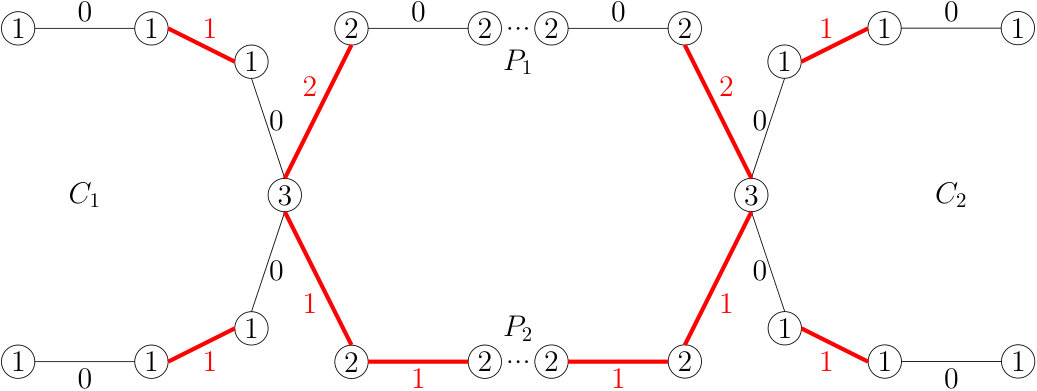 Figure 2
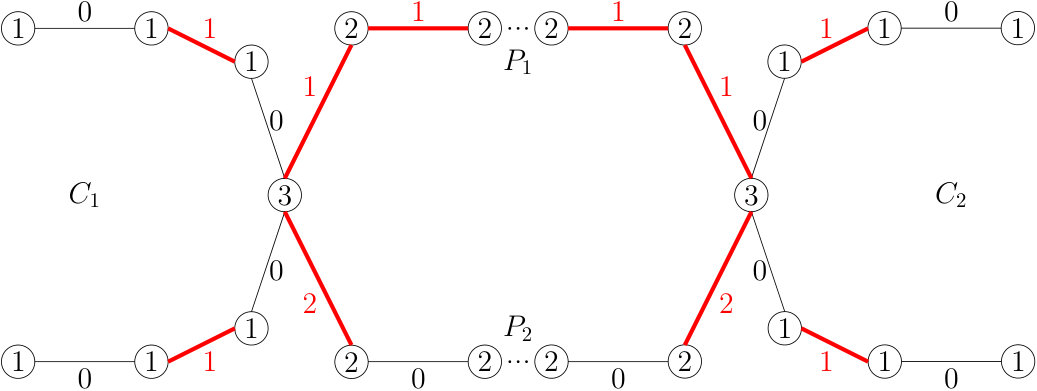 Figure 3
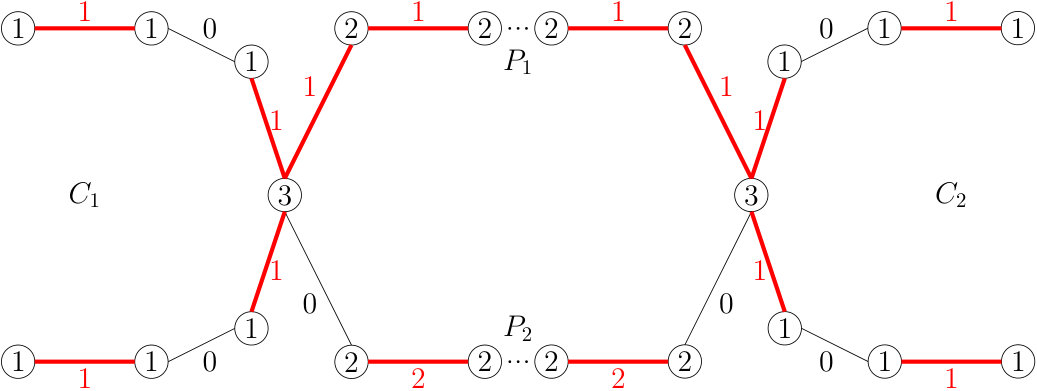 Figure 4
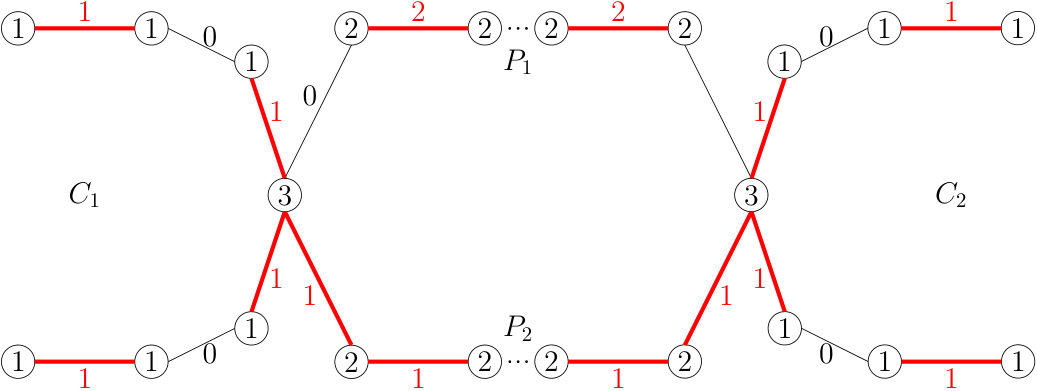 Figure 5
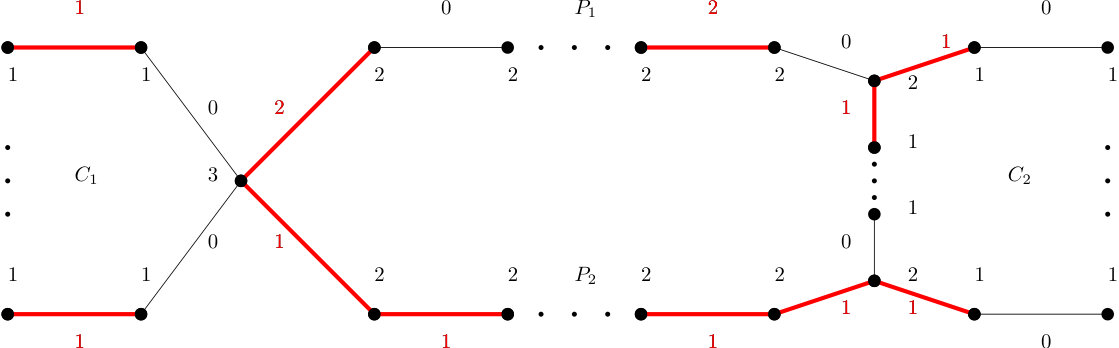 Figure 6
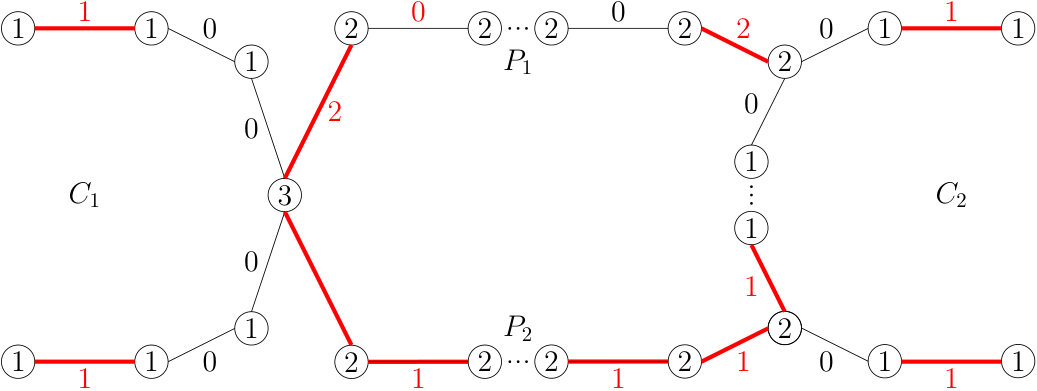 Figure 7
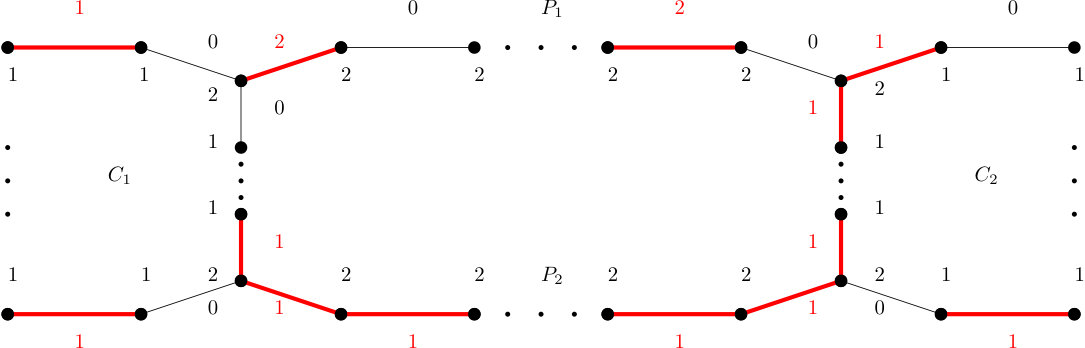 Figure 8
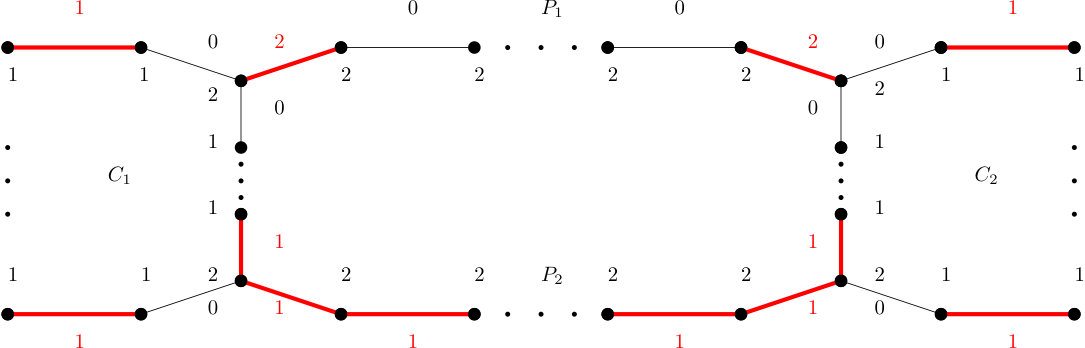 Figure 9
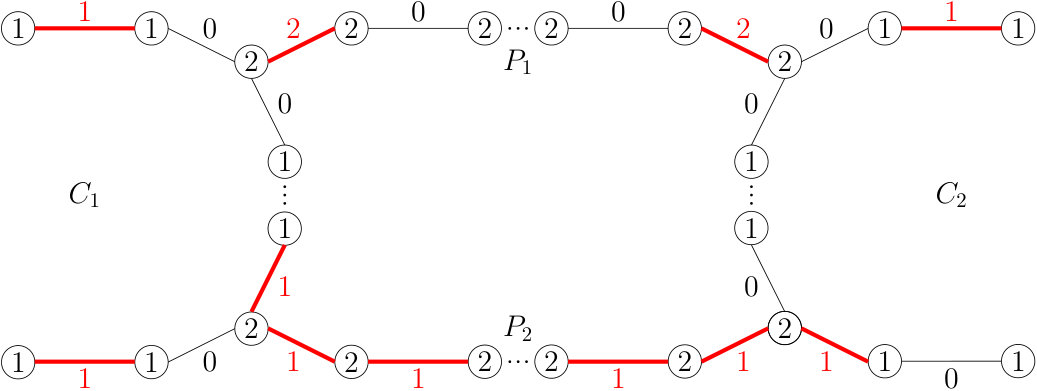 Figure 10
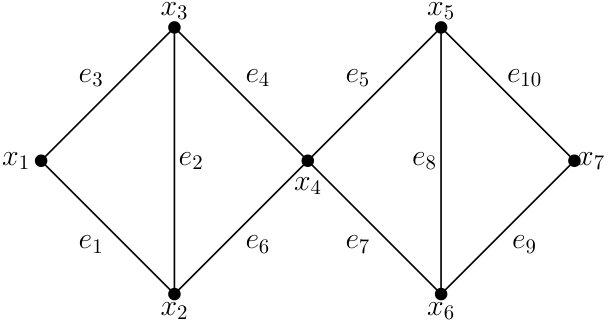 Figure 11
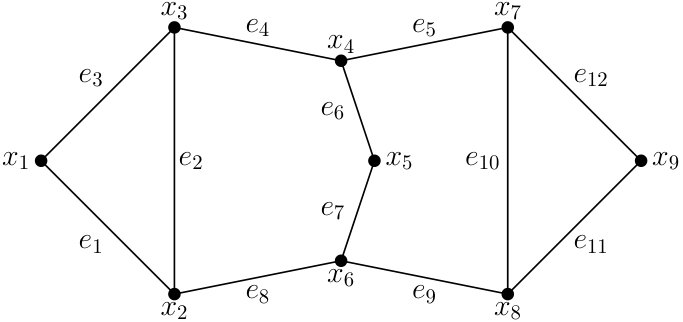 Figure 12
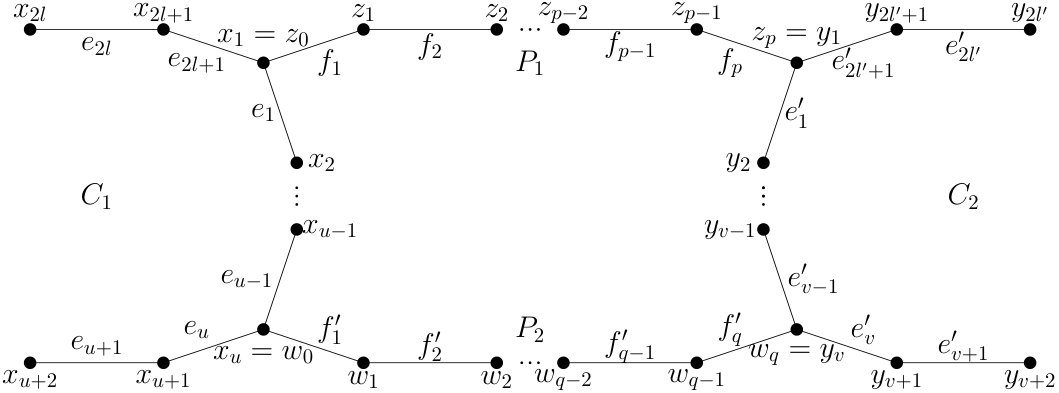 Figure 13
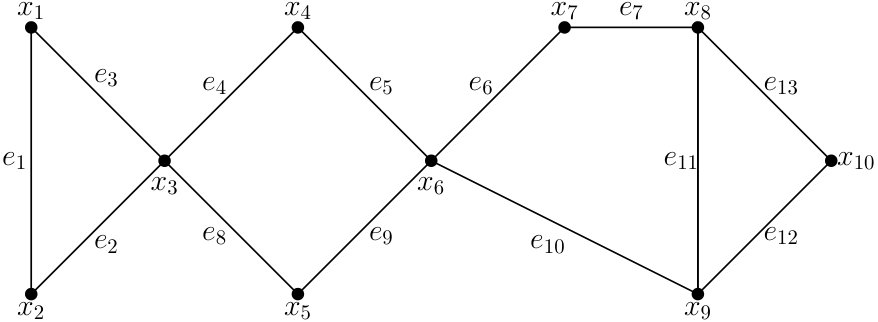 Figure 14
Peer Reviews
No public reviews on file for this paper yet. If you reviewed it on a platform where reviews are public (OpenReview, ICLR, NeurIPS, ICML), you can paste yours below so the community can read it here.
Videos
No videos yet. Explain this paper in a talk, walkthrough, or lecture? Add one.
Taxonomy
TopicsCommutative Algebra and Its Applications · Algebraic structures and combinatorial models · Advanced Combinatorial Mathematics
Algebraic properties of toric rings of graphs
Huy Tài Hà
Tulane University
Department of Mathematics
6823 St. Charles Ave.
New Orleans, LA 70118, USA
[email protected] http://www.math.tulane.edu/$\sim$tai/ ,
Selvi Kara
University of South Alabama
Department of Mathematics and Statistics
411 University Blvd. North
Mobile, AL 36688, USA
and
Augustine O’Keefe
Connecticut College
Mathematics Department
270 Mohegan Avenue Pkwy.
New London, CT 06320, USA
Abstract.
Let be a simple graph. We investigate the Cohen-Macaulayness and algebraic invariants, such as the Castelnuovo-Mumford regularity and the projective dimension, of the toric ring via those of toric rings associated to induced subgraphs of .
Key words and phrases:
toric rings, graphs, Cohen-Macaulay, regularity, projective dimension, odd cycle condition
1. Introduction
Let be a simple graph over the vertex set and with edge set . Let be an arbitrary field, and identify the vertices and edges of with the variables in polynomial rings and , respectively. The toric ring associated to , denoted by , is defined to be the image of the following monomial -algebra homomorphism:
[TABLE]
Toric rings in general (defined to be the image of monomial maps between polynomial rings; see [8]) are the object of study in various areas in mathematics. Toric rings associated to graphs have attracted significant attention in combinatorial commutative algebra. For instance, their algebraic properties and invariants have been investigated in [1, 2, 3, 5, 12, 13, 14, 16, 17, 21]. Their toric ideals (the kernel of ) have also been studied in [7, 10, 19, 20].
In this paper, we examine the Cohen-Macaulayness and algebraic invariants of toric rings associated to graphs. Our approach is to see how properties and invariants of could be derived from or bounded by similar properties and invariants of for a subgraph of . Our work hinges on the following observation: if is an induced subgraph of then the homology groups of are contained in the homology groups of (see Lemma 3.4). Particularly, it follows that important algebraic invariants of are bounded below by that of and, under certain conditions, the non-Cohen-Macaulayness of implies that of (see Theorem 3.6).
This approach allows us to quickly recover a main result of recent work of Biermann, O’Keefe and Van Tuyl ([3, Theorem 2.6] and, subsequently, [3, Theorem 1.1]) for the regularity of . We also obtain similar statements for the projective dimension of . Specifically, we prove the following theorems.
Theorem 3.7. Let be a simple graph. Suppose that contains an induced subgraph which is the disjoint union of graphs . Then
- (1)
2. (2)
Theorem 3.9. Let be a simple graph. Suppose that contains an induced subgraph which is the disjoint union of complete bipartite graphs . Then
- (1)
2. (2)
To prove Theorems 3.7 and 3.9, we make use of our initial observation that the regularity and projective dimension of are bounded below by that of for an induced subgraph of (Theorem 3.6), and show that the regularity and the projective dimension of toric rings are additive with respect to disjoint union of graphs (Lemma 3.8).
Our method further leads us to the problem of finding “forbidden” structures in which prevent from being Cohen-Macaulay. We give such a forbidden structure in the following theorem.
Theorem 5.1. Let be a simple graph. Suppose that and contains an induced subgraph which consists of:
- •
two vertex-disjoint odd cycles; and
- •
two vertex-disjoint (except possibly at their endpoint vertices) paths of length connecting these cycles.
Then the toric ring is not Cohen-Macaulay.
To prove Theorem 5.1, we also make use of our initial observation, Theorem 3.6, to reduce to the case where consists of exactly two odd cycles that are connected by exactly two paths of length which do not have any vertex in common (except possibly at the endpoints). In this case, we then apply a well-known formula (cf. Theorem 2.5) which relates the graded Betti numbers of to the reduced homology of certain simplicial complexes and, by a suitable choice of , show that an appropriate graded Betti number of is not zero.
It follows from the main theorem of Ohsugi and Hibi [16] that if every pair of induced odd cycles in either share a vertex or are connected by an edge then is normal. By a celebrated result of Hochster [15], is Cohen-Macaulay in this case. On the other hand, if consists of exactly two odd cycles which are connected by only one path (of length ) then is not normal but Cohen-Macaulay. Thus, the structure of having two induced odd cycles connected by (at least) two paths of length is, in some sense, the minimal structure that one could look for to break the Cohen-Macaulayness of .
The paper is structured as follows. In the next section, we establish notation and terminology used in the paper. In Section 3, we give our initial observation that properties and invariants of could be derived from or bounded by those of for an induced subgraph of . We will also prove our first two main results, Theorems 3.7 and 3.9, in this section. In Section 4, we focus on a forbidden structure and, for a suitable choice of , completely describe the associated simplicial complex . This description of is key in the proof of the sufficient condition for the non-Cohen-Macaulayness of presented in the last section. In Section 5, we prove our last main result, Theorems 5.1, and give a number of examples.
Acknowledgement. The first named author is partially supported by the Simons Foundation (grant #279786). Part of this work was done when the first two authors were visiting Vietnam Institute for Advanced Study in Mathematics (VIASM). The authors would like to thank VIASM for its support and hospitality. The authors would also like to thank K. Kimura for providing Example 5.4 and for spotting a gap in our first draft.
2. Preliminaries
We assume that the reader is familiar with basic concepts and terminology in combinatorial commutative algebra. For unexplained notations, we refer the reader to standard texts in the area [4, 9, 11].
Throughout the paper, shall denote a simple graph over the vertex set and edge set (where and ). A simple graph is a graph without loops nor multiple edges. When the vertex set and edge set of are not specified, we shall use and , respectively, to denote these sets.
The following familiar structures in graphs will be used in our discussion.
Definition 2.1**.**
Let be a simple graph.
- (1)
A graph is a subgraph of if and . 2. (2)
A subgraph of is an induced subgraph if for any , if and only if . 3. (3)
A path in is an alternating sequence of distinct vertices and edges (except possibly the endpoints) , where . 4. (4)
A cycle is a path whose endpoint vertices coincide. An odd cycle is a cycle with odd number of edges.
Let be a field, and let and be polynomial rings, where by abusing notation we identify the vertices and edges of with indeterminates. Let denote the image of the -algebra homomorphism:
[TABLE]
Definition 2.2**.**
Let be a simple graph on vertices and edges. Let be the incidence matrix of . For , we shall denote by the column of corresponding to . Let and let be the semigroup spanned by .
Remark 2.3**.**
Suppose that . The polynomial ring has a natural -graded structure in which , where represents the standard unit basis for . The monomial map induces an -graded structure for . Moreover, since , when , in fact induces a natural -graded structure for and .
For , we shall denote by (or simply ) the number of generators of multidegree of the th syzygy module of (i.e., the -graded Betti number of .) Then if .
The center of our work is to investigate the vanishing and non-vanishing of graded Betti numbers of . We shall recall a construction from [1], which facilitates a mean to relate graded Betti numbers of to reduced homology groups of certain simplicial complexes, the degree complexes.
Definition 2.4**.**
Let be a simple graph, and let . Define to be the simplicial complex on whose facets are (maximal sets) of the form
[TABLE]
(Clearly, if .)
Theorem 2.5** ([1, Lemma 4.1]).**
**
3. Regularity and projective dimension
The aim of this section is to provide bounds for the regularity and projective dimension of the toric ring in terms of the toric rings associated to induced subgraphs of . Particularly, we shall recover a main result of Biermann, O’Keefe and Van Tuyl [3] on the regularity of and prove similar statements for the projective dimension of .
We shall start by investigating how homology groups of , for an induced subgraph of , are compared to those of . This is also a keystone of our study on the Cohen-Macaulayness of later on in the paper. To achieve this, we will make use of the notion of retract algebras, which we shall now recall.
Definition 3.1**.**
Let be a field and let be a graded ring. We call a standard graded -algebra if and is generated by as a -algebra. In this case, let be its maximal homogeneous ideal.
Definition 3.2**.**
Let be a -algebra and let be a -subalgebra of . The natural inclusion is said to be an algebra retract if there exists a surjective -algebra homomorphism (a retraction map) such that .
Notation 3.3**.**
For a standard graded -algebra , we shall write for the Koszul homology of with respect to a system of minimal generators of .
The following observation is key for our work. This observation allows us to relate homological properties and algebraic invariants of to that of toric rings associated to induced subgraphs of .
Lemma 3.4**.**
Let be an algebra retract of standard graded -algebras. Then the inclusion induces the following algebra retracts
[TABLE]
Proof.
This statement is the content of [17, Proposition 2.4]. We shall include the proof for completeness.
Let be the retraction map. We may choose a -basis of such that for some , forms a -basis of , and such that for and for . Let and be the Koszul complexes of and with respect to and . Then and .
[TABLE]
Observe that the inclusion induces a homomorphism , and the map induces a homomorphism
[TABLE]
where is a -dimensional -vector space. Particularly, is a subalgebra of and is precisely the image of . This implies that , i.e., is an algebra retract. ∎
Corollary 3.5**.**
Let be an algebra retract of graded -algebras. Suppose that and , where and are standard graded polynomial rings, and and are homogeneous ideals containing no forms of degree 1. Then for any , we have
[TABLE]
Proof.
The statement follows from Lemma 3.4 and the fact that graded Betti numbers can be computed from homology of the Koszul complexes. ∎
Theorem 3.6**.**
Let be a simple graph and let be an induced subgraph of .
- (1)
* and .* 2. (2)
If and is not Cohen-Macaulay then neither is .
Proof.
Observe that the natural inclusion is an algebra retract with retraction map defined as follows: for any edge ,
[TABLE]
Thus, (1) follows directly from Corollary 3.5.
To prove (2), assume that is not Cohen-Macaulay. It follows, by Hochster’s work [15], that is not normal. The main theorem of Ohsugi and Hibi [16] then implies that is not bipartite (and, in particular, is not bipartite). By [21, Proposition 3.2], we have and . Since is not Cohen-Macaulay, we have . Thus, by the Auslander-Buchsbaum formula, we have This, together with (1), implies that
[TABLE]
By Auslander-Buchsbaum formula again, we have
[TABLE]
Hence, is not Cohen-Macaulay, and (2) is proved. ∎
We are now ready to state our first main theorem, the first part of which recovers [3, Theorem 2.6].
Theorem 3.7** (See [3, Theorem 2.6]).**
Let be a simple graph. Suppose that contains an induced subgraph which is the disjoint union of graphs . Then
- (1)
** 2. (2)
**
Proof.
Let be the disjoint union of . Then is an induced subgraph of . By Theorem 3.6, we have
- •
; and
- •
The conclusion now follows from Lemma 3.8 below. ∎
Lemma 3.8**.**
Let be the disjoint union of simple graphs . Then
- (1)
. 2. (2)
.
Proof.
Suppose that and for . It is easy to see that
[TABLE]
Thus, the minimal free resolution of as a -module is obtained by taking the tensor product of those of (as a -module). In particular, we have
[TABLE]
The assertion now follows by the definition of regularity and projective dimension. ∎
As a consequence of Theorem 3.7, we also recover [3, Theorem 1.1] and prove a similar statement for the projective dimension. Recall that a complete bipartite graph is the graph consisting of two disjoint subsets of the vertices and , where and , and edges .
Theorem 3.9** (See [3, Theorem 1.1]).**
Let be a simple graph. Suppose that contains an induced subgraph which is the disjoint union of complete bipartite graphs . Then
- (1)
** 2. (2)
**
Proof.
The conclusion follows from Theorem 3.7 and Lemma 3.10 below. ∎
Part (1) of the following lemma is a direct consequence of [6, Lemma 3.1]. It was also proved by a different method in [3].
Lemma 3.10**.**
Let be a complete bipartite graph. Then
- (1)
** 2. (2)
**
Proof.
It is easy to see that can be viewed as the coordinate ring of the Segre embedding . Part (1) now follows from [6, Lemma 3.1].
To prove part (2), observe that is Cohen-Macaulay (cf. [18]). Thus, by [21, Proposition 3.2], we have ∎
4. A forbidden structure and its degree complex
Our preliminary result, Theorem 3.6, allows us to focus on structures that prevent from being Cohen-Macaulay. In this section, we shall consider such a forbidden structure and, for a suitable multidegree , describe its degree complex . This degree complex allows us to compute certain graded Betti number of , based on Theorem 2.5, and to conclude that is not Cohen-Macaulay in this case.
Our forbidden structure is a graph which consists of exactly two induced odd cycles and , which are connected by two vertex-disjoint (except possibly at their endpoints) paths and of length , as depicted in Figure 1. Throughout this section, we shall assume that is such a graph.
Notation 4.1**.**
Throughout this section, we shall label the vertices and edges of in the following more convenient way:
- •
, , where .
- •
, , where .
- •
, , where , and .
- •
, , where , and .
Our choice of is given as follows:
[TABLE]
Remark 4.2**.**
It can be seen that in the decomposition , the coefficients on path are completely determined given . More specifically, since , we must have . If then it forces . This, together with , again forces . Keep going in this fashion, we have if is odd and if is even. The situation is similar if we start with . If , then since , we must have . Again, since , we must have . Keep going in this fashion, we have for all . The same observation also works for the coefficients on path .
It can be further seen that for a vertex on , since , we must have either and or and (i.e., knowing one of the coefficients determines the other one.) The exception to this rule is when or , where the determination of and also depends on the value of or . The same observation also works for the coefficients of edges on .
Proposition 4.3**.**
* has exactly 4 facets which can be explicitly described.*
Proof.
Consider an expression . Our argument is a case by case analysis. We consider the following cases depending on the endpoints of and , which in turn have their subcases depending on the value of .
Case 1: and share both endpoint vertices. Without loss of generality, suppose that and . Since , we must have .
Case 1a: . It follows from Remark 4.2 that, in this case, if is odd and if is even. Observe that since , we cannot have both and (and ). Thus, by Remark 4.2, we must have for odd and for even. This, together with the fact that , forces . Again, by Remark 4.2, we deduce that for all .
If is odd then since , and , we must have . This implies, by Remark 4.2, that if is odd and if is even. Thus, the expression is uniquely determined, which gives the following facet of :
[TABLE]
If is even then since , and , we must have . This implies, by Remark 4.2, that if is odd and if is even. Thus, the expression , in this case, gives the following facet of instead:
[TABLE]
Case 1b: . By Remark 4.2, we have for all . Suppose first that . Then , and it follows from Remark 4.2 that if is odd and if is even. Since and , we must have . Remark 4.2 gives us that if is odd and if is even.
If is odd then since and , we must have . This implies, by Remark 4.2, that if is odd and if is even, and eventually determines the following facet of :
[TABLE]
If is even then similarly, we obtain the following facet of instead:
[TABLE]
Suppose, on the other hand, that . Then by Remark 4.2, we have if is odd and if is even. This, together with the fact that and , forces . It follows, by Remark 4.2, that if is odd and if is even.
Now, if is odd then, by a similar argument as above, we obtain the facet
[TABLE]
and if is even then we obtain the facet
[TABLE]
Case 1c: . Observe if then by tracing around , we must have . This implies that , a contradiction. Thus, we have , which then implies that . By Remark 4.2, we deduce that if is odd and if is even, and for all .
If is odd then, by a similar argument as above, we have the facet
[TABLE]
and if is even then we get the facet
[TABLE]
Hence, in Case 1, we conclude that has 4 facets , where or .
Case 2: and share exactly one endpoint vertex. Without loss of generality, we may assume that , and , where . Noting that , our arguments proceed similarly to that in Case 1 by considering subcases depending on the value of . In each subcase, we shall point out the similarities with Case 1, and leave the details to the interested reader.
Case 2a: . By similar arguments as that of Case 1a, we have if is odd and if is even, for odd and for even, and for all . Note also that since and , we have . Thus, again by considering of is odd or even (i.e., if is 2 or 0) and making use of Remark 4.2, we deduce that either
[TABLE]
Therefore, either is odd or even, we always obtain a facet for .
Case 2b: By the same arguments as that of Case 1b, we have for all . Suppose first that . Then, as before, we deduce that if is odd and if is even, and that if is odd and if is even. Now, by considering if is odd or even and considering the value , we obtain a facet of .
Suppose, on the other hand, that . The same arguments as in Case 1b then imply that if is odd and if is even, and if is odd and if is even. Once again, by considering if is odd or even and the value , we always obtain another facet of .
Case 2c: . As in Case 1c, we deduce that if is odd and if is even, and for all . To this end, by considering if is odd or even and the value , we again obtain a facet of .
Hence, in Case 2, we obtain 4 facets for (one for each Case 2a and Case 2c, and two for Case 2b).
Case 3: and do not share any endpoint vertices. Without loss of generality (and after a relabeling if necessary), we may assume that , , , and , where and . Our arguments will proceed similarly to that in Cases 1 and 2 with some minor differences, which we shall identify in detail. As before, noting that , we shall consider subcases depending on the value of .
Case 3a: . Since in this case, we must have . It then follows from Remark 4.2 that if is odd and if is even. Particularly, at , we always have . Since , this implies that . Applying Remark 4.2 to the paths and , we deduce that if is odd, if is even, and for all .
To this end, we again consider if is odd or even. If is odd then , which forces . Also, at , since , we have . It follows, by Remark 4.2, that if is odd and if is even. Thus, in this case we obtain a facet of . On the other hand, if is even then , which forces . This, together with the hypothesis that and Remark 4.2, implies that if is odd and if is even. We again obtain a facet of .
Case 3b: . Since , we must have either and or and . By making use of Remark 4.2 and tracing around the odd cycle , it can be seen that the coefficients ’s alternate between 0 and 1, except at exactly one place, where the ’s remain 1 and 1 or 0 and 0. It follows from the hypothesis that this exception must be at , where we have .
Suppose that . Then since , we must have . Relabel the vertices on starting with (i.e., is now labeled by ), and interchange the role of and . Then we are back to the same situation as in Case 3a, which again gives us a facet of .
Suppose, on the other hand, that . Then we have . By the same relabeling of the vertices and interchanging the role of and , we bring to the situation of Case 3c, which we shall consider next. This gives us another facet of for Case 3b.
Case 3c: . By Remark 4.2, we have if is odd and if is even. Since , it follows that . By Remark 4.2 and tracing around , we have if is odd and if is even. Particularly, at , we have and or and . This implies that . It follows from Remark 4.2 again that for all .
To this end, we once again consider if is odd or even. Similarly to the arguments in Case 3a, we again obtain a facet for .
Hence, in Case 3, we show that contains 4 facets (one for each Case 3a and Case 3c, and two for Case 3b). ∎
5. Non-Cohen-Macaulay toric rings
In this section, we shall use the forbidden structure described in the last section to give a sufficient condition for the toric ring of a graph not to be Cohen-Macaulay.
Observe that a simplicial complex is determined by its facets, so we shall denote the simplicial complex with facets by . The next main result of our paper is stated as follows.
Theorem 5.1**.**
Let be a simple graph. Suppose that and contains an induced subgraph which consists of:
- •
two vertex-disjoint odd cycles; and
- •
two vertex-disjoint (except possibly at their endpoint vertices) paths of length connecting these cycles.
Then the toric ring is not Cohen-Macaulay.
Proof.
By Theorem 3.6, we may assume that is the graph consisting of two vertex-disjoint odd cycles connected by exactly two vertex-disjoint (except possibly at their endpoints) paths of length , and we may relabel the vertices and edges of as in Notation 4.1.
It follows from [21, Proposition 3.2] that . By the Auslander-Buchsbaum formula, we also have
[TABLE]
To show that is not Cohen-Macaulay, it suffices to show that . To achieve this, we shall pick a particular multidegree and prove that . Indeed, take , where s_{x}=1+\big{|}\{j~{}|~{}x\in P_{j}\}\big{|}. By Theorem 2.5, we have
[TABLE]
Thus, it remains to show that .
Based on our arguments in Proposition 4.3, we shall consider the following cases:
- •
and share both endpoint vertices;
- •
and share only one endpoint vertex; and
- •
and share no endpoint vertices.
Our arguments for these cases are basically identical since in each case, as shown in Proposition 4.3, has exactly 4 facets which can be explicitly described. For this reason, we shall only present the detailed proof for the first case, where and share both endpoint vertices.
By the proof of Proposition 4.3, consists of 4 facets and as described. For the simplicity of arguments, we shall also assume that and are odd (the other situations follow exactly the same arguments). That is, and are as depicted in Figures 2, 5, 3, and 4. Particularly, we have
[TABLE]
For , let . Then . Consider the nested Mayer-Vietoris sequences as in Figure 8.
It can be seen that and . Thus, , for , consists of two facets with nonempty intersection and, therefore, is contractible and has trivial reduced homology. That is, for all and . It follows from the Mayer-Vietoris sequence that .
Observe further that, for , also consists of two facets with nonempty intersection and, thus, is contractible. Therefore, for all and . Hence, we have the following isomorphisms
[TABLE]
Observe finally that
[TABLE]
is the simplicial complex with exactly two disjoint facets. It follows that
[TABLE]
which completes the proof of the theorem. ∎
When the two paths connecting the induced odd cycles and are allowed to share internal vertices, we no longer necessarily have a forbidden structure. This is illustrated in the following examples.
Example 5.2**.**
Let be the graph in Figure 9. By a direct computation, we have . Thus, is Cohen-Macaulay.
Example 5.3**.**
Let be the graph in Figure 10. By a direct computation, we have . Particularly, is not Cohen-Macaulay.
Theorem 5.1 is no longer true without the condition that . We thank K. Kimura for showing us the following example.
Example 5.4**.**
Let be the graph in Figure 11 and let be the induced subgraph of which excludes the vertex . Then It can be seen that is a forbidden structure, and is not Cohen-Macaulay with . However, is Cohen-Macaulay with
Our computation in the proof of Theorem 5.1 further gives us the following bound for the regularity of in terms of the size of its forbidden structure.
Corollary 5.5**.**
Let be a simple graph that contains an induced subgraph which consists of:
- •
two vertex-disjoint odd cycles; and
- •
two vertex-disjoint (except possibly at their endpoint vertices) paths of length connecting these cycles.
Suppose that and the lengths of the two paths connecting the two odd cycles in are and . Then .
Proof.
It is easy to see that with the choice , where
[TABLE]
as given in the proof of Theorem 5.1, we have By Corollary 3.5 and the proof of Theorem 5.1, we also have that
[TABLE]
Thus, ∎
The reference list from the paper itself. Each links out to its DOI / PubMed record.
- 1[1] A. Aramova and J. Herzog, Koszul cycles and Eliahou-Kervaire type resolutions. J. Algebra 181 (1996), 347-370.
- 2[2] C. Bertone, and V. Micale, On the dimension of the minimal vertex cover semigroup ring of an unmixed bipartite graph. Matematiche (Catania) 63 (2008), no. 2, 157-163 (2009).
- 3[3] J. Biermann, A. O’Keefe and A. Van Tuyl, Bounds on the regularity of toric ideals of graphs. Adv. in Appl. Math. 85 (2017), 84-102.
- 4[4] M P.Brodmann, R.Y. Sharp, Local Cohomology: An Algebraic Introduction with Geometric Applications. Cambridge University Press, (2012).
- 5[5] A. Corse and U. Nagel, Monomial and toric ideals associated to Ferrers graphs. Trans. Amer. Math. Soc. 361 (2009), no. 3, 1371-1395.
- 6[6] D. Cox and E. Materov, Tate resolutions for Segre embeddings. Algebra Number Theory 2 (2008), no. 5, 523-550.
- 7[7] A. D’Alì, Toric ideals associated with gap-free graphs. J. Pure Appl. Algebra 219 (2015), no. 9, 3862-3872.
- 8[8] D. Cox, J.B. Little, and H.K. Schenck, Toric varieties. Graduate Studies in Mathematics, 124 . American Mathematical Society, Providence, RI, 2011. xxiv+841 pp.