Improving Fine-tuning in Composite Higgs Models
Avik Banerjee, Gautam Bhattacharyya, Tirtha Sankar Ray

TL;DR
This paper explores a next-to-minimal composite Higgs model with a SO(6)/SO(5) coset, analyzing how Higgs-singlet mixing affects resonance masses and Higgs couplings, with implications for LHC searches.
Contribution
It demonstrates that Higgs-singlet mixing in this model allows for heavier top-partners and relaxes LHC bounds compared to minimal models.
Findings
Higgs-singlet mixing can accommodate heavier resonances.
Deviations in Higgs couplings from SM predictions are significant.
Future precision Higgs measurements will constrain the model tightly.
Abstract
In this paper we investigate the next-to-minimal composite Higgs model with a SO(6)/SO(5) coset, whose pNGB sector includes a Standard Model singlet in addition to the usual Higgs doublet. The fermions are embedded in the representation 6 of SO(6). We study the region of parameter space of the model where the radiatively generated potential has global minima with both the doublet and the singlet fields developing vacuum expectation values. We investigate the consequences of kinetic and mass mixing between the Higgs and the singlet scalar that arise in this framework. We demonstrate that the ensuing doublet-singlet mixing can provide a handle to accommodate heavier resonances (top-partners) for a given compositeness scale as compared to the minimal composite Higgs model, thus relaxing the tension with the direct LHC bounds. The main phenomenological consequence of this is a sizable…
Click any figure to enlarge with its caption.
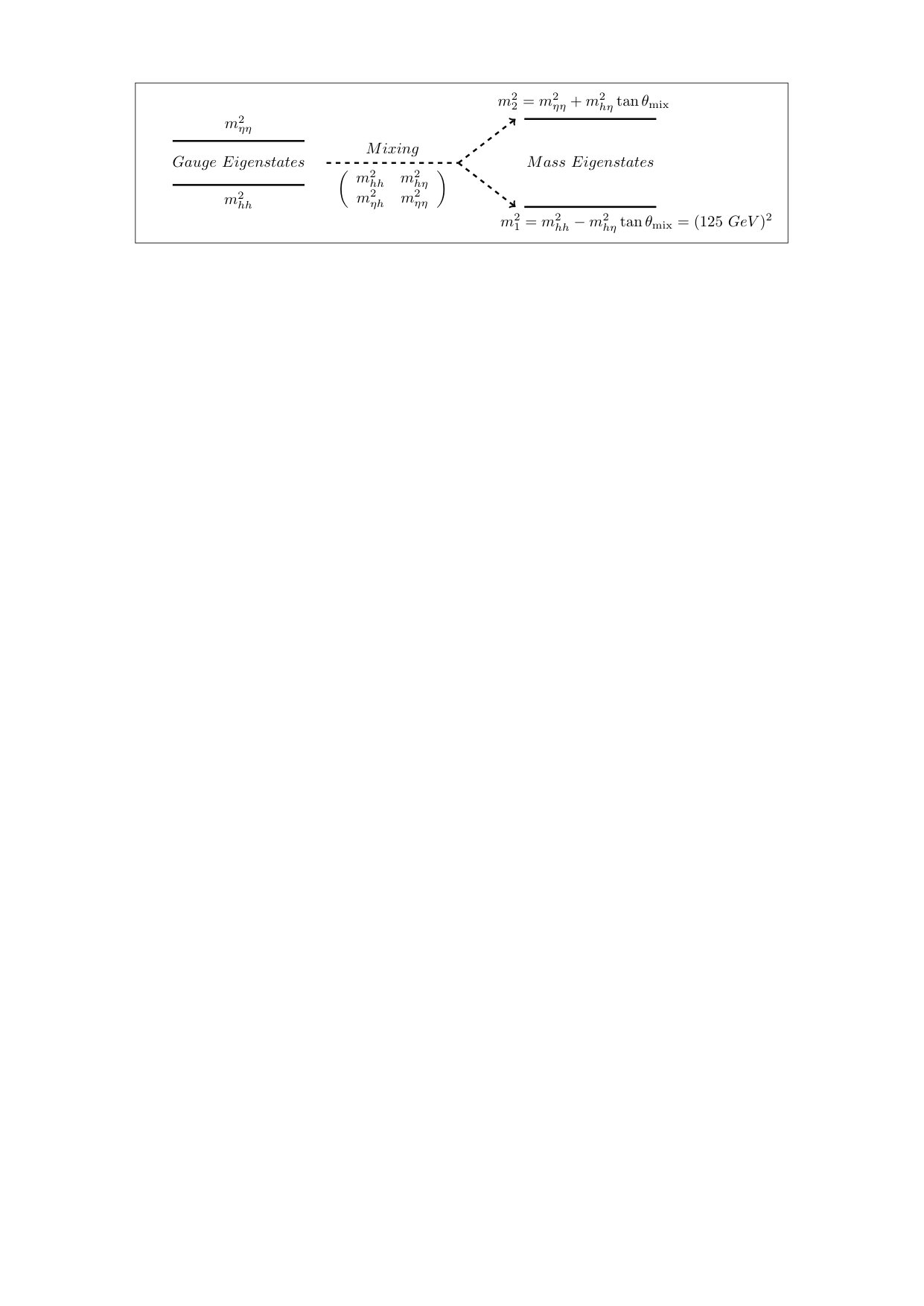 Figure 1
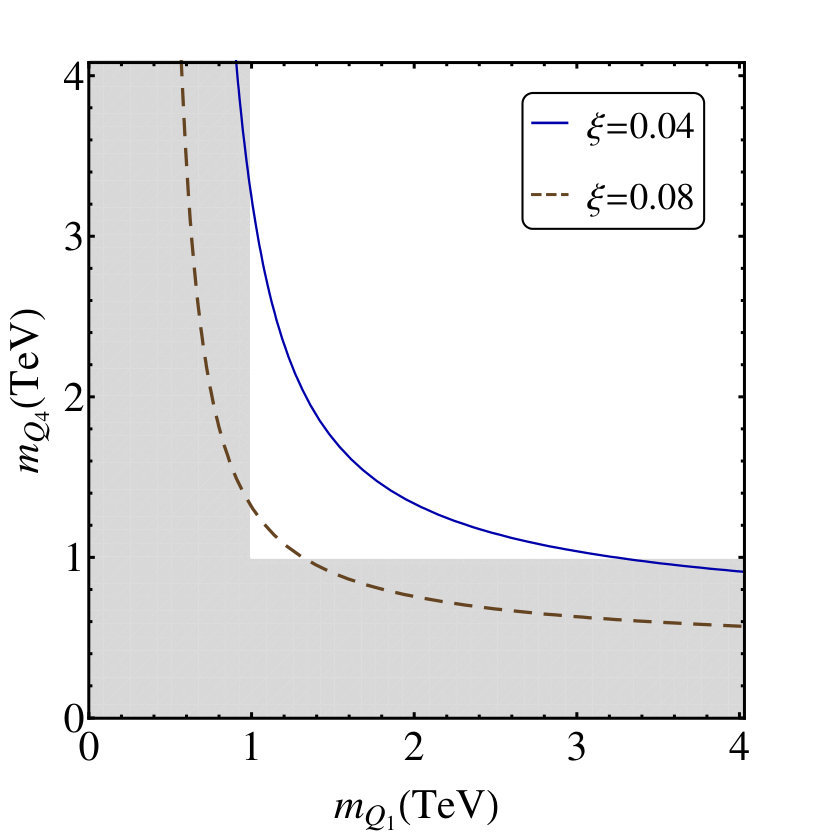 Figure 2
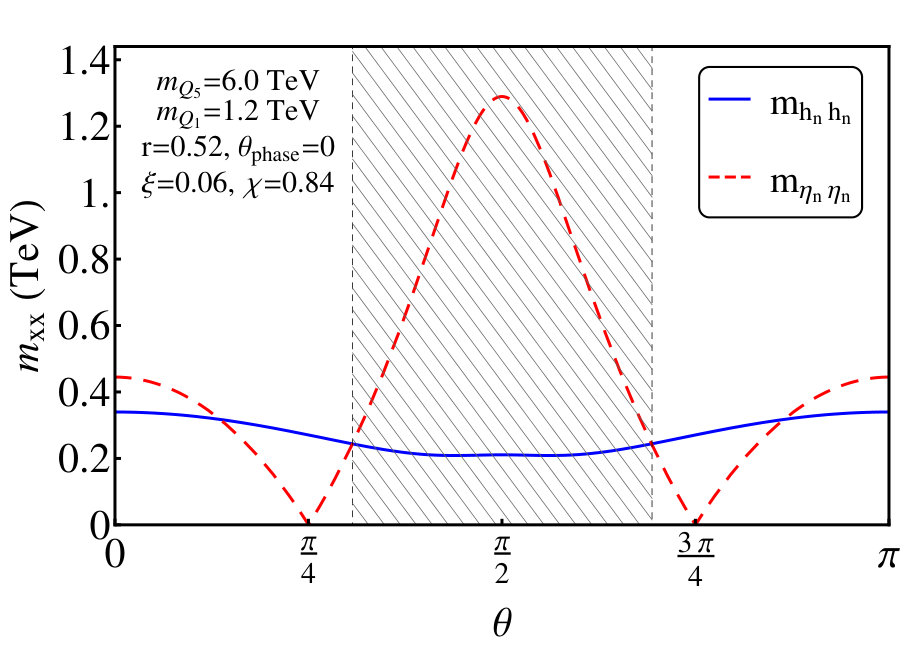 Figure 3
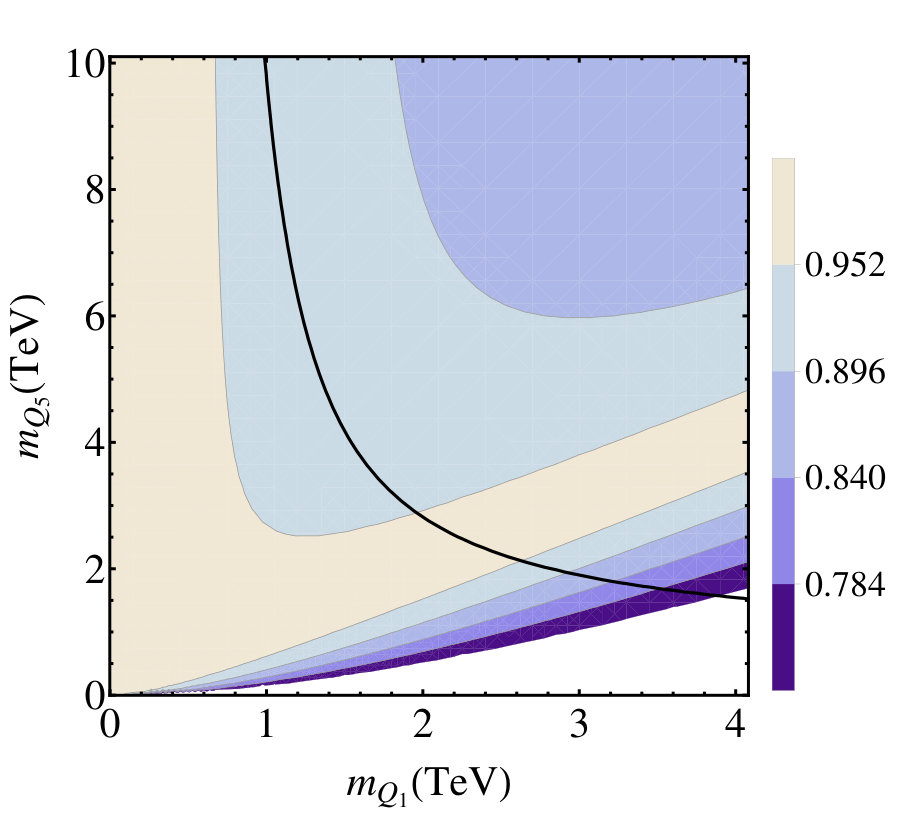 Figure 4
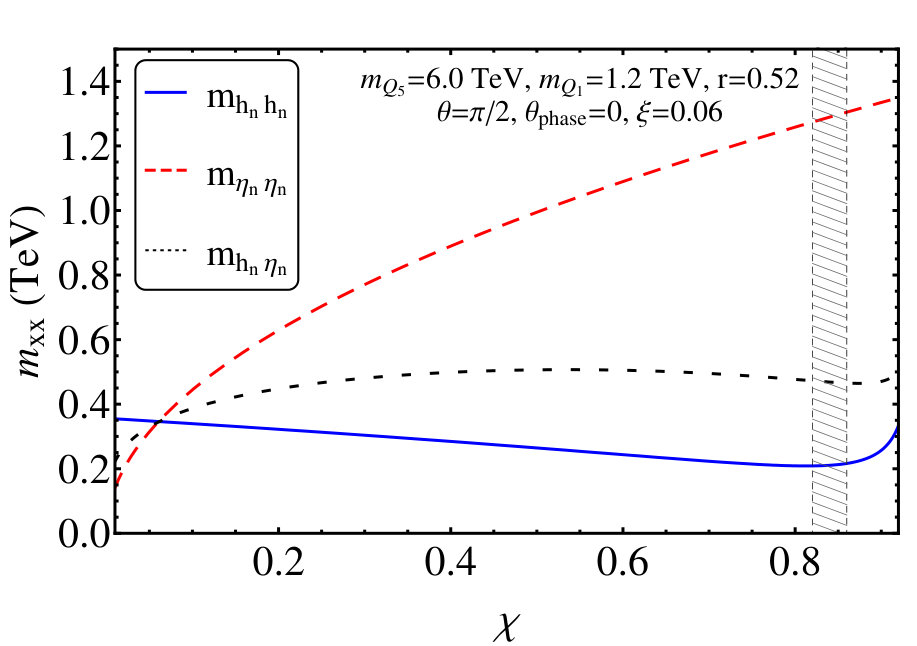 Figure 5
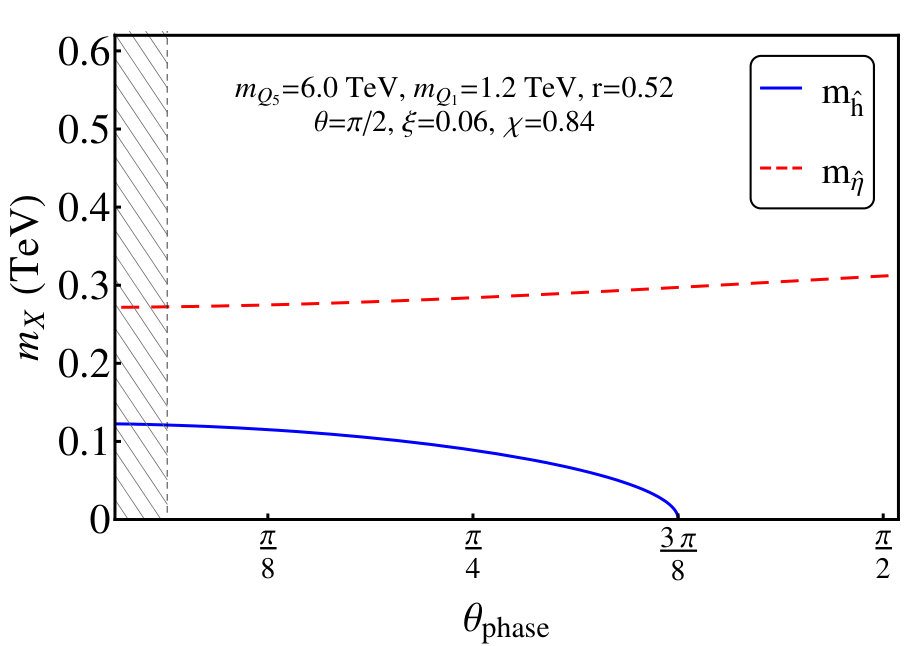 Figure 6
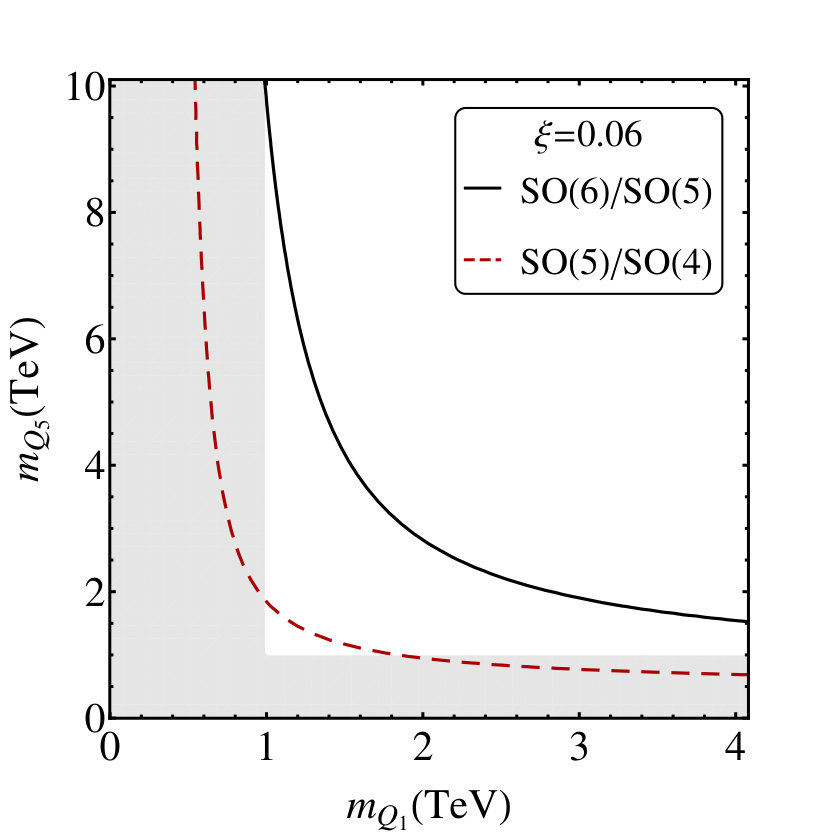 Figure 7
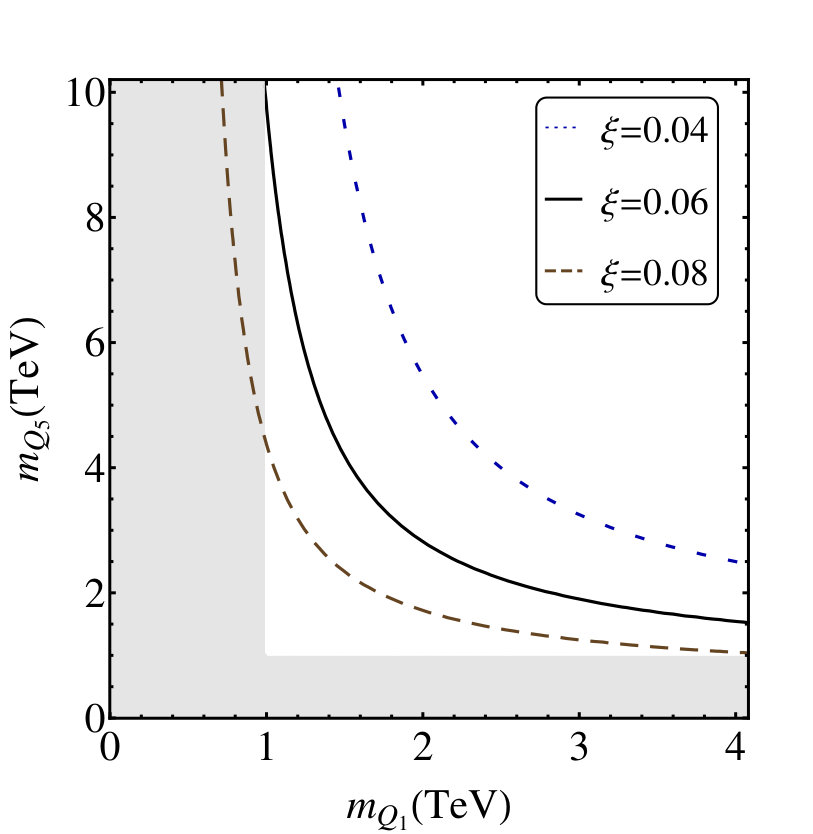 Figure 8
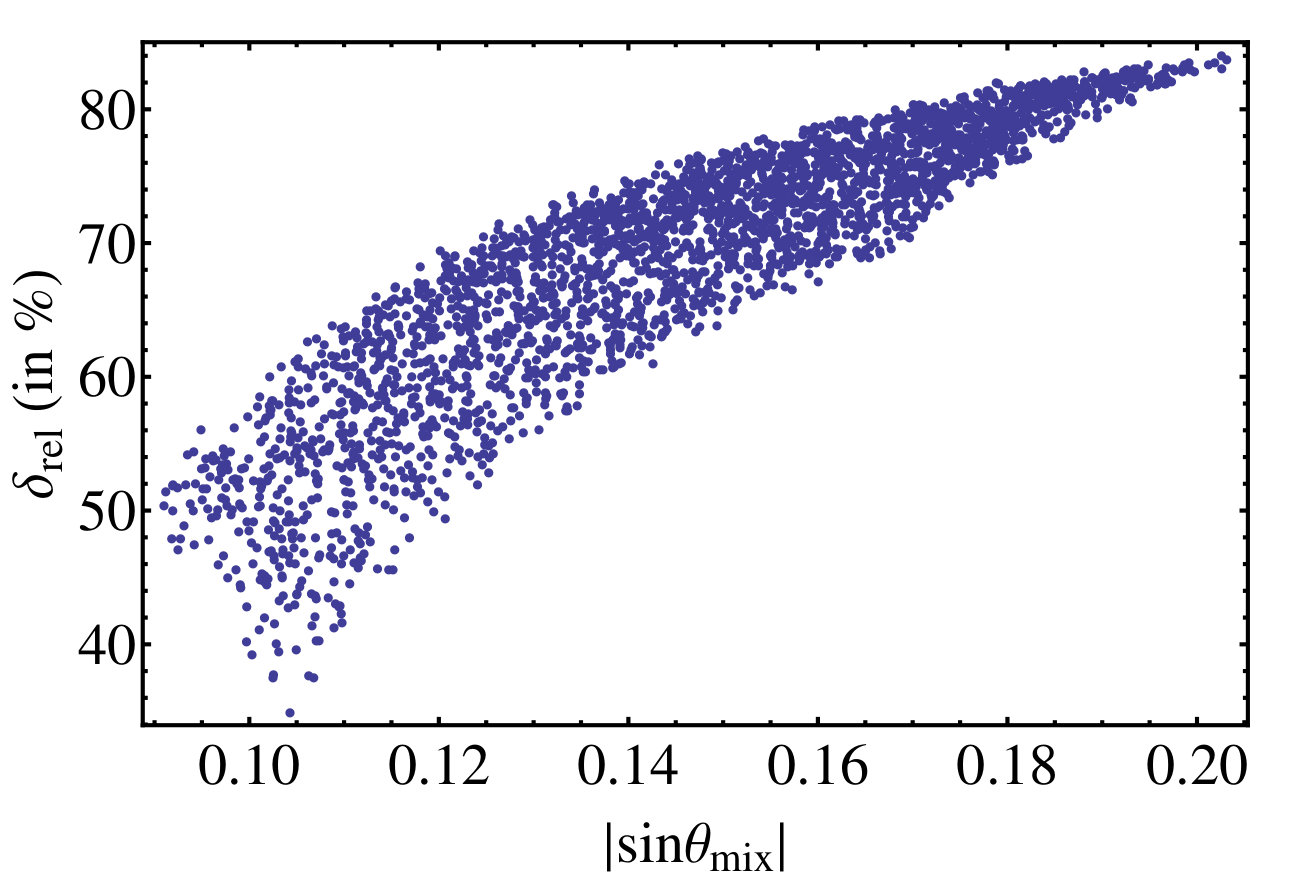 Figure 9
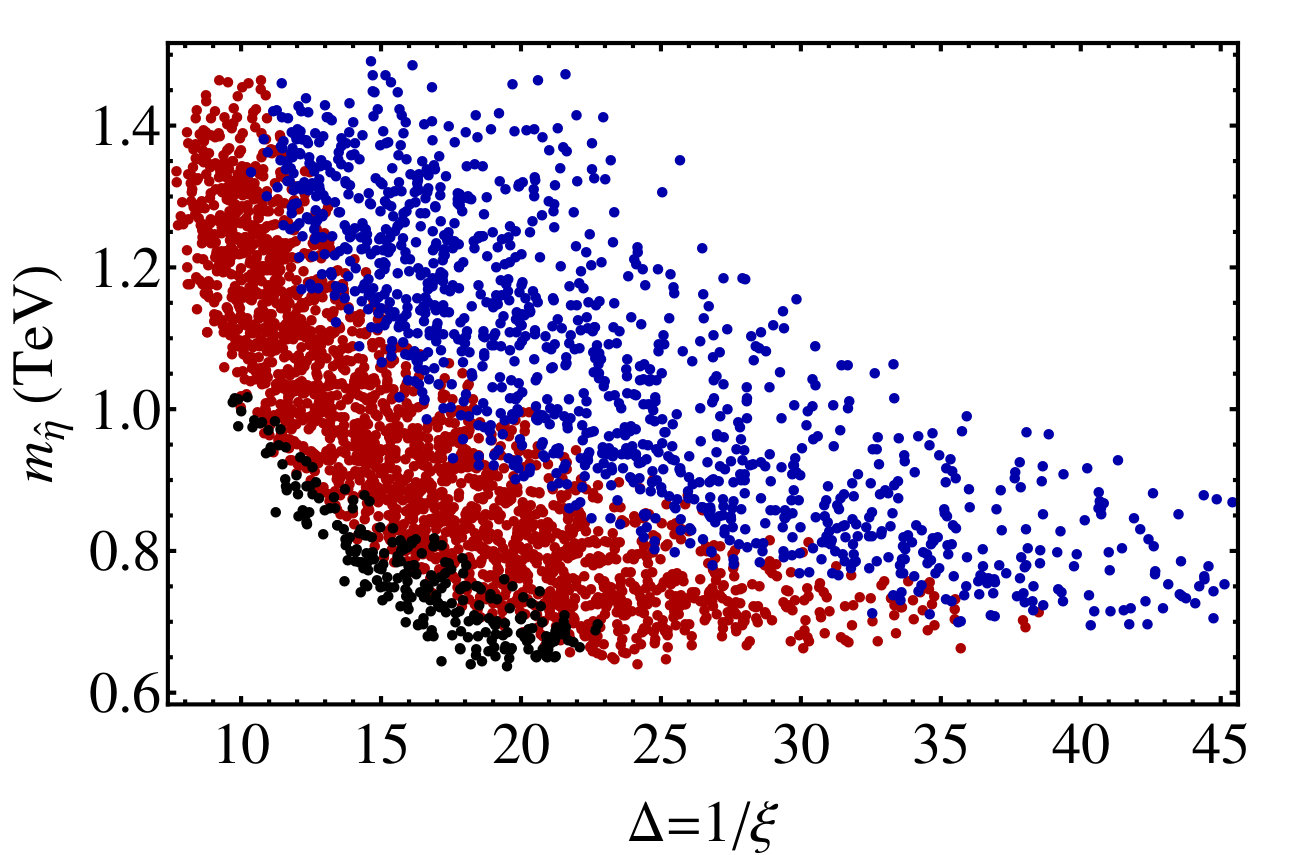 Figure 10
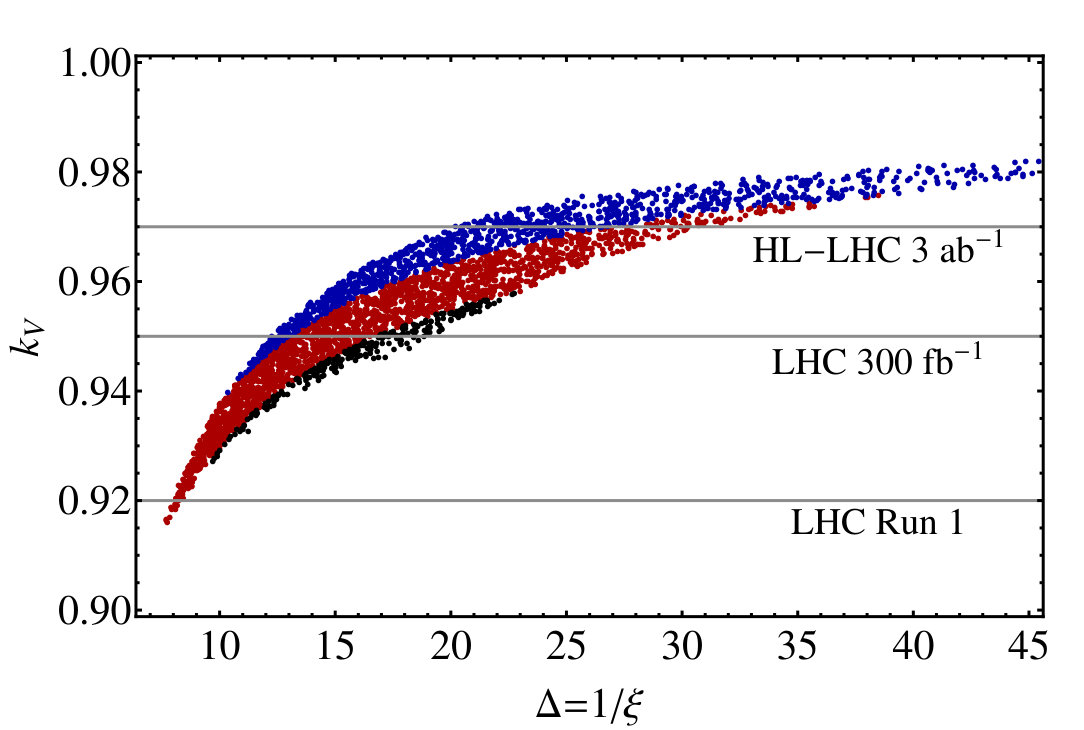 Figure 11
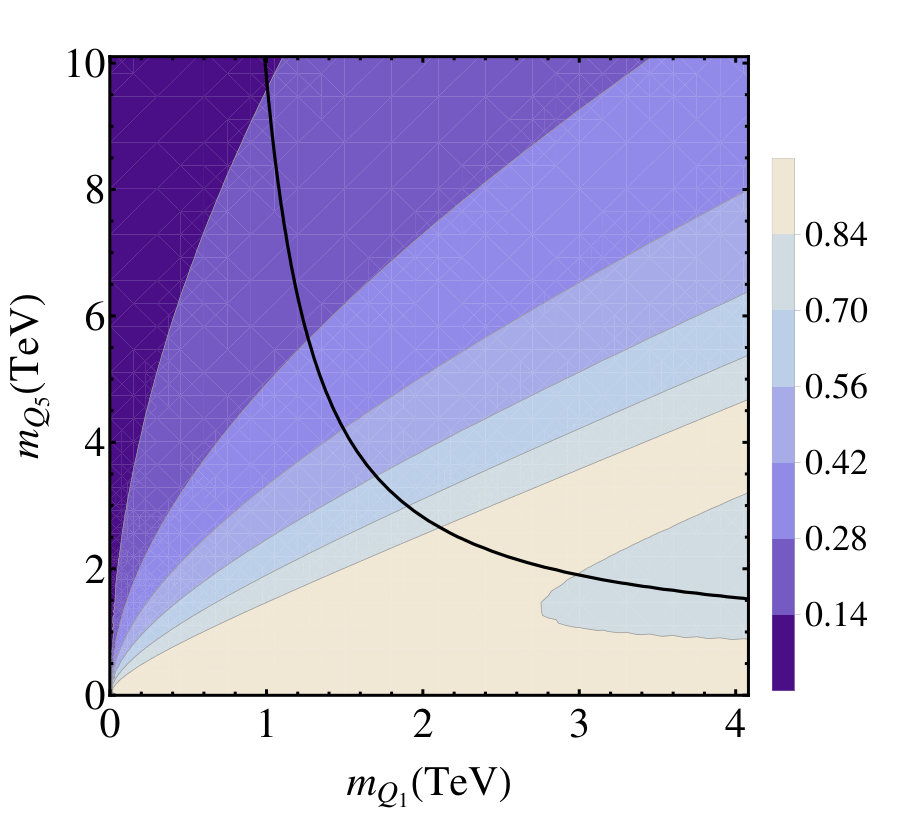 Figure 12
Peer Reviews
No public reviews on file for this paper yet. If you reviewed it on a platform where reviews are public (OpenReview, ICLR, NeurIPS, ICML), you can paste yours below so the community can read it here.
Videos
No videos yet. Explain this paper in a talk, walkthrough, or lecture? Add one.
**Improving Fine-tuning in Composite Higgs Models
** Avik Banerjee *a,*[email protected], Gautam Bhattacharyya *a,*[email protected], Tirtha Sankar Ray *b,*[email protected]
a) Saha Institute of Nuclear Physics, HBNI, 1/AF Bidhan Nagar, Kolkata 700064, India
*b)*Department of Physics and Centre for Theoretical Studies, Indian Institute of Technology Kharagpur, Kharagpur 721302, India
Abstract
In this paper we investigate the next-to-minimal composite Higgs model with a coset, whose pNGB sector includes a Standard Model singlet in addition to the usual Higgs doublet. The fermions are embedded in the representation of . We study the region of parameter space of the model where the radiatively generated potential has global minima with both the doublet and the singlet fields developing vacuum expectation values. We investigate the consequences of kinetic and mass mixing between the Higgs and the singlet scalar that arise in this framework. We demonstrate that the ensuing doublet-singlet mixing can provide a handle to accommodate heavier resonances (top-partners) for a given compositeness scale as compared to the minimal composite Higgs model, thus relaxing the tension with the direct LHC bounds. The main phenomenological consequence of this is a sizable deviation of the Higgs couplings from the Standard Model predictions. While the present experimental precision in the measurement of the Higgs couplings still allows for considerable release of this tension, future measurements of the Higgs branching ratios with increased precision would lead to stringent constraints on this setup.
1 Introduction
The continued absence of new physics at experiments in the energy and intensity frontiers complemented with lack of any pointers from astrophysical experiments have squeezed the space for TeV scale beyond Standard Model physics (BSM) to claustrophobic proportions. However, several theoretical issues like the stability of the weak scale from any high scale dynamics that the Standard Model (SM) might couple to, or the existence of the hyper-charge Landau pole [1] at a trans-Planckian scale demanding nontrivial dynamics at higher scales, indicate that the SM is an effective theory. These and associated theoretical issues remain the main driving force behind the BSM physics. As we enter the precision Higgs era following discovery of the Higgs boson [2, 3] at GeV, in addition to the electroweak precision constraints a set of new constraints from Higgs physics gets imposed on BSM scenarios.
The composite Higgs framework, where the Higgs is identified with a pseudo-Nambu-Goldstone boson (pNGB) originating from spontaneous breaking of a global symmetry in a strongly interacting sector, provides a consistent framework to shield the weak scale from the gauge hierarchy problem [4, 5, 6, 7, 8, 9]. The scale of spontaneous symmetry breaking identified as the compositeness scale separates the weak scale from any higher dynamics. It is the related inexact shift symmetry of the pNGB Higgs that protects the Higgs mass from sensitivity to the UV scale. In these models the Higgs potential is generated at one-loop by the explicit breaking of the global symmetries of the strong sector that is communicated by the linear mixing of the strong sector operators with the SM states. Within this framework of the so called partial compositeness, where the potential is generated mainly by top quark induced interactions, the Higgs mass is expected to scale as [10]
[TABLE]
where is a generic mass of the strong sector resonances that mix with the top and is the compositeness scale. The ratio is a measure of tuning required to obtain the electroweak vacuum expectation value (vev) of the Higgs as compared to the compositeness scale . In general, the vev-tuning in this class of models is expected to be greater than . In most cases it can be estimated as , where is a model dependent parameter [11, 12, 13, 14, 15]. In this paper we assume that quantifies the minimal tuning in the Higgs vev. In fact, we mainly focus on relative tuning between models, where the numerical impact of mostly cancels out in ratios. It is clear from Eq. (1.1) that the relative lightness of the Higgs boson requires either a relatively light coloured resonance or a large fine-tuning. The non-observation of any exotic resonance at the LHC [16] implies larger values of and hence more fine-tuned scenario. This is basically a restatement of the more generic observation that the measured Higgs boson mass of GeV is somewhat on the lower side for the otherwise well-motivated composite Higgs framework. This may be contrasted with the supersymmetric extension of the SM where the Higgs mass is perceived to be on the heavier side [17, 18].
The connection of light resonances with composite Higgs mass has been studied extensively in the context of minimal composite Higgs model (MCHM) based on coset applying the QCD-like Weinberg sum rules [19, 20, 10, 11, 21], effective two-site models [11] or from explicit calculations with the 5D duals of these theories [22, 23]. Within the MCHM framework the LHC results [16] put severe constraints on the region of parameter space with moderate . Interestingly, it was shown that two-loop contributions to the Coleman-Weinberg (C-W) potential from the coloured vector resonances of the strong sector relaxes this by [24]. Implications of the lepton () resonances on fine-tuning have also been considered [25, 26].
In this paper we explore the possibility of increasing the mass gap between the top-partner resonances and the Higgs boson for a given by employing a possible tree-level doublet-singlet mixing in the pNGB scalar sector of non-minimal model. If the singlet state is heavier, the mixing can lead to a level-repulsion pushing the dominantly doublet eigenstate down to match the observed Higgs mass at 125 GeV. The masses of both the states before mixing are conceivably larger and hence more natural from the composite Higgs perspective. The setup is depicted schematically in Fig. 1.1. This possibility naturally demands a larger set of pNGBs in the strong sector than in MCHM, implying an enlargement of the coset space. Many such non-minimal composite Higgs frameworks have been discussed in the literature [27, 28, 29, 30, 31, 32].
Here we will confine ourselves to the next-to-minimal composite Higgs model with a coset , which would suffice to demonstrate the phenomenon of level-repulsion as a proof of principle. This coset represents the minimal extension beyond MCHM, as it introduces an extra SM gauge-singlet scalar along with the four components of the usual Higgs doublet [27, 33, 34, 35, 36, 37]. Several aspects of this model has been discussed in the literature, e.g. in the context of dark matter [38, 39, 40, 41] and electroweak baryogenesis [42]. Incidentally this also represents the minimal coset that allows for a 4D ultraviolet completion [43, 44, 45, 46, 47, 48]. Here we will be interested in the parameter space where the radiatively generated C-W potential for the Higgs doublet and the SM singlet minimizes to non-zero vevs for both scalars. This may allow for a nontrivial mixing between the Higgs and the SM singlet in both the kinetic terms and the potential. This is somewhat complementary to most of the studies carried out in the literature for the non-minimal models where the singlet is assumed not to develop a vev making it a possible dark matter candidate. The collider phenomenology of this framework has recently been studied [49].
The paper is organised as follows. In section 2, we briefly review the MCHM, specifically focusing on the rôle of top-partner resonances for reproducing the 125 GeV mass of the Higgs boson. In section 3, we review the next-to-minimal model with coset and the associated C-W potential. In section 4, we discuss the relaxation in the correlation between the top-partner and the Higgs mass induced by the level-splitting mechanism. Some phenomenological implications are discussed in section 5, before concluding in section 6.
2 Higgs mass and light top-partners in minimal model
In this section we briefly review the C-W scalar potential and the correlation between the light top-partners and the Higgs mass within MCHM. Its coset is having four pNGBs that can be identified with the components of the SM Higgs doublet. The pNGBs can be parametrised with the non-linear representation () [50, 51] in the unitary gauge in terms of the dimensionless field normalised by the compositeness scale () as [22]
[TABLE]
The Higgs potential and the phenomenology of the model depends on the representation into which the SM fermions are embedded. The minimal representation that ensures a custodial protection of the coupling is the fundamental of SO(5). Here we confine our discussion to this minimal framework . The most important contribution to the Higgs potential driving electroweak symmetry breaking (EWSB) comes from the top sector. The relevant part of the Lagrangian is given by [10]
[TABLE]
where the ’s are the structure functions which depend on the top-partner masses of the strong sector. The one-loop C-W potential has the structure [7, 52]
[TABLE]
Minimization of the potential in Eq. (2.3) yields
[TABLE]
The Higgs mass can be expressed in terms of the coefficient and the parameter as
[TABLE]
To calculate the parameters of the potential we utilise the Weinberg sum rules to model the structure functions. We employ two strong sector resonances (one singlet and a quadruplet under ) with masses and which saturate the integrals. Calculation of the coefficients and from the top and gauge sectors is described in Appendix A.
In Fig. 2.1 we plot the contours for GeV in the plane for and . The figure suggests that a light Higgs boson implies at least one of the top-partners is relatively light. The present LHC constraints on the top-partners exclude the region below TeV [16]. The situation changes when one embeds the fermions in other representations, see for example [53]. Here we make a passing remark on the issue of double-tuning [21, 11], which eases in cases when there are multiple invariants in the Yukawa structure. In the presence of double-tuning, the total fine-tuning in the Higgs vev can be estimated by , as mentioned previously444A complementary method based on statistical approach to estimate the fine-tuning can be found in [15].. In case of , can be naïvely parametrised as , where and represent the decay constant and mass of the lightest fermionic resonances, respectively. For illustration, a typical estimate shows with the resonance mass TeV and [11].
3 Next-to-minimal model: coset
The next-to-minimal model enlarges the coset to [27, 46, 54, 34] which includes an additional CP-odd SM singlet along with the usual pNGB Higgs doublet. Interestingly this coset is homomorphic to . A brief review of the salient features of this model is now in order.
3.1 Parametrization of pNGB degrees of freedom
The spontaneous breaking of global , at the composite scale , delivers five pNGBs. Four of them transform as under , and the other is a singlet of transforming as . The pNGBs are parametrised as
[TABLE]
where are the generators along the broken directions as given in Appendix B, and denotes the vacuum . In unitary gauge, can be written in terms of a CP-even field, , and a CP-odd field, , as [38]
[TABLE]
3.2 Gauge sector and kinetic mixing
The kinetic term for the pNGBs can be written as
[TABLE]
where the covariant derivative is , with and as the SM gauge couplings. Expanding the covariant derivatives, we get the complete gauge-kinetic term as
[TABLE]
In the region of parameter space where both and get vevs, a kinetic mixing between and is obtained. This becomes explicit once we write down the Lagrangian in terms of the shifted fields (i.e. and )
[TABLE]
The kinetic term can be canonically normalised by a non-unitary rotation of and , as is routinely employed in Radion-Higgs scenarios [55, 56, 57] or in the case of kinetic mixing in abelian gauge extensions of the SM [58]. The canonically normalised fields denoted by are related to the gauge eigenstates by the following redefinitions
[TABLE]
where the coefficients are given by
[TABLE]
The transformation described in Eq. (3.6) is not unique555The general non-unitary rotation is of the form,
\begin{split}h=ah_{n}+d\eta_{n}~{},\qquad\eta=bh_{n}+c\eta_{n}~{}.\end{split}
To calculate the coefficients, we need to put the above transformations back in Eq. (3.5) and demand that, coefficients of and would be and that of would be zero. Definitely, there are three constraint equations and four variables . Therefore, no unique solution can be found. We take the special choice for our analysis. We have checked that the final results do not depend on the choice of the shift., however the phenomenology of the ensuing theory is independent of this choice.
3.3 Fermion embedding
The radiatively generated potential receives contributions from the gauge and Yukawa sectors. Gauge interactions generate a potential only for the doublet state . Further, the potential for is protected by a global symmetry, which is isomorphic to a rotation in the 5-6 direction of Eq. (3.2) [27, 38]. To generate a potential for , this has to be broken explicitly by the SM Yukawa couplings. This implies that some SM fermions embedded in an incomplete multiplet of should be charged under . In the present analysis, we embed the SM fermions in the fundamental 6 representation of SO(6). Under the group decomposition , one obtains
[TABLE]
where the subscripts denote the -charge. Note that the two singlets under in Eq. (3.8) are charged under and hence are capable of breaking the symmetry protecting . The left-handed top quark is embedded into protecting the coupling [59]. On the other hand, right-handed top quark is embedded as a linear combination in both . To generate proper SM hypercharges, we assume that the representation 6 of SO(6) is additionally charged under a global with , and . Finally, we write down the explicit embeddings for the top quark as
[TABLE]
where denote the cosine (sine) of an angle which is a free parameter [33]. Clearly, and , restores the in the sense that potential for is no longer generated from the top sector making it an electroweak axion which is severely constrained from charged kaon decay [60].
3.4 Effective potential
With the top quark being embedded in the fundamental representation of as described in Eqs. (3.9) and (3.10) and the nonlinear realization of pNGBs given in Eq. (3.2), one can write down the effective Lagrangian for the top-Higgs sector in terms of the group theoretic invariants. We assume in Eq. (3.10), which considerably simplifies the derived potential without losing any key feature required for the present discussion. The effective Lagrangian is given by
[TABLE]
As anticipated, the couplings to are through alone as it has a non trivial -charge. The effective one-loop potential involving the dimensionless fields and obtained from the above Lagrangian can be parametrised as
[TABLE]
A detailed calculation of the potential from partial compositeness scenario for the coefficients and are given in Appendix C using the Weinberg sum rules framework. The convergence of integrals involved in and requires introduction of at least three top-partner resonances, whereas for the calculability of the other three coefficients only two resonances would suffice. The coefficients and contain gauge as well as top contributions, whereas the rest of the parameters contain only the top contributions. This implies that a generic minimization is expected to yield a non-zero vev for arising from the negative contribution of the top sector to the quadratic. On the other hand, the vev of the doublet requires a smart cancellation between the top and gauge sectors. The minimum of the above potential corresponds to
[TABLE]
Recall, , where GeV. Note, and ensure stability of the potential. The condition for both and to develop vevs implies . Also it follows from Eq. (3.2) that
[TABLE]
In terms of the canonically normalised fields we obtain the following scalar mass matrix
[TABLE]
where
[TABLE]
To avoid tachyonic eigenvalues we impose and . Clearly a non-zero gives rise to mass-mixing between the doublet and singlet. The mass eigenvalues can be calculated as [61]
[TABLE]
where the doublet-singlet mixing angle is given by
[TABLE]
The eigenvectors corresponding to the eigenvalues and are given by
[TABLE]
4 Level-splitting mechanism in the model
In this section we study the improvement in the tension between the light Higgs mass and the top-partner masses for a given within the framework of the next-to-minimal model introduced in the previous section. We focus on the region of the parameter space where this tension is released by the level-splitting mechanism that is operative when both and develop vevs. We would confine ourselves to the region where the vev of the singlet field is close to its natural value , a choice which does not considerably worsen the vev-tuning. Thus still notionally represents the minimal vev-tuning in this model.
The potential given in Eq. (3.12) can be minimised using the expressions of Eq. (3.13) as discussed in Appendix C. This yields the mass matrix given in Eq. (3.15) which can be expressed in terms of the masses of the two lightest resonances and We will treat and as free parameters in our analysis. The decay constants of the vector-like fermionic resonances , defined in Appendix C, are measures of compositeness of the left- and right-handed top quarks. The compositeness fractions can be expressed as [52]
[TABLE]
We further parametrise the ratio of the decay constants by
[TABLE]
The compositeness of is constrained to be smaller than from precision measurements [62], i.e. . The expression for the physical top quark mass can be extracted from Eq. (3.11) as
[TABLE]
where corresponds to the phase associated with the decay constants, which are in general be complex. Notice from the above expression that for smaller values of the top quark has to be more composite in order to generate GeV.
The free parameters in the theory now reduce to and the top-partner resonance masses . To achieve our goal through the level-splitting mechanism we need to ensure the following conditions:
. 2. 2.
. 3. 3.
The predominantly doublet state should have a mass GeV.
Naïvely, one would expect that would necessarily imply . Note that , being the parameter associated with the singlet field , receives contribution only from loops involving (which is substantially composite as discussed later in the context of Fig. 2(b)), while receives contributions from both and loops in addition to a contribution from the gauge bosons. As a result, can even be larger than when all the contributions are combined. However, the interplay of , and especially through Eqs. (3.13), (3.16) and (3.17) can yield a substantial region where is satisfied. To demonstrate the choice of parameters we show the variation of the elements of the mass matrix given in Eq. (3.15) as a function of the associated parameters in Fig. 4.1. As can be understood from the plot in Fig. 1(a), is satisfied when (as defined in Eq. (3.10)) is near or However, the condition that both the doublet and the singlet receive vevs requires to be close to 666While the doublet vev ensures EWSB, the singlet vev generates doublet-singlet mixing required for level-splitting. . Note that and are not quite sensitive to unlike . As demonstrated in Figs. 1(b) and 1(c), GeV requires and to be near zero. Further the choice for is constrained by the measurements of the Higgs couplings at the LHC, as well as meeting the condition . The latter constraints prefer the region where , which is the region explored in this paper. Choosing these parameters admittedly results in additional tuning in the model. A quantitative estimate of this additional tuning asks for a statistical approach which is beyond the mandate of the present paper. In any case, we already obtain a considerable relaxation in the top-partner masses required to reproduce GeV for a given compositeness scale, as will be discussed below.
In Fig. 2(a) we demonstrate the quantitative impact of level-splitting in the parameter space of the top-partner resonance masses. Guided by the discussion above, we fix the other parameters (see caption of Fig. 2(a)) to zoom into the region where the relaxation of the top-partner masses is most pronounced. The red dashed line is the contour on which the Higgs mass is 125 GeV for the minimal model for . Here we have mapped while comparing the contours for the minimal and non-minimal models. For the same , we find that the contour shifts to heavier resonance masses away from the LHC direct search limits. The level-repulsion mechanism is responsible for this shift. The magnitude of this shift depends on the amount of doublet-singlet mixing. Fig. 2(b) shows the Higgs mass contours in the next-to-minimal setup for different choices of .
The percentage improvement in in this model compared to the minimal model is estimated as
[TABLE]
where for standardization we have kept the masses of the lowest two top-partners identical in both and setups. In Fig. 3(a) we show the improvement of fine-tuning as a function of the doublet-singlet mixing angle , defined in Eq. (3.21). In Fig. 3(b), we plot the mass of the dominantly singlet state with . It is evident from Fig. 3(b) that a smaller can be obtained at the expense of increasing . Also, for the same larger mixing results in smaller , as evident from Eq. (3.21).
5 Phenomenological consequences
In this section we discuss some of the phenomenological consequences of this setup. The doublet-singlet scalar mixing ensures that the Higgs couplings to massive gauge bosons are further suppressed compared to the minimal model. This can provide an avenue to probe and constrain this framework. In the region of parameter space of interest (namely, ), the top quark (mainly the right-handed component) turns out to be substantially composite. And finally, the singlet-like state is unstable and its decay signatures would leave tangible imprint in colliders.
Constraints on the doublet-singlet mixing come mainly from the Higgs couplings with the gauge bosons. Like in the minimal model, the Higgs couplings to the massive gauge bosons are already suppressed by a factor of with respect to the SM value. On top of that, doublet-singlet mixing induces an additional suppression quantified by . This suppression can be parametrised as
[TABLE]
Within the minimal model, a lower bound GeV [63] was obtained from Higgs physics. This is a somewhat conservative estimate compared to the limit [64] obtained from electroweak precision tests which involve uncertainties stemming from some incalculable UV dynamics. In the next-to-minimal model, the extra suppression strengthens the above limit on . In fact, we have estimated that with , the lower bound increases to GeV. For all the parameter choices that have gone into Fig. 4.2, the doublet-singlet mixing is always kept below , and GeV (i.e. ). In Fig. 5.1 we present the deviation of the Higgs couplings to massive gauge bosons, defined in Eq. (5.1), with the parameter . The plot shows that even a moderate is well within the LHC tolerance limit [65]. However, future Higgs branching ratio measurements with higher precision would challenge such tolerance [66, 67]. Additionally, mixing between CP-even and CP-odd states would also have consequences testable in future measurements. It is worth noting that the physical Higgs couplings with the gauge bosons are always suppressed with respect to both the minimal composite model as well as the SM. On the other hand, the coupling of the physical Higgs to the top quark is not necessarily suppressed which may lead to interesting phenomenological consequences.
In Figs. 2(a) and 2(b), we have plotted the compositeness fraction of and , defined in Eq. (4.1), in the parameter space of the top-partner masses. Note that turns out to be relatively elementary [62]777However, in the region where , appears to be composite. This is a calculational artifact of forcing to fixed values for simplified presentation in the plot and simultaneously determining from Eq. (4.3) using . In fact, can be consistently kept mostly elementary by choosing appropriate values of ., while is mostly composite in a large region of viable parameter space. Suggested studies to probe the compositeness of [68, 69] would provide another handle to constrain and explore this mechanism.
Finally, we briefly comment on the phenomenology of the additional singlet-like state , whose detailed collider phenomenology has been studied in [37, 49]. Since it has a small doublet component depending on the mixing parameter it has nontrivial coupling to the gauge bosons. It also has a nontrivial coupling to the third generation quarks. If the mass of is within the range of the LHC it can be produced in the same way as the 125 GeV Higgs has been produced with the maximum contribution coming from gluon fusion. For large mass the production will be suppressed even for sizable mixing. For and , novel channels like and would open up. As shown in [49], for the choice of TeV, the production cross section of times its branching ratio into channel in LHC (13 TeV) lies in the range pb, and the same for channel is two orders of magnitude smaller. While the CMS and ATLAS exclusion limits on the same quantity for the final states hovers around the predicted upper limit, the experimental exclusion limits for the channel currently lie substantially above the predicted numbers. As regards the production cross section times the branching ratio in the diphoton channel, the theory prediction for TeV is in the range pb, while the CMS and ATLAS sensitivities lie two orders above.
6 Conclusions
In this paper we have explored the scalar sector of the next-to-minimal composite Higgs model, having a coset , where the set of pNGB states contains an additional SM singlet compared to the minimal model. We demonstrate that a relaxation in the top-partner mass for a given compositeness scale and the measured Higgs mass is achieved in the next-to-minimal model employing the level-splitting mechanism. This is operative in a generic minima of the potential where both the doublet and the singlet scalars receive vevs leading to a non-trivial doublet-singlet mixing. Consequently, the relatively lighter doublet-like state becomes even more lighter, to be identified with the observed GeV Higgs boson, while the mass of the singlet-like state is further jacked up. We have performed an extensive scan over the parameter space where the theory is in agreement with all phenomenological constraints. We observe a substantial improvement in the minimal vev-tuning parameter . This improvement can be phrased through the modification of Eq. (1.1), using Eq. (3.20), as follows,
[TABLE]
where the second term in the right-hand side is necessarily positive. Eq. (6.1) thus allows for a larger value of compared to what is admissible by Eq. (1.1) for the same choice of . Admittedly, the enhanced naturalness came at the expense of adding an extra singlet scalar which descended from the enlarged coset of the present scenario compared to the minimal model.
There are three main phenomenological consequences of this setup. First, there would be a larger deviation in the Higgs couplings to the and bosons compared to minimal case. The Higgs coupling to the top quark would be modified too. The deviations are still within the LHC limit but would start getting constrained with more precise measurements of the Higgs branching ratios. Second, the pronounced compositeness of the right-handed top quark that dominates the parameter space of our interest is worth noting. Searches for -compositeness in colliders can be a tool to probe such a mechanism. Finally, the phenomenology of the singlet-like scalar would resemble that of the observed Higgs boson a significant suppression in its couplings.
Acknowledgments
We thank Tomasz Dutka, Tony Gherghetta and Raymond Volkas for collaboration during the early stages of the project. Discussions with Tony Gherghetta, Aldo Deandrea, Ben Gripaios and Giacomo Cacciapaglia are gratefully acknowledged. We also thank the participants of the Indo-French LIA THEP and CEFIPRA INFRE-HEPNET Kick-off meeting at IISc, Bangalore (2016), for raising concerns on the issue of fine-tuning in composite Higgs models in general. AB acknowledges financial support from Department of Atomic Energy, Government of India. GB acknowledges support of the J.C. Bose National Fellowship from the Department of Science and Technology, Government of India (SERB Grant No. SB/S2/JCB-062/2016). TSR is partially supported by the Department of Science and Technology, Government of India, under the Grant Agreement number IFA13-PH-74 (INSPIRE Faculty Award).
Appendix A Effective potential in model
The Lagrangian for top-quark (in fundamental representation of ) is given by
[TABLE]
The top-quark contribution to one-loop C-W potential, obtained using the above Lagrangian can be expressed as
[TABLE]
The parameters and are calculated by integrating over the structure functions. We use the Weinberg sum rules to model the structure functions and introduce minimal set of resonances required to saturate the integrals making them finite. Following two conditions on each of the form factors are needed for the convergence of :
[TABLE]
whereas, to make calculable, one extra condition is required, which gives rise to one more sum rule:
[TABLE]
The parameters in the potential can now be calculated as
[TABLE]
where is the top quark mass and and represent the masses corresponding to the two lightest top-partners transforming as singlet and quadruplet under , respectively. It follows from Eq. (A.5) that, the top-quark contribution alone gives . The gauge sector contribution on the other hand, enabling a cancellation with fermion contribution, can effectively reduce . Considering both gauge and top contributions, the total potential can be written as
[TABLE]
where[10]
[TABLE]
where are masses of the vector resonances in the strong sector. These are also expected to be light to account for the perturbative unitarity of the theory [70]. It is crucial to note that, is always positive. Clearly, to drive EWSB, is a requirement. The numerical impact of is small.
Appendix B Algebra
We have used the following convention for the generators of :
[TABLE]
where denotes the unbroken indices and denotes the broken indices for . The explicit expressions of the generators in fundamental representation of are as follows:
[TABLE]
where run from 1 to 6.
Appendix C Effective potential from the top sector for model
With the elementary top quark embeddings given in Eqs. (3.9) and (3.10), the effective Lagrangian involving the top quark can be constructed by taking group theoretic invariants as follows,
[TABLE]
where is given in Eq. (3.2), and the momentum dependent form factors encode the details of the dynamics of composite resonances. Substituting explicit forms of and , as given in Eqs. (3.9), (3.10) and (3.2) respectively, the effective Lagrangian takes the following form:
[TABLE]
This leads to the following one-loop effective Coleman-Weinberg potential:
[TABLE]
where is the number of QCD colours of the fermions (), and denotes the Euclidean momenta. The form factors can be split keeping in mind representations as follows,
[TABLE]
and represent resonances transforming as singlet and five-plet under , respectively. Now, in view of the results obtained from large-N formalism, form factors encoding strong dynamics can be written as a sum of contributions from infinite number of resonance particles with increasing mass as
[TABLE]
The quantities are the decay constants of the corresponding resonances. After expanding all the logarithms the potential can be written as follows,
[TABLE]
where the parameters and are listed below:
[TABLE]
In the above expressions, and denote the integrals over the momentum dependent form factors as follows:
[TABLE]
It can be readily observed that, and become finite if , which can be achieved with two resonances only, whereas become finite if fall with faster than . To achieve the latter, minimum three resonances are required. Note that, are present only in the expressions for and . Since the scalar mass matrix involves neither of the above mentioned two coefficients, employing only two resonances we can calculate the two scalar masses. The masses of these two resonances (one singlet and another a five-plet of ) have been denoted by and . Assuming , the Weinberg sum rules arising from the condition, , with () lead to
[TABLE]
Imposing the above condition, the form factors turn out to be
[TABLE]
To calculate , we make another assumption that are real, and
[TABLE]
With the above assumption
[TABLE]
Employing all these relations, the integrals and can be evaluated exactly as
[TABLE]
and
[TABLE]
The reference list from the paper itself. Each links out to its DOI / PubMed record.
- 1[1] G. F. Giudice, G. Isidori, A. Salvio and A. Strumia, Softened Gravity and the Extension of the Standard Model up to Infinite Energy , JHEP 02 (2015) 137 , [ 1412.2769 ]. · doi ↗
- 2[2] ATLAS collaboration, G. Aad et al., Observation of a new particle in the search for the Standard Model Higgs boson with the ATLAS detector at the LHC , Phys. Lett. B 716 (2012) 1–29 , [ 1207.7214 ]. · doi ↗
- 3[3] CMS collaboration, S. Chatrchyan et al., Observation of a new boson at a mass of 125 Ge V with the CMS experiment at the LHC , Phys. Lett. B 716 (2012) 30–61 , [ 1207.7235 ]. · doi ↗
- 4[4] D. B. Kaplan and H. Georgi, SU(2) x U(1) Breaking by Vacuum Misalignment , Phys. Lett. B 136 (1984) 183–186 . · doi ↗
- 5[5] M. J. Dugan, H. Georgi and D. B. Kaplan, Anatomy of a Composite Higgs Model , Nucl. Phys. B 254 (1985) 299–326 . · doi ↗
- 6[6] R. Contino, The Higgs as a Composite Nambu-Goldstone Boson , in Physics of the large and the small, TASI 09, proceedings of the Theoretical Advanced Study Institute in Elementary Particle Physics, Boulder, Colorado, USA, 1-26 June 2009 , pp. 235–306, 2011. 1005.4269 . DOI . · doi ↗
- 7[7] G. Panico and A. Wulzer, The Composite Nambu-Goldstone Higgs , Lect. Notes Phys. 913 (2016) pp.1–316 , [ 1506.01961 ]. · doi ↗
- 8[8] C. Csaki and P. Tanedo, Beyond the Standard Model , in Proceedings, 2013 European School of High-Energy Physics (ESHEP 2013): Paradfurdo, Hungary, June 5-18, 2013 , pp. 169–268, 2015. 1602.04228 . DOI . · doi ↗