Burling graphs, chromatic number, and orthogonal tree-decompositions
Stefan Felsner, Gwena\"el Joret, Piotr Micek, William T., Trotter, Veit Wiechert

TL;DR
This paper demonstrates that for certain graphs, having two tree-decompositions with small intersections does not bound the chromatic number, contrasting with known results for path-decompositions.
Contribution
It provides a counterexample showing that two tree-decompositions with small intersections do not guarantee bounded chromatic number, extending Burling's triangle-free graphs.
Findings
Graphs with large chromatic number can have two tree-decompositions with intersections of at most two vertices.
This remains true even if one decomposition is a path-decomposition.
Counterexamples are constructed using Burling's triangle-free graphs.
Abstract
A classic result of Asplund and Gr\"unbaum states that intersection graphs of axis-aligned rectangles in the plane are -bounded. This theorem can be equivalently stated in terms of path-decompositions as follows: There exists a function such that every graph that has two path-decompositions such that each bag of the first decomposition intersects each bag of the second in at most vertices has chromatic number at most . Recently, Dujmovi\'c, Joret, Morin, Norin, and Wood asked whether this remains true more generally for two tree-decompositions. In this note we provide a negative answer: There are graphs with arbitrarily large chromatic number for which one can find two tree-decompositions such that each bag of the first decomposition intersects each bag of the second in at most two vertices. Furthermore, this remains true even if one of the…
Click any figure to enlarge with its caption.
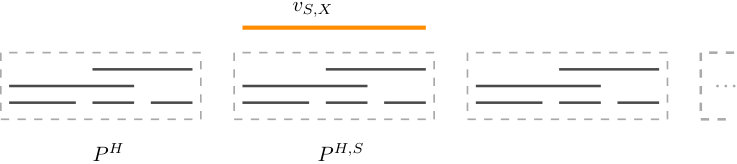 Figure 1
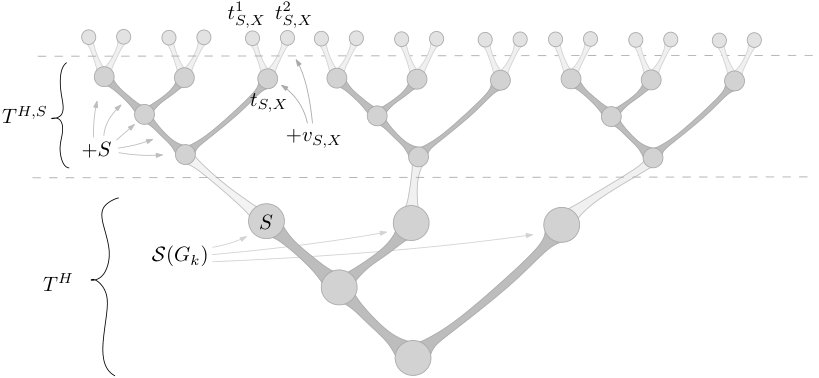 Figure 2
Peer Reviews
No public reviews on file for this paper yet. If you reviewed it on a platform where reviews are public (OpenReview, ICLR, NeurIPS, ICML), you can paste yours below so the community can read it here.
Videos
No videos yet. Explain this paper in a talk, walkthrough, or lecture? Add one.
Burling graphs, chromatic number, and orthogonal tree-decompositions
Stefan Felsner
Institut für Mathematik
Technische Universität Berlin
Berlin, Germany
Gwenaël Joret
Computer Science Department
Université Libre de Bruxelles
Brussels, Belgium
[email protected] Supported by an ARC grant from the Wallonia-Brussels Federation of Belgium.
Piotr Micek
Theoretical Computer Science Department
Jagiellonian University
Kraków, Poland
Institute of Mathematics
Freie Universität Berlin
Berlin, Germany
[email protected] Supported by a Polish National Science Center grant (SONATA BIS 5; UMO-2015/18/E/ST6/00299).
William T. Trotter
School of Mathematics
Georgia Institute of Technology
Atlanta, Georgia, U.S.A.
Veit Wiechert
Institut für Mathematik
Technische Universität Berlin
Berlin, Germany
[email protected] Supported by the Deutsche Forschungsgemeinschaft within the research training group ‘Methods for Discrete Structures’ (GRK 1408).
Abstract
A classic result of Asplund and Grünbaum states that intersection graphs of axis-aligned rectangles in the plane are -bounded. This theorem can be equivalently stated in terms of path-decompositions as follows: There exists a function such that every graph that has two path-decompositions such that each bag of the first decomposition intersects each bag of the second in at most vertices has chromatic number at most . Recently, Dujmović, Joret, Morin, Norin, and Wood asked whether this remains true more generally for two tree-decompositions. In this note we provide a negative answer: There are graphs with arbitrarily large chromatic number for which one can find two tree-decompositions such that each bag of the first decomposition intersects each bag of the second in at most two vertices. Furthermore, this remains true even if one of the two decompositions is restricted to be a path-decomposition. This is shown using a construction of triangle-free graphs with unbounded chromatic number due to Burling, which we believe should be more widely known.
1 Burling graphs
For each , we define the Burling graph and a collection of stable sets of by induction on as follows. First, let be the graph consisting of a single vertex and let contain just the single vertex stable set of . Next, suppose for the inductive case. First, take a copy of , which we think of as the ‘master’ copy. For each stable set , let denote a new copy of . Furthermore, for each stable set , introduce a new vertex adjacent to all vertices in but no others. Let us denote by the graph obtained from resulting from these vertex additions. The graph is then defined as the union of and over all . Its collection consists of two sets for each and , namely: and . Observe that and are both stable sets of .
Burling defined the family in his PhD Thesis [2] in 1965 and proved that these graphs have unbounded chromatic number. However, this construction went mostly unnoticed until it was rediscovered in [11]. (One exception is a set of unpublished lecture notes of Gyárfás [8] from 2003, which has a section devoted to Burling graphs.)
Theorem 1** ([2]).**
For every , the Burling graph is triangle free and has chromatic number at least .
Proof.
The fact that is triangle free follows directly by observing that, when creating a vertex in the definition of , its neighborhood is a stable set. To show that , we prove the following stronger statement by induction on : For every proper coloring of , there exists a stable set such that uses at least colors for vertices in . This is obviously true for , so let us assume and consider the inductive case. Let be a proper coloring of . In what follows, the notations , , and refer to the graphs used in the definition of . By induction, there is a stable set such that uses at least colors on . Similarly, there is a stable set such that uses at least colors on . If uses at least colors on , we are done since . If not, then uses exactly the same set of colors on and on . This implies that the vertex is colored with a color not in , and hence uses colors on the stable set . ∎
Mycielski [10], and Erdős and Hajnal [6] each described easy constructions of triangle-free graphs with unbounded chromatic number that are classics nowadays. We believe that Burling graphs should be more widely known, for their definition is simple and yet they exhibit some unique properties. In particular, Burling graphs admit various geometric representations that are not known to exist for any other family of triangle-free graphs with unbounded chromatic number, which we briefly survey now.
First, recall that a class of graphs is -bounded if there is a function such that for all , where denotes the maximum size of a clique in .
Burling [2] showed that each can be obtained as the intersection graph of axis-aligned boxes in . Hence, this implies that intersection graphs of axis-aligned boxes in are not -bounded. This is in contrast with the result of Asplund and Grünbaum [1] that for intersection graphs of axis-aligned rectangles. (We remark that Reed and Allwright [12] (see also [9]) described another interesting construction of axis-aligned boxes in whose intersection graph has high chromatic number, with the extra property that the interiors of the boxes are pairwise disjoint, implying that the clique number is at most .)
In the 1970s, Erdős asked whether intersection graphs of line segments in the plane are -bounded. A negative answer was provided by Pawlik, Kozik, Krawczyk, Lasoń, Micek, Trotter, and Walczak [11]: The authors represented the Burling graphs as intersection graphs of segments in the plane. This result also disproves the conjecture of Scott [13] that, for every graph , the class of graphs excluding every subdivision of as an induced subgraph is -bounded. Indeed, segment intersection graphs—and thus in particular Burling graphs—do not contain any subdivision of as an induced subgraph when is the -subdivision of a non-planar graph. Later on, Chalopin, Esperet, Li, and Ossona de Mendez [3] showed that Burling graphs in fact even exclude all subdivisions of as an induced subgraph when is the -subdivision of .
2 Application to orthogonal tree-decompositions
A tree-decomposition of a graph is a pair where is a tree and the sets () are subsets of called bags satisfying the following properties:
for each edge there is a bag containing both and , and 2. 2.
for each vertex , the set of vertices with induces a non-empty subtree of .
The width of the tree-decomposition is the maximum size of a bag minus . The tree-width of is the minimum width of tree-decompositions of . Path-decompositions and path-width are defined analogously, with the extra requirement that the tree be a path. We refer the reader to Diestel [4] for background on tree-decompositions.
The following generalization of tree-decompositions was recently introduced by Stavropoulos [15, 14] and investigated by Dujmović, Joret, Morin, Norin, and Wood [5]. Suppose that are tree-decompositions of a graph . Let then the -width of these decompositions be the maximum of over all . The -tree-width of , also called -medianwidth of in [15, 14], is the minimum -width of all -tuples of tree-decompositions of . Replacing trees with paths, we obtain the corresponding notion of -path-width of , also known as -latticewidth [14]. Intuitively, to show that the -tree-width or -path-width of is small, we want to choose a -tuple of tree/path-decompositions of that are as ‘orthogonal’ as possible: For instance, to see that a grid has bounded -path-width, one can take a ‘horizontal’ path-decomposition where bags are unions of two consecutive columns, and a ‘vertical’ one where bags are unions of two consecutive rows.
The -tree-width of for forms a non-increasing sequence of numbers that converges to the clique number of , and the same is true for the -path-width of [15, 14]. Thus these numbers can be seen as interpolating between the tree-width / path-width of (plus one) and its clique number.
Some graph classes of interest already have bounded -tree-width. For instance, planar graphs, and more generally graphs excluding a fixed graph as minor [5]. In fact, for planar graphs and some of their generalizations, one can even require one of the two tree-decompositions to be a path-decomposition such that each vertex appears in at most two bags, see [5] and the references therein. Note however that graphs with bounded -tree-width are not necessarily sparse: All bipartite graphs have -tree-width (and even -path-width) at most .
The -path-width of a graph can equivalently be defined as the minimum such that is a subgraph of an intersection graph of axis-aligned boxes in with . (To see this, recall that axis-aligned boxes in satisfy the Helly property.) In particular, is bounded from above by a function of the -path-width of , since intersection graphs of axis-aligned rectangles in the plane are -bounded [1]. This prompted the authors of [5] to ask whether the same remains true for the -tree-width of . We show that this is not the case, even if one the two decompositions is restricted to be a path-decomposition.
Theorem 2**.**
For every , the Burling graph has a tree-decomposition and a path-decomposition such that for every and every .
Proof.
The proof is by induction on . To facilitate the induction, we will prove that the tree-decomposition and the path-decomposition can be chosen such that
for every and every ; 2. 2.
for every , there exists such that , and 3. 3.
for every and every .
The claim is trivially true for , so let us consider the inductive case . As before, the notations , , and refer to the graphs used in the definition of . Let and denote the tree-decomposition and path-decomposition of given by the induction hypothesis. Similarly, for each stable set , let and denote the tree-decomposition and path-decomposition of obtained from induction. (As expected, we assume that , , and all the s and s are pairwise vertex disjoint.)
Define the tree as follows. Start with the union of and for all . Then, for each , add an edge linking a vertex such that (which exists by induction) to an arbitrary vertex in . Finally, for each and , let denote a vertex in such that . Add two leaves , adjacent to .
The bags () of the tree-decomposition of are defined as follows (see Figure 1 for an illustration) :
[TABLE]
For each vertex , the set of vertices such that clearly induces a subtree of . Moreover, the two endpoints of each new edge of the form with , , and lie in a common bag, namely with . It follows that is a tree-decomposition of .
We show that property 2 holds. Recall that each set in is either of the form or of the form for some and . In the former case, for . In the latter case, for . Hence, 2 is satisfied.
Next, we define the path-decomposition of . The path indexing the decomposition is defined simply by taking the union of the paths and for all , and connecting them in a path-like way (arbitrarily). The bags () are defined as follows (see Figure 2 for an illustration):
[TABLE]
Observe that is a path-decomposition of . Indeed, for each vertex the set of vertices such that clearly induces a subpath of . Moreover, the two endpoints of each new edge of the form with , , and lie in a common bag since for every .
Let us prove that property 3 is satisfied. Consider sets and , and a vertex . First suppose . Then , and thus holds by induction. Similarly, and again follows from induction. Next assume for some . Then , and thus by induction. Also, and hence . It follows that property 3 holds.
It remains to show that our newly defined tree and path-decompositions together satisfy property 1. Let thus and . First, suppose that . If , then holds by induction. If for some , then and are disjoint.
Next, suppose that for some and . Thus, . If , then , and we know that this set has size at most by induction, since satisfies property 3. If for some distinct from , then and are disjoint. If , then . Since holds by induction thanks to property 3, we deduce that .
The above observations also imply that if or for some and , since in these cases. Finally, suppose that for some and for all . Then . If , then , and (as in the above paragraph) that set has size at most by induction, since satisfies property 3. If for some distinct from , then and are disjoint. If , then by induction.
Hence, holds in all cases, and therefore property 1 is satisfied. ∎
We conclude the paper with an open problem in the spirit of exploring how the Asplund-Grünbaum result [1] could be extended. A spaghetti tree-decomposition of a graph is a tree-decomposition of such that is rooted at some vertex and, orienting all edges of away from , the subtree of induced by is a directed path for each vertex .
Conjecture 3**.**
There exists a function such that for every and every graph admitting a spaghetti tree-decomposition and a path-decomposition such that for every and .
We remark that, for all we know, the above conjecture could even be true with two spaghetti tree-decompositions. Let us also mention that the class of graphs that admit a spaghetti tree-decomposition such that if and only if and intersect has been studied by Galvin [7] (note that this is a subclass of chordal graphs).
Acknowledgements
We thank Ross Kang for pointing out references [8, 12] and an anonymous referee for mentioning reference [7].
The reference list from the paper itself. Each links out to its DOI / PubMed record.
- 1[1] E. Asplund and B. Grünbaum. On a coloring problem. Math. Scand. , 8:181–188, 1960.
- 2[2] J. P. Burling. On coloring problems of families of prototypes . Ph D thesis, University of Colorado, Boulder, 1965.
- 3[3] J. Chalopin, L. Esperet, Z. Li, and P. Ossona de Mendez. Restricted frame graphs and a conjecture of Scott. Electron. J. Combin. , 23(1):Paper 1.30, 21, 2016. ar Xiv:1406.0338 .
- 4[4] R. Diestel. Graph theory , volume 173 of Graduate Texts in Mathematics . Springer, Heidelberg, fourth edition, 2010.
- 5[5] V. Dujmović, G. Joret, P. Morin, S. Norin, and D. R. Wood. Orthogonal tree decompositions of graphs. SIAM Journal on Discrete Mathematics , to appear. ar Xiv:1701.05639 .
- 6[6] P. Erdős and A. Hajnal. On chromatic number of infinite graphs. In Theory of Graphs (Proc. Colloq., Tihany, 1966) , pages 83–98. Academic Press, New York, 1968.
- 7[7] F. Gavril. A recognition algorithm for the intersection graphs of directed paths in directed trees. Discrete Math. , 13(3):237–249, 1975.
- 8[8] A. Gyárfás. Combinatorics of intervals. Unpublished lecture notes (2003).