Zero Range Process and Multi-Dimensional Random Walks
Nicolay M. Bogoliubov, Cyril Malyshev

TL;DR
This paper explores the connection between zero range processes, non-Hermitian Hamiltonians, and multi-dimensional lattice walks, providing algebraic solutions and expressing probabilities through symmetric functions.
Contribution
It introduces a novel interpretation of conditional probabilities as generating functions for multi-dimensional lattice walks bounded by hyperplanes.
Findings
Conditional probabilities are expressed as generating functions for walks.
Conditional probabilities and walk counts are formulated via symmetric functions.
The approach links non-equilibrium statistical mechanics with combinatorial lattice walk analysis.
Abstract
The special limit of the totally asymmetric zero range process of the low-dimensional non-equilibrium statistical mechanics described by the non-Hermitian Hamiltonian is considered. The calculation of the conditional probabilities of the model are based on the algebraic Bethe ansatz approach. We demonstrate that the conditional probabilities may be considered as the generating functions of the random multi-dimensional lattice walks bounded by a hyperplane. This type of walks we call the walks over the multi-dimensional simplicial lattices. The answers for the conditional probability and for the number of random walks in the multi-dimensional simplicial lattice are expressed through the symmetric functions.
Click any figure to enlarge with its caption.
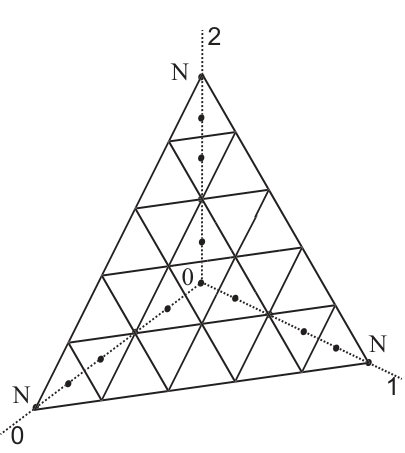 Figure 4
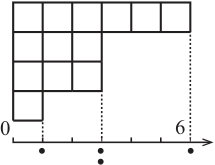 Figure 4
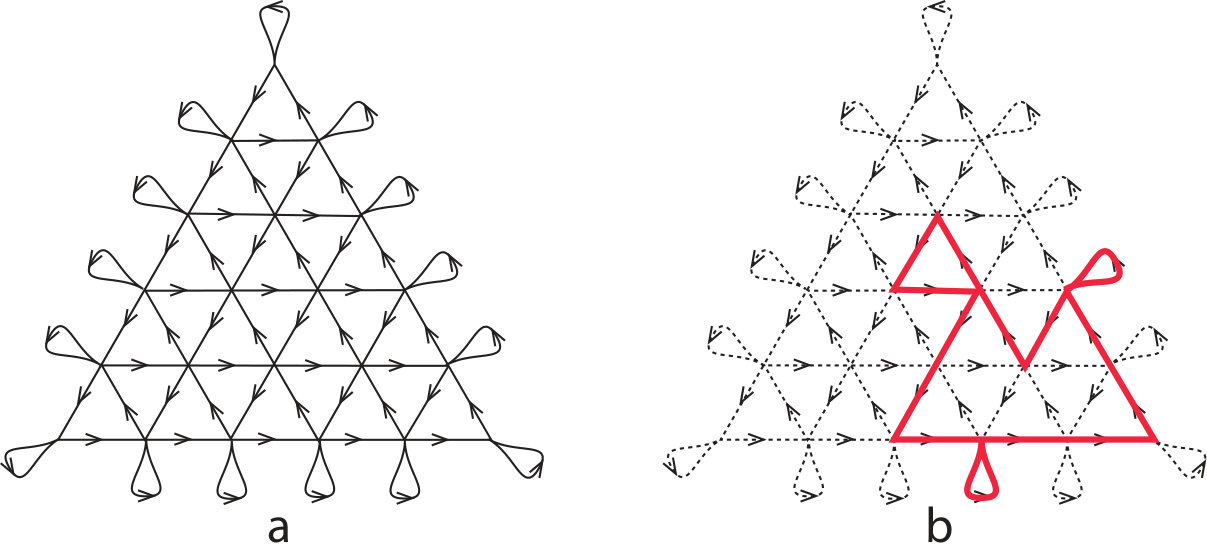 Figure 3
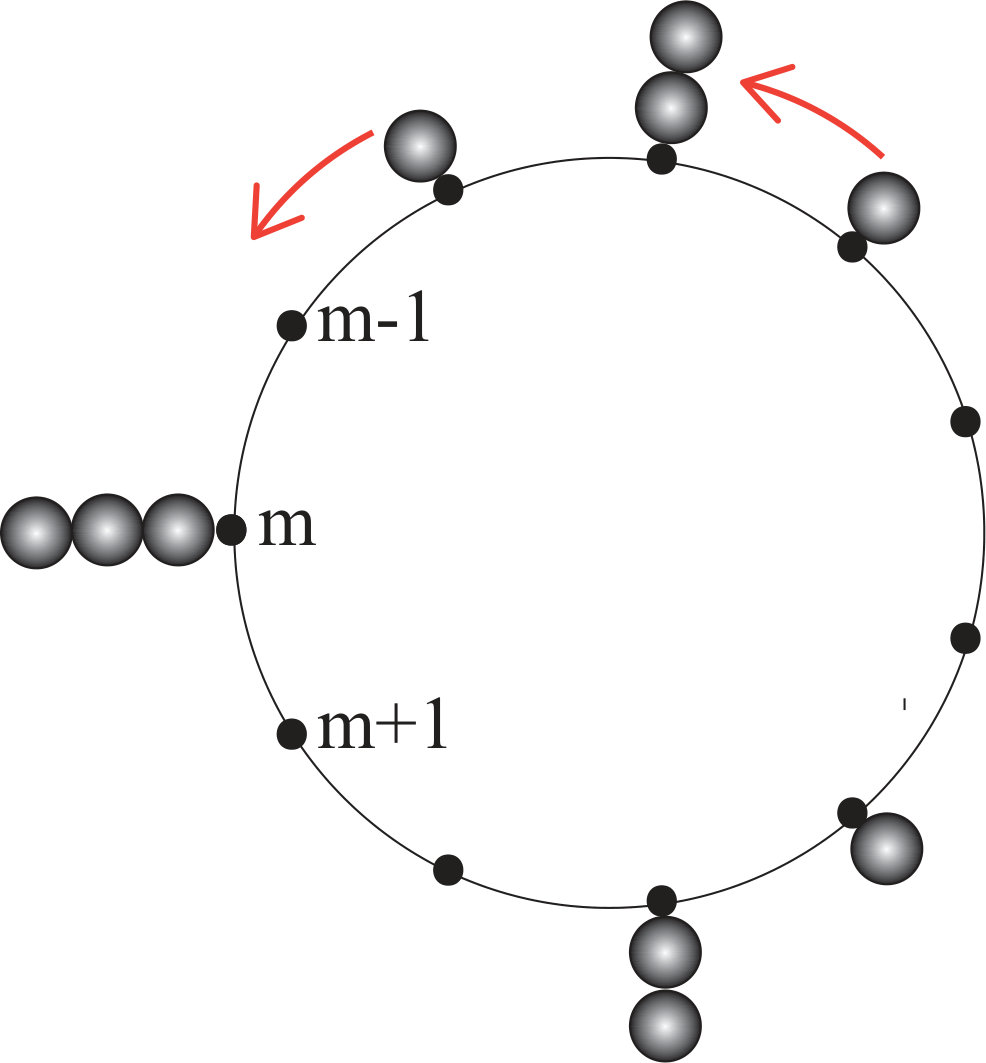 Figure 4
Peer Reviews
No public reviews on file for this paper yet. If you reviewed it on a platform where reviews are public (OpenReview, ICLR, NeurIPS, ICML), you can paste yours below so the community can read it here.
Videos
No videos yet. Explain this paper in a talk, walkthrough, or lecture? Add one.
\FirstPageHeading
\ShortArticleName
Zero Range Process and Multi-Dimensional Random Walks
\ArticleName
Zero Range Process and Multi-Dimensional
Random Walks††This paper is a contribution to the Special Issue on Recent Advances in Quantum Integrable Systems. The full collection is available at http://www.emis.de/journals/SIGMA/RAQIS2016.html
\Author
Nicolay M. BOGOLIUBOV †‡ and Cyril MALYSHEV †‡
\AuthorNameForHeading
N.M. Bogoliubov and C. Malyshev
\Address
† St.-Petersburg Department of Steklov Institute of Mathematics of RAS,
† Fontanka 27, St.-Petersburg, Russia \EmailD[email protected], [email protected]
\Address
‡ ITMO University, Kronverksky 49, St.-Petersburg, Russia
\ArticleDates
Received March 28, 2017, in final form July 14, 2017; Published online July 22, 2017
\Abstract
The special limit of the totally asymmetric zero range process of the low-dimensional non-equilibrium statistical mechanics described by the non-Hermitian Hamiltonian is considered. The calculation of the conditional probabilities of the model are based on the algebraic Bethe ansatz approach. We demonstrate that the conditional probabilities may be considered as the generating functions of the random multi-dimensional lattice walks bounded by a hyperplane. This type of walks we call the walks over the multi-dimensional simplicial lattices. The answers for the conditional probability and for the number of random walks in the multi-dimensional simplicial lattice are expressed through the symmetric functions.
\Keywords
zero range process; conditional probability; multi-dimensional random walk; correlation function; symmetric functions
\Classification
05A19; 05E05; 82B23
1 Introduction
The zero-range process is a stochastic lattice gas where the particles hop randomly with an on-site interaction that makes the jump rate dependent only on the local particle number. The zero range processes (ZRPs) belong to a class of minimal statistical-mechanics models of the low-dimensional non-equilibrium physics [12, 30]. Being exactly solvable the model and its other variations are intensively studied both by mathematicians and physicists [9, 15, 16, 21, 25, 26].
In this paper we consider the totally asymmetric simple zero range process (TASZRP) [13, 17], which describes a system of indistinguishable particles placed on a one-dimensional lattice, moving randomly in one direction from right to left with the equal hopping rate on a periodic ring. The dynamical variables of the model are the phase operators [11] which can be regarded as a special limit of -bosons [5, 19]. The application of the quantum inverse method (QIM) [13, 17, 20] allows to calculate the scalar products and form-factors of the model and represent them in the determinantal form [3, 8]. The relation of the considered model and the totaly asymmetric simple exclusion process (TASEP) was discussed in [8, 27].
Certain quantum integrable models solvable by the QIM demonstrate close relationship [2, 6, 7] with the different objects of the enumerative combinatorics [31, 32] and the theory of the symmetric functions [22]. It appeared that the correlation functions of some integrable models may be regarded as the generating functions of plane partitions and random walks.
Different types of random walks [14, 18, 31, 32] are of considerable recent interest due to their role in quantum information processing [10, 29]. The walks on multi-dimensional lattices were studied by many authors [4, 23, 24, 28].
In this paper we shall calculate the conditional probability of the model and reveal its connection with the generating function of the lattice paths on multi-dimensional oriented lattices bounded by a hyperplane.
The layout of the paper is as follows. In the introductory Section 2 we give the definition of the TASZRP. The solution of the model by QIM is presented in Section 3. In Section 4 conditional probability is calculated. The random walks over the -dimensional oriented simplicial lattice with retaining boundary conditions are introduced and the connection of their generating function with the conditional probability is established.
2 Totally asymmetric simple zero range hopping model
Consider a system with particles on a periodic one-dimensional lattice of length , i.e., on a ring, where sites and are identical. Each site of a lattice contains arbitrary number of particles. The particles evolve with the following dynamics rule: during the time interval [] a particle on a site jumps with probability to the neighbouring site . There are no restrictions on the number of particles on a lattice site.
A configuration of the system is characterized by the list of all possible arrangements of particles amongst the available sites. The total number of configurations is, therefore,
[TABLE]
The probability of finding the system in configuration at time satisfies the master equation
[TABLE]
where is the Markov matrix of the size . For the entry is the transition rate from to . It is equal to unity, if the transition is allowed, and is zero otherwise. The diagonal entry is equal to the number of occupied sites in the configuration . The elements of the columns and rows of add up to zero and total probability is conserved
[TABLE]
The process described is stochastic, the unique stationary state of this system being the one, in which all different configurations have equal weight.
A configuration is represented by the sequence of occupation numbers , satisfying the condition , . We can rewrite the master equation (2.2) for the TAZRP in the form
[TABLE]
where is the number of occupied sites in the configuration , i.e., the number of . This equation has to be supplemented by the condition that , if at least one of the .
To formulate the dynamic of the system in terms of a quantum mechanical model we denote a particle configuration as a Fock vector and define a probability vector
[TABLE]
where are the probabilities of configuration . The generator of the master equation (2.3) may be written as
[TABLE]
Here, the phase operators were introduced. They satisfy commutation relations
[TABLE]
where is the number operator and is vacuum projector: . This algebra has a representation on the Fock space:
[TABLE]
The states are orthogonal, . The Fock vectors are generated from the vacuum state
[TABLE]
by action of rising operators
[TABLE]
The total number operator
[TABLE]
commutes with the Hamiltonian (2.4):
[TABLE]
The hopping term of the Hamiltonian (2.4) annihilates the particle in the site and creates it in the site :
[TABLE]
The vacuum projector due to the definition (2.5) acts on the Fock vector in the following way
[TABLE]
and
[TABLE]
The operator
[TABLE]
counts the number of occupied sites in the configuration
[TABLE]
The evolution of the quantum system is governed by the imaginary time Schrödinger equation
[TABLE]
which is equivalent to the master equation (2.3) for the probabilities equal to the matrix elements
[TABLE]
The initial () probability distribution defines the state
[TABLE]
The state
[TABLE]
is a left eigenvector of the model, which obeys
[TABLE]
Correspondingly, has one right eigenvector with eigenvalue zero, which is associated with the state : , where is (2.1), . The vector does not evolve in time and, therefore, corresponds up to normalization factor to a steady state distribution of the system
[TABLE]
In this paper we shall calculate the conditional probability
[TABLE]
which is equal to probability, that in a time the system will be in a pure state defined by the occupation numbers provided that initially the system was prepared in a pure state .
3 Solution of the TASZRP
To apply the scheme of the QIM to the solution of the Hamiltonian (2.4) we define -operator [8] which is matrix with the operator-valued entries acting on the Fock states according to (2.5):
[TABLE]
where is a parameter. This -operator satisfies the intertwining relation
[TABLE]
in which is the -matrix
[TABLE]
where
[TABLE]
The monodromy matrix is the matrix product of -operators
[TABLE]
The commutation relations of the matrix elements of the monodromy matrix are given by the same -matrix (3.2)
[TABLE]
The transfer matrix is the trace of the monodromy matrix in the auxiliary space
[TABLE]
The relation (3.5) means that for arbitrary .
From the definitions (3.1) and (3.4) one finds by direct calculation that the entries of the monodromy matrix are polynomials in . For and one has
[TABLE]
where the dots stand for the terms not important for further consideration. We also find that
[TABLE]
The representation (3.7) allows to express the Hamiltonian (2.4) through the transfer matrix (3.6)
[TABLE]
By construction this Hamiltonian commutes with the transfer matrix
[TABLE]
Since the Hamiltonian (2.4) is non-Hermitian we have to distinguish between its right and left eigenvectors. The -particle right state-vectors are taken in the form
[TABLE]
where is defined in (3.8), and implies a collection of arbitrary complex parameters : . The left state-vectors are equal to
[TABLE]
where is given by (3.9). The vacuum state (2.6) is an eigenvector of and ,
[TABLE]
with the eigen-values
[TABLE]
The state-vectors (3.11) and (3.12) are the eigenvectors both of the Hamiltonian (2.4) and of the transfer matrix (3.6), if, and only if, the variables satisfy the Bethe equations
[TABLE]
where are the elements of the -matrix (3.3). In the explicit form the Bethe equations are given by
[TABLE]
There are equation (2.1) sets of solutions of these equations. The eigenvalues of the transfer matrix (3.6) in the general form are equal to
[TABLE]
For the model under consideration
[TABLE]
Here, the generating function of complete symmetric functions h_{l}\big{(}{\bf u}^{-2}\big{)}\equiv h_{l}\big{(}u_{1}^{-2},u_{2}^{-2},\ldots, u_{N}^{-2}\big{)} [22] is introduced
[TABLE]
Equation (3.10) enables to obtain the spectrum of the Hamiltonian (2.4). The -particle eigenenergies
[TABLE]
are equal to
[TABLE]
The steady state (2.10) corresponds to a special solution of Bethe equations (3.14) when all .
4 The calculation of conditional probability
For the models associated with the -matrix (3.2) the scalar product of the state-vectors (3.11) and (3.12) is given by the formula [1]:
[TABLE]
where is the Vandermonde determinant,
[TABLE]
and the matrix is characterized by the entries , ,
[TABLE]
with and given by (3.13).
The norm of the state-vector is defined by the scalar product (4.1) when the arguments and satisfy the Bethe equations (3.14). For the present case of the generalized phase model we substitute , , respecting the Bethe equations (3.14) into the entries of the matrix . The resulting matrix is denoted as , and its entries at are equal to
[TABLE]
where is given by (3.14). L’Hôspital rule gives the diagonal entries of
[TABLE]
where
[TABLE]
As a result, the squared norm on the Bethe solution takes the form
[TABLE]
The state-vectors belonging to the different sets of solutions of the Bethe equations (3.14) are orthogonal. The eigenvectors (3.11) and (3.12) provide the resolution of the identity operator
[TABLE]
where the summation is over all independent solutions of the Bethe equations (3.14).
Inserting the resolution of the identity operator (4.5) into (2.11), one obtains the general answer for the conditional probability
[TABLE]
For the simplicity let us consider the initial state equal to and the final one respectively to . The conditional probability (2.11) of this process is specified as follows
[TABLE]
where equation (2.7) has been used. Inserting the resolution of the identity operator (4.5) into (4.7), we obtain
[TABLE]
where the summation is over all independent solutions of equations (3.14).
The decomposition (3.9) for and gives that
[TABLE]
and eventually the answer is
[TABLE]
where is given by (4.3), (4.4).
To obtain the explicit answer for the conditional probability in the general case (4.6) we shall express state vectors (3.11) and (3.12) in the coordinate form. The state-vector (3.11) has the representation
[TABLE]
where the symmetric function is equal, up to a multiplicative pre-factor, to
[TABLE]
Here denotes the partition of non-increasing non-negative integers,
[TABLE]
and is the Vandermonde determinant (4.2). There is a one-to-one correspondence between a sequence of the occupation numbers , , and the partition
[TABLE]
where each number appears times (see Fig. 2). The sum in equation (4.8) is taken over all partitions into at most parts with .
Acting by the Hamiltonian (2.4) on the state-vector (4.8), we find that the wave function (4.9) satisfies the equation
[TABLE]
together with the exclusion condition
[TABLE]
The energy is given by (3.15). The state-vector (4.8) is the eigenvector of the Hamiltonian (2.4) with the periodic boundary conditions if the parameters satisfy the Bethe equations (3.14).
The relations (4.8), (4.10) and (4.11) can be viewed as an implementation of the coordinate Bethe ansatz [17], which is an alternative to the approach of the algebraic Bethe ansatz considered in Section 3. Although the model is solved by the algebraic Bethe ansatz, representations of the type of (4.8) are especially useful in discussing the combinatorial properties of the quantum integrable models [2, 6, 7].
Expanding the left state-vector (3.12), we obtain
[TABLE]
where the wave function is given by the symmetric function
[TABLE]
It satisfies the equations
[TABLE]
From equations (4.8), (4.12) one obtains
[TABLE]
where
[TABLE]
Finally, the expression for the conditional probability (4.6) has the form
[TABLE]
Here is the squared norm (4.3).
5 Multi-dimensional lattice walks bounded by a hyperplane
Starting from -dimensional hypercubical lattice with unit spacing , let us define the non-negative orthant as a subset of (hereafter ). Consider a subset of consisting of sites with coordinates constrained by the requirement :
[TABLE]
The set {\rm Simp}_{(N)}\big{(}\mathbb{Z}^{M+1}\big{)} is compact -dimensional, and we shall call it simplicial lattice. A two-dimensional triangular simplicial lattice is presented in Fig. 3. A sequence of points in is called lattice path of steps [18].
Random walks over sites of {\rm Simp}_{(N)}\big{(}\mathbb{Z}^{M+1}\big{)} are defined by a set of admissible steps (step set ) so that at each step an coordinate increases by unity, while the nearest neighbouring one decreases by unity. Namely, each element of is given by sequence so that , for all pairs with and , and for all and . The step set ensures that trajectory of a random walk (lattice path) determined by the starting point lies in -dimensional set {\rm Simp}_{(N)}\big{(}\mathbb{Z}^{M+1}\big{)}.
Directed random walks on -dimensional oriented simplicial lattice are defined by a step set so that , for all pairs with and , and for all . It may occur that some points on the boundary of the simplicial lattice also belong to a random walk trajectory. Therefore, the walker’s movements should be supplied with appropriate boundary conditions. The boundary of the simplicial lattice consists of faces of highest dimensionality . Under the retaining boundary conditions the walker comes to a node of the boundary, and either continues to move in accordance with the elements of , or keeps staying in the node. An oriented two-dimensional simplicial lattice with the retaining boundary conditions is presented in Fig. 4.
To establish the connection of the exponential generation function of lattice paths and the conditional probability (2.11) we shall interpret the coordinates of a walker in a simplicial lattice {\rm Simp}_{(N)}\big{(}\mathbb{Z}^{M+1}\big{)} as the occupation numbers of -component Fock space and describe the steps of a walker with the help of the Fock state-vectors . Operator shifts the value of the coordinate of the walker downwards , while upwards . If the walker arrived at an arbitrary node of component of the boundary, it can make either allowed step or stay on it due the action of operator (2.9). The number operator acts as the coordinate operator , . Since the occupation numbers are non-negative integers and their sum is conserved (2.8), we can regard operator
[TABLE]
as a generator of steps of a walker in {\rm Simp}_{(N)}\big{(}\mathbb{Z}^{M+1}\big{)} with the retaining boundary conditions. The operators (5.1) and (2.4) are related
[TABLE]
The number of lattice paths made by a walker over the -dimensional simplicial lattice in steps with the ending nodes and is given by the expression
[TABLE]
It is straightforward to verify that
[TABLE]
where , and it is natural to impose the condition .
The exponential generating function of lattice paths in is defined as a formal series
[TABLE]
Due to definition (5.2) it may be expressed as
[TABLE]
Taking into account the connection (5.2) we obtain the desired relation of the conditional probability (2.11) and generation function of lattice paths (5.3):
[TABLE]
From the expression (4.13) it follows that the number of lattice paths made by a walker in the -dimensional simplicial lattice in steps with the ending nodes and is equal to
[TABLE]
where the function h_{1}\big{(}{\bf u}^{-2}\big{)} is introduced in (3.15).
Acknowledgements
This work was supported by RFBR grant 16-01-00296. N.M.B. acknowledges the Simons Center for Geometry and Physics, Stony Brook University at which some of the research for this paper was performed.
The reference list from the paper itself. Each links out to its DOI / PubMed record.
- 1[1] Bogoliubov N.M., Boxed plane partitions as an exactly solvable boson model, J. Phys. A: Math. Gen. 38 (2005), 9415–9430, cond-mat/0503748 . · doi ↗
- 2[2] Bogoliubov N.M., The X X O 𝑋 𝑋 𝑂 XXO Heisenberg chain and random walks, J. Math. Sci. 138 (2006), 5636–5643. · doi ↗
- 3[3] Bogoliubov N.M., Calculation of correlation functions in totally asymmetric exactly solvable models on a ring, Theoret. and Math. Phys. 175 (2013), 755–762. · doi ↗
- 4[4] Bogoliubov N.M., Quantum walks and phase operators, in preparation.
- 5[5] Bogoliubov N.M., Bullough R.K., Pang G.D., Exact solution of the q 𝑞 q -boson hopping model, Phys. Rev. B 47 (1993), 11495–11498. · doi ↗
- 6[6] Bogoliubov N.M., Malyshev C., Correlation functions of X X 0 𝑋 𝑋 0 XX 0 Heisenberg chain, q 𝑞 q -binomial determinants, and random walks, Nuclear Phys. B 879 (2014), 268–291, ar Xiv:1401.7624 . · doi ↗
- 7[7] Bogoliubov N.M., Malyshev C.L., Integrable models and combinatorics, Russ. Math. Surv. 70 (2015), 789–856. · doi ↗
- 8[8] Bogoliubov N.M., Nassar T., On the spectrum of the non-Hermitian phase-difference model, Phys. Lett. A 234 (1997), 345–350. · doi ↗