Quantum spin Hall density wave insulator of correlated fermions
Gaurav Kumar Gupta, Tanmoy Das

TL;DR
This paper introduces a novel topological quantum order called the quantum spin-Hall density wave (QSHDW) state, characterized by a $Z_2$ invariant, spatial modulation, and weak topological insulator properties in correlated fermion systems.
Contribution
It proposes a new topological phase driven by spin-orbit density wave order, with unique symmetry and boundary state features, extending quantum spin-Hall concepts to density wave systems.
Findings
Identifies a $Z_2$ topological invariant in density wave order
Predicts weak topological insulator behavior with spin-polarized boundary states
Suggests realizations in quantum wires and quasi-2D systems
Abstract
We present the theory of a new type of topological quantum order which is driven by the spin-orbit density wave order parameter, and distinguished by topological invariant. We show that when two oppositely polarized chiral bands [resulting from the Rashba-type spin-orbit coupling , is crystal momentum] are significantly nested by a special wavevector , it induces a spatially modulated inversion of the chirality () between different sublattices. The resulting quantum order parameters break translational symmetry, but preserve time-reversal symmetry. It is inherently associated with a -topological invariant along each density wave propagation direction. Hence it gives a weak topological insulator in two dimensions, with even number of spin-polarized boundary states. This phase is analogous to the quantum…
Click any figure to enlarge with its caption.
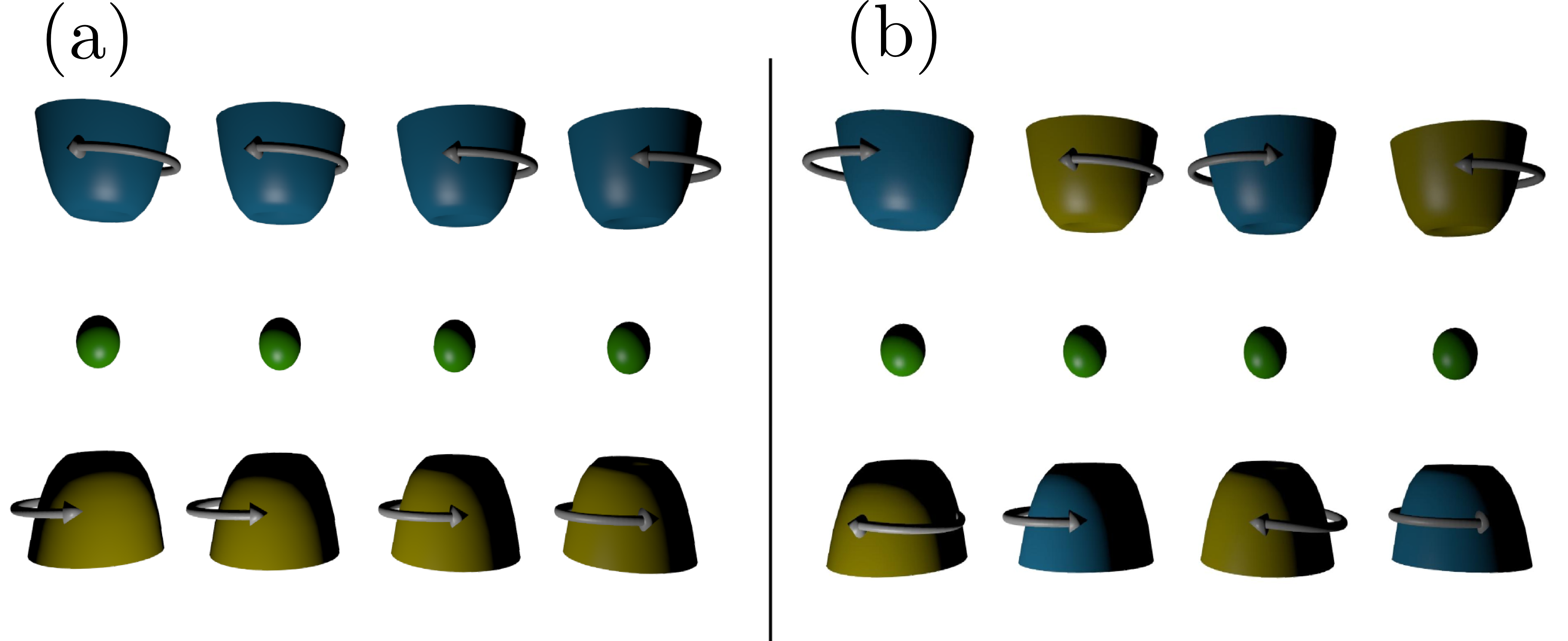 Figure 1
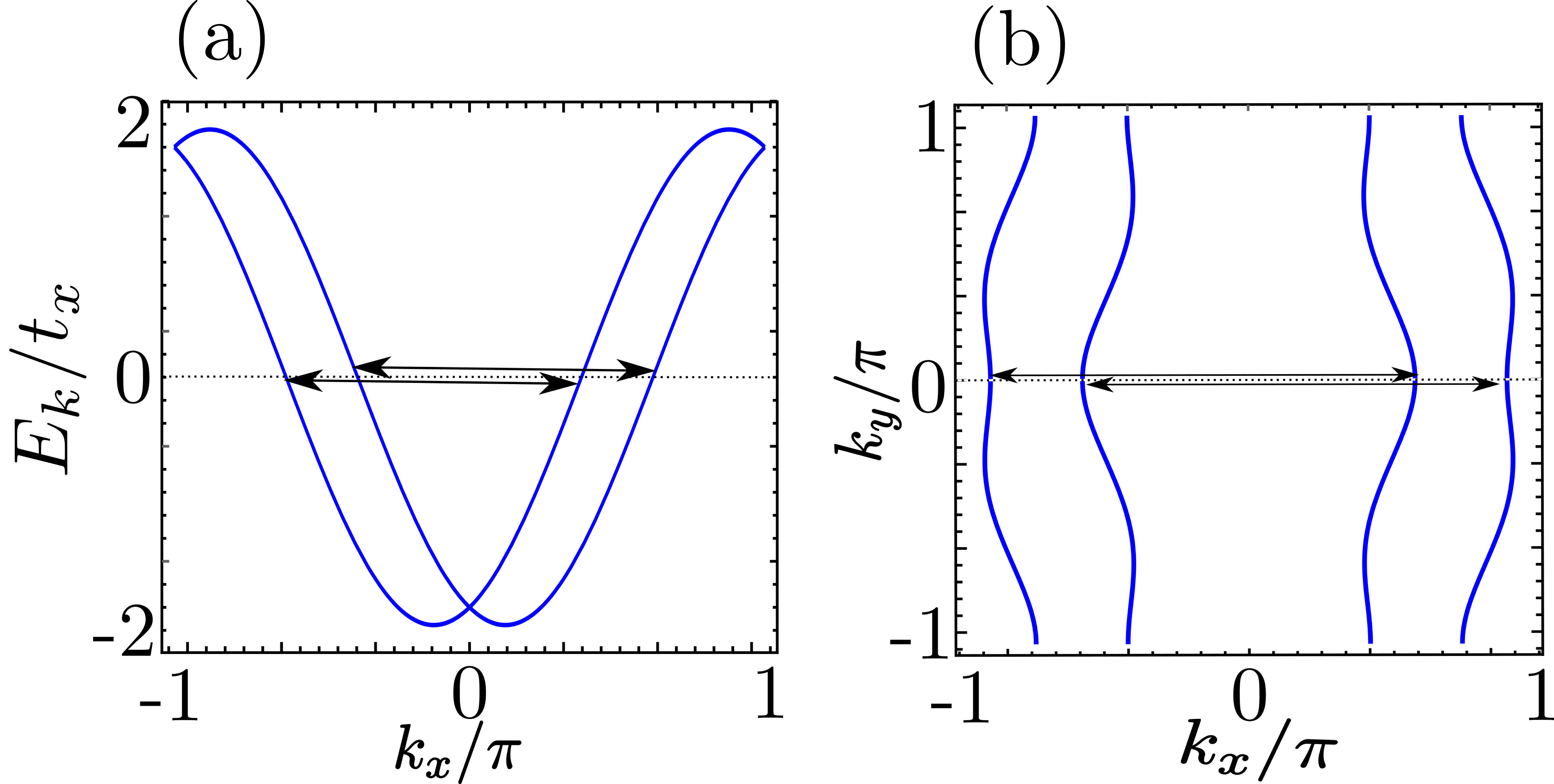 Figure 2
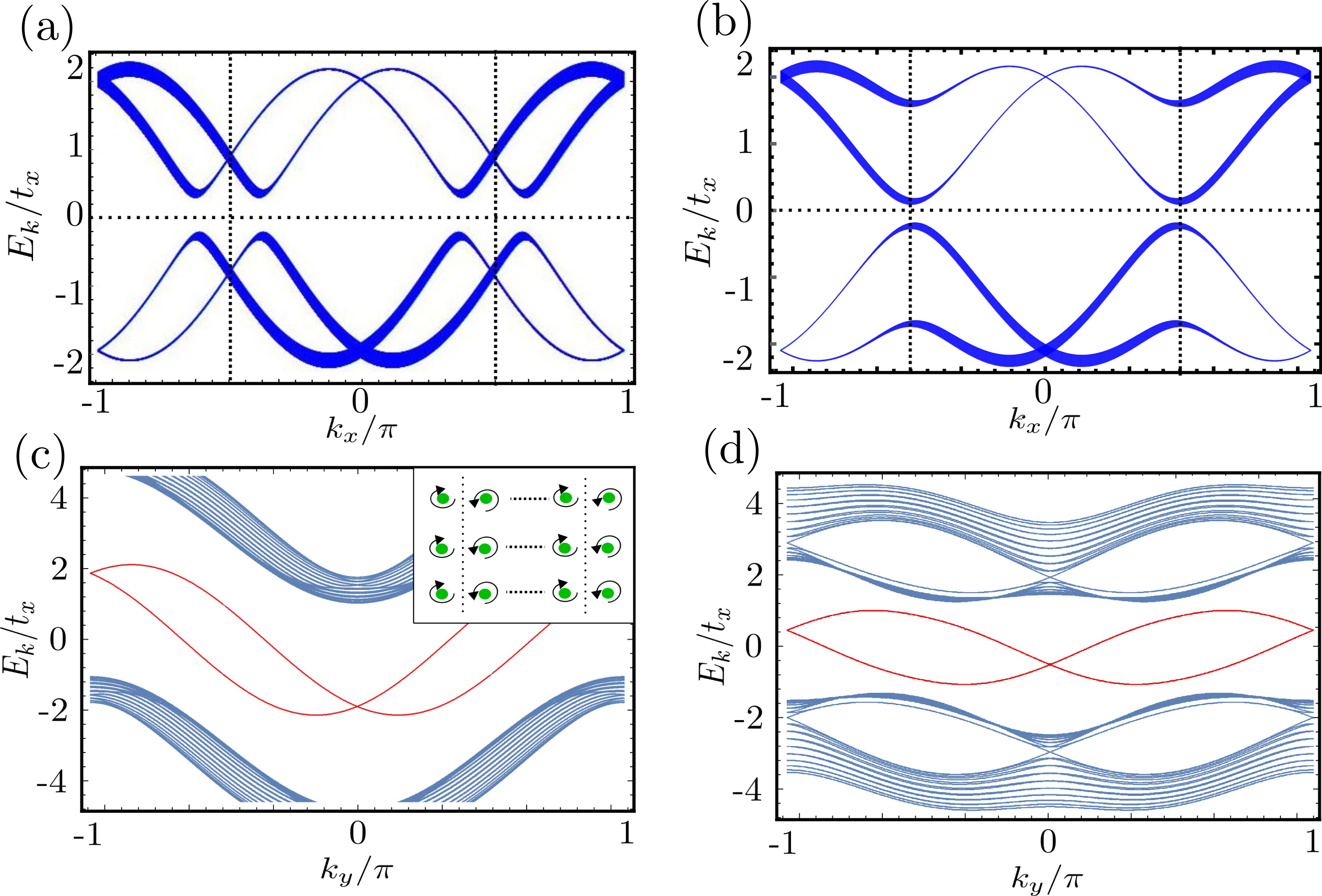 Figure 3
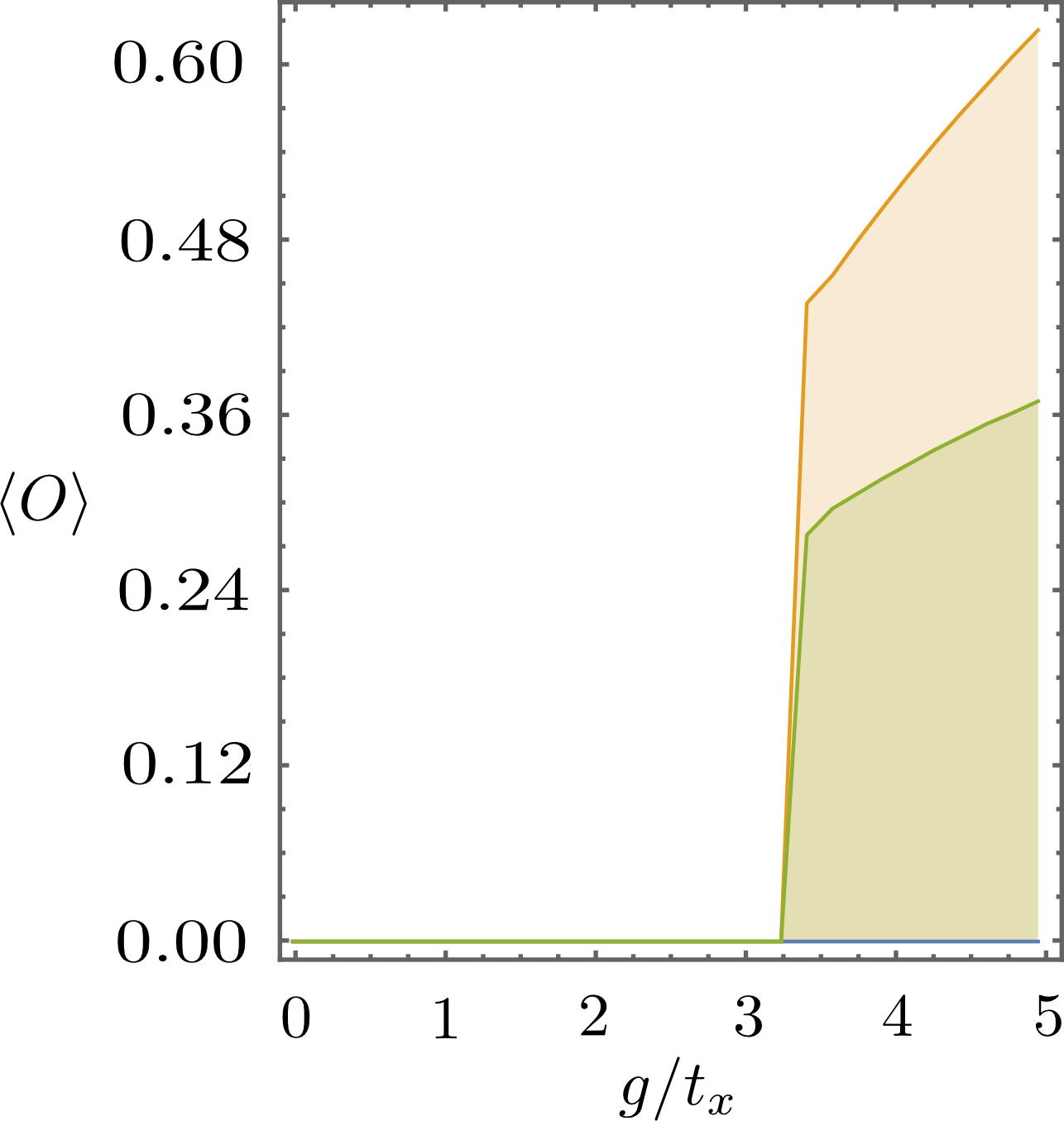 Figure 4
Peer Reviews
No public reviews on file for this paper yet. If you reviewed it on a platform where reviews are public (OpenReview, ICLR, NeurIPS, ICML), you can paste yours below so the community can read it here.
Videos
No videos yet. Explain this paper in a talk, walkthrough, or lecture? Add one.
Quantum spin Hall density wave insulator of correlated fermions
Gaurav Kumar Gupta
Tanmoy Das
Department of Physics, Indian Institute of Science, Bangalore, India - 560012
Abstract
We present the theory of a new type of topological quantum order which is driven by the spin-orbit density wave order parameter, and distinguished by topological invariant. We show that when two oppositely polarized chiral bands [resulting from the Rashba-type spin-orbit coupling , is crystal momentum] are significantly nested by a special wavevector , it induces a spatially modulated inversion of the chirality () between different sublattices. The resulting quantum order parameters break translational symmetry, but preserve time-reversal symmetry. It is inherently associated with a -topological invariant along each density wave propagation direction. Hence it gives a weak topological insulator in two dimensions, with even number of spin-polarized boundary states. This phase is analogous to the quantum spin-Hall state, except here the time-reversal polarization is spatially modulated, and thus it is dubbed quantum spin-Hall density wave (QSHDW) state. This order parameter can be realized or engineered in quantum wires, or quasi-2D systems, by tuning the spin-orbit couping strength and chemical potential to achieve the special nesting condition.
pacs:
73.43.Cd, 73.43.Nq, 73.22.Gk, 71.70.Ej
A topological state of matter can arise when two bands with opposite chirality are inverted across the Fermi level at odd number of time-reversal (TR) invariant momenta (TRIM).TIreviewTD ; TIreviewSCZ ; TIreviewCK One of the prerequisites is thus to obtain a momentum dependence of the spin state or chirality, which is often triggered by the spin-orbit coupling (SOC). The inversion of the chirality between the bulk conduction and valence bands across the insulating band gap at the TRIM is protected by the TR symmetry, leading to a topological insulator (TI). At the boundary, both chiral states meet at the TRIM with gapless edge or surface states. Within the Dirac Hamiltonian notation, the inverted bulk band gap (denoted by ) at the TRIM provides the negative Dirac mass, while the associated gapless boundary states.
While strong quantum fluctuations or disorder are often detrimental to the band topology, they can conversely drive the inversion of the chiral bands with non-trivial topological properties. These states are not always defined by a Landau order parameter, rather distinguished by a topological invariant of the correlated electronic bands. Examples of such states include topological Mott,TMI ; TAI Kondo,TKI and AndersonTDI insulators. Antiferromagnetic order parameter can give a distinct topological class which breaks time-reversal and translation symmetries, but preserves their combinations.TAFM To date, TIs have been realized in various non-interacting systems including HgTe/CdTe,HgTeTh ; HgTeExp InAs/GaSb InAsGaSb quantum wells for two-dimensional (2D) TIs, and Bi-based chalcogenides for 3D TIs.BiSbTh ; BiSbExp ; BiSeTh ; BiSeExp ; BiTeExp SmB6, TKI ; SmB6 and YbB6 YbB6 have been extensively studied both theoretically and experimentally as potential candidates for topological Kondo insulators.
Proposal: We develop the theory of a Landau-type topological order parameter driven by staggered chiral band inversion. The order parameter arises from the translational symmetry breaking due to Fermi surface (FS) nesting between Rashba-type SOC (RSOC) split bands. Such nesting between opposite chiral states may occur in 2D systems or quantum wires of Bi, Pb, Sb, and similar elements in which both SOC and interaction are large.PbFS ; PbNC The nesting strength is enhanced with reduced system dimensionality and thickness.PbFS ; PbNC Our theory relies on a particular nesting vector or , where the helicity of the RSOC (with being the RSOC strength, and are the crystal momenta) is reversed to . This is the key feature responsible for modulated chiral band inversion. We find that as a Landau type order parameter develops due to this FS instability, it leads to a negative Dirac mass and insulating band gap. Along the direction of the nesting, we find that correlated electronic bands are associated with non-trivial invariant, with spin-polarized zero-energy boundary states. Such a state can be compared with a non-interacting QSH insulator in 2D, with the distinction that here every alternative atoms possess opposite chirality in the same valence band, owing to translational symmetry breaking, as illustrated in Fig. 1(b). Thus we call it a quantum spin-Hall density wave (QSHDW) insulator.
Theory of QSHDW: To develop the theory of QSHDW, we use a single band tight-binding model in a 2D lattice with RSOC. The FS nesting is generally known to increase as the dimensionality is reduced. For this reason, we use anisotropic tight-binding hoppings along the - and -directions ( and ), so that the nesting at the wavevector or can be monitored by changing the ratio . The concept and formalism of the QSHDW is general for any dimension as long as the corresponding nesting wavevector allows for the chirality inversion at all given dimensions. We use a tight-binding dispersion with nearest neighbor hopping as , where is the chemical potential, and and are the lattice constants along the - and -directions, respectively. For the RSOC we assume an isotropic SOC strength, for simplicity.
The non-interacting dispersion with RSOC is shown in Fig. 2(a), with two horizontal arrows dictating the nesting vectors connecting the two helical bands. For our numerical calculations, we use , , and , which are realistic parameters for Bi-surface state grown on Ag thin films.SODW For Bi- and Pb- atomic wires with one monolayer coverage, the intrinsic value of the FS nesting is SODW ; PbFS . Starting from this band parameter, we estimate that the required chemical potential shift to obtain the nesting is about 1.74 , which can be achieved with chemical doping or gating or varying thickness, among others.
The interaction term responsible for the emergence of the QSHDW can be sought from onsite Hubbard, or Hund’s coupling or Heisenberg interaction, as shown explicitly in the supplementary material (SM).SM Here we use a generalized form as
[TABLE]
where is the strength of the onsite interaction. () is the creation (annihilation) operator for an electron with Bloch momentum , and spin .
We define a four component Nambu-Gor’kov spinor . For the particular type of nesting depicted in Figs. 2(a-b), one singlet and two possible triplet order parameters which can develop as:
[TABLE]
where the Dirac -matrices have the representation =(,, , , , , ) in the same spinor . , and are the Pauli matrices in the sublattice and spin basis, respectively, and is the 22 identity matrix. Except and , all other matrices here are odd under TR symmetry. Here, we are interested only in the TR invariant order parameters for topological consequence. Therefore, the TR invariance of these order parameters requires that the structure factor must complement the symmetry of the corresponding matrices under TR symmetry. Therefore for singlet state must be even under TR symmetry, while all three for the triplet states must be odd under TR symmetry. In what follows, the order parameters can be either even parity and spin singlet or odd parity and spin triplet. This is also consistent with the fermionic antisymmetric property of the order parameters.
These order parameters introduce electronic gap terms as . All order parameters govern nontrivial topological phase as to be shown later. For the singlet case, we take (-wave) without loosing generality. For the triplet gaps , we find through self-consistent solution (see supplementary materialsSM ) that has higher prosperity to form and possesses larger amplitude than the term. Henceforth, we thus consider only the term for the triplet case. We consider a -wave form factor for the odd parity term as . We note that the essential topological character deduced here does not depend on the form factor, which will be clearer below. At , the mean-field Hamiltonian can be fully expressed in terms of the Dirac matrices as (for singlet):
[TABLE]
and for triplet:
[TABLE]
Here , and , and are the real and imaginary parts of the RSOC (). In analogy with the Dirac Hamiltonian, we can easily recognize that gives the Dirac mass term which controls the topological phase transition, while helps open electronic gap between the opposite chiral states.
Few remarks are in order about why the presnt mean-field model gives correct result in such quasi-1D systems. In quasi-1D systems, one may expect that a Luttinger liquid theory might be more appropriate. However, experimentally it is demonstrated that at finite temperature and in the presence of impurity scattering, the quantitative difference between the Luttinger liquid and Fermi liquid behavior is small and often undetectable.Wang Therefore, a Fermi liquid like physics with mean-field order parameter can be used here. Moreover, in the weak coupling region, quantum fluctuations are Fermi liquid like, i.e. it scales quadratically with energy. Such weak fluctuations only become appreciable near the quantum critical regime where the gap becomes small. Away from the critical region, the QSHDW order is robust against quantum fluctuations.
Electronic insulator. For a pure 1D case (), any infinitesimally small value of produces an insulating band gap. As the FS warping increases with increasing , some parts of the FS (which are not nested by ) remain ungapped for small values of (topological invariant may still be defined for the cases with small FS pockets, giving rise to QSHDW semimetals). With larger , insulating gap appears. The critical value of required for the insulating state increases with increasing .
In Figs. 3(a-b), we demonstrate the electronic dispersion for a QSHDW triplet (singlet)insulator. The vertical width of each line in Fig. 3(a-b) dictates the electronic weight associated with the main bands (thickness of the line corresponds to the contribution from first reduced BZ (RBZ)). As the main and shadow bands possess different spin-orbit chirality (due to ), the emergence of QSHDW order is naturally accompanied by chirality inversion at the TRS momenta. In the present QSHDW theory, due to non-collinearity of the spin coming from the SOC, the spin expectation value of two different bands at each sublattice cancels each other, and thus the system presenves TR symmetry.
Topological properties. For the calculation of topological invariants in single particle picture (also applicable to mean field electronic bands), Kane and Mele proposed the concept of ‘TR polarization’. This is a Z2 analog of the charge polarization for integer quantum hall stateKaneMele . TR polarization depends on the number of times an electron exchanges its ‘TR partner’ between its Bloch state, , and its TR conjugate in half of the BZ. This is essentially quantified by the Pfaffian of a matrix with components , where ( is the complex conjugate operator) is the TR operator, and and are valence band indices. Relative sign of Pf[] between any two TR invariant k-points becomes opposite if the electron switches its TR partner odd number of times in traversing between them. This in other words implies that the Pf[] vanishes at odd number of momenta in between the two high-symmetric k-points.KaneMele The invariant is defined as:
[TABLE]
where L covers half the BZ. As , the residue theory dictates that . If there are odd number of , one obtains (modulo 2), otherwise, . According to Kane-Mele criterion, there are three invariants in 2D: (:), where is the net invariant giving a strong topological insulator, while are the weak topological invariants representing odd number of band inversions along the and directions, respectively.
In the present 1D case, the chirality or the TR polarizibility is reversed along the direction of the nesting. For both singlet and triplet cases, we find that Pf[] changes sign when going from to , and it vanishes at , but not in the perpendicular directions. Therefore, the system possess a strong topological invariant () along this direction (in 1D), but a weak topological insulator in 2D with invariants (0:10). This behavior also makes our model distinct from the Kane-Mele model of the QSH insulator in graphene which is defined by invariant (1:00).
Boundary state. Due to the bulk boundary correspondence, non-trivial invariant implies the existence of zero energy edge states as long as the TR symmetry is held. The present system resembles a Su-Schrieffer-Heeger SSH type model in 1D if we map the two atoms with opposite chirality in larger unit cell as two sublattices. Therefore, the topological invariant in the bulk dictates a single end state inside the gap. The end state is localized at the two ends of the lattice in the nesting direction (here -direction), but disperses along the -direction. They are further split by the RSOC.
To show the behavior of these edge states, we investigate a strip geometry, see inset to Fig. 3(d) , with open boundary condition along the -direction while keeping the periodic boundary condition along the -direction. Splitting the corresponding (triplet) Hamiltonian into three parts as , where and are the non-interacting terms in the first and second RBZ, while is the interaction term, we get
[TABLE]
Here . The index takes care of the fact that for the RSOC, the nearest neighbor (spin-flip) hopping along directions have opposite sign. is the lattice site index along the -direction, and prime over summation indicates that it is restricted within the corresponding RBZ. corresponds to the triplet/singlet case. Also, 1st in H belongs to sublattice while 2nd belongs to sublattice. The eigenvalues of are plotted in Fig. 3 with for triplet(singlet). This gap value requires an interaction strength of . It should be noted that the interaction strength chosen to show the edge state is much higher than the value required to open the insulating gap. For each 1D strip, invariant dictates zero energy end states (Zak phase). The nearest neighbor end states are coupled to each other by RSOC, and thus are split at all values except at the TR invariant points. Since the bulk system is a weak topological insulator, the boundary states are not immune to perturbations, as also evident from the presence of even number of Dirac nodes in the BZ.
2D extension. Finally, we explore a 2D system in which we explicitly include both nestings , and , which makes the Hamiltonian in Eq. [5 & 7] a one. In such case, the topological properties become difficult to deduce analytically. Numerically, we find that Pf[] changes sign every time while going from one TRIM point to another, in both , and -directions, giving rise to the weak invariant (0:11), a 2D QSHDW insulator.
Conclusions. We presented the theory of a new state of matter, called QSHDW state, which is a spontaneous symmetry breaking quantum phase associated with a non trivial invariant. Designing and synthesis of quasi-2D atomic quantum wires have become a routine laboratory exercise, and it has been extensively shown that both intrinsic and extrinsic tunings of electronic properties, SOC and Coulomb interaction are very easy in such geometry.PbNC In fact, the FS nesting between different helical states is observed in a number of quasi-1D,PbFS and 2D systems.Bi2D Moreover, it is shown that the FS nesting properties, RSOC as well as the charge screening process can be monitored by varying sample thickness and substrate.PbFS ; Bi2D In this connection, ferroelectric or polar substrates can also have versatile role to enhance SOC and interaction strength.
1D SOC is recently observed in optical lattice, where our idea can also be explored with the existing setups. From theoretical perspective, the generalization of the proposed topological phase to higher dimensional FS with the same nesting condition along all directions is possible. For example, non-centrosymmetric heavy-fermion materials would be potential candidates to explore large SOC an interaction. Therefore, we envision that the emergence of QSHDW insulator may open a new area in the field of interaction induced TIs.
Acknowledgements.
The work is facilitated by the computer cluster facility at the Department of Physics at the Indian Institute of Science. We acknowledge funding from the DST under young research scientist award given through the SERB.
I I. Derivation of the order parameter
I****A. Hubard Interaction
[TABLE]
where are the site index and is the total number of sies. Taking the Fourier transformation to the momentum space, we get
[TABLE]
(1) For , and we get
[TABLE]
where . Using the fermionic anti-commutation relations we can rearrange the operators in to get
[TABLE]
The first term gives the Hartee interaction which is neglected here (usually density-functional theory based calculation incorporates this term). Expanding the Hamiltonian in terms of the mean-field order parameter , we get
[TABLE]
(2) If we take and = in Eq. (S2), we get
[TABLE]
Expanding the Hamiltonian in terms of the mean-field order parameter , we get
[TABLE]
I****B. Heisenberg Interaction
[TABLE]
where are site index and
[TABLE]
This gives
[TABLE]
as seen in the Hubbard term, the above terms will also lead to the similar terms on taking the fourier transformation and hence leads to the similar type of order parameter.
I****C. Hund’s Coupling
[TABLE]
where are band indices. Since Hund’s coupling is very much similar to Heisenberg interaction hence this will also lead to the similar type of order parameter.
I****D. General Interaction Hamiltonian
[TABLE]
where is for Hubbard interaction, for Heisenberg interaction and for Hund’s coupling.
II II. Self-consistent gap equations
In this section we will show how the two gap terms () changes with the interaction strength by solving it self-consistently. The mean-field Hamiltonians corresponding to the two order parameters are
[TABLE]
[TABLE]
So we can evaluate self-consistently by finding out the expectation value of (), i.e, where are the eigenstates of H below Fermi level. The corresponding result is shown in Fig. S1.
III III. Full Gamma matrices
[TABLE]
[TABLE]
[TABLE]
[TABLE]
[TABLE]
[TABLE]
[TABLE]
References
- (1) L. Fu and C. L. Kane, Phys. Rev. B 76, 045302 (2007).
The reference list from the paper itself. Each links out to its DOI / PubMed record.
- 1(1) A. Bansil, H. Lin, and T. Das, Rev. Mod. Phys. 88 , 021004 (2016).
- 2(2) X.-L. Qi and S.-C. Zhang, Rev. Mod. Phys. 83 , 1057 (2011).
- 3(3) M. Z. Hasan and C. L. Kane, Rev. Mod. Phys. 82 , 3045 (2010).
- 4(4) S. Raghu, X.-L. Qi, C. Honerkamp, and S.-C. Zhang, Phys. Rev. Lett. 100 , 156401 (2008).
- 5(5) R. S. K. Mong, A. M. Essin, and J. E. Moore, Phys. Rev. B 81 , 245209 (2010).
- 6(6) M. Dzero, K. Sun, V. Galitski, and P. Coleman, Phys. Rev. Lett. 104 , 106408 (2010).
- 7(7) J. Li, R.-L. Chu, J. K. Jain, and S.-Q. Shen, Phys. Rev. Lett. 102 , 136806 (2009).
- 8(8) R. S. K. Mong, A. M. Essin, and J. E. Moore, Phys. Rev. B. 81 , 245209 (2010).