Quality-Driven Disorder Handling for M-way Sliding Window Stream Joins
Yuanzhen Ji, Jun Sun, Anisoara Nica, Zbigniew Jerzak, Gregor, Hackenbroich, Christof Fetzer

TL;DR
This paper introduces a flexible, quality-driven disorder handling method for m-way sliding window stream joins that minimizes latency while maintaining user-defined result quality, outperforming existing approaches.
Contribution
It proposes a generic buffer-based disorder handling approach with an analytical model to optimize latency-quality tradeoff for sliding window joins.
Findings
Reduces result latency by up to 95% compared to state-of-the-art methods.
Supports arbitrary join conditions in m-way sliding window joins.
Maintains specified result quality levels effectively.
Abstract
Sliding window join is one of the most important operators for stream applications. To produce high quality join results, a stream processing system must deal with the ubiquitous disorder within input streams which is caused by network delay, asynchronous source clocks, etc. Disorder handling involves an inevitable tradeoff between the latency and the quality of produced join results. To meet different requirements of stream applications, it is desirable to provide a user-configurable result-latency vs. result-quality tradeoff. Existing disorder handling approaches either do not provide such configurability, or support only user-specified latency constraints. In this work, we advocate the idea of quality-driven disorder handling, and propose a buffer-based disorder handling approach for sliding window joins, which minimizes sizes of input-sorting buffers, thus the result latency,…
Click any figure to enlarge with its caption.
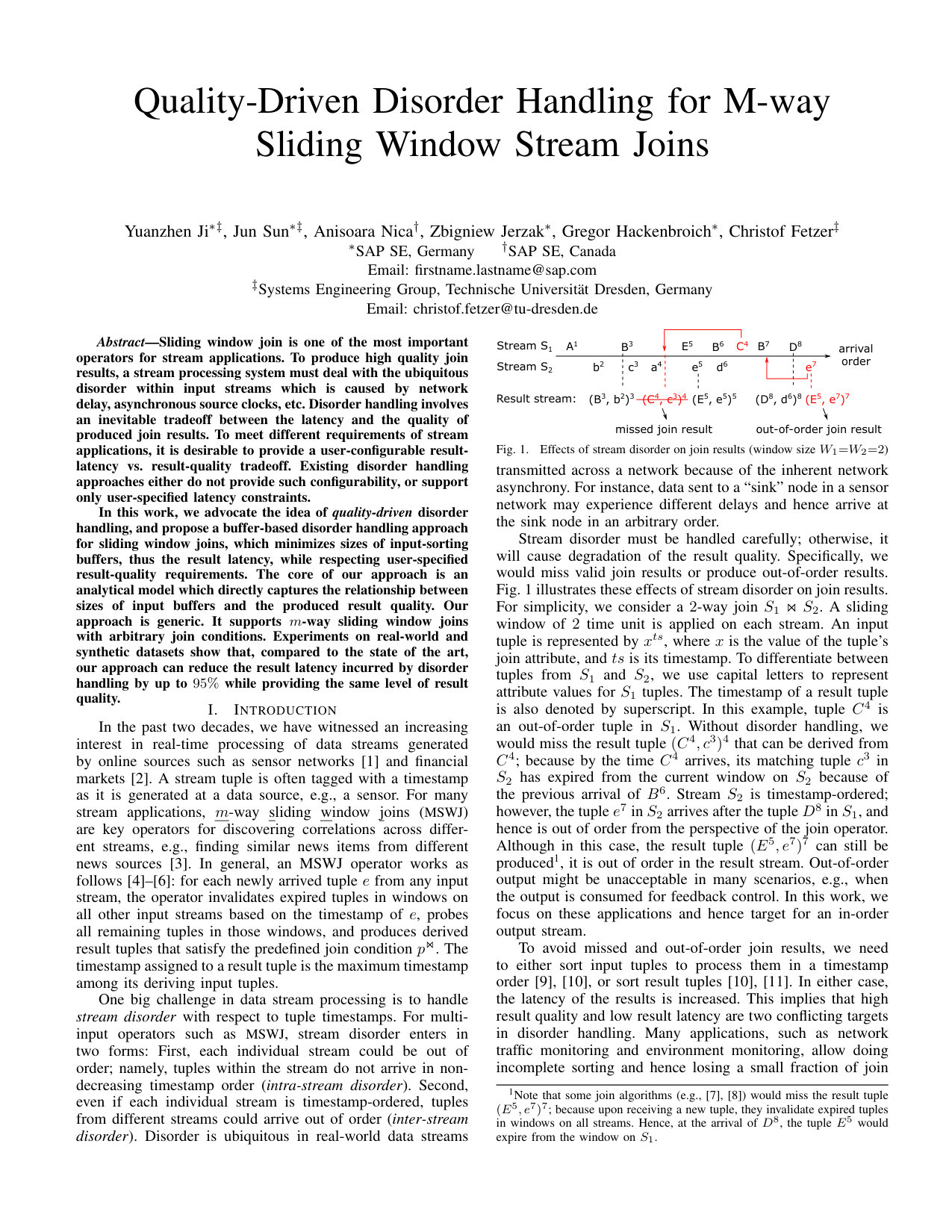 Figure 1
Peer Reviews
No public reviews on file for this paper yet. If you reviewed it on a platform where reviews are public (OpenReview, ICLR, NeurIPS, ICML), you can paste yours below so the community can read it here.
Videos
No videos yet. Explain this paper in a talk, walkthrough, or lecture? Add one.
See pages 1-last of paper.pdf