Kolmogorov turbulence defeated by Anderson localization for a Bose-Einstein condensate in a Sinai-oscillator trap
Leonardo Ermann, Eduardo Vergini, Dima L. Shepelyansky

TL;DR
This paper investigates how Anderson localization can suppress Kolmogorov turbulence in a Bose-Einstein condensate within a Sinai-oscillator trap, revealing a threshold for turbulent energy flow to high energies.
Contribution
It demonstrates that Anderson localization can inhibit weak wave turbulence in a BEC, identifying the conditions under which energy localization occurs versus turbulent energy transfer.
Findings
Anderson localization prevents energy cascade in certain regimes.
A critical threshold exists for turbulence to overcome localization.
The phenomenon can be experimentally studied with ultra cold atoms.
Abstract
We study the dynamics of a Bose-Einstein condensate in a Sinai-oscillator trap under a monochromatic driving force. Such a trap is formed by a harmonic potential and a repulsive disk located in the center vicinity corresponding to the first experiments of condensate formation by Ketterle group in 1995. We argue that the external driving allows to model the regime of weak wave turbulence with the Kolmogorov energy flow from low to high energies. We show that in a certain regime of weak driving and weak nonlinearity such a turbulent energy flow is defeated by the Anderson localization that leads to localization of energy on low energy modes. A critical threshold is determined above which the turbulent flow to high energies becomes possible. We argue that this phenomenon can be studied with ultra cold atoms in magneto-optical traps.
Click any figure to enlarge with its caption.
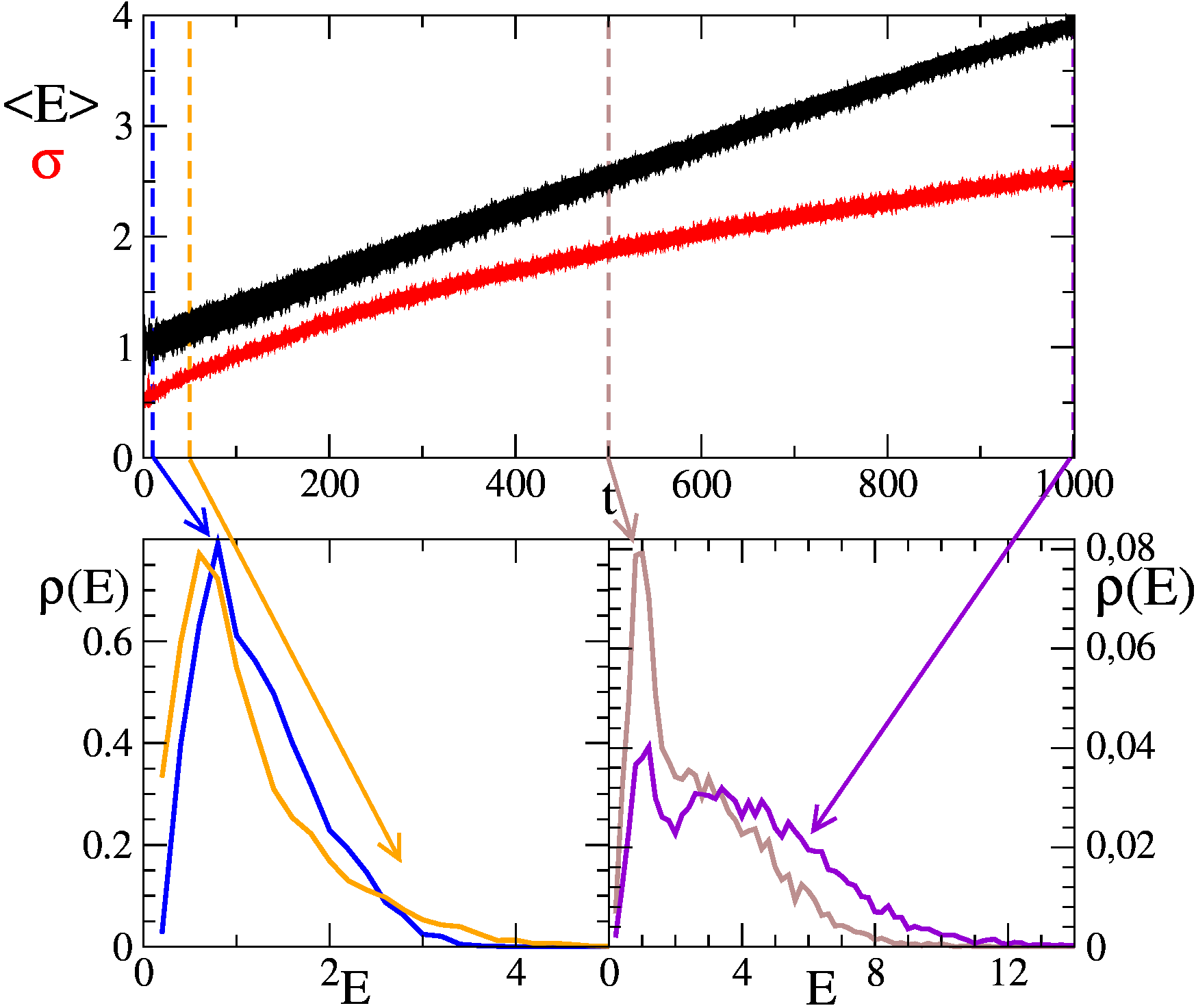 Figure 1
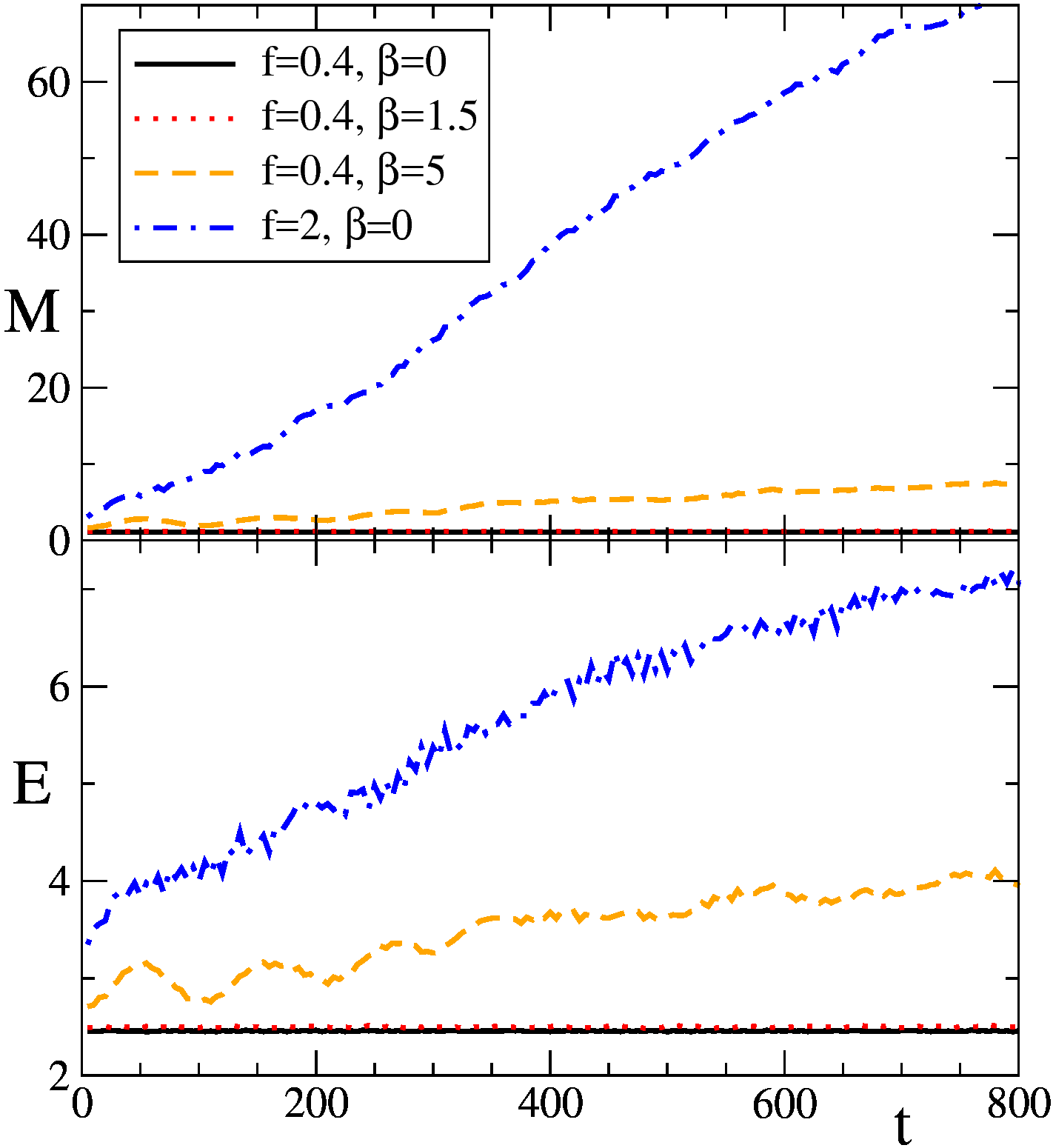 Figure 2
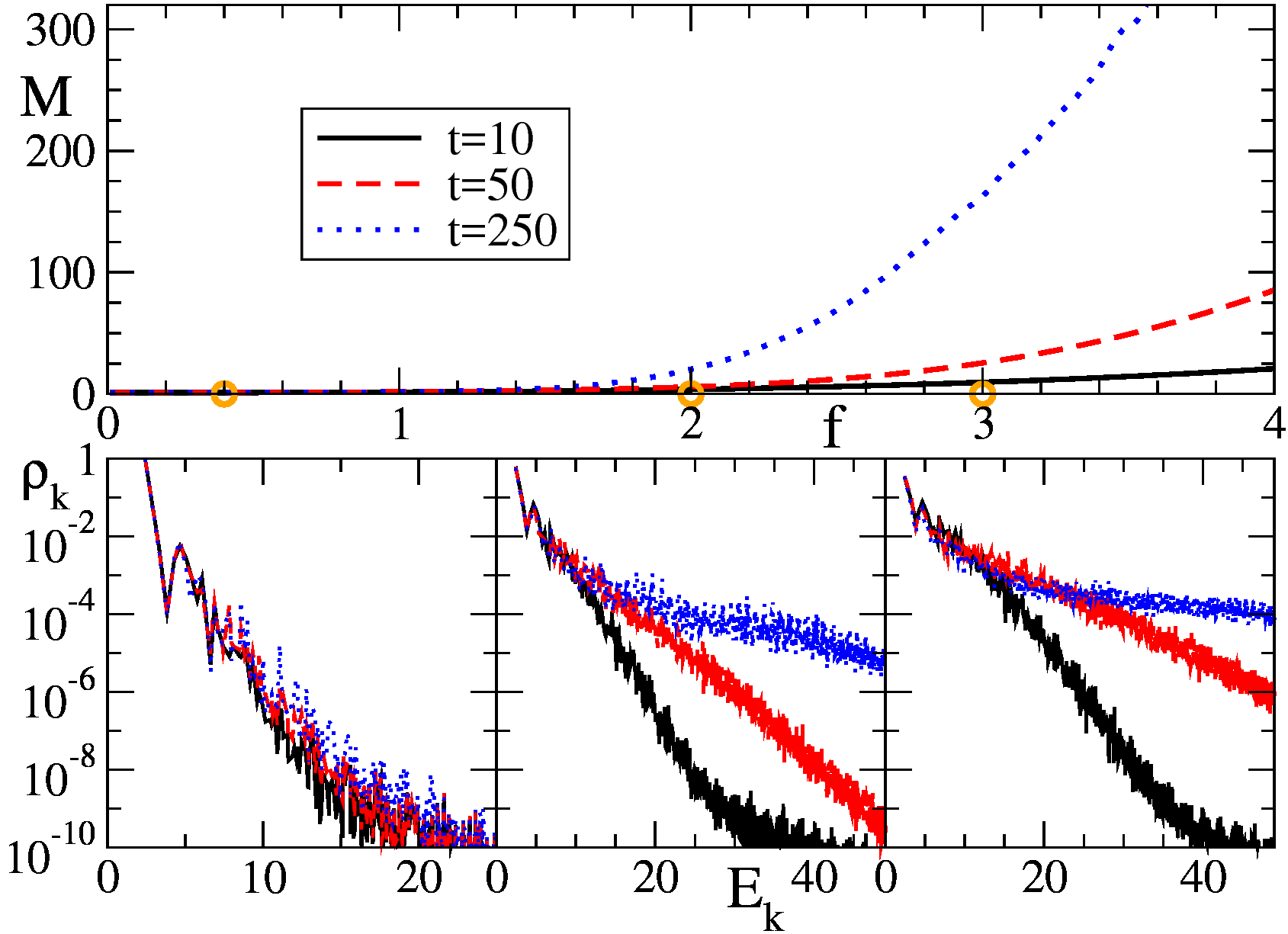 Figure 3
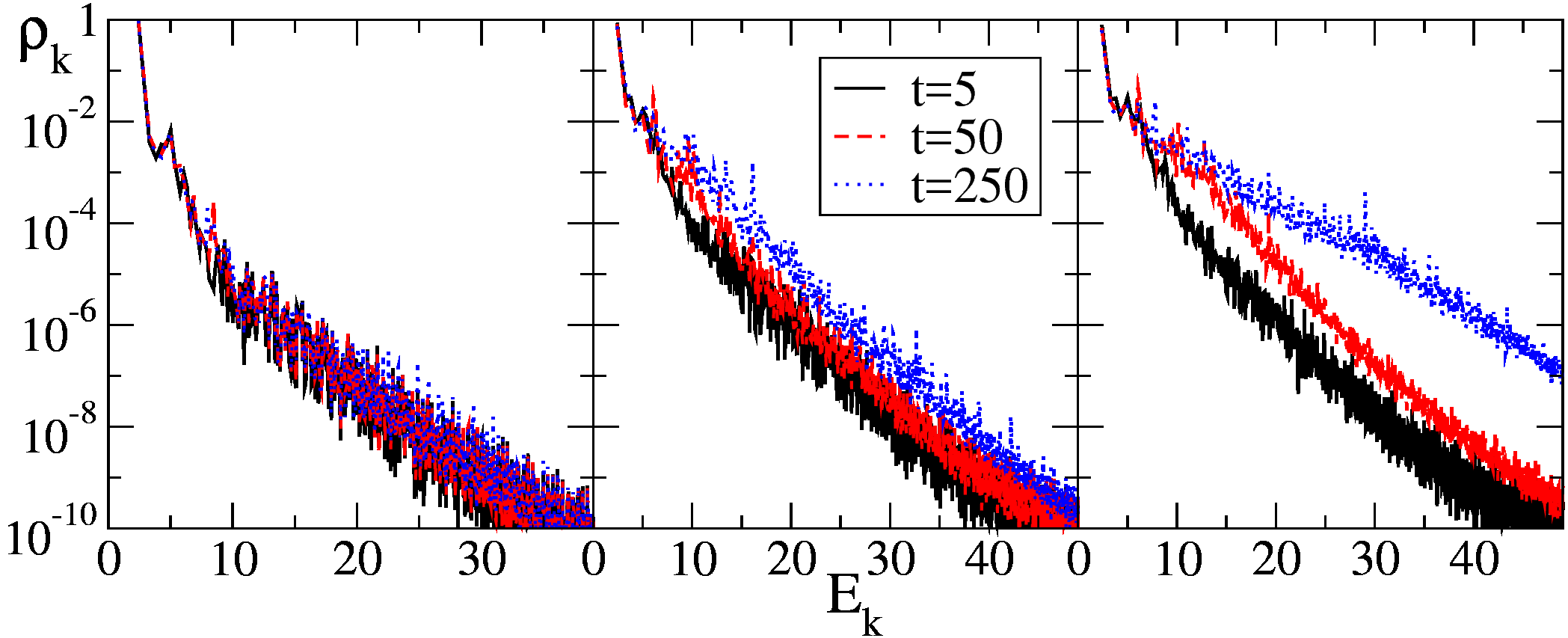 Figure 4
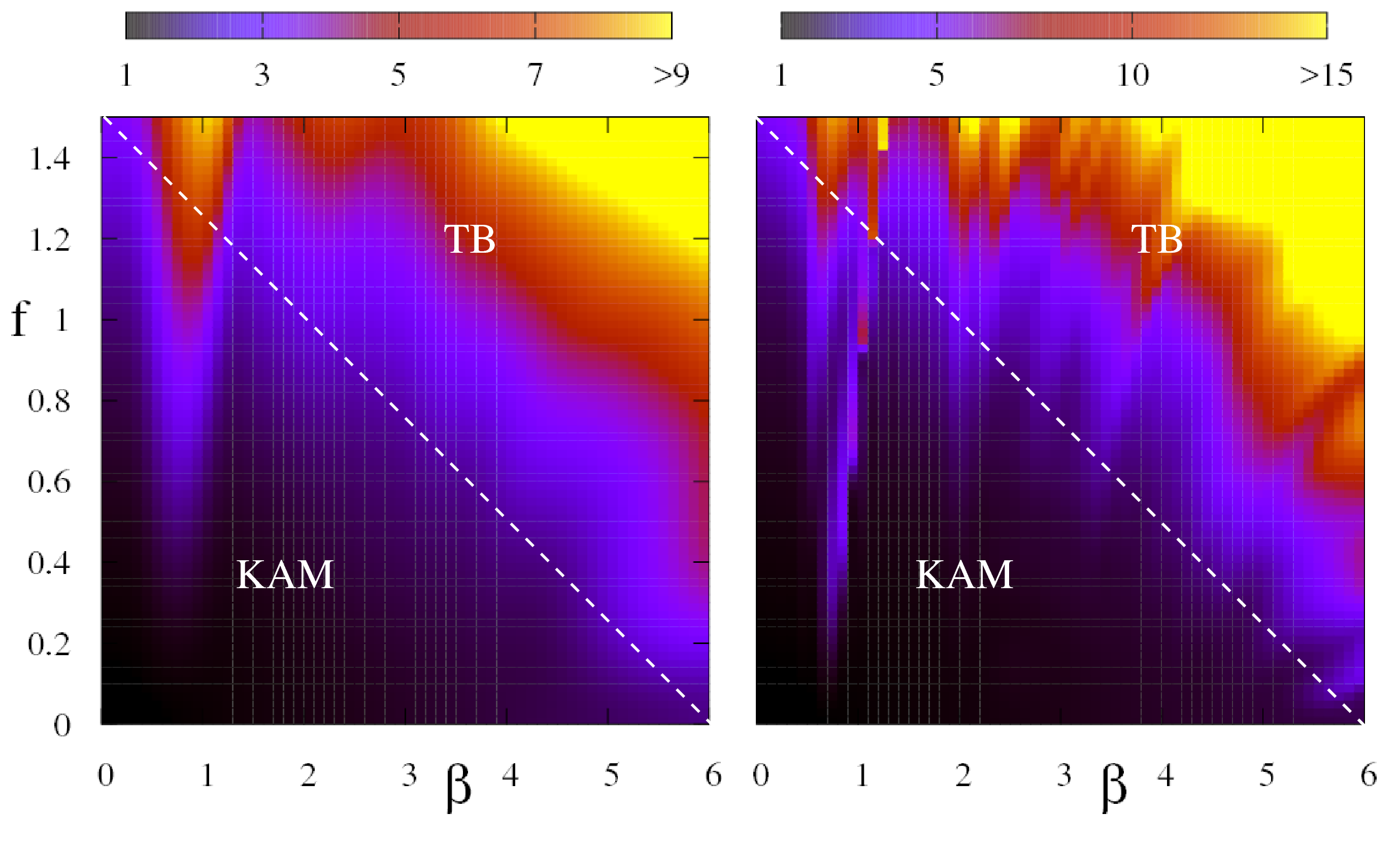 Figure 5
Peer Reviews
No public reviews on file for this paper yet. If you reviewed it on a platform where reviews are public (OpenReview, ICLR, NeurIPS, ICML), you can paste yours below so the community can read it here.
Videos
No videos yet. Explain this paper in a talk, walkthrough, or lecture? Add one.
Kolmogorov turbulence defeated by
Anderson localization
for a Bose-Einstein condensate in a Sinai-oscillator trap
Leonardo Ermann
Departamento de Física, Gerencia de Investigación y Aplicaciones, Comisión Nacional de Energía Atómica. Av. del Libertador 8250, 1429 Buenos Aires, Argentina
CONICET, Godoy Cruz 2290 (C1425FQB) CABA, Argentina
Eduardo Vergini
Departamento de Física, Gerencia de Investigación y Aplicaciones, Comisión Nacional de Energía Atómica. Av. del Libertador 8250, 1429 Buenos Aires, Argentina
Dima L. Shepelyansky
Laboratoire de Physique Théorique, IRSAMC, Université de Toulouse, CNRS, UPS, 31062 Toulouse, France
(March 21, 2017)
Abstract
We study the dynamics of a Bose-Einstein condensate in a Sinai-oscillator trap under a monochromatic driving force. Such a trap is formed by a harmonic potential and a repulsive disk located in the center vicinity corresponding to the first experiments of condensate formation by Ketterle group in 1995. We argue that the external driving allows to model the regime of weak wave turbulence with the Kolmogorov energy flow from low to high energies. We show that in a certain regime of weak driving and weak nonlinearity such a turbulent energy flow is defeated by the Anderson localization that leads to localization of energy on low energy modes. A critical threshold is determined above which the turbulent flow to high energies becomes possible. We argue that this phenomenon can be studied with ultra cold atoms in magneto-optical traps.
pacs:
05.45.Mt, 67.85.Hj, 47.27.-i, 72.15.Rn
The Kolmogorov turbulence kolm41 ; obukhov is based on a concept of energy flow from large spacial scales, where an energy is pumped by an external force, to small scales where it is absorbed by dissipation. As a result a polynomial energy distribution over wave modes is established which has been obtained first from scaling arguments for hydrodynamics turbulence kolm41 ; obukhov . Later the theory of weak turbulence, based on diagrammatic techniques and the kinetic equation, demonstrated the emergence of polynomial distributions for various types of weakly interacting nonlinear waves filonenko ; zakharovbook ; nazarenkobook . However, this theory is based on a fundamental hypothesis directly stated in the seminal work of Zhakharov and Finonenko: “In the theory of weak turbulence nonlinearity of waves is assumed to be small; this enables us, using the hypothesis of the random nature of the phase of individual waves, to obtain the kinetic equation for the mean square of the wave amplitudes”. But in finite systems the dynamical equations for waves do not involve Random Phase Approximation (RPA) and the question of RPA validity, and hence of the whole concept of energy flow from large to small scales, remains open.
Indeed, it is known that in a random media with a fixed potential landscape the phenomenon of Anderson localization anderson1958 breaks a diffusive spreading of probability in space due to quantum interference effects, even if the underline classical dynamics of particles produces an unlimited spreading. At present the Anderson localization has been observed for a large variety of linear waves in various physical systems akkermans . A similar phenomenon appears also for quantum systems in a periodically driven *ac-*field with a quantum dynamical localization in energy and number of absorbed photons chirikov1981 ; fishman1982 ; chirikov1988 ; prosen ; dlsscholar . This dynamical localization in energy has been observed in experiments with Rydberg atoms in a microwave field koch ; dlsscholar and cold atoms in driven optical lattices raizen ; garreau . Thus in the localized phase the periodic driving is not able to pump energy to a system even if the classical dynamics is chaotic with a diffusive spreading in energy.
Of course, the Anderson localization takes place for linear waves. The question about its robustness in respect to a weak nonlinearity attracted recently a significant interest of nonlinear science community dlsdanse ; pikodls ; fishmandanse ; ermannnjp ; flach with the first experiments performed in nonlinear media and optical lattices segev ; inguscio . These studies show that below a certain threshold the Anderson localization remains robust in respect to a weak nonlinearity while above the threshold a subdiffusive spearing over the whole system size takes place. However, the studies are done for conservative systems without external energy pumping. The numerical simulations for a simple model of kicked nonlinear Schrödinger equation on a ring gave indications that an energy flow to high energies is stopped by the Anderson localization for a weak nonlinearity dlskolm but such a model is rather far from real experimental possibilities with nonlinear media or cold atoms.
In this Letter we consider a realistic system of Bose-Einstein condensate (BEC) of cold atoms captured in a Sinai-oscillator trap under a monochromatic force. In fact this system in three dimensions (3D) had been used for a pioneering realization of BEC reported in ketterle1995 (see also ketterle2002 ; ketterle2002rmp ). It represents a harmonic trap with a repulsive potential in a vicinity of the trap center created by a laser beam. The repulsive potential can be well approximated by a rigid disk which creates scattering of atoms and instability of their classical dynamics. In two dimensions (2D) with a harmonic potential replaced by rigid rectangular walls the systems represents the well-known Sinai billiard where the mathematical results guaranty that the whole system phase space is chaotic with a positive Kolmogorov entropy sinai1970 . Recently is was shown that the classical phase space remains practically fully chaotic if the rigid walls are replaced by a harmonic potential which is much more suitable for BEC experiments sinaiosl . The corresponding quantum system is characterized by the level spacing statistics of random matrix theory wigner satisfying the Bohigas-Giannoni-Schmit conjecture bohigas and thus belonging to the systems of quantum chaos haake .
The effects of nonlinearity for BEC evolution in a Sinai-oscillator trap has been studied in sinaiosl in the frame of the Gross-Pitaevskii equation (GPE) becbook . It was shown sinaiosl that at weak nonlinearity the dynamics of linear modes remains quasi-integrable while above a certain threshold there is onset of dynamical thermalization leading to the usual Bose-Einstein distribution landau over energies of linear eigenmodes. Even if being chaotic this system has energy conservation and there is no energy flow to high energy modes. However, a monochromatic driving force breaks the energy conservation leading for a classical dynamics to a diffusive energy growth and probability transfer to high energy modes typical for the Kolmogorov turbulence. Here we show that there is a regime where such an energy transfer to waves with high wave vectors is suppressed by the dynamical localization being similar to the Anderson localization in disordered solids.
We note that the Kolmogorov turbulence for BEC in 2D rectangular and 3D cubic billiards has been studied numerically in nazarenko2014 ; tsubota2015 . However, the integrable shape of these billiards does not allow to realize a generic case of random matrix spectrum of linear modes typical for our billiard belonging to the class of quantum chaos systems haake .
For our model the classical dynamics and quantum evolution in absence of interactions are described by the Hamiltonian
[TABLE]
Here the first two terms describe 2D oscillator with frequencies , the third term represents the potential of rigid disk of radius and the last term gives a driven monochromatic field of amplitude . Here we fixed the mass , frequencies , , and disk radius . The disk center is placed at so that the disk bangs a hole in a center vicinity as it was the case in the experiments ketterle1995 . In the quantum case we have the usual commutator relations with for dimensional units.
The BEC evolution in the Sinai oscillator trap is described by the GPE, which reads:
[TABLE]
where describes nonlinear interactions for BEC. Here we use the same Sinai oscillator parameters as in sinaiosl with normalization . The numerical integration of (2) is done in the same way as in prosen ; sinaiosl with a Trotter time step () evolution for noninteracting part of followed by the nonlinear term contribution.
The results for energy growth with time for classical dynamics (1) are shown in Fig. 1. The energy and its dispersion are steadily growing with time. We expect that at large times the energy increases diffusively with a rate assuming that and . The data of Fig. 1 give us at .
We note that the estimate for comes from the fact that an oscillating velocity component gives a velocity change at disk collision (like with oscillating wall) and an energy change so that the diffusion is where an average time between collisions is defined from the ergodicity relation of ratio of disk area and area of chaotic motion at energy , where ; thus at large times . The fit for in Fig. 1 gives (for ) and (for ) being comparable to the theoretical value . We attributed a deviation from theory to not sufficiently large amplitude of motion required for expression at reached energies.
We also introduce cells of finite energy size and determine the probability distribution over energy cells counting a relative number of trajectories inside each cell. The results of Fig. 1 show that the width of probability distribution in energy is growing in time corresponding to increase of .
The situation is drastically different in the quantum case at . Here, at small , the dynamical localization leads to a complete suppression of energy and average mode number growth with their restricted oscillations in time (see Fig. 2). The probability distribution over eigenstates with eigenenergies of (1) (for stationary case ) is shown in Fig. 3. For small , on average there is a clear exponential decay of probability with a number of absorbed photons and a photonic localization length . Such a localization decay is similar to those discussed for atoms dlsscholar ; koch and quantum dots prosen in a microwave field. However, above a certain , e.g. at , we obtain delocalized probabilities with a flat plateau distribution at high energies.
According to the theory of dynamical localization described in dlsscholar ; prosen ; deloc1d we have where is the density of states. According to sinaiosl we have and . With the above expression for the classical diffusion in energy we obtain . Similar to the quantum chaos model deloc1d we have significantly growing with the number of absorbed photons so that the delocalization of quantum chaos takes place at . As in deloc1d this leads to a delocalization above a certain border with a flat probability distribution on high energies as it is seen in Fig. 3. This gives the delocalization border for quantum states: for the initial ground state at and . The data for in Fig. 3 give the critical value being somewhat smaller than the value given by the above estimate. We attribute this difference to the fact that the above estimate for , and hence for , is valid in the limit of large spacial oscillations being larger than . The delocalization transition at is similar to the Anderson transition, or metal-insulator transition, in disordered systems anderson1958 ; akkermans .
The results for are presented in Figs. 2, 4. For , when the steady-state probability is well localized at , they clearly show that at there is no growth of energy and mode number . Thus there is no energy flow to high energies and the Anderson localization remains robust for weak nonlineary perturbation. This is also well confirmed by a stable in time probability distribution over energies shown in Fig. 4 (left panel). For larger nonlinearity and there appears a growth of with time (Fig. 2). At larger and there is emergence of energy flow to high energies and increasing probability at high energies (Fig. 4 right panel).
The global dependence of average mode number on driving amplitude and nonlinearity is shown in Fig. 5. We see that there is a stability region of small values where the values remain small even at large times. This region corresponds to the localized insulator phase (I), from the view point of Anderson localization, of quasi-integrable (or laminar) phase from the view point of nonlinear dinamics (or turbulence). Outside of this region we have large values of number of populated states so that this regime corresponds to the delocalized metallic or turbulence phase (M-TB). According to the obtained results we conclude that this quasi-stable (or insulator) regime (see Fig. 5) is approximately described by the relation
[TABLE]
assuming that . Inside the I-region the turbulent Kolmogorov flow of energy to high modes is suppressed by the Anderson localization. At small nonliniarity we expect a validity of the Kolmogorov-Arnold-Moser theory (KAM) chirikov ; lichtenberg leading to a quasi-integrable dynamics and trapping of energy on large length modes. At the same time we should note that the mathematical prove of KAM for nonlinear perturbation of pure-point spectrum of Anderson localization and the GPE (2) still remains an open challenge fishmandanse ; wang ; kuksin .
Outside of the stability region (3) a microwave driving transfers the energy flow from low to high energy modes generating the Kolmogorov energy flow. We expect that the energy dissipation and high modes leads to the the Kolmogorov spectrum of energy distribution zakharovbook ; nazarenkobook over modes. Our results show that the RPA is definitely not valid and that, at small amplitudes of a monochromatic driving and small nonlinearity, the Kolmogorov turbulent flow to high modes is defeated by the Anderson localization and the KAM integrability. The transition from KAM phase to turbulence phase corresponds to the insulator-metal transition in disordered systems with the energy axis corresponding to the spatial distance respectively. The KAM or insulator phase corresponds to a usual observation that a small wind (small amplitude) is not able to generate turbulent waves.
The experimental realization of our system with BEC in a magneto-optical trap corresponds to the experimental conditions described in ketterle1995 . A monochromatic perturbation can be created by oscillations of the center of harmonic potential or effectively by oscillations of the disk position created by the laser beam. We note that the experimental investigations of turbulent cascades in quantum gases become now possible becturbulence as well as a thermometry of energy distribution in ultra cold atom ensembles grimm . Thus we hope that the interesting fundamental aspects of nonlinear dynamics and weak turbulence will be tested with cold atom experiments.
This work was supported in part by the Pogramme Investissements d’Avenir ANR-11-IDEX-0002-02, reference ANR-10-LABX-0037-NEXT (project THETRACOM).
The reference list from the paper itself. Each links out to its DOI / PubMed record.
- 1(1) A.N. Kolmogorov, The local structure of turbulence in an incompressible liquid for very large Reynolds numbers , Dokl. Akad. Nauk SSSR 30 , 299 (1941); Dissipation of energy in the locally isotropic turbulence , 32 , 19 (1941) [in Russian] (English trans. Proc. R. Soc. Ser. A 434 , 19 (1991); 434 , 15 (1991)).
- 2(2) A.M. Obukhov, On energy distribution in the spectrum of a turbulent flow , Izv. AN SSSR Ser. Geogr. Geofiz., 5(4-5) , 453 (1941) [in Russian].
- 3(3) V.E. Zakharov and N.N. Filonenko, Weak turbulence of capillary waves , J. Appl. Mech. Tech. Phys. 8 (5) , 37 (1967).
- 4(4) V.E. Zhakharov, V. S. L’vov and G. Falkovich, Kolmogorov spectra of turbulence , Springer-Verlag, Berlin (1992)
- 5(5) S. Nazarenko, Wave turbulence , Springer-Verlag, Berlin (2011).
- 6(6) P.W. Anderson, Absence of diffusion in certain random lattices , Phys. Rev. 109 , 1492 (1958).
- 7(7) E. Akkermans and G. Montambaux, Mesoscopic physics of electrons and photons , Cambridge Univ. Press, Cambridge (2007).
- 8(8) B.V. Chirikov, F.M. Izrailev and D.L. Shepelyansky, Dynamical stochasticity in classical and quantum mechanics , Sov. Sci. Rev. C - Math. Phys. Rev. (Ed. S.P. Novikov) 2 , 209 (1981).