General Refraction Problems with Phase Discontinuity
Cristian E. Gutierrez, Luca Pallucchini, and Eric Stachura

TL;DR
This paper develops a mathematical framework for analyzing metasurfaces with phase discontinuities on curved surfaces, establishing conditions linking surface curvature and refraction directions, applicable to near and far fields.
Contribution
It introduces analytical conditions connecting surface curvature and refraction directions, extending phase discontinuity analysis to non-flat geometries with a vector Snell law formulation.
Findings
Derived conditions for phase discontinuities on curved metasurfaces
Unified approach for near and far field cases
Formulated a vector Snell law with discontinuities
Abstract
This paper provides a mathematical approach to study metasurfaces in non flat geometries. Analytical conditions between the curvature of the surface and the set of refracted directions are introduced to guarantee the existence of phase discontinuities. The approach contains both the near and far field cases. A starting point is the formulation of a vector Snell law in presence of abrupt discontinuities on the interfaces.
Click any figure to enlarge with its caption.
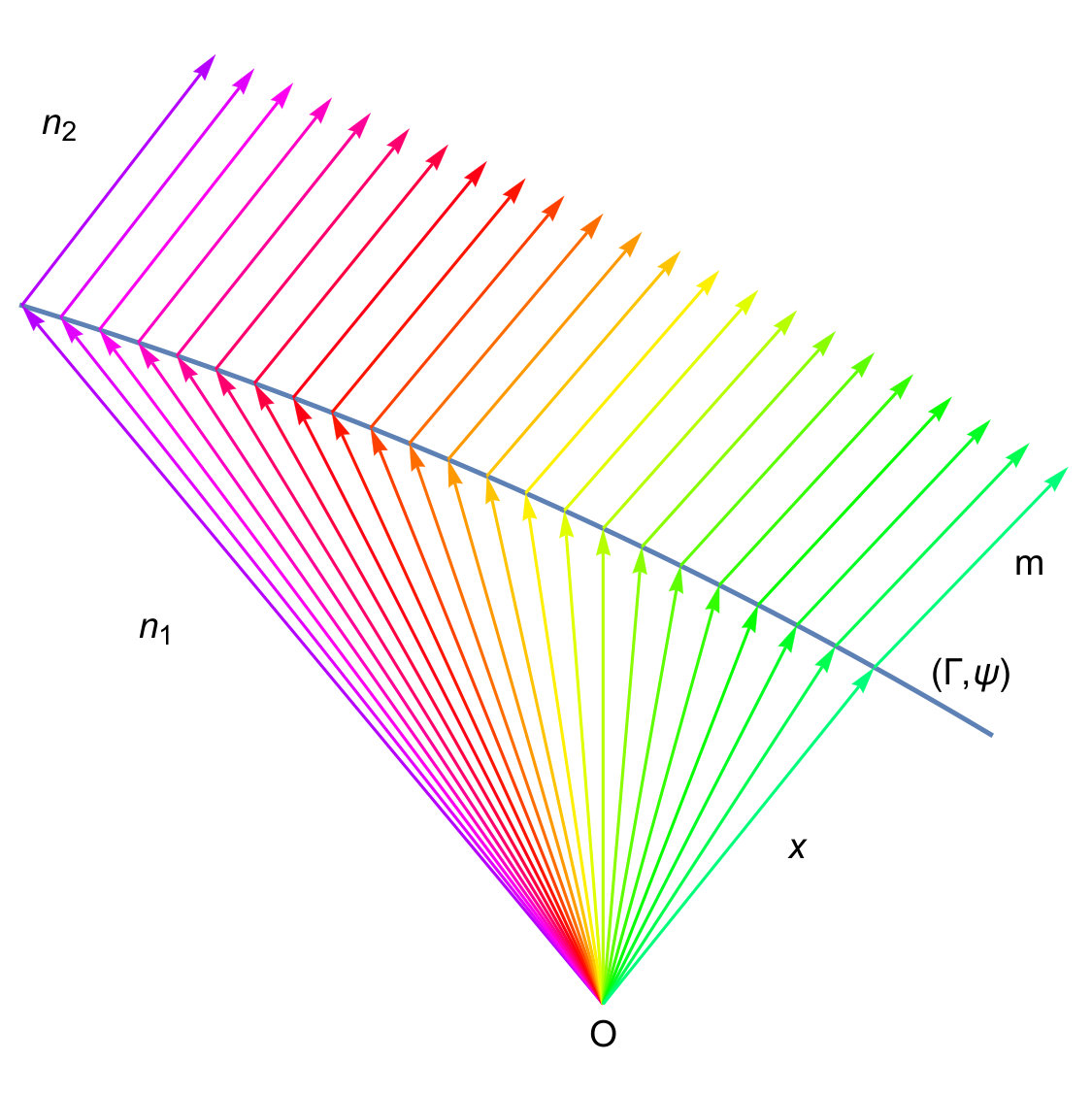 Figure 1
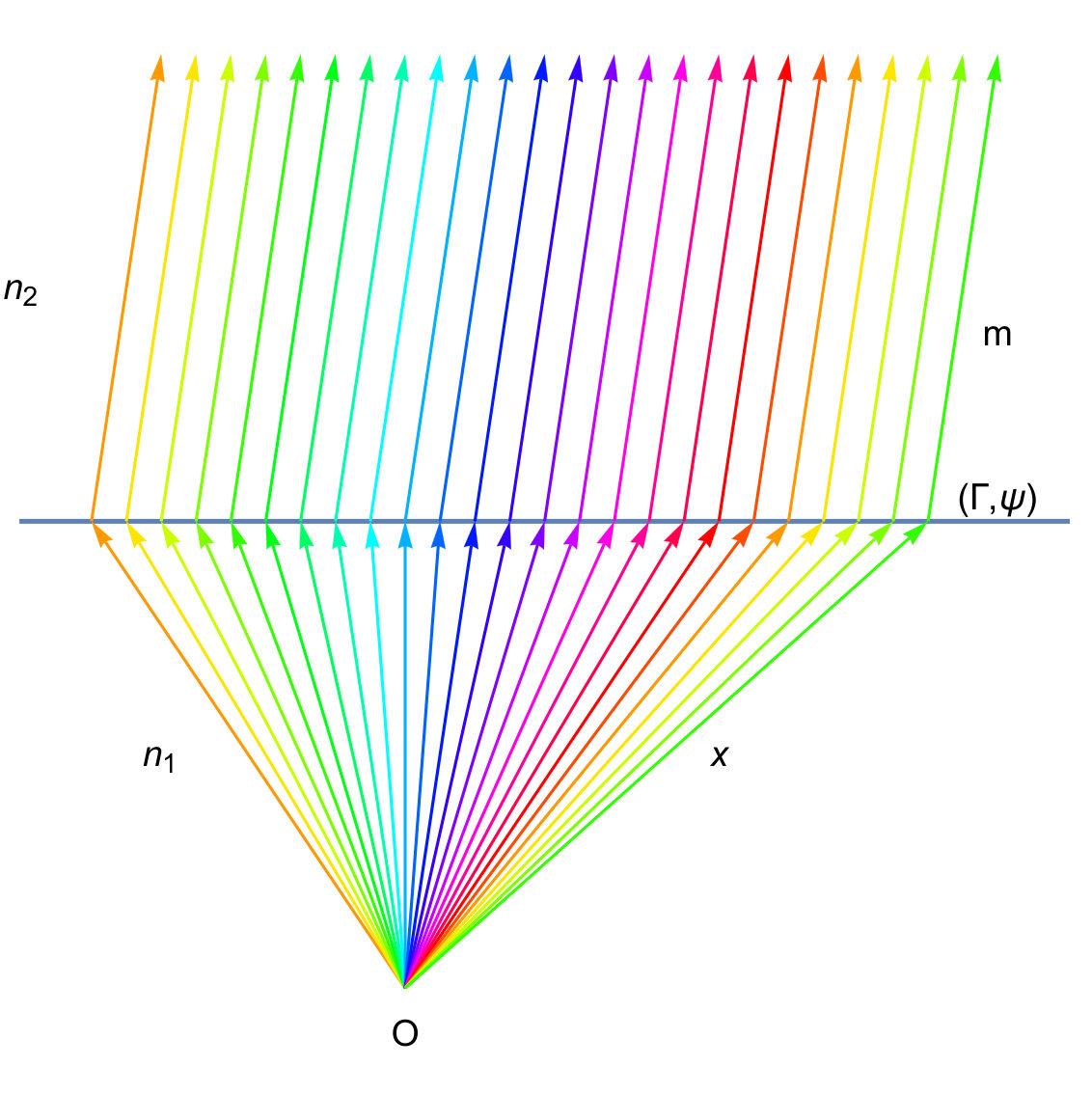 Figure 2
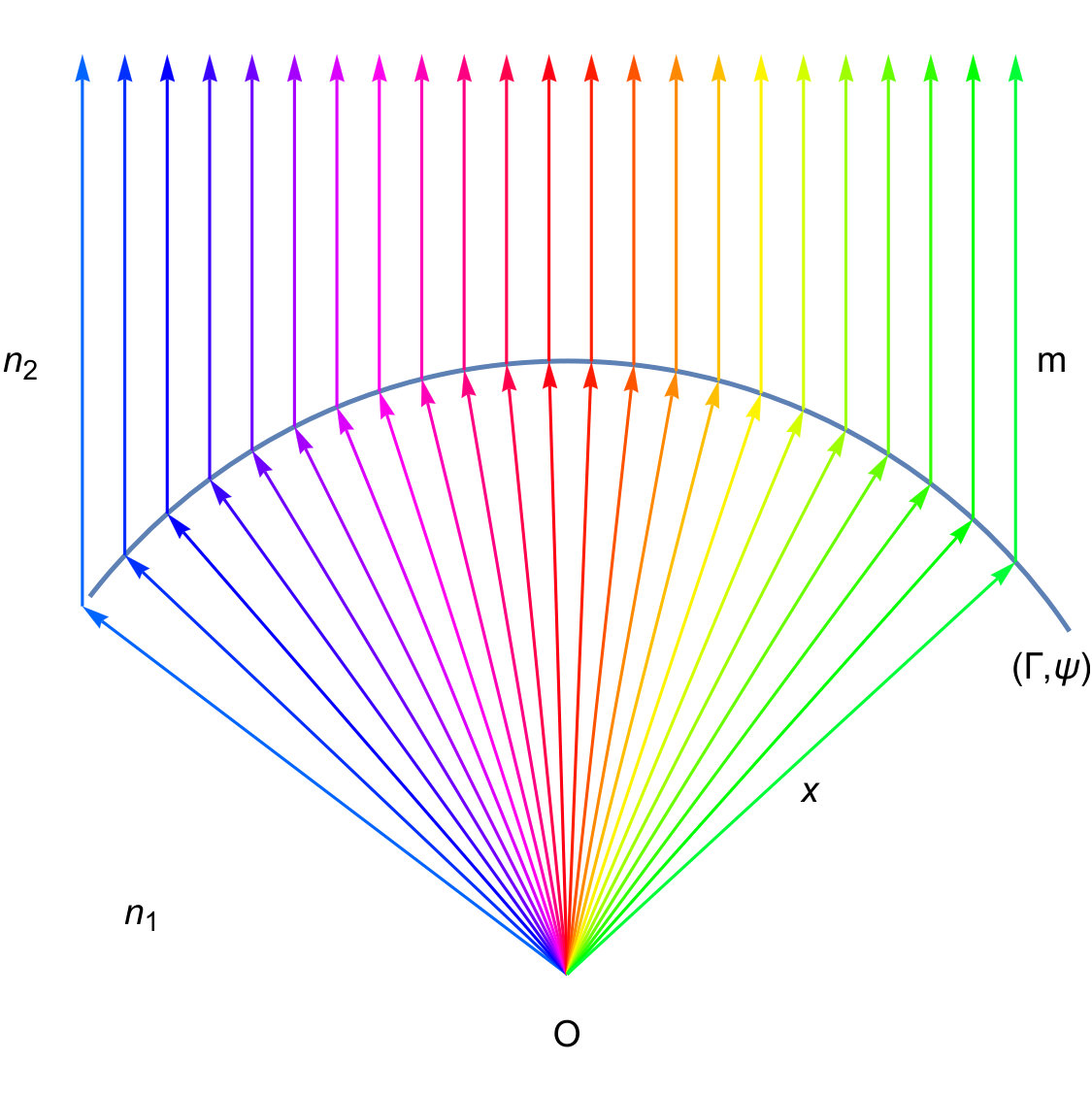 Figure 3
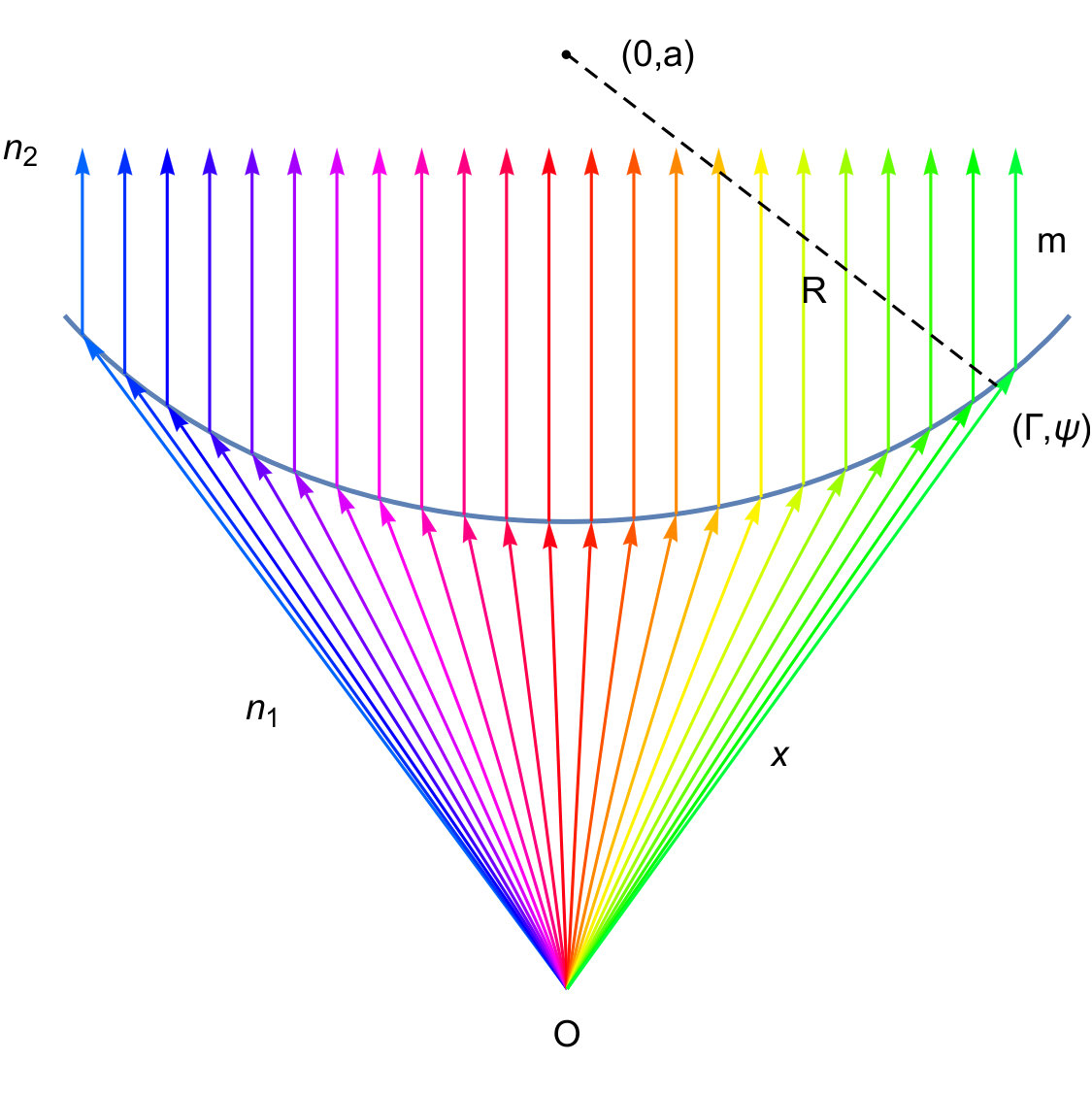 Figure 4
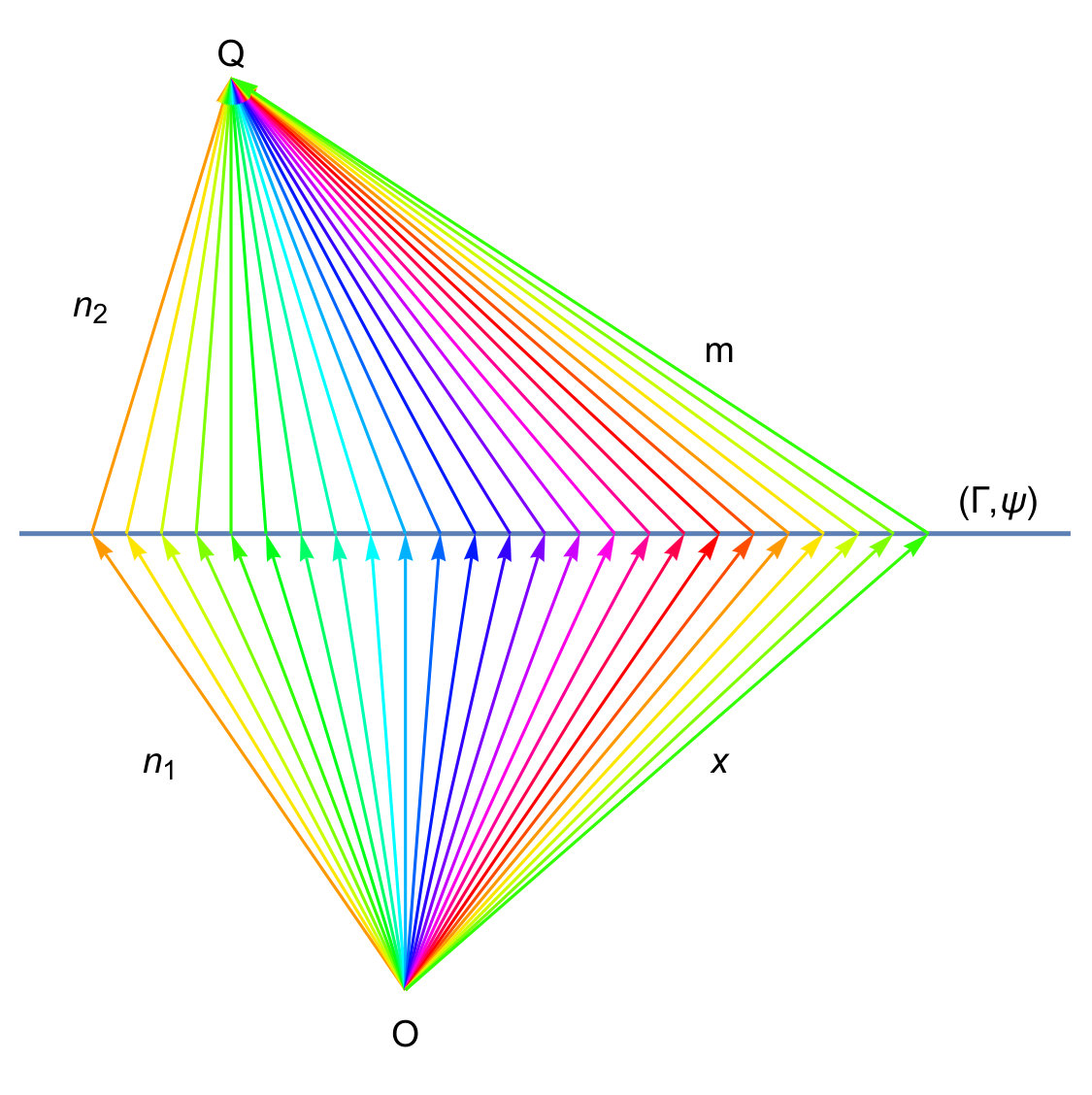 Figure 5
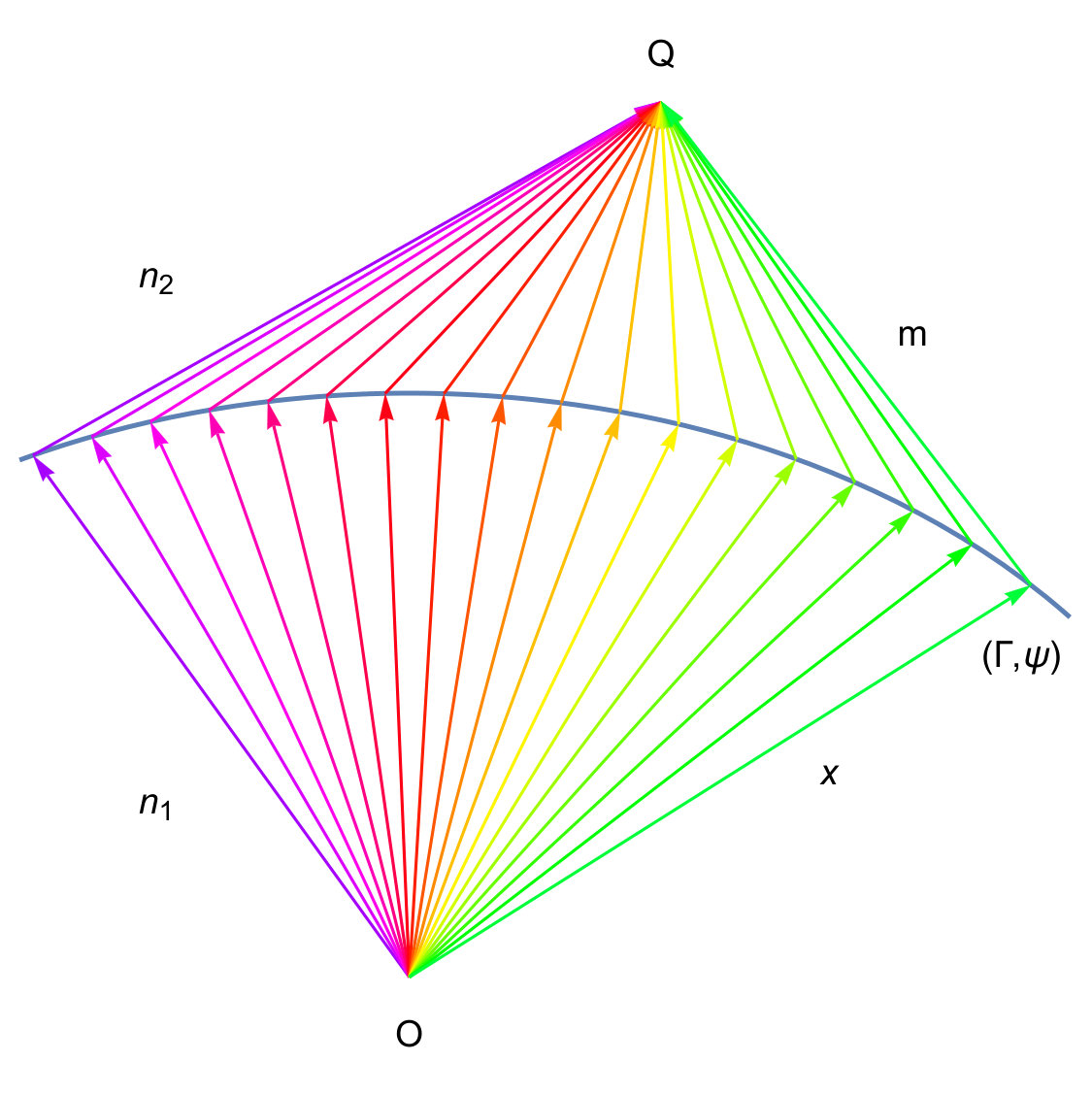 Figure 6
Peer Reviews
No public reviews on file for this paper yet. If you reviewed it on a platform where reviews are public (OpenReview, ICLR, NeurIPS, ICML), you can paste yours below so the community can read it here.
Videos
No videos yet. Explain this paper in a talk, walkthrough, or lecture? Add one.
Taxonomy
TopicsAdvanced Antenna and Metasurface Technologies · Metamaterials and Metasurfaces Applications · Antenna Design and Analysis
General Refraction Problems with Phase Discontinuity
Cristian E. Gutiérrez, Luca Pallucchini, and Eric Stachura
Address for C.E.G and L.P: Department of Mathematics
Temple University
Philadelphia, PA 19122
[email protected], [email protected]
Department of Mathematics
Haverford College
Haverford, PA 19041
Abstract.
This paper provides a mathematical approach to study metasurfaces in non flat geometries. Analytical conditions between the curvature of the surface and the set of refracted directions are introduced to guarantee the existence of phase discontinuities. The approach contains both the near and far field cases. A starting point is the formulation of a vector Snell law in presence of abrupt discontinuities on the interfaces.
The first author is partially supported by NSF grant DMS–1600578.
Contents
-
3 Derivation of a Vector Snell Law with phase discontinuity using wavefronts
-
4 Far field uniformly refracting planar and spherical metalenses
1. Introduction
For classical lens design, a typical problem is to find two surfaces so that the region sandwiched between them and filled with an homogeneous material refracts light in a desired manner. For metalens design, a surface is given and the question is to find a function on the surface (a phase discontinuity) so that the pair, surface together with the phase discontinuity (the metalens) refracts light in a desired manner. The subject of metalenses is a flourishing area of research and one of the nine runners-up for Science’s Breakthrough of the Year 2016 [sci16]. Metalenses have been designed for flat geometries with the scalar generalized laws of reflection and refraction with phase discontinuities, see [YGK*+*11], [AGY*+*12], [AKG*+*12], and the comprehensive review article [YC14]. These general laws have been experimentally observed by using arrays of optical antennas on silicon. The review in [CTY16] describes the past 15 years of progress on metasurfaces, from experimental realization of the generalized laws of refraction, to applications in wavefront and beam shaping. Recently, it has been proven [ARW*+*16] that at certain frequencies, a thin layer of nanoparticles on a perfectly conducting sheet acts as a metasurface. For more recent work in the area and an extensive up to date bibliography, we refer to [GCA*+*17]; see also [KZRC*+*16] and [KCD*+*16].
The purpose of this paper is to provide a mathematically rigorous foundation to deal with general metasurfaces and to determine the relationships between the curvature of the surface and the phase discontinuity. A problem we solve is the following: when light emanates from a point source, find a metalens that refracts light into a prescribed set of directions or points, see Figure 1. In fact, given a surface and a compatible set of directions, satisfying appropriate curvature type conditions, we show that a phase discontinuity exists on the surface so that the metalens refracts light into the prescribed set of directions, Section 5. Vice versa, given a phase discontinuity and a fixed direction, we find the admissible surfaces for that phase discontinuity and direction, Section 6. Of great importance to answer these questions in general geometries is the formulation of a generalized Snell’s law in vector form, Equation (3.3), which is deduced using wave fronts in Section 3. In term of wave vectors, a vector law is formulated in [AKG*+*12, Equation (2)]. However, Equation (3.3) is effective and flexible for the actual calculation of phase discontinuities in general and to obtain our results. We illustrate these with explicit constructions for planar and spherical interfaces, Sections 4.1, 4.2, 7.1, and 7.2; see also Remark 5.3.
The outline of the paper is as follows. In Section 2, we briefly recall the classical Snell’s law for surfaces without phase discontinuities. Then in Section 3 we derive a generalized Snell’s law in the presence of a phase discontinuity using wavefronts, Equation (3.3), and analyze the possible critical angles. The far field problem is studied in Section 4 for the plane and the sphere. In Section 5 we allow for variable directions in the far field. In Section 6, conditions are derived so that given a phase discontinuity a surface exists. Finally, in Section 7 the near field problem is addressed.
2. Background
We recall the classical Snell’s law in vector form here. Suppose is a surface in that separates two media and that are homogeneous and isotropic, with refractive indices and respectively. If a ray of light***Since the refraction angle depends on the frequency of the radiation, we assume that light rays are monochromatic. having direction , the unit sphere in , and traveling through medium strikes at the point , then this ray is refracted in the direction through medium according to the Snell law in vector form:
[TABLE]
where is the unit normal to the surface to at pointing towards medium ; see [Lun64, Subsection 4.1]. It is assumed here that .
This has several consequences:
- (a)
the vectors are all on the same plane (called the plane of incidence); 2. (b)
the well known Snell’s law in scalar form holds:
[TABLE]
where is the angle between and (the angle of incidence), and is the angle between and (the angle of refraction).
Equation (2.1) is equivalent to , which means that the vector is parallel to the normal vector . If we set , then
[TABLE]
for some . Notice that (2.2) univocally determines . Taking dot products with and in (2.2) we get , , and . In fact, there holds
[TABLE]
The formulation (2.2) is useful solve refraction problems for lens design, see [GH09], [GM13], [GS14], [GT13], and [DLGM17] for a numerical implementation.
3. Derivation of a Vector Snell Law with phase discontinuity using wavefronts
Let be the refractive indices of two homogeneous media and , respectively. Suppose a surface separates the two media, and an incoming light ray in medium with wave vector strikes . Assume that there is a real-valued function , the phase discontinuity, defined in a neighborhood of the surface . Notice that must be defined in a neighborhood of because the gradient of will be considered. If denotes the unit normal vector to , then the refracted wave vector satisfies [AKG*+*12, Equation (2)]:
[TABLE]
We give an alternate formulation and derivation of this result by using wavefronts; our starting point is [Gut14, Section 2.2]. For each , denotes a surface in the variables that separates the part of the space that is at rest from the part of the space that is disturbed by the electric and magnetic fields. This surface is called a wave front, and the light rays are the orthogonal trajectories to the wave fronts at each time . We assume that , and so we can solve in , obtaining that ; so letting run, the wave fronts are then the level sets of .
Let , and be as above. An incoming wave front on medium strikes the surface and it is then transmitted into a wave front in medium (of course, there is also a wave front reflected back). Assuming as before that , , and solving in , we get that the wave fronts are given by for , respectively. Suppose the surface is parameterized by , , . If there were no phase discontinuity on the surface , then we would have along . But since there is now a phase discontinuity on , we have the following jump condition along :
[TABLE]
Taking derivatives in and yields
[TABLE]
and
[TABLE]
That is, the vector must be normal to ; as such there exists a real number such that
[TABLE]
where is the unit normal to .
Let denote the light rays in medium having speed , for ; i.e., the orthogonal trajectories to . In particular, we have that , and by the chain rule
[TABLE]
If we parameterize the rays so that , then we obtain
[TABLE]
since is parallel to . Letting
[TABLE]
we obtain from (3.2) the following formula
[TABLE]
Taking cross products with the unit normal in (3.3), we obtain the equivalent formula
[TABLE]
Recall that is the unit direction of the incident ray, is the unit direction of the refracted ray, is the unit outer normal at the incident point on and is calculated at the incident point. Note that in the case is constant, we recover the classical Snell’s law in vector form (2.1)†††Notice that if constant, then . Taking dot product with yields . This means that is on the plane through the origin having normal which is the plane generated by and . Therefore are all on the same plane, i.e., the plane of incidence. On the other hand, if is not necessarily constant, then from (3.4) . Again taking dot product with yields , that is, . That is, now the refracted vector lies on the plane through the origin and perpendicular to the vector where is calculated at the point on the surface where the ray with direction strikes it. This shows that in the general case the refracted vector is not on the plane generated by and ..
Starting from (3.3), we now calculate . Taking dot products in (3.3) and solving for yields
[TABLE]
Next taking dot products in (3.3) with itself, expanding, and substituting from the previous expression, yields that satisfies the quadratic equation:
[TABLE]
Solving for yields
[TABLE]
Since must be a real number, the quantity under the square root must be non-negative, i.e.,
[TABLE]
Assuming this for now, it remains to check which sign () to take in (3.6). Dotting (3.3) with and using (3.6) yields
[TABLE]
so
[TABLE]
Since and , we obtain that
[TABLE]
We next analyze (3.7), which will yield the critical angles. Equation (3.7) is equivalent to
[TABLE]
Thus, if is such that
[TABLE]
then (3.7) holds. On the other hand, if
[TABLE]
then (3.7) holds when either
[TABLE]
Therefore, the critical angles between and are with
[TABLE]
Remark 3.1**.**
In two dimensions the critical angles are considered in [YGK*+*11]. It is assumed there that the interface is the -axis, the region is filled with a material with refractive index , and the region with a material with refractive index . Also the phase discontinuity satisfies that is constant and is tangential to the interface, i.e., with, for example, . Therefore, the above calculations applied to this case yield
[TABLE]
where . Squaring both sides we obtain
[TABLE]
and the critical angles are therefore the solutions to the equation
[TABLE]
i.e.,
[TABLE]
which is in agreement with [YGK*+*11, Formula (3)].
In three dimensions the critical angles are considered in [AKG*+*12]. The interface is the -plane, the region is filled with a material with refractive index , and the region with a material with refractive index . Also the phase discontinuity is tangential to the interface, i.e., and without loss of generality we may assume . Once again, the above calculations applied to this case yield
[TABLE]
Proceeding as before we find
[TABLE]
recovering [AKG*+*12, Formula (8)].
Remark 3.2**.**
The reflection case is when , so (3.3) and (3.8) become
[TABLE]
with the unit incident direction, the unit reflected vector, the unit normal to the interface at the striking point, and at the striking point. Notice that the choice of the plus sign in front of the square root is because for reflection .
4. Far field uniformly refracting planar and spherical metalenses
Let be a surface in three dimensional space and be a vector valued function defined on ; . If is an incident unit direction striking at a point , and is the unit refracted direction, then we obtain, dividing by in the generalized Snell law (3.3), that
[TABLE]
where is the unit outer normal to at for some ; .
Suppose rays emanate from the origin and we are given a fixed unit vector . Our goal is to answer the following two questions. First, given a surface separating media and , find a field defined on so that all rays from the origin are refracted into the direction . The second question is, given a field defined in a region of , find a separation surface between and within that region so that all rays emanating from the origin are refracted into the direction .
We begin in this section answering the first question when is either a plane or a sphere, surfaces of traditional interest in optics, showing explicit phase discontinuities. For general surfaces, the first question is considered in Section 5, even for the more general case of variable . The second question is answered in Section 6.
4.1. Case of the plane
Let be the plane in with . We want to determine a field defined on so that all rays emanating from the origin are refracted into the unit direction , with , Figure 2(a).
Using spherical coordinates , , is described parametrically by
[TABLE]
Since the normal to the plane is , then (4.1) implies that and . Hence and are univocally determined. Also, from (4.1) we get
[TABLE]
Notice also that from (3.8),
[TABLE]
which in the present case yields
[TABLE]
This means that in (4.3) each determines and vice-versa.
We now write the field in rectangular coordinates . Since , we can write
[TABLE]
for . From (4.2) and , so . Let .
Therefore, if on the plane we give the field
[TABLE]
then resulting metasurface does the desired refraction job. If we want to be the gradient of a function, then must be a gradient, which is only possible when a constant; that is, . As a particular case when , , and , we obtain the equivalent [YC14, Formula (2)] (where a different orientation of the coordinates is used) with . Notice also that if we want in (4.4) to be tangential to the plane , that is, , then .
4.2. Case of the sphere
Now, the surface considered is a sphere of radius centered at the origin, that is, , with spherical coordinates. We denote by ; Figure 2(b). Since is a sphere, the normal and from (4.1) we get so
[TABLE]
That is,
[TABLE]
Notice that . Set , so the system is equivalent to
[TABLE]
If , the last matrix has rank two, so the space of solutions has dimension one and the solutions are given by
[TABLE]
with arbitrary. Therefore,
[TABLE]
with arbitrary.
Notice that if in (4.5) we take cross product with , we get
[TABLE]
Hence, if we want to pick tangential to the sphere, we obtain
[TABLE]
is a field defined on the sphere of radius . We shall determine a function defined in a neighborhood of the sphere of radius such that , and satisfying
[TABLE]
In fact, we have ()
[TABLE]
and similarly,
[TABLE]
Integrating the derivative in yields
[TABLE]
and integrating the derivate in we obtain
[TABLE]
with an arbitrary constant. Writing this in rectangular coordinates yields
[TABLE]
We now define on a neighborhood of so that (4.6) holds. Define
[TABLE]
We have
[TABLE]
so for , with , we obtain
[TABLE]
as desired. Therefore the phase discontinuity from (4.7) has gradient tangential to the sphere and can be placed on the spherical interface so that all rays from the origin are refracted into the fixed direction .
5. Metalenses refracting into a set of variable directions
Suppose is a given unit field of directions, and let be a surface given parametrically by where are spherical coordinates and is the polar radius. We want to see when is it possible to have a phase discontinuity on the surface so that each ray from the origin with direction is refracted into the direction . From (4.1)
[TABLE]
so
[TABLE]
Taking cross product with yields
[TABLE]
If is tangential to , then and so
[TABLE]
that is,
[TABLE]
If , then
[TABLE]
Since and ,
[TABLE]
and similarly
[TABLE]
Let us now consider the first order system in
[TABLE]
where . If the given set of directions and the surface satisfy
[TABLE]
then by [Har02, Chapter 6, pp. 117-118](see also (6.17) below) there exists solving (5.1). By integration we then obtain that the phase discontinuity satisfies along that
[TABLE]
To find the gradient of we need to have defined in a neighborhood of the surface such that (5.3) holds and that its gradient satisfies on
[TABLE]
Notice that this implies . To construct the function in a neighborhood of the surface (we will construct it in a neighborhood of each point in ), given parametrically by , we use the notion of envelope from classical differential geometry; see for example [Pog59, Chapter 5, Section 4] or [dC76, Chapter 3]. We will actually construct a surface that is developable, in particular, it has Gauss curvature zero. For a recent reference on developable surfaces, its applications and design see [TBWP16].
Since the required must satisfy (5.3), consider the surface given parametrically by
[TABLE]
in four dimensions. At each point , consider the 4-dimensional vector
[TABLE]
where and is the unit normal to the surface at . Next consider the plane passing through the point and with normal , that is, in coordinates , has equation
[TABLE]
Therefore we have a family of planes depending on the parameters , and we will let be by definition the envelope to this family of planes. Of course, we need to know under what conditions on and this envelope exists. It will be defined by solving the system of equations
[TABLE]
In fact, let us fix values , and let be the corresponding value on the surface ; and consider the map
[TABLE]
The function has continuous partial derivatives in a neighborhood of the point , and
[TABLE]
By the implicit function theorem, if the Jacobian determinant
[TABLE]
then there are unique differentiable functions in the variables defined in a neighborhood of such that , and with
[TABLE]
for all . Therefore, if we let for , then is the function we need, i.e., is by construction defined in a neighborhood of the point and satisfies (5.3) and (5.4).
We now analyze under what conditions on the surface and , (5.8) holds. Notice first that since , the matrix inside the determinant in (5.8) equals
[TABLE]
and therefore (5.8) means
[TABLE]
Let us find what this means in terms of the initial surface and the field . To simplify the notation let , so we can write (5.6) as
[TABLE]
By calculation
[TABLE]
We first show that
[TABLE]
Indeed, we have
[TABLE]
so
[TABLE]
Hence
[TABLE]
since and . The same calculation with instead of yields the second identity in (5.10).
Next, differentiating (5.10) with respect to and yields
[TABLE]
since . Hence letting in (5.11) yields
[TABLE]
Now let us calculate these dot products. First set
[TABLE]
and write
[TABLE]
since , and . Also and , so we obtain similarly
[TABLE]
Next, differentiating yields
[TABLE]
Therefore
[TABLE]
and so
[TABLE]
with . Notice that the first and third matrices in the last determinant are respectively the first fundamental form of the 2-sphere, and the second fundamental form of the surface .
Therefore, we have proved the following: if a variable field and a surface satisfy the compatibility condition (5.2), and the determinant (5.13) is not zero at a point , then there is a neighborhood of the point and a phase discontinuity function defined in for the surface , with gradient tangential to , so that it yields the desired refraction job, i.e., each ray emanating in the direction , for in a neighborhood of , is refracted by the metasurface into the direction .
Remark 5.1** (Case when is a constant vector).**
If is constant, then (5.2) is clearly satisfied by any and in condition (5.13) the second matrix on the right hand side is zero.
Remark 5.2**.**
To illustrate the determinant condition (5.13), let us consider the special case when is a sphere centered at the origin, and is a constant vector. We have , and . So and similarly for and . Also , , and Hence , , and Therefore the determinant in (5.13) equals
[TABLE]
For example, if , i.e., all rays are refracted vertically, then the determinant equals
[TABLE]
which is not zero as long as or zero. This shows also that for the sphere the phase discontinuity exists and can be obtained by solving the system of equations (5.7). Notice that in this case a phase discontinuity was calculated explicitly in Section 4.2 and given by (4.7).
Remark 5.3** (Case when is off centered).**
A case considered in [AKG*+*12, Section 3] is when a sphere of radius is centered at a point with , and the authors claim there that it is not possible to find a phase discontinuity on such a sphere so that all rays from the origin are refracted into the vertical direction. We believe this claim is in error and in fact, with the method above will show that for each unit with , there is a phase discontinuity defined in a neighborhood of such a sphere so that its gradient is tangential to the sphere and so that radiation from the origin is refracted into a fixed direction , see Figure 3.
In particular, when is vertical a phase discontinuity exists. By reversibility of optical paths, this shows that the conclusion in [AKG*+*12, Section 3] is incorrect.
First, the lower part of the sphere with center at and radius is parametrized by the vector with
[TABLE]
where ; and the unit normal to the sphere pointing upwards is
[TABLE]
To show our claim, we need to verify that the determinant in (5.13) is not zero. From (5.12) we obtain by simple calculations that
[TABLE]
Therefore the determinant in (5.13) equals
[TABLE]
with
[TABLE]
The last determinant is not zero for such that
[TABLE]
Let us take for example , i.e., rays are refracted vertically, then we get
[TABLE]
so is independent of . If , then , and , so
[TABLE]
Recall that . If , since , we obtain that . If , then if and only if . This shows that in these cases the determinant in (5.14) is not zero for with close to zero. Therefore there exists a phase discontinuity , on the sphere centered at with radius , defined in a neighborhood of each point of the form with close to zero.
6. Given a phase discontinuity find an admissible surface
We now turn to the second question proposed at the beginning of Section 4, that is, of finding the surface when the field is given. The unknown surface is given parametrically by
[TABLE]
where are spherical coordinates as before, and we seek the polar radius ; the value of along the surface is . From (4.1), is a multiple of the normal at , so
[TABLE]
We have
[TABLE]
so
[TABLE]
and a similar equation for . That is, satisfies the first order nonlinear system of pdes (depending on )‡‡‡We are assuming that .:
[TABLE]
If with
[TABLE]
then (6.15) can be written as
[TABLE]
To solve the system (6.16) we need an initial condition, say , and use a result from [Har02, Chapter 6, pp. 117-118], that is, if
[TABLE]
holds for all in an open set , then for each there is neighborhood of and a unique solution defined for solving the system (6.16) and satisfying .
We will see under what circumstances on the field condition (6.17) is satisfied, and therefore the existence of the desired surface will be guaranteed. Set
[TABLE]
then
[TABLE]
We have
[TABLE]
Hence
[TABLE]
and
[TABLE]
Therefore (6.17) holds if
[TABLE]
Since we assume and , this is equivalent to
[TABLE]
that is,
[TABLE]
We have
[TABLE]
Now
[TABLE]
If we let
[TABLE]
then
[TABLE]
where are row vectors and denotes the transpose. Similarly
[TABLE]
Suppose , then is a symmetric matrix, so
[TABLE]
[TABLE]
[TABLE]
and (6.19) reads
[TABLE]
which can be written as
[TABLE]
From the Cauchy-Binet formula for cross products¶¶¶., this means that
[TABLE]
and since , (6.20) is equivalent to the following geometric condition:
[TABLE]
Therefore, if the field , is given in (6.18), and (6.20) (or equivalently (6.21)) holds in an open set in the variables , then for each the system (6.15) has a unique solution defined in a neighborhood of and satisfying the initial condition . Notice that if is a constant field, then and so (6.20) obviously holds. In this case, (6.15) can be easily integrated and the solution is
[TABLE]
with constants.
Notice also that with the choice as in (4.4), with so , the system of equations (6.15) becomes
[TABLE]
whose solution is , where the constant is determined by the point where the solution passes through. This is in agreement with (4.2).
7. Near field refracting metasurfaces
The near field case can be regarded as a special case from Section 5 when the vector field points towards a fixed point , and therefore the method from that section can be used to derive conditions for the existence of the desired metasurface. In fact, if the surface is parametrized by and , then it is easy to see that the compatibility condition (5.2) holds. The existence of the phase discontinuity then follows when the determinant in (5.13) is not zero.
However, the phase discontinuities in the planar and spherical cases can be obtained explicitly as follows; see Figure 4.
7.1. Case of a plane interface
Let be the origin in medium with index and let be a point in medium with index . Denote by the plane with equation so that it separates the points and . We find the field so that rays from are refracted into . We know from Section 4.1 that is given parametrically by (4.2); the normal . So we seek such that (4.1) holds. Since the refracted vector from each point on the plane interface to the point has unit direction , must satisfy
[TABLE]
Re writing these equations in rectangular coordinates yields
[TABLE]
Therefore, , , are determined:
[TABLE]
where is chosen arbitrarily. Notice that if we let
[TABLE]
and choose , then , and so the plane with the phase discontinuity function does the desired refraction job.
7.2. Case of a spherical interface
If is the sphere of radius centered at the origin, that is, , then the normal , and from (4.1) we get
[TABLE]
As before taking cross product with yields
[TABLE]
Assuming is tangential to the sphere,
[TABLE]
If , then
[TABLE]
Hence
[TABLE]
and similarly
[TABLE]
since . Since is assumed , we get
[TABLE]
Integrating (7.2) in yields
[TABLE]
for some function . To calculate , we differentiate the integral with respect to and use (7.4):
[TABLE]
which implies from (7.3). Therefore, the phase discontinuity on the sphere satisfies
[TABLE]
with a constant. Writing this in rectangular coordinates yields
[TABLE]
We now define on a neighborhood of so that (7.1) holds. Let
[TABLE]
We have
[TABLE]
so for , with , we obtain
[TABLE]
as desired. Therefore the phase discontinuity in (7.5) has gradient tangential to the sphere and can be placed on the spherical interface so that all rays from the origin are refracted into the point .
8. Conclusion
A rigorous mathematical foundation of general metasurfaces is provided. The starting point is the derivation of a generalized Snell’s law in the presence of a phase discontinuity using wavefronts. This is used also to derive all possible critical angles. We solve, under appropriate curvature type conditions on the surface , the problem of finding a phase discontinuity, so that the pair (surface and phase discontinuity) refracts light in a desired manner. When a phase discontinuity is given, we derive conditions so that a surface is admissible for that phase discontinuity in the far field setting. Extensions to the case when the far field is a set of variable directions are given, and examples and explicit calculations of phase discontinuities are also provided. The near field case is also studied.
The reference list from the paper itself. Each links out to its DOI / PubMed record.
- 1[AGY + 12] Francesco Aieta, Patrice Genevet, Nanfang Yu, Mikhail A. Kats, Zeno Gaburro, and Federico Capasso. Out-of-plane reflection and refraction of light by anisotropic optical antenna metasurfaces with phase discontinuities. Nano letters , 12(3):1702–1706, 2012.
- 2[AKG + 12] Francesco Aieta, Ali Kabiri, Patrice Genevet, Nanfang Yu, Mikhail A Kats, Zeno Gaburro, and Federico Capasso. Reflection and refraction of light from metasurfaces with phase discontinuities. Journal of Nanophotonics , 6(1):063532–063532, 2012.
- 3[ARW + 16] Habib Ammari, Matias Ruiz, Wei Wu, Sanghyeon Yu, and Hai Zhang. Mathematical and numerical framework for metasurfaces using thin layers of periodically distributed plasmonic nanoparticles. In Proc. R. Soc. A , volume 472. The Royal Society, 2016.
- 4[CTY 16] Hou-Tong Chen, Antoinette J Taylor, and Nanfang Yu. A review of metasurfaces: physics and applications. Reports on Progress in Physics , 79(7):076401, 2016.
- 5[d C 76] M. P. do Carmo. Differential Geometry of Curves and Surfaces . Prentice-Hall, 1976.
- 6[DLGM 17] Roberto De Leo, C. E. Gutiérrez and Henok Mawi, On the Numerical Solution of the Far Field Refractor Problem , preprint, 2017.
- 7[GCA + 17] Patrice Genevet, Federico Capasso, Francesco Aieta, Mohammad Rezakhorasaninejad, and Robert Devlin. Recent advances in planar optics: from plasmonic to dielectric metasurfaces. Optica , 4(1):2334–2536, January 2017.
- 8[GH 09] C. E. Gutiérrez and Qingbo Huang, The refractor problem in reshaping light beams , Arch. Rational Mech. Anal. 193 (2009), no. 2, 423–443.