First measurement of $\boldsymbol{T}$-odd moments in $\boldsymbol{D^{0} \rightarrow K_{S}^{0} \pi^{+} \pi^{-} \pi^{0}}$ decays
Belle Collaboration: K. Prasanth, J. Libby, I. Adachi, H. Aihara, S., Al Said, D. M. Asner, V. Aulchenko, T. Aushev, R. Ayad, V. Babu, I. Badhrees,, S. Bahinipati, A. M. Bakich, V. Bansal, E. Barberio, M. Berger, V. Bhardwaj,, B. Bhuyan, J. Biswal, A. Bobrov, A. Bondar

TL;DR
This paper presents the first measurement of T-odd moments in D0 decays to K_S^0 pi+ pi- pi0, finding results consistent with no CP violation, using a large data sample from the Belle experiment.
Contribution
It provides the first measurement of T-odd moments in this decay mode and explores CP violation sensitivity in different phase space regions.
Findings
Measured CP-violation-sensitive asymmetry consistent with zero.
Performed phase space analysis showing no evidence of CP violation.
Utilized a large dataset of 966 fb^{-1} from Belle.
Abstract
We report the first measurement of the -odd moments in the decay from a data sample corresponding to an integrated luminosity of collected by the Belle experiment at the KEKB asymmetric-energy collider. From these moments we determine the -violation-sensitive asymmetry , which is consistent with no violation. In addition, we perform measurements in different regions of the phase space; these are also consistent with no violation.
Click any figure to enlarge with its caption.
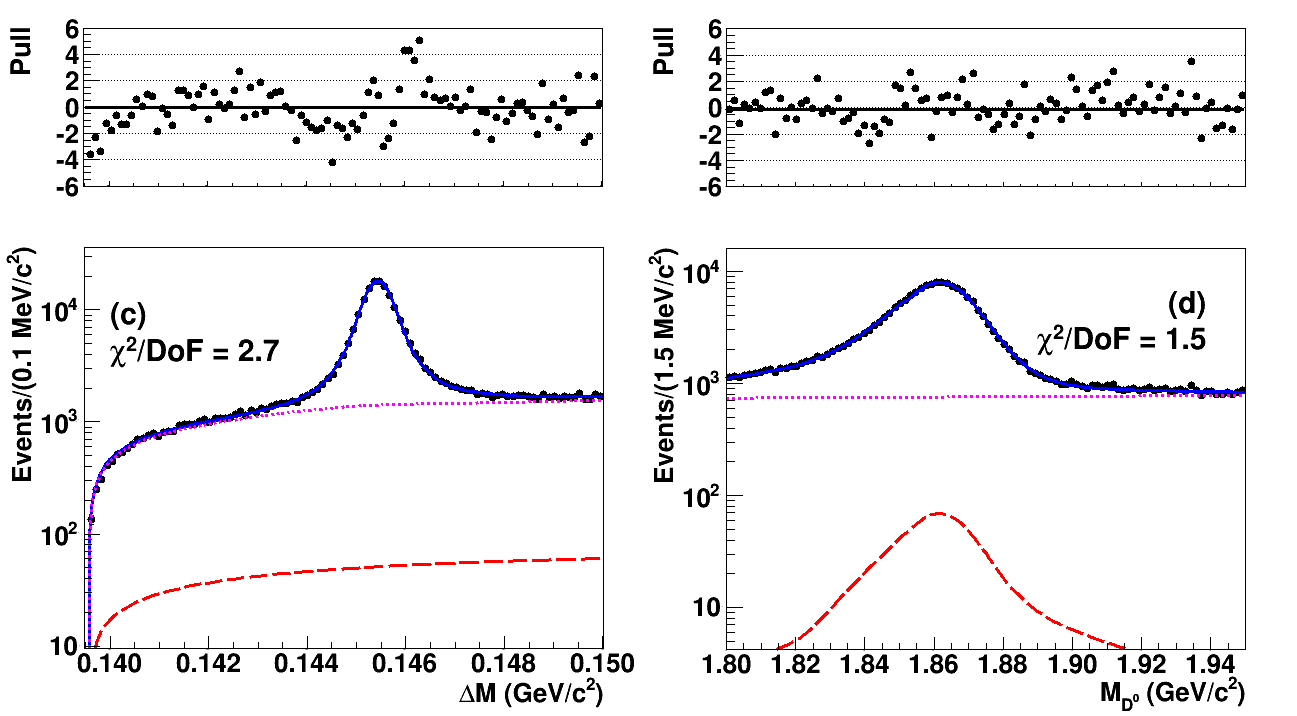 Figure 1
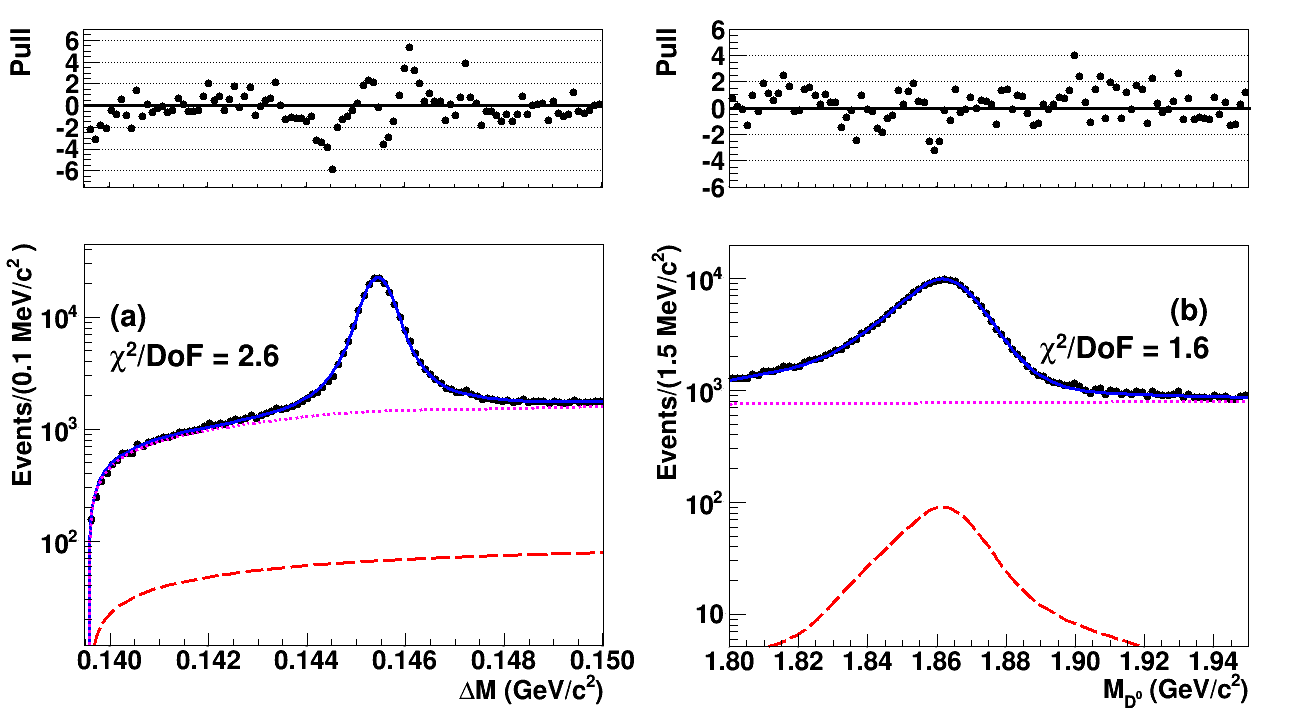 Figure 2
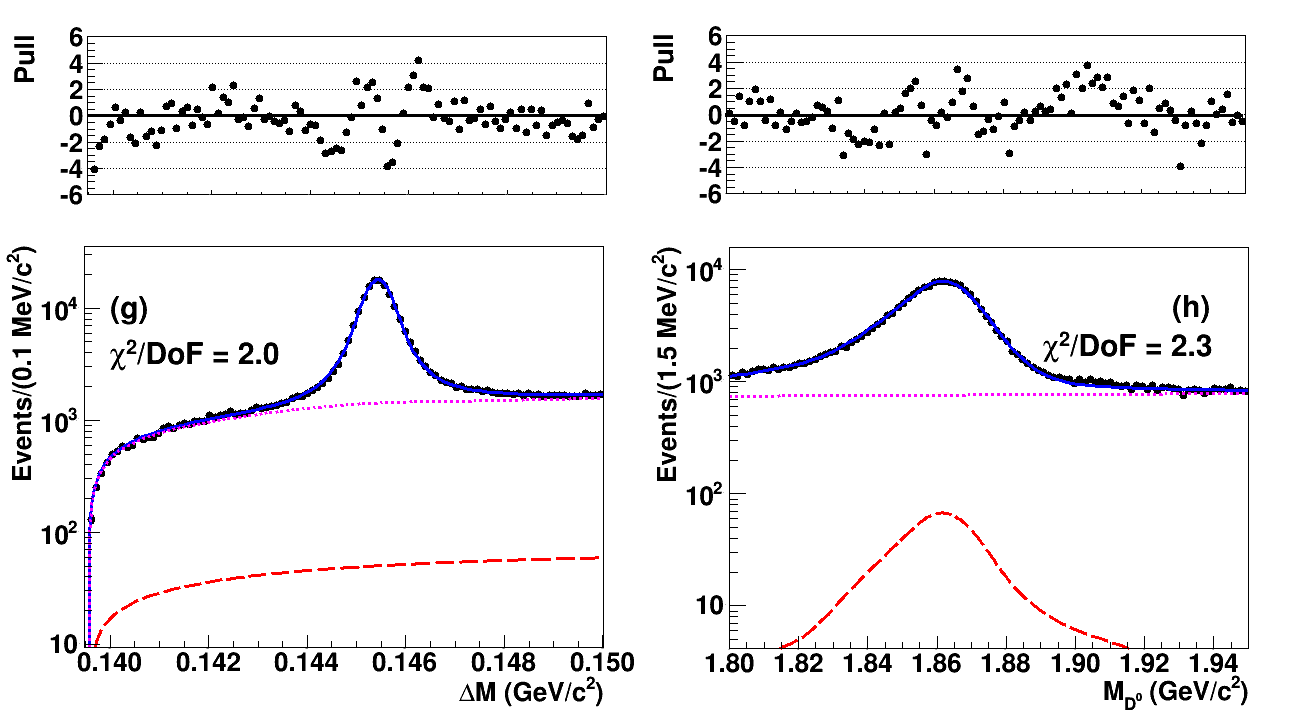 Figure 3
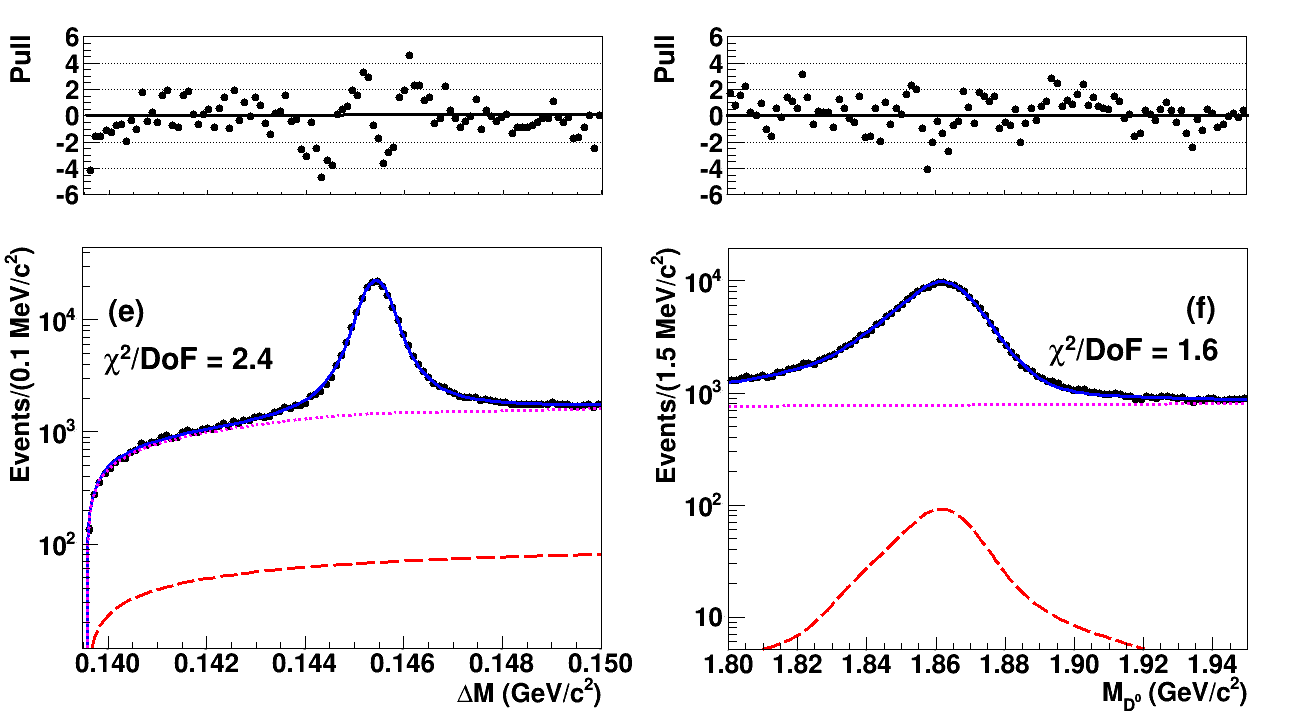 Figure 4
| Bin | Resonance | Invariant mass | ||
|---|---|---|---|---|
| requirement (GeV/) | ||||
| 1 | 3.6 0.5 0.5 | |||
| 2 | 0.2 1.3 0.4 | |||
| 3 | 6.9 0.3 | |||
| 4 | 22.0 0.6 0.6 | |||
| 5 | 25.5 0.7 0.5 | |||
| 6 | 24.5 1.0 | |||
| 7 | 19.7 0.8 | |||
| 8 | 13.2 0.9 0.4 | |||
| 9 | Remainder | 20.5 1.0 |
Peer Reviews
No public reviews on file for this paper yet. If you reviewed it on a platform where reviews are public (OpenReview, ICLR, NeurIPS, ICML), you can paste yours below so the community can read it here.
Videos
No videos yet. Explain this paper in a talk, walkthrough, or lecture? Add one.
The Belle Collaboration
First measurement of -odd moments in decays
K. Prasanth
Indian Institute of Technology Madras, Chennai 600036
J. Libby
Indian Institute of Technology Madras, Chennai 600036
I. Adachi
High Energy Accelerator Research Organization (KEK), Tsukuba 305-0801
SOKENDAI (The Graduate University for Advanced Studies), Hayama 240-0193
H. Aihara
Department of Physics, University of Tokyo, Tokyo 113-0033
S. Al Said
Department of Physics, Faculty of Science, University of Tabuk, Tabuk 71451
Department of Physics, Faculty of Science, King Abdulaziz University, Jeddah 21589
D. M. Asner
Pacific Northwest National Laboratory, Richland, Washington 99352
V. Aulchenko
Budker Institute of Nuclear Physics SB RAS, Novosibirsk 630090
Novosibirsk State University, Novosibirsk 630090
T. Aushev
Moscow Institute of Physics and Technology, Moscow Region 141700
R. Ayad
Department of Physics, Faculty of Science, University of Tabuk, Tabuk 71451
V. Babu
Tata Institute of Fundamental Research, Mumbai 400005
I. Badhrees
Department of Physics, Faculty of Science, University of Tabuk, Tabuk 71451
King Abdulaziz City for Science and Technology, Riyadh 11442
S. Bahinipati
Indian Institute of Technology Bhubaneswar, Satya Nagar 751007
A. M. Bakich
School of Physics, University of Sydney, New South Wales 2006
V. Bansal
Pacific Northwest National Laboratory, Richland, Washington 99352
E. Barberio
School of Physics, University of Melbourne, Victoria 3010
M. Berger
Stefan Meyer Institute for Subatomic Physics, Vienna 1090
V. Bhardwaj
Indian Institute of Science Education and Research Mohali, SAS Nagar, 140306
B. Bhuyan
Indian Institute of Technology Guwahati, Assam 781039
J. Biswal
J. Stefan Institute, 1000 Ljubljana
A. Bobrov
Budker Institute of Nuclear Physics SB RAS, Novosibirsk 630090
Novosibirsk State University, Novosibirsk 630090
A. Bondar
Budker Institute of Nuclear Physics SB RAS, Novosibirsk 630090
Novosibirsk State University, Novosibirsk 630090
G. Bonvicini
Wayne State University, Detroit, Michigan 48202
A. Bozek
H. Niewodniczanski Institute of Nuclear Physics, Krakow 31-342
M. Bračko
University of Maribor, 2000 Maribor
J. Stefan Institute, 1000 Ljubljana
T. E. Browder
University of Hawaii, Honolulu, Hawaii 96822
D. Červenkov
Faculty of Mathematics and Physics, Charles University, 121 16 Prague
V. Chekelian
Max-Planck-Institut für Physik, 80805 München
A. Chen
National Central University, Chung-li 32054
B. G. Cheon
Hanyang University, Seoul 133-791
K. Chilikin
P.N. Lebedev Physical Institute of the Russian Academy of Sciences, Moscow 119991
Moscow Physical Engineering Institute, Moscow 115409
R. Chistov
P.N. Lebedev Physical Institute of the Russian Academy of Sciences, Moscow 119991
Moscow Physical Engineering Institute, Moscow 115409
K. Cho
Korea Institute of Science and Technology Information, Daejeon 305-806
S.-K. Choi
Gyeongsang National University, Chinju 660-701
Y. Choi
Sungkyunkwan University, Suwon 440-746
D. Cinabro
Wayne State University, Detroit, Michigan 48202
N. Dash
Indian Institute of Technology Bhubaneswar, Satya Nagar 751007
S. Di Carlo
Wayne State University, Detroit, Michigan 48202
Z. Doležal
Faculty of Mathematics and Physics, Charles University, 121 16 Prague
Z. Drásal
Faculty of Mathematics and Physics, Charles University, 121 16 Prague
D. Dutta
Tata Institute of Fundamental Research, Mumbai 400005
S. Eidelman
Budker Institute of Nuclear Physics SB RAS, Novosibirsk 630090
Novosibirsk State University, Novosibirsk 630090
D. Epifanov
Budker Institute of Nuclear Physics SB RAS, Novosibirsk 630090
Novosibirsk State University, Novosibirsk 630090
H. Farhat
Wayne State University, Detroit, Michigan 48202
J. E. Fast
Pacific Northwest National Laboratory, Richland, Washington 99352
T. Ferber
Deutsches Elektronen–Synchrotron, 22607 Hamburg
B. G. Fulsom
Pacific Northwest National Laboratory, Richland, Washington 99352
V. Gaur
Virginia Polytechnic Institute and State University, Blacksburg, Virginia 24061
N. Gabyshev
Budker Institute of Nuclear Physics SB RAS, Novosibirsk 630090
Novosibirsk State University, Novosibirsk 630090
A. Garmash
Budker Institute of Nuclear Physics SB RAS, Novosibirsk 630090
Novosibirsk State University, Novosibirsk 630090
R. Gillard
Wayne State University, Detroit, Michigan 48202
P. Goldenzweig
Institut für Experimentelle Kernphysik, Karlsruher Institut für Technologie, 76131 Karlsruhe
D. Greenwald
Department of Physics, Technische Universität München, 85748 Garching
J. Haba
High Energy Accelerator Research Organization (KEK), Tsukuba 305-0801
SOKENDAI (The Graduate University for Advanced Studies), Hayama 240-0193
T. Hara
High Energy Accelerator Research Organization (KEK), Tsukuba 305-0801
SOKENDAI (The Graduate University for Advanced Studies), Hayama 240-0193
K. Hayasaka
Niigata University, Niigata 950-2181
M. T. Hedges
University of Hawaii, Honolulu, Hawaii 96822
W.-S. Hou
Department of Physics, National Taiwan University, Taipei 10617
K. Inami
Graduate School of Science, Nagoya University, Nagoya 464-8602
A. Ishikawa
Department of Physics, Tohoku University, Sendai 980-8578
R. Itoh
High Energy Accelerator Research Organization (KEK), Tsukuba 305-0801
SOKENDAI (The Graduate University for Advanced Studies), Hayama 240-0193
Y. Iwasaki
High Energy Accelerator Research Organization (KEK), Tsukuba 305-0801
W. W. Jacobs
Indiana University, Bloomington, Indiana 47408
I. Jaegle
University of Florida, Gainesville, Florida 32611
H. B. Jeon
Kyungpook National University, Daegu 702-701
Y. Jin
Department of Physics, University of Tokyo, Tokyo 113-0033
D. Joffe
Kennesaw State University, Kennesaw, Georgia 30144
K. K. Joo
Chonnam National University, Kwangju 660-701
T. Julius
School of Physics, University of Melbourne, Victoria 3010
A. B. Kaliyar
Indian Institute of Technology Madras, Chennai 600036
K. H. Kang
Kyungpook National University, Daegu 702-701
G. Karyan
Deutsches Elektronen–Synchrotron, 22607 Hamburg
T. Kawasaki
Niigata University, Niigata 950-2181
C. Kiesling
Max-Planck-Institut für Physik, 80805 München
D. Y. Kim
Soongsil University, Seoul 156-743
J. B. Kim
Korea University, Seoul 136-713
K. T. Kim
Korea University, Seoul 136-713
M. J. Kim
Kyungpook National University, Daegu 702-701
S. H. Kim
Hanyang University, Seoul 133-791
Y. J. Kim
Korea Institute of Science and Technology Information, Daejeon 305-806
K. Kinoshita
University of Cincinnati, Cincinnati, Ohio 45221
P. Kodyš
Faculty of Mathematics and Physics, Charles University, 121 16 Prague
S. Korpar
University of Maribor, 2000 Maribor
J. Stefan Institute, 1000 Ljubljana
D. Kotchetkov
University of Hawaii, Honolulu, Hawaii 96822
P. Križan
Faculty of Mathematics and Physics, University of Ljubljana, 1000 Ljubljana
J. Stefan Institute, 1000 Ljubljana
P. Krokovny
Budker Institute of Nuclear Physics SB RAS, Novosibirsk 630090
Novosibirsk State University, Novosibirsk 630090
T. Kuhr
Ludwig Maximilians University, 80539 Munich
R. Kulasiri
Kennesaw State University, Kennesaw, Georgia 30144
R. Kumar
Punjab Agricultural University, Ludhiana 141004
T. Kumita
Tokyo Metropolitan University, Tokyo 192-0397
A. Kuzmin
Budker Institute of Nuclear Physics SB RAS, Novosibirsk 630090
Novosibirsk State University, Novosibirsk 630090
Y.-J. Kwon
Yonsei University, Seoul 120-749
J. S. Lange
Justus-Liebig-Universität Gießen, 35392 Gießen
I. S. Lee
Hanyang University, Seoul 133-791
C. H. Li
School of Physics, University of Melbourne, Victoria 3010
L. Li
University of Science and Technology of China, Hefei 230026
L. Li Gioi
Max-Planck-Institut für Physik, 80805 München
D. Liventsev
Virginia Polytechnic Institute and State University, Blacksburg, Virginia 24061
High Energy Accelerator Research Organization (KEK), Tsukuba 305-0801
M. Lubej
J. Stefan Institute, 1000 Ljubljana
T. Luo
University of Pittsburgh, Pittsburgh, Pennsylvania 15260
M. Masuda
Earthquake Research Institute, University of Tokyo, Tokyo 113-0032
T. Matsuda
University of Miyazaki, Miyazaki 889-2192
D. Matvienko
Budker Institute of Nuclear Physics SB RAS, Novosibirsk 630090
Novosibirsk State University, Novosibirsk 630090
K. Miyabayashi
Nara Women’s University, Nara 630-8506
H. Miyata
Niigata University, Niigata 950-2181
R. Mizuk
P.N. Lebedev Physical Institute of the Russian Academy of Sciences, Moscow 119991
Moscow Physical Engineering Institute, Moscow 115409
Moscow Institute of Physics and Technology, Moscow Region 141700
G. B. Mohanty
Tata Institute of Fundamental Research, Mumbai 400005
H. K. Moon
Korea University, Seoul 136-713
T. Mori
Graduate School of Science, Nagoya University, Nagoya 464-8602
R. Mussa
INFN - Sezione di Torino, 10125 Torino
M. Nakao
High Energy Accelerator Research Organization (KEK), Tsukuba 305-0801
SOKENDAI (The Graduate University for Advanced Studies), Hayama 240-0193
T. Nanut
J. Stefan Institute, 1000 Ljubljana
K. J. Nath
Indian Institute of Technology Guwahati, Assam 781039
Z. Natkaniec
H. Niewodniczanski Institute of Nuclear Physics, Krakow 31-342
M. Nayak
Wayne State University, Detroit, Michigan 48202
High Energy Accelerator Research Organization (KEK), Tsukuba 305-0801
M. Niiyama
Kyoto University, Kyoto 606-8502
N. K. Nisar
University of Pittsburgh, Pittsburgh, Pennsylvania 15260
S. Nishida
High Energy Accelerator Research Organization (KEK), Tsukuba 305-0801
SOKENDAI (The Graduate University for Advanced Studies), Hayama 240-0193
S. Ogawa
Toho University, Funabashi 274-8510
S. Okuno
Kanagawa University, Yokohama 221-8686
H. Ono
Nippon Dental University, Niigata 951-8580
Niigata University, Niigata 950-2181
P. Pakhlov
P.N. Lebedev Physical Institute of the Russian Academy of Sciences, Moscow 119991
Moscow Physical Engineering Institute, Moscow 115409
G. Pakhlova
P.N. Lebedev Physical Institute of the Russian Academy of Sciences, Moscow 119991
Moscow Institute of Physics and Technology, Moscow Region 141700
B. Pal
University of Cincinnati, Cincinnati, Ohio 45221
C.-S. Park
Yonsei University, Seoul 120-749
H. Park
Kyungpook National University, Daegu 702-701
S. Paul
Department of Physics, Technische Universität München, 85748 Garching
L. Pesántez
University of Bonn, 53115 Bonn
R. Pestotnik
J. Stefan Institute, 1000 Ljubljana
L. E. Piilonen
Virginia Polytechnic Institute and State University, Blacksburg, Virginia 24061
C. Pulvermacher
High Energy Accelerator Research Organization (KEK), Tsukuba 305-0801
M. Ritter
Ludwig Maximilians University, 80539 Munich
A. Rostomyan
Deutsches Elektronen–Synchrotron, 22607 Hamburg
Y. Sakai
High Energy Accelerator Research Organization (KEK), Tsukuba 305-0801
SOKENDAI (The Graduate University for Advanced Studies), Hayama 240-0193
M. Salehi
University of Malaya, 50603 Kuala Lumpur
Ludwig Maximilians University, 80539 Munich
S. Sandilya
University of Cincinnati, Cincinnati, Ohio 45221
L. Santelj
High Energy Accelerator Research Organization (KEK), Tsukuba 305-0801
T. Sanuki
Department of Physics, Tohoku University, Sendai 980-8578
Y. Sato
Graduate School of Science, Nagoya University, Nagoya 464-8602
O. Schneider
École Polytechnique Fédérale de Lausanne (EPFL), Lausanne 1015
G. Schnell
University of the Basque Country UPV/EHU, 48080 Bilbao
IKERBASQUE, Basque Foundation for Science, 48013 Bilbao
C. Schwanda
Institute of High Energy Physics, Vienna 1050
A. J. Schwartz
University of Cincinnati, Cincinnati, Ohio 45221
Y. Seino
Niigata University, Niigata 950-2181
K. Senyo
Yamagata University, Yamagata 990-8560
M. E. Sevior
School of Physics, University of Melbourne, Victoria 3010
V. Shebalin
Budker Institute of Nuclear Physics SB RAS, Novosibirsk 630090
Novosibirsk State University, Novosibirsk 630090
C. P. Shen
Beihang University, Beijing 100191
T.-A. Shibata
Tokyo Institute of Technology, Tokyo 152-8550
J.-G. Shiu
Department of Physics, National Taiwan University, Taipei 10617
B. Shwartz
Budker Institute of Nuclear Physics SB RAS, Novosibirsk 630090
Novosibirsk State University, Novosibirsk 630090
F. Simon
Max-Planck-Institut für Physik, 80805 München
Excellence Cluster Universe, Technische Universität München, 85748 Garching
R. Sinha
Institute of Mathematical Sciences, Chennai 600113
A. Sokolov
Institute for High Energy Physics, Protvino 142281
E. Solovieva
P.N. Lebedev Physical Institute of the Russian Academy of Sciences, Moscow 119991
Moscow Institute of Physics and Technology, Moscow Region 141700
M. Starič
J. Stefan Institute, 1000 Ljubljana
J. F. Strube
Pacific Northwest National Laboratory, Richland, Washington 99352
K. Sumisawa
High Energy Accelerator Research Organization (KEK), Tsukuba 305-0801
SOKENDAI (The Graduate University for Advanced Studies), Hayama 240-0193
T. Sumiyoshi
Tokyo Metropolitan University, Tokyo 192-0397
M. Takizawa
Showa Pharmaceutical University, Tokyo 194-8543
J-PARC Branch, KEK Theory Center, High Energy Accelerator Research Organization (KEK), Tsukuba 305-0801
Theoretical Research Division, Nishina Center, RIKEN, Saitama 351-0198
U. Tamponi
INFN - Sezione di Torino, 10125 Torino
University of Torino, 10124 Torino
K. Tanida
Advanced Science Research Center, Japan Atomic Energy Agency, Naka 319-1195
F. Tenchini
School of Physics, University of Melbourne, Victoria 3010
K. Trabelsi
High Energy Accelerator Research Organization (KEK), Tsukuba 305-0801
SOKENDAI (The Graduate University for Advanced Studies), Hayama 240-0193
M. Uchida
Tokyo Institute of Technology, Tokyo 152-8550
S. Uehara
High Energy Accelerator Research Organization (KEK), Tsukuba 305-0801
SOKENDAI (The Graduate University for Advanced Studies), Hayama 240-0193
T. Uglov
P.N. Lebedev Physical Institute of the Russian Academy of Sciences, Moscow 119991
Moscow Institute of Physics and Technology, Moscow Region 141700
Y. Unno
Hanyang University, Seoul 133-791
S. Uno
High Energy Accelerator Research Organization (KEK), Tsukuba 305-0801
SOKENDAI (The Graduate University for Advanced Studies), Hayama 240-0193
P. Urquijo
School of Physics, University of Melbourne, Victoria 3010
C. Van Hulse
University of the Basque Country UPV/EHU, 48080 Bilbao
G. Varner
University of Hawaii, Honolulu, Hawaii 96822
A. Vinokurova
Budker Institute of Nuclear Physics SB RAS, Novosibirsk 630090
Novosibirsk State University, Novosibirsk 630090
V. Vorobyev
Budker Institute of Nuclear Physics SB RAS, Novosibirsk 630090
Novosibirsk State University, Novosibirsk 630090
A. Vossen
Indiana University, Bloomington, Indiana 47408
E. Waheed
School of Physics, University of Melbourne, Victoria 3010
C. H. Wang
National United University, Miao Li 36003
M.-Z. Wang
Department of Physics, National Taiwan University, Taipei 10617
P. Wang
Institute of High Energy Physics, Chinese Academy of Sciences, Beijing 100049
M. Watanabe
Niigata University, Niigata 950-2181
Y. Watanabe
Kanagawa University, Yokohama 221-8686
E. Widmann
Stefan Meyer Institute for Subatomic Physics, Vienna 1090
K. M. Williams
Virginia Polytechnic Institute and State University, Blacksburg, Virginia 24061
E. Won
Korea University, Seoul 136-713
H. Yamamoto
Department of Physics, Tohoku University, Sendai 980-8578
Y. Yamashita
Nippon Dental University, Niigata 951-8580
H. Ye
Deutsches Elektronen–Synchrotron, 22607 Hamburg
J. Yelton
University of Florida, Gainesville, Florida 32611
Y. Yook
Yonsei University, Seoul 120-749
C. Z. Yuan
Institute of High Energy Physics, Chinese Academy of Sciences, Beijing 100049
Y. Yusa
Niigata University, Niigata 950-2181
Z. P. Zhang
University of Science and Technology of China, Hefei 230026
V. Zhilich
Budker Institute of Nuclear Physics SB RAS, Novosibirsk 630090
Novosibirsk State University, Novosibirsk 630090
V. Zhukova
Moscow Physical Engineering Institute, Moscow 115409
V. Zhulanov
Budker Institute of Nuclear Physics SB RAS, Novosibirsk 630090
Novosibirsk State University, Novosibirsk 630090
A. Zupanc
Faculty of Mathematics and Physics, University of Ljubljana, 1000 Ljubljana
J. Stefan Institute, 1000 Ljubljana
Abstract
We report the first measurement of the -odd moments in the decay from a data sample corresponding to an integrated luminosity of collected by the Belle experiment at the KEKB asymmetric-energy collider. From these moments we determine the -violation-sensitive asymmetry , which is consistent with no violation. In addition, we perform measurements in different regions of the phase space; these are also consistent with no violation.
pacs:
11.30.Er, 13.25.Ft, 14.40.Lb, 13.66.Jn
††preprint:
Belle Preprint 2017-01
KEK Preprint 2016-62
Standard Model (SM) violation, which is due to the Kobayashi-Maskawa mechanism KM , is very small in interactions involving decays of charm hadrons. Hence, any enhancement with respect to the SM prediction can indicate new physics effects due to particles or interactions not included in the SM CHARMREVIEW . The decay has a self-conjugate final state that can be used for a precise test of symmetry. Due to its large branching fraction of 5.2 PDG , one can isolate a sample of decays that allows a test at a precision of . This decay has been studied once before MARKIII but with a sample of only 140 events. Here, we report the first measurement of the time-reversal () asymmetry in decays, which is sensitive to violation via the theorem CPT . This is the first asymmetry measurement for a meson decay with two neutral particles in the final state, one of which is a meson.
For this measurement, we use the method described in Refs. TODD1 ; TODD2 ; TODD3 ; TODD4 . This method was used by the FOCUS FOCUS , BaBar BABARTODD1 ; BABARTODD2 , and LHCb LHCBTODD Collaborations for similar measurements of -violating asymmetries in , , and decays. The measurement is performed by constructing the scalar triple product
[TABLE]
where , , and are the momenta of any three of the daughter particles. Similarly, is defined as the -conjugate observable with daughter particles. There must be at least four particles in the final state for to not be co-planar with and and allow nonzero . We define two asymmetry parameters as
[TABLE]
for and , respectively, with being a partial decay rate. These asymmetries can be nonzero due to the final state interaction (FSI) effects BIGI . These effects are eliminated by taking the difference between and as
[TABLE]
for which a nonzero value would be a clear signature of violation CPT .
In this Letter, we also present measurements of in nine regions of the final state phase space. The regions are selected to isolate eigenstates such as , vector-vector (VV) states such as , Cabibbo-favored (CF) states such as and doubly-Cabibbo-suppressed (DCS) states such as .
The Belle detector BELLE is located at the interaction region of the KEKB asymmetric-energy collider KEKB . The analysis is performed with a data sample corresponding to an integrated luminosity of 966 fb*-1* collected at or near center-of-mass energies corresponding to the ( = 1, 2, 3, 4, 5) resonances, where 74% of the sample is taken at the peak. The sub-detectors relevant to this measurement are: a tracking system comprising a silicon vertex detector (SVD) and a 50-layer central drift chamber (CDC), a particle identification system comprising of a barrel like arrangement of time-of-flight (TOF) scintillation counters and an array of aerogel threshold Cherenkov counters (ACC), and a CsI(Tl) crystal-based electromagnetic calorimeter (ECL). These subdetectors are located inside a 1.5 T superconducting magnet.
Samples of Monte Carlo (MC) simulated data are used to optimize the selection criteria and to understand various types of background. The EvtGen EVTGEN and Geant3 GEANT3 software packages are used to generate the events and simulate the detector response, respectively. We also include initial and final state radiation effects PHOTOS in the simulation study.
We reconstruct the final state in events CHARGECONJUGATION in which and is a collection of particles produced along with the meson. The meson is so called because its momentum is low compared to the final state particles originating from the decay. We use the charge of to identify whether the accompanying candidate is a or a meson.
We require candidate daughters of the and to have a distance of closest approach along and perpendicular to the beam direction of less than 3.0 cm and 0.5 cm, respectively; this removes tracks not originating from the interaction region. Furthermore, these track candidates need to be positively identified as pions based on the combined information from the CDC, TOF, and ACC. The pion identification requirement has an efficiency of 88% PID with the probability of misidentification of a kaon as a pion candidate of 8%. We select candidates from pairs of oppositely charged tracks, both treated as pions. The two tracks are required to have a invariant mass within of the mass PDG , where is the mass resolution. The decay vertex of the candidates is required to be displaced from the interaction point by a transverse distance of greater than 0.22 cm for momenta greater than 1.5 GeV/, and greater than 0.08 cm for momenta between 0.5 and 1.5 GeV/ KSHORT . We select meson candidates from pairs of photons reconstructed in the ECL. The photons have different minimum energy criteria of 50 MeV, 100 MeV, or 150 MeV, depending on whether they are reconstructed in the barrel, forward endcap, or backward endcap regions of the ECL, respectively. These criteria suppress the beam-related backgrounds, which are typically asymmetric in polar angle. A candidate is selected when the invariant mass of the photon pair lies between 115 and 145 MeV/, which covers an asymmetric interval corresponding to 3 about the nominal mass of the meson PDG . We require that candidates have momentum greater than 350 MeV/ to reduce combinatorial background from random combinations of particles not originating from decays. We kinematically constrain the meson to its known mass PDG to improve the momentum resolution. We identify a candidate if its reconstructed invariant mass is between 1.80 and 1.95 GeV/.
We select candidates from the remaining pion candidates in the event that produce at least one hit in the SVD; this requirement reduces the multiplicity of candidates within an event. We form from the selected and candidates. To eliminate mesons from decays, which have different kinematic and topological properties, we require the momentum in the center-of-mass frame to be greater than 2.5 GeV/. A small contamination of 0.015% and 0.096% from and events, respectively, is found from MC simulation studies. We define the variable , where is the mass of the candidate; this peaks at 145 MeV/ PDG for correctly reconstructed mesons. We require to be less than 150 MeV/ to suppress the combinatorial background. We perform kinematically-constrained vertex fits for both the vertex (using the , tracks, vertex, and momentum) and the vertex (using the momentum and track). We remove very poorly reconstructed candidates whose vertex fit quality parameter exceeds 1000. We also apply a kinematically-constrained mass fit for the meson candidates to improve the resolution of the momenta of daughters.
Selection criteria are chosen to maximize the significance , where is the number of MC signal (background) events in the signal region, defined as 144–147 MeV/ for and 1.82–1.90 GeV/ for . Two types of backgrounds are significant: (1) ‘combinatorial’ and (2) ‘random .’ The latter consists of a correctly reconstructed decay paired with a candidate that is not from a common parent. The background contributions in the selected data sample are 55% and 1% for combinatorial and random components, respectively. The signal purity is 79% in the signal region. The selection efficiency estimated from MC simulation is 4, and the selected data sample contains 1691029 events.
The selection results in an average multiplicity of 1.5 candidates per event. In events with two or more candidates, we retain for further analysis the one with the smallest value of the vertex. MC studies indicate that this requirement selects the correct candidate in 74% of the events with multiple candidates.
We define in the rest frame as for events and for as ; the values of and with other combinations of final state particles are found to yield identical results. To determine , we first divide the data sample into four categories using the value and charge: with , with , with , and with . We then perform a simultaneous maximum likelihood fit to the two-dimensional distributions of and to determine and yields. The two yields and and two asymmetry parameters ( and ) of the signal component are floated in the fit.
We model the signal component of the distribution with a probability density function (PDF) that is the sum of a Crystal Ball (CB) function CB , a Landau distribution, and two Gaussian functions, with a common value for the Gaussian means and Landau central value. The combinatorial background component is parametrized with a first-order polynomial. The random component is modeled by the signal PDF.
The signal component is described by a PDF formed from the sum of a CB function, two Gaussians, and an asymmetric Gaussian function. The combinatorial component is parametrized by a PDF that is the sum of an empirical threshold function and a Gaussian function. The threshold function has the form
[TABLE]
where is the normalization parameter, and are shape parameters, and is the mass of the charged pion PDG . We observe a small peaking structure in the signal region of the combinatorial background distribution that is due to partially reconstructed candidates associated with a genuine , such as a correctly reconstructed event combined with a low momentum from the rest of the event. We fix the Gaussian parameters and the fraction of Gaussian contribution of the combinatorial background PDF to those obtained from the MC sample. The random component is modeled with the same threshold function as the combinatorial background.
We calculate signal yields via a two-dimensional unbinned maximum likelihood fit to the values and . To perform this fit, we include a small correlation term in the PDFs between the width of and the value of . We parametrize the width of the dominant signal-component Gaussian of as
[TABLE]
where is a constant and is the known mass of the meson PDG .
The background component yields for all four samples are floated independently, but the shape parameters are common for the four categories. In total, there are 21 free and nine fixed parameters in the fit. The parameters fixed from MC are one of the widths of the asymmetric Gaussian, the width and exponent of the CB PDFs in the signal component, the normalization parameter in the threshold PDF, three Gaussian parameters for the peaking structure in the combinatorial background, the relative contribution of the CB and Gaussian functions to the PDF of the random component, and the fraction of PDF that contains the correlation in the two-dimensional signal PDF of and . The signal-enhanced and distributions of the data for the four categories are shown in Fig. 1, along with the fit projections. The total signal yield obtained from the fit is and the asymmetries are and , where the uncertainties are statistical. The non-uniform pull for the fits is due to the remaining correlation between and . However, from MC studies we find that this correlation does not cause any bias in the signal yields, in , nor in . The large value for is due to the FSI effects BIGI . The value of is consistent with no violation.
We divide the phase space into nine exclusive regions according to the intermediate resonance contributions. These are (1) ( eigenstate), (2) ( eigenstate), (3) (VV CF state), (4) (VV DCS state), (5) (CF state), (6) (DCS state), (7) , (8) and (9) everything else. Due to the relatively small size of these samples in comparison with the combined one, we reduce the number of free shape parameters to six while fitting the distributions of and in each bin. The remaining parameters are fixed to the values obtained from the fit to the combined data sample. The free parameters are the mean and the width of the signal component and the four CB parameters for the signal component. The and values in each bin are listed in Table 1. The results for are all consistent with no violation. The values of vary significantly due to the different resonance contributions. A value indicates the presence of a single partial wave, as in bin 2 where the -wave dominates. Values of indicate a significant interference between even and odd partial waves as in bins 3 to 9 RSINHA .
The sources of systematic uncertainties are the signal and background models, efficiency dependence on , resolution, and potential fit bias. The dominant contribution comes from modelling the signal and background PDFs. The fixed parameters in the fit not related to the peaking combinatorial background are varied by standard deviation from their nominal value obtained from a simulation sample corresponding to the same integrated luminosity as the data; we assign the change in as a systematic uncertainty. Without having a suitable control sample to study the peaking component of the combinatorial background, we change the value of the fraction of Gaussian PDF to twice the value found in the MC sample and then to zero. The resulting changes and , respectively, for are assigned as a systematic uncertainty. These uncertainties are combined, accounting for correlations among the parameters, to give a total uncertainty of .
To study the dependence of the efficiency on , we calculate the efficiency in 10 bins of between (GeV/)3 and (GeV/)3. We find a relative spread of 10% in efficiency across the bins that varies quadratically as , where within its statistical limit. This dependence is due to a reduced reconstruction efficiency for low-momentum daughters, which tend to have values close to zero. We correct the measured value for the efficiency dependence and see negligible change because of the symmetry implied by . We introduce an artificial asymmetry by changing the value of by one standard deviation and perform the efficiency correction again. The change in of is assigned as the systematic uncertainty due to the efficiency dependence. The parameter is found to be different for and but still compatible within uncertainties. We take the difference of in when applying different efficiency corrections for and as a systematic uncertainty. The resolution follows a Cauchy distribution with zero mean and a half width at half maximum of 1.325 (MeV/)3. We add a corresponding smearing to the distribution to determine a systematic change in due to any asymmetric cross feed between the positive and negative intervals. The variation in due to the migration is , which is taken as a systematic uncertainty from this source. We obtain the fit bias systematic uncertainty, which is a multiplicative one, from a linearity test by giving different input values for in sets of simulated pseudo-experiments. We find a possible fit-bias uncertainty of . We add all the individual systematic uncertainties in quadrature to obtain a total systematic uncertainty of .
In addition to the systematic studies, we perform other cross checks. There is an asymmetry between the number of and events reconstructed in the data sample due to the forward-backward asymmetry generated by interference between the virtual photon and boson AFB . This production asymmetry, coupled with the asymmetry of the Belle detector, may induce a different reconstruction efficiency as a function of for and . This asymmetry is modeled in the MC samples and is found to introduce no bias to the measured value of . We also measure in bins of , where is the polar angle of the with respect to the beam direction defined in the center-of-mass system, and find that the results are consistent with the integrated value. To check for any further systematic effect due to detector reconstruction asymmetry for particles of different charges, we compare the momentum and azimuthal angle distributions for and daughters in data and MC samples and find no significant difference. Furthermore, we study the dependence of the distribution on the momentum selection criterion by varying the latter value by 100 MeV/. No significant change in the shape of the distribution is observed. In addition, we estimate the possible contamination from the decay , which is an irreducible background, and find that the contribution is negligible.
In summary, we report the first measurement of the -odd moment asymmetry for , consistent with no violation. The results in various bins of phase space also show no evidence for violation. This result constitutes one of the most precise tests of violation in the meson system PDG . The measurement uncertainties are statistically dominated and thus can be improved further with the data from the upcoming Belle II experiment BELLEII .
We thank the KEKB group for excellent operation of the accelerator; the KEK cryogenics group for efficient solenoid operations; and the KEK computer group, the NII, and PNNL/EMSL for valuable computing and SINET5 network support. We acknowledge support from MEXT, JSPS and Nagoya’s TLPRC (Japan); ARC (Australia); FWF (Austria); NSFC and CCEPP (China); MSMT (Czechia); CZF, DFG, EXC153, and VS (Germany); DST (India); INFN (Italy); MOE, MSIP, NRF, BK21Plus, WCU and RSRI (Korea); MNiSW and NCN (Poland); MES and RFAAE (Russia); ARRS (Slovenia); IKERBASQUE and UPV/EHU (Spain); SNSF (Switzerland); MOE and MOST (Taiwan); and DOE and NSF (USA).
The reference list from the paper itself. Each links out to its DOI / PubMed record.
- 1(1) M. Kobayashi and T. Maskawa, Prog. Theor. Phys. 49 , 652 (1973).
- 2(2) Y. Grossman, A. L. Kagan, and Y. Nir, Phys. Rev. D 75 , 036008 (2007).
- 3(3) C. Patrignani et al. (Particle Data Group), Chin. Phys. C 40 , 100001 (2016).
- 4(4) D. Coffman et al. (MARK III Collaboration), Phys. Rev. D 45 , 2196 (1992).
- 5(5) G. Lüders, Det. Kong. Danske Videnskabernes Selskab, Mat.-fys. Medd. 28 , 005 (1954).
- 6(6) E. Golowich and G. Valencia, Phys. Rev. D 40 , 112 (1989).
- 7(7) W. Bensalem and D. London, Phys. Rev. D 64 , 116003 (2001).
- 8(8) W. Bensalem, A. Datta, and D. London, Phys. Rev. D 66 , 094004 (2002).