Oscillating dipole with fractional quantum source in Aharonov-Bohm electrodynamics
G. Modanese

TL;DR
This paper explores how fractional quantum mechanics alters electromagnetic field behavior, revealing non-transverse components and blurred near- and far-field distinctions using Aharonov-Bohm electrodynamics with non-local currents.
Contribution
It demonstrates the impact of non-local, non-conserved quantum currents on electromagnetic fields within an extended Maxwell framework, highlighting novel space dependence effects.
Findings
Propagating fields may have non-transverse components.
Near-field and wave zone distinctions become blurred.
Non-local quantum currents influence electromagnetic field behavior.
Abstract
We show, in the case of a special dipolar source, that electromagnetic fields in fractional quantum mechanics have an unexpected space dependence: propagating fields may have non-transverse components, and the distinction between near-field zone and wave zone is blurred. We employ an extension of Maxwell theory, Aharonov-Bohm electrodynamics, which is compatible with currents conserved globally but not locally, we have derived in another work the field equation , where is a non-local function of , called "secondary current". Y.\ Wei has recently proved that the probability current in fractional quantum mechanics is in general not locally conserved. We compute this current for a Gaussian wave packet with fractional parameter and find that in a suitable limit it can be approximated by our simplified dipolar source.…
Click any figure to enlarge with its caption.
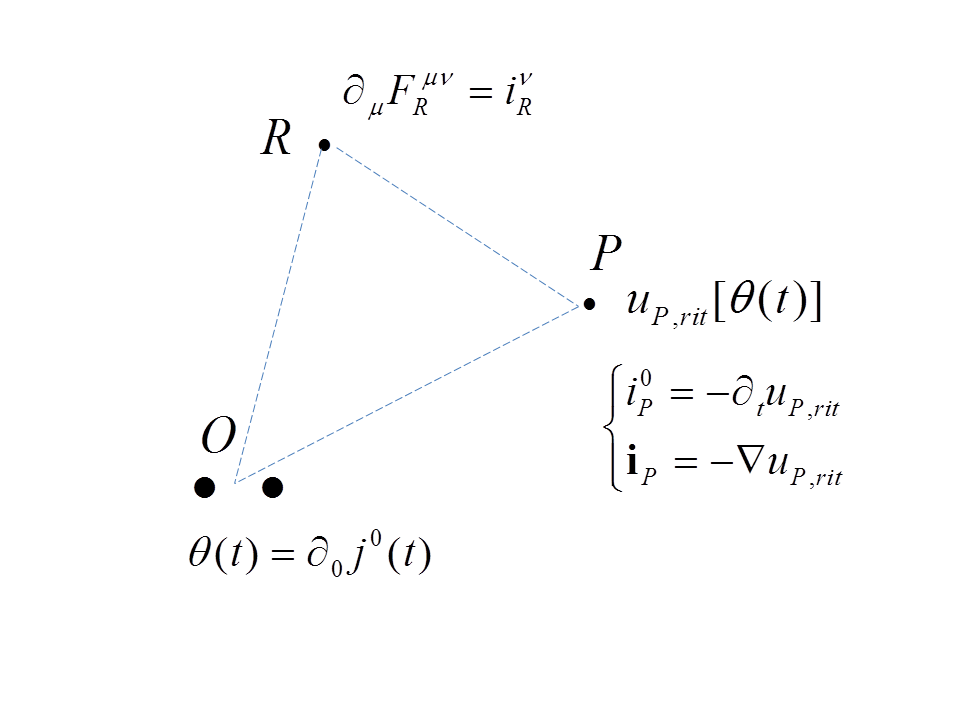 Figure 1
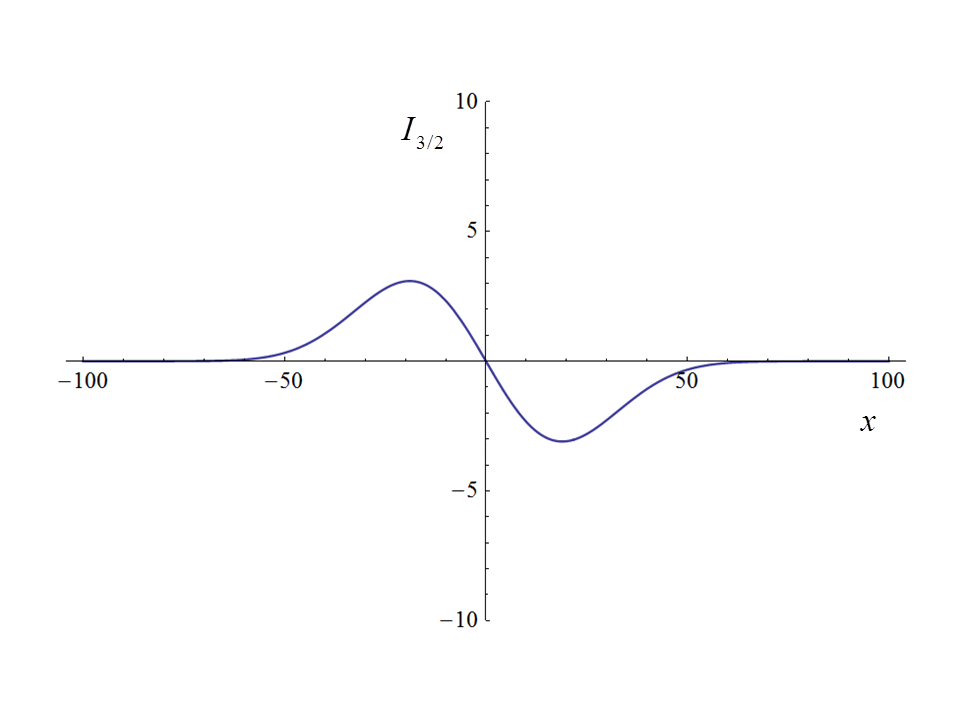 Figure 2
 Figure 3
 Figure 4
Peer Reviews
No public reviews on file for this paper yet. If you reviewed it on a platform where reviews are public (OpenReview, ICLR, NeurIPS, ICML), you can paste yours below so the community can read it here.
Videos
No videos yet. Explain this paper in a talk, walkthrough, or lecture? Add one.
Oscillating dipole with fractional quantum source in Aharonov-Bohm electrodynamics
Giovanni Modanese
Free University of Bolzano-Bozen, P.za Università 5, Bolzano 39100, Italy
Abstract
We show, in the case of a special dipolar source, that electromagnetic fields in fractional quantum mechanics have an unexpected space dependence: propagating fields may have non-transverse components, and the distinction between near-field zone and wave zone is blurred. We employ an extension of Maxwell theory, Aharonov-Bohm electrodynamics, which is compatible with currents conserved globally but not locally; we have derived in another work the field equation , where is a non-local function of , called “secondary current”. Y. Wei has recently proved that the probability current in fractional quantum mechanics is in general not locally conserved. We compute this current for a Gaussian wave packet with fractional parameter and find that in a suitable limit it can be approximated by our simplified dipolar source. Currents which are not locally conserved may be present also in other quantum systems whose wave functions satisfy non-local equations. The combined electromagnetic effects of such sources and their secondary currents are very interesting both theoretically and for potential applications.
keywords:
MSC:
78A25, 78A40, 81Q05 \KWDGeneralized Maxwell theory, Fractional Schrödinger equation, Local current conservation
††journal: Results in Physics
Aharonov-Bohm electrodynamics [1] is a natural extension of Maxwell theory which allows to couple the electromagnetic field also to a current density that is not locally conserved, i.e., it is such that in some region (). A coupling of this kind would of course be inconsistent in the Maxwell theory, since the Maxwell field equations with source are written as and the tensor is antisymmetric. Aharonov-Bohm electrodynamics has only reduced gauge invariance and one additional degree of freedom, namely the scalar field (which is a pure gauge mode in Maxwell theory).
If only locally conserved sources are present, the Aharonov-Bohm theory reduces to Maxwell theory. This happens for all classical sources and for quantum sources which obey a wave equation with locally conserved current, like the Schrödinger equation or Ginzburg-Landau equation. In [2] it was shown, after obtaining a covariant formulation of the Aharonov-Bohm theory and its explicit solution for , that a censorship property holds: the measurable field strength does not allow to “see” electromagnetically a non-conserved source , because it satisfies the equation , where is a non-local function of , called “secondary current” (see eq. (3)), and is conserved.
Aharonov-Bohm electrodynamics can be applied in principle to systems which exhibit quantum charge anomalies [3] or to superconducting states described by non-local equations [4, 5]. Very recently, however, a new possible direct application has emerged. As shown by Wei [6], the Schrödinger equation of fractional quantum mechanics [7] has in general a current which is not locally conserved. This may allow particle teleportation and represents a problem for the compatibility of fractional quantum mechanics with Maxwell electrodynamics, but not for Aharonov-Bohm electrodynamics, where instead it leads to new interesting physical possibilities.
In order to illustrate these features in a paradigmatic, simplified situation, we analyze here the features of the Aharonov-Bohm electromagnetic field generated by a non-conserved current of the form
[TABLE]
This corresponds to a charge which oscillates periodically between the positions and , without an intermediate current, therefore with a kind of teleportation, as allowed by fractional quantum mechanics. The source (1) can be seen as the limit of a suitably defined wave packet (see below).
In order to find the electromagnetic field generated by this source one must solve the Aharonov-Bohm equations, which in covariant form are (with )
[TABLE]
[TABLE]
Let us define, with reference to the four-current (1), the quantity . Eq. (3), which gives the secondary current, can be rewritten as , where is the mathematical analogue of the retarded electric potential in Lorentz gauge of a charge , satisfying the equation . This allows us to compute at any point (see Fig. 1). Note that the potential will not be equal to the familiar dipole potential of Maxwell theory, because the source (1) is different from a physical oscillating particle.
From eq. (2) and general unicity theorems ([8]; see also [9]), we deduce that the field at any point is the Maxwell field with source . This must include all the contributions from at each point , retarded according to the distance . Note that such contributions will in general not be transversal with respect to the direction . The distinction between near field and wave zone will also be blurred, since the secondary source extends far beyond the localized primary source .
Finally, let us relate our simplified Ansatz (1) to a non-conserved current in fractional quantum mechanics. According to Wei [6], the correct probability continuity equation in fractional quantum mechanics is , where ( corresponds to ordinary quantum mechanics) and the extra source term is . As an example, Wei computes for a wave function of the form , where and are two plane waves with different energies. In order to extend this to a more realistic localized wave function, we define a Gaussian wave packet of the form
[TABLE]
where , , . The fractional extra source term can then be written as
[TABLE]
As an example, we have computed numerically for , at . With parameters (number of wavelets), (main wave number), , (which simply define the length and mass scale) we obtain the function in Fig. 2. By tuning the parameters we can obtain a wave packet with two peaks more localized in space and a small frequency spread; the result will be approximated well by our Ansatz (1). The full computation of requires in any case a numerical solution.
The reference list from the paper itself. Each links out to its DOI / PubMed record.
- 1[1] Hively, L.M., and G.C. Giakos (2012) Int. J. of Signal and Imaging Systems Engineering 5, 3; and references therein.
- 2[2] Modanese, G. (2016) Generalized Maxwell equations and charge conservation censorship, ar Xiv: 1609:00238.
- 3[3] Cheng, T.-P., and L.-F. Li Gauge theory of elementary particle physics , Clarendon, Oxford, 2000.
- 4[4] Modanese, G., “Covariant formulation of Aharonov-Bohm electrodynamics and its application to coherent tunnelling”, in Unified Field Mechanics II - Preliminary Formulations and Empirical Tests , Ed.s R.L. Amoroso, L.H. Kauffman, P. Rowlands, World Scientific, 2017.
- 5[5] Clarke, J. (1968) J. de Physique Colloques, 29, C 2-3.
- 6[6] Wei, Y. (2016), Phys. Rev. E 93, 066103.
- 7[7] Laskin, N. (2002), Phys. Rev. E 66, 056108.
- 8[8] Woodside, D.A. (2009), Am. J. Phys. 77, 438.