Steady state preparation of long-lived nuclear spin singlet pair at room temperature
Q. Chen, I. Schwarz, and M.B. Plenio

TL;DR
This paper proposes a room-temperature, dissipative method to reliably generate long-lived nuclear spin singlet pairs using NV centers, enhancing quantum memory and sensing applications.
Contribution
It introduces a novel dissipative protocol combining NV center electron spins and RF control for robust singlet state preparation at room temperature.
Findings
High-fidelity singlet pair generation demonstrated in 13C dimers
Protocol is robust to external magnetic field fluctuations
Feasible under realistic experimental conditions
Abstract
The coherent high-fidelity generation of nuclear spins in long-lived singlet states which may find application as quantum memory or sensor represents a considerable experimental challenge. Here we propose a dissipative scheme that achieves the preparation of pairs of nuclear spins in long-lived singlet states by a protocol that combines the interaction between the nuclei and a periodically reset electron spin of an NV center with local rf-control of the nuclear spins. The final state of this protocol is independent of the initial preparation of the nuclei, is robust to external field fluctuations and can be operated at room temperature. We show that a high fidelity singlet pair of a 13C dimer in a nuclear bath in diamond can be generated under realistic experimental conditions.
Click any figure to enlarge with its caption.
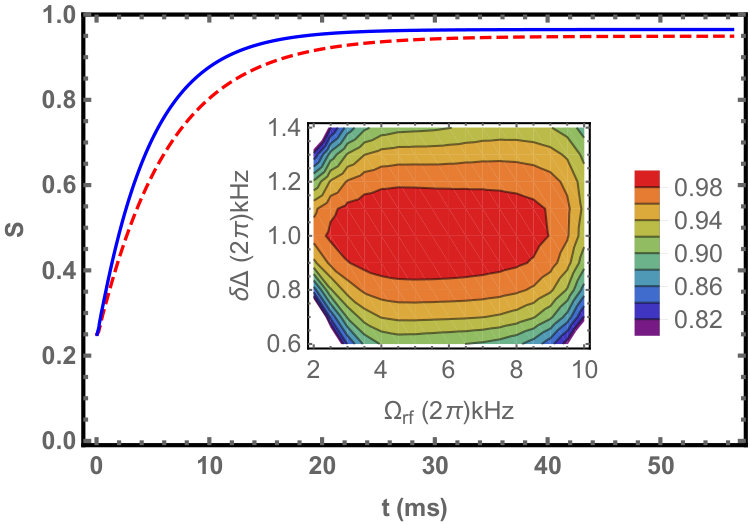 Figure 1
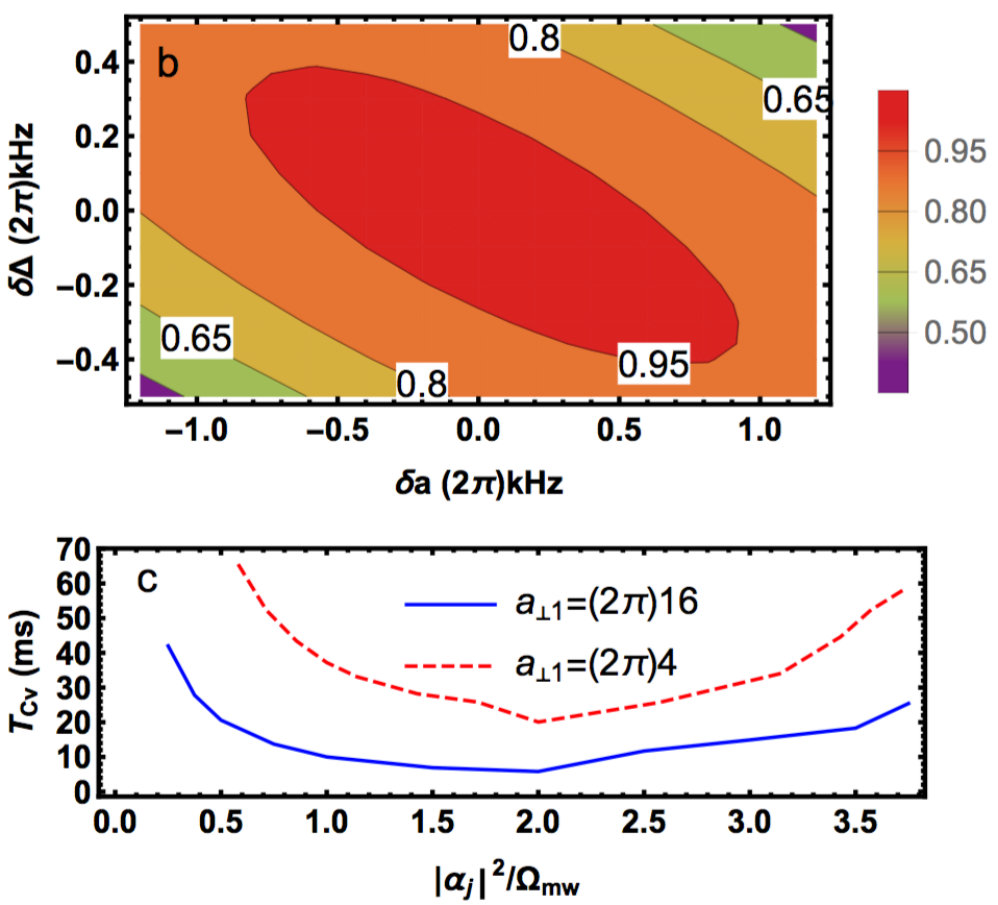 Figure 2
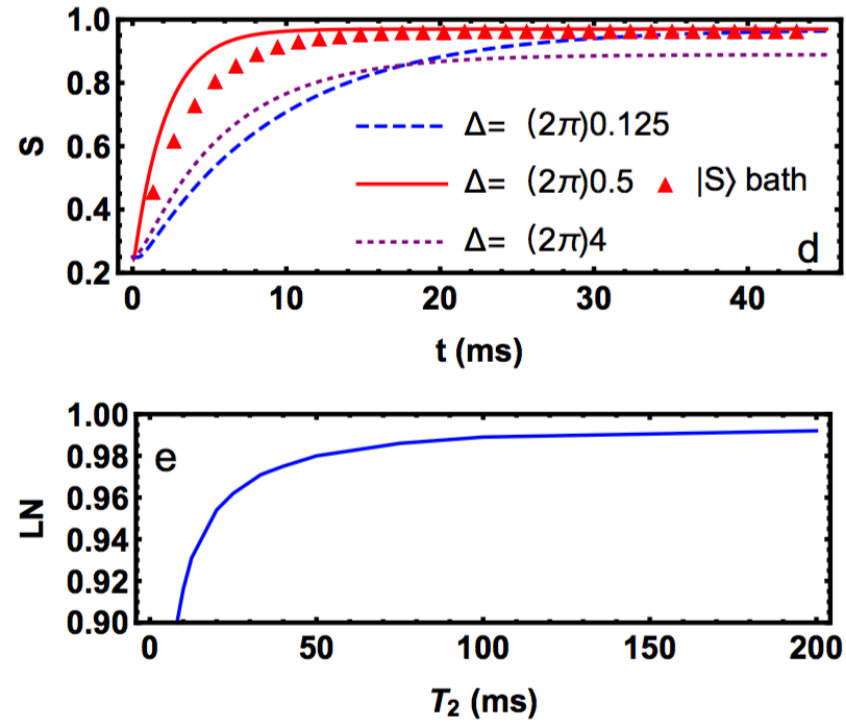 Figure 3
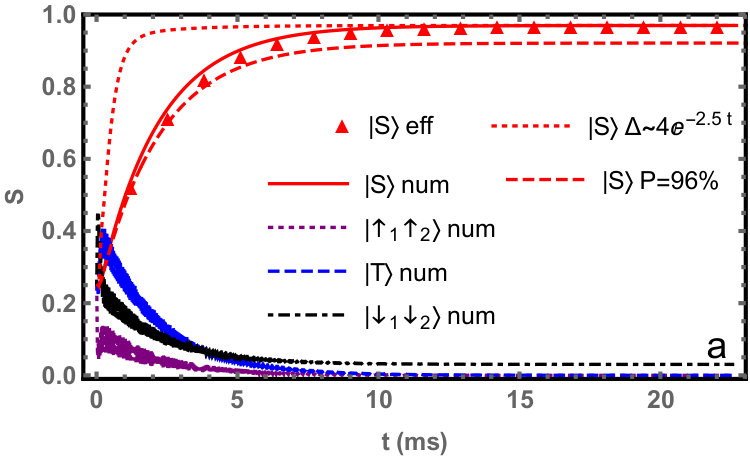 Figure 4
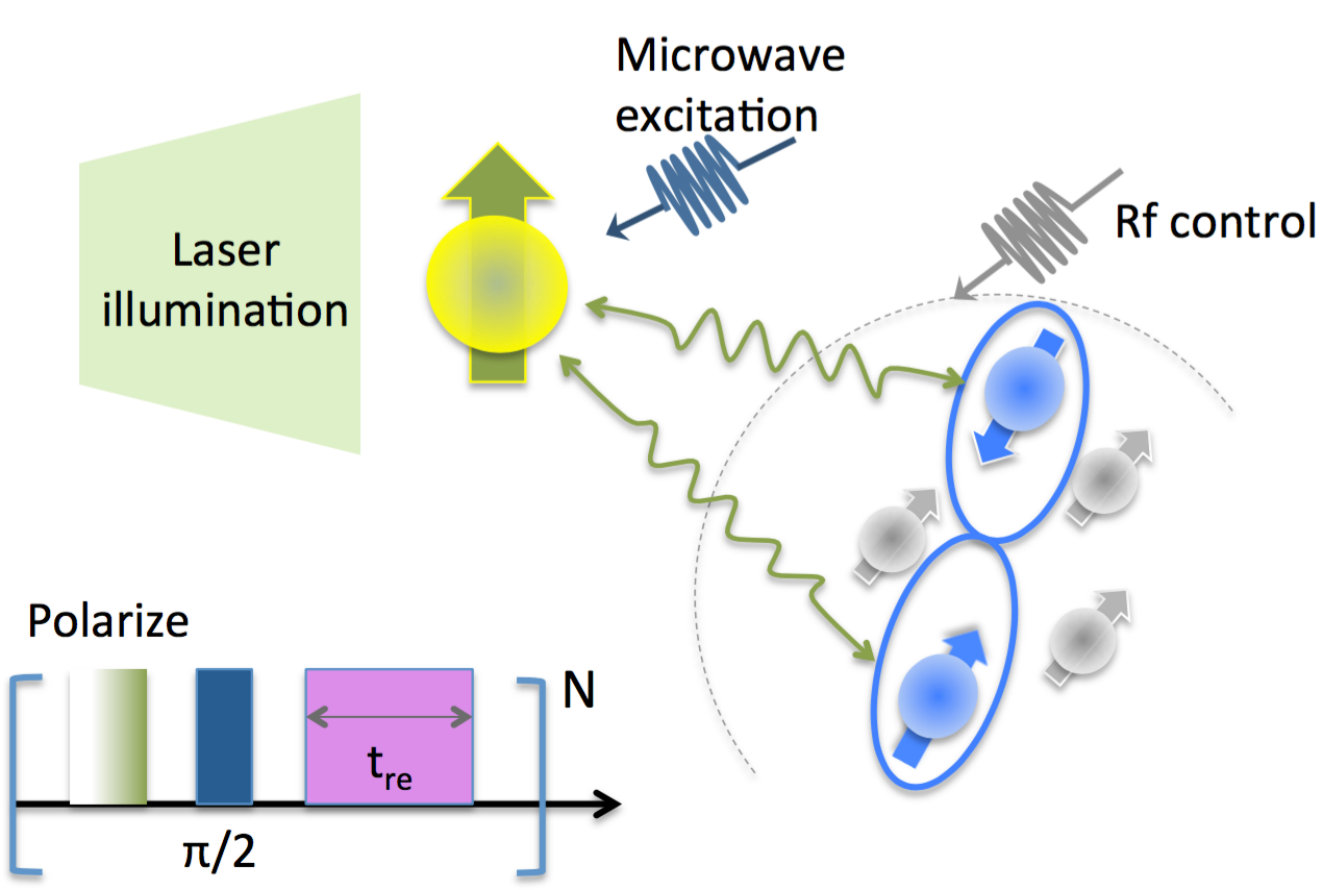 Figure 5
Peer Reviews
No public reviews on file for this paper yet. If you reviewed it on a platform where reviews are public (OpenReview, ICLR, NeurIPS, ICML), you can paste yours below so the community can read it here.
Videos
No videos yet. Explain this paper in a talk, walkthrough, or lecture? Add one.
Steady state preparation of long-lived nuclear spin singlet pair at room temperature
Q. Chen
I. Schwarz
M.B. Plenio
Institut für Theoretische Physik, Albert-Einstein-Allee 11, Universität Ulm, 89069 Ulm, Germany
Abstract
The coherent high-fidelity generation of nuclear spins in long-lived singlet states which may find application as quantum memory or sensor represents a considerable experimental challenge. Here we propose a dissipative scheme that achieves the preparation of pairs of nuclear spins in long-lived singlet states by a protocol that combines the interaction between the nuclei and a periodically reset electron spin of an NV center with local rf-control of the nuclear spins. The final state of this protocol is independent of the initial preparation of the nuclei, is robust to external field fluctuations and can be operated at room temperature. We show that a high fidelity singlet pair of a 13C dimer in a nuclear bath in diamond can be generated under realistic experimental conditions.
Introduction — The preparation of nuclear spins in singlet states is attracting increasing attention as their weak coupling to environmental relaxation processes makes them promising candidates for storing nuclear hyperpolarization even beyond their relaxation time warren2009increasing ; vasos2009long . Nuclear spin-singlet states offer a broad range of applications in medicine, materials science, biology and chemistry. They are used as a resource for spectroscopic interrogation of couplings within many-spin system pileio2007j ; pileio2009extremely , the monitoring of protein conformational changes bornet2011long , the probing of slow diffusion of biomolecules ahuja2009diffusion or as quantum memories reiserer2016robust . However, the key strength of nuclear singlets, namely their weak interaction with their environment due to the anti-symmetry of the singlet state, is also their weakness, as it makes the high fidelity singlet-state preparation and their manipulation a challenge devience2013preparation ; emondts2014long .
The nitrogen-vacancy (NV) defect center in diamond which has been studied extensively over the past decade for precision sensing and quantum information processes (QIP) offers new perspectives here wu2016diamond . The NV center with its surrounding nuclei forms a natural hybrid quantum register taminiau2014universal ; waldherr2014quantum in which electron spins are used for fast high-fidelity control and readout, and proximal nuclear spins can be controlled and used as memories due to their ultra-long coherence time. Furthermore, NV centers are excellent hyperpolarization agents to polarize nearby nuclear spins at ambient condition alvarez2015local ; chen2015optical ; scheuer2016optically , which gives rise to several orders of enhancement of nuclear magnetic resonance (NMR) signals.
In these room temperature applications of the NV-center, relaxation processes of the NV center induce decoherence on both the NV and the surrounding nuclear spins, which is a major obstacle for the high-fidelity preparation of entangled target states. However, it has been recognised early that dissipation can also be a resource that enables entangled state preparation plenio1999cavity ; plenio2002entangled . In recent years theoretical protocols that design dissipative processes has been focused on the creation of entanglement between atoms, ions and spins muschik2011dissipatively ; kastoryano2011dissipative ; rao2013dark ; rao2016dissipative ; greiner2016purification , the stabilisation of quantum gates ChenSP2017 ; bermudez2013dissipation and dissipative entanglement generation have been realised experimentally in atomic ensembles krauter2011entanglement , ion traps lin2013dissipative , and superconducting qubits shankar2013autonomously .
Here we propose a dissipative approach to generate, at room temperature, nuclear spin-singlet states in a spin bath in which all spins are coupled to an NV electron spin in diamond. Our method includes two important features. First, the frequent resets of the NV stabilises it in a particular state and provides a tunable artificial reservoir. Secondly, the coherent local control of nuclear spins by radio-frequency fields with imbalanced detunings to the two nuclear Larmor frequencies, ensures that the steady singlet state of the nuclei is unique. An important merit of dissipative state preparation is its resilience to errors due to imperfect state initialization and fluctuation of the driving fields. Our method can be applied to interacting or non-interacting nuclear spins which have similar magnitude couplings to the NV. Additionally, high fidelity singlet pairs of a 13C dimer in a nuclear bath in diamond can be generated with the realistic parameters. The so generated spin singlet state exhibits a lifetime that extends well beyond the -limit of the electron spins.
Model — We consider an NV center and two nearby 13C spins with gyromagnetic ratio . Their interaction can be described by the dipole-dipole term , where is the hyperfine vector, and non-secular terms are neglected due to the energy mismatch of the two spins. In an external magnetic field (i.e, G), the effective Lamor frequency of nuclear spin is . A microwave (MW) field (Rabi frequency and frequency ) and a radio frequency (rf) field (Rabi frequency and frequency ) are applied to the NV and the nuclear spins, respectively. In a suitable interaction picture we can rewrite the effective Hamiltonian of the NV spin as where the microwave is resonant with the transition, and the microwave dressed states define . Working in a rotating frame with respect to and by using a rotating wave approximation, we find the simplified Hamiltonian (details are included in SI SI )
[TABLE]
with and .
We follow the basic cooling cycles for nuclear spin polarization christ2007quantum ; london2013detecting , namely an iteration between evolution according to Hamiltonian (1) followed by reinitialization of the electron spin to . The nuclei effectively “see” a large polarisation reservoir of the periodically reset of electron spin, and the density matrix of the system evolves according to
[TABLE]
in which is the time evolution operator, presents the trace over the electron and is the density matrix of nuclear spins in the system. In order to allow for a perturbative treatment, we consider short times between the NV resets () we can expand the time evolution operators to second order and eliminate electronic degrees of freedom by a partial trace. The periodic resets introduce an effective relaxation mechanism and the effective relaxation of the NV spin is given by the life time and the reset time (). Additionally, frequent resets with ensures that the electron spin stays close to the reset state and .
By adiabatic elimination of the NV spin (see SI SI ), the reduced density operator of the nuclear spin subsystem is governed by the master equation
[TABLE]
in which , with the dephasing rate of the nuclear spins and with . Here the effective dissipation item is due to the dissipation induced by the NV resets in combination with the interaction between the electron and nuclear spins (last term in Eq. (1)) leaving the local nuclear dynamics described by the Hamiltonian
[TABLE]
Without the applied rf field and , the readily obtained master equation represents the basic cooling scheme for nuclear spin polarization. This scheme has two decoupled nuclear spins states, the fully polarised state as well as, for equally strong coupled spins, the dark state . As a result, the stationary state of the nuclear spins will be a mixture of these two states which is neither fully polarised nor fully entangled. Our goal is the preparation of a maximally entangled singlet state. In the following we show how local rf-control can remove the fully polarization state of the nuclear spins from the manifold of stationary states such that the dynamics of the nuclear spins then converges to a singlet state.
Singlet pair generation for non-interacting spins — For two nuclei that couple equally to the NV, i.e. , and the choice for the rf-field, it is easy to see that the unique steady state of the system is given by
[TABLE]
with the normalization coefficient . It is an eigenstate to eigenvalue [math] of both, the effective Hamiltonian and the Lindblad operator . Notice that when there is no detuning, i.e. , the system is decomposable and the steady state is not unique. However, a small imbalance in the detuning between the two nuclear spins, i.e. , breaks the symmetry and leads to being the unique steady state. We use the logarithmic negativity (LN) plenio2005logarithmic ; LN to measure the entanglement, . Therefore, in the limit (), one can have , which shows that the steady state of the system will achieve the singlet state independent of the initial state.
Fig. (2a) shows the result of a numerical simulation using the original full Hamiltonian Eq. (1) and periodic NV resets. The results which show near perfect singlet generation are well approximated by the effective master equation Eq. (2). Even for imperfect matched detuning () and an asymmetry of the couplings high fidelity is maintained with (see Fig. (2b)). Furthermore, our simulations show that the singlet pair generation is also robust to imperfections in the reinitialization of the NV. A reset fidelity of 96% polarization for the electron spin (achieved by current experimental technology waldherr2011dark ) suffices to provide a singlet state with .
Another important factor for dissipative entanglement generation is the convergence time of the scheme. is limited by the effective dissipation rate () and the strength of of the local rf-control and the detuning via the ratios and . Notice that also controls the singlet generation fidelity and we use to ensure high fidelity which in turn induces a relatively long . For a given , we find that the optimal convergence time is achieved for , see Fig. (2c). Additionally, the convergence may be accelerated by using an adiabatic change of the imbalance of the detuning over time. The choice kHz yields the dotted red line in Fig.(2a), which favours rapid approach to the target.
The singlet state preparation can be controlled by using the weak external magnetic field (i.e, G). Chosing two nuclei with similar couplings to the NV we can adjust the external magnetic field direction to obtain the same perpendicular coupling components and a difference between parallel components. As the detuning is induced by the parallel components, choosing the NV reset time and Rabi frequency appropriately achieves high fidelity of singlet pair generation and relatively short convergence time. As shown in Fig. (2d), a singlet pair is generated with high fidelity for a large range kHz kHz. Additionally, is also tunable via a magnetic field gradient grinolds2011quantum , which makes the adiabatic change of the detuning imbalance possible grinolds2011quantum . Therefore it is not difficult to find two nuclear spins matching the requirements for high fidelity generation of a nuclear singlet pair.
So far we have not considered the effect of environmental noise on the nuclei. In order to model a more realistic situation, we include a small nuclear spin bath surrounding our nuclear spins pair. In Fig. (2d) we see the impact of such a spin bath by comparing the red curve (noise free) and the red triangles (with spin bath). Notice that the other spins are unaffected by our singlet generation protocol because and and is chosen such that the perturbative treatment is valid. The intrinsic decoherence of nuclear spins can be neglected when the coherence time ( 500 ms maurer2012room for 13C spins in diamond under ambient conditions) exceeds . For a very noisy environment, e.g., nuclear spins in a molecule on the NV surface the singlet fidelity will be adversely affected. One way to eliminate the influence of intrinsic dissipation is by increasing the engineered correlated decay , which is limited by the small coupling between the NV and nuclear spins. In order to get the steady state of a two-qubit system, one can solve the system of differential equations for the elements of the stabilized density matrix or equivalent Bloch vector. The solution is an eighth-order polynomial in which the can be maximized. Therefore, one can optimize the dynamics by using the first-order perturbation in the small parameter , and the is maximized by . We show the optimized in Fig. (2e). Additionally, the rate of convergence can be accelerated by starting with a large initial detuning and decrease it to the optimal value.
Singlet pair generation for interacting spins in a dimer — If one intends to generate a singlet state of two interacting spins in a dimer, the dipole-dipole interaction is not negligible and the local dynamics is given by
[TABLE]
where is the coupling strength between nuclear spins, is the angle between the nuclear spin position vector and the magnetic field. It is easy to see that is an eigenstate of the last term in . Therefore, one can proceed analogously to the case of non-interacting nuclear spins and adjust the detunings and the Rabi frequency of the rf field to ensure that the singlet state is unique. Then the singlet state of the pair of interacting nuclear spins in a dimer is again generated as the steady state (see the simulation in Fig. 3). In this simulation we consider a 13C dimer ( 1.3 nm from NV center) in diamond, the NV position nm and NV axis is parallel to the crystal axis [111]. The magnetic field is applied along NV axis. nm is the C-C bond length. A value of kHz (or 1.37 kHz) indicates the dimer is either aligned along the direction of the external field (or tilted from the magnetic field by 109.5*∘*), which tends to have comparable perpendicular coupling components and small imbalanced parallel components. Suppose kHz, and nuclear spins positions as nm and nm, as shown in Fig. 3, a singlet pair with high 0.98 is generated. The scheme is robust to the fluctuation of the detunings and Rabi frequency of rf field, see Fig. 3. In general, there are many nuclear spins surrounding the NV spin. Therefore, we also performed simulations which consider the dimer in a small nuclear bath (three additional nuclear spins coupled to the NV spin). For 0.55% of spins abundance, the probability of finding the dimer along the NV axis within nm of the NV center is 2.4% (see SI SI ).
Conclusion — In summary, we propose a dissipative approach to generate long-lived singlet pair in both non-interacting and interacting nuclear spins which are dipole coupled to the electron spin of a nearby NV center in diamond at room temperature. The key idea is the combination of periodic resets of the electron spin which generates tunable dissipation and coherent radio-frequency control of the target nuclear spins. We show that the dissipative entanglement is generated for any initial state of the spins and is robust in the presence of external field fluctuations and other imperfections. High fidelity nuclear singlet states provide a resource for a host of applications.
Acknowledgements — This work was supported by the ERC Synergy Grant BioQ and the EU projects DIADEMS, EQUAM AND HYPERDIAMOND as well as the DFG CRC/TR21.
The reference list from the paper itself. Each links out to its DOI / PubMed record.
- 1(1) W. S. Warren, E. Jenista, R. T. Branca, and X. Chen, “Increasing hyperpolarized spin lifetimes through true singlet eigenstates,” Science , vol. 323, no. 5922, pp. 1711–1714, 2009.
- 2(2) P. Vasos, A. Comment, R. Sarkar, P. Ahuja, S. Jannin, J.-P. Ansermet, J. Konter, P. Hautle, B. Van den Brandt, and G. Bodenhausen, “Long-lived states to sustain hyperpolarized magnetization,” Proceedings of the National Academy of Sciences , vol. 106, no. 44, pp. 18 469–18 473, 2009.
- 3(3) G. Pileio and M. H. Levitt, “J-stabilization of singlet states in the solution nmr of multiple-spin systems,” Journal of Magnetic Resonance , vol. 187, pp. 141–145, 2007.
- 4(4) G. Pileio, M. Carravetta, and M. H. Levitt, “Extremely low-frequency spectroscopy in low-field nuclear magnetic resonance,” Physical review letters , vol. 103, p. 083002, 2009.
- 5(5) A. Bornet, P. Ahuja, R. Sarkar, L. Fernandes, S. Hadji, S. Y. Lee, A. Haririnia, D. Fushman, G. Bodenhausen, and P. R. Vasos, “Long-lived states to monitor protein unfolding by proton nmr,” Chem Phys Chem , vol. 12, no. 15, pp. 2729–2734, 2011.
- 6(6) P. Ahuja, R. Sarkar, P. R. Vasos, and G. Bodenhausen, “Diffusion coefficients of biomolecules using long-lived spin states,” Journal of the American Chemical Society , vol. 131, no. 22, pp. 7498–7499, 2009.
- 7(7) A. Reiserer, N. Kalb, M. S. Blok, K. J. van Bemmelen, T. H. Taminiau, R. Hanson, D. J. Twitchen, and M. Markham, “Robust quantum-network memory using decoherence-protected subspaces of nuclear spins,” Physical Review X , vol. 6, p. 021040, 2016.
- 8(8) S. J. De Vience, R. L. Walsworth, and M. S. Rosen, “Preparation of nuclear spin singlet states using spin-lock induced crossing,” Physical review letters , vol. 111, no. 17, p. 173002, 2013.