Probing the Extragalactic Cosmic Rays origin with gamma-ray and neutrino backgrounds
Noemie Globus, Denis Allard, Etienne Parizot, Tsvi Piran

TL;DR
This paper investigates the origins of extragalactic ultra-high-energy cosmic rays using gamma-ray and neutrino backgrounds, analyzing recent Fermi-LAT and IceCube data to constrain source models and predict future detection prospects.
Contribution
It demonstrates that a mixed-composition UHECR model aligns with current gamma-ray and neutrino observations and explores future detection possibilities for cosmogenic neutrinos.
Findings
Mixed-composition UHECR model consistent with Fermi-LAT and IceCube data.
Constraints on UHECR source evolution derived from gamma-ray and neutrino fluxes.
Future experiments could detect cosmogenic neutrinos to further test UHECR models.
Abstract
GeV-TeV gamma-rays and PeV-EeV neutrino backgrounds provide a unique window on the nature of the ultra-high-energy cosmic-rays (UHECRs). We discuss the implications of the recent Fermi-LAT data regarding the extragalactic gamma-ray background (EGB) and related estimates of the contribution of point sources as well as IceCube neutrino data on the origin of the UHECRs. We calculate the diffuse flux of cosmogenic -rays and neutrinos produced by the UHECRs and derive constraints on the possible cosmological evolution of UHECR sources. In particular, we show that the mixed-composition scenario considered in \citet{Globus2015b}, which is in agreement with both (i) Auger measurements of the energy spectrum and composition up to the highest energies and (ii) the ankle-like feature in the light component detected by KASCADE-Grande, is compatible with both the Fermi-LAT measurements and…
Click any figure to enlarge with its caption.
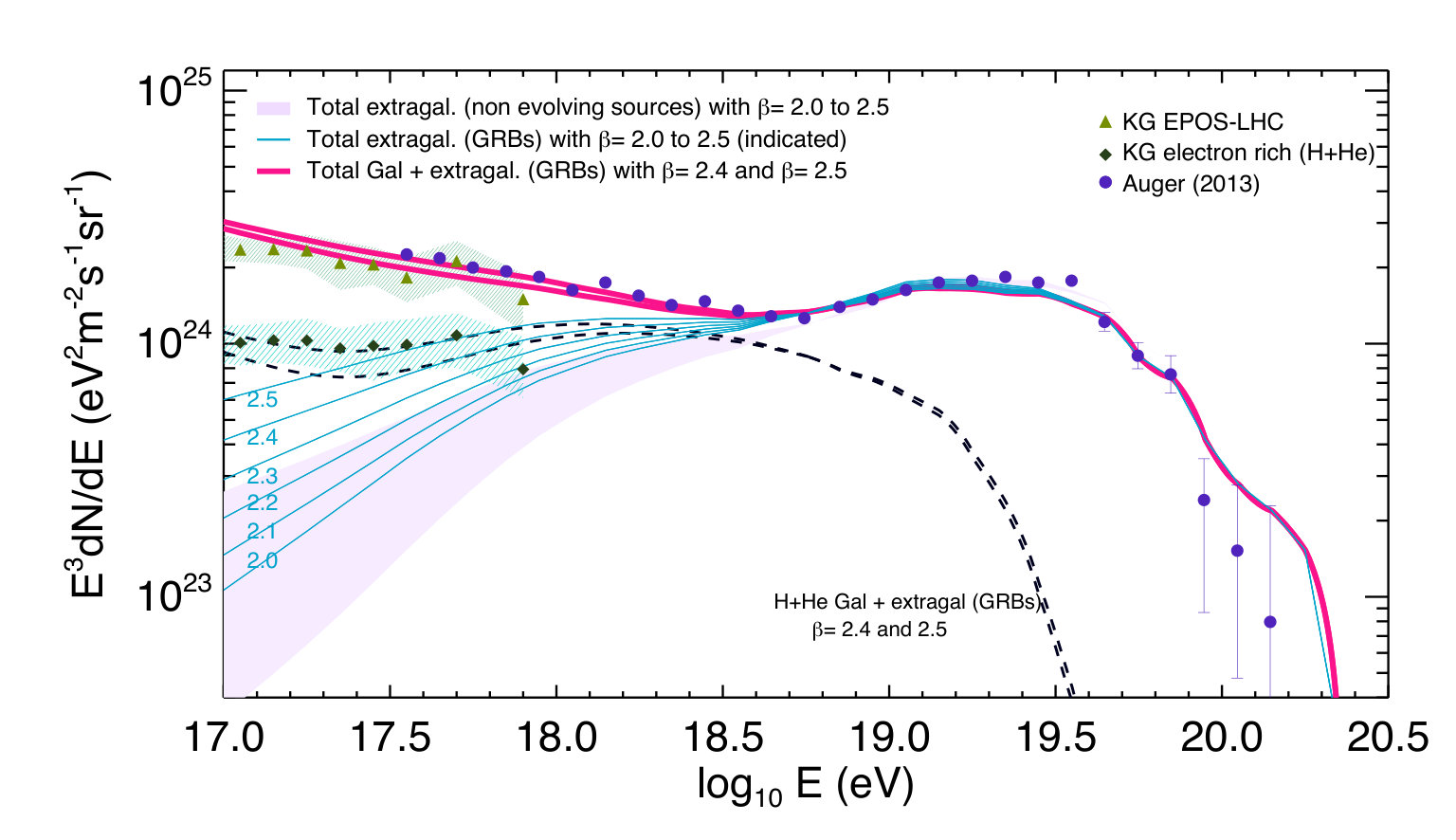 Figure 1
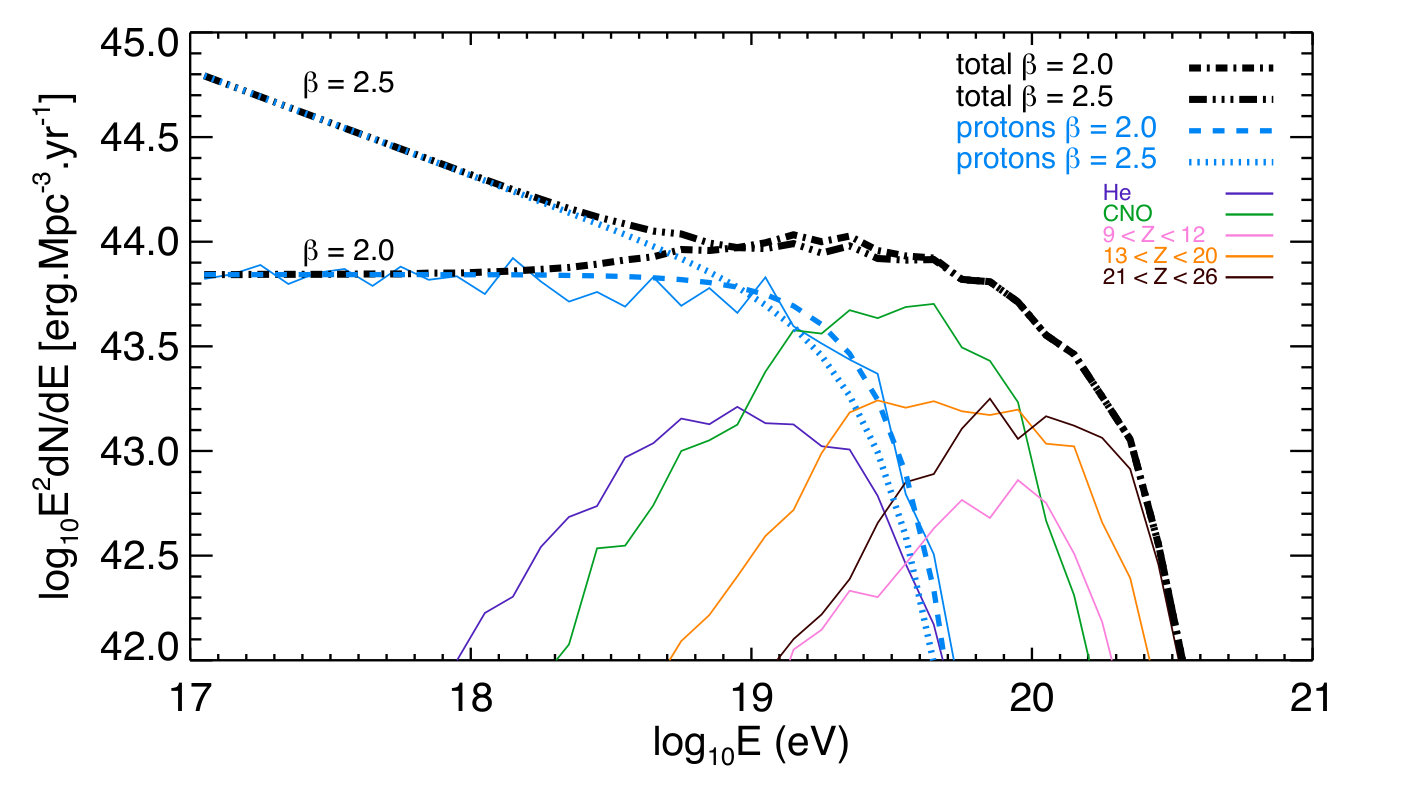 Figure 2
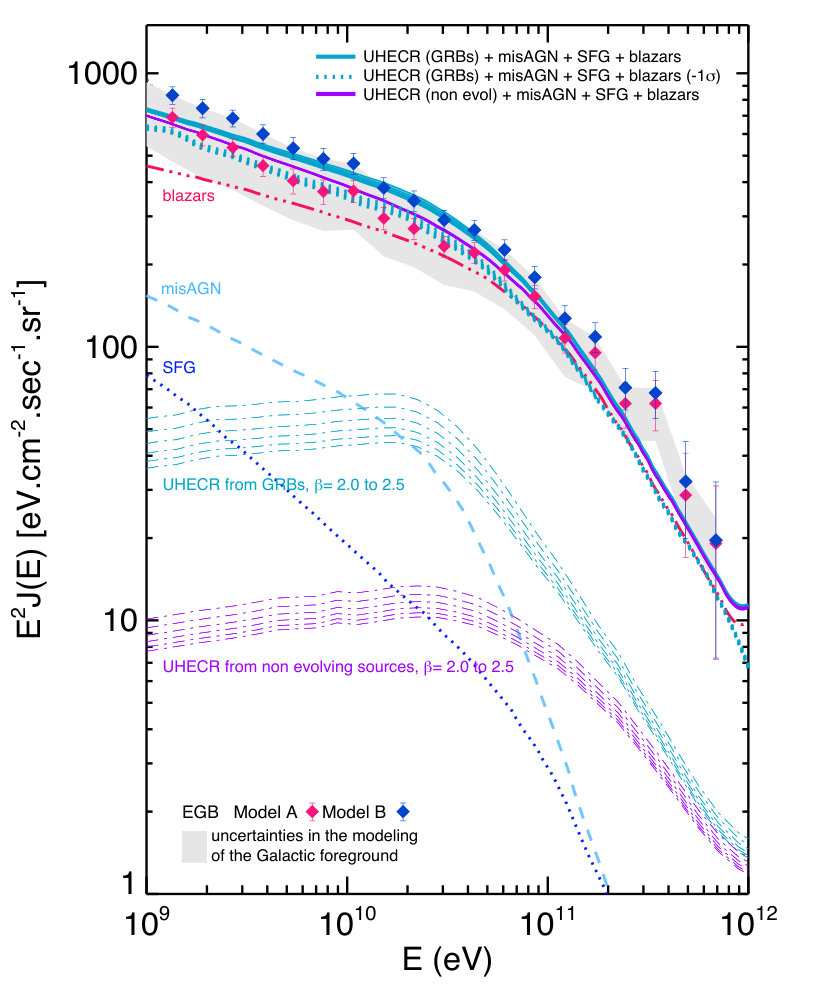 Figure 3
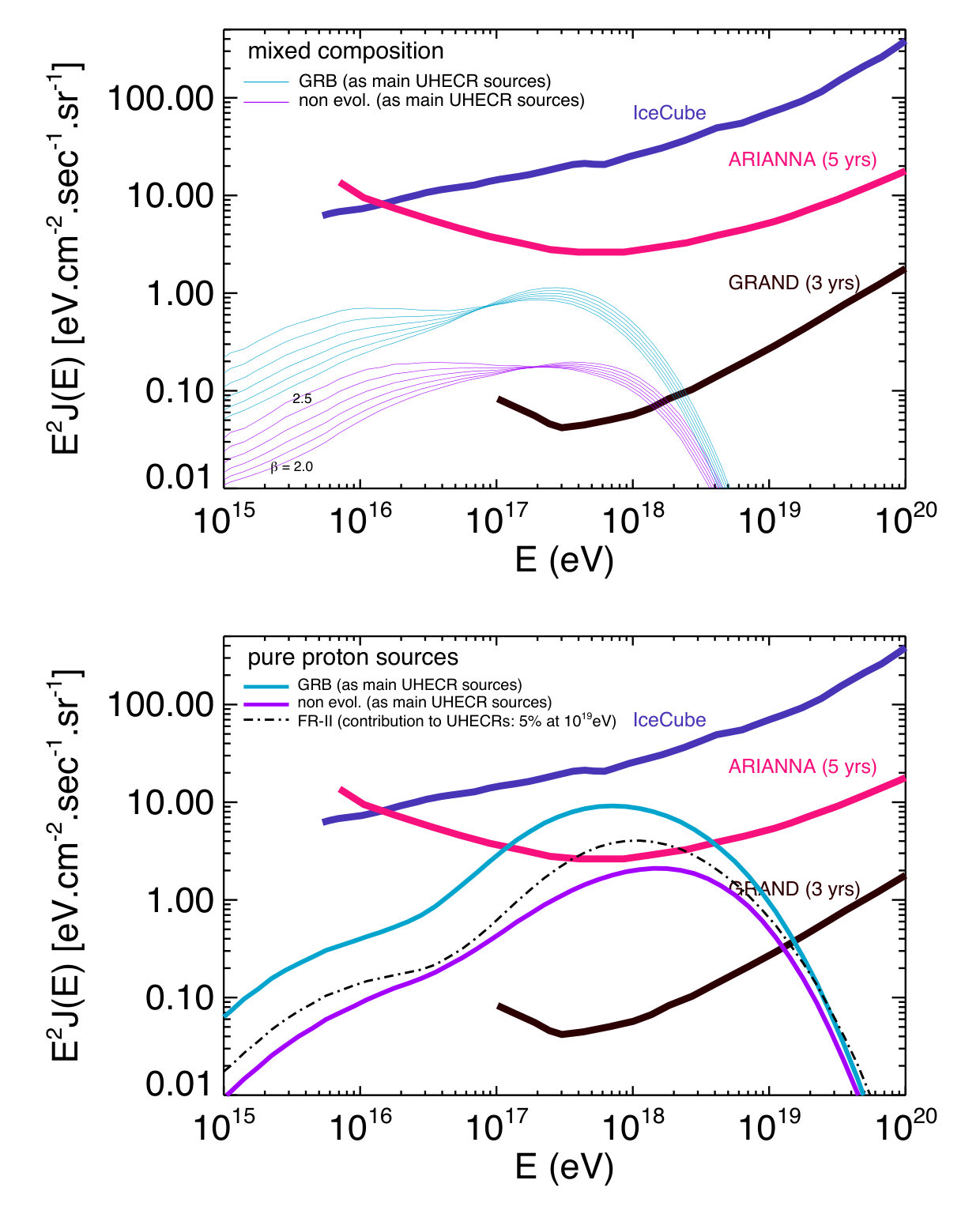 Figure 4
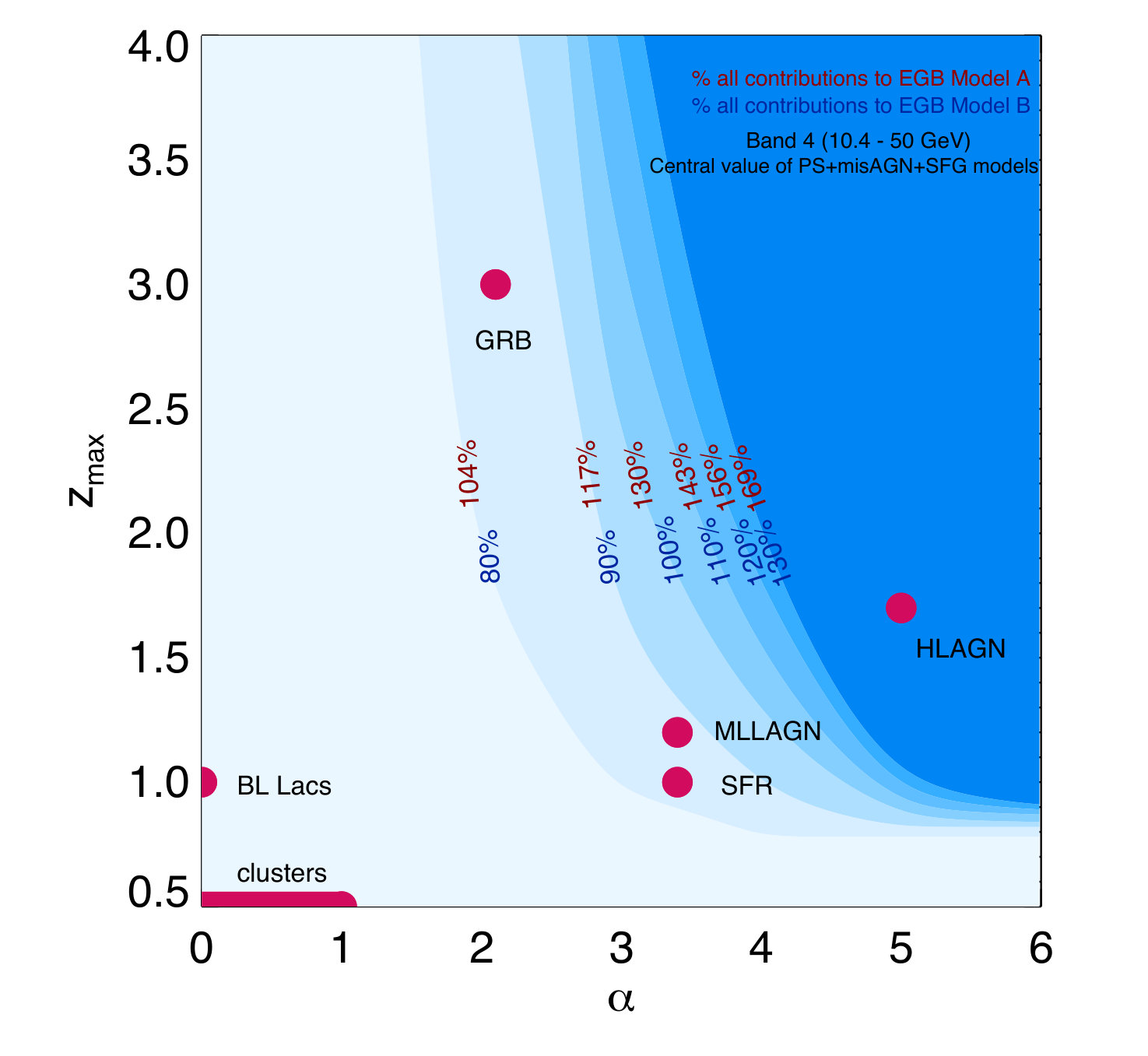 Figure 5
| \rowcolorflux Energy bands | \raisebox{-.9pt}{1}⃝ | \raisebox{-.9pt}{2}⃝ | \raisebox{-.9pt}{3}⃝ | \raisebox{-.9pt}{4}⃝ | \raisebox{-.9pt}{5}⃝ | \raisebox{-.9pt}{6}⃝ |
| \rowcolorflux (in GeV) | 1.04–1.99 | 1.99–5.0 | 5.0–10.4 | 10.4–50 | 50–171 | 50–2000 |
| () | ||||||
| (% Model A) | ||||||
| (% Model B) | ||||||
| () | ||||||
| (% Model A) | ||||||
| (% Model B) |
Peer Reviews
No public reviews on file for this paper yet. If you reviewed it on a platform where reviews are public (OpenReview, ICLR, NeurIPS, ICML), you can paste yours below so the community can read it here.
Videos
No videos yet. Explain this paper in a talk, walkthrough, or lecture? Add one.
Probing the Extragalactic Cosmic Rays origin with gamma-ray and neutrino backgrounds
Noemie Globus11affiliation: Racah Institute of Physics, The Hebrew University, 91904 Jerusalem, Israel , Denis Allard22affiliation: Laboratoire Astroparticule et Cosmologie, Université Paris Diderot/CNRS, 10 rue A. Domon et L. Duquet, F-75205 Paris Cedex 13, France , Etienne Parizot22affiliation: Laboratoire Astroparticule et Cosmologie, Université Paris Diderot/CNRS, 10 rue A. Domon et L. Duquet, F-75205 Paris Cedex 13, France , Tsvi Piran11affiliation: Racah Institute of Physics, The Hebrew University, 91904 Jerusalem, Israel
Abstract
GeV-TeV gamma-rays and PeV-EeV neutrino backgrounds provide a unique window on the nature of the ultra-high-energy cosmic-rays (UHECRs). We discuss the implications of the recent Fermi-LAT data regarding the extragalactic gamma-ray background (EGB) and related estimates of the contribution of point sources as well as IceCube neutrino data on the origin of the UHECRs. We calculate the diffuse flux of cosmogenic -rays and neutrinos produced by the UHECRs and derive constraints on the possible cosmological evolution of UHECR sources. In particular, we show that the mixed-composition scenario considered in Globus et al. (2015b), which is in agreement with both (i) Auger measurements of the energy spectrum and composition up to the highest energies and (ii) the ankle-like feature in the light component detected by KASCADE-Grande, is compatible with both the Fermi-LAT measurements and with current IceCube limits. We also discuss the possibility for future experiments to detect associated cosmogenic neutrinos and further constrain the UHECR models, including possible subdominant UHECR proton sources.
Subject headings:
cosmic rays
1. Motivation
The interaction of UHECRs with the photon backgrounds during their propagation in intergalactic space produces cosmogenic -ray photons (Strong & Wolfendale, 1973; Stecker, 1973) through electromagnetic cascades that contribute to the extragalactic gamma-ray background (EGB) at GeV-TeV energies, and cosmogenic neutrinos (s, Berezinsky & Zatsepin, 1969) mostly from PeV to multi-EeV energies. The flux of these secondary messengers is highly sensitive to the spectral shape, maximal energy, composition and cosmological evolution of the UHECR sources. Therefore one can derive important constraints on the UHECR origin from a multi-messenger approach that takes these into account (Protheroe & Johnson, 1996; Coppi & Aharonian, 1997; Ahlers & Salvado, 2011; Decerprit & Allard, 2011; Berezinsky et al., 2016; Supanitsky, 2016; Gavish & Eichler, 2016, for -rays); (e.g. Stecker, 1979; Engel et al., 2001; Seckel & Stanev, 2005; Allard et al., 2006; Anchordoqui et al., 2007; Ahlers et al., 2009; Kotera et al., 2010, for s).
Source models implying a cosmological evolution much stronger than the star formation rate (SFR) have already been ruled out as the main UHECR contributors by the first Fermi-LAT estimates of the purely diffuse component of the EGB (Abdo et al., 2010), independently of the maximum energy of UHECRs (), in particular for steep (soft) cosmic-ray injection spectra (e.g. Berezinsky et al., 2010; Ahlers et al., 2010; Decerprit & Allard, 2011). These strong evolutions have also been ruled out by the IceCube limits on s, in the case of source spectra with large values of the maximum energy-per-nucleon ( eV, see Aartsen et al., 2016).
Moreover, the recent Fermi-LAT data (Ackermann et al., 2015), together with statistics of the photon counts in the skymap pixels (e.g. Malyshev & Hogg, 2011, and references therein) have enabled different authors (Ackermann et al., 2016; Zechlin et al., 2016, hereafter A16 and Z16) to estimate the flux contributed by point sources (PS) well below the Fermi-LAT detection limits. These studies show that resolved and unresolved PS account for the majority of the EGB. Since a -ray background due to extragalactic cosmic rays (EGCRs) is unavoidable, it is crucial to verify that the proposed UHECR source models do not violate the existing constraints.
Recent measurements by the Pierre Auger Observatory (Auger) indicate that the composition of UHECRs is mixed (predominantly light) at the ankle of the cosmic-ray spectrum, and it gets progressively heavier as the energy increases (Aab et al., 2014). This composition trend can be interpreted as the signature of a low maximal energy-per-unit-charge ( eV) of the nuclei accelerated at the dominant sources of UHECRs. Below eV, the KASCADE-Grande experiment reported an ankle-like feature in the energy spectrum of light (proton-helium) elements with a break at eV (Apel et al., 2013; Bertaina et al., 2015). This “light ankle” can be naturally understood as the emergence of a light EGCR component, taking over the steeper Galactic cosmic-ray (GCR) component.
In this Letter, we investigate constraints that can be set on mixed-composition EGCR models, taking into account the most recent Fermi-LAT estimates of the EGB and its unresolved component. We discuss the viability of a class of mixed-composition models in which the KASCADE-Grande and Auger data are understood in terms of a transition between a GCR component and a single EGCR component with a soft proton spectrum and low . This soft proton component would be responsible for the light ankle and it would be the dominant contributor to the cosmogenic -ray flux. This model was shown to be compatible with the spectrum and composition data at all energies (Globus et al., 2015b, hereafter G15b), and it is consistent with the anisotropy constraints on galactic protons (Tinyakov et al., 2016).
2. Source model
Any phenomenological EGCR model that account for the data needs a very hard spectrum at the sources, to reproduce the evolution of the composition above the ankle observed by Auger, and a soft proton component, to account for the light ankle seen by KASCADE-Grande. As an example we consider the EGCR source model for UHECR acceleration at gamma-ray bursts (GRB) internal shocks (Globus et al., 2015a, hereafter G15a), whose basic features result from the presence of a dense, broad-band photon field in the acceleration environment, and should thus also be expected in other types of powerful high-energy sources. Those features are:
A very hard source spectrum for the composed nuclei (harder than below ), with a rigidity-dependent cut-off due to the selection of high rigidity particles by the escape process.
A much softer source spectrum for the nucleons, due to the free escape of neutrons produced by the photo-disintegration of nuclei.
Both features would arise in any model based on electromagnetic acceleration including a significant dissociation of the nuclei at the source.
The exact shape of the source spectrum of the escaping nucleons and composed nuclei depends on various physical parameters, such as the shock geometry and its time evolution, the local magnetic turbulence, and the competition between energy losses and escape (G15a). Moreover, the distribution of source luminosities influences the shape of the effective UHECR spectrum (obtained after convoluting the individual source spectra by the source luminosity function). The effective spectrum from the GRB model (G15a) is displayed in the upper panel of Fig. 1.
Since the extragalactic protons around eV contribute significantly to the expected cosmogenic -ray flux in the Fermi energy range, we explore, for the sake of generality, (i) different slopes for the proton component (as could result from different physical parameters describing the sources) while keeping the same maximal rigidity and spectral shape for heavier nuclei; (ii) different cosmological evolutions, assuming an average source power proportional to up to a redshift .
The soft proton component of the effective UHECR spectrum (upper panel of Fig. 1) is well fitted by a power law with a Gaussian cut-off, with and eV. In the following, we allow for a modification of the original proton spectrum, and consider a range of spectral indices . The two proton spectra obtained with the extreme values of are represented by thick dashed and dotted blue lines, respectively. The implied range of UHECR emissivities above eV is . When considering different cosmological evolutions, we need to further rescale the propagated spectrum by a factor between and to match the Auger data at high energy. The Monte-Carlo procedure used to calculate the cosmic-ray, and -ray spectra is presented in Decerprit & Allard (2011).
3. Propagated cosmic-ray spectra
The lower panel of Fig. 1, depicts the propagated UHECR spectra for , for EGCR sources evolving as GRBs (Wanderman & Piran, 2010, blue lines) and for non evolving sources (violet shaded area). Varying the cosmological evolution of UHECR sources does not affect the high-energy part of the propagated spectrum, since the sources contributing at these energies are located at low redshifts (due to the GZK horizon effect). However, a stronger source evolution implies a larger contribution of the more distant sources and thus a larger UHECR flux at lower energies. As a result, a suitable combination of the soft proton source spectrum and a strong cosmological evolution can reproduce the light (supposedly proton-helium) cosmic-ray component estimated from KASCADE-Grande data.
In the case of a GRB-like cosmological evolution (or SFR-like (Yüksel et al., 2008) that gives very similar results), proton spectral indices provide a good fit to the KASCADE-Grande data when summing the light EGCR component with the GCR light component obtained in G15b (dashed line in Fig. 1). The resulting proton abundance increases over the eV energy range, before slowly dropping above the ankle, reproducing the observed composition trend in the GCR-to-EGCR transition and above.
In a non-evolving scenario, softer proton indices (, and thus larger injection power density) are required to obtain such a large contribution of the EGCR component at low energy. Conversely, a stronger source evolution than that of GRBs would require harder proton indices.
The reference list from the paper itself. Each links out to its DOI / PubMed record.
- 1Aab et al. (2014) Aab A. et al. (Pierre Auger Collaboration), 2014, Phys. Rev. D 90, 122006
- 2Aartsen et al. (2016) Aartsen, M. G. et al. [Ice Cube collaboration], 2016, Phys. Rev. Lett. 117 (24), 241101, ar Xiv:1607.05886 [astro-ph.HE]
- 3Abdo et al. (2010) Abdo A. A. et al. [Fermi Collaboration], 2010, Ap J, vol. 720, pp. 435
- 4Ackermann et al. (2015) Ackermann M. e. a., 2015, Ap J, 799, 86
- 5Ackermann et al. (2016) Ackermann M. e. a., 2016, Phys Rev Letters,116, 151105
- 6Ackermann et al. (2012) Ackermann, M., Ajello, M., Allafort, A., et al. 2012 b, Ap J, 755, 164
- 7Ahlers et al. (2009) Ahlers M., Anchordoqui L. A. and Sarkar S., 2009, Phys. Rev. D 79(8), 083009.
- 8Ahlers et al. (2010) Ahlers M., Anchordoqui L. A., Gonzalez-Garcia M. C., Halzen F. and Sarkar S., 2010, Astroparticle Physics, vol. 34, pp 106, ar Xiv: 1005.2620.