11institutetext:
SEPARATION IN SIMPLY LINKED NEIGHBOURLY 4-POLYTOPES
T.BISZTRICZKY
Abstract
The Separation Problem asks for the minimum number s(O,K)
of hyperplanes required to strictly separate any interior point O
of a convex body K from all faces of K. The Conjecture is s(O,K)
≤2d in \bbbrd, and we verify this for the class of
simply linked neighbourly 4-polytopes.
2010 MSC: 52B11, 52B05.
keywords: Gohberg-Markus-Hadwiger covering number, neighbourly polytope, separation problem
1 INTRODUCTION
We recall that the Separation Problem is the polar version of the Gohberg-Markus-Hadwiger Covering Problem for convex bodies, and refer to [2], [6] and [9] for an overview of the topic.
For convex d-polytopes P, the Conjecture has been verified in the case that P is cyclic or a type of neighbourly 4-polytope( totally-sewn or with at most ten vertices). We refer to [3] for an overview of these results.
In the following, we assume that P is a neighbourly 4-dimensional polytope in \bbbr4. Then P is convex and any two distinct vertices determine an edge of P. We refer to [8] and [12] for the basic geometric and combinatorial properties of P.
With formal definitions to follow; we note only that cyclic polytopes are neighbourly and totally-sewn, and that totally-sewn P are linked. Thus, we verify the Conjecture for a new class of P.
As for organization: Section 2 contains definitions and conventions. In Section 3, we examine the inner structure of P. In Section 4, we determine some separation properties of P. We introduce simply linked P and present our separation results in Section 5 and 6.
2 DEFINITIONS
Let Y be a set of points in \bbbrd. Then conv Y and aff Y denote, respectively, the convex hull and the affine hull of Y. For sets Y1,Y2,⋯,Yk, let
[TABLE]
and ⟨Y1,Y2,⋯,Yk⟩= aff (Y1∪Y2∪⋯∪Yk). For a point y, let [y]=[{y}] and ⟨y⟩=⟨{y}⟩.
Let Q∈\bbbrddenote a (convex) d-polytope with V(Q),E(Q) and F(Q) denoting, respectively, its sets of vertices, edges and facets. For x∈V(Q), Q/x denotes the vertex figure of Q at x. For E=[x,y]∈E(Q), Q/E denotes the quotient polytope (Q/y)/x. We note that Q/E is a (d−2)-polytope.
Let d=4. As a simplification, we assume always that Q/x is contained in a hyperplane H⊂\bbbr4 that strictly separates x from each y∈V(Q)/{x}, and denote H∩[x,y]=H∩⟨x,y⟩ also by y. Then of importance here are the following:
2.1
For yi∈V(Q)/{x}; a plane ⟨y1,y2,y3⟩ separates y4 and y5 in ⟨Q/x⟩ if, and only if, the hyperplane ⟨x,y1,y2,y3⟩ separates y4 and y5 in \bbbr4, and
2.2
For yi∈V(Q)/E; a line ⟨z1,z2⟩ separates z3 and z4 in ⟨Q/E⟩ if, and only if the hyperplane⟨E,z1,z2⟩ separates z3 and z4 in \bbbr4.
Let S⊂\bbbr3 be a 3-polytope with s≥4 vertices. Then S is stacked if either s=4 or S is the convex hull of a stacked 3-polytope with s−1 vertices and a point in \bbbr3 that is beyond exactly one facet of S.
Let S be stacked, {x,y,z}⊂V(S) and C=[x,y,z] be a triangle. We say that C is a cut of S if E(C)⊂E(S) but C∈/F(S). All the cuts of S decompose S into components, each of which is a 3-simplex. We note that ∣V(S)∣=s yields that S has s−4 cuts and s−3 components.
Let Nm denote the family of combinatorially distinct neighbourly 4-polytopes with m≥5 vertices, P∈Nm+1,x∈V(P) and Q=[V(P)\{x}]. We note that Q∈Nm.
The relevance of stacked 3-polytopes here is the following result in [1]:
2.3
P/x* is a stacked 3-polytope with m vertices; furthermore, [y1,y2,y3,y4] is a component of P/x if, and only if, [y1,y2,y3,y4]∈F(Q)\F(P). Hence, x is beyond exactly m−3 facets of Q.*
Next, let E=[x,y]∈E(P). Then E is a universal edge of P if [E,z] is a 2-face of P for each z∈V(P)/{x,y}. Let U(P) denote the set of universal edges of P. We observe from [12] and [13] that
2.4
E=[x,y]∈U(P)* if, and only if, x and y lies on the same side of every hyperplane determined by the vertices of P. From the same sources; if ∣V(P)≥7 then any vertex of P is on at most two members of U(P), and ∣U(P)∣≤∣V(P)∣.*
We recall that a cyclic 4-polytope Cm with m vertices is combinatorially equivalent to the convex hull of m points on the moment curve in \bbbr4. From [7], [8] and [12], we note that Cm∈Nm, N6={C6}, ∣U(C6)∣=9, N7={C7}, ∣U(Cm)∣=m for m≥7, and any 4-subpolytope of Cm is again cyclic. For m≥6, there is a natural ordering (Gale’s Evenness Condition) of V(Pm) that corresponds to the order of appearance of equivalent points on the moment curve.
Let m≥8. Most of our knowledge about members of Nm is based upon various construction techniques: given Q∈Nm−1, find a point xˉ∈\bbbr4/Q such that Qˉ=[Q,xˉ]∈Nm. It is noteworhy that, at present, known constructions such as Shemer Sewing, Extended Sewing and Gale Sewing(cf. [12], [10] and [11]) yield that U(Qˉ)\U(Q)=∅. We introduce a class of polytopes to reflect this fact.
Let n≥7 and Pn∈Nn. We say that Pn is linked if for m=n−1,⋯,6, there is a Pm∈Nm with the property that
[TABLE]
We say that Pn is linked under the (vertex) array xn>xn−1>⋯>x1 if for m=n−1,⋯,6,
[TABLE]
For xt∈{x7,⋯,xn} and xr∈{x1,⋯,xt−1}, we say that xt is linked to xr (xt→xr) if [xt,xr]∈U(Pt) and [xt,xj]∈/U(Pt) for j>max{6,r}.
By way of clarification for requiring that t≥7; we note that
2.5
P6* is cyclic and there are disjoint three element subsets Y and Z of V(P6) such that U(P6)={[y,z]∣y∈Y and z∈Z}. Thus, there is no meaningful labeling of a greatest or a least vertex of P6*
3 THE INNER STRUCTURE OF P
Let v∈V(P), Q⊂P, v∈/Q, Q∈Nm and R=[Q,v]. We recall that
R∗=R/v is a stacked 3-polytope and that y∈V(Q) denotes also {y∗}=⟨v,y⟩∩⟨R∗⟩. We describe R∗.
Let
[TABLE]
[TABLE]
and
[TABLE]
From 2.1, we have that
Zt=∅(Zt′=∅) if and only if, [y1,yt,yt+1] ([y2,yt,yt+1]) is a cut of R∗.
Hence, we have a generic description of R∗; cf. the Schlegel diagram in Figure 1.
Next, we observe from 2.3 and 2.1 that
⟨y1,y2,yt,yt+1⟩ separates v and Q for t=3,⋯,a−1, and
⟨v,y1,y2,yt⟩ separates Zr∪Zr′(r<t) and Zs∩Zs′(s≥t) for t=4,⋯,a−1.
From 2.2, we depict these separation properties with respect to Q/[y1,y2] and R/[y1,y2] in Figure 2.
REMARKS Let R∗=R/v be labeled as above.
3.1
If a=m then F(Q)\F(R)={[y1,y2,yt,yt+1]∣ t=3,⋯,a−1}, [y1,y2]∈U(Q) and {[v,y1],[v,y2]}⊂U(R).
There is such a labeling of R∗ if R is cyclic or if R is constructed by a Shemer sewing of v onto Q.
3.2
If w∈V(P)\V(Q) and [w,v]∈U([Q,v,w]) then F(Q)\F([Q,w])=F(Q)\F(R) by 2.4.
3.3
Let 3<t<a. If ⟨v,y1,y2,yt⟩ strictly separates vertices pt and st of Q then [pt,st] is not an edge of R∗, and [v,pt,st] is not a face of R.
We note from Figure 2 that under the hypotheses of 3.3, each hyperplane through ⟨y1,y2,yt⟩ strictly separates some two of v, pt and st. Thus, the following is the more general result; cf. [5].
3.4
If {xa,xb,xc,xe,xf,xg} is a set of six vertices of P and each hyperplane of \bbbr4 though {xa,xb,xc} strictly separates two of xe,xf and xg, then [xa,xb,xc] and [xe,xf,xg] are not faces of P.
4 GENERIC SEPARATION PROPERTIES OF P
Let P∈Nm,m≥6, and O be an interior point of P. We determine hyperplanes H∈\bbbr4 that strictly separate O from facets of P. As a simplification, we determine H that do not contain O. We consider first F∈F(P) that either are contained in a subpolytope Q such that O∈/int Q or have a common vertex w.
Lemma A
( cf. [4] ) Let O∈bd(Q). Then O is strictly separated from any F∈F(P)∩F(Q) by one of at most three hyperplanes.
Lemma B
Let w∈V(P),R∈Nm−1,P=[R,w] and F∈F(P) such that w∈F. Then O is strictly separated from any such F by one of at most four(six) hyperplanes in case O is (is not) an interior point of R.
Proof
Since P∗=P/w is stacked and O∈int P, it follows that O∗∈⟨w,O⟩∩P∗ is in a component A∗=[x∗,y∗,z∗,v∗] of P∗. If O∗∈relint A∗ then O is separated from F by one of ⟨w,x,y,z⟩, ⟨w,x,y,v⟩, ⟨w,x,z,v⟩ and ⟨w,y,z,v⟩.
Let O∗∈B∗=[x∗,y∗,z∗], say. Then B∗ is a cut of P∗, O∈⟨w,x,y,z⟩ and there are subpolytopes P′ and P′′ of P such that P′∩P′′=[w,x,y,z],[P′,P′′]=P and (since w∈F) either F⊂P′ or F⊂P′′.
We recall from 2.3 that [x,y,z,v]∈F(R)\F(P). If O∈int R then it is clear that O∈/[w,x,y,z]; that is, O∈/P′∪P′′ and O is separated from F by one of two hyperplanes. If O∈[w,x,y,z] then O∈bd(P′)∩bd(P′′) and we apply LEMMA A. ∎
REMARKS Let Q be a subpolytope of P such that O∈/int Q.
4.1
If Q∈Nm−1 then O is strictly separated from any F∈F(P) by one of at most nine( three from LEMMA A, six from LEMMA B) hyperplanes.
4.2
If Q∈Nm−3 then O is strictly separated from any F∈F(P) by one of at most fifteen hyperplanes.
For 4.2, we apply LEMMA B under the assumption that O is an interior point of any Q′∈Nm−1 such that Q′⊂P
5 SIMPLY LINKED P
Let n≥7 and P=Pn∈Nn be linked under the array xn>xn−1>⋯>x1.
Let W={ws,ws−1,⋯,w1} be an s element subset of V(P) with the induced array ws>ws−1>⋯>w1 in the case s>1. Then W is a chain if either s=1 or
[TABLE]
For xk∈V(P), let Vk denote the union of all chains of P with xk as the least vertex.
Finally, we say that Pn is simply linked if for k=7,⋯,n:
Vk is a chain, and
for disjoint chains Vc and Vd, there are xi=xj in V(P6) such that xc→xi,xd→xj and [xi,xj]∈/U(P6).
Henceforth, we assume that Pn is simply linked. Then it follows from 2.5 that {x7,⋯,xn} is the union of at most three pairwise disjoint maximal chains.
Lemma C
*Let 6≤m<n,xm<xt,xk<xt and xt∈/Vk.
C.1 H∩[Vt]=∅ for any hyperplane H spanned from {x1,⋯,xm}.
C.2 Let Hh=⟨xa,xb,xc,xh⟩ be a hyperplane with {xa,xb,xc}⊂{x1,⋯,xm} and Hh∩Vk={xh}. Then Hh∩[Vt]=∅.
C.3 Let xt→xj,xj∈/{xa,xb,xc} and Hh be defined as above. Then Hh∩[Vj]=∅.*
Proof
Since P is simplicial, it follows from H∩[Vt]=∅ that H strictly separates some xv and xu in the chain Vt such that xv→xu. Then [xv,xu]∈U(Pv) and Pm⊂Pt⊂Pv yield a contradiction by 2.4.
As above, Hh∩[Vt]=∅ implies that Hh strictly separates some xs and xq in Vt such that xs→xq. Thus, C.1 yields that xs<xh and xt∈Ps⊂Ph. From xh∈Vk and xk<xt<xh, there is an xg∈Vk such that xh→xg. Then [xg,xh]∈U(Ph),xm<xt<xh,Vk∩{xa,xb,xc}=∅ and 2.4 yield that in the pencil of hyperplanes containing ⟨xa,xb,xc⟩:
[TABLE]
Hence, ⟨xa,xb,xc,xg⟩also strictly separates xs and xq, and xt∈Ps⊂Pg⊂Ph. It now follows from xh→xg→⋯→xk that xt∈Ps⊂Pk⊂Ph; a contradiction.
We note that Vj={xj}∪Vt and
that if Hh∩[Vj]=∅ then Hh strictly separates xt and xj by C.2, and xt<xh by C.1. We now argue on above and obtain a contradiction. ∎
REMARKS We recall that Pm=[xm,xm−1,⋯,x1] for m=n,⋯,6. Let P5 denote any 4-subpolytope of P6. In view of 2.5,
5.1
there is a labeling of V(P6), which we may denote by x1,x2⋯,x6, such that
P6* satisfies Gale’s Evenness Condition with x1<x2<⋯<x6,Y={x1,x3,x5},Z={x2,x4,x6}*
P5=[x1,x2,⋯,x5], and
any hyperplane through ⟨Y⟩ strictly separates two elements of Z.
We recall that P=Pn is simply linked under xn>xn−1>⋯>x1 and Pm=[xm,⋯,x1] for m≥5. Let O be an interior point of P,6≤m≤n−1 and O∈Pm\Pm−1. We note that a vertex of [xm+1,⋯,xn] is linked to a vertex of Pm.
With v=xw>xm,Q=Pm and R=[Q,v], we label Q and R∗=R/v
as in Section 3 so that xw→y1 (hence, each Zt′ is empty) and ⟨xw,O⟩∩[y1,y2,yt,yt+1]=∅ for some 3≤t≤a−1. We let T=[y1,y2,yt,yt+1],
[TABLE]
and note that
T∈F(Q)\F(R) and V(Pm)=Ya∪Z3∪⋯∪Za−1=V(T)∪Zt−∪Zt∪Zt+.
From the Schlegel diagram of R∗ on [y1,y2,ya] in Figure 1, we readily obtain diagrams of R∗ on 2-faces containing [y1,yt] or [y2,yt]. In Figure 3, 4 and 5, we depict associated polygons R/[y1,y2],R/[y1,yt] and R/[y2,yt] that include [Vw](as per 3.2 and C.1) and hyperplanes H1,H2,H3,H4 and H5 that separate O and [Vw]. We note that each of H2,H3,H4 and H5 intersects and supports [Vw]. For i=1,⋯,5, let Hi− and Hi+ denote the open half-spaces of \bbbr4 determined by Hi with Vw⊂Hi∪Hi+.
REMARKS Let F∈F(P) and assume by 4.2 that m≤n−3. From ⟨xw,O⟩∩T=∅, we have the following:
5.2
O is separated from all F with a common vertex by one of at most four hyperplanes; cf. LEMMA B.
5.3
O∈[xm,Pm−1]\Pm−1* is separated from any F∈F(Pm) by one of at most five hyperplanes.*
5.4
If F∩Vw=∅ then F intersects at most one of Zt−,Zt and Zt+; cf. 3.4.
5.5
If O∈/T then O is separated from any F such that F∩Vw=∅ and V(F)⊂V(Pm)∪Vw by one of H2,H3,H4, and H1 or H5 in the case F∩(Zt−∪Zt∪Zt+)=∅.
5.6
Let xm∈/T. Then O is separated from any F such that V(F)⊂V(Pm−1)∪Vw by one hyperplane.
Regarding 5.6; let ⟨xw,O⟩∩T={p1}. Then ⟨xw,O⟩∩bd(Pm−1)={p1,p2} and ⟨xw,O⟩∩bd(Pm)={p1,p3} with p2∈[p1,p3]. From O∈[xm,Pm−1]\Pm, we obtain that O∈[p2,p3]. It is now clear that there is an F′∈F(Pm−1) such that p2∈F′ and ⟨F′⟩ separates O from F with V(F)⊂V(Pm−1)∪Vw.∎
Since P is simply linked and m≤n−3, we consider the case that {xm+1,⋯,xn} is the union of mutually disjoint chains Vw,Vs and Vr with xw→y1∈Pm,xs→y^1∈Pm and xr→yˉ1=xm. Then with labelings analogous to the one for Q=Pm and R∗[Pm,xw]/xw;
[TABLE]
corresponds to [Pm,xs]/xs and
[TABLE]
corresponds to [Pm,xr]/xr.
We simplify the notation and let uj=y^j,Uj=Z^j,rj=yˉj and Vj=Zˉj.
With reference to Figure 3, 4 and 5, we assume that {T,L,I}⊂F(Pm) and that
⟨xw,O⟩∩T=∅ with T=[y1,y2,yt,yt+1]∈/F([Pm,xw]),
⟨xs,O⟩∩K=∅ with K=[u1,u2,uk,uk+1]∈/F([Pm,xs]),
⟨xr,O⟩∩I=∅ with I=[v1,v2,vi,vi+1]∈/F([Pm,xr]),
O is separated from [Vs]([Vr]) by H^1,⋯,H^5(Hˉ1,⋯,Hˉ5) and
Vs⊂H^j∪H^j+(Vr⊂Hˉj∪Hˉj+) for j=1,⋯,5.
REMARK We refer to Figure 4, and consider any hyperplane H′ through ⟨y1,yt,yt+1⟩ in the case that xs→u1=y2. Then [xs,y2]∈U(Ps), and it follows from LEMMA C that if H′∩Zt=∅, then H′∩[y2,xs]=∅,H′∩[Vs]=∅ and H′ strictly separates [Vs] and [Vw]. The following now follows from 3.4:
5.7
If u1=y2 and F∩Vs=∅=F∩Vw then F∩Zt=∅.
Lemma D
Let F∈F(P). Then F intersects at most two of V2,V4 and V6, and at most two of Vw,Vs and Vr.
Proof
The existence of Vw,Vs and Vr imply that {x7,⋯,xn} is the union of pairwise disjoint chains Ve,Vf and Vg, say. Since P6 is cyclic with x1<x2<⋯<x6, we may assume by 2.5 and 5.1 that xe→x2,xf→x4 and xg→x6.
From 5.1 and LEMMA C, we obtain that any hyperplane H through ⟨x1,x3,x5⟩ strictly separates two of V2,V4 and V6. Hence, no face of P intersects each of V2,V4 and V6 by 3.4. ∎
REMARK We refer to Figure 3, 4 and 5, and consider a v∈V(P) with the property that v∈H1−,v∈/H2+∪H3+∪H4+ and no hyperplane spanned from v,y1,y2,yt,yt+1 intersects [Vw].
Then ⟨xw,y1,y2,yt⟩ separates v and Zt−,⟨xw,y1,y2,yt+1⟩ separates v and Zt+, and ⟨xw,y1,yt,yt+1⟩ separates v and Zt. From [Pm,xw]/[xw,y1], it now follows that [xw,y1,v] is not a 2-face of [Pm,xw,v] or [xw,y1,y2,yt,yt+1,v]. Since the latter polytope is cyclic, we obtain from 5.1 that
5.8
⟨v,y2,yt,yt+1⟩* strictly separates xw and y1.*
Lemma E
*Let xw<xs,F∈F(P) and F∩Vw=∅=F∩Vs. Then O is separated from any such F by
E.1 at most three hyperplanes (H^2,H^3,H^4) in the case xw∈H^1− and O∈/bd(K),
E.2 one hyperplane (Hi,2≤i≤4) in the case u1∈/T and O∈/bd(T),
E.3 one hyperplane (Hi,2≤i≤5) in the case xw∈H^i+,u1∈T,xs∈H1− and O∈/bd(T), and
E.4 at most two hyperplanes from H2,H3,H^2,H^3 in the case xw∈H^1+,xs∈H1+,O∈/bd(K)∪bd(T) and either T=K , or T=K and F∩H1−=∅=F∩H^2−.*
Proof
We refer to Figure 3, 4 and 5, and the analogous figures with Vs,K,Uj=Z^j and H^j for the location of O, and note V(F)⊂V(Pm)∪Vw∪Vs by LEMMA D.
E.1 Let xw∈H^1−. Then Vw⊂H^1− by C.1, and either (V(F)∩H^1−)∩H^j+=∅ for some j∈{2,3,4} or there is a v∈Vw such that v∈/H^2+∪H^3+∪H^4+. In case of the former, O is separated from F by H^j; cf. 5.4. In case of the latter, it follows from xw<xs and C.3 that ⟨v,u2,uk,uk+1∩[Vs∪{u1}]=∅; a contradiction of 5.8.
E.2 Let u1∈/T. Then xs→u1∈Pm yields that u1∈Zt−∪Zt∪Zt+⊂H2+∪H3+∪H4+ and Vs⊂H1−. Now xw<xs and C.1 yield that if u1⊂Hj+ then Vs⊂Hj+ and O is separated from F by Hj.
E.3 Let xw∈H^1+ and u1∈T. Then u1∈{y2,yy,yt+1},y1∈{u2,uk,uk+1} and may assume that u1=y2 and y1=u2. From 5.7, we obtain that F∩Zt=∅=F∩Uk.
Let xs∈H1−. Then ⟨T⟩=H1=H^1=⟨K⟩ and T=K; cf. Figure 6 with xs∈H3+, say, and Vs⊂H1−∩H3+. We consider the hyperplanes through ⟨y1,y2,yt+1⟩ and obtain from 3.4 that F∩Zt−=∅. Hence, O is separated from F by H3 in this case.
E.4 Let xw∈H^1+,xs∈H1+ and O∈/bd(K)∪bd(T). Then u1∈T, we assume that (y1,y2)=(u2,u1) and note that F∩(Zt∪Uk)=∅.
If T=K then we may assume also that Vs⊂H1+∪H3+ as in Figure 6. If there is an F′∈F(P) such that O is not separated from F′ by H3 then F′∩Zt+=∅ by 5.4. From F′∩Zt=∅, it now follows that F′∩(Zt−∪{yt})=∅.
Let Zt−(s)={z∈Zt−∣⟨y1,y2,yt+1,z⟩ does not separate xw and xs} . We apply C.1 and 3.4, and obtain that F′∩Zt−⊂Zt−(s). Thus, either O is separated from F′ by H1 (and so H^2), or there is an F′ such that F′∩Zt−=∅. In the latter case, it is easy to check (cf. Figure 6) that O is separated from any such F′ by H2 or H^2.
Finally, let T=K with (y1,y2,yt,yt+1)=(u2,u1,uk,uk+1) and, say, Vs⊂H3+. We argue now as above that if O is not separated from F′∈F(P) by H3 or H1=H^1 then O is separated from F′ by H2 or H^2. ∎
REMARK We observe that under the hypotheses of LEMMA E, it follows from LEMMA A that
5.9
If O∈bd(k)∪bd(T) and H is a separating hyperplane through O then we may replace H by three strictly separating hyperplanes.
6 SEPARATION RESULTS
With O∈intP, let s(O) denote the minimum number of hyperplanes required to strictly separate O from any facet of P. We prove that s(O)≤16 under the assumption that P=Pn is simply linked under the array xn>xn−1>⋯>x1,Pm=[xm,⋯,x2,x1] for m=n−1,⋯,5 and V(P)={x1,x3,x5}∪V2∪V4∪V6.
6.1
We consider first the case of O∈Pm\Pm−1 for some 6≤m≤n. As noted in Sections 4 and 5, we may assume that m≤n−3 and that {xm+1,⋯,xn} is the union of non-empty chains Vr,Vs and Vw described in Section 5.
Our arguments are based upon
the location of xm with respect to T and K,
the order of xr with respect to xw<xs, and
the location of O with respect to T,K and I.
For each location of O, we present the separation result
{k}: property: rationale
to indicate that at most k separating hyperplanes suffice for F∈F(P) with the indicated property due to the specified reasons. {−} indicates that the separating hyperplanes for this case have already counted.
I. xm∈/T∪K
Then T∪K⊂Pm−1 and O∈/T∪K. From xm∈H1−∩H^1−,xr→xm and 2.4,we have that xr∈H1−∩H^1−. Next, LEMMA D and its proof yield that any F intersects at most two of Vw,Vr and Vs, and that [v1,u1,y1] is not a 2-face of Pm. Hence , xm∈I implies that {u1,y1}⊂I.
I.1 O∈/bd(I)
We apply our Lemmas and Remarks. Then
{4}:xm∈F:5.2
{1}:V(F)⊂V(Pm−1)∪Vw:5.6
{1}:V(F)⊂V(Pm−1)∪Vs:5.6
{3}:F∩Vw=∅=F∩Vs:E.1, and
{4}:V(F)⊂V(Pm)∪Vr,F∩Vr=∅:5.5 with Hˉ2,Hˉ3,Hˉ4,Hˉ5(as v1=xm∈/F).
It remains to consider F that inersect Vr and Vw∪Vs. Here, we apply {u1,y1}⊂I and LEMMA E with relabeling as necessary
I. 1.1 xr<xw<xs
As xw and xs are interchangeable with respect to xr, we assume that u1∈/I,
say. Then
{−}:F∩Vr=∅=F∩Vs:xr<xs,u1∈/I and E.2 with Hˉ2,Hˉ3 and Hˉ4 already counted, and
{3}:F∩Vr=∅=F∩Vw:xr<xw,xr∈H1− and E.1.
I. 1.2 xw<xr<xs
If u1∈/I then one case is above, and
{1}:F∩Vr=∅=F∩Vw:xw<xr,v1=xm∈/T and E.2
If u1∈I and y1∈/I then
{−}:F∩Vr=∅=F∩Vw:xw<xr,xw∈Hˉ1− and E.1, and
{3}:F∩Vr=∅=F∩Vs:xr<xs,xr∈H^1− and E.1 .
I. 1.3 xw<xs<xr
Then v1=xm∈/T∪K and E.2 yield {1} for F∩Vw=∅=F∩Vr, and {1} for F∩Vs=∅=F∩Vr.
I.2 O∈bd(I)
We recall that ⟨xw,O⟩∩T=∅ and O∈/T. Hence, H1=⟨T⟩ strictly separates O and xw, and xw is necessarily beneath any facet of Pm that contains O. Thus xw∈Hˉ1− and, similarly,xs∈Hˉ1−; whence Vw∪Vs⊂Hˉ1−.Since v1=xm implies that Hˉ1∩Hˉ5=[v2,vi,vi+1]⊂bd(Pm−1), it follows from O∈Hˉ1\Pm−1 that O∈/[v2,vi,vi+1]. From these observations, we have that
{3}:F∩Vr=∅:(LEMMA)A.
{8}:V(F)⊂V(Pm)∪Vr,F∩Vr=∅ :5.5, A and 5.9 with Hˉ1,Hˉ2,Hˉ3,Hˉ4 as separating hyperplanes and O∈Hˉ1∩Hˉj for some j∈{2,3,4}. We apply LEMMA A and replace Hˉ1 and Hˉj as per 5.9. We indicate these eight hyperplanes by 2Hˉi+3+3.
We now argue as in I.1.1, I.1.2 and I.3 with 5.9 applied for Hˉ1 and Hˉj, and obtain the same counts. Thus, s(O)≤16 in each of these cases.
II. xm∈K and xm∈/T.
Then T⊂Pm−1,O∈/T,xr∈H1− and we let xm=u2. We have again that {y1,u1}⊂I; and from {v1,u1}⊂K, it follows that y1∈/K and xw∈H^1−. We note that xm=u2 yields that H^4 separates O from any F with xm∈/F and V(F)⊂Vs∪{u1,u2,uk,uk+1}.
II.1 O∈/bd(I)∪bd(K)
Similarly to I.1, we obtain
{4}:xm∈F:5.2,
{1}:V(F)⊂V(Pm−1)∪Vs:5.6,
{3}:V(F)⊂V(Pm)∪Vs,F∩Vs=∅:5.5 with H^2,H^3,H^4,
{4}:V(F)⊂V(Pm)∪Vr,F∩Vr=∅:5.5 with Hˉ2,Hˉ3,Hˉ4,Hˉ5 and
{−}:F∩Vw=∅=F∩Vs:xw<xs,xw∈H^1−, and E.1.
II.1.1 xr<xw<xs
If u1∈/I then we recall that xr∈H1− and argue as in I.1. If y1∈/I then
{−}:F∩Vr=∅=F∩Vw:xr<xw and E.2.
For F∩Vr=∅=F∩Vs; we obtain from xr<xs and u1∈I that one of E.1, E.3 or E.4 is applicable. We note that E.1 and E.3 yield {−}, and E.4 yields either {−} or {3} with O∈I=K and 5.9 applied to H^1=Hˉ1.
Henceforth, as a simplification, we list only “worst case scenario”results. In that regard, it is noteworthy that the assertion of E.4 is the same if xs and xw are interchanged.
II.1.2 xw<xr<xs or xw<xs<xr
Then as worst case scenarios, we have
{1}:F∩Vw=∅=F∩Vr:xm=v1∈/T and E.2, and
{3}:F∩Vs=∅=F∩Vr: E.4, 5.9 with O∈H^1=Hˉ1.
II.2 O∈bd(I)
We note that as in I.2; xw∈Hˉ1− and
{8}:V(F)⊂V(Pm)∩Vr,F∩Vr=∅:2Hˉi+3+3 with O∈Hˉ1∩Hˉj for some j∈{2,3,4}.
If xs∈Hˉ1− then Vw∪Vs⊂Hˉ1−,
{3}:F∩Vr=∅: LEMMA A
and, as worst case scenario, E.2 and {y1,u1}⊂I yield xr<xw<xs and u1∈I. Then
{−}:F∩Vr=∅=F∩Vw:y1∈/I and E.2, and
{5}:F∩Vr=∅=F∩Vs:xr∈H^1−, E.1, 5.9 with O∈H^i for some i∈{2,3,4}
Let xs∈Hˉ1+. Then u1∈I with u1=v2, say, and ⟨xs,O⟩∩ bd(Pm)⊂I. Hence, we choose K=I with u2=v1,uk=vi and uk+1=vi+1. Then H^1=Hˉ1 and
{5}:V(F)⊂V(Pm)∪Vs,F∪Vs=∅:2H^i+3 with O∈Hˉ1∩H^j and {H^j,H^i,H^i}={H^2,H^3,H^4}.
From {y1,u1}⊂I, we obtain that y1∈/I and xw∈Hˉ1−=H^1− and
{3}:V(F)⊂V(Pm)∪Vw: LEMMA A,
{−}:F∩Vw=∅=F∩Vs:xw<xs,xw∈H^1− and E.1,
{−}:F∩Vw=∅=F∩Vr : either xw<xr and E.1, or xr<xw,y1∈/I and E.2, and
{−}:F∩Vr=∅=F∩Vs: E.4 with Hˉ1=H^1,Hˉ2,Hˉ3,H^2,H^3.
II.3 O∈bd(K) and O∈/bd(I)
We recall that xw∈H^1−, and note that I=K implies that xr∈H^1−. Then
{3}:F∩Vs=∅: LEMMA A,
{8}:V(F)⊂V(Pm)∪Vs,F∩Vs=∅:2H^i+3+3 with O∈H^1∩H^j for some j={2,3,4},
{−}:F∩Vw=∅=F∩Vs:xw<xs,xw∈H^1− and E.1, and as worst case scenario,
{3}:F∩Vs=∅=F∩Vr:xs<xr,xs∈Hˉ1− and E.1.
III. xm∈T and xm∈/K.
As {y1,v1=xm}⊂T and K⊂Pm-1, we have that u1∈H1−,Vs⊂H1−,Vr⊂H^1− and O∈/K. We let v1=y2 and note that H4 separates O from any F with xm∈/F⊂[Vw∪{y1,yt,yt+1}].
III.1. O∈/bd(I)∪bd(T)
As in II.1, we obtain that
{4}:xm∈F: 5.2,
{1}:V(F)⊂V(Pm−1)∪Vs: 5.6,
{3}:V(F)⊂V(Pm)∪Vw,F∩Vw=∅: 5.5 with H2,H3,H4,
{4}:V(F)⊂V(Pm)∪Vr,F∩Vr=∅: 5.5 with Hˉ2,Hˉ3,Hˉ4,Hˉ5, and
{−}:F∩Vw=∅=F∩Vs:xw<xs,u1=T and E.2.
We note that our repetitive arguments are dependent upon Lemmas A and E, and {u1,y1}⊂I. Also that we present only worst case scenarios.
If xr<xs then with u1∈I and y1∈/I, we have
{3}:F∩Vr=∅=F∩Vs:xr∈H^1− with E.1, and
{−}:F∩Vr=∅=F∩Vw: either xr<xw with E.2, or xw<xr with E.1.
Let xw<xs<xr. By E.1, we may assume that {xw,xs}⊂Hˉ1−. With xs∈Hˉ1+ and xr∈H^1, we have u1∈I,y1∈/I,xw∈Hˉ1−,
{−}:F∩Vw=∅=F∩Vr: E.1, and
{1}:F∩Vs=∅=F∩Vr :E.2 or E.3.
With xw∈Hˉ1+, we have xs∈Hˉ1−,
{−}:F∩Vs=∅=F∩Vr : E.1, and
{3}:F∩Vw=∅=F∩Vr : E.4 and 5.9 with O∈T=I.
III.2 O∈bd(I).
We note as in I.2 that xs∈Hˉ1− follows from O∈/K. Next, we obtain the same separating hyperplanes for F with F∩Vr=∅ and V(F)⊂V(Pm)∪Vr as in II.2, and with xw and xs interchanged, the corresponding worst case scenario for xw∈Hˉ1−.
Let xw∈Hˉ1+. Then we choose T=I and, similarly to II.2, obtain that
{5}:V(P)⊂V(Pm)∪Vw,F∩Vw=∅:2Hi+3 with H1=H1ˉ, and O∈H1∩Hj for some j∈{2,3,4},
{3}:V(P)⊂V(Pm)∪Vs: LEMMA A,
{−}:F∩Vw=∅=F∩Vs:xw<xs,u1∈/T and E.2,
{−}:F∩Vr=∅=F∩Vs: either xr<xs,u1∈/I and E.2, or xs<xr,xs∈Hˉ1− and E.1, and
{−}:F∩Vr=∅=F∩Vs: E.4.
III.3 O∈bd(T) and O∈/bd(I).
Then I=T and xr∈H1−. We recall that y1∈/Tand xs∈H1−. Hence,
{8}:V(F)⊂V(Pm)∪Vw,F∩Vw=∅:2Hi+3+3 with O∈H1∩Hj and {Hj,Hi,Hi}={H2,H3,H4}.
{3}:F∩Vw=∅: LEMMA A,
{−}:F∩Vw=∅=F∩Vs:xw<xs,u1∈/T and E.2, and as worst case scenario,
{3}:F∩Vw=∅=F∩Vr:xw<xr,xw∈Hˉ1− and E.1.
IV xm∈T∩K.
We let v1=xm=y2=u2, and note that {v1,y1}⊂T implies that u1∈/T and xs∈H1−; and {v1,u1}⊂K implies that y1∈/K and xw∈H^1−.
IV.1 O∈/bd(K)∪bd(T)∪bd(I).
We recall that O∈Pm\Pm−1. Then
{5}:xm∈F or F⊂Pm: 5.3,
{3}:V(F)⊂V(Pm)∪Vw=∅,y2=xm∈/F: 5.5 with H2,H3, and H4 for F∩Zt=∅ or F∩(Zt−∪Zt∪Zt+)=∅,
{3}:V(F)⊂V(Pm)∪Vs,F∩Vs=∅,u2=xm∈/F: 5.5 with H^2,H^3,H^4,
{4}:V(F)⊂V(Pm)∪Vr,F∩Vr=∅: 5.5 with Hˉ2,Hˉ3,Hˉ4,Hˉ5, and
{−}:F∩Vw=∅=F∩Vs:xw<xs,xw∈H^1− and E.1.
We observe that for xr and xs: E.1 and E.2 yield {−} for F∩Vr=∅=F∩Vs, and E.3 and E.4 yield u1∈I,v1∈K and the worst case scenario
{1}:F∩Vr=∅=F∩Vs : either xs<xr with H^5, or xr<xs with Hˉ1=H^1.
The corresponding observation for xr and xw, and {u1,y1}⊂I, now yield
{1}:F∩Vr=∅=F∩(Vw∪Vs).
IV.2 O∈bd(K).
Then O∈/Pm−1 and u2=xm imply that O∈/[u1,uk,uk+1] and
{8}:V(F)⊂V(Pm)∪Vs,F∩Vs=∅:2H^i+3+3 with O∈H^1∩H^j and {H^j,H^i,H^i}={H^2,H^3,H^4}
We recall that xw∈H^1−. If xr∈H^1− then
{3}:F∩Vs=∅: LEMMA A,
{−}:F∩Vw=∅=F∩Vs:xw<xs and E.1, and
{3}:F∩Vr=∅=F∩Vs:xs<xr and either xs∈Hˉ1− and E.1, or xs∈Hˉ1+,v1∈K,xr∈H^1− and E.3, 5.9 with O∈H^5.
Let xr∈H^1+. Then we choose I=K with (v1,v2,vi,vi+1)=(u2,u1,uk,uk+1), and note that y1∈I=K and xw∈Hˉ1−=H^1−. Now
{3}:V(F)⊂V(Pm)∪Vw: LEMMA A with H^1−,
{5}:V(F)⊂V(Pm)∪Vr,F∩Vr=∅:2Hˉi+3 with O∈H^1∩Hˉj and {Hˉj,Hˉi,Hˉi}={Hˉ2,Hˉ3,Hˉ4},
{−}:F∩Vw=∅=F∩Vs:xw<xs and E.1,
{−}:F∩Vw=∅=F∩Vr: either xw<xr and E.1, or xr<xw and E.2, and
{−}:F∩Vs=∅=F∩Vr: E.4.
IV.3 O∈bd(T)
We argue as in IV.2 with
{8}:V(F)⊂V(Pm)∪Vw,F∩Vw=∅:2Hi+3+3,
{−}:F∩Vw=∅=F∩Vs:xw<xs and E.2, and the cases xr∈H1− and xr∈H1+.
IV.4 O∈bd(I) and O∈/bd(K)∪bd(T)
Since we choose K=I(T=I) if xs∈Hˉ1+(xw∈Hˉ1+), we may assume that {xw,xs}⊂Hˉ1−. Then
{8}:V(F)⊂V(Pm)∪Vr,F∩Vr=∅:2Hˉ1+3+3 with O∈Hˉ1∩Hˉj and {Hˉj,Hˉi,Hˉi}={Hˉ2,Hˉv,Hˉ4}, and
{3}:F∩Vr=∅: LEMMA A
If u1∈/I ,then
{−}:F∩Vs=∅=F∩Vr: either xr<xs and E.2, or xs<xr and E.1, and
{3}:F∩Vw=∅=F∩Vr:xr<xw and E.1.
Let u1∈I. Then y1∈/I and we argue as above with xs and xw interchanged.∎
6.2
It remains to determine s(O) in the case that O∈P6 and (in view of 5.1) O is contained in every 4-subpolytope of P6. Since P6 satisfies Gale’s Evenness Condition with x1<x2<x3<x4<x5<x6 and O is not contained in any facet of P6, it follows that
[TABLE]
From LEMMA D and its proof, we have
V(P)={x1,x3,x5}∪V2∪V4∪V6,
any hyperplane through ⟨x1,x3,x5⟩ intersects at most two of V2,V4 and V6, and
any F∈F(P) intersects at most two of V2,V4 and V6.
Let Wij=[{x1,x3,x5}∪Vi∪Vj],i=j in {2,4,6}. Then [x1,x3,x5]⊂bd(Wij), any F∈F(P) is contained is some Wij, and s(O)≤9 by LEMMA A. ∎
We conclude with the observation that any linked P with ∣V(P)∣≤11 is simply linked, and the problem: Is every linked P also simply linked?

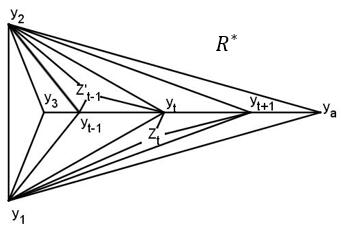 Figure 1
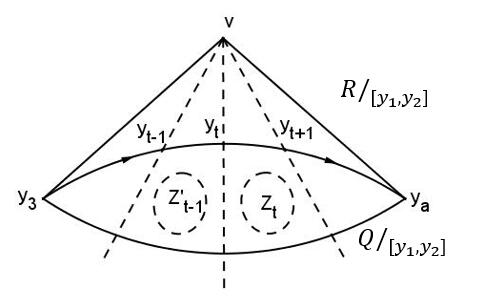 Figure 2
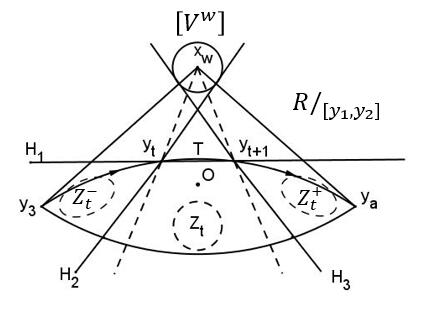 Figure 3
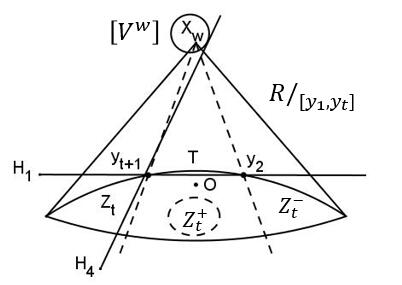 Figure 4
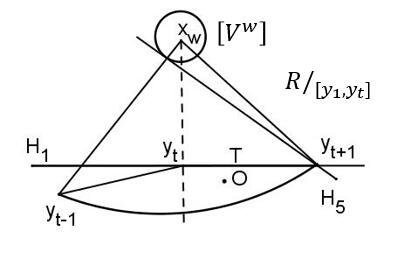 Figure 5
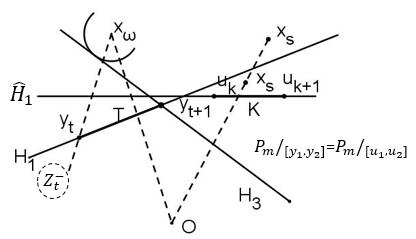 Figure 6