Fiber cavities with integrated mode matching optics
Gurpreet Kaur Gulati, Hiroki Takahashi, Nina Podoliak, Peter Horak and, Matthias Keller

TL;DR
This paper presents a new all-fiber mode matching technique for fiber-based Fabry-Pérot cavities, significantly improving coupling efficiency and versatility for various applications.
Contribution
The authors introduce a novel fiber assembly combining graded-index and multimode fibers to enhance mode matching in FFPCs, achieving 90% efficiency at long cavity lengths.
Findings
Achieved 90% mode matching efficiency for a 400 μm cavity.
Significantly improved mode matching compared to conventional methods.
Versatile approach adaptable to various single mode fibers.
Abstract
In fiber based Fabry-P\'{e}rot Cavities (FFPCs), limited spatial mode matching between the cavity mode and input/output modes has been the main hindrance for many applications. We have demonstrated a versatile mode matching method for FFPCs. Our novel design employs an assembly of a graded-index and large core multimode fiber directly spliced to a single mode fiber. This all-fiber assembly transforms the propagating mode of the single mode fiber to match with the mode of a FFPC. As a result, we have measured a mode matching of 90\% for a cavity length of 400 . This is a significant improvement compared to conventional FFPCs coupled with just a single mode fiber, especially at long cavity lengths. Adjusting the parameters of the assembly, the fundamental cavity mode can be matched with the mode of almost any single mode fiber, making this approach highly versatile and…
Click any figure to enlarge with its caption.
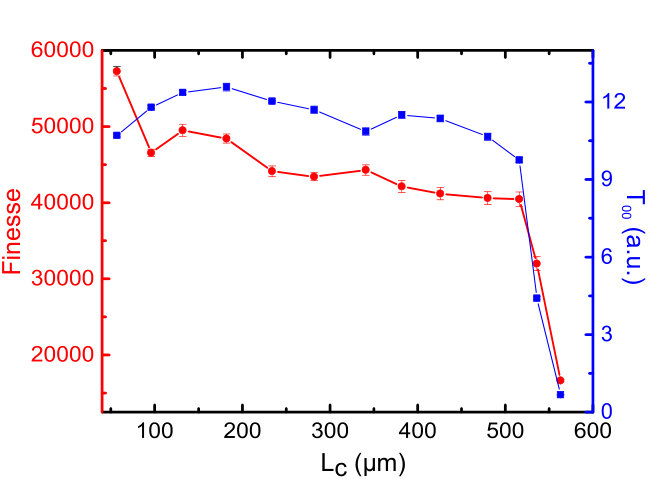 Figure 1
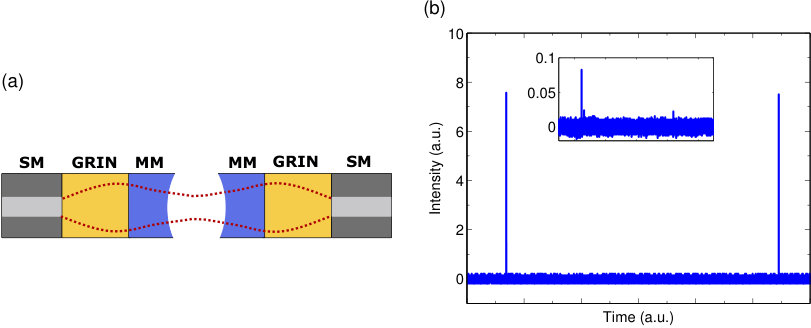 Figure 2
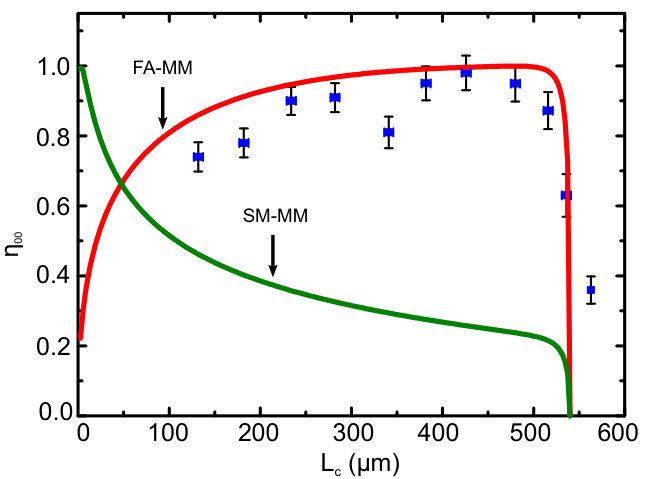 Figure 3
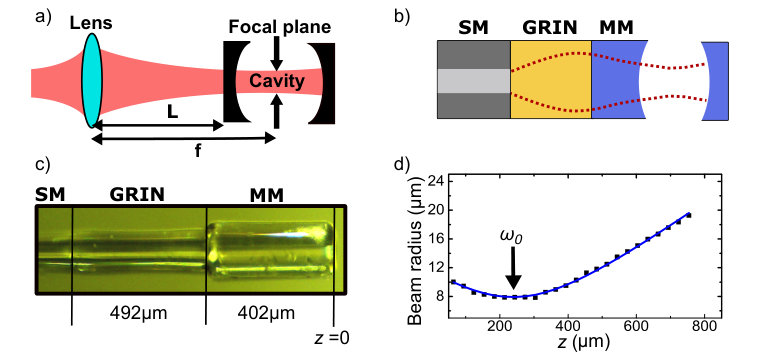 Figure 4
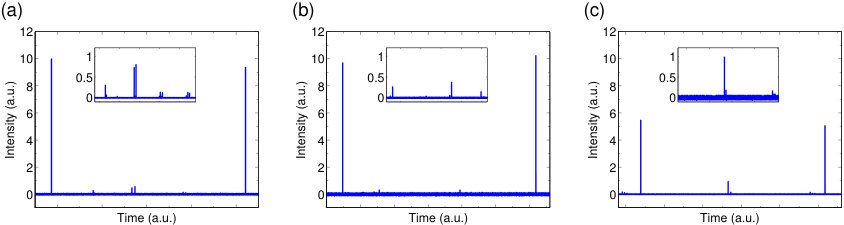 Figure 5
Peer Reviews
No public reviews on file for this paper yet. If you reviewed it on a platform where reviews are public (OpenReview, ICLR, NeurIPS, ICML), you can paste yours below so the community can read it here.
Videos
No videos yet. Explain this paper in a talk, walkthrough, or lecture? Add one.
Fiber cavities with integrated mode matching optics
Gurpreet Kaur Gulati
Department of Physics and Astronomy, University of Sussex, Falmer, BN1 9QH, U.K.
Hiroki Takahashi
Department of Physics and Astronomy, University of Sussex, Falmer, BN1 9QH, U.K.
Nina Podoliak
Optoelectronics Research Centre, University of Southampton, Southampton SO17 1BJ, U.K.
Peter Horak
Optoelectronics Research Centre, University of Southampton, Southampton SO17 1BJ, U.K.
Matthias Keller
Department of Physics and Astronomy, University of Sussex, Falmer, BN1 9QH, U.K.
Abstract
In fiber based Fabry-Pérot Cavities (FFPCs), limited spatial mode matching between the cavity mode and input/output modes has been the main hindrance for many applications. We have demonstrated a versatile mode matching method for FFPCs. Our novel design employs an assembly of a graded-index and large core multimode fiber directly spliced to a single mode fiber. This all-fiber assembly transforms the propagating mode of the single mode fiber to match with the mode of a FFPC. As a result, we have measured a mode matching of 90% for a cavity length of 400 . This is a significant improvement compared to conventional FFPCs coupled with just a single mode fiber, especially at long cavity lengths. Adjusting the parameters of the assembly, the fundamental cavity mode can be matched with the mode of almost any single mode fiber, making this approach highly versatile and integrable.
Optical Fabry-Pérot cavities are essential tools for a wide range of applications in science and technology. In recent years, newly developed laser ablation techniques made it possible to fabricate high-quality mirrors directly on the facets of optical fibers, leading to the advent of miniaturized fiber-based Fabry-Pérot cavities (FFPCs) Hunger et al. (2012). FFPCs support significantly smaller mode volumes compared to the conventional Fabry-Pérot cavities based on bulk optical mirrors. The resulting quantum mechanical effects have been exploited in atomic Colombe et al. (2007); Steiner et al. (2013), molecular Toninelli et al. (2010), solid state Albrecht et al. (2013); Miguel-Sánchez et al. (2013); Besga et al. (2015) and optomechanical systems Flowers-Jacobs et al. (2016) and are crucial for applications in quantum science and technology. Furthermore, due to their compactness and integration with fiber optics, FFPCs have many potential technological applications beyond fundamental scientific research, e.g., tunable frequency filters Miller and Janniello (1990), scanning microscopy Mader et al. (2015), gas sensing Petrak et al. (2014) and micro-fluidics Ni et al. (2016). Recently several novel laser machining methods have been developed Takahashi et al. (2014); Ott et al. (2016) and detailed characterizations of FFPCs has been carried out Bick et al. (2016); Gallego et al. (2016); Benedikter et al. (2015); Podoliak et al. (2017). Despite these latest developments, the limited spatial mode matching of FFPCs to their inputs and outputs is still a substantial hindrance for many applications. In contrast to conventional Fabry-Pérot cavities, where mode matching can be achieved with free space optics, this is not possible with FFPCs. Usually, FFPCs are directly coupled to a single mode (SM) fiber where the mode matching is simply the overlap between the cavity mode and the output mode emanating from the SM fiber. There are no controllable elements once the cavity geometry and the type of the SM fiber are fixed. In particular, the mode matching efficiencies will be severely limited when the cavity length becomes much longer than the Rayleigh range of the output mode of the SM fiber. Using large mode field diameter fibers such as photonic crystal fibers Ott et al. (2016) or tapered fibers, which adiabatically transform the fiber mode diameter to that of the cavity, the mode matching can be improved. However, the mismatch of the wavefront curvatures ultimately limits the mode matching efficiency.
In this letter we demonstrate a novel design of FFPCs which enables optimized mode matching between the cavity and fiber output mode, and which is also free from the constraints of the cavity and fiber geometries. Using a concatenation of a graded-index (GRIN) and multimode (MM) fibers spliced together, a versatile all-fiber mode-matching assembly can be built. With this assembly directly attached to a FFPC, not only the field diameter of the fiber mode but also its wavefront curvature can be precisely engineered to match the mode of the FFPC. As a result, this technique enables the use of almost any optical SM fibers as an input/output for FFPCs in a fully integrated manner. We have designed, built and characterized a FFPC with integrated mode matching assembly and have measured a mode matching efficiency of up to 90% where the conventional design only achieves 30%.
In order to achieve an optimal mode overlap between an optical cavity and a laser beam in free space, a single lens with an appropriate focal length () has to be located at the right distance () from the position of the cavity (see Fig. 1 (a)). Our design follows the same concept but in an all-fiber implementation (Fig. 1 (b)). As the focusing element we employ a GRIN fiber (OFS, BF04432-1) with its length determining the effective focal length. Firstly, the GRIN fiber is spliced (Fujikura FSM1000 ARC Master) to a cleaved single mode fiber (IVG, Cu800). Then the GRIN fiber is precisely cleaved (Fujikura CT100) under a microscope Wang et al. (2014) to a predefined length to within . The length of GRIN fiber is adjusted such that the resulting mode waist matches that of the FFPC. Even though the splice losses between the SM and GRIN fibers are low ( 0.01 dB as specified by the splicer analysis), they result in a modification of the effective mode field diameter at the SM-GRIN interface, which needs to be taken into account when cleaving the GRIN fiber. The actual mode waist is confirmed by measuring the mode profile at the output of the SM-GRIN assembly along the axial direction. To this end, a laser beam is coupled into the other end of the SM fiber and the output beam from the GRIN fiber is measured using a knife edge translating across the beam. Fitting the measurement with the propagation of a Gaussian beam, the waist size and its position with respect to the end facet of the GRIN fiber is found. To position the cavity mirrors at the optimal distance from the GRIN fiber a piece of a MM fiber is spliced to it. This fiber serves as a spacer as well as a carrier for the cavity mirror. Due to the large core size of the MM fiber, it does not disturb the free propagation of the mode shaped by the GRIN fiber. Based on the waist position measurement, the MM fiber is cleaved at the optimal position for the desired cavity geometry. Finally, the end facet of the MM fiber is laser ablated Takahashi et al. (2014). The resulting mode matching fiber assembly (FA), shown in Fig.1(c), is a concatenation of a SM, GRIN and MM fiber which are directly spliced together, producing a co-axial all-fiber structure. The final mode profile measured at the output of FA, is illustrated in Fig.1(d) which clearly depicts that the output beam is converging to a waist outside the assembly. After characterizing the mode, the end facet of the MM fiber is coated with a highly reflective dielectric coating (20 ppm losses at 866 nm from Laseroptik GmbH).
To evaluate the mode matching between the fiber and cavity modes, we set up a FFPC. One of the fibers is clamped on a custom-made fiber mount, including a sheer piezo actuator which can translate the fiber along its axis for fine tuning and scanning of the cavity length. This mount is in turn attached to a kinematic prism stage to allow angular adjustment. The second fiber is mounted on a motorized translation stage facilitating 3-dimensional adjustment of the fiber position. In particular, the fiber can be translated to adjust the cavity length. To facilitate the fiber cavity alignment and the measurement of the distance between the fiber tips, two perpendicularly arranged microscopes are used to radially observe the fiber cavity. Hence, the cavity length can be measured to within . After adjusting the fiber alignment with the microscopes, laser light at is coupled into one of the fibers while the light transmitted through the cavity and entering into the second fiber is detected using a photo diode at the uncoated fiber end. The fibers are then further aligned by observing the cavity transmission, to maximize the transmission of the TEM00 mode, while scanning the length of the cavity with the piezo actuator.
In order to determine the mode matching between the fiber and the cavity modes, we use an FA as the input of the cavity and a MM fiber, with a laser machined and high reflectivity coated end facet, as the output. The FA has a designed waist size of 8.1 at a distance of 230 from the end facet of the assembly and a radius of curvature (ROC) of 700 . The MM fiber for the cavity output has a ROC of 540 . Using these parameters, the expected mode matching from the numerical simulation is better than 90% for cavity lengths between 180 and 520 , with a maximum of 99.9% at 460 (shown in Fig.4).
Employing a MM fiber at the output of the cavity is beneficial as the entire cavity transmission spectrum can be observed without spatially filtering high order transverse modes of the cavity. As described in Bick et al. (2016), the mode matching of a FFPC can not be determined by simultaneously observing the cavity’s reflection and transmission since the reflected light at the cavity input is mode-filtered by the SM input fiber. Thus, utilizing the resonant dips in the reflection would greatly overestimate the cavity coupling. Therefore in this work, only the transmission spectra are used to determine the mode matching.
The ratio of the cavity transmission intensities of the fundamental TEM00 mode () and of the modes of order () defined by
[TABLE]
can be used to estimate the real mode matching efficiency of the fiber mode to the cavity’s fundamental mode. This approximation for the mode matching () is valid as long as the damping for all the cavity modes is the same. The transmission intensity is not only a function of the mode-matching efficiency but also of the cavity finesse for the corresponding mode:
[TABLE]
where includes the efficiencies independent of the mode orders, as well as the detection and propagation efficiencies, and is the intensity of the input beam. When the values of are the same irrespective of the mode order, is satisfied in Eq. (1) from the normalization condition . Otherwise the contribution of the higher order modes may be underestimated, leading to an overestimation of the mode matching. In particular, clipping losses Hunger et al. (2010) can lead to an increased damping for the high order modes due to their larger spatial extension on the cavity mirrors.
To eliminate this effect on our measurements, we measure the finesses of all the modes visible in the transmission spectrum to confirm uniform damping of the modes. To this end, the cavity length, , is measured using a calibrated microscope and the free spectral range (FSR) is calculated as FSR. An electro-optic modulator is used to generate sidebands on the laser to act as a frequency calibration of the transmission spectrum to evaluate the cavity linewidth Takahashi et al. (2014). The finesse is then calculated by .
In Fig. 2 the transmission spectra at three different cavity lengths are displayed with the insets showing details of the higher order mode peaks. In addition, Fig. 3 shows the finesse as well as the transmission intensity, of the fundamental mode as a function of the cavity length. The finesse exhibits the typical behavior of a fiber cavity with MM fiber mirrors Brandstätter et al. (2013); Takahashi et al. (2014); Benedikter et al. (2015) with a plateau across most of the length range and a sharp drop at the edge of the stability limit. Similarly, is stable across most of the stability region of the cavity. However, the transmission spectra show a very different behavior with = 74% at a cavity length of 132 , 69% at 536 and a 90% at the cavity length of 426 . At these three cavity lengths, we confirmed that the cavity finesse is identical within the measurement errors for all the modes visible in the spectrum, and hence, is a good measure for mode matching.
The mode matching at a cavity length is related to the one at through
[TABLE]
Hence, from a single measurement of at a cavity length , the mode matching efficiency at an arbitrary cavity length can be calculated by using only the transmission and finesse of the fundamental mode. Here we use the measurement at a cavity length of 132 () as reference where holds, and calculate the estimated mode matching efficiencies over the entire range of the cavity length by using Eq. (3) and the data set in Fig. 3.
As shown in Fig.4, the mode matching efficiencies calculated in this way fit well with the numerical prediction, constituting another strong evidence that our mode-matching assembly is working as expected. Fig. 4 also shows a numerical simulation where the same cavity geometry is used but the FA is replaced with a SM fiber. One can see the substantial advantage of our FA for cavity lengths .
Another interesting system is one where both sides of the cavity are constituted by the mode matching fiber assemblies (FA-FA system). This configuration implements a bi-directional input-output system (see Fig. 5a). Fig. 5b shows a transmission spectrum for such a system with the input side of the cavity being the FA described above. The output side of the cavity is formed by another FA with ROC of 630 and designed for a waist size of 8.4 at a distance of 230 from the end facet of assembly. The length of the cavity is adjusted for the optimal mode matching between the fiber and the cavity modes.
Here we see, the intensity ratio of 98.6 % at a cavity length of 420 , which is a result of the mode filtering happening on both sides of the cavity. In other words, in this scenario, the transmission is proportional to instead of , resulting in enhanced suppression of the higher order peaks. This value of in turn corresponds to on average for a single FA, which is consistent with the results in Fig. 2 at the same cavity length.
In this letter we have demonstrated a versatile method to optimize the mode matching between input/output optical fibers and FFPCs. Using a combination of GRIN and MM fibers, the modes of almost any SM fiber can be matched to the mode of a FFPC. This enables the use of standard polarization maintaining fibers as well as specialty fibers such as spun fibers or photonic crystal fibers in conjunction with FFPCs. With mode matching efficiencies of about 90%, FFPCs can now be utilized for a wide range of applications where good coupling between the cavity an optical SM fibers is crucial.
I Acknowledgments
We gratefully acknowledge support from EPSRC through the UK Quantum Technology Hub: NQIT - Networked Quantum Information Technologies (EP/M013243/1) and EP/J003670/1. G.K.G., H.T. and M.K. thank Qiming Wu for his help in the preparation of the fibers.
II Competing financial interests
The authors declare no competing financial interests.
The reference list from the paper itself. Each links out to its DOI / PubMed record.
- 1Hunger et al. (2012) D. Hunger, C. Deutsch, R. Barbour, R. Warburton, and J. Reichel, AIP Adv. 2 , 012119 (2012) .
- 2Colombe et al. (2007) Y. Colombe, T. Steinmetz, G. Dubois, F. Linke, D. Hunger, and J. Reichel, Nature 450 , 272–276 (2007) .
- 3Steiner et al. (2013) M. Steiner, H. Meyer, C. Deutsch, J. Reichel, and M. Köhl, Phys. Rev. Lett. 110 , 043003 (2013) .
- 4Toninelli et al. (2010) C. Toninelli, Y. Delley, T. Stöferle, A. Renn, S. Götzinger, and V. Sandoghdar, Appl. Phys. Lett. 97 , 021107 (2010) .
- 5Albrecht et al. (2013) R. Albrecht, A. Bommer, C. Deutsch, J. Reichel, and C. Becher, Phys. Rev. Lett. 110 , 243602 (2013) .
- 6Miguel-Sánchez et al. (2013) M. Miguel-Sánchez, A. Reinhard, E. Togan, T. Volz, A. Imamoǵlu, B. Besga, J. Reichel, and J. Estéve, New J. Phys. 15 , 045002 (2013) .
- 7Besga et al. (2015) B. Besga, C. Vaneph, J. Reichel, J. Estéve, A. Reinhard, J. Miguel-Sánchez, A. Imamoǵlu, and T. Volz, Phys. Rev. Applied 3 , 014008 (2015) .
- 8Flowers-Jacobs et al. (2016) N. Flowers-Jacobs, S. Hoch, J. Sankey, A. Kashkanova, A. Jayich, C. Deutsch, J. Reichel, and J. Harris, Appl. Phys. Lett. 101 , 221109 (2016) .