Microcanonical analysis of Boltzmann and Gibbs Entropies in trapped cold atomic gases
Kenneth J. Higginbotham, Daniel E. Sheehy

TL;DR
This paper compares Boltzmann and Gibbs entropy definitions in a trapped fermionic gas, highlighting differences in temperature predictions and clarifying the implications for systems with bounded energy spectra.
Contribution
It provides a detailed microcanonical analysis of entropy definitions in a quantum system, emphasizing their differences and physical implications.
Findings
Gibbs temperature aligns more closely with grand canonical temperature for small particle numbers.
Boltzmann entropy can suggest negative temperatures, which are not realized in this system.
Significant differences exist between the two entropy definitions in bounded quantum systems.
Abstract
We analyze a gas of noninteracting fermions confined to a one-dimensional harmonic oscillator potential, with the aim of distinguishing between two proposed definitions of the thermodynamic entropy in the microcanonical ensemble, namely the standard Boltzmann entropy and the Gibbs (or volume) entropy. The distinction between these two definitions is crucial for systems with an upper bound on allowed energy levels, where the Boltzmann definition can lead to the notion of negative absolute temperature. Although negative temperatures do not exist for the system of fermions studied here, we still find a significant difference between the Boltzmann and Gibbs entropies, and between the corresponding temperatures with the Gibbs temperature being closer (for small particle number) to the temperature based on a grand canonical picture.
Click any figure to enlarge with its caption.
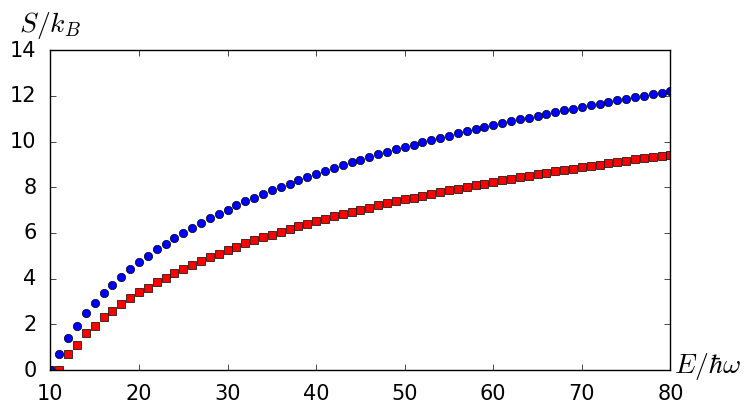 Figure 1
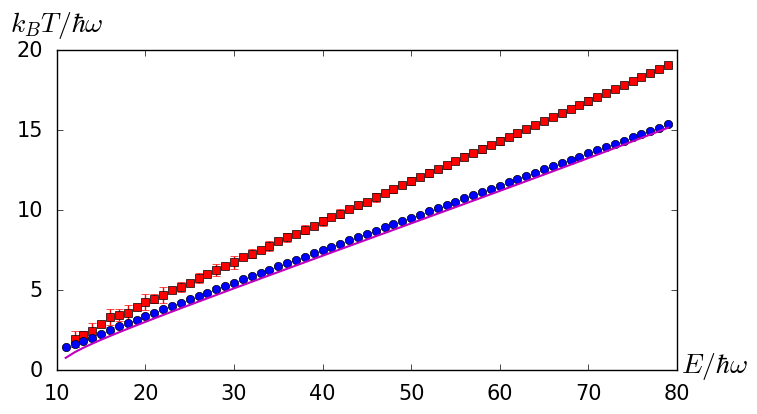 Figure 1
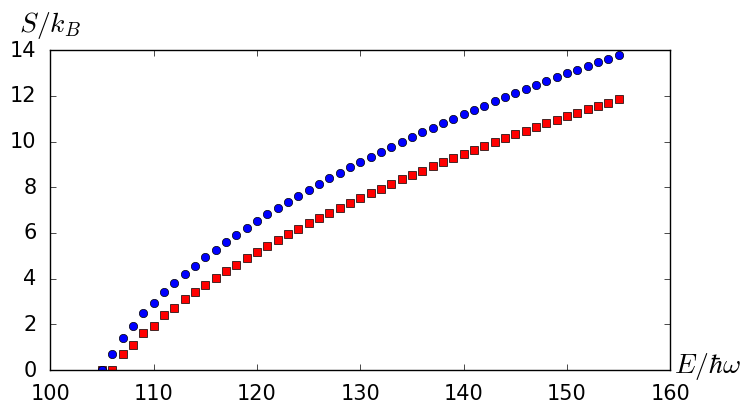 Figure 2
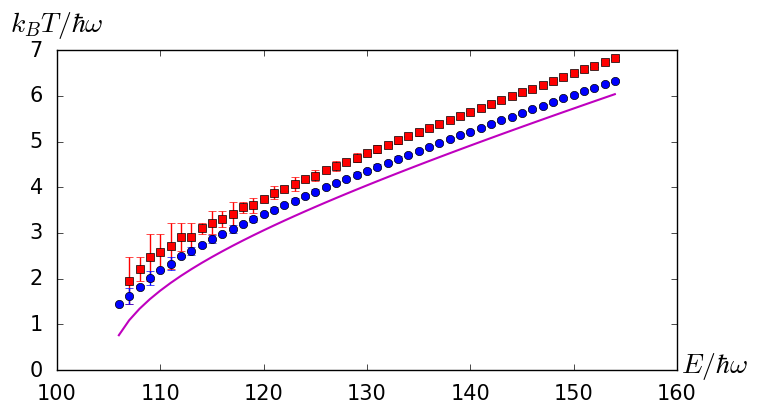 Figure 2
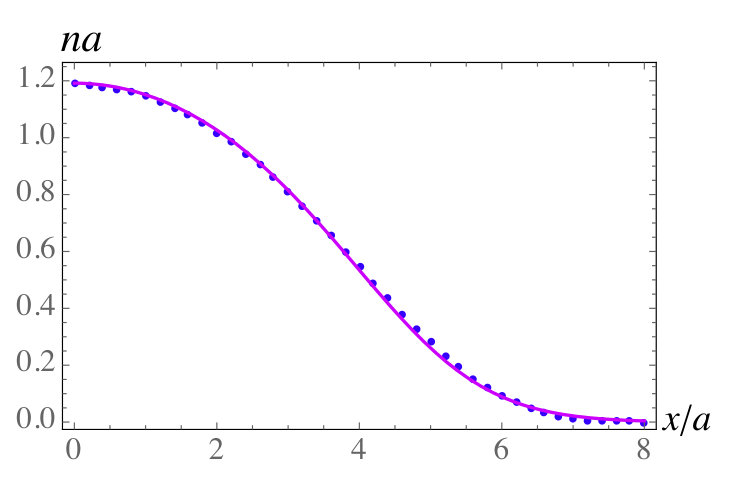 Figure 3
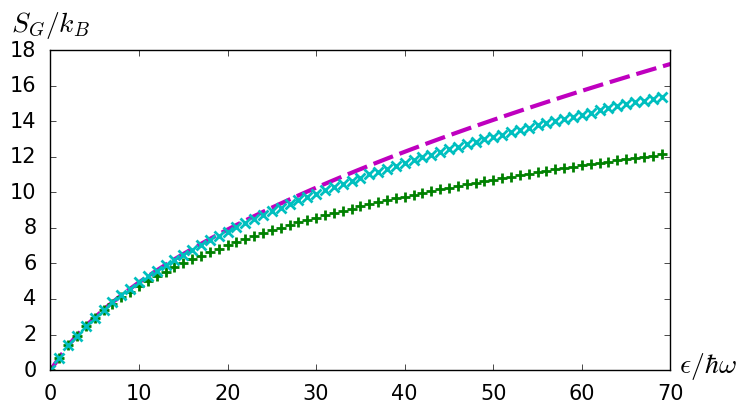 Figure 4
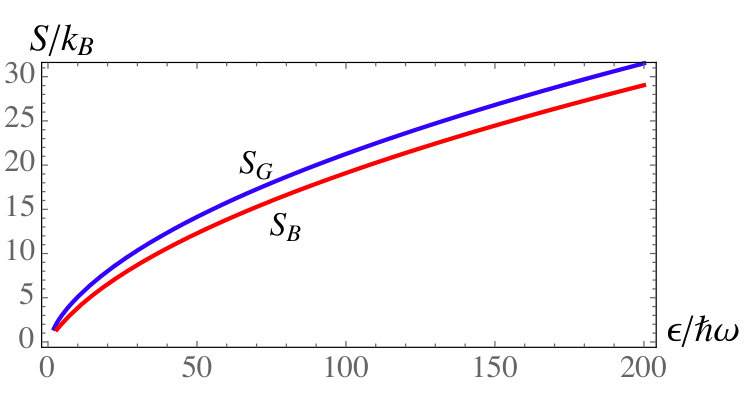 Figure 5
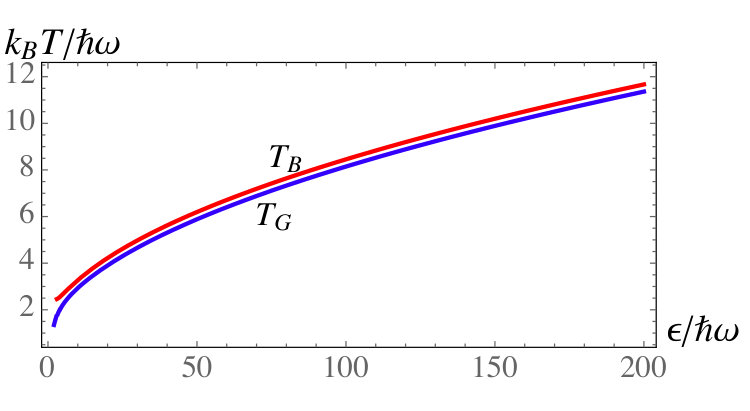 Figure 5
Peer Reviews
No public reviews on file for this paper yet. If you reviewed it on a platform where reviews are public (OpenReview, ICLR, NeurIPS, ICML), you can paste yours below so the community can read it here.
Videos
No videos yet. Explain this paper in a talk, walkthrough, or lecture? Add one.
Microcanonical analysis of Boltzmann and Gibbs Entropies in trapped cold atomic gases
Kenneth J. Higginbotham
School of Physics, Georgia Institute of Technology, Atlanta, Georgia 30332
Daniel E. Sheehy
Department of Physics and Astronomy, Louisiana State University, Baton Rouge, Louisiana 70803
Abstract
We analyze a gas of noninteracting fermions confined to a one-dimensional harmonic oscillator potential, with the aim of distinguishing between two proposed definitions of the thermodynamic entropy in the microcanonical ensemble, namely the standard Boltzmann entropy and the Gibbs (or volume) entropy. The distinction between these two definitions is crucial for systems with an upper bound on allowed energy levels, where the Boltzmann definition can lead to the notion of negative absolute temperature. Although negative temperatures do not exist for the system of fermions studied here, we still find a significant difference between the Boltzmann and Gibbs entropies, and between the corresponding temperatures with the Gibbs temperature being closer (for small particle number) to the temperature based on a grand canonical picture.
I Introduction
Recent work by Dunkel and Hilbert DunkelNatPhys (DH), motivated by classic early experiments on spin systems Purcell1951 ; Ramsay1956 and recent experiments on cold atomic gases Braun2013 confined to optical lattices, has proposed that the notion of negative absolute temperatures arises from a definition of entropy that is thermodynamically inconsistent.
The idea of negative temperatures has existed at least since the 1950’s, when it was applied to understand experiments on spin systems Purcell1951 ; Ramsay1956 , and since then it has become standard textbook material in thermodynamics and statistical physics. More recently, evidence of negative temperature has been found in experiments on cold atomic gases Braun2013 . In each case, negative temperatures arise because the system in question possesses an upper bound in the total energy . For energies close to the upper bound, the number of available microstates (which is directly related to the Boltzmann entropy) decreases with increasing energy, implying a negative absolute temperature using the Boltzmann entropy definition.
For a quantum system defined by Hamiltonian , the Boltzmann entropy can be written as
[TABLE]
where is Boltzmann’s constant and \Omega(E)={\rm Tr}\big{[}\delta(E-H)\big{]} counts the number of microstates at energy . Here, is a parameter with units of energy chosen so that the argument of the logarithm is dimensionless. In Ref. DunkelNatPhys , DH argue for an alternate “volume” definition of entropy (due to Gibbs) that instead counts all microstates up to energy . We can define the Gibbs entropy as:
[TABLE]
with the Heaviside step function. Although less well-known, the Gibbs entropy has appeared in some thermodynamics textbooks (e.g., Ref. Becker ). For either case, the temperature is defined by the usual relation
[TABLE]
and we thus define the Boltzmann () and Gibbs () temperatures by combining Eq. (1) or Eq. (2) with Eq. (3). For spin systems in magnetic fields, as well as the system of cold atomic gases in optical lattices studied in Ref Braun2013 , the difference in these entropy definitions leads to a situation in which can be negative, while is positive. The proposal by DH that the Gibbs definition is the correct one has led to a spirited debate in the literature SchneiderComment ; Dunkel2014p ; FrenkelWarren ; Dunkel2014 ; Hilbert2014 ; Swendsen2015 ; Poulter ; Campisi ; Abraham . Here, we mainly bypass this debate, and investigate a system (inspired by experiments on cold atomic gases) that does not exhibit negative Boltzmann temperature, but which, nonetheless, will have a small (but possibly observable) difference between the two entropy and temperature definitions.
II Main Results
In this paper we study the distinction between Gibbs and Boltzmann entropies and temperatures in the context of ultracold trapped atomic gases, which are perhaps the simplest system that can truly be taken to be in the microcanonical ensemble. We study identical fermionic atoms confined in a quasi-one dimensional trapping potential (realized by a trap that exhibits tight confinement in two directions and weak confinement in the third). Of course, this system does not have an upper energy bound, and therefore is not expected to exhibit negative temperature. Nonetheless, there is still a difference between the Gibbs and Boltzmann entropy definitions, implying a difference between and that could be experimentally significant at small . Since experiments on cold atomic gases have already accessed the small- regime Serwane and have realized the quasi-1D regime using an optical lattice potential LiaoNature2010 ; Revelle2016 , we propose that our results may be relevant for future experiments that can distinguish between the Boltzmann and Gibbs temperature definitions, shedding further light on this controversy.
In asking the question of which temperature definition, Boltzmann or Gibbs, is correct, we need a third temperature scale to compare to. A common way to measure the temperature in cold atomic gas experiments is by measuring the atom density vs. position and comparing to a theoretical formula based on the Fermi distribution Hung2011 . Inspired by this, we shall define a third temperature scale, , based on the grand-canonical picture in which single-particle levels are occupied according to the Fermi distribution. One question that we shall address is whether the expected value of is closer to or (if either) for a 1D trapped fermionic atomic gas assumed to be in the microcanonical ensemble at total particle number and energy . A natural objection to this line of reasoning is that only holds rigorously for large , in the thermodynamic limit (where number and energy fluctuations can be neglected), whereas we consider the regime of small (where the difference between and is largest). However, in practice we find that the microcanonical density profile is very accurately fit by the grand canonical picture even in the small regime. This implies that an experiment attempting to extract the temperature by observing the local density as a function of position would “measure” a temperature close to .
Our main result can be seen in Fig. 1 that compares these entropy and temperature definitions for the case of fermions. This figure shows that, at least in the small regime, the inequalities and hold. Indeed, the difference between and increases with increasing energy, while remains close to suggesting that, at least at small , the Gibbs definition is the appropriate one (i.e., closer to the definition consistent with a grand-canonical picture based on the Fermi distribution). As discussed below, the difference between and decreases with increasing (as seen in Fig. 2), consistent with the expectation that they should be equal in the thermodynamic limit. We argue below, however, that for any fixed , for sufficiently large energy, the qualitative behavior shown in Fig. 1 holds.
III System Hamiltonian and Entropy Calculations
We study a single-species gas of atomic fermions confined to a harmonic trapping potential that is anisotropic, satisfying . At sufficiently low numbers of particles, such that the system chemical potential is also much less than , such a gas can be accurately modeled by the one-dimensional second quantized Hamiltonian
[TABLE]
where is the momentum operator, the particle mass, and the fermionic field operators satisfy the anticommutation relation . It is convenient to express in terms of mode operators , which are related to the field operators by
[TABLE]
where is the well-known solution to the one-dimensional quantum harmonic oscillator,
[TABLE]
where is the th Hermite polynomial and is the oscillator length. The corresponding eigenvalue is , giving for the system Hamiltonian, after plugging Eq. (5) into Eq. (4),
[TABLE]
Henceforth, we shall measure lengths in units of the oscillator length and measure energies relative to . It is also convenient to drop the zero point energy, so that . Our next task is to analyze the behavior of a gas of fermions, described by , in the microcanonical ensemble. Then, a member of this ensemble is described by a wavefunction with certain levels occupied:
[TABLE]
with the vacuum state. Due to the Pauli principle, no two may coincide.
Since the energy eigenvalues are discrete, our definition of will differ from that given below Eq. (1) but instead simply count the total number of allowed microstates with total energy . Indeed, since the single-particle energies are integers, the energy eigenvalue of , , is also an integer, so that the problem of determining is related to the well-known integer partitioning problem. Following standard notation, we define to be the total number of partitions of the integer and to be the number of partitions of the integer into exactly parts so that, for example, (with the partitions being ) and (with the partitions being ). Both functions allow repetitions of integers appearing in the partitions, which we must exclude due to the Pauli principle. However, it turns out that the number of partitions of the integer into exactly parts excluding repetitions, , is related to by:
[TABLE]
To verify this well-known identity, we establish a one-to-one correspondence between partitions associated with the left and right sides of this formula. Thus, consider one of the partitions on the right side, which is of the form . By definition, this partition has energy and may contain some number of repeated integers but satisfies (with larger integers to the left as in the above examples). However, a new partition with no repeated integers can be obtained by incrementing the integers in this partition thusly: . This partition clearly satisfies , and has energy since the increments of each integer add to . Since it is clear that any restricted partition (corresponding to ) can be connected to an unrestricted partition (corresponding to ), the relation Eq (9) holds. To obtain our final expression for in terms of , we recall that a fermion in the lowest level has zero energy (not contributing to ). This finally implies that the total number of microstates has two contributions:
[TABLE]
with the first (second) term on the right side corresponding to microstates in which the level is unoccupied (occupied).
In terms of Eq. (10), the Boltzmann entropy is
[TABLE]
while the Gibbs entropy sums over all allowed total energies less than :
[TABLE]
In Figs. 1 and 2, we show our numerical results for and (top panel) along with the Boltzmann and Gibbs temperatures (bottom panel) as a function of the total system energy . Due to the Pauli principle, the minimum system energy is
[TABLE]
We see that the Gibbs entropy is larger than the Boltzmann entropy, , with a difference that increases with increasing system energy. Similarly, the Gibbs temperature (obtained by numerically differentiating the entropy results and using Eq. (3)) is lower than the Boltzmann temperature. The solid line in the bottom panel of Figs. 1 and 2 shows the “grand-canonical” temperature , extracted by assuming that the equations for the grand-canonical ensemble hold:
[TABLE]
with (and ) the Fermi distribution. Although these only determine the mean particle number and energy (with fluctuations that vanish in the thermodynamic limit), they provide a unique prediction that can be compared to and .
We now argue that the local density profile of a 1D trapped fermionic gas in the microcanonical ensemble is approximately consistent with the grand canonical ensemble picture even at small . To establish this, in Fig. 3, we compare the microcanonical density,
[TABLE]
for the case of and , to the grand canonical density
[TABLE]
using the temperature () and chemical potential () obtained by solving Eqs. (14) for the same system parameters. For these parameters, while . In cold atomic gas experiments, the temperature is often extracted by measuring the density profile (and assuming the grand-canonical picture holds). Thus, the close agreement in Fig. 3 suggests that a cloud at this energy and particle number would be “measured” to have a temperature given by , closer to .
IV Universal entropy at low energies
Our results suggest that the Gibbs and Boltzmann entropy and temperature definitions agree at small but differ at large , with the Gibbs temperature definition being closer to the grand-canonical temperature. In this section we show that the Gibbs and Boltzmann entropy formulas have a universal form at low energies that greatly simplifies their calculation. We will propose that the approximate agreement between and is related to the fact that the universal formulas hold at low energies, and that the deviation of from occurs when the system is outside of the universal regime.
To establish the existence of the universal entropy formulas, we define the relative with the minimum energy Eq. (13). Then, as illustrated in Fig. 4, the Gibbs entropies, plotted as a function of , are universal (independent of ) for sufficiently small . A similar universality holds for .
This universality at small follows from the following mathematical identity for the integer partition function Hwang :
[TABLE]
relating to the unrestricted partition function at small . When this result is combined with Eq. (9) and plugged into Eq. (10), we find
[TABLE]
where we note that only the second term of Eq. (10) contributes in this small- regime. In this context, the identity Eq. (18) can be related, physically, to the Pauli principle: for , the only allowed microstate of the fermion gas is the ground state which has all levels filled up to the Fermi level . If we increase the energy of our system to small , the allowed microstates simply correspond to particle-hole excitations of this ground state in which fermions are promoted from levels slightly below to slightly above . In these microstates, all levels up to level (at least) are occupied. This follows because exciting a fermion from a lower level would cost too much energy, and implies that the number of microstates is given by the number of ways to construct such excitations i.e., by the number of unrestricted partitions of . This implies Eq. (18). This picture holds for the microstates only for , implying the restriction .
Equation (18) implies the following expressions for the Boltzmann and Gibbs entropies in the universal regime:
[TABLE]
The calculation of and via Eq. (19) is much easier than via the direct formula Eq. (10) since they depend only on the unrestricted integer partition function. In fact, a convenient asymptotic large- formula for has been derived by Hardy and Ramanujan Hardy
[TABLE]
which allows a straightforward approximate numerical evaluation of and in the large regime. In the top panel Fig. 5, we compare and computed using Eq. (19) along with Eq. (20), with the comparison between and appearing in the bottom panel. The close agreement between these curves is natural, given that we expect the difference between the Gibbs and Boltzmann entropies to vanish in the large system “thermodynamic” limit. We propose that, since the univesal formulas Eq. (19) only hold for , the large difference between and that we find for small occurs when these systems are outside of the universal regime and that, for any fixed , the approximate agreement between and holds only for , with differences between and (and between and ) occuring for large .
V Concluding Remarks
We have investigated the Gibbs () and Boltzmann () entropies for a system of fermions in a one-dimensional harmonic oscillator potential with total energy , finding that the Gibbs and Boltzmann entropy and temperature definitions approximately agree at small while diverging from each other at large . In the large energy regime, we find that the corresponding Boltzmann temperature is much higher than the Gibbs temperature, with the latter being close to , the temperature expected based on the grand-canonical ensemble. Thus, we find a striking (and potentially experimentally observable) difference between the Gibbs and Boltzmann pictures for the entropy and temperature in the microcanonical ensemble.
For sufficiently large , standard thermodynamics arguments imply that the difference between and should vanish. We found that the agreement between and at low energies is connected to the existence of universal formulas for these entropies that apply for sufficiently small , allowing us to numerically establish agreement among these entropy and temperature definitions for larger .
We proposed that, for any fixed , this agreement will break down for larger system energies (beyond the universal regime). This would imply that any system at fixed would exhibit the qualitative behavior shown in Figs. 1 and 2 for sufficiently large , with the difference between and (and between and ) increasing with increasing . Since establishing this is quite numerically intensive (except for the small cases presented here), we leave further investigation of this issue for future work.
Acknowledgments This work was supported through the REU Site in Physics & Astronomy (NSF grant 1560212) at Louisiana State University and by NSF grant DMR-1151717.
The reference list from the paper itself. Each links out to its DOI / PubMed record.
- 1(1) J. Dunkel and S. Hilbert, Nature Physics 10 , 67 (2013).
- 2(2) E.M. Purcell and R.V. Pound, Phys. Rev. 81 , 279 (1951).
- 3(3) N.F. Ramsay, Phys. Rev. 103 , 20 (1956).
- 4(4) S. Braun, J.P. Ronzheimer, M. Schreiber, S.S. Hodgman, T. Rom, I. Bloch, and U. Schneider, Science 339 , 52 (2013).
- 5(5) R. Becker, “Theory of Heat”, 2nd edition, Springer, 1967
- 6(6) U. Schneider, S. Mandt, A. Rapp, S. Braun, H. Weimer, I. Bloch, and A. Rosch, ar Xiv:1407.4127
- 7(7) J. Dunkel and S. Hilbert, ar Xiv:1408.5392
- 8(8) D. Frenkel and P.B. Warren, Am. J. Phys. 83 , 163 (2015).