Ground state sign-changing solutions for a class of nonlinear fractional Schr\"odinger-Poisson system in $\mathbb{R}^{3}$
Chao Ji

TL;DR
None
Contribution
None
Abstract
In this paper, we are concerned with the existence of the least energy sign-changing solutions for the following fractional Schr\"{o}dinger-Poisson system: \begin{align*} \left\{ \begin{aligned} &(-\Delta)^{s} u+V(x)u+\lambda\phi(x)u=f(x, u),\quad &\text{in}\, \ \mathbb{R}^{3},\\ &(-\Delta)^{t}\phi=u^{2},& \text{in}\,\ \mathbb{R}^{3}, \end{aligned} \right. \end{align*} where is a parameter, and , stands for the fractional Laplacian. By constraint variational method and quantitative deformation lemma, we prove that the above problem has one least energy sign-changing solution. Moreover, for any , we show that the energy of the least energy sign-changing solutions is strictly larger than two times the ground state energy. Finally, we consider as a parameter and study the convergence property of…
Click any figure to enlarge with its caption.
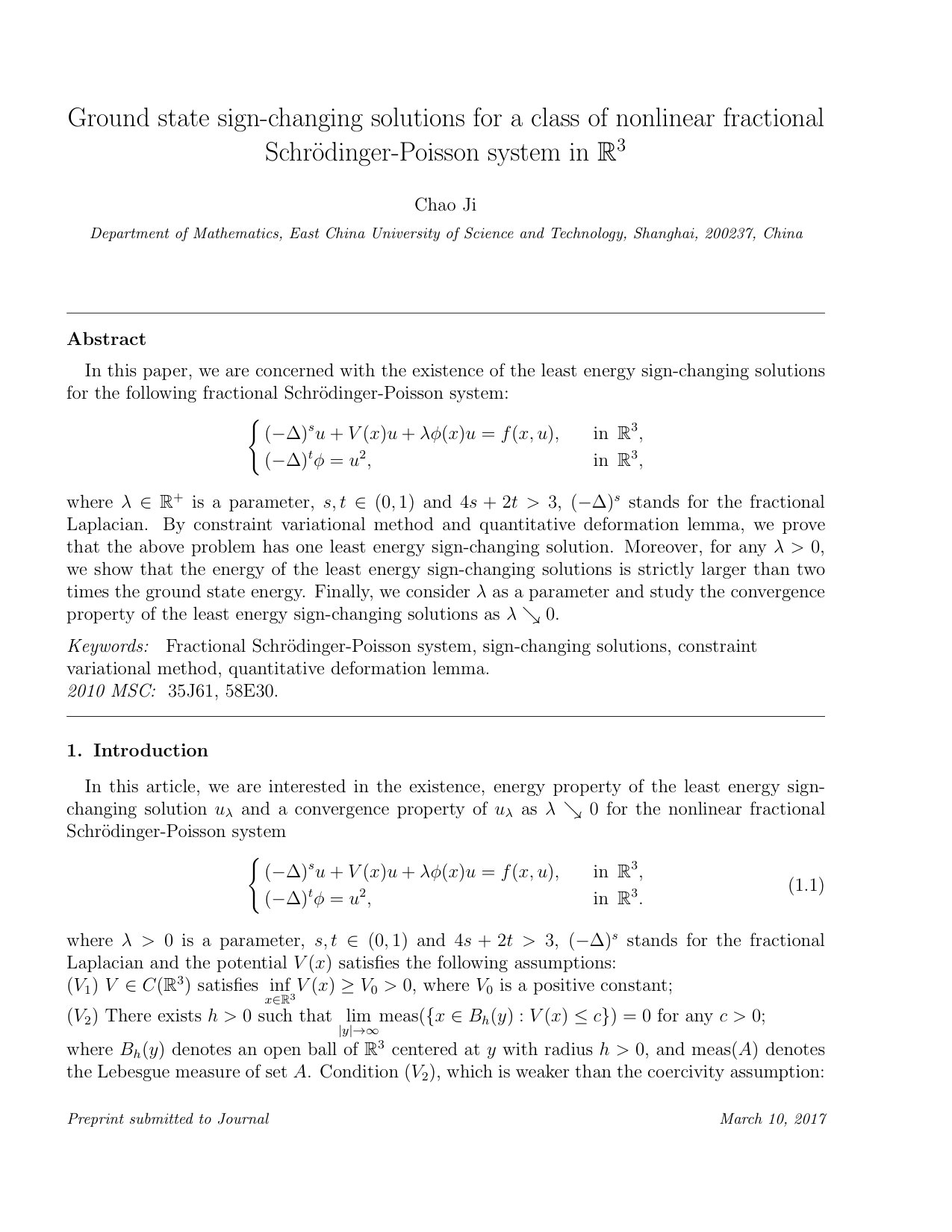 Figure 1
Peer Reviews
No public reviews on file for this paper yet. If you reviewed it on a platform where reviews are public (OpenReview, ICLR, NeurIPS, ICML), you can paste yours below so the community can read it here.
Videos
No videos yet. Explain this paper in a talk, walkthrough, or lecture? Add one.
Taxonomy
TopicsNonlinear Partial Differential Equations · Advanced Mathematical Physics Problems · Advanced Mathematical Modeling in Engineering
Ground state sign-changing solutions for a class of nonlinear fractional Schrödinger-Poisson system in
Chao Ji
Department of Mathematics, East China University of Science and Technology, Shanghai, 200237, China
Abstract
In this paper, we are concerned with the existence of the least energy sign-changing solutions for the following fractional Schrödinger-Poisson system:
[TABLE]
where is a parameter, and , stands for the fractional Laplacian. By constraint variational method and quantitative deformation lemma, we prove that the above problem has one least energy sign-changing solution. Moreover, for any , we show that the energy of the least energy sign-changing solutions is strictly larger than two times the ground state energy. Finally, we consider as a parameter and study the convergence property of the least energy sign-changing solutions as .
keywords:
Fractional Schrödinger-Poisson system, sign-changing solutions, constraint variational method, quantitative deformation lemma.
MSC:
[2010] 35J61, 58E30.
††journal: Journal
1 Introduction
In this article, we are interested in the existence, energy property of the least energy sign-changing solution and a convergence property of as for the nonlinear fractional Schrödinger-Poisson system
[TABLE]
where is a parameter, and , stands for the fractional Laplacian and the potential satisfies the following assumptions:
satisfies , where is a positive constant;
There exists such that for any ;
where denotes an open ball of centered at with radius , and denotes the Lebesgue measure of set . Condition , which is weaker than the coercivity assumption: as , was originally introduced by Bartsch and Wang in [1] to overcome the lack of compactness for the local elliptic equations and then was used by Pucci, Xia and Zhang in [18] for the fractional Schrödinger-Kirchhoff type equations. Moreover, on the nonlinearity we assume that
is a Carathéodory function and as for uniformly.
For some , there exits such that
[TABLE]
where .
, where .
is an increasing function of on for a.e. .
When , the system (1.1) reduces to the following Schrödinger-Poisson system
[TABLE]
This kind of system has a strong physical meaning. For instance, they appear in quantum mechanics models ([4, 6]), and in semiconductor theory([2, 3]). For the research of Schrödinger-Poisson system, we may refer to [9, 10, 13, 19, 23].
In recent years, there has been a great deal work dealing with the nonlinear equations or systems involving fractional Laplacian operators, which arise in fractional quantum mechanics [11, 12], physics and chemistry [14], obstacle problems [21], optimization and finance [7] and so son. In the remarkable work of Caffarelli and Silvestre [5], the authors express this nonlocal operator as a Dirichlet-Neumann map for a certain elliptic boundary value problem with local differential operators defined on the upper boundary. This technique is a valid tool to deal with the equations involving fractional operators in the respects of regularity and variational methods. For some results on the fractional differential equations, we refer to [8, 16, 18, 25, 26]. Recently, Using the method in [5] and variational method, in [22], Teng studied the ground state for the fractional Schrödinger-Poisson system with critical Sobolev exponent. To the best of our knowledge, there are few papers which considered the least energy sign-changing solutions of system (1.1). In [20], Combining constraint variational methods and quantitative deformation lemma, Shuai firstly studied the least energy sign-changing solutions for a class of Kirchhoff problems in bounded domain, where a stronger condition that was assumed. In virtue of the fractional operator and Poisson equation are included in (1.1), our problem is more complicated and difficult.
Now we recall the fractional Sobolev spaces. We firstly define the homogeneous fractional Sobolev space as follows
[TABLE]
which is the completion of under the norm
[TABLE]
The embedding is continuous and for any , there exists a best constant such that
[TABLE]
The fractional Sobolev space is defined by
[TABLE]
endowed with the norm
[TABLE]
In this paper, we denote the fractional Sobolev space for (1.1) by
[TABLE]
with the norm
[TABLE]
In the sequel, we need the following embedding lemma which is a special case of Lemma 1 in [18], so we omit its proof.
Lemma 1.1**.**
* Suppose that holds. Let , then the embeddings*
[TABLE]
are continuous, with for all . In particular, there exists a constant such that
[TABLE]
*Moreover, if , then the embedding is compact for any .
Suppose that hold. Let be fixed and be a bounded sequence in , then there exists such that, up to a subsequence,*
[TABLE]
Assume that , if , there holds and thus by Lemma 1.1. For , the linear functional is defined by
[TABLE]
the Hölder’s inequality and (1.2) implies that
[TABLE]
By the Lax-Milgram theorem, there exists a unique such that
[TABLE]
that is is the weak solution of
[TABLE]
and the representation formula holds
[TABLE]
which is called t-Riesz potential, where
[TABLE]
In the sequel, we often omit the constant for convenience in (1.3). The properties of the function are given as follows.
Lemma 1.2** ([22]).**
*If , then for any , we have
(1)$$\phi_{u}^{t}:H^{s}(\mathbb{R}^{3})\rightarrow\mathcal{D}^{t,2}(\mathbb{R}^{3}) is continuous and maps bounded sets into bounded maps;
(2)$$\int_{\mathbb{R}^{3}}\phi_{u}^{t}{u}^{2}dx\leq\mathcal{S}_{t}^{2}\|u\|^{4}_{L^{\frac{12}{3+2t}}};
(3)$$\phi_{\tau u}^{t}=\tau^{2}\phi_{u}^{t} for all , ;
(4)$$\phi_{u_{\theta}}=\theta^{2s}(\phi_{u}^{t})_{\theta} for all , where
If in then in ;
If in then in and .*
If we substitute in (1.1), it leads to the following fractional Schrödinger equation
[TABLE]
whose solutions are the critical points of the functional defined by
[TABLE]
where . The functional and for any
[TABLE]
We call a least energy sign-changing solution to problem (1.1) if is a solution of problem (1.4) with and
[TABLE]
where and .
For problem (1.4), due to the effect of the nonlocal term and , that is
[TABLE]
for , a straightforward computation yields that
[TABLE]
[TABLE]
So the methods to obtain sign-changing solutions of the local problems and to estimate the energy of the sign-changing solutions seem not suitable for our nonlocal one (1.4). In order to get a sign-changing solution for problem (1.4), we firstly try to seek a minimizer of the energy functional over the following constraint:
[TABLE]
and then we show that the minimizer is a sign-changing solution of (1.4). To show that the minimizer of the constrained problem is a sign-changing solution, we will use the quantitative deformation lemma and degree theory.
The following are the main results of this paper.
Theorem 1.1**.**
Let and hold. Then for any , problem (1.1) has a least energy sign-changing solution , which has precisely two nodal domains.
Let
[TABLE]
and
[TABLE]
Let be a sign-changing solution of problem (1.4), it is clear from (1.7) and (1.8) that .
Theorem 1.2**.**
Under the assumptions of Theorem 1.1, is achieved and , where is the least energy sign-changing solution obtained in Theorem 1.1. In particular, is achieved either by a positive or a negative function.
It is clear that the energy of the sign-changing solution obtained in Theorem1.1 depends on . As a by-product of this paper, we give a convergence property of as , which reflects some relationship between and in problem (1.4).
Theorem 1.3**.**
If the assumptions of Theorem 1.1 hold, then for any sequence with as , there exists a subsequence, still denoted by , such that strongly in as , where is a least energy sign-changing solution of the problem
[TABLE]
which has precisely two nodal domains.
This paper is organized as follows. In Section2, we present some preliminary lemmas which are essential for this paper. In Section 3, we give the proofs of Theorems 1.1–1.3 respectively.
2 Some Technical Lemmas
We will use constraint minimization on to look for a critical point of . For this, we start with this section by claiming that the set is nonempty in .
Lemma 2.1**.**
Assume that and hold, if with , then there exists a unique pair such that .
Proof.
Fixed an with . We first establish the existence of and . Let
[TABLE]
and
[TABLE]
[TABLE]
By and , it is easy to see that and for small and and for large. Thus, there exist such that
[TABLE]
From (2.1), (2.2) and (2.3), we have
[TABLE]
and
[TABLE]
By virtue of Miranda’s Theorem[15], there exists some point with such that . So .
Now, we prove the uniqueness of the pair and consider two cases.
Case 1. .
If , then . It means that
[TABLE]
that is
[TABLE]
and
[TABLE]
We show that is the unique pair of numbers such that .
Assume that is another pair of numbers such that . By the definition of , we have
[TABLE]
and
[TABLE]
Without loss of generality, we may assume that . Then, from (2.6), we have
[TABLE]
Moreover, we have
[TABLE]
By (2.8) and (2.4), one has
[TABLE]
By and (2.8), it implies that . By the same method, we may get by , (2.5) and (2.7), it shows that .
Case 2. .
If , then there exists a pair of positive numbers such that . Suppose that there exists another pair of positive numbers such that . Set and , we have
[TABLE]
Since , we obtain that and , which implies that is the unique pair of numbers such that . The proof is completed. ∎
Lemma 2.2**.**
Assume that and hold. For a fixed with . If and , then there exists a unique pair such that .
Proof.
For with , by Lemma 2.2, we know that there exist and such that . Without loss of generality, suppose that . Moreover, we have
[TABLE]
Since , it yields that
[TABLE]
Combine (2.10) and (2.11), we have
[TABLE]
If , the left-hand side of this inequality is negative. But from , the right-hand side of this inequality is positive, so have . The proof is thus complete. ∎
Lemma 2.3**.**
For a fixed with , then which obtained in Lemma 2.1 is the unique maximum point of the function defined as .
Proof.
From the proof of Lemma 2.1, we know that is the unique critical point of in . By , we conclude that uniformly as , so it is sufficient to show that a maximum point cannot be achieved on the boundary of . If we assume that is a maximum point of with . Then since
[TABLE]
is an increasing function with respect to if is small enough, the pair is not a maximum point of in . The proof is now finished. ∎
By Lemma 2.1, we define the minimization problem
[TABLE]
Lemma 2.4**.**
Assume that and hold, then can be achieved for any .
Proof.
For every , we have . From , , for any , there exists such that
[TABLE]
By Sobolev embedding theorem, we get
[TABLE]
Pick . So there exists a constant such that .
By , we have
[TABLE]
Then
[TABLE]
This implies that is coercive in and .
Let be such that . Then is bounded in by (2.14). Using Lemma 1.1, up to a subsequence, we have
[TABLE]
Moreover, the conditions , and Lemma 1.1 imply that
[TABLE]
Since , we have , that is
[TABLE]
and
[TABLE]
Similar as (2.12) and (2.13), we also have for all , where is a constant.
Since , by (2.17) and (2.18) again, we have
[TABLE]
Using the boundedness of , there is such that
[TABLE]
Choosing , we get
[TABLE]
where is a positive constant, in fact, .
By (2.19) and Lemma 1.1 (ii), we get
[TABLE]
Thus, . From Lemma 2.1, there exists , such that
[TABLE]
Now, we show that , . By (2.15), (2.17), the weak semicontinuity of norm, Fatou’s Lemma and Lemma 1.2, we have
[TABLE]
From (2.20) and Lemma 2.2, we have . Similarly, . The condition implies that is a non-negative function, increasing in , so we have
[TABLE]
We then conclude that . Thus, and .
∎
3 Proof of Main Results
In this section, we are devoted to proving our main results.
Proof of Theorem 1.1.
We firstly prove that the minimizer for the minimization problem is indeed a sign-changing solution of problem (1.4), that is, . For it, we will use the quantitative deformation lemma.
It is clear that . From Lemma 2.2, for any and ,
[TABLE]
If , then there exist and such that
[TABLE]
Let and . From Lemma 2.3, we also have
[TABLE]
For and , there is a deformation such that
if ;
;
for all .
See [24] for more details. It is clear that
[TABLE]
Now we prove that which contradicts to the definition of . Let us define and
[TABLE]
[TABLE]
Lemma 2.1 and the degree theory imply that . it follows from that on . Consequently, we obtain
[TABLE]
Thus, for some , so that
[TABLE]
which is a contradiction. From this, is a critical point of , moreover, it is a sign-changing solution for problem (1.4).
Now we prove that has exactly two nodal domains. By contradiction, we assume that has at least three nodal domains , , . Without loss generality, we may assume that a.e. in and a.e. in . Set
[TABLE]
where
[TABLE]
So , and for . Assume that , then and , i.e. . By Lemma 2.1, there is a unique pair of positive numbers such that
[TABLE]
so we have
[TABLE]
From for , we have
[TABLE]
By Lemma 2.2, we know that . Since
[TABLE]
From , we have
[TABLE]
[TABLE]
which is impossible, so has exactly two nodal domains. ∎
Proof of Theorem 1.2.
Similar as the proof of Lemma 2.4, for each , we can get a such that , where and are defined by (1.5) and (1.6), respectively. Moreover, the critical points of on are the critical points of in . Thus, is a ground state solution of problem (1.4).
From Theorem 1.1, we know that problem (1.4) has a least energy sign-changing solution which changes sign only once. Suppose that . As the proof of Step 1 in Lemma 2.1, there is a unique such that
[TABLE]
Similarly, there exists a unique , such that
[TABLE]
Moreover, Lemma 2.2 implies that . Therefore, by Lemma 2.3, we obtain that
[TABLE]
that is . It follows that which cannot be achieved by a sign-changing function. This completes the proof. ∎
Now we prove Theorem 1.3. In the following, we regard as a parameter in problem (1.1). We shall study the convergence property of as .
Proof of Theorem 1.3.
For any , let be the least energy sign-changing solution of problem (1.1) obtained in Theorem 1.1, which has exactly two nodal domains.
Step 1. We show that, for any sequence with as , is bounded in .
Choose a nonzero function with . By and , for any , there exists a pair , which does not depend on , such that
[TABLE]
Then in view of Lemmas 2.1 and Lemma 2.2, for any , there is a unique pair such that . Thus, for all , we have
[TABLE]
Moreover, for large enough, we obtain
[TABLE]
So is bounded in .
Step 2. The problem has a sign-changing solution .
By step 1 and Lemma 1.1, there exists a subsequence of , still denoted by and such that
[TABLE]
Since is the least energy sign-changing solution of (1.4) with , then we have
[TABLE]
for all . From (3.1), we get that
[TABLE]
for all . So is a weak solution of (1.7). From a similar argument of the proof in Lemma 2.4, we know that .
Step 3. The problem (1.7) has a least energy sign-changing solution , and there is a unique pair such that . Moreover, as .
Via a similar argument in the proof of Theorem 1.1, there is a least energy sign-changing solution for problem (1.7) with two nodal domain, so we have
[TABLE]
and
[TABLE]
By Lemma 2.1, there exits an unique pair of such that . So we have
[TABLE]
and
[TABLE]
From and as , we get that the sequences and are bounded. Assume that and as . From (2.16), (3.4) and (3.5), we have
[TABLE]
and
[TABLE]
Moreover, by and , we know that is nondecreasing in . So from (3.2), (3.3), (3.6), (3.7), we obtain that .
Now we complete the proof of Theorem 1.3. We only need to show that obtained in step 2 is a least energy sign-changing solution of problem (1.7). By Lemma 2.3, we have
[TABLE]
This show that is a least energy sign-changing solution of problem (1.7) which has precisely two nodal domains. We complete the proof of Theorem 1.3. ∎
Acknowledgements
C. Ji is supported by NSFC (grant No. 11301181) and China Postdoctoral Science Foundation funded project.
References
- [1] T. Bartsch, Z.Q. Wang, Existence and multiplicity results for some superlinear elliptic problems on , Comm. in Partial Differential Equations, 20 (1995), 1725–1741.
- [2] V. Benci, D. Fortunato, An eigenvalue problem for the Schrödinger-Maxwell equations, Topol. Methods Nonlinear Anal. 11 (1998), 283–293.
- [3] V. Benci, D. Fortunato, Solitary waves of nonlinear Klein-Gordon equation coupled with Maxwell equations, Rev. Math. Phys. 14 (2002), 409–420.
- [4] R. Benguria, H. Brezis, E.H. Lieb, The Thoms-Fermi-von Weizsäcker theory of atoms and molecules, Comm. Math. Phys. 79 (1981), 167–180.
- [5] L. Caffarelli, L. Silvestre, An extension problem related to the fractional Laplacian, Comm. in Partial Differential Equations, 32 (2007), 1245–1260.
- [6] I. Catto, P.L. Lions, Binding of atoms and stability of molecules in Hartree and Thomas-Fermi theories. Part 1: A necessary and sufficient condition for the stability of general molecular system, Comm. in Partial Differential Equations, 17 (1992), 1051–1110.
- [7] R. Cont, P. Tankov, Financial Modeling with Jump Processes, Chapman Hall/CRC Financial Mathematics Series, 2004, Boca Raton.
- [8] X.J. Chang, Z.Q. Wang, Ground state of scalar field equations involving a fractional Laplacian with general nonlinearity, Nonlinearity, 26 (2013), 479–494.
- [9] I. Ianni, G. Vaira, On concentration of positive bound states for the Schrödinger-Poisson system with potentials, Adv. Nonlinear Stud. 8 (2008), 573–595.
- [10] Y.S. Jiang, H.S. Zhou, Bound states for a stationary nonlinear Schrödinger-Poisson system with sign-changing potential in , Acta Mathematica Scientia 29 (2009), 1095–1104.
- [11] N. Laskin, Fractional quantum mechanics and Lévy path integrals, Phys. Lett. A 268 (2000) 298-305.
- [12] N. Laskin, Fractional Schrödinger equations, Phys. Rev. 66 (2002) 56-108.
- [13] G.B. Li, S.J. Peng, S.S. Yan, Infinitely many positive solutions for the nonlinear Schrödinger-Poisson system, Commun. Contemp. Math. 12 (2010), 1069–1092.
- [14] R. Metzler, J.Klafter The random walls guide to anomalous diffusion: a fractional dynamics approach, Phys. Rep. 339 (2000) 1-77.
- [15] C. Miranda, Un’osservazione su un teorema di Brouwer, Boll. Unione Mat. Ital. 3 (1940), 5-7.
- [16] G. Molica Bisci, V. Rădulescu, Ground state solutions of scalar field fractional for Schrödinger equations, Calc. Var. Partial Differential Equations 54 (2015), 2985–3008.
- [17] G. Molica Bisci, V. Rădulescu, R. Servadei Variational Methods for Nonlocal Fractional Problems, Cambridge: Cambridge University Press, 2016.
- [18] P. Pucci, M.Q. Xia, B.L. Zhang, Multiple solutions for nonhomogeneous Schrödinger-Kirchhoff type equations involving the fractional p-Laplacian in , Calc. Var. Partial Differ. Equ. 54 (2015), 2785–2806.
- [19] D. Ruiz, The Schrödinger-Poisson equation under the effect of a nonlinear local term, J. Funct. Anal. 237 (2006), 655–674.
- [20] W. Shuai, Sign-changing solutions for a class of Kirchhoff-type problem in bounded domains, J. Differential Equations, 259 (2015), 1256–1274.
- [21] L. Silvestre, Regularity of the obstacle problem for a fractional power of the Laplace operator, Comm. Pure Appl. Math. 60 (2007) 67-112.
- [22] K.M. Teng, Existence of ground state solutions for the nonlinear fractional Schrödinger-Poisson system with critical Sobolev exponent, J. Differential Equations, 261 (2016), 3061–3106.
- [23] Z.P. Wang, H.S. Zhou, Sign-changing solutions for the nonlinear Schrödinger-Poisson system in , Calc. Var. Partial Differential Equations, 52(2015), 927–943.
- [24] M. Willem, Minimax Theorems, Birkhäuser, Boston, 1996.
- [25] X. Zhang, B.L. Zhang, M.Q. Xiang, Ground states for fractional Schrdinger equations involving a critical nonlinearity, Adv. Nonlinear Anal. 5 (2016), 293–314.
- [26] X. Zhang, B.L. Zhang, D. Repovš, Existence and symmetry of solutions for critical fractional Schrdinger equations with bounded potentials, Nonlinear Anal. 142 (2016), 48–68.
The reference list from the paper itself. Each links out to its DOI / PubMed record.
- 1[1] T. Bartsch, Z.Q. Wang, Existence and multiplicity results for some superlinear elliptic problems on ℝ N superscript ℝ 𝑁 \mathbb{R}^{N} , Comm. in Partial Differential Equations, 20 (1995), 1725–1741.
- 2[2] V. Benci, D. Fortunato, An eigenvalue problem for the Schrödinger-Maxwell equations , Topol. Methods Nonlinear Anal. 11 (1998), 283–293.
- 3[3] V. Benci, D. Fortunato, Solitary waves of nonlinear Klein-Gordon equation coupled with Maxwell equations , Rev. Math. Phys. 14 (2002), 409–420.
- 4[4] R. Benguria, H. Brezis, E.H. Lieb, The Thoms-Fermi-von Weizsäcker theory of atoms and molecules , Comm. Math. Phys. 79 (1981), 167–180.
- 5[5] L. Caffarelli, L. Silvestre, An extension problem related to the fractional Laplacian , Comm. in Partial Differential Equations, 32 (2007), 1245–1260.
- 6[6] I. Catto, P.L. Lions, Binding of atoms and stability of molecules in Hartree and Thomas-Fermi theories. Part 1: A necessary and sufficient condition for the stability of general molecular system , Comm. in Partial Differential Equations, 17 (1992), 1051–1110.
- 7[7] R. Cont, P. Tankov, Financial Modeling with Jump Processes , Chapman Hall/CRC Financial Mathematics Series, 2004, Boca Raton.
- 8[8] X.J. Chang, Z.Q. Wang, Ground state of scalar field equations involving a fractional Laplacian with general nonlinearity , Nonlinearity, 26 (2013), 479–494.