Crossing-Line-Node Semimetals: General Theory and Application to Rare-Earth Trihydrides
Shingo Kobayashi, Youichi Yamakawa, Ai Yamakage, Takumi Inohara,, Yoshihiko Okamoto, and Yukio Tanaka

TL;DR
This paper develops a theoretical framework for classifying crossing-line-node semimetals with mirror symmetry, including effects of spin-orbit interaction, and applies it to rare-earth trihydrides to identify their topological phases.
Contribution
It introduces a general classification scheme for crossing-line-node semimetals considering symmetry and spin-orbit effects, aiding material identification.
Findings
Identifies crossing-line-node Dirac semimetal in rare-earth trihydrides
Classifies topological phase transitions induced by spin-orbit interaction
Provides a method to predict semimetal behavior from band structures without detailed calculations
Abstract
Multiple line nodes in energy-band gaps are found in semimetals preserving mirror-reflection symmetry. We classify possible configurations of multiple line nodes with crossing points (crossing line nodes) under point-group symmetry. Taking the spin-orbit interaction (SOI) into account, we also classify topological phase transitions from crossing-line-node Dirac semimetals to other topological phases, e.g., topological insulators and point-node semimetals. This study enables one to find crossing-line-node semimetal materials and their behavior in the presence of SOI from the band structure in the absence of SOI without detailed calculations. As an example, the theory applies to hexagonal rare-earth trihydrides with the HoD3 structure and clarifies that it is a crossing-line-node Dirac semimetal hosting three line nodes.
Click any figure to enlarge with its caption.
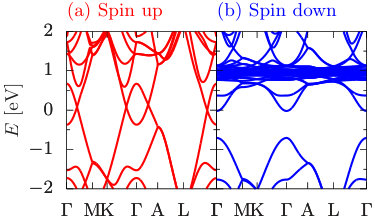 Figure 1
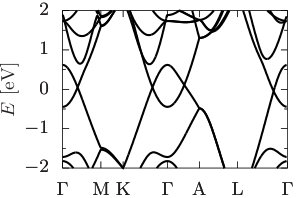 Figure 2
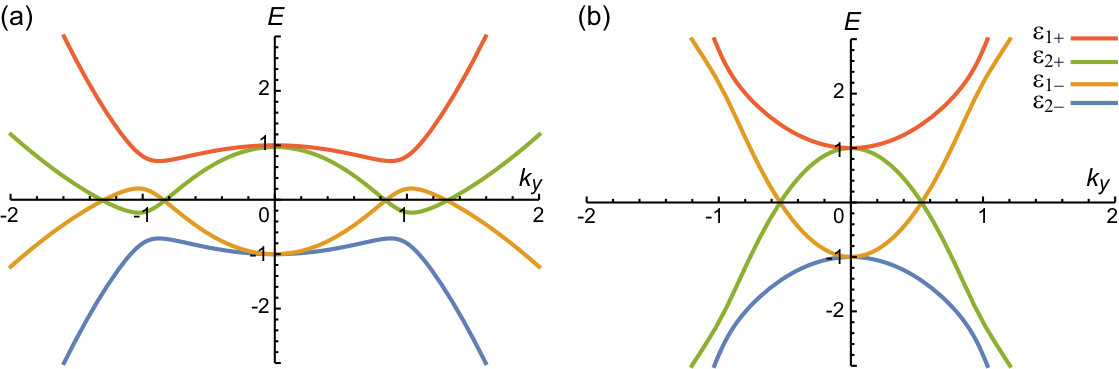 Figure 3
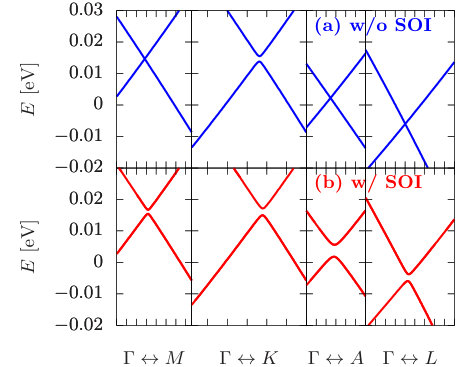 Figure 4
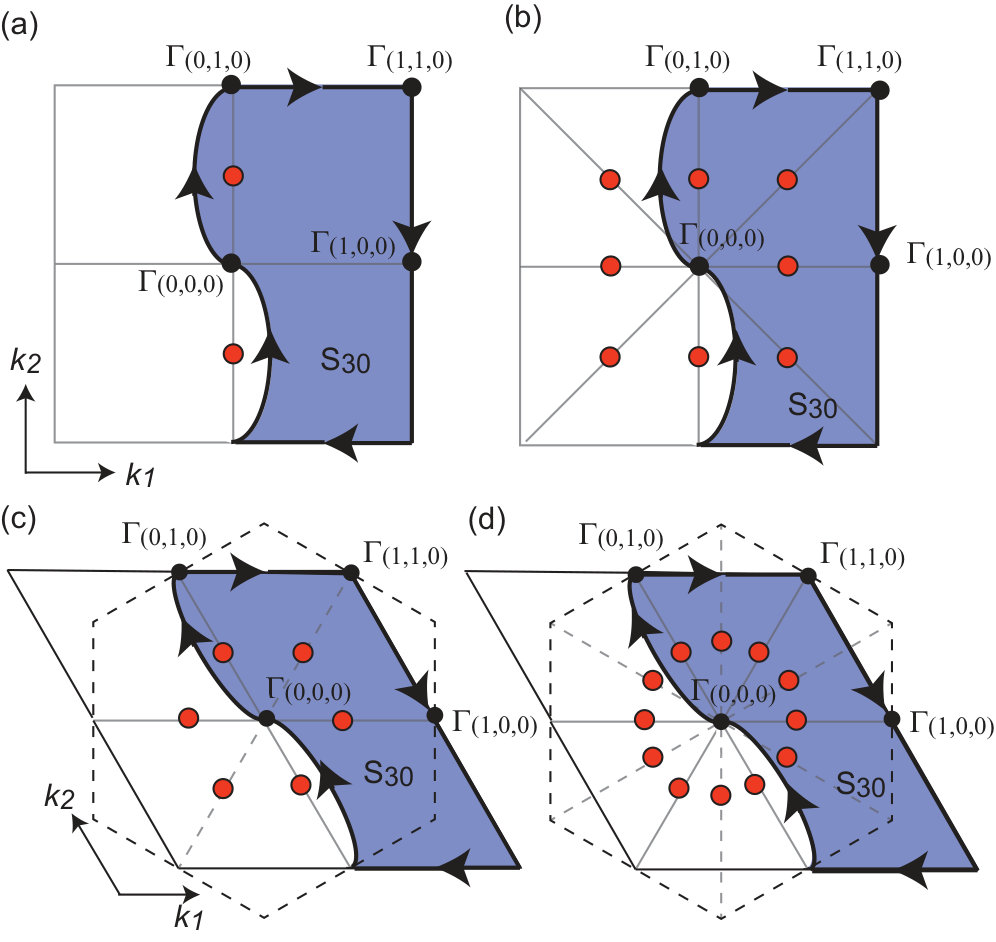 Figure 5
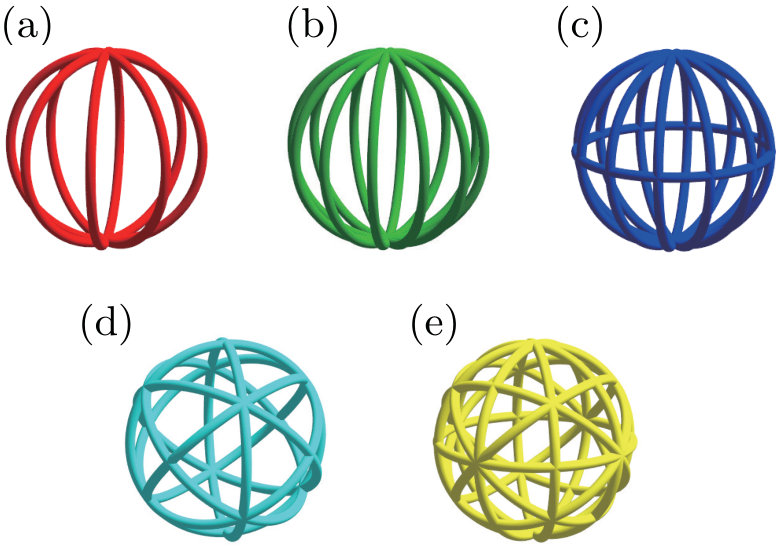 Figure 6
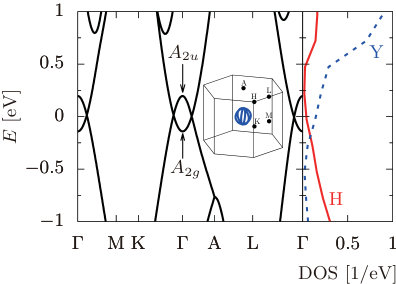 Figure 7
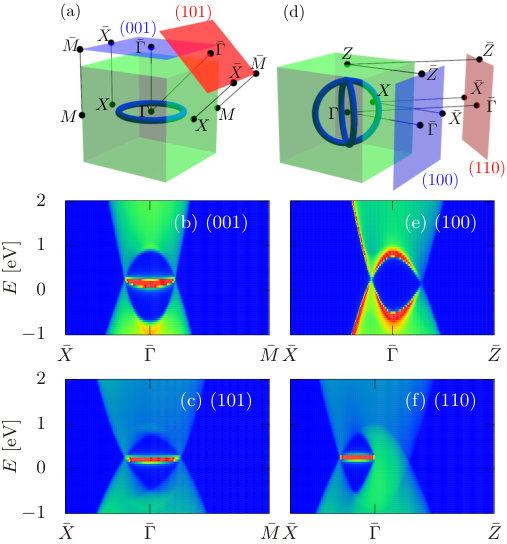 Figure 8
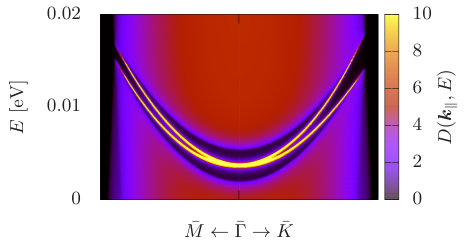 Figure 9
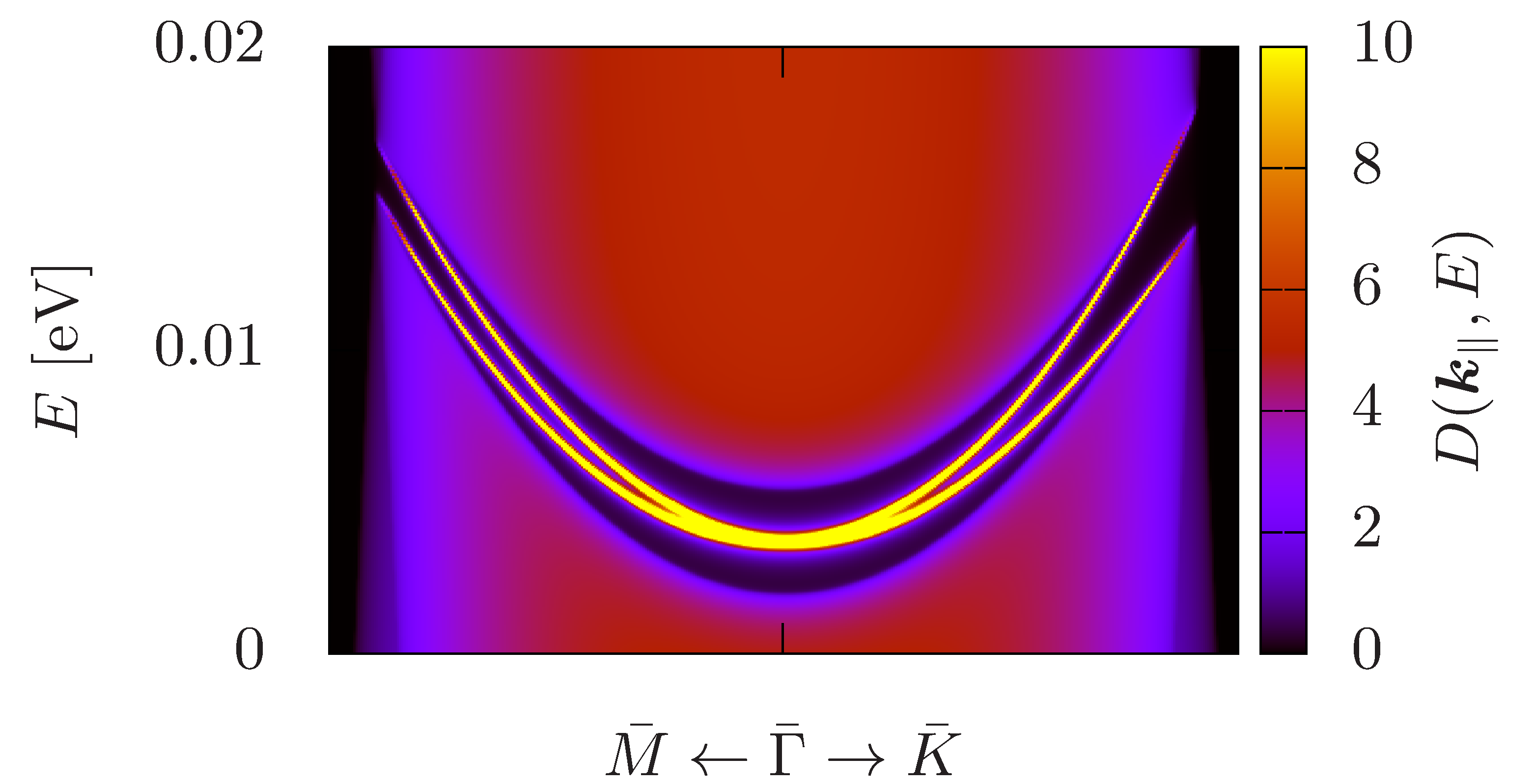 Figure 10
| PG | Line nodes | SOI |
|---|---|---|
| , | TI | |
| TI | ||
| (, , ) | I | |
| , | TI | |
| I | ||
| TI | ||
| (, ) | , | DP |
| I | ||
| , , , | TI | |
| NI | ||
| , | TI | |
| I | ||
| (, ) | , , , | DP |
| NI | ||
| , | TI | |
| I | ||
| TI | ||
| , | DP | |
| TI |
| Material | LN | w/ SOI | TRIM | PG | Ref. |
|---|---|---|---|---|---|
| MT carbon | DP | Weng et al.,2015 | |||
| LaN | DP | Zeng et al., | |||
| Cu3NPd | DP | Kim et al.,2015b; Yu et al.,2015 | |||
| CaTe | DP | Du et al., | |||
| YH3 | TI | this work |
| PG | Line nodes | |
|---|---|---|
| , | ||
| () | ||
| ; ; | ; ; | |
| ; ; | ; ; | |
| ; ; | ; ; | |
| ; ; ; | ; ; ; | |
| ; ; ; | ; ; ; | |
| ; ; | ; ; | |
| ; ; ; ; | ; ; ; ; | |
| ; ; | ; ; | |
| ; ; ; | ; ; ; | |
| ; ; ; | ; ; ; | |
| ; ; | ; ; | |
| PG | Level scheme | Line nodes |
|---|---|---|
| () | ||
| , | ||
| , | ||
| , | ||
| , | ||
| () | ||
| () | , , | |
| , | ||
| , | ||
| , , | ||
| , , , | ||
| , | ||
| , | ||
| , | ||
| , | ||
| () | ||
| , | ||
Peer Reviews
No public reviews on file for this paper yet. If you reviewed it on a platform where reviews are public (OpenReview, ICLR, NeurIPS, ICML), you can paste yours below so the community can read it here.
Videos
No videos yet. Explain this paper in a talk, walkthrough, or lecture? Add one.
Taxonomy
TopicsHydrogen Storage and Materials · Rare-earth and actinide compounds
Crossing-Line-Node Semimetals:
General Theory and Application to Rare-Earth Trihydrides
Shingo Kobayashi
Institute for Advanced Research, Nagoya University, Nagoya 464-8601, Japan
Department of Applied Physics, Nagoya University, Nagoya 464-8603, Japan
Youichi Yamakawa
Department of Physics, Nagoya University, Nagoya 464-8602, Japan
Institute for Advanced Research, Nagoya University, Nagoya 464-8601, Japan
Ai Yamakage
Department of Applied Physics, Nagoya University, Nagoya 464-8603, Japan
Institute for Advanced Research, Nagoya University, Nagoya 464-8601, Japan
Takumi Inohara
Department of Applied Physics, Nagoya University, Nagoya 464-8603, Japan
Yoshihiko Okamoto
Department of Applied Physics, Nagoya University, Nagoya 464-8603, Japan
Institute for Advanced Research, Nagoya University, Nagoya 464-8601, Japan
Yukio Tanaka
Department of Applied Physics, Nagoya University, Nagoya 464-8603, Japan
Abstract
Multiple line nodes in energy-band gaps are found in semimetals preserving mirror-reflection symmetry. We classify possible configurations of multiple line nodes with crossing points (crossing line nodes) under point-group symmetry. Taking the spin-orbit interaction (SOI) into account, we also classify topological phase transitions from crossing-line-node Dirac semimetals to other topological phases, e.g., topological insulators and point-node semimetals. This study enables one to find crossing-line-node semimetal materials and their behavior in the presence of SOI from the band structure in the absence of SOI without detailed calculations. As an example, the theory applies to hexagonal rare-earth trihydrides with the HoD3 structure and clarifies that it is a crossing-line-node Dirac semimetal hosting three line nodes.
I Introduction
The degeneracy (node) of the energy spectrum in the Brillouin zone is a topological object. Gapless semimetals are the realization of topological nodes in condensed matter physics Murakami (2007); Wan et al. (2011); Young et al. (2012); Fang et al. (2012); Wang et al. (2012); Chiu et al. (2016); Chan et al. (2016). Interestingly, semimetals hosting topological nodes exhibit novel transport and response phenomena for external electromagnetic fields Koshino and Ando (2010); Zyuzin et al. (2012); Zyuzin and Burkov (2012); Hosur and Qi (2013). For instance, in Weyl semimetals, which have point nodes in the Brillouin zone, electric current flows perpendicular to an electric field (anomalous Hall effect) and parallel to a magnetic field (chiral magnetic effect Fukushima et al. (2008)) due to the topological structure of the nodes.
Since topological invariants crucially depend on the spatial dimension Schnyder et al. (2008); Kitaev (2009); Ryu et al. (2010); Matsuura et al. (2013), node structures other than point nodes are expected to induce topological responses distinct from those in Weyl semimetals. The line node Burkov et al. (2011); Chiu and Schnyder (2014); Fang et al. (2015); Gao et al. (2016); Fang et al. (2016); Yu et al. (2016); Carbotte (2016); Lim and Moessner (2017); Roy ; Murakami et al. is one of these intriguing topological electronic states. Many line-node semimetal materials Mullen et al. (2015); Chen et al. (2015, 2015); Kim et al. (2015a); Liu et al. (2016); Weng et al. (2016); Huang et al. (2016); Xie et al. (2015); Yamakage et al. (2016); Ezawa (2016); Zhu et al. (2016); Hirayama et al. (2017); Kawakami and Hu ; Xu et al. (2017); Geilhufe et al. (2017); gup have been proposed and some measurements have actually seen line nodes in semimetals Bian et al. ; Schoop et al. (2015); Neupane et al. (2016); Wu et al. (2016); Hu et al. (a); Okamoto et al. (2016); Takane et al. (2016); Emmanouilidou et al. . Moreover, exotic magnetic transports Singha et al. ; Ali et al. ; Wang et al. ; Hu et al. (b) in line-node semimetals has been recently reported. In addition, superconductivity is also found in the noncentrosymmetric line-node semimetal PbTaSe2 Wang et al. (2016); Zhang et al. ; Chang et al. (2016); Pang et al. (2016); Guan et al. . Line-node semimetals have great potential for diverse developments in materials science.
In contrast to point nodes, there are many types of configurations of line nodes, i.e., single, spiral Heikkilä et al. (2011); Heikkilä and Volovik (2011), chain Bzdušek et al. , separate multiple Hirayama et al. ; Bian et al. ; Schoop et al. (2015); Neupane et al. (2016); Bian et al. (2016), nexus Heikkilä and Volovik (2015); Hyart and Heikkila ; Zhu et al. , and crossing Weng et al. (2015); Zeng et al. ; Kim et al. (2015b); Yu et al. (2015); Du et al. line nodes.
In this work, we focus on crossing-line-node semimetals, as shown in Fig. 1, and study a general theory for it from the viewpoint of crystalline symmetry. The configuration of the crossing line nodes is uniquely determined for a given level scheme of conduction and valence bands under a point-group symmetry. The spin-orbit interaction (SOI) may open a gap in the line nodes but the crossing points possibly remain gapless, i.e., a Dirac semimetal may be realized. We also clarify whether the resulting states are Dirac semimetals or (topological) insulators. Applying the obtained results, one can find Dirac semimetals and topological insulators from line-node semimetals and can derive their topological indices from the band calculation in the absence of SOI.
As an example, we apply the present theory to a hexagonal hydride, YH3 [space group (No. 165)], with the HoD3 structure Mansmann and Wallace (1964). YHx has been focused on as a switchable mirror Huiberts et al. (1996), i.e., the metal-insulator transition takes place at from a reflecting cubic crystal to a transparent hexagonal one. From optical measurements Griessen et al. (1997); van Gogh et al. (1999); Lee and Shin (1999); van Gogh et al. (2001), the gap has been evaluated to be 2.8 eV or slightly smaller. On the other hand, early band calculations predicted that the hexagonal YH3 is a semimetal rather than an insulator Wang and Chou (1993); Dekker et al. (1993); Wang and Chou (1995). Subsequent studies discussed another lower symmetric structure Kelly et al. (1997), weak van Gelderen et al. (2000); Miyake et al. (2000); van Gelderen et al. (2002) and strong Eder et al. (1997); Ng et al. (1997, 1999) correlation effects giving rise to a finite gap in YH3. Although the actual material is insulating, we study the gapless electronic structure of the YH3 without correlation effects, as a representative of HoD3-structure materials, and its topological properties in detail since the electronic structure has been established so it is useful for further investigations. The YH3 with HoD3 structure is shown to be a semimetal hosting three crossing line nodes. A tiny energy gap ( meV) is induced in the line nodes by SOI. This gap is characterized by the topological indices of (1;000).
II Crossing line nodes protected by point group symmetries
In general, a band crossing located on high-symmetry planes/lines is stable toward band repulsion if each energy band belongs to different eigenstates of crystalline symmetry. In particular, in mirror-reflection symmetric systems without SOI, a band crossing forms a stable Dirac line node (DLN) when it lies on a mirror-reflection plane and two energy bands have different mirror-reflection eigenvalues. Generalizing this approach to all point groups, we investigate crossing line nodes protected by point groups: , , , , , and () and their possible topological phase transitions to topological insulators and Dirac semimetals.
Here, we consider a level scheme consisting of one-dimensional (1D) irreducible representations (IRRs) of the lowest conduction and highest valence bands. We focus on mirror-reflection symmetry-protected DLNs encircling time-reversal invariant momenta (TRIM). According to the Schoenflies symbols, mirror reflections are labeled as , , and , which represent horizontal, vertical, and diagonal mirror-reflection operations in point groups, respectively. When conduction and valence bands cross on a ()-symmetric plane, the band crossing is stable if 1D IRRs and have different eigenvalues of from each other, i.e., the character of is in . Furthermore, the number of crossing lines corresponds to the number of equivalent planes. For example, in -symmetric systems, possible crossing-line-node configurations are , , and for , , and , respectively, where labels line nodes protected by () symmetry. Table 1 shows possible crossing line nodes for each point group, and the correspondence with the level schemes is shown in Appendix A. The symmetry-adapted effective Hamiltonian for 1D IRRs are also described in Appendix B. The study of crossing line nodes for 1D IRRs can be generalized to crossing line nodes for higher dimensional IRRs. In that case, it is necessary to take into account the effect of multibands. Nevertheless, when we choose a basis diagonalizing , the mechanism for protecting line nodes is the same as in the 1D IRR case: namely, a line node on a -symmetric plane is stable if two bands forming the line node have the different eigenvalues of . In particular, a level scheme consisting of 2D (3D) IRRs leads to two (three) line nodes at most on a -symmetric plane. Possible line node configurations for 2D and 3D IRRs are listed in Table 7 in Appendix.
III Effect of SOI
In systems with SOI, mirror-reflection symmetry-protected line nodes are generally unstable Yamakage et al. (2016) except for nonsymmorphic systems Fang et al. (2015); Liang et al. (2016) since the mirror-reflection eigenvalues for spin up and down are different, i.e., with spin up hybridizes with with spin down. This instability potentially leads to different topologically nontrivial phases such as Dirac/Weyl semimetals and topological insulators. The criteria for realizing these topological phases depend intrinsically on the level schemes and the number of line nodes encircling a TRIM, as we shall show in the following.
In the presence of SOI, the energy bands are labeled by the double representations, and 1D IRRs without SOI all become 2D IRRs after taking the product with the spin- representation . Therefore, after including SOI, the crossing points of multiple line nodes on the -symmetric line remains as a Dirac point if each crossing energy band belongs to different double representations within , i.e., when in are compatible with the 1D IRRs of , and and are different. Note that the -symmetry-protected Dirac points occur independently of the presence of spatial-inversion symmetry. The same criterion is applicable to higher dimensional IRRs if is decomposed into 2D IRRs, and two different 2D IRRs cross on a -symmetric line. However, we do not completely predict the presence of Dirac points from the level schemes since the multibands are labeled again after including the SOI. Off the -symmetric line, antisymmetric SOI may turn line nodes into Weyl points. The presence/absence of the Weyl points depends totally on the form of the SOI. It is beyond the scope of the paper to discuss such Weyl points.
If the SOI opens a gap on line nodes or an effect of breaking the crystalline symmetry destabilizes the Dirac point, the time-reversal-invariant systems potentially become topological insulators, depending on the band topology of the occupied states. For centrosymmetric systems with point groups , , , , and (), we can adapt the parity criterion proved in Ref. Kim et al., 2015b for the crossing line nodes, which allows us to determine the topological number of the topological insulator from the number of DLNs in the system without the SOI: (see Appendix C for more details)
[TABLE]
where is the number of DLNs encircling the TRIM for the -th primitive reciprocal lattice vector.
On the other hand, for noncentrosymmetric systems, we can partially determine the topological numbers from the number of DLNs by adapting the mirror-parity criterion proved in Ref.Yamakage et al., 2016, which is applicable to the DLN of , , and , of , and of and . For these cases, the strong index is given by Eq. (1). The weak indices and are given by Eq. (2). The third weak index is also determined from Eq. (2), except for and . For example, when a single DLN encircles a TRIM in the absence of SOI, the topological numbers are given by () for of and ; () for of , of , and of and , where is determined for , , and due to the presence of an additional mirror-reflection symmetry. Other noncentrosymmetric systems are outside the scope of the mirror-parity criterion and depend on the details of the SOI.
The obtained results enable us to predict the Dirac points and topological invariants in the presence of SOI from the band structures in the absence of SOI, without calculating the inversion/mirror-reflection parities of the wave functions. As an example, in Table 2, we show the results for four materials proposed in the literature.
IV Application to rare-earth trihydrides
Applying the general theory, we show that a hexagonal rare-earth trihydride with the HoD3 structure is a crossing-line-node semimetal with three line nodes. As a representative of the HoD3-structure materials, we consider the hexagonal YH3. Results for LuH3 and ferromagnetic GdH3 are shown in Appendix F. In the present work, the band structure is calculated using the WIEN2k code Blaha et al. (2001). We used the full-potential linearized augmented plane-wave method within the generalized gradient approximation. 10 10 8 point sampling was used for the self-consistent calculation.
The gapless band structure in the hexagonal YH3 was originally proposed by Dekker et al. Dekker et al. (1993) and is verified by our calculation, as shown in Fig. 2.
Nearly gapless band dispersions are found on the M, K, and A lines. The detailed calculation shown in Fig. 3(a) reveals that the band gap closes at 0.13 Å*-1* on the lines and at 0.14 Å*-1* on the lines while the gap opens by 4 meV on the K line. Moreover, the conduction and valence bands at the point are assigned to the and representations of , respectively.
From the general theory, the system must host three crossing line nodes in the A2g–A2u scheme. Three crossing line nodes are actually seen on the three mirror (MAL) planes. The location of the nodes is depicted in the inset of Fig. 2. On the K line, a tiny band gap opens since the KAH planes are not mirror planes. On other low-symmetry lines, the band gap is also weakly generated, on the order of 1 meV. In other words, the system could behave as a Dirac-surface-node semimetal such as graphene networks Zhong et al. (2016) and Ba ( V, Nb, Ta; S, Se) Liang et al. (2016), except for the low-energy and low-temperature regime (less than 1 meV).
It is worth mentioning that the Fermi surface of the hole-doped system mainly consists of the 1 orbitals of the H atoms (see the right panel of Fig. 2). At eV, at which the carrier density is about cm*-3*, 90% of the total density of states comes from the 1 orbitals of H. This Fermi surface might lead to high-temperature superconductivity, as in hydrogen sulfide Drozdov et al. (2015); Akashi et al. (2015); Einaga et al. (2016). Indeed, YH3 has been predicted to be a superconductor below 40 K under 17.7 GPa Kim et al. (2009), although the crystal structure is not the HoD3 structure but the fcc under pressure Ahuja et al. (1997); Palasyuk and Tkacz (2005); Ohmura et al. (2006); Kume et al. (2007); Machida et al. (2007).
As mentioned above, the crossing line nodes realize and encircle the point, which has the -point-group symmetry. The conduction and valence bands at the point are not degenerate, i.e., belong to the 1D IRRs of the point group. Then, our general theory shown in Table 1 and Eqs. (1) and (2) tells us that the SOI induces a gap on the crossing line nodes. The resulting gapped state is a strong topological insulator of (1;000). Notice that, strictly speaking, the system is semimetallic but the topological invariants are well defined since the direct gap opens at any momenta. The first-principles data, which are shown in Fig. 3(b), coincides with this prediction. The induced spin-orbit gap is estimated to be on the order of 1 meV. The SOI of the Y atom is small because it is not a heavy element. The SOI of the H atom is, obviously, negligible. Note that the Dirac point on the A point, which is located 0.7 eV below the Fermi level, still remains even in the presence of SOI, due to the nonsymmorphic symmetry of Young et al. (2012).
Finally, we construct a low-energy effective Hamiltonian in the vicinity of the point to describe the crossing line nodes and SOI, as follows: Here, denotes the Pauli matrix for the orbitals ( for the and orbitals, respectively). denotes the Pauli matrix for the spin. The parameters are determined to reproduce the crossing line nodes of the first-principles data: eVÅ3, eVÅ, eVÅ. As seen in Fig. 2, the band structure is nearly isotropic and particle-hole symmetric, hence the parameters approximately satisfy and . Calculating the surface states of the above effective model, we verify that YH3 is a strong topological insulator of . We focus on the surface. in the above Hamiltonian is regularized as and . The obtained lattice Hamiltonian is solved by using the recursive Green’s function technique Miyata et al. (2013, 2015), and the angle-resolved density of states on the (001) surface is shown in Fig. 4.
The system is, as mentioned above, a semimetal but hosts gapless surface states around the point, which is projected from the point onto the surface, within the direct gap. This directly proves that the direct gap of YH3 is characterized by the topological indices (1;000).
V Summary
We studied a general theory classifying crossing-line-node semimetals under point-group symmetries. The classification tells us the configuration of crossing line nodes for a given level scheme of conduction and valence bands. This also enables us to determine whether the crossing line nodes are gapped by the SOI from the configuration of the nodes. This will be quite important for materials development, i.e., one can predict materials being topological insulators and semimetals by exploring the band-calculation database in the absence of SOI, without any detailed calculations.
We found that the rare-earth trihydride YH3, as a representative of HoD3–structure materials, is a crossing-line node semimetal, which hosts three line nodes on the mirror-reflection-invariant planes. Although YH3 is known to probably be an insulator by correlation effects, the present study encourages us to address materials with the HoD3 structure and promises to realize a new topological semimetal.
This study has extensively revealed the electronic states of crossing line nodes. There, on the other hand, remains an interesting issue: topological transports and responses in crossing-line-node semimetals. The configuration is distinct from those of other point, line, and surface nodal structures. Therefore, we expect new topological quantum phenomena in crossing-line-node semimetals, which should be clarified in future work.
Acknowledgements.
This work was supported by the Grants-in-Aid for Young Scientists (B, Grant No. 16K17725), for Research Activity Start-up (Grant No. JP16H06861), and for Scientific Research on Innovative Areas “Topological Material Science” (JSPS KAKENHI Grants No. JP15H05851 and No. JP15H05853). S.K. was supported by the Building of Consortia for the Development of Human Resources in Science and Technology.
Appendix A Tables of line node configurations for 1D IRRs
Tables 3, 4, and 5 show the correspondence between the level schemes and line node configurations building on the criteria, where and [math] indicate line nodes protected by and the absence of a stable line node. After including the SOI, when crossing DLNs encircle a TRIM, they transform into normal (NI)/topological (TI) insulators or a Dirac point (DP). For the case of I, the SOI makes a gap on the crossing DLNs, but we cannot determine whether the system becomes a TI or NI from the point group symmetries.
Appendix B Symmetry-adapted effective models
First of all, consider a level scheme consisting of 1D IRRs and . The low-energy effective Hamiltonian is generally described by
[TABLE]
where are the identity and Pauli matrices in the orbital space and . We assume that the Hamiltonian (3) possesses time-reversal symmetry, which demands that , , and . The group operation on this Hamiltonian is defined by
[TABLE]
where is a unitary matrix in terms of in the orbital space and represents a rotation matrix concerning in the momentum space. Since we focus on the 1D IRRs, becomes or . In particular, the mirror-reflection operations , , and are given as follows:
- •
in , , , , and :
[TABLE]
- •
in and ; in and (); in ():
[TABLE]
- •
in and ; in and :
[TABLE]
- •
in , , , and :
[TABLE]
Assuming that the crossing energy bands appear around the ()-symmetric planes, the crossing line is stable if on the -symmetric planes because the term describes the band mixing between and and makes a gap. Thus, the stable DLNs requires that , leading to , where and are the momenta parallel to and perpendicular to the -symmetric planes. This condition is consistent with the criterion in the main paragraph. Table 6 shows the symmetry-adapted for each line node configuration.
Next, consider a level scheme consisting of 2D (3D) IRRs () [()]. To avoid cumbersome multiband effects, we ignore the level splitting and consider doubly (triply) degenerate conduction and valence bands as a starting point. In that case, the energy bands all form a DLN, and it is possible to decompose the effective Hamiltonian for 2D (3D) IRRs into two (three) effective Hamiltonians in terms of 1D IRRs. As an example of 2D IRRs, we discuss the level scheme () for . The symmetry operators are defined as
[TABLE]
Then, the symmetry-adapted effective Hamiltonian is given by
[TABLE]
where and . Here, , , , , , , and are material dependent parameters. The effective Hamiltonian can be described by the block-diagonal form: , where is a effective Hamiltonian with . When and cross on the -symmetric planes, we obtain six DLNs and label this line node configuration as , where represents th-degenerate DLNs protected by , i.e., line nodes appear on the -symmetric plane. To check the effect of band splitting, we include it as a perturbation: with
[TABLE]
Since the three -symmetric planes are equivalent, we focus on the -symmetric plane of , on which the eigenvalues of are
[TABLE]
The energy bands are plotted in Fig. 5. The small band splitting does not break the line node structure when [see Fig. 5 (a)]. On the other hand, for large , changes to due to the change in band structure [see Fig. 5 (b)]. Thus, although there exist at most two line nodes on a -symmetric plane, we can engineer the line node configuration from to or [math] by the band splitting . In a similar manner, we can construct symmetry-adapted effective models for 3D IRRs. For example, consider the level scheme consisting of () of . In this case, the Hamiltonian is block-diagonalized as , where is a effective Hamiltonian with . Thus, we obtain nine DLNs, labeled by . After including the effect of band splitting, changes to , , or [math]. In general, the decomposition of level schemes () into is possible if includes a 1D IRR whose character of is . We list possible decompositions for level schemes with 2D and 3D IRRs in Table 7. Our method derives symmetry-adapted effective models in a comprehensive fashion, but accidental line nodes often occur off mirror-reflection symmetric planes.
Finally, we mention the cases that level schemes consist of different dimensional IRRs, such as , , and . In this case, the above decomposition is not applicable because when we ignore a band splitting, a band always remains uncoupled with other bands, resulting in a metallic phase. Hence, we need to remove the unwanted energy bands away from the Fermi level by a band splitting. Then, we can engineer mirror-reflection symmetry-protected line nodes in a similar manner.
Appendix C Topological numbers
A mirror-reflection symmetry-protected line node is attributed to the band degeneracy between the conduction and valence bands with opposite mirror-reflection eigenvalues. That is, on the -symmetric plane, the topological number can be given by counting the number of occupied states with outside and inside of the nodal loops:
[TABLE]
where is the number of occupied states with outside (inside) a nodal loop. In the following, we consider time-reversal-invariant systems and show the topological number of line nodes, which is associated with the topological number of TIs.
C.1 topological number in the absence of SOI
From previous studies Kim et al. (2015b); Yamakage et al. (2016); Chan et al. (2016), a DLN gives a nontrivial topological number in terms of the Berry phase, which links to the drumhead surface state and polarization (see Appendix D). The Berry phase in spinless systems is defined by Yamakage et al. (2016)
[TABLE]
where and are the non-Abelian Berry connection and the sewing matrix defined by, respectively,
[TABLE]
Here, , is the Bloch function with band index , and the sewing matrix originates from a nontrivial periodic boundary condition:
[TABLE]
instead of imposing the momentum dependence on a group operation. Using the Berry phase, the topological number is given by
[TABLE]
where takes values of [math] or due to the constraints from the spatial-inversion or mirror-reflection symmetry. If , a loop encircles a band degeneracy, implying that an odd number of DLNs penetrate into the inner side of . In the following, we relate the topological numbers to spatial-inversion or mirror-reflection eigenvalues at a high symmetric momentum. Note that a similar argument was discussed in Refs. Kim et al., 2015b; Yamakage et al., 2016. For simplicity, we assume in the following that the nontrivial boundary condition occurs only for the direction, i.e., , where is a momentum perpendicular to .
First of all, consider centrosymmetric systems. The Hamiltonian hosts the spatial-inversion symmetry as
[TABLE]
where is the spatial-inversion operator. Under the inversion operation, the non-Abelian Berry connection transforms as
[TABLE]
where . As we consider the loop , where is a TRIM on the plane perpendicular to the direction, the integral of becomes
[TABLE]
which yields
[TABLE]
Substituting Eq. (24) into Eq.(16), one obtains
[TABLE]
where . Therefore, when we choose the basis as , this results in
[TABLE]
which relates the topological number to the parity eigenvalues of the TRIMs. Here, is the eigenvalue of at and takes . For a surface (), the topological number of is given by
[TABLE]
where is the number of DLNs penetrating into . Note that when a DLN crosses , we slightly modify the path with spatial-inversion symmetry. (See Fig. 6 as an example.)
Next, consider noncentrosymmetric systems. In this case, we use the mirror-reflection symmetry instead of the spatial-inversion symmetry. The mirror-reflection symmetry satisfies
[TABLE]
where is the mirror-reflection operator. Under the mirror-reflection operation, the non-Abelian Berry connection transforms as
[TABLE]
where . After integrating along in a similar manner to the case of the spatial-inversion symmetry, it turns out that
[TABLE]
where . When we choose the basis that satisfies , where is a TRIM on a line perpendicular to the mirror-reflection symmetric plane and , the topological number is described by the mirror-reflection eigenvalues:
[TABLE]
Also, if we take a loop as which is the surface perpendicular to the mirror-reflection symmetric plane, one obtains
[TABLE]
In contrast with the spatial inversion cases, Eq. (32) is applicable only if a DLN does not cross .
Finally, we mention the connection between the topological number and . When a Dirac nodal ring exists on the plane of and encircles a TRIM, it follows from the definition of that
[TABLE]
where is a TRIM outside (inside) the nodal ring on the plane of .
C.2 topological number of topological insulators
Taking into account the SOI, some cases become topological insulators. Here, we prove the criterion of topological insulators, connecting the number of DLNs with the topological number of topological insulators. We start with the simplified expression: Yamakage et al. (2016)
[TABLE]
with
[TABLE]
where and includes the spin degrees of freedom, i.e., in the SOI-free limit. The topological number is obtained by and . Note that Eq. (34) is applicable to noncentrosymmetric systems only when the axis is perpendicular to the mirror-reflection symmetric plane. When we choose a loop that does not cross DLNs in systems without SOI, the systems have a gap along with and without the SOI. Hence, the topological number does not change even when the SOI is turned off. Therefore, Eq. (34) is rewritten as
[TABLE]
where represents the number of line nodes penetrating into the surface . Using the eigenvalues, Equation (36) immediately leads to
[TABLE]
and Eqs. (1) and (2) in the main paper. Equation (36) is described by, for centrosymmetric systems,
[TABLE]
and, for noncentrosymmetric systems,
[TABLE]
Concretely, consider a crossing DLN encircling in a centrosymmetric system. In this case, the topological number (34) is calculated as and , where is the number of line nodes encircling . Thus, one obtains
[TABLE]
Therefore, when the SOI makes a gap, the systems with an odd number of DLNs become topological insulators.
Appendix D Drumhead surface states
The one-dimensional invariant Eq. (20) partially guarantees the presence of drumhead surface states Yamakage et al. (2016); Chan et al. (2016). Here, we show an example of drumhead surface states for crossing-line-node semimetals.
As an example, we examine two minimal models consisting of and orbitals (– model) and of and orbitals (– model) under the point-group symmetry. The Hamiltonians for these models are explicitly shown in the next section E. Line nodes appear on the plane () in the former model [Fig. 7(a)] while on the diagonal mirror planes () but not on the vertical planes () () in the latter model [Fig. 7(b)]. The configurations, and , of line nodes are consistent with the general theory discussed in the main manuscript. Moreover, the general formulae Eqs. (31) and (33) derived in the previous section tells us that the one-dimensional invariant , where the subscript denotes the direction of the integral path and is perpendicular to , is obtained as follows: for the – model and for the – model for located within the line nodes. Additionally, in the latter model, holds because there is no line node on the (100) and (010) planes. Correspondingly, there exist surface states on the (001) surface of the former model and on the (110) and surfaces of the latter model while there is no surface state on the (100) and (010) surfaces in the latter model, as numerically verified below.
We show the angle-resolved density of states on two different surfaces for the two models by calculating the surface Green’s function Miyata et al. (2013, 2015). There exists a drumhead surface state within the line node on both the (001) [Fig. 7(b)] and (101) [Fig. 7(c)] surfaces of the – model. The – model, on the other hand, has no surface state on the (100) surface, as shown in Fig. 7(e), because the two line nodes have completely overlapped onto the (100) surface. On the other surfaces, e.g., the (110) surface shown in Fig. 7(f), surface states can emerge in the region in which the line nodes are not overlapping. This result is also consistent with the general theory.
Appendix E Effective models
E.1 – model in
Hamiltonian:
[TABLE]
with
[TABLE]
up to the second order of the momentum . The Hamiltonian is regularized on the cubic lattice into
[TABLE]
with
[TABLE]
[TABLE]
In order to calculate the surface electronic states, we set the semi-infinite Hamiltonian as
[TABLE]
On the (001) plane, for and , the onsite and hopping matrices are given by
[TABLE]
On the (101) plane, for and , we have
[TABLE]
and
[TABLE]
The parameters are set at , , , , , , in the calculation (Fig. 7).
E.2 – model in
[TABLE]
[TABLE]
[TABLE]
[TABLE]
[TABLE]
[TABLE]
Appendix F Rare-earth trihydrides
HoD3-structured materials without correlations ubiquitously exhibit crossing line nodes in the band gap. We show the energy band structure of LuH3, which has 14 electrons, with the HoD3 structure as another example of a crossing-line-node semimetal. The lattice constant is taken from the calculated value in Ref. Kong et al., 2012.
The obtained first-principles band structure shown in Fig. 8 is quite similar to that for YH3 (Fig. 2) without correlation effects, i.e., three crossing line nodes ( of in Table 1) are realized.
One more example is ferromagnetic GdH3 with the HoD3 structure, where Gd’s have spins. The energy bands for spin up (majority) and for spin down (minority) are shown in Fig. 9. The electrons migrate from the Fermi level to higher-energy regions. The remaining spin-up state hosts three crossing line nodes, as with LuH3 (Fig. 8), while the spin-down state is insulating. The resulting state is a crossing-line-node () half semimetal. Note that, in the actual material of GdH3, the antiferromagnetic state is more stable Kong et al. (2013) than the ferromagnetic state as the ground state and has been observed below K Flood (1977); Carlin et al. (1980).
The reference list from the paper itself. Each links out to its DOI / PubMed record.
- 1Murakami (2007) Shuichi Murakami, “Phase transition between the quantum spin hall and insulator phases in 3D: emergence of a topological gapless phase,” New J. Phys. 9 , 356 (2007) .
- 2Wan et al. (2011) Xiangang Wan, Ari M. Turner, Ashvin Vishwanath, and Sergey Y. Savrasov, “Topological semimetal and fermi-arc surface states in the electronic structure of pyrochlore iridates,” Phys. Rev. B 83 , 205101 (2011) . · doi ↗
- 3Young et al. (2012) S. M. Young, S. Zaheer, J. C. Y. Teo, C. L. Kane, E. J. Mele, and A. M. Rappe, “Dirac Semimetal in Three Dimensions,” Phys. Rev. Lett. 108 , 140405 (2012) . · doi ↗
- 4Fang et al. (2012) Chen Fang, Matthew J. Gilbert, Xi Dai, and B. Andrei Bernevig, “Multi-Weyl Topological Semimetals Stabilized by Point Group Symmetry,” Phys. Rev. Lett. 108 , 266802 (2012) . · doi ↗
- 5Wang et al. (2012) Zhijun Wang, Yan Sun, Xing-Qiu Chen, Cesare Franchini, Gang Xu, Hongming Weng, Xi Dai, and Zhong Fang, “Dirac semimetal and topological phase transitions in A 3 Bi ( a = Na 𝑎 Na a=\text{Na} , K, Rb),” Phys. Rev. B 85 , 195320 (2012) . · doi ↗
- 6Chiu et al. (2016) Ching-Kai Chiu, Jeffrey C. Y. Teo, Andreas P. Schnyder, and Shinsei Ryu, “Classification of topological quantum matter with symmetries,” Rev. Mod. Phys. 88 , 035005 (2016) . · doi ↗
- 7Chan et al. (2016) Y.-H. Chan, Ching-Kai Chiu, M. Y. Chou, and Andreas P. Schnyder, “Ca 3 P 2 and other topological semimetals with line nodes and drumhead surface states,” Phys. Rev. B 93 , 205132 (2016) . · doi ↗
- 8Koshino and Ando (2010) Mikito Koshino and Tsuneya Ando, “Anomalous orbital magnetism in Dirac-electron systems: Role of pseudospin paramagnetism,” Phys. Rev. B 81 , 195431 (2010) . · doi ↗