Some Time-changed fractional Poisson processes
A. Maheshwari, P. Vellaisamy

TL;DR
This paper investigates two types of fractional Poisson processes time-changed by Lévy subordinators, analyzing their distributional properties, dependence structures, and providing simulations to illustrate their behaviors.
Contribution
It introduces and studies TCFPP-I and TCFPP-II, new fractional Poisson processes with time changes, detailing their properties, distributions, and differential equations, which were not previously explored.
Findings
TCFPP-I exhibits long-range dependence under certain conditions.
TCFPP-II is characterized as a renewal process with a specific waiting time distribution.
Sample path simulations demonstrate the processes' behaviors.
Abstract
In this paper, we study the fractional Poisson process (FPP) time-changed by an independent L\'evy subordinator and the inverse of the L\'evy subordinator, which we call TCFPP-I and TCFPP-II, respectively. Various distributional properties of these processes are established. We show that, under certain conditions, the TCFPP-I has the long-range dependence property and also its law of iterated logarithm is proved. It is shown that the TCFPP-II is a renewal process and its waiting time distribution is identified. Its bivariate distributions and also the governing difference-differential equation are derived. Some specific examples for both the processes are discussed. Finally, we present the simulations of the sample paths of these processes.
Click any figure to enlarge with its caption.
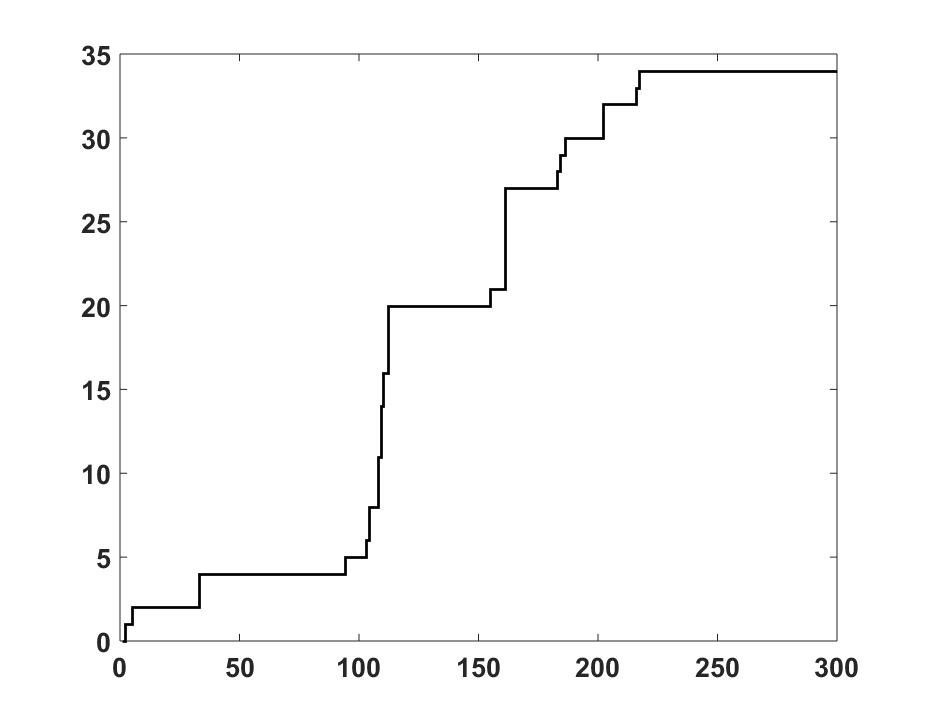 Figure 1
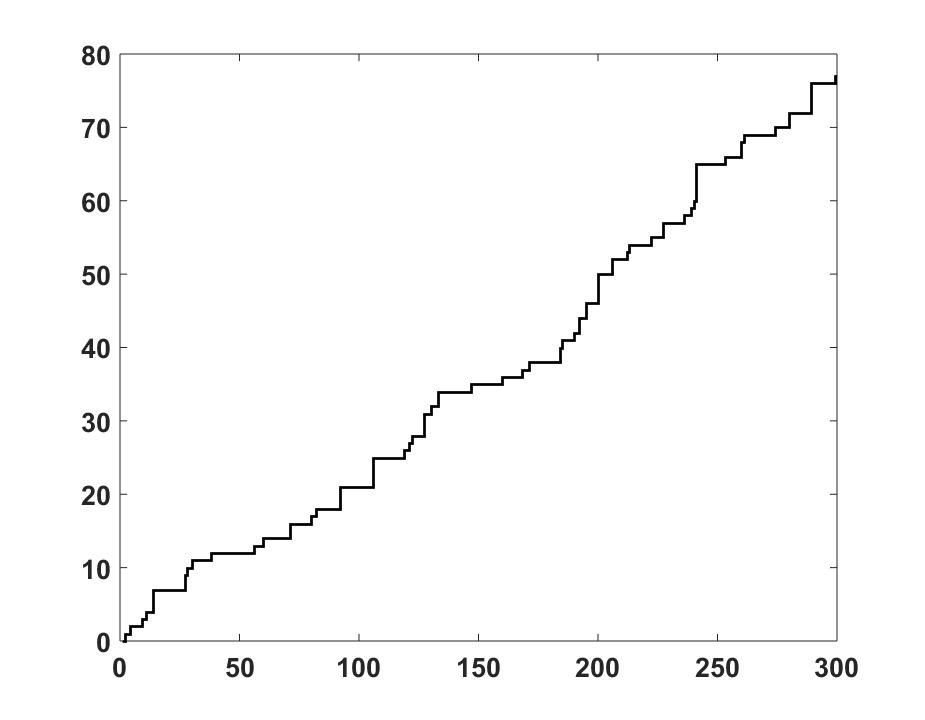 Figure 2
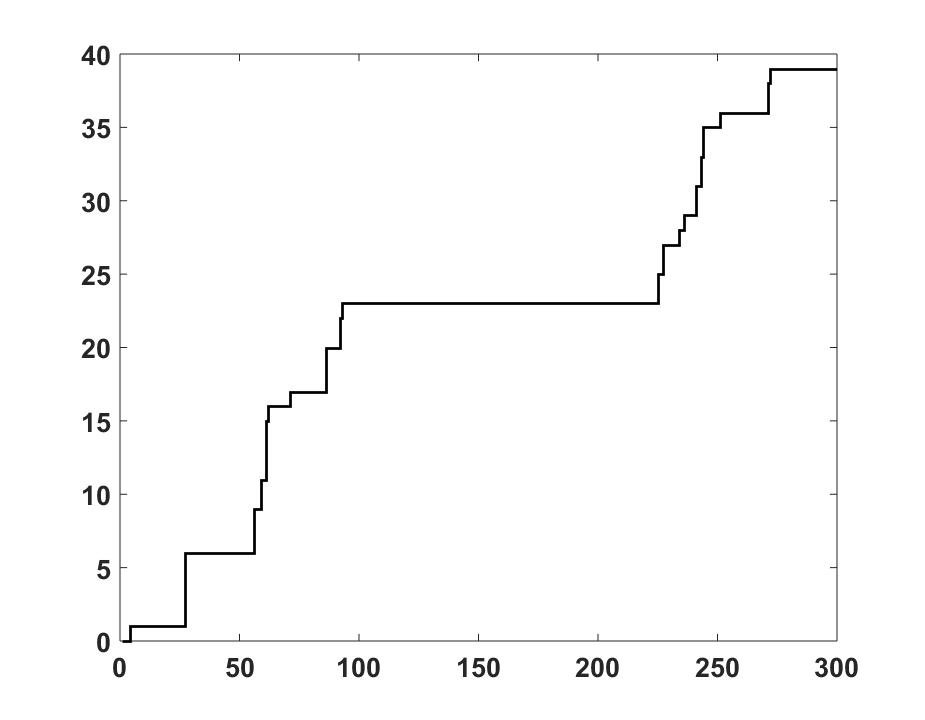 Figure 3
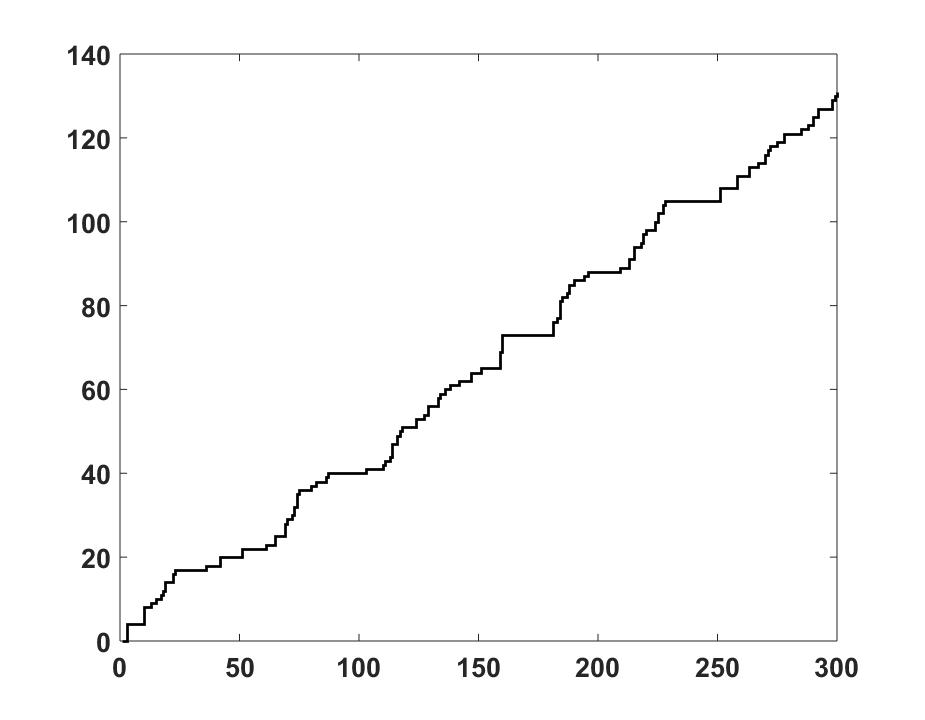 Figure 4
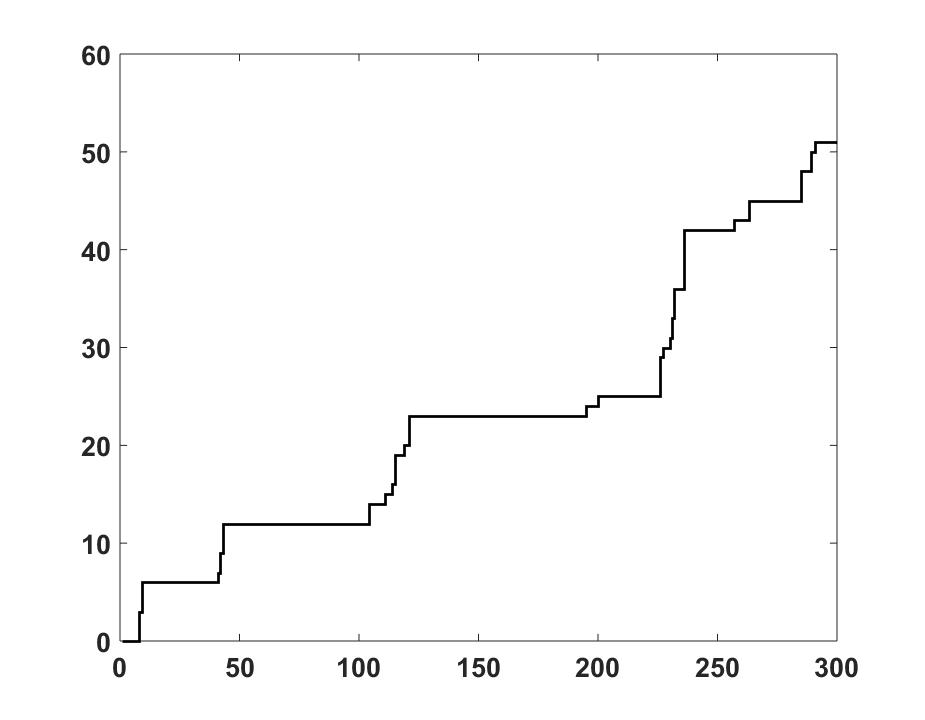 Figure 5
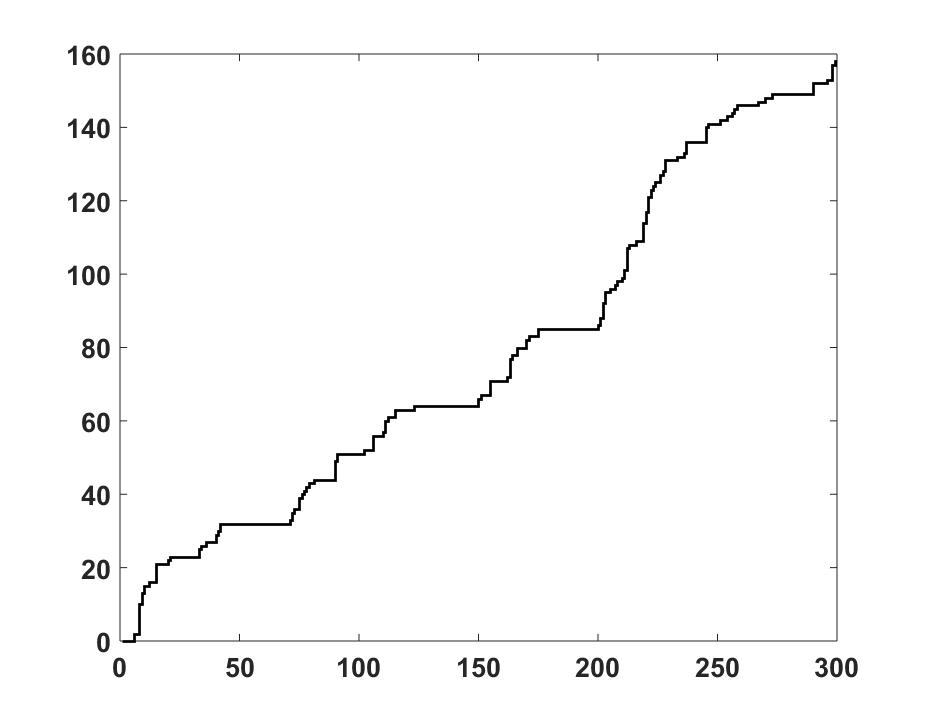 Figure 6
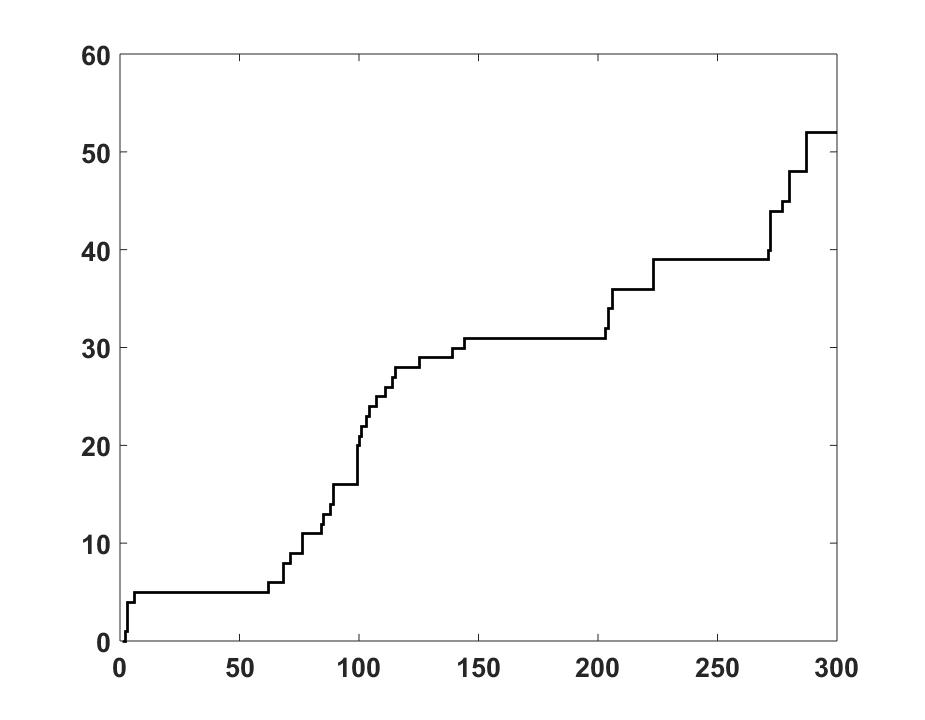 Figure 7
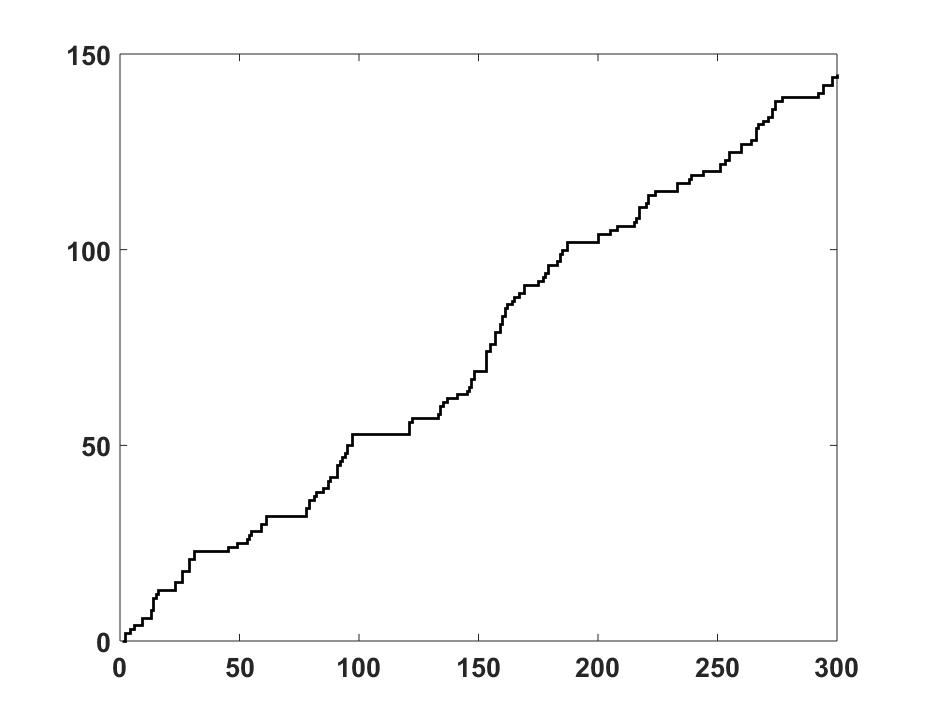 Figure 8
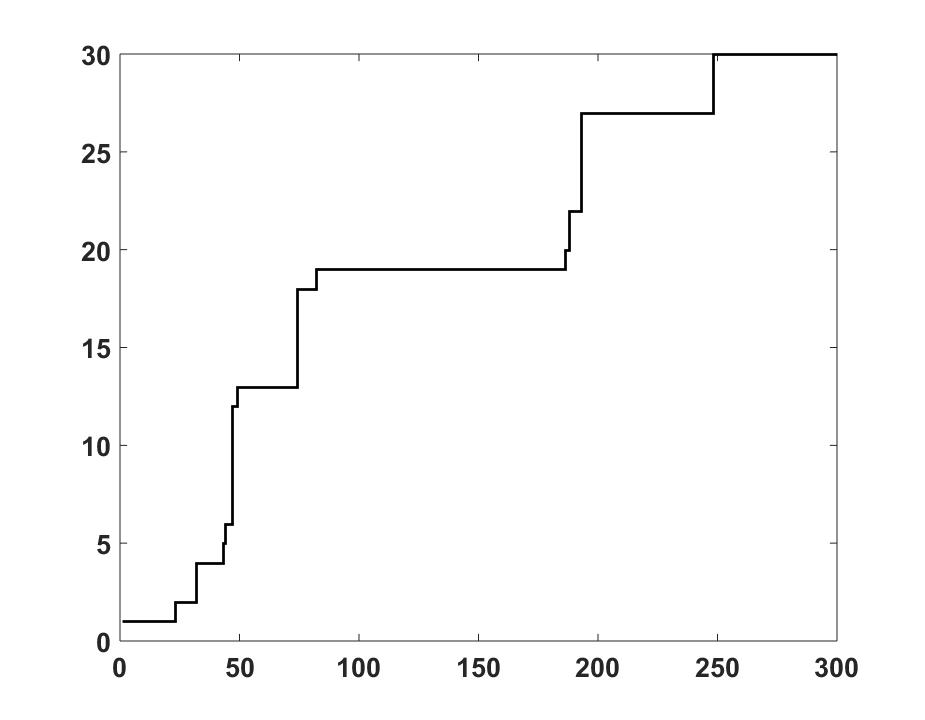 Figure 9
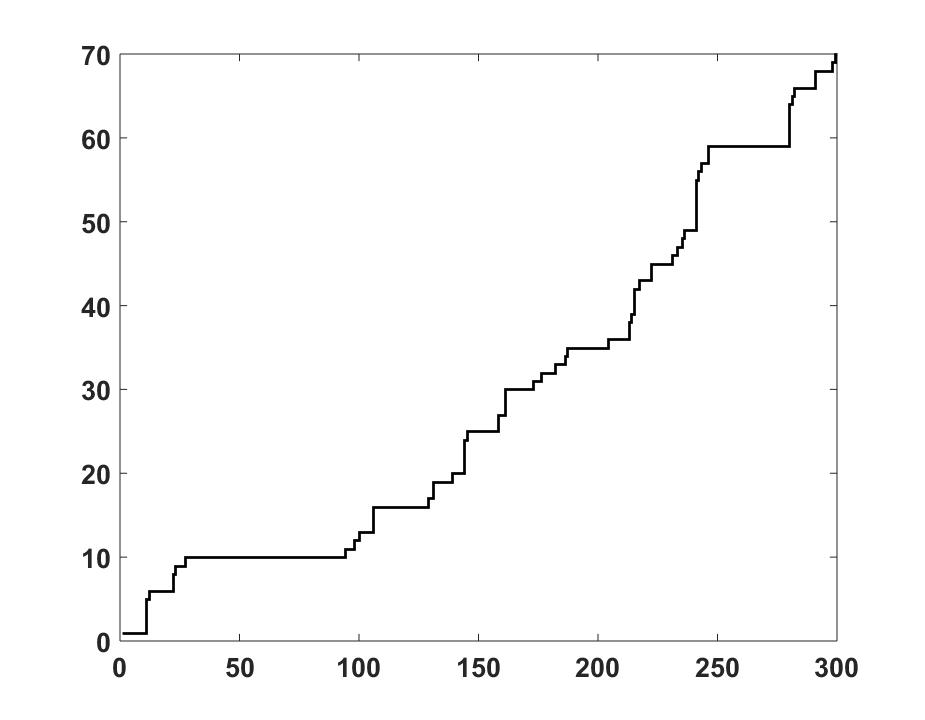 Figure 10
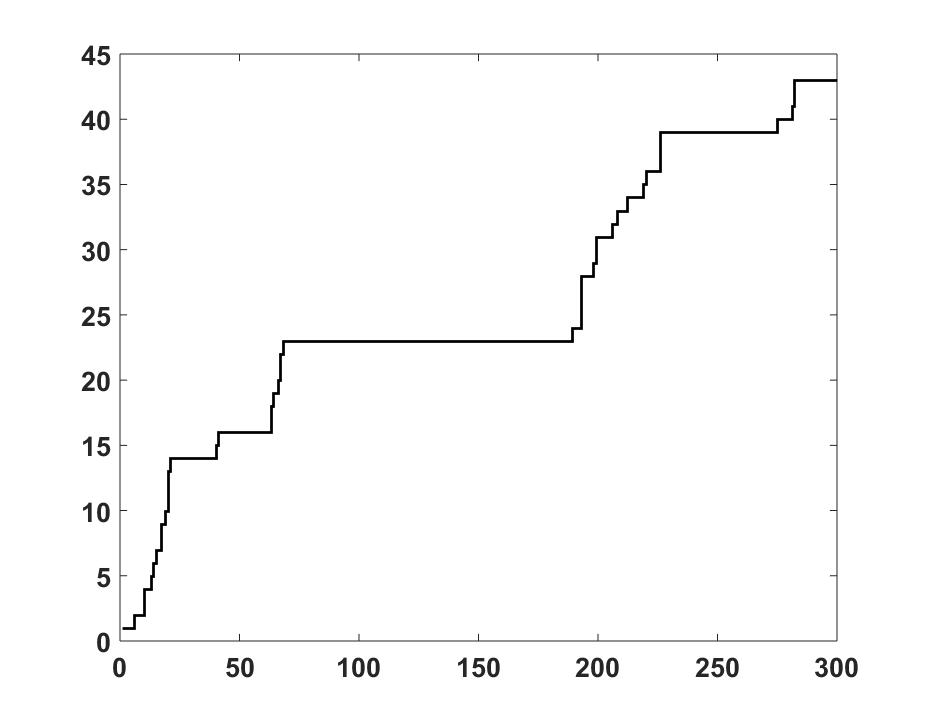 Figure 11
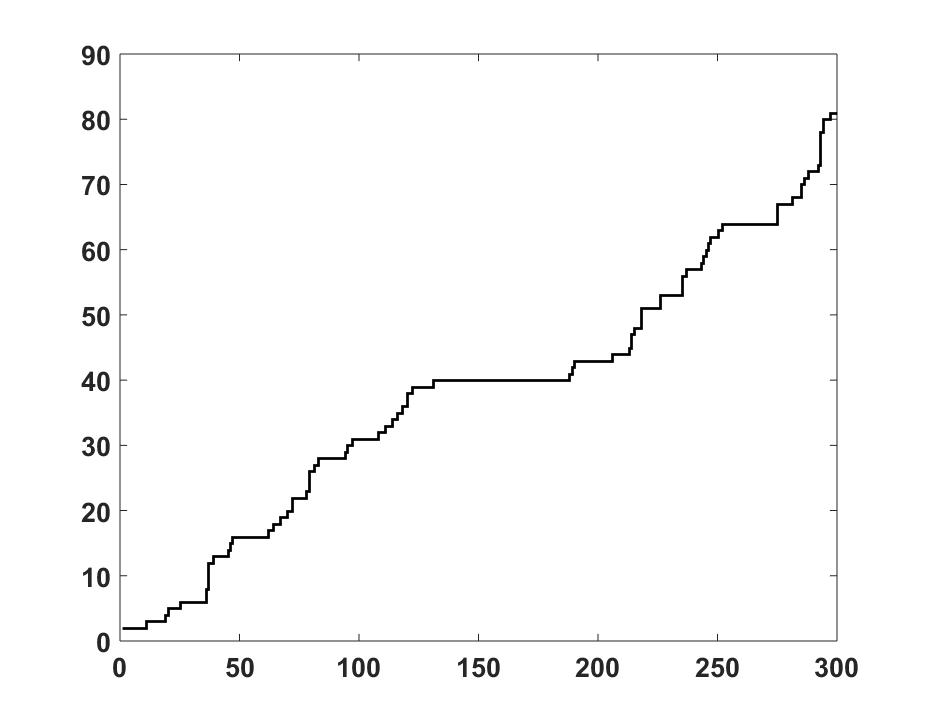 Figure 12
Peer Reviews
No public reviews on file for this paper yet. If you reviewed it on a platform where reviews are public (OpenReview, ICLR, NeurIPS, ICML), you can paste yours below so the community can read it here.
Videos
No videos yet. Explain this paper in a talk, walkthrough, or lecture? Add one.
Taxonomy
TopicsFractional Differential Equations Solutions · Mathematical functions and polynomials · Statistical Distribution Estimation and Applications
Some Time-changed fractional Poisson processes
A. Maheshwari∗ and P. Vellaisamy∗
∗Postal address: Department of Mathematics, Indian Institute of Technology Bombay, Powai, Mumbai 400076, INDIA.
[email protected], [email protected]
Abstract.
In this paper, we study the fractional Poisson process (FPP) time-changed by an independent Lévy subordinator and the inverse of the Lévy subordinator, which we call TCFPP-I and TCFPP-II, respectively. Various distributional properties of these processes are established. We show that, under certain conditions, the TCFPP-I has the long-range dependence property and also its law of iterated logarithm is proved. It is shown that the TCFPP-II is a renewal process and its waiting time distribution is identified. Its bivariate distributions and also the governing difference-differential equation are derived. Some specific examples for both the processes are discussed. Finally, we present the simulations of the sample paths of these processes.
Key words and phrases:
Lévy subordinator, fractional Poisson process, simulation.
2010 Mathematics Subject Classification:
60G22; 60G55
1. Introduction
Recently, there has been a considerable interest in studying the fractional Poisson process (FPP) . The early development of the FPP is due [32, 16, 21]. Later, a rich growth of the literature is contributed by [24, 25, 5, 6]. It is proved in [25] that the FPP can be seen as the subordination of the Poisson process by an independent inverse -stable subordinator, that is,
[TABLE]
where is the Poisson process with rate and is the inverse -stable subordinator. The relation between the inverse -stable subordinator and the -stable subordinator is
[TABLE]
where the Laplace transform (LT) of the -stable subordinator is given by , . [18] studied the time-changed Poisson process subordinated with the inverse Gaussian, the first-exit time of the inverse Gaussian, the stable and the tempered stable subordinator. [28] studied the Poisson process subordinated by an independent -stable subordinator , called the space fractional Poisson process. In [30], studied the Poisson process subordinated with independent Lévy subordinator and [36] studied the FPP subordinated with an independent gamma subordinator to obtain the fractional negative binomial process (FNBP). Observe that the Lévy subordinator covers most of the special subordinators (see [3, Theorem 1.3.15]) considered in the literature.
The goal of the present work is to study the FPP time-changed by an independent Lévy subordinator (hereafter referred to as the subordinator) with LT (see [3, Section 1.3.2])
[TABLE]
where
[TABLE]
is the Bernstein function. Here is the drift coefficient and is a non-negative Lévy measure on positive half-line such that
[TABLE]
The assumption guarantees that the sample paths of are almost surely strictly increasing. [30] studied the process where is the subordinator with drift coefficient . We investigate the process
[TABLE]
where the time variable is replaced by an independent subordinator and call the time-changed fractional Poisson process version one (TCFPP-I). The probability mass function (pmf) of TCFPP-I is obtained and its mean and covariance functions are computed. We discuss the asymptotic behavior of the covariance function for large . Using these results, we prove the long-range dependence (LRD) property for the TCFPP-I process, under certain conditions. The law of iterated logarithm for the TCFPP-I is also proved.
The first-exit time of is defined as
[TABLE]
which is the right-continuous inverse of the subordinator . We consider also the time-changed fractional Poisson process version two (TCFPP-II) defined by
[TABLE]
The pmf, mean and covariance functions for the TCFPP-II are derived. We also discuss the asymptotic behavior of the mean and variance functions of the TCFPP-II. The bivariate distribution and the difference-differential equation governing the pmf of the TCFPP-II are derived. Lastly, we present the simulations for some special TCFPP-I and TCFPP-II processes.
The paper is organized as follows. In Section 2, we present some preliminary definitions and results. The TCFPP-I and the TCFPP-II processes are investigated in detail in Section 3 and 4, respectively. In Section 5, we present the simulations for some specific TCFPP-I and TCFPP-II processes.
2. Preliminaries
In this section, we present some preliminary results which are required later in the paper.
The Mittag-Leffler function is defined as (see [27])
[TABLE]
The generalized Mittag-Leffler function is defined as (see [31])
[TABLE]
Let . The fractional Poisson process (FPP) , which is a generalization of the Poisson process , is defined to be a stochastic process for which satisfies (see [21, 24, 25])
[TABLE]
Here, denotes the Caputo-fractional derivative defined by
[TABLE]
The pmf of the FPP is given by (see [21, 25])
[TABLE]
The mean, variance and covariance functions (see [21, 22]) of the FPP are given by
[TABLE]
where , , , and , is the incomplete beta function.
3. Time-changed fractional Poisson process-I
In this section, we consider the FPP time-changed by a subordinator , defined in (1.2), for which the moments for all . Note is an increasing process with
Definition 3.1** **(TCFPP-I).
The time-changed fractional Poisson process version one (TCFPP-I) is defined as
[TABLE]
where is the FPP and is independent of the subordinator .
We suppress the parameter , unless the context requires, associated with the processes and .
Theorem 3.1**.**
The one-dimensional distributions of the TCFPP-I is given by
[TABLE]
Proof.
Let be the pdf of . Then, from (2.4),
[TABLE]
Remark 3.1**.**
It can be seen that the *pmf * satisfies the normalizing condition . We have
[TABLE]
We next present some examples of the TCFPP-I processes.
Example 3.1** (Fractional negative binomial process).**
Let be the gamma subordinator, where , the gamma distribution with density
[TABLE]
where both and are positive. It is known that (see [3, p. 54])
[TABLE]
The fractional negative binomial process (FNBP), introduced and studied in detail in [36], is defined by time-changing the FPP by an independent gamma subordinator, that is,
[TABLE]
It is known that (see [36, eq. (4.4)])
[TABLE]
From (3.1), the pmf of is
[TABLE]
which coincides with the pmf of the FNBP obtained in [36]. Also, it holds that
Example 3.2** (FPP subordinated by tempered -stable subordinator).**
Let be the tempered -stable subordinator with LT
[TABLE]
The pdf of the tempered -stable subordinator is given by (see [2, eq. (2.2)])
[TABLE]
where is the pdf of the -stable subordinator . The FPP time-changed by an independent tempered -stable subordinator is defined as
[TABLE]
In this case, the pmf (3.1) reduces to
[TABLE]
It is easy to show that
Example 3.3** (FPP subordinated by inverse Gaussian subordinator).**
Let be the inverse Gaussian subordinator with LT (see [3, Example 1.3.21])
[TABLE]
The FPP time-changed by an independent inverse Gaussian subordinator is defined as
[TABLE]
It is known that (see [15, 18]) the moments of are given by
[TABLE]
where is the modified Bessel function of third kind with index . We can substitute the moments of in (3.1) to obtain the pmf of . Moreover, it can be shown that
We next obtain the mean, the variance and the covariance functions of the TCFPP-I.
Theorem 3.2**.**
Let and . The distributional properties of the TCFPP-I are as follows:
(i) ,
(ii),
[TABLE]
Proof.
Using (2.5), we get
[TABLE]
which proves Part (i). From (2.6) and (2.5),
[TABLE]
which leads to
[TABLE]
By (3.3) and (3.4), Part (iii) follows. Part (ii) follows from Part (iii) by putting . ∎
Index of dispersion. The index of dispersion for a counting process is defined by (see [12, p. 72])
[TABLE]
The stochastic process is said to be overdispersed if for all (see [7, 36]). Since the mean of the TCFPP-I is nonnegative, it suffices to show that Var. From Theorem 3.2, we have that
[TABLE]
where and for all (see [7, Section 3.1]). Hence, the TCFPP-I exhibits overdispersion.
We next derive the asymptotic expansion for the covariance function of the TCFPP-I process. The following result generalizes Lemma 4.1 of [23] to the subordinator . First, recall the following definition.
Definition 3.2**.**
Let and be positive functions. We say that is asymptotically equal to , written as , as , if
[TABLE]
Theorem 3.3**.**
Let , and be fixed. Let be the subordinator with , where is the Bernstein function defined in (1.3). If as , then
(i) the asymptotic expansion of is
[TABLE]
(ii) the asymptotic expansion of is
[TABLE]
Proof.
(i) Since the subordinator has stationary and independent increments, it suffices to show that
[TABLE]
Also, is an increasing process with so that
[TABLE]
Now consider
[TABLE]
From (3.5) and (3.6), we have that
[TABLE]
Taking the limit as tends to infinity in the above equation and using the fact that has independent increments, we get
[TABLE]
which proves Part (i).
To prove Part (ii), it suffices to show that, in view of Part (i),
[TABLE]
Note first that
[TABLE]
which leads to
[TABLE]
Hence,
[TABLE]
On the other hand,
[TABLE]
This leads to
[TABLE]
using Part (i). By (3.7) and (3.8), we have that
[TABLE]
This completes the proof of Part (ii). ∎
Remark 3.2**.**
The assumption, in Theorem 3.3, that as , is satisfied for the following subordinators.
(a) Gamma subordinator: It is known (see [36]) that , which implies as .
(b) Inverse Gaussian subordinator: The moments of inverse Gaussian subordinator are given in (3.2). The asymptotic expansion of , for large , is (see [15, eq. (A.9)])
[TABLE]
where . For , the asymptotic expansion of (3.2), as , is
[TABLE]
which implies that as
We next show that the TCFPP-I, under certain conditions on the subordinator , possesses the LRD property. There are various definitions in the literature for the LRD property of a stochastic process. We now present the definition (see [13, 23]) that will be used in this paper.
Definition 3.3**.**
Let and be fixed. Assume a stochastic process has the correlation function Corr that satisfies
[TABLE]
for large , , and . That is,
[TABLE]
for some and We say has the long-range dependence (LRD) property if and has the short-range dependence (SRD) property if .
Note (3.10) implies that Corr behaves like , for large .
Theorem 3.4**.**
Let be such that and for some and positive constants and with . Then the TCFPP-I has the LRD property.
Proof.
Consider the last term of given in Theorem 3.2 (iii), namely,
[TABLE]
Using Theorem 3.3 (ii), we get for large ,
[TABLE]
Using (3.11), Theorem 3.2 (iii) and , we get,
[TABLE]
since for large , and
Similarly, from Theorem 3.2 (ii) and , we have that
[TABLE]
where . Thus, from (3.12) and (3.13), we have for large ,
[TABLE]
which decays like the power law . Hence, the TCFPP-I exhibits the LRD property.∎
Remark 3.3**.**
From Remark 3.2, it can be seen that moments of the gamma subordinator has the asymptotic expansion and . Therefore, the FNBP exhibits the LRD property. Similarly, for the inverse Gaussian subordinator , we have the asymptotic expansion and . Hence, also has the LRD property.
Definition 3.4**.**
We call a function regularly varying at 0+ with index (see [8]) if
[TABLE]
We first reproduce the following law of iterated logarithm (LIL) for the subordinator from [8, Chapter III, Theorem 14].
Lemma 3.1**.**
Let be a subordinator with , where is regularly varying at with index . Let be the inverse function of and
[TABLE]
Then
[TABLE]
We next prove the LIL for the TCFPP-I.
Theorem 3.5** (Law of iterated logarithm).**
Let the Laplace exponent of the subordinator be regularly varying at 0+ with index . Then, for ,
[TABLE]
where
[TABLE]
and is the inverse -stable subordinator.
Proof.
Since (see [26, Proposition 3.1]), we have
[TABLE]
The law of large numbers for the Poisson process implies
[TABLE]
Note that , as (see [8, page 73]). Consider now,
[TABLE]
where the last step follows from (3.14). ∎
When , the LIL for the time-changed Poisson process (discussed in [30]) can be proved in a similar way and is stated below.
Corollary 3.1**.**
Let the Laplace exponent of the subordinator be regularly varying at 0+ with index . Then
[TABLE]
where
[TABLE]
Example 3.4**.**
The space fractional Poisson process, introduced in [28], defined by time changing the Poisson process by an independent -stable subordinator, that is,
[TABLE]
where is the -stable subordinator with LT . Here, the corresponding Bernstein function is regularly varying with index . Therefore, by Corollary 3.1, we have the LIL for the space fractional Poisson process with
[TABLE]
4. Time-changed fractional Poisson process-II
The first-exit time of the subordinator is its right-continuous inverse, defined by
[TABLE]
and is called an inverse subordinator (see [8]). Note that for any , (see [1, Section 2.1]). We now consider the FPP time-changed by an inverse subordinator.
Definition 4.1** **(TCFPP-II).
The time-changed fractional Poisson process version two (TCFPP-II) is defined as
[TABLE]
where is the FPP and is independent of the inverse subordinator .
We now present some results and distributional properties of the TCFPP-II. The proofs of some of them are shortened or omitted to avoid repetition from the previous section.
The one-dimensional distributions of the TCFPP-II can be written as
[TABLE]
which follows from (2.4).
Theorem 4.1**.**
Let . Then
(i) ,
(ii),
[TABLE]
Proof.
The proof is similar to the proof of Theorem 3.2 and hence is omitted. ∎
We next discuss the asymptotic behavior of moments of the TCFPP-II. The mean and variance functions contain the term of the form . Therefore, we study the asymptotic behavior of . It will be studied using the Tauberian theorem (see [34, Theorem 4.1] and [8, p. 10]), which we reproduce here. Recall that a function , , is slowly varying at [math] (respectively ) if for all , , as (respectively ).
Theorem 4.2**.**
(Tauberian theorem) Let be a slowly varying function at [math] (respectively ) and let . Then for a function , the following are equivalent:
(i) (respectively ).
(ii) (respectively ),
where is the LT of .
Let . The LT of the -th moment of is given by (see [19])
[TABLE]
where is the Bernstein function associated with . The asymptotic moments can be specifically computed for special cases, which also serves examples of the TCFPP-II processes.
Example 4.1** (FPP subordinated with inverse gamma subordinator).**
We study the FPP time-changed by the inverse of the gamma subordinator , with corresponding Bernstein function . The right-continuous inverse of the gamma subordinator is defined as
[TABLE]
We study the asymptotic behavior of the mean of , that is, the function . The LT of is given by
[TABLE]
Note that as . Now using Theorem 4.2, we get (see also [20, Proposition 4.1])
[TABLE]
The asymptotic behavior of variance function of can also be computed using above expression.
Example 4.2** (FPP subordinated with the inverse tempered -stable subordinator).**
Consider the FPP subordinated with the inverse tempered -stable subordinator . The inverse tempered -stable subordinator is introduced by [19] and they studied its asymptotic behavior of moments. The -th moment of satisfies (see [19, Proposition 3.1])
[TABLE]
Therefore, we have that
[TABLE]
Example 4.3** (FPP subordinated with inverse of the inverse Gaussian subordinator).**
The right-continuous inverse of the inverse Gaussian subordinator , with corresponding Bernstein function , denoted by , defined as (see [35])
[TABLE]
Hence from (4.2)
[TABLE]
Using above result and Theorem 4.2, we get
[TABLE]
We finally get the asymptotic moments as
[TABLE]
We next show that the TCFPP-II is a renewal process. We begin with the following lemma.
Let be a subordinator with the associated Bernstein function . Let be the right-continuous inverse of . We call, rather loosely, the inverse subordinator corresponding to .
Lemma 4.1**.**
Let and be two independent inverse subordinators corresponding to Bernstein functions and , respectively. Then
[TABLE]
where
Proof.
Consider two independent subordinators and with
[TABLE]
where and are the associated Bernstein functions. We claim that
[TABLE]
where denotes the composition of functions. To see this, let us compute the LT of the left-hand side
[TABLE]
Since is again a Bernstein function (see [33, Remark 5.28 (ii)]) and is a Lévy process (see [3, Theorem 1.3.25]), it follows that is a subordinator with associated Bernstein function .
Consider next have the inverse subordinators defined by
[TABLE]
Then the process
[TABLE]
which completes the proof. ∎
Corollary 4.1**.**
Let be inverse -stable subordinator corresponding to , and be an inverse subordinator corresponding to . Then from (4.4),
[TABLE]
where .
Remark 4.1**.**
One can further generalize the TCFPP-I process and TCFPP-II process , by subordinating it again with a subordinator and an inverse subordinator, respectively. As it clearly shown in (4.5) and (4.4), the subordination of subordinator and inverse subordinator yields again a subordinator and an inverse subordinator, respectively. Hence, further subordination leads again to the processes of type TCFPP-I and TCFPP-II . This is also valid for -iterated subordination.
Theorem 4.3**.**
The TCFPP-II is a renewal process with iid waiting times with distribution
[TABLE]
where is the inverse subordinator corresponding to .
Proof.
Using (1.1) and Corollary 4.1, we have
[TABLE]
where Therefore, the TCFPP-II is a Poisson process time-changed by an inverse subordinator corresponding to Bernstein function From [25, Theorem 4.1], we deduce that the time-changed Poisson process
[TABLE]
is a renewal process with iid waiting times having the distribution (4.7). ∎
Remark 4.2**.**
By [25, Remark 5.4], the pmf , given in (4.1), of the TCFPP-II satisfies
[TABLE]
in the mild sense, where , is the Lévy measure associated to Bernstein function and is the Heaviside function.
We next present the bivariate distributions of the TCFPP-II, which generalizes a result by [29, Theorem 2.1]. Let be the distribution function of the waiting time and be the time of th jump. Since ’s are iid, we have that , where denotes the -fold convolution of . For , define , where is the time elapsed between -th and -th jump. Clearly, and , for .
Theorem 4.4**.**
Let and be nonnegative integers. Let be the inverse subordinator corresponding to The TCFPP-II has the bivariate distributions given by,
[TABLE]
where and is the -fold convolution of , with , the Dirac delta function at zero.
Proof.
Case 1: When , we have (see Figure 1)
[TABLE]
Case 2: When , it follows that (see Figure 2)
[TABLE]
Since the waiting times between events are iid, we have that
[TABLE]
which completes the proof. ∎
Let us examine a special case of Theorem 4.4 for the FPP.
Remark 4.3**.**
It is known (see [25]) that the FPP is a renewal process whose inter-arrival times follow the Mittag-Leffler distribution, that is,
[TABLE]
where is the Mittag-Leffler function defined in (2.1). Let us define , where is the Dirac delta function at zero. This implies for (see [29] and references therein),
[TABLE]
where is the generalized Mittag-Leffler function defined in (2.2). The LT of the inverse -stable subordinator is given by (see [9, eq. (16)])
[TABLE]
Using (4.8), (4.9) and Theorem 4.4, the bivariate distribution of the FPP, when , is
[TABLE]
For ,
[TABLE]
which coincides (2.9) of [29]. Indeed, it is shown in [29, eq. (2.6)] that
[TABLE]
When , , and and
[TABLE]
the bivariate distribution of the Poisson process, as expected.
5. Simulation
In this section, we present simulated sample paths for some TCFPP-I and TCFPP-II processes. The sample paths for the FNBP, the FPP subordinated with tempered -stable subordinator (FPP-TSS) and the FPP subordinated with inverse Gaussian subordinator (FPP-IGN) are presented for a chosen set of parameters. The simulations of the corresponding TCFPP-II process of the FPP subordinated with inverse gamma subordinator (FPP-IG), the FPP subordinated with inverse tempered -stable subordinator (FPP-ITSS), and the FPP subordinated with inverse of inverse Gaussian subordinator (FPP-IIGN) are also given in this section. We first present the algorithm for simulation of the FPP.
Algorithm 1** **(Simulation of the FPP).
This algorithm (see [10]) gives the number of events of the FPP up to a fixed time .
- (a)
Fix the parameters and for the FPP. 2. (b)
Set and 3. (c)
Repeat while
- Generate three independent uniform random variables , .
- Compute (see [17])
[TABLE] 3. and . 4. (d)
Next .
Then denotes the number of events occurred up to time .
We next present the algorithms for the simulation of the gamma subordinator, the tempered -stable subordinator and the inverse Gaussian subordinator. The generated sample paths from these algorithms will then be used to simulate the inverse subordinator and the TCFPP-I.
Algorithm 2** **(Simulation for the gamma subordinator).
- (a)
Fix the parameters and for gamma subordinator. 3. (b)
Choose an interval Choose uniformly spaced time points with 4. (c)
Simulate independent gamma random variables , using GSS algorithm (see [4, p. 321]). 5. (d)
The discretized sample path of at is with
Algorithm 3** **(Simulation for the TSS).
- (a)
Choose the parameters and . 3. (b)
Choose an interval Choose time points 4. (c)
Simulate for from the Algorithm 3.2 of [14]. 5. (d)
Compute the increments
[TABLE]
with 6. (e)
The discretized sample path of at is
Algorithm 4** **(Simulation of the IGN subordinator).
The algorithm to generate the IGN random variables is given in [11, p. 183].
- (a)
Choose an interval Choose uniformly spaced time points with 2. (b)
Since IGN subordinator has independent and stationary increments, IGN for and . Now generate iid IGN variables ’s as follows (see [11, p. 183], therein substituted ):
- Generate a standard normal random variable .
- Assign .
- Assign .
- Generate a uniform random variable .
- If , return ; else return .
- (c)
Assign . The discretized sample path of at is
Consider next the algorithm to simulate the inverse subordinator . We first define with the step length as (see [20])
[TABLE]
where is the value of the subordinator evaluated at , which can be simulated by using the method presented above. Observe that trajectory of has increments of length at random time instants governed by process and therefore is the approximation of operational time.
Algorithm 5** **(Simulation of the inverse subordinator).
- (a)
Fix the parameters for the inverse subordinator, whichever under consideration. 3. (b)
Choose uniformly spaced time points with 4. (c)
Let and . 5. (d)
Repeat while
- Generate an independent random variables with
- Set .
- Next .
- (e)
The discretized sample path of at is with
Note that the simulations for the inverse of gamma subordinator, the inverse of tempered -stable subordinator and the inverse of inverse Gaussian subordinator can be done using the above algorithm by replacing the special case for the subordinator.
We next present a general algorithm to simulate the TCFPP-I, namely the FNBP, the FPP-TSS and the FPP-IGN processes. The same algorithm can be used to simulate the TCFPP-II, namely the FPP-IG, the FPP-ITSS and the FPP-IIGN processes.
Algorithm 6** **(Simulation of the TCFPP-I and the TCFPP-II).
- (a)
Fix the parameters for the subordinator (inverse subordinator), under consideration. Choose the fractional index and rate parameter for the FPP. 3. (b)
Fix the time for the time interval and choose uniformly spaced time points with . 4. (c)
Simulate the values of the subordinator (inverse subordinator) at using the algorithm for respective subordinator (inverse subordinator). 5. (d)
Using the values generated in Step (c), as time points, compute the number of events of the FPP using Algorithm 1.
Acknowledgments
A part of this work was done while the second author was visiting the Department of Statistics and Probability, Michigan State University, during Summer-2016.
The reference list from the paper itself. Each links out to its DOI / PubMed record.
- 1[1] Aletti, G., Leonenko, N. and Merzbach E.: Fractional Poisson fields and martingales, (2016). ar Xiv:1601.08136.
- 2[2] Alrawashdeh, M. S., Kelly, J. F., Meerschaert, M. M. and Scheffler, H. -P.: Applications of inverse tempered stable subordinators, Comput. Math. Appl., in press, (2016).
- 3[3] Applebaum, D.: Lévy Processes and Stochastic Calculus . Second ed., Cambridge University Press, Cambridge, 2009. MR 2512800
- 4[4] Avramidis, A. N., L’ecuyer, P. and Tremblay, P.-A.: Efficient simulation of gamma and variance-gamma processes, Simulation Conference, 2003. Proceedings of the 2003 Winter 1 , (2003), 319–326.
- 5[5] Beghin, L. and Orsingher, E.: Fractional Poisson processes and related planar random motions, Electron. J. Probab. 14 , (2009), 1790–1827. MR 2535014
- 6[6] Beghin, L. and Orsingher, E.: Poisson-type processes governed by fractional and higher-order recursive differential equations, Electron. J. Probab. 15 , (2010), 684–709. MR 2650778
- 7[7] Beghin, L. and Macci, C.: Fractional discrete processes: compound and mixed Poisson representations, J. Appl. Probab. 51 , (2014), 9–36. MR 3189439
- 8[8] Bertoin, J.: Lévy Processes , Cambridge University Press, Cambridge, 1996. MR 1406564