Fractional Sobolev metrics on spaces of immersed curves
Martin Bauer, Martins Bruveris, Boris Kolev

TL;DR
This paper explores fractional Sobolev metrics on spaces of smooth and Sobolev-regular curves, proving local well-posedness of geodesic equations and establishing conditions for strong Riemannian metrics, advancing shape analysis tools.
Contribution
It introduces and analyzes fractional order Sobolev metrics on curve spaces, proving well-posedness and metric strength conditions, extending previous work on invariant metrics.
Findings
Proves local well-posedness of geodesic equations for fractional Sobolev metrics.
Shows $H^s$-metrics induce strong Riemannian metrics for $s > 3/2$.
Generalizes analysis of right invariant metrics on diffeomorphism groups.
Abstract
Motivated by applications in the field of shape analysis, we study reparametrization invariant, fractional order Sobolev-type metrics on the space of smooth regular curves and on its Sobolev completions . We prove local well-posedness of the geodesic equations both on the Banach manifold and on the Fr\'{e}chet-manifold provided the order of the metric is greater or equal to one. In addition we show that the -metric induces a strong Riemannian metric on the Banach manifold of the same order , provided . These investigations can be also interpreted as a generalization of the analysis for right invariant metrics on the diffeomorphism group.
Click any figure to enlarge with its caption.
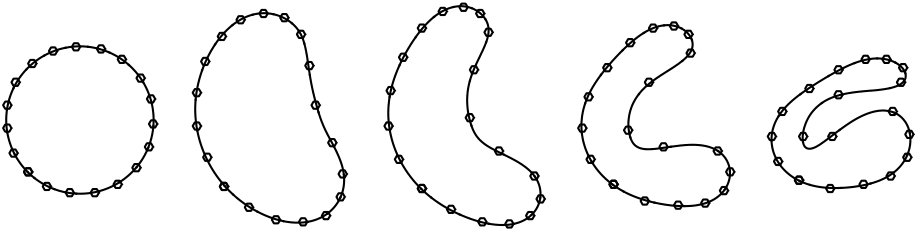 Figure 1
Peer Reviews
No public reviews on file for this paper yet. If you reviewed it on a platform where reviews are public (OpenReview, ICLR, NeurIPS, ICML), you can paste yours below so the community can read it here.
Videos
No videos yet. Explain this paper in a talk, walkthrough, or lecture? Add one.
Fractional Sobolev metrics on spaces of immersed curves
Martin Bauer
Faculty for Mathematics, Florida State University, USA
,
Martins Bruveris
Department of Mathematics, Brunel University London, Uxbridge, UB8 3PH, United Kingdom
and
Boris Kolev
Aix Marseille Université, CNRS, Centrale Marseille, I2M, UMR 7373, 13453 Marseille, France
Abstract.
Motivated by applications in the field of shape analysis, we study reparametrization invariant, fractional order Sobolev-type metrics on the space of smooth regular curves and on its Sobolev completions . We prove local well-posedness of the geodesic equations both on the Banach manifold and on the Fréchet-manifold provided the order of the metric is greater or equal to one. In addition we show that the -metric induces a strong Riemannian metric on the Banach manifold of the same order , provided . These investigations can be also interpreted as a generalization of the analysis for right invariant metrics on the diffeomorphism group.
Key words and phrases:
Sobolev metrics of fractional order
2010 Mathematics Subject Classification:
58D05, 35Q35
Contents
- 1 Introduction
- 2 Parametrized and unparametrized curves
- 3 Riemannian metrics on immersions
- 4 The geodesic equation
- 5 Smoothness of the metric
- 6 Smoothness of the spray
- 7 Strong Riemannian metrics
- A Smooth curves in
- B Square-root of an operator in
1. Introduction
The interest in Riemannian metrics on infinite-dimensional manifolds is fueled by their connections to mathematical physics and in particular fluid dynamics. It was Arnold who discovered in 1966 that the incompressible Euler equation, which describes the motion of an ideal fluid, has an interpretation as the geodesic equation on an infinite-dimensional manifold; the manifold in question is the group of volume-preserving diffeomorphisms equipped with the -metric. Since then many other PDEs in mathematical physics have been reinterpreted as geodesic equations. Examples include Burgers’ equation, which is the geodesic equation of the -metric on the group of all diffeomorphisms of the circle, , and the Camassa–Holm equation [11], the geodesic equation of the -metric [23] on the same group. Interestingly, geodesic equations corresponding to fractional orders in the Sobolev scale have also found applications in physics: Wunsch showed that the geodesic equation of the homogenous -metric on is connected to the Constantin–Lax–Majda equation [14, 40, 18], which itself is a simplified model of the vorticity equation.
The geometric interpretation of a PDE as the geodesic equation enables one to show local well-posedness of the PDE. This was done first by Ebin and Marsden [16] for the Euler equation. Using a similar method Constantin and Kolev showed in [13] that the geodesic equation of Sobolev -metrics on with integer is locally well-posed. In [17] this was extend by Escher and Kolev to the Sobolev -metrics of fractional order . Similar results were shown for the diffeomorphism group of compact manifolds by Shkoller in [33, 34] and by Preston and Misiolek in [31]. Fractional metrics on have been studied in [5] by Bauer, Escher and Kolev. The local well-posedness of the geodesic equation for fractional order metrics on the diffeomorphism group of a general manifold remains an open problem.
In this paper we study the local well-posedness of a family of PDEs that arise as geodesic equations on the space of immersed curves. To be precise consists of smooth, closed curves with nowhere vanishing derivatives. We can regard the diffeomorphism group
[TABLE]
as an open subset of the space of immersions. If we replace on the right hand side by we obtain the space of curves. The PDE
[TABLE]
where and is a time-dependent curve, is the geodesic equation for the -metric
[TABLE]
This is a (weak) Riemannian metric on . The weight in the integral makes the metric invariant under the natural -action and leads to the appearance of arc length derivatives in the geodesic equation. This PDE can be seen as a generalization of the geodesic equation on ,
[TABLE]
which becomes, when written in terms of the Eulerian velocity , Burgers’ equation,
[TABLE]
While the behaviour of Burgers’ equation is well-known, to our knowledge, nothing is known about the local well-posedness of the -geodesic equation on the space of curves.
The situation improves when we add higher derivatives to the Riemannian metric. By doing so, we get the -metric
[TABLE]
where are constants. The corresponding geodesic equation is
[TABLE]
with
[TABLE]
Interestingly, the behaviour of the geodesic equation is better understood in the seemingly more complicated case where . For the PDE is locally but generally not globally well-posed [30], while for the PDE has solutions that are global in time [9].
Inspired by related work [5, 17] on geodesic equations on the diffeomorphism group we consider -metrics of non-integer order , i.e.
[TABLE]
with being, for each fixed curve , a Fourier multiplier of order ; the precise assumptions made on are described in Section 3. The geodesic equation takes the form
[TABLE]
where and are expressions that are defined in Theorem 4.1. It is a nonlinear evolution equation of second order in and of order in ; the right hand side is quadratic in and highly nonlinear in . For non-integer , both and are nonlocal functions of both and . While not immediately obvious, we show in Example 4.3 that it contains the geodesic equations for the -metric and the -metrics as special cases.
Our contribution is to show in Corollary 6.5 that the geodesic equation for the -metric is locally well-posed in the Sobolev space for and .
Connections to shape analysis
Throughout the article we will assume that the operator defining the metric is equivariant with respect to the action of the diffeomorphism group , i.e.,
[TABLE]
This is equivalent to requiring that the Riemannian metric is invariant under the action of , meaning
[TABLE]
This assumption is necessary in order to apply the class of Sobolev metrics in shape analysis.
The mathematical analysis of shapes has been the focus of intense research in recent years [21, 26, 15, 42, 35] and has found applications in fields such as image analysis, computer vision, biomedical imaging and functional data analysis. An important class of shapes are outlines of planar objects. Mathematically, these shapes can be represented by equivalence classes of parametrized curves modulo the reparametrization group . This yields the following geometric picture,
[TABLE]
A key step in shape analysis is to define an efficiently computable distance function between shapes in order to measure similarity between shapes. This distance function can be the geodesic distance induced by a Riemannian metric. Since it is difficult to work with the quotient directly, the standard approach is instead to define a Riemannian metric on , that is -invariant.
Such a metric can then induce a Riemannian metric on the quotient space, making a Riemannian submersion; this metric would be given by the formula
[TABLE]
Hence we will only look at -invariant metrics on in this paper.
The arguably simplest invariant metric is the -metric, corresponding to the operator . However, its induced geodesic distance function is identically zero, both, on the space of parametrized curves as well as the quotient space of unparametrized curves; this was shown by Michor and Mumford [28, 29], see also [1]. This means that between any two curves there exists a path of arbitrary short length. This property makes the metric ill-suited for most applications in shape analysis, because a notion of distance between shapes is one of the basic tools there. As a consequence higher order metrics, mostly of integer order, were studied and used successfully in applications; see [30, 22, 36, 41, 39, 37]. For an overview on various metrics on the shape space of parametrized and unparametrized curves see [30, 3, 4]. As an example we have included an optimal deformation between two unparametrized curves with respect to a second order Sobolev metric in Figure 1.
Fractional order metrics have been briefly mentioned [27, Section 3]. However, so far, an analysis of the well-posedness of the corresponding geodesic equation was missing. This is the question we will focus on in this paper.
2. Parametrized and unparametrized curves
In this article we consider the space of smooth regular curves with values in
[TABLE]
As an open subset of the Fréchet space , it is a Fréchet manifold. Its tangent space at any curve is the vector space of smooth functions:
[TABLE]
The group of smooth diffeomorphisms of the circle
[TABLE]
acts on the space of regular curves via composition from the right:
[TABLE]
Taking the quotient with respect to this group action, we obtain the shape space of un-parameterized curves
[TABLE]
Note that the action of on is not free, and thus that the quotient space is not a manifold, but only an orbifold with finite isotropy groups. A way to overcome this difficulty is to consider the slightly smaller space of free immersions , i.e., those immersions upon which acts freely. This space is an open and dense subset of and the corresponding quotient space
[TABLE]
is again a Fréchet manifold, see [12].
3. Riemannian metrics on immersions
Let be a Riemannian metric on . Motivated by applications in the field of shape analysis we require to be invariant with respect to the diffeomorphism group , i.e.,
[TABLE]
This invariance is a necessary assumption for to induce a Riemannian metric on the shape space , such that the projection map is a Riemannian submersion.
We assume that the metric is given in the form
[TABLE]
where is a continuous linear operator that depends on the foot point . Associated to the metric is a map
[TABLE]
In terms of we have . If is -invariant, then the family of operators has to be -equivariant,
[TABLE]
Example 3.1** (Integer order Sobolev metrics).**
Motivated by their applicability in shape analysis [43, 38, 27, 30] important examples are Sobolev metrics with constant coefficients,
[TABLE]
and scale-invariant Sobolev metrics,
[TABLE]
with constants , for ; one requires and calls the order of the metric. Here, denotes differentiation with respect to arc length, integration with respect to arc length and the corresponding curve length.
Using integration by parts we obtain a formula for the operator :
[TABLE]
for metrics with constant coefficients and
[TABLE]
for scale-invariant metrics.
Because it will be important later, we note that if is a constant speed curve, then the operator for a metric with constant coefficients is
[TABLE]
it is a differential operator with constant coefficients and the coefficients depend only on the length of the curve.
Until now local and global well-posedness results have been established only for the Sobolev metrics of integer order [30, 7, 9, 6]. The main goal of this article is to extend these results to metrics of fractional order; in particular to metrics, for which the operator is defined using Fourier multipliers of a certain class.
Given a curve , let be a diffeomorphism such that has constant speed. Reparametrization invariance of the metric implies that
[TABLE]
in other words, is determined by its behaviour on constant speed curves.
Remark 3.2**.**
The situation is similar to that of right-invariant metrics on diffeomorphism groups, which are determined by their behaviour at the identity diffeomorphism. For curves, the invariance property is weaker and the space of constant speed curves is still quite large.
Let us write the invariance property (3.7) in terms of : by a straight-forward calculation we obtain
[TABLE]
which implies the identity
[TABLE]
The class of metrics on constant speed curves is large. To make it more manageable we will restrict the possible dependance of on the curve .
Assumption**.**
We assume from this point onwards, that the operator depends on only through its length ; in other words
[TABLE]
where is a smooth curve with values in the space of linear maps, 111This is equivalent to requiring that the map given by is smooth..
Then, with this assumption,
[TABLE]
Requiring this form for the operator imposes a restriction on . For consider , defined as . If a curve has constant speed, then so does and thus . Therefore (3.8) implies
[TABLE]
or equivalently after differentiating with respect to ,
[TABLE]
This means that has to be a Fourier multiplier, i.e.,
[TABLE]
where is called the symbol of . We will write or . For now we make no assumptions on the symbol apart from requiring that the map is smooth. More control on the symbol will be necessary in order to prove well-posedness of the geodesic equation.
Example 3.3** (Integer order Sobolev metrics).**
For Sobolev metrics with constant coefficients the symbol of the operator is
[TABLE]
with the identity matrix, and for scale-invariant metrics it is
[TABLE]
Remark 3.4**.**
Even though all known situations correspond to Fourier multipliers of the form with , a multiple of the identity matrix, we will treat in this article general matrix-valued symbols, because doing so introduces no additional difficulties.
4. The geodesic equation
Geodesics between two curves are critical points of the energy functional
[TABLE]
where is a path in joining and . The geodesic equation is obtained by computing the derivative of on paths with fixed endpoints. We will use the following notations
[TABLE]
and
[TABLE]
where is the derivative of with respect to the parameter and
[TABLE]
We have the following commutation rules for and ,
[TABLE]
which imply that because commutes with , that the operator commutes with ,
[TABLE]
This will be used when computing the geodesic equation.
Theorem 4.1**.**
Assume that, for each , the operator
[TABLE]
is invertible with a continuous inverse. Then the weak Riemannian metric (3.2) on has a geodesic spray which is given by
[TABLE]
where
[TABLE]
with
[TABLE]
and
[TABLE]
The geodesic equation is
[TABLE]
To compute these equations, we will first derive a variational formula for the reparametrization function .
Lemma 4.2**.**
The derivative of the map is given by
[TABLE]
Proof.
Using the variational formulas for and ,
[TABLE]
the lemma follows directly from
[TABLE]
Proof of Theorem 4.1.
We can write the energy of a path as
[TABLE]
The variation of the energy in direction is then given by
[TABLE]
Let us start with the term involving . After integrating by parts we get
[TABLE]
Next we deal with . Using the formula
[TABLE]
and Lemma 4.2 we obtain a formula for the variation of ,
[TABLE]
Therefore we have
[TABLE]
Because is symmetric and commutes with ,
[TABLE]
and thus the function
[TABLE]
is periodic with . Next we integrate by parts,
[TABLE]
Finally we consider the term involving . Since
[TABLE]
we have
[TABLE]
Grouping all these expressions together, we can express as
[TABLE]
where
[TABLE]
Thus we obtain the geodesic equation
[TABLE]
The existence of the geodesic spray follows from (4.4), which can be rewritten as
[TABLE]
Note that in this last step we used the invertibility of on . ∎
Next we will see how the geodesic equation simplifies for Sobolev metrics with constant coefficients and scale-invariant metrics. First note, that using integration by parts we can write
[TABLE]
We shall also make use of the following identity, valid for and ),
[TABLE]
Setting
[TABLE]
we obtain
[TABLE]
as well as
[TABLE]
Example 4.3** (Metrics with constant coefficients).**
For metrics with constant coefficients we have
[TABLE]
and thus their -derivatives are
[TABLE]
Therefore
[TABLE]
and
[TABLE]
Since
[TABLE]
it follows that
[TABLE]
Thus the geodesic equation has the form
[TABLE]
Thus we have regained the formula from [30].
Example 4.4** (Scale-invariant metrics).**
For scale-invariant metrics we have
[TABLE]
and thus their -derivatives are
[TABLE]
Therefore
[TABLE]
A similar calculation as before gives
[TABLE]
and therefore
[TABLE]
5. Smoothness of the metric
For any we can consider the Sobolev completion , which is an open set of the Hilbert vector space . It is the aim of this section to show that the metric extends to a smooth weak metric on , for high enough . It turns out that the smoothness of the metric reduces to the smoothness of the mapping
[TABLE]
We will begin our investigations with this question.
It is well-known (see for instance [16, Appendix A]) that, given a differential operator of order with smooth coefficients and a diffeomorphism , the conjugate operator is again a differential operator of order , whose coefficients are polynomial expressions in , its derivatives and ; in particular, the mapping
[TABLE]
is smooth for and , where is group of -diffeomorphisms of . In [17] Escher and Kolev extended this result to Fourier multipliers by showing that the map remains smooth when is a Fourier multiplier of class (to be defined below).
The proof that the mapping is smooth that we present here is inspired by [17, 5], but in the present case we have to deal with Fourier multipliers that depend (in a nice way) on a parameter .
First we introduce the classes and of Fourier multipliers (for further details see [32] for instance). A Fourier multiplier acts on a function via
[TABLE]
and its symbol is a function .
Definition 5.1**.**
Given , the Fourier multiplier belongs to the class , if satisfies
[TABLE]
for each , where .
Here we define the difference operator via
[TABLE]
We equip the space with the topology induced by the seminorms
[TABLE]
where is some norm on . With this topology is a Fréchet space. The class coincides with the one defined in [17]; the equivalence is shown in [32].
Example 5.2**.**
Any linear differential operator of order with constant coefficients belongs to . Furthermore the operator , which defines the -norm via
[TABLE]
belongs to .
Remark 5.3**.**
A Fourier multiplier of class extends for any to a bounded linear operator
[TABLE]
and the linear embedding
[TABLE]
is continuous.
Now we introduce the class of parameter-dependent symbols.
Definition 5.4**.**
Given , the class consists of smooth curves , of Fourier multipliers. We will call such a curve a -symbol.
We will often write for or, by slight abuse of notation, to denote the whole curve . Using the material in Appendix A, we can give an alternative description of the space of one-parameter families of symbols.
Lemma 5.5**.**
Given , a family of smooth curves with defines an element in the class if and only if for each ,
[TABLE]
holds locally uniformly in .
Proof.
Let . Since all derivatives of a smooth curve are locally bounded, it follows that for all , the expression is bounded locally uniformly in and hence satisfies (5.2) for some constants .
Conversely, let a family of smooth curves satisfying the above estimates be given. Define the curves . The estimate (5.2) shows that the curves are locally bounded in and hence by Lemma A.1 the curve is an element of . ∎
The following is the main theorem that will be used to show the smoothness of the metric. Set
[TABLE]
with .
Proposition 5.6**.**
Let and belong to the class . Then the map
[TABLE]
is smooth provided and .
Proof.
It was established in [17, Thm. 3.7] that for the mapping
[TABLE]
is smooth. Using the uniform boundedness principle [24, 5.18] it follows that the map
[TABLE]
is smooth222When are Fréchet spaces or more generally convenient vector spaces, is the space of bounded linear maps equipped with the topology of uniform convergence on bounded sets; see [24, 5.3] for details.. Because the inclusion
[TABLE]
is bounded [24, 5.3], the following map is smooth
[TABLE]
via the exponential law [24, 3.12] this is equivalent to the smoothness of the joint map
[TABLE]
Next we note that the maps
[TABLE]
are smooth – this can be seen from their definitions – and since the composition
[TABLE]
is smooth as well. To conclude the proof we note that can be written as the composition . ∎
Corollary 5.7**.**
Let and belong to the class . Then the bilinear form
[TABLE]
extends smoothly to provided and .
Proof.
It is enough to show that
[TABLE]
is smooth, where denotes pointwise multiplication by . Now
[TABLE]
is smooth for and the conclusion follows by Proposition 5.6 and the fact that composition of continuous linear mappings between Banach spaces is smooth. ∎
6. Smoothness of the spray
In order to prove the existence and smoothness of the spray, we will require moreover an ellipticity condition on -symbols. For the purpose of this article, we will adopt the following definition.
Definition 6.1**.**
An element of the class is called locally uniformly elliptic, if for all and
[TABLE]
holds locally uniformly in .
Remark 6.2**.**
A Fourier multiplier of class is elliptic, if for all and
[TABLE]
holds for all . Such an induces a bounded isomorphism between and , for all .
We summarize our considerations by introducing the following class of operators which will be denoted .
Definition 6.3**.**
A family of Fourier multipliers is an element of the class , if
- (1)
is in the class , 2. (2)
is a positive Hermitian matrix for all and 3. (3)
is locally uniformly elliptic.
Theorem 6.4**.**
Let , and belong to . Then
[TABLE]
defines a smooth weak Riemannian metric of order on with a smooth geodesic spray.
Proof.
It is shown in Corollary 5.7 that extends smoothly to . We can write
[TABLE]
and because are positive Hermitian matrices, only for . Thus is a Riemannian metric. It is a weak Riemannian metric, because the inner product induces on each tangent space the -topology, while the manifold itself carries the -topology and by our assumptions .
It remains to show that the geodesic spray of exists and is smooth. For each , the operator is an elliptic Fourier multiplier and thus induces a bi-bounded linear isomorphism on . Thus we can apply Theorem 4.1, which shows that the geodesic spray exists on the space of smooth immersions. We will show that the map extends smoothly to the Sobolev completion . Then is necessarily the geodesic spray of on .
We have the following formula for ,
[TABLE]
The map
[TABLE]
defined on the open subset of invertible operators is smooth and so is by Proposition 5.6; therefore so is the composition . Thus we need to show that
[TABLE]
is smooth between . The first term is the derivative of with respect to the first variable and hence the map is smooth between . Arc-length derivation
[TABLE]
is smooth and pointwise multiplication in extends to a continuous bilinear mapping
[TABLE]
Therefore, noting that and , the expression is a smooth map . Next we use the fact that the antiderivative
[TABLE]
is a bounded linear mapping. Thus maps smoothly and because we have that is smooth between . The last term is . First we note that the map between is smooth. A term-by-term inspection shows that the map , where is the integrand in the definition of is a smooth map and thus is smooth as well. Thus the extension of to has a smooth spray. ∎
As a corollary, using the Cauchy–Lipschitz theorem, we obtain the local existence of geodesics on the Hilbert manifold .
Corollary 6.5**.**
Let belong to the class , where , and let . Consider the geodesic flow on the tangent bundle induced by the Fourier multiplier . Then, given any , there exists a unique non-extendable geodesic
[TABLE]
with and on the maximal interval of existence , which is open and contains [math].
As a consequence of a no-loss-no-gain argument, we also obtain local well-posedness on the space of smooth curves.
Corollary 6.6**.**
Let belong to the class , where . Consider the geodesic flow on the tangent bundle induced by the Fourier multiplier . Then, given any , there exists a unique non-extendable geodesic
[TABLE]
with and on the maximal interval of existence , which is open and contains [math].
Proof.
Since the metric is invariant by re-parametrization, it is invariant in particular by translations of the parameter. A similar observation has been used in [17, Section 4] to show that local existence of geodesic still holds in the smooth category. The proof is based on a no loss-no gain result in spatial regularity, initially formulated in [16] (see also [8]). The same argument is still true here and leads to the local existence of the geodesics on the Fréchet manifold . ∎
7. Strong Riemannian metrics
The goal of this section is to show, that metrics of order (induced by a Fourier multiplier in the class ), induce strong smooth Riemannian metrics on the Sobolev completion of the same order as the metric. Let be of class with . In Section 6 it was shown that the corresponding Riemannian metric
[TABLE]
can be extended smoothly to for . Now we want to improve this to . Of particular interest is the case , when the topologies induced by the inner products coincide with the manifold topology.
Any positive Hermitian matrix has a unique positive square root which depends smoothly on . We have, moreover, the stronger result that an operator in the class has a square root in the class (see Lemma B.2). With we have the identities
[TABLE]
furthermore, because is a Hermitian matrix, the operator is -symmetric and for each curve the operator is -symmetric. Therefore we can rewrite the metric in the symmetric form
[TABLE]
We obtain therefore the following expression for the operator on :
[TABLE]
where
[TABLE]
and is the transpose of . The latter formula can now be used to obtain the following result concerning the smooth extension of this family of inner products into a strong Riemannian metric on , provided .
Theorem 7.1**.**
Let and . Then the expression
[TABLE]
defines a smooth and strong Riemannian metric on .
Remark 7.2**.**
For strong metrics on a Lie group the invariance of the metric implies the geodesic and metric completeness of the space, see [20, Lemma 5.2]. This has been used in [5] to show completeness of the -metric on , see also [10] for integer orders on the diffeomorphism group of a general manifold. Unfortunately, there is no automatic analogue of this result in our situation. To prove the global well-posedness on the space of regular curves additional assumptions on the dependence of the operator on the length will be necessary. In future work, we plan to follow this line of research and use a similar strategy as in [7] for integer orders to obtain this result.
Proof.
Since and , the mapping
[TABLE]
defines, for each , a bounded isomorphism between and its dual . Thus we need only to show that the mapping
[TABLE]
is smooth. Since transposition between Banach spaces is itself a bounded operator it follows that the transpose
[TABLE]
is smooth iff
[TABLE]
is smooth, which is the case by Proposition 5.6. Now, the mapping
[TABLE]
is smooth for . Finally, since composition of bounded operators between Banach spaces is itself a bounded operator, it follows that the composition
[TABLE]
is smooth. ∎
Remark 7.3**.**
A smooth, strong Riemannian metric on a Hilbert manifold has a smooth spray (see [25] for instance). However, formula (4.2) is no longer useful in that case because it is not clear that this expression extends to a smooth map from to . Following Lang [25, Proposition 7.2], we introduce the inner product on :
[TABLE]
so that
[TABLE]
Here, is the transpose of a bounded operator
[TABLE]
In that case, there is an alternative expression for the spray, which is nevertheless equivalent to (4.2). It is given implicitly by the formula
[TABLE]
Appendix A Smooth curves in
The right framework to work with smooth maps on infinite dimensional (other than Banach spaces) are convenient vector spaces (see [19, 24]). Note that every Fréchet space is a convenient vector space. We will need the following lemma about recognising smooth curves in convenient vector spaces.
Lemma A.1**.**
[19, 4.1.19]** Let be a curve in a convenient vector space. Let be a point-separating subset of bounded linear functionals such that the bornology of has a basis of -closed sets. Then the following are equivalent:
- (1)
* is smooth;* 2. (2)
There exist locally bounded curves such that is smooth with , for each .
To apply this lemma to the space of Fourier multipliers we need to choose a suitable set of linear functionals. This is accomplished in the following lemma.
Lemma A.2**.**
Let and . Then the bornology of has a basis consisting of -closed sets.
Proof.
We can regard as a subset of both as well as . It is shown in [19, 4.1.21] that the bornology of has a basis of -closed sets. We embed as a closed subspace into
[TABLE]
Because the bornology of the product is the product bornology it follows that a basis for the bornology on is given by -closed sets, where and denotes the canonical projection onto the -th factor. Here we note that on the set is contained in the linear space of and hence the bornology of has a basis consisting of -closed sets. ∎
Appendix B Square-root of an operator in
Since a positive definite Hermitian matrix has a unique positive square root, which depends smoothly on its coefficients, we can define formally the square root of an element in the class . In order to prove this we need the following lemma.
Lemma B.1**.**
[5, Lemma 4.8]** Let be three matrices satisfying
[TABLE]
with Hermitian and positive definite. Then
[TABLE]
where denotes the Frobenius norm, i.e. .
The following lemma together with its proof is a generalisation of [5, Lemma 4.7] to our situation of one-parameter families of symbols.
Lemma B.2**.**
The positive square root of an operator in the class belongs to the class . Conversely, the square of an operator in the class belongs to the class .
Proof.
We will prove the estimate
[TABLE]
which holds locally uniformly in , by induction over . If the statement is . Assume that it has been proven for . Then let and, omitting the arguments , we obtain using the product rule,
[TABLE]
with
[TABLE]
Then by the induction assumption
[TABLE]
and hence we obtain via Lemma B.1,
[TABLE]
This completes the induction. ∎
The reference list from the paper itself. Each links out to its DOI / PubMed record.
- 1[1] M. Bauer, M. Bruveris, P. Harms, and P. W. Michor. Vanishing geodesic distance for the Riemannian metric with geodesic equation the Kd V-equation. Ann. Global Anal. Geom. , 41(4):461–472, 2012.
- 2[2] M. Bauer, M. Bruveris, P. Harms, and J. Møller-Andersen. A numerical framework for Sobolev metrics on the space of curves. SIAM J. Imaging Sci. , 10(1):47–73, 2017.
- 3[3] M. Bauer, M. Bruveris, and P. W. Michor. Overview of the geometries of shape spaces and diffeomorphism groups. J. Math. Imaging Vision , 50(1-2):60–97, 2014.
- 4[4] M. Bauer, M. Bruveris, and P. W. Michor. Why use Sobolev metrics on the space of curves. In Riemannian computing in computer vision , pages 233–255. Springer, Cham, 2016.
- 5[5] M. Bauer, J. Escher, and B. Kolev. Local and global well-posedness of the fractional order EP Diff equation on ℝ d superscript ℝ 𝑑 \mathbb{R}^{d} . Journal of Differential Equations , 258(6):2010–2053, 2015.
- 6[6] M. Bauer, P. Harms, and P. W. Michor. Sobolev metrics on shape space of surfaces. J. Geom. Mech. , 3(4):389–438, 2011.
- 7[7] M. Bruveris. Completeness properties of Sobolev metrics on the space of curves. J. Geom. Mech. , 7(2):125–150, 2015.
- 8[8] M. Bruveris. Regularity of maps between Sobolev spaces. Ann. Glob. Anal. Geom. , pages 1–14, 2017. Online first.