Current fluctuations in unconventional superconductor junctions with impurity scattering
Pablo Burset, Bo Lu, Shun Tamura, Yukio Tanaka

TL;DR
This paper studies how impurity scattering affects current fluctuations in unconventional superconductor junctions, revealing robustness of certain topological states and proposing noise-current ratio as an experimental signature.
Contribution
It provides a self-consistent analysis of current fluctuations in 2D unconventional superconductor junctions with impurities, highlighting the robustness of specific topological states and the utility of noise measurements.
Findings
Superconductivity is suppressed by impurities in most cases.
Gapful nontrivial superconductors are robust against impurity scattering.
Nodal p_x-wave superconductors are nearly immune due to odd-frequency pairing.
Abstract
The order parameter of bulk two-dimensional superconductors is classified as nodal, if it vanishes for a direction in momentum space, or gapful if it does not. Each class can be topologically nontrivial if Andreev bound states are formed at the edges of the superconductor. Non-magnetic impurities in the superconductor affect the formation of Andreev bound states and can drastically change the tunneling spectra for small voltages. Here, we investigate the mean current and its fluctuations for two-dimensional tunnel junctions between a normal-metal and unconventional superconductors by solving the quasi-classical Eilenberger equation self-consistently, including the presence of non-magnetic impurities in the superconductor. As the impurity strength increases, we find that superconductivity is suppressed for almost all order parameters since (i) at zero applied bias, the effective…
Click any figure to enlarge with its caption.
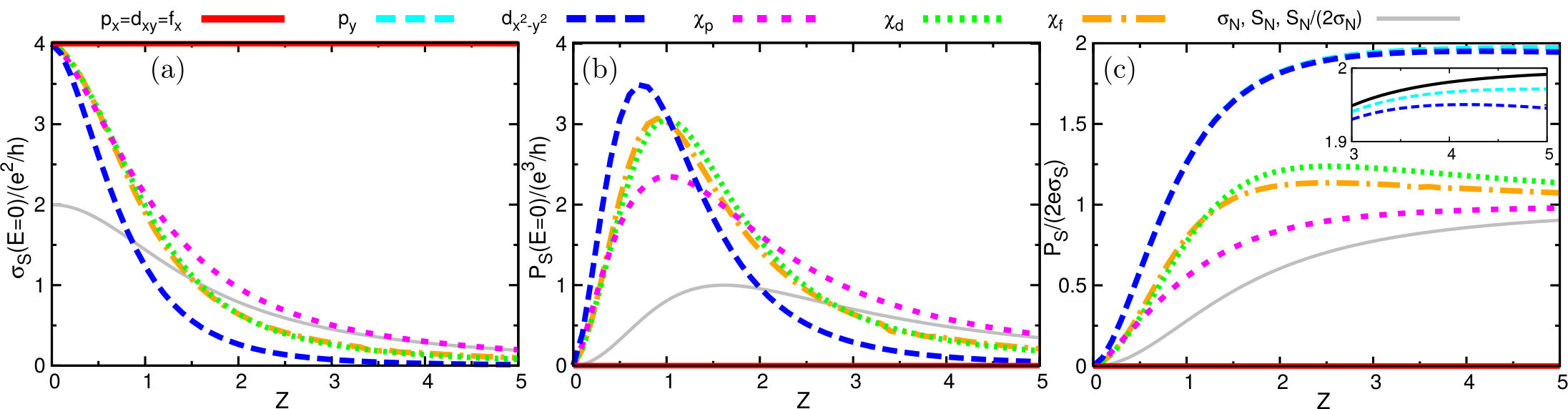 Figure 1
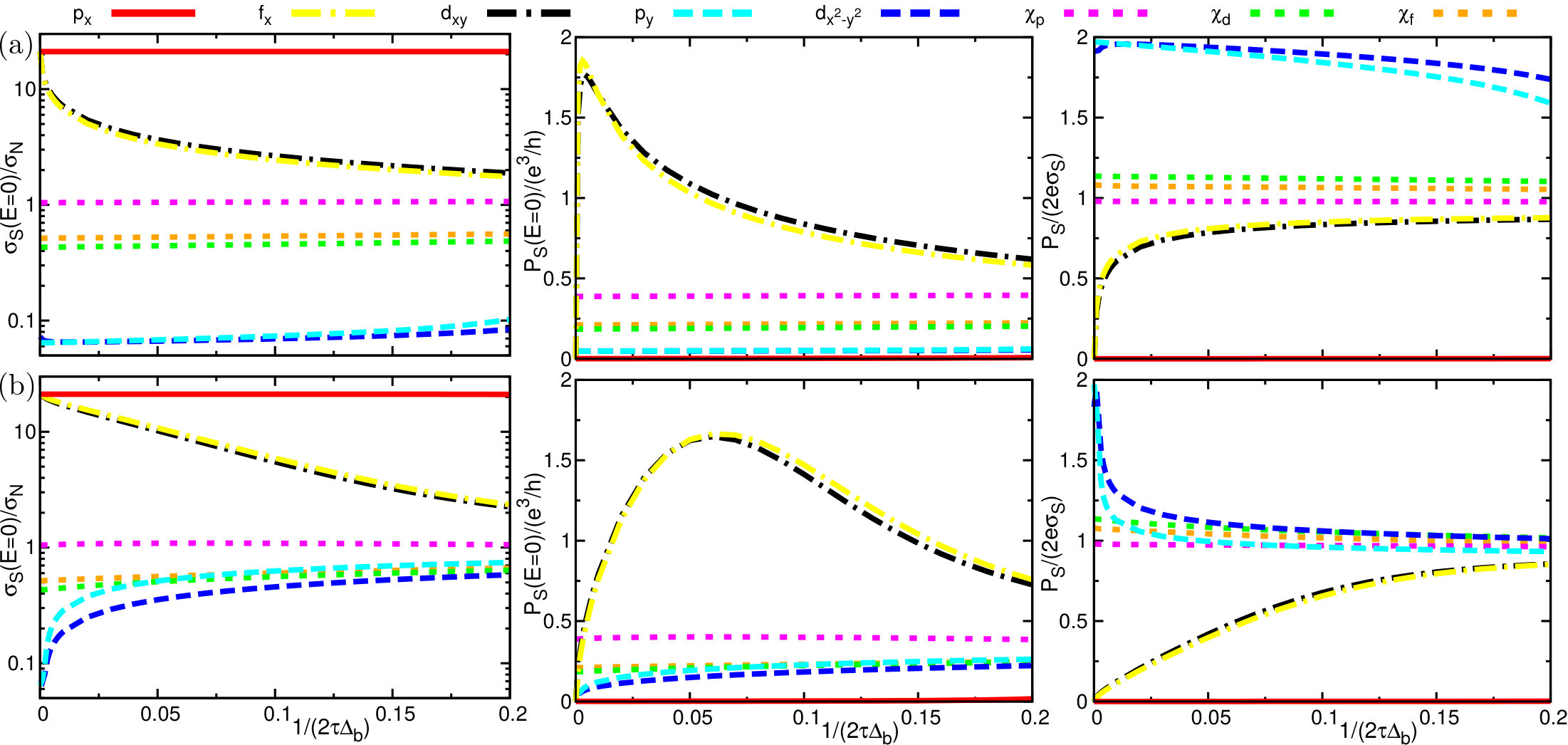 Figure 2
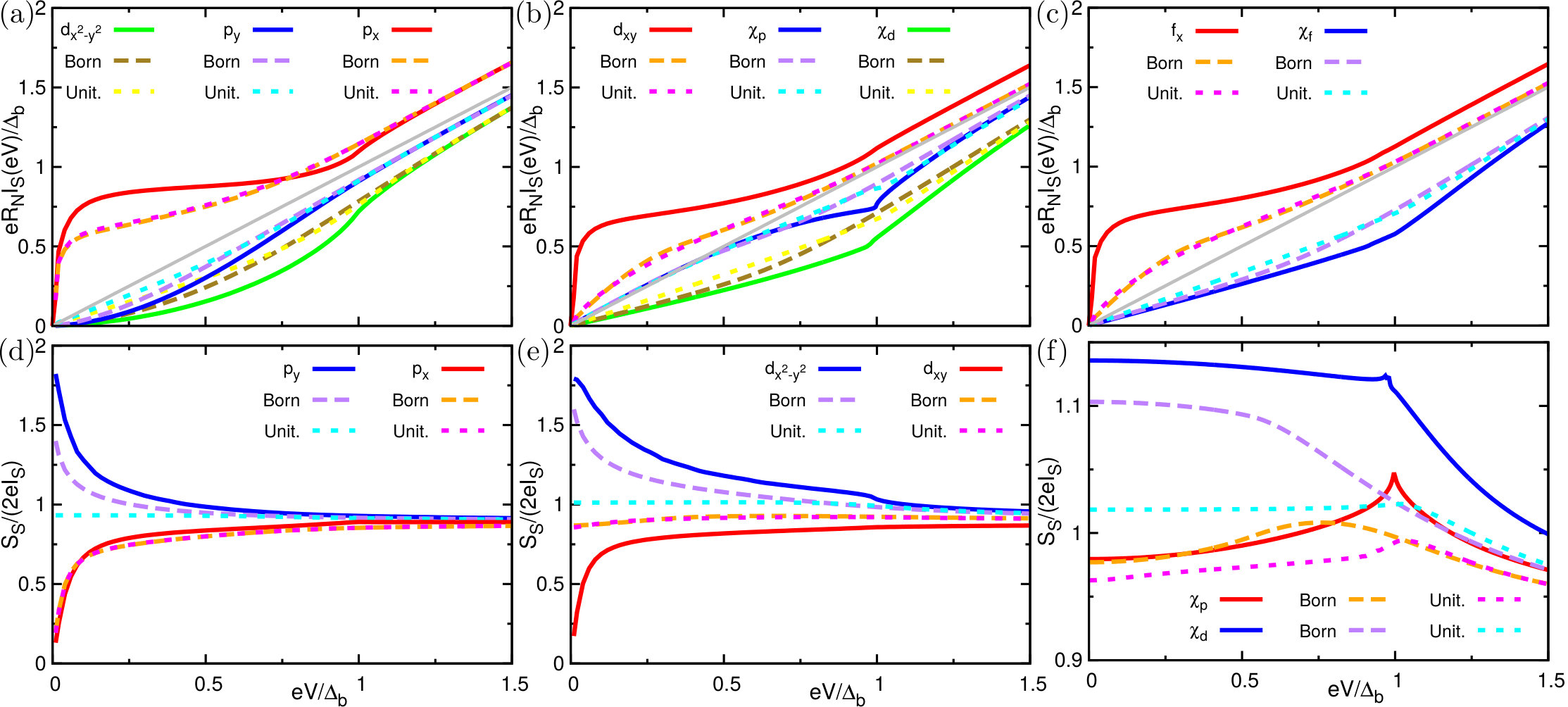 Figure 3
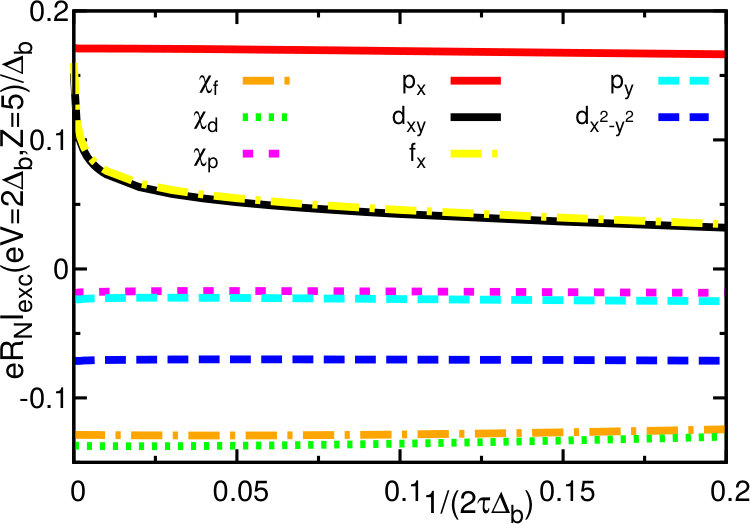 Figure 4
| type | wave | node | SABS | ||||||||||
|---|---|---|---|---|---|---|---|---|---|---|---|---|---|
| bal | impurity | bal. | impurity | bal. | impurity | bal. | impurity | ||||||
| 1. Gapful trivial | |||||||||||||
| 2. Gapful non-trivial | chiral- | linear | |||||||||||
| chiral- | linear | ||||||||||||
| chiral- | linear | ||||||||||||
| 3. Nodal trivial | (B) | (B) | (B) | ||||||||||
| (U) | (U) | (U) | |||||||||||
| (B) | (B) | (B) | |||||||||||
| (U) | (U) | (U) | |||||||||||
| 4. Nodal non-trivial | flat | ZBP | ZBP | ||||||||||
| flat | ZBP | ||||||||||||
| flat | ZBP | ||||||||||||
Peer Reviews
No public reviews on file for this paper yet. If you reviewed it on a platform where reviews are public (OpenReview, ICLR, NeurIPS, ICML), you can paste yours below so the community can read it here.
Videos
No videos yet. Explain this paper in a talk, walkthrough, or lecture? Add one.
Current fluctuations in unconventional superconductor junctions with impurity scattering
Pablo Burset
Institute for Theoretical Physics and Astrophysics, University of Würzburg, D-97074 Würzburg, Germany
Department of Applied Physics, Nagoya University, Nagoya 464-8603, Japan
Department of Applied Physics, Aalto University, FIN-00076 Aalto, Finland
Bo Lu
Department of Applied Physics, Nagoya University, Nagoya 464-8603, Japan
National Graphene Institute, University of Manchester, Booth St E, M13 9PL, Manchester, UK
Shun Tamura
Department of Applied Physics, Nagoya University, Nagoya 464-8603, Japan
Yukio Tanaka
Department of Applied Physics, Nagoya University, Nagoya 464-8603, Japan
Abstract
The order parameter of bulk two-dimensional superconductors is classified as nodal, if it vanishes for a direction in momentum space, or gapful if it does not. Each class can be topologically nontrivial if Andreev bound states are formed at the edges of the superconductor. Non-magnetic impurities in the superconductor affect the formation of Andreev bound states and can drastically change the tunneling spectra for small voltages. Here, we investigate the mean current and its fluctuations for two-dimensional tunnel junctions between a normal-metal and unconventional superconductors by solving the quasi-classical Eilenberger equation self-consistently, including the presence of non-magnetic impurities in the superconductor. As the impurity strength increases, we find that superconductivity is suppressed for almost all order parameters since
i) at zero applied bias, the effective transferred charge calculated from the noise-current ratio tends to the electron charge and
ii) for finite bias, the current-voltage characteristics follows that of a normal state junction.
There are notable exceptions to this trend. First, gapful nontrivial (chiral) superconductors are very robust against impurity scattering due to the linear dispersion relation of their surface Andreev bound states. Second, for nodal nontrivial superconductors, only -wave pairing is almost immune to the presence of impurities due to the emergence of odd-frequency -wave Cooper pairs near the interface. Owing to their anisotropic dependence on the wave vector, impurity scattering is an effective pair breaking mechanism for the rest of nodal superconductors. All these behaviors are neatly captured by the noise-current ratio, providing a useful guide to find experimental signatures for unconventional superconductivity.
pacs:
73.23.-b,74.20.Rp,74.45.+c,74.50.+r
I Introduction
The symmetry of the superconducting order parameter is crucial to determine many properties of a superconductor. The majority of superconductors feature a conventional spin-singlet -wave pair potential. Any deviation from this pair potential, be it spin-triplet states or higher harmonics like -wave or -wave, is considered unconventionalSigrist and Ueda (1991). One of the most interesting consequences of unconventional pairings is the formation of surface Andreev bound states (SABS) when the pair potential changes sign on the Fermi surfaceBuchholtz and Zwicknagl (1981); Bruder (1990); Hu (1994); Tanaka and Kashiwaya (1995); Kashiwaya and Tanaka (2000). The formation of SABS is related with the emergence of a zero bias peak (ZBP) in the tunnel conductanceTanaka and Kashiwaya (1995); Kashiwaya and Tanaka (2000). While conventional -wave pairing is robust against non-magnetic impuritiesAnderson (1959), many unconventional pairings are fragile owing to their anisotropic dependence on the wave vectorBalatsky et al. (2006). Some SABS have a topological origin and would be protected against imperfections or impuritiesSchnyder et al. (2008); Sato (2009, 2010); Ryu et al. (2010); Qi and Zhang (2011); Mizushima et al. (2015). However, impurity scattering reduces or completely suppresses the ZBP for many cases, making it difficult to detect unconventional pairing symmetries from conductance measurements onlyLu et al. (2016). To go beyond dc conductance, it is interesting to study the non-equilibrium current fluctuations or shot noiseBlanter and Büttiker (2000). The shot noise reveals the effective charge transferred in a given tunneling process through the noise-current ratio. For example, the effective charge of a tunnel junction between a normal metal and a superconductor is doubled, revealing the uncorrelated transfer of Cooper pairs due to Andreev processesKhlus (1987); *noiseNS_1994; *Beenakker_1994; Anantram and Datta (1996); Dieleman et al. (1997).
In this work we study the current, shot noise and noise-current ratio of normal-metal–superconductor junctions, including the effect of non-magnetic impurity scattering in the superconductor, for the most representative two-dimensional unconventional order parameters. Depending on the shape of the order parameter in reciprocal space, superconductors in two dimensions can be classified into two groups:
(i) Gapful superconductors with a finite order parameter and
(ii) Nodal superconductors where the order parameter vanishes in a given direction.
At the same time, each order parameter can be topologically nontrivial or trivial depending on whether SABS appear or not. For example, the conventional spin-singlet -wave state belongs to the gapful trivial group. Chiral superconductorsKallin and Berlinsky (2016) are also gapped in the bulk, but feature SABS with a linear dispersion relation; they thus belong to the gapful nontrivial group. Sr2RuO4 is a strong candidate for chiral spin-triplet -wave superconductorMackenzie and Maeno (2003); *Maeno_2012; *Kallin_2012. Experiments have failed to detect the predicted spontaneous edge current in Sr2RuO4, suggesting that the chiral symmetry could be on a higher harmonic, like - or -waveHuang et al. (2014); *Masaki_2015; *Simon_2015. Chiral pairing states have also been proposed for other systems, including grapheneBlack-Schaffer and Honerkamp (2014). Chiral superconductors are currently attracting a lot of attention since their topologically nontrivial edge states, which display a linear dependence on the momentum, are a condensed matter realization of Majorana statesRead and Green (2000); Fujimoto (2008); Sau et al. (2010); *Lutchyn_2010. On the other hand, nodal superconductors with a vanishing order parameter feature SABS with a flat dispersion relation at their edgesSato et al. (2011). Nodal superconductivity naturally appears in high-Tc cupratesTanaka and Kashiwaya (1995); *Kashiwaya_1995; Kashiwaya and Tanaka (2000) (-wave) and noncentrosymmetric superconductorsTanaka et al. (2010); *Yada_2011. It can also be engineered by proximity effect from a conventional superconductor in materials with strong spin-orbit couplingYou et al. (2013); Ikegaya et al. (2015) (-wave). Assuming that the junction lies along the -direction, nodal trivial groups include - and -wave, while nodal nontrivial correspond to , and similar111We are considering the situation where the nodal direction lies along the -direction. In a more general case, there can be an angle between the nodal direction and the -axis. A slightly tilted -wave or -wave pairing is then nontrivial, but it will behave in a similar way as the trivial cases studied here. We are only interested in the representative behavior for two-dimensional superconductors, so we will not consider such cases here. .
This paper is organized as follows. We describe our model and present the main definitions for the transport observables in Sec. II. In Sec. III, we present an exhaustive collection of transport results for ballistic junctions with unconventional superconductors. Here, our model reproduces many well-known results from previous works and we discuss the most representative behavior of the different pairing symmetries. Next, in Sec. IV we show the main results of this work as we discuss the effect of impurities on the current, shot noise and noise-current ratio of unconventional superconductors. We report our conclusions in Sec. V.
II Model
We consider a two-dimensional normal-metal–superconductor junction where transport takes place along the direction and set the interface at . We thus parametrize the conserved transverse component of the wave vector using the angle of incidence , with the Fermi wave vector. Depending on the direction of propagation of the quasiparticles, we define the angles and . We model the scattering at the interface using a -function potential , with the dimensionless barrier strength and the electron mass. We assume a clean normal metal () and a uniform distribution of non-magnetic impurities in the superconducting region () with induced self-energy . The superconducting order parameter is given by , with . In the normal region, we take . For a spin-degenerate system, the quasi-classical Green’s functionSerene and Rainer (1983); Rammer and Smith (1986); Millis et al. (1988); Ashida et al. (1989) for Matsubara frequency , where is the temperature and an integer, is a matrix in particle-hole space that satisfies the Eilenberger equationEilenberger (1968)
[TABLE]
Here, is the component of the Fermi velocity and the particle-hole space is spanned by Pauli matrices , with the identity matrix. The quasi-classical Green’s function is normalized as .
To account for unconventional superconductivity in the rightmost region (), we use the notation
[TABLE]
with the Heaviside function. The subindices refer to the real or imaginary part of the order parameter. We choose the global gauge so that the order parameter is real for non-chiral superconductors or it is proportional to a cosine function of the angle for chiral ones. The resulting form factors are enumerated in Table 1.
The spatial dependence of the order parameter is determined self-consistently in terms of the quasi-classical Green’s function, namelyLu et al. (2016); Tanaka et al. (2007a)
[TABLE]
with the angle average defined as . The sums include a cutoff , defined as the maximum integer that satisfies . is the critical temperature of the bulk superconductor and is the Debye frequency, ignoring thermodynamic phenomena. In the bulk of the superconductor, i.e., deep inside the superconducting region, a finite order parameter fulfills .
Following Ref. Lu et al., 2016, the self-energy for the distribution of non-magnetic impurities is written as , with
[TABLE]
where and are the normal scattering rate and the strength of a single impurity potential, respectively.
For the numerical calculations, it is useful to express the Green’s function in terms of the Riccati parametersNagato et al. (1993); Schopohl and Maki (1995); Shelankov and Ozana (2000) as
[TABLE]
where and satisfy the equations
[TABLE]
with
[TABLE]
Finally, at the interface, we set the boundary conditionsNagato and Nagai (1995); Matsumoto and Shiba (1996); Eschrig (2000); Fogelström (2000); Zhao et al. (2004)
[TABLE]
with the normal state angle-dependent transmission.
Following the scattering formalismBlonder et al. (1982), the Andreev () and normal () reflection amplitudes at the interface are given by
[TABLE]
with and the real excitation energy of an incident quasiparticle.
Using the reflection amplitudes, we define the differential conductanceTanaka and Kashiwaya (1995); Kashiwaya and Tanaka (2000)
[TABLE]
and differential noise powerAnantram and Datta (1996)
[TABLE]
In the normal state, the differential conductance and noise power are respectively defined as
[TABLE]
The zero-temperature current and shot noise are then obtained integrating Eqs. (13) and (14) for a finite voltage, respectively,
[TABLE]
with the voltage drop at the NS interface222In the self-consistent evaluation of the pairing states, we have not included thermodynamic phenomena. Accordingly, in the numerical calculations, we choose a sufficiently small temperature . .
III Ballistic junction
In this section, we use our model for the study of ballistic (impurity-free) normal-metal–superconductor junctions with a barrier controlling the interface transmission. The following results for conductance, shot noise and noise-current ratio are gathered in Table 1 under the columns “ballistic”.
In the limit of transparent junction, with , all types of superconductor feature a perfect Andreev reflection at the interface. Consequently, the differential conductance is a constant with twice the value of the normal state conductance for small applied bias voltage compared to the bulk gap [see Fig. 1(a)]. To clearly distinguish between the different types of superconductor, one must make use of the tunnel conductance, opening the possibility of normal backscattering at the interface. As we approach the tunnel limit, , the zero-energy conductance for each type of superconductor becomes different featuring three illustrative behaviors.
Nodal nontrivial superconductors, with -, -, or -wave symmetry, feature a perfect Andreev reflection independently of the barrier strength. Since the normal state conductance is reduced by increasing , the normalized tunnel conductance prominently displays a zero-bias peak.
For gapful nontrivial (chiral) superconductors, the conductance reduces to a finite value, slightly over for the chiral -wave case or comparable to for the rest of chiral pairing states.
For trivial superconductors, both nodal and gapful, the conductance is reduced well below the normal state conductance . The resulting normalized tunnel conductance is strongly suppressed for small energies, featuring a (U-) V-shape profile for (gapful) nodal pairing states. In the gapful trivial case the conductance tends to zero, while for the nodal trivial cases it tends to a finite but small valueLu et al. (2016).
The tunnel conductance in the ballistic limit is thus a useful tool to explore the symmetry of the superconducting pairing. However, the height of the zero-bias peak and the gap suppression are very sensitive to the barrier strength and are also rounded by temperature effectsLu et al. (2016). Therefore, tunnel conductance experiments can sometimes be ambiguous. Charge fluctuations of the current provide an extra layer of information on the symmetry of the pairing potential. For a ballistic junction, the noise power at zero temperature can also be interpreted in terms of the reflection processes onlyKhlus (1987); *noiseNS_1994; *Beenakker_1994; Anantram and Datta (1996). For energies below the gap, the integrand of Eq. (14) reduces to . Consequently, for perfect Andreev reflection () or in the absence of it (), the noise power is zero. Therefore, nodal nontrivial superconductors are always noiseless at zero energy independently of the barrier strengthZhu and Ting (1999); Tanaka et al. (2000), as shown in Fig. 1(b). The noise power for the rest of pairing states develops a maximum between the transparent and tunnel limits. The maxima for each pairing occur for different values of the barrier strength. However, it would be pointless to use this to experimentally identify each symmetry since the barrier is a fitting parameter that accounts for many possible sources of interfacial scatteringBlonder et al. (1982).
A more clear distinction between all superconductors is given by the noise-current ratio, shown in Fig. 1(c), which determines the effective charge transferred at the interface. Since nodal nontrivial superconductors are noiseless independently of the barrier strength, their ratio is also zero. Gapped nontrivial (chiral) superconductors have an effective charge equal to the electron charge in the tunnel limitTanaka et al. (2000). In this case, the conducting channels are a superposition of modes with a strong Andreev reflection amplitude (i.e., those with angle of incidence that feature a linear SABS) and others with strong normal backscattering (for ). For trivial superconductors, gapful or nodal, the effective transferred charge approaches in the tunnel regime, indicating the transfer of a Cooper pair at the junction. Small differences between -, - and -wave superconductors appear in the tunnel limit, as shown in the inset of Fig. 1(c). However, they do not affect the general behavior of the ratio.
In summary, there are three general trends for ballistic junctions that are neatly captured in the noise-current ratio in the tunnel limit:
(i) Nodal nontrivial superconductors display a noiseless zero-bias peak and their ratio is zero;
(ii) chiral superconductors feature a conductance of magnitude comparable to the normal state with noise-current ratio ; and
(iii) trivial (gapful and nodal) superconductors have a suppressed conductance and ratio approaching .
IV Impurity scattering in the superconductor
We now consider the presence of non-magnetic impurities in the superconductor. We explore two cases for the impurity potential. The Born limit accounts for weak impurity potentials that induce small scattering phase shifts. We thus take the limit in Eq. (5) and find
[TABLE]
In the bulk of the superconductor, the Green’s function becomes divergent for energies close to the continuum levels at the edges of the gap. Close to the interface, however, the Green’s function can develop divergences in the presence of emergent SABS and it is approximately zero otherwise. Whether the superconductor is nontrivial and develops SABS or it is trivial and does not have subgap states crucially determines the impact of the impurity scatteringLu et al. (2016). For nontrivial superconductors, given a fixed scattering rate , the self-energy diverges in the Born limit and is greatly suppressed in the Unitary limit. For trivial superconductors we expect the opposite behavior.
In the following, we set the barrier strength , where the general behavior of trivial and nontrivial unconventional superconducting orders is clearly displayed, and study the effect of scattering by non-magnetic impurities in the superconductor for zero and finite applied bias.
IV.1 Effect of impurities at zero bias.
The zero bias transport results, for a tunnel junction with , are shown in Fig. 2(a) for the Born limit and in Fig. 2(b) for the Unitary one. In both cases, we immediately observe a different behavior between -wave and the rest of nodal nontrivial states. For the moderate impurity scattering rates considered in this work, -wave superconductors are immune to the effect of non-magnetic impurities. The ballistic zero-bias noiseless conductance is unaltered in Born and Unitary limits. Conversely, for - and -wave cases the zero-bias conductance peak is reduced by the impurity potential. As the impurity strength is increased, conductance and shot noise tend to the same value, with ratio equal to . It is interesting to note that the noise power for these superconductors, which is zero in the ballistic limit, develops a maximum as a function of the scattering rate , similarly to the barrier dependence in the ballistic limit for the rest of superconductors. Nodal trivial superconductors, like - and -wave cases, are also strongly modified by impurities. In the Unitary limit, the conductance and shot noise of these superconductors are increased at zero bias, in clear tendency toward the normal state case. A similar trend is observed in the Born limit, although the evolution with the scattering rate is very smooth. By looking at the noise-current ratio, this tendency becomes evident for both Born and Unitary limits (rightmost panels of Fig. 2). The ratio is reduced from to for trivial pairings, and increased from [math] to for nontrivial ones, with the notable exception of -wave. As expected from Eq. (17), this transition is faster in the Born limit than in the Unitary one for nontrivial superconductors, while trivial pairings follow the opposite behavior.
The special case of -wave pairing can be explained by the emergence of isotropic odd-frequency Cooper pairs at the interfaceTanaka and Golubov (2007); Tanaka et al. (2007a). Inhomogeneous superconducting systems feature an ubiquitous presence of odd-frequency pairingBergeret et al. (2001); *Bergeret_RMP; *Linder_2010c; *Linder_2015; *Linder_2015b; Tanaka et al. (2007b); Yokoyama (2012); *Black-Schaffer_2012; *Crepin_2015; *Burset_2015; *Aperis_2015; Sothmann et al. (2014); *Burset_2016; Black-Schaffer and Balatsky (2013); *Asano_2015, where the wave function of Cooper pairs is odd under the exchange of the time coordinates of the electrons forming itTanaka et al. (2012); Eschrig (2015); Mizushima et al. (2015). In the ballistic limit, the noiseless zero-bias conductance peak of nodal nontrivial superconductors is formed due to a dominant odd-frequency pairing state near the interfaceLu et al. (2016). To fulfill Fermi-Dirac statistics, these Cooper pairs form a -wave state for -wave superconductors or a -wave state (-wave) for -wave (-wave) superconductors. The presence of impurities suppresses all the anisotropic pairing states and only -wave order maintains the ballistic result.
Finally, chiral superconductors are mostly unaffected by the impurity scattering. This behavior is clearly shown by the noise-current ratio, which remains almost in both Born and Unitary limits for several values of the scattering rate. At first sight this result seems at odds with the fact that nontrivial superconductors should be sensitive to impurity scattering in the Born limit. The main difference is that gapful nontrivial superconductors feature SABS with a linear dispersion relation, instead of flat bands like nodal superconductors. The resulting angle-averaged Green’s function at low energies for chiral superconductors is not divergent, since the SABS only contribute for specific values of the angle (e.g., for , the chiral -wave SABS has a small contribution at ). This fundamental difference justifies the importance of chiral superconductors as sources of SABS with topological protection against disorderKallin and Berlinsky (2016); Gnezdilov et al. (2015).
IV.2 Effect of impurities at finite bias.
We now study the voltage dependence of the current and fluctuations. In the normal state, the current through the junction follows a linear ohmic behavior where , with the normal state resistance and the applied voltage (see gray lines in Fig. 3). In the superconducting state, the current is drastically changed for bias values comparable to the superconducting gap . The curves of conventional singlet -wave normal-metal–superconductor junctions in the ballistic limit are well-known, see, e.g., Refs. Blonder et al., 1982; Cuevas et al., 1996. In the tunnel regime, the current is suppressed for voltages below the gap, while it is linear with slope for high voltages . This conventional behavior is qualitatively reproduced by nodal trivial superconductors with - and -wave symmetries. The main difference being a less pronounced suppression below the gap in the ballistic case; see solid blue and green lines of Fig. 3(a). In the presence of impurities, the subgap suppression is even milder (dashed lines for the Born limit and dotted lines for the Unitary limit).
Chiral -wave superconductors, blue line in Fig. 3(b), are clearly distinguished from chiral - and -wave cases, green line in Fig. 3(b) and blue line in Fig. 3(c), respectively. While chiral -wave superconductors mostly follow an ohmic behavior, with a small dip at , the current for the other chiral waves is suppressed below , even for voltages over the gap. The finite voltage current is thus helpful to distinguish chiral -wave symmetry from -wave or higher, which is qualitatively similar to trivial superconductors. The main effect of impurity scattering on chiral superconductors is to soften the dip at , where the presence of continuum bands makes divergeBakurskiy et al. (2014); Lu et al. (2016). As a consequence, the self-energy is acutely increased in the Born limit, while it is suppressed in the unitary limit; c.f., Eq. (17). The current dips, which are clearly distinguishable in the ballistic limit, can still be appreciated in the Unitary limit but are completely suppressed in the Born limit.
Nodal nontrivial superconductors display a completely different behavior. Even in the tunnel regime considered here with , the subgap current is greatly enhanced in the ballistic limit. The impurity scattering reduces the subgap contribution of - and -wave superconductors, although the current is still greater than . Conversely, the current for -wave superconductors is enhanced over the ohmic case even in the presence of impurities.
As for the zero-bias results, the noise-current ratio clearly displays the behavior of each pairing state, as it is shown in Fig. 3(d-f)333The noise-current ratio in Fig. 3(d-f) is only well defined for finite voltage, since . . The ohmic curves for yield a ratio . For nodal trivial gaps, the ballistic, Born and Unitary limits present different ratios going from (ballistic) to (Unitary). Nodal nontrivial pairings quickly approach the ohmic limit in the presence of impurities, with the exception of -wave state. In Fig. 3(f) we compare the chiral -wave and -wave states (which also qualitatively represents chiral -wave). Chiral -wave is only slightly modified by impurities at finite voltage. At low voltage, the ratio is only slightly affected in the Unitary limit. However, the rest of chiral states are a bit more sensitive, although in a small scale.
In order to study the characteristics at high voltages, we define the excess current as the difference between the superconducting and normal state currents, namely,
[TABLE]
The presence of a finite excess current for high voltages, ideally for , indicates a strong contribution of Andreev reflections for energies below the gapBlonder et al. (1982); Cuevas et al. (1996); Scheer et al. (2001); Wiedenmann et al. (2016). In the ballistic limit, nodal nontrivial superconductors feature a finite excess current while it is suppressed for the rest of superconductors at large voltages. The value of the maximum excess current is determined by the interface transparency, resulting in . In Fig. 4, we show the evolution of the excess current as a function of the impurity scattering rate, calculated at . Negative values of indicate that the excess current is suppressed for . It is interesting that the presence of impurity scattering does not accelerate the transition into for chiral or trivial superconductors. However, impurity scattering suppresses the excess current for nodal nontrivial superconductors, with the exception of -wave. Remarkably, -wave superconductors maintain the ballistic result even in the presence of impurities, even though the excess current for the rest of nodal nontrivial cases is reduced to the normal state case. The presence of a noiseless perfect Andreev reflection in the zero energy channel of -wave superconductors is thus directly responsible for a finite excess current, even in the presence of impurities.
V Conclusions
We present an exhaustive description of the transport properties of two-dimensional junctions with unconventional superconductors, including the effect of scattering by non-magnetic impurities in the superconductor. The main results of this work are gathered in Table 1. We have classified two-dimensional superconducting order parameters as gapful or nodal, where the latter vanishes for a particular direction of the wave vector. Each class can be topologically nontrivial if the superconductor features SABS. The noise-current ratio is a perfect tool to identify each class in an impurity-free ballistic junction in the tunnel limit. Indeed, the ratio is zero for nodal nontrivial superconductors, for gapful nontrivial ones, and for trivial pairings, both nodal or gapful.
The inclusion of impurity scattering at the superconductor further distinguishes unconventional superconductors, and these changes are again clearly captured in the noise-current ratio. The ratio for trivial superconductors is decreased from to as the scattering rate is increased. This transition is faster in the Unitary limit; dominant in the absence of SABS. Conversely, the ratio for nodal nontrivial superconductors is increased from [math] to , and the transition is faster in the Born limit. A notable exception is the case of -wave. This special nodal pairing develops an -wave odd-frequency component at the interface which is highly resistant to impurity scattering. Interestingly, gapful nontrivial (chiral) superconductors are also resistant to the impurity scattering. The linear dispersion of the SABS in these superconductors guarantees that the correction coming from the self-energy of the impurity distribution is always small. Their noise-current ratio is thus barely changed by the presence of non-magnetic impurities, a clear signature of the topological protection of these pairing states.
Our results can be used for the experimental classification of pairing symmetries. We have demonstrated the utility of noise measurements for the identification of order parameters, even in the cases where tunnel conductance can be ambiguousTikhonov et al. (2016).
A special mention should be made about -wave pairing. The flat band SABS of this nodal superconductor induces a perfect Andreev reflection, resulting in an noiseless resonance at zero energy. This behavior survives the presence of non-magnetic impurities in the superconductor and can be observed even when the normal metal is in the diffusive regimeTanaka and Kashiwaya (2004); *Yokoyama_2005. The origin of this anomalous proximity effect is the formation of isotropic odd-frequency Cooper pairs at the interfaceTanaka and Golubov (2007). Another manifestation of such an exotic odd-frequency Andreev resonance presented here is that the excess current maintains the ballistic maximum value in the presence of impurities; a feature unique to this pairing state. The special zero-energy state of -wave superconductors is connected to the emergence of a Majorana bound stateIkegaya et al. (2016). Indeed, Majorana states are always accompanied by odd-frequency Cooper pairsAsano and Tanaka (2013); Kashuba et al. (2017). It is thus very motivating that a finite excess current has been recently reported in experiments to identify Majorana bound states in topological Josephson junctionsWiedenmann et al. (2016).
Finally, the connection between symmetry of the pairing state and transport properties of two-dimensional spin-degenerate superconducting junctions presented here provides a good starting point to consider more complicated three-dimensional pairing states.
Acknowledgements.
The authors are grateful to Y. Asano for valuable discussions. P.B. acknowledges support from Japan Society for the Promotion of Science International Research Fellowship. B.L. acknowledges EPSRC grant EP/N010345/1 and European Graphene Flagship Project. This work was supported by a Grant-in-Aid for Scientific Research on Innovative Areas Topological Material Science JPSJ KAKENHI (Grants No. JP15H05851, and No. JP15H05853), a Grant-in-Aid for Scientific Research B (Grant No. JP15H03686), a Grant-in-Aid for Challenging Exploratory Research (Grant No. JP15K13498) from the Ministry of Education, Culture, Sports, Science, and Technology, Japan (MEXT).
The reference list from the paper itself. Each links out to its DOI / PubMed record.
- 1Sigrist and Ueda (1991) Manfred Sigrist and Kazuo Ueda, “Phenomenological theory of unconventional superconductivity,” Rev. Mod. Phys. 63 , 239–311 (1991) . · doi ↗
- 2Buchholtz and Zwicknagl (1981) L. J. Buchholtz and G. Zwicknagl, “Identification of p 𝑝 p -wave superconductors,” Phys. Rev. B 23 , 5788–5796 (1981) . · doi ↗
- 3Bruder (1990) C. Bruder, “Andreev scattering in anisotropic superconductors,” Phys. Rev. B 41 , 4017–4032 (1990) . · doi ↗
- 4Hu (1994) Chia-Ren Hu, “Midgap surface states as a novel signature for d 𝑥𝑎 2 superscript subscript 𝑑 𝑥𝑎 2 {\mathit{d}}_{\mathit{x}\mathit{a}}^{2} - x b 2 superscript subscript 𝑥 𝑏 2 {\mathit{x}}_{\mathit{b}}^{2} -wave superconductivity,” Phys. Rev. Lett. 72 , 1526–1529 (1994) . · doi ↗
- 5Tanaka and Kashiwaya (1995) Yukio Tanaka and Satoshi Kashiwaya, “Theory of tunneling spectroscopy of d 𝑑 \mathit{d} -wave superconductors,” Phys. Rev. Lett. 74 , 3451–3454 (1995) . · doi ↗
- 6Kashiwaya and Tanaka (2000) Satoshi Kashiwaya and Yukio Tanaka, “Tunnelling effects on surface bound states in unconventional superconductors,” Reports on Progress in Physics 63 , 1641 (2000) . · doi ↗
- 7Anderson (1959) P.W. Anderson, “Theory of dirty superconductors,” Journal of Physics and Chemistry of Solids 11 , 26 – 30 (1959) . · doi ↗
- 8Balatsky et al. (2006) A. V. Balatsky, I. Vekhter, and Jian-Xin Zhu, “Impurity-induced states in conventional and unconventional superconductors,” Rev. Mod. Phys. 78 , 373–433 (2006) . · doi ↗