Quantum diffusion of electromagnetic fields of ultrarelativistic spin-half particles
Balthazar Peroutka, Kirill Tuchin

TL;DR
This paper investigates the quantum diffusion effects on electromagnetic fields generated by ultrarelativistic spin-half particles, revealing deviations from classical Coulomb fields at microscopic distances.
Contribution
It introduces a quantum wave packet approach to compute electromagnetic fields, highlighting the diffusion effect for relativistic particles described by the Dirac equation.
Findings
Electromagnetic fields differ from Coulomb fields at the Compton wavelength scale.
Quantum diffusion causes the electromagnetic field to spread out more than classical predictions.
Results provide insights into quantum effects in high-energy particle fields.
Abstract
We compute electromagnetic fields created by a relativistic charged spin-half particle in empty space at distances comparable to the particle Compton wavelength. The particle is described as a wave packet evolving according to the Dirac equation. It produces the electromagnetic field that is essentially different from the Coulomb field due to the quantum diffusion effect.
Click any figure to enlarge with its caption.
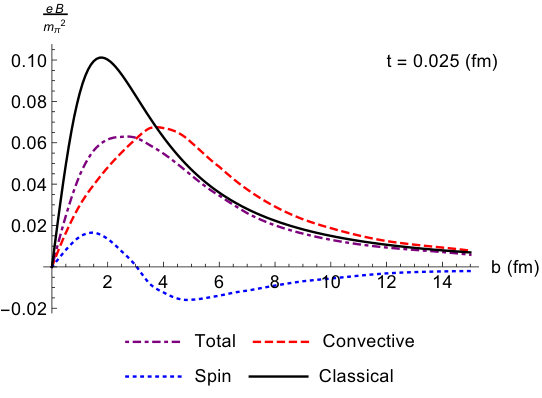 Figure 1
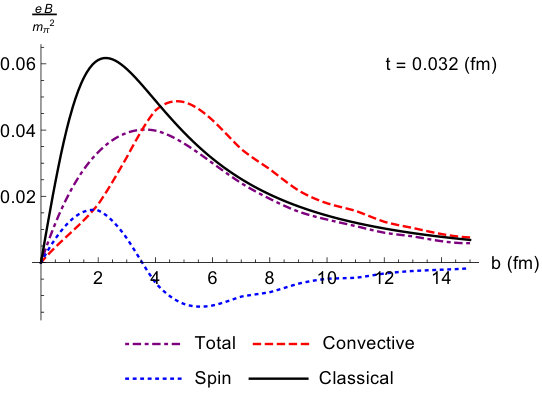 Figure 2
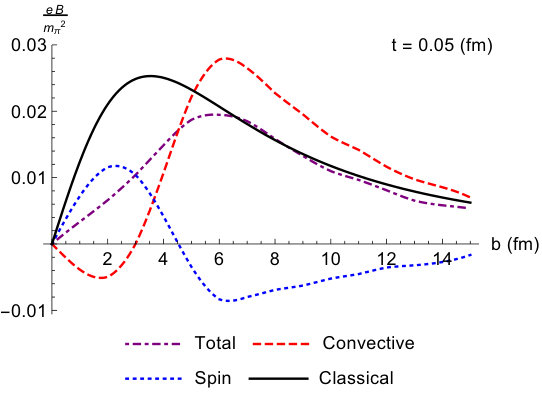 Figure 3
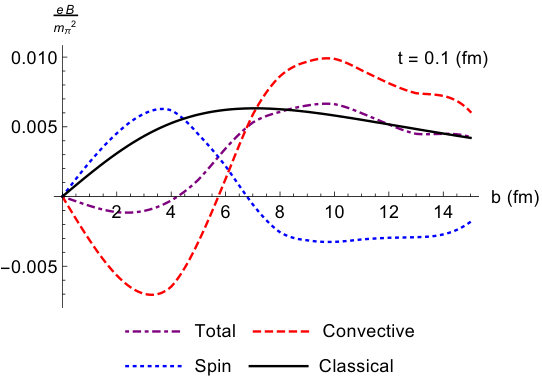 Figure 4
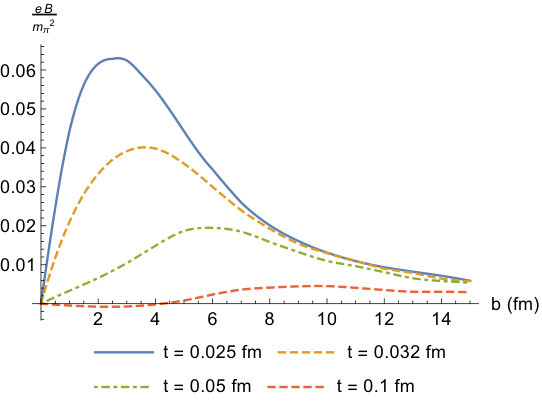 Figure 5
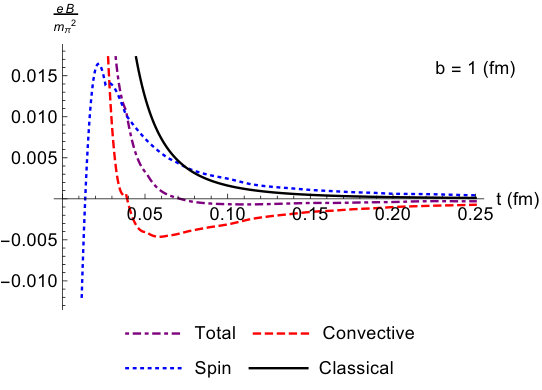 Figure 6
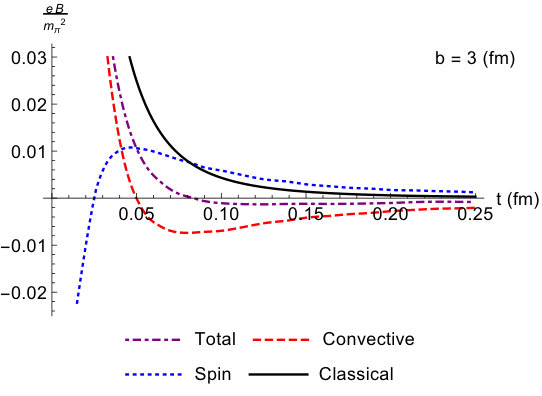 Figure 7
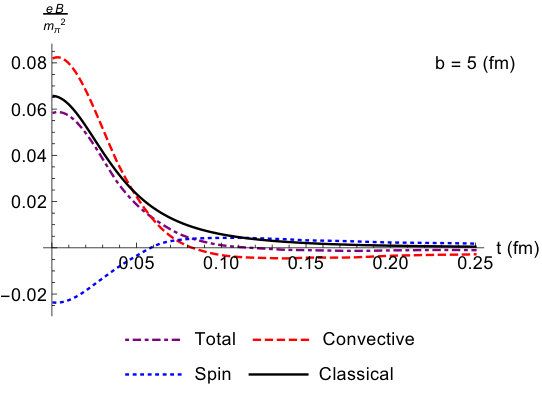 Figure 8
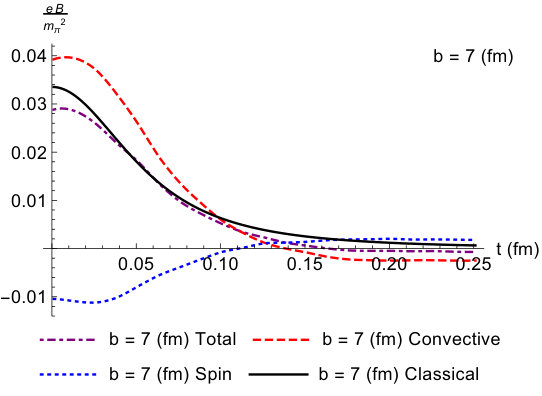 Figure 9
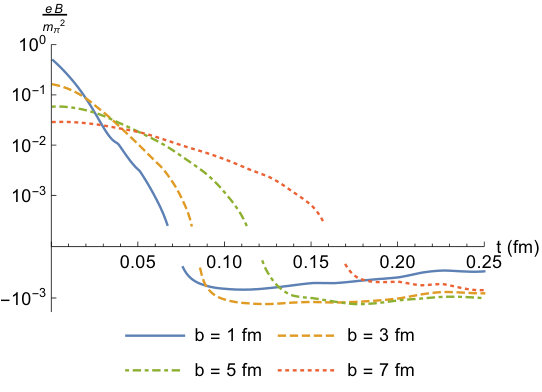 Figure 10
Peer Reviews
No public reviews on file for this paper yet. If you reviewed it on a platform where reviews are public (OpenReview, ICLR, NeurIPS, ICML), you can paste yours below so the community can read it here.
Videos
No videos yet. Explain this paper in a talk, walkthrough, or lecture? Add one.
Quantum diffusion of electromagnetic fields of ultrarelativistic spin-half particles
Balthazar Peroutka
Kirill Tuchin
Department of Physics and Astronomy, Iowa State University, Ames, Iowa, 50011, USA
Abstract
We compute electromagnetic fields created by a relativistic charged spin-half particle in empty space at distances comparable to the particle Compton wavelength. The particle is described as a wave packet evolving according to the Dirac equation. It produces the electromagnetic field that is essentially different from the Coulomb field due to the quantum diffusion effect.
I Introduction
It has been known for a while that very intense electromagnetic fields are created in ultra-relativistic hadronic and nuclear collisions Rafelski:1975rf ; Greiner:1985ce ; Ambjorn:1990jg ; Olesen:2012zb ; Ambjorn:1988tm . However, no convincing experimental evidence of their impact on the scattering dynamics has been observed. In recent years, a renewed interest to this subject was motivated by the relativistic heavy-ion collision experiments. The electromagnetic fields are intense enough to modify the properties of the nuclear matter produced in these collisions. In order to evaluate the impact of these fields on the nuclear matter, it is crucial to know their space-time structure. In Kharzeev:2007jp ; Skokov:2009qp ; Bzdak:2011yy ; Voronyuk:2011jd ; Ou:2011fm ; Deng:2012pc ; Bloczynski:2012en production of the electromagnetic fields was studied using the hadron transport models, neglecting the nuclear medium electric and magnetic response and flow. In Bzdak:2011yy ; Deng:2012pc ; Bloczynski:2012en it was pointed out that the quantum nature of the nucleus wave function gives rise to strong field fluctuation, so that even in central collisions the r.m.s. does not vanish. In Tuchin:2010vs ; Tuchin:2013apa ; Tuchin:2013ie ; Zakharov:2014dia it is argued that due to the finite electric conductivity of nuclear matter, the lifetime of the electromagnetic field is significantly longer than in vacuum. Anomalous transport can also affect the field producing oscillations Tuchin:2014iua ; Manuel:2015zpa ; Li:2016tel and even forcing the field into the topologically non-trivial configurations Tuchin:2016tks ; Tuchin:2016qww ; Hirono:2016jps ; Hirono:2015rla ; Xia:2016any ; Qiu:2016hzd . The electromagnetic field in the nuclear medium, unlike that in vacuum, strongly depends on the initial conditions Tuchin:2015oka . The nuclear medium produced in relativistic heavy-ion collisions is well described by the relativistic hydrodynamics. Relativistic magneto-hydrodynamic calculations were done in Pu:2016ayh ; Roy:2015kma ; Inghirami:2016iru in the ideal limit (infinite electrical conductivity).
In a recent publication Holliday:2016lbx we argued that one can treat the sources of the electromagnetic field, i.e. the valence quarks, neither as point particles (classical limit) nor as plane waves, which have infinite spatial extent. This is because the interaction range, the quark wave function size and the dimensions of the produced nuclear matter have similar extent. As the first step towards understanding the quantum dynamics of the electromagnetic field sources, in Holliday:2016lbx we modeled valence quarks as spinless Gaussian wave packets. Solving the Klein-Gordon equation we computed the charge and current densities and the resulting electromagnetic fields in vacuum. In the present work we extend our approach to compute the spin contribution to the electromagnetic field. As in Holliday:2016lbx we start with the initial Gaussian wave packet and evolve it in time according to the Dirac equation. At this point we completely neglect the medium effects as our goal is to study the effect of quantum diffusion of the quark wave function. This way our calculation is applicable to any hadronic and nuclear collisions.
Before we proceed to the description of our calculation, it is worthwhile to set the notations, definitions and normalizations. The wave function of a spin-half particle can be expanded in a complete set of the momentum and helicity eigenstates:
[TABLE]
where . The four-component bispinor is the momentum and helicity eigenstate normalized as
[TABLE]
is the momentum wave function at , normalized as
[TABLE]
With these conventions
[TABLE]
Solutions of the Dirac equation with given momentum and helicity normalized by (2) are
[TABLE]
where the two-component spinors are helicity eigenstates.
II Rest frame
In the rest frame, although the particle momentum vanishes, the momentum of the Fourier components in (1) is finite, which is the reason for the wave function diffusion. Although the particle spin projection on any axis is conserved, only spin projection on the momentum direction is conserved for states with given momentum. This is why the helicity eigenstates are the correct choice of the spin basis.
Taking the direction of observation to be -axis, i.e. and describing the momentum direction by the polar and azimuthal angles and we write the helicity eigenstates
[TABLE]
Using these in (9) yields
[TABLE]
Plugging (23) into (1) yields, after integration over the momentum directions (keeping in mind that ), the wave function in the rest frame
[TABLE]
where
[TABLE]
where and are the Fresnel integrals related to the error function:
[TABLE]
The corresponding charge and current densities are obtained using
[TABLE]
The resulting and are spherically symmetric. In particular is directed along the -axis, which coincides with the direction of in our coordinate system.
[TABLE]
[TABLE]
Given the charge and current densities, the electric field can be computed as
[TABLE]
where is the retarded time and . The only non-vanishing component of the electromagnetic field in the rest frame is the radial component of the electric field :
[TABLE]
We emphasize, that although the entire discussion of this section deals with a charged point particle at rest, its electromagnetic field is different from the Coulomb field due to the quantum evolution of the particle wave function.
III Convective and spin currents
It is instructive to separate the convective and spin contributions (marked below by the subscripts and respectively). Using the Gordon identity
[TABLE]
we can write the charge and current densities (32) as
[TABLE]
where
[TABLE]
Explicit expressions for the convective charge and current densities read
[TABLE]
[TABLE]
Here the integrals
[TABLE]
can be expressed in terms of the Fresnel integrals (31). The corresponding field is computed using (35).
IV Lab frame
In the Lab frame moving with constant velocity with respect to the rest frame, the electric charge moves with velocity . In contrast to the previous sections, in this and the next sections, all quantities pertaining to the rest frame are denoted by the subscript [math], whereas those pertaining to the Lab frame bear no such subscript. The Lorentz transformations relating the coordinates and the fields in the two frames are
[TABLE]
Here and . Thus, the electric field (36) in the Lab frame transforms into
[TABLE]
Using the cylindrical coordinates one can write
[TABLE]
where
[TABLE]
and . is the magnitude of the electric field in the rest frame. Impact parameter is a distance from the moving charge in the transverse direction.
V Results
To compute the electromagnetic field created by a relativistic wave packet, one needs to specify the initial wave function. We adopted a Gaussian distribution
[TABLE]
Its width in the coordinate space is fixed at fm reflecting the strong interactions range. We also assumed that the momentum wave function is independent of , i.e. it is the same for all spin states. Other parameters used in our numerical calculations were the valence quark mass GeV, electric charge (we omit the quark charges 2/3 and -1/3) and the boost factor .
The results of our calculations are exhibited in Fig. 1-Fig. 3. Shown in Fig. 1 is the dependence of the magnetic field on time (left panel) and distance (right panel). On the left panel notice that at later time the magnetic field changes sign. We have observed this effect before for a scalar particle Holliday:2016lbx , where it is, in fact, much more prominent. We will add a few more comments about the sign flip later in this section.
In Fig. 2 we plot each of the lines shown in Fig. 1 (left panel) separately along with its convective and spin components. Also plotted is the corresponding classical (boosted Coulomb) field for comparison. At large , the classical (i.e. point) and quantum (i.e. wave packet) sources induce the same field as expected. While the convective current contributes to the monopole term falling off as at large , the leading spin current contribution starts with the dipole term which falls off as . At later times, due to the quantum diffusion, the deviation from the classical field is observed in a wider range of distances.
In Fig. 3 we plot each of the lines shown in Fig. 1 (right panel) separately along with its convective and spin components as well as the classical field. In order to better demonstrate the sign flip dynamics we use the linear scale for the vertical axis. It is seen that while the convective part of the magnetic field changes its sign from positive to negative, the spin part changes its sign from negative to positive at about the same time. This makes the sign flip effect for the magnetic field generated by spin-1/2 particle less pronounced than for the field generated by a scalar particle (computed in Holliday:2016lbx ). The origin of the spin flip can be traced back to (35) in which the last two terms are proportional to the rate of decrease of charge density and the corresponding increase of the current density due to the quantum diffusion of the wave packet in the outward radial direction.
VI Conclusions
We computed the magnetic field created by a single valence quark, which is represented by a wave packet satisfying the Dirac equation and moving in free space with relativistic velocity. We observed that the classical description of the valence quarks as point-particles is not accurate for calculations of the electromagnetic field in hadron and/or nuclear collisions as it breaks down at distances as large as fm at . Moreover it misses an important spin-flip effect that occurs due to the quantum diffusion of the wave packet.
This paper is a step towards our ultimate goal of determining the structure and dynamics of electromagnetic fields created in relativistic hadron and nuclear collisions, and in particular, in heavy-ion collisions. In the forthcoming publication, we intend to study the effect of the conducting medium on the electromagnetic field created by quantum sources.
Acknowledgements.
This work was supported in part by the U.S. Department of Energy under Grant No. DE-FG02-87ER40371.
The reference list from the paper itself. Each links out to its DOI / PubMed record.
- 1(1) W. Greiner, B. Muller and J. Rafelski, “Quantum Electrodynamics Of Strong Fields,” Berlin, Germany: Springer (1985) 594 P. (Texts and Monographs In Physics)
- 2(2) J. Rafelski and B. Muller, “Magnetic Splitting of Quasimolecular Electronic States in Strong Fields,” Phys. Rev. Lett. 36 , 517 (1976).
- 3(3) J. Ambjorn and P. Olesen, “On Electroweak Magnetism,” Nucl. Phys. B 315 , 606 (1989).
- 4(4) J. Ambjorn and P. Olesen, “W condensate formation in high-energy collisions,” Phys. Lett. B 257 , 201 (1991).
- 5(5) P. Olesen, “W condensation at the LHC?,” ar Xiv:1207.7045 [hep-ph].
- 6(6) D. E. Kharzeev, L. D. Mc Lerran and H. J. Warringa, “The effects of topological charge change in heavy ion collisions: ’Event by event P and CP violation’,” Nucl. Phys. A 803 , 227 (2008).
- 7(7) V. Skokov, A. Y. Illarionov and V. Toneev, “Estimate of the magnetic field strength in heavy-ion collisions,” Int. J. Mod. Phys. A 24 , 5925 (2009)
- 8(8) V. Voronyuk, V. D. Toneev, W. Cassing, E. L. Bratkovskaya, V. P. Konchakovski and S. A. Voloshin, “(Electro-)Magnetic field evolution in relativistic heavy-ion collisions,” Phys. Rev. C 83 , 054911 (2011)