Single-top quark cross-section measurements in ATLAS
Dominic Hirschbuehl (on behalf of the ATLAS Collaboration)

TL;DR
This paper reports comprehensive measurements of all three single top-quark production channels at the LHC, including new results at 13 TeV and evidence for the s-channel at 8 TeV, advancing understanding of top-quark production.
Contribution
It provides the first measurements of single top-quark production in all channels at 13 TeV and evidence for the s-channel at 8 TeV, expanding experimental knowledge.
Findings
First 13 TeV measurements of t-channel production
First evidence of s-channel production at 8 TeV
Detailed cross-section results for all channels
Abstract
This article presents measurements of all three single top-quark production channels. Detailed measurements of -channel single top-quark production using data collected by the ATLAS experiment in proton--proton collisions at a centre-of-mass energy of 8 TeV are shown as well es first results using 13 TeV at the LHC. The associated production of a top quark and a boson is presented for data collected at 13 TeV, while the first evidence of single top-quark production in the -channel is shown for data collected at 8 TeV.
Click any figure to enlarge with its caption.
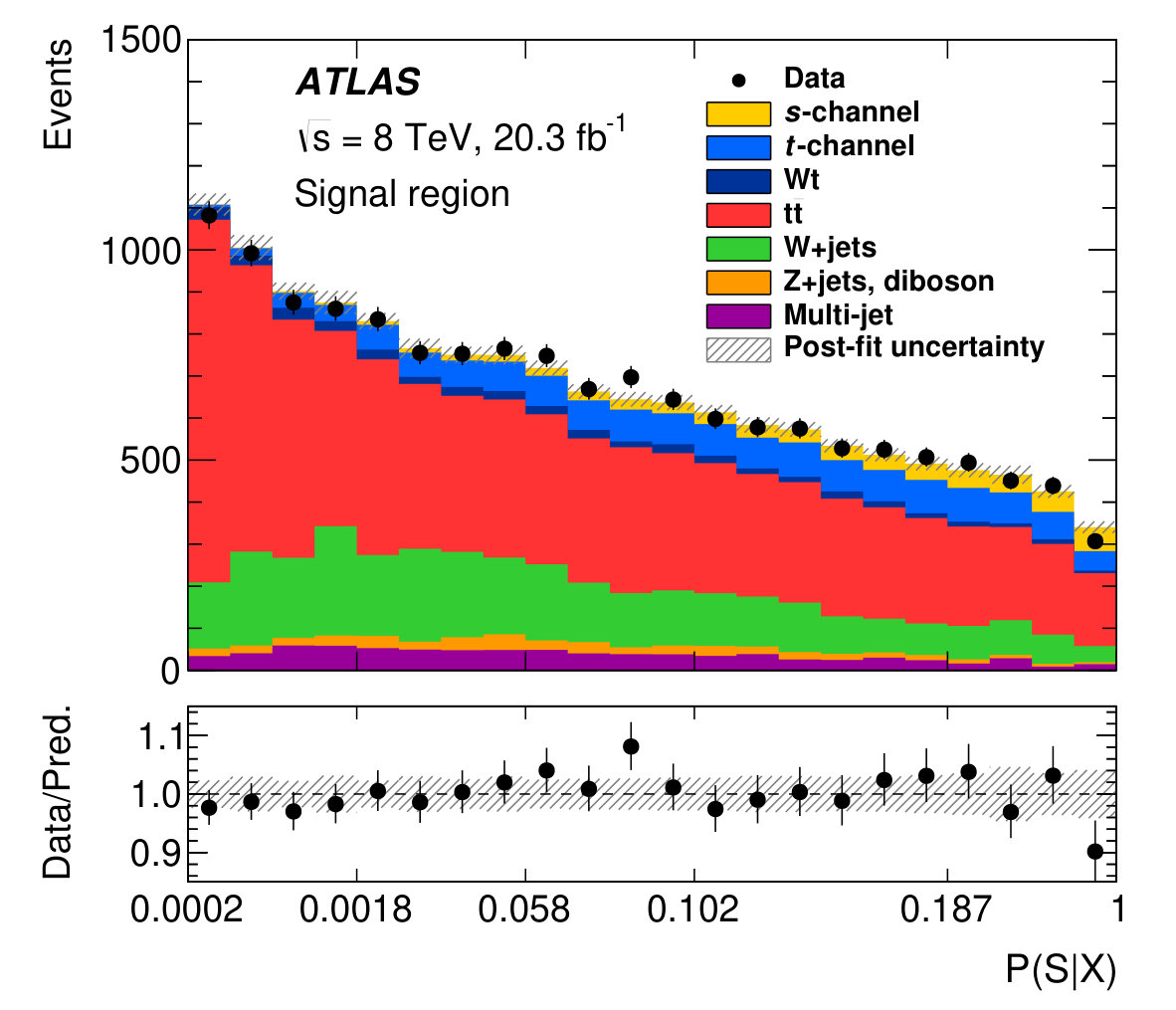 Figure 3
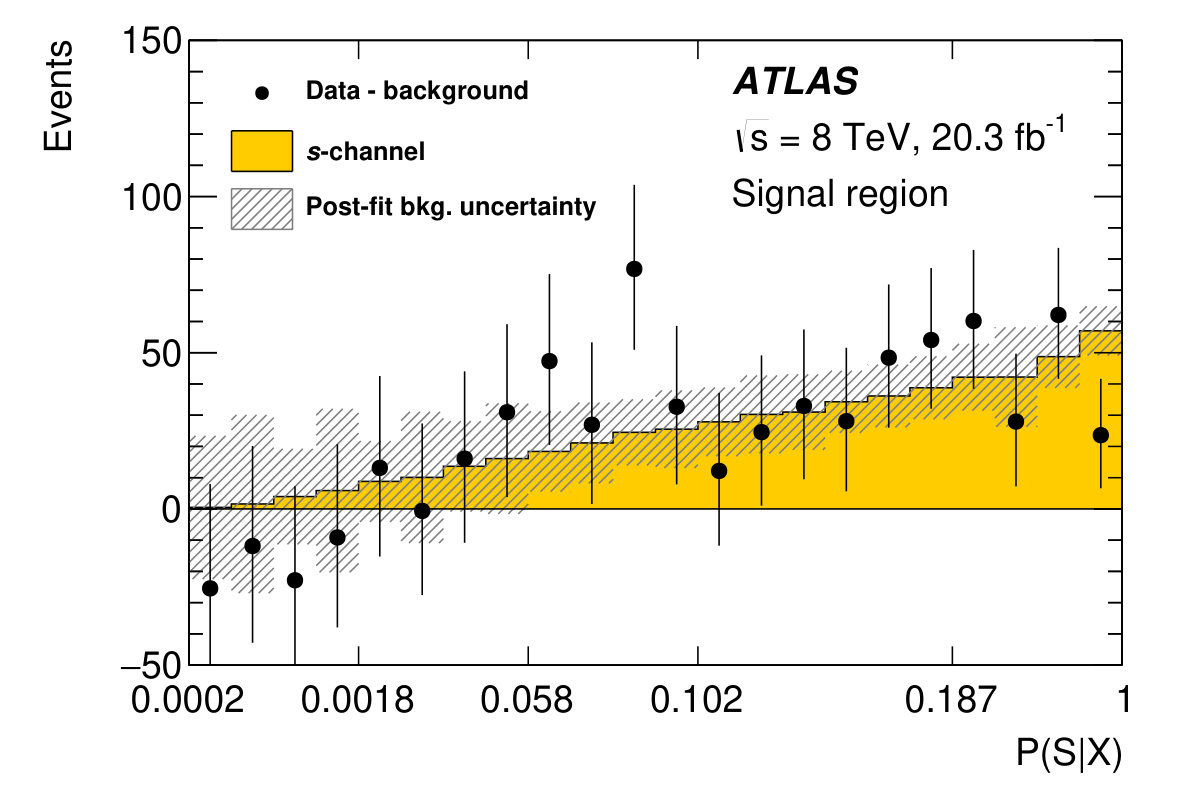 Figure 4
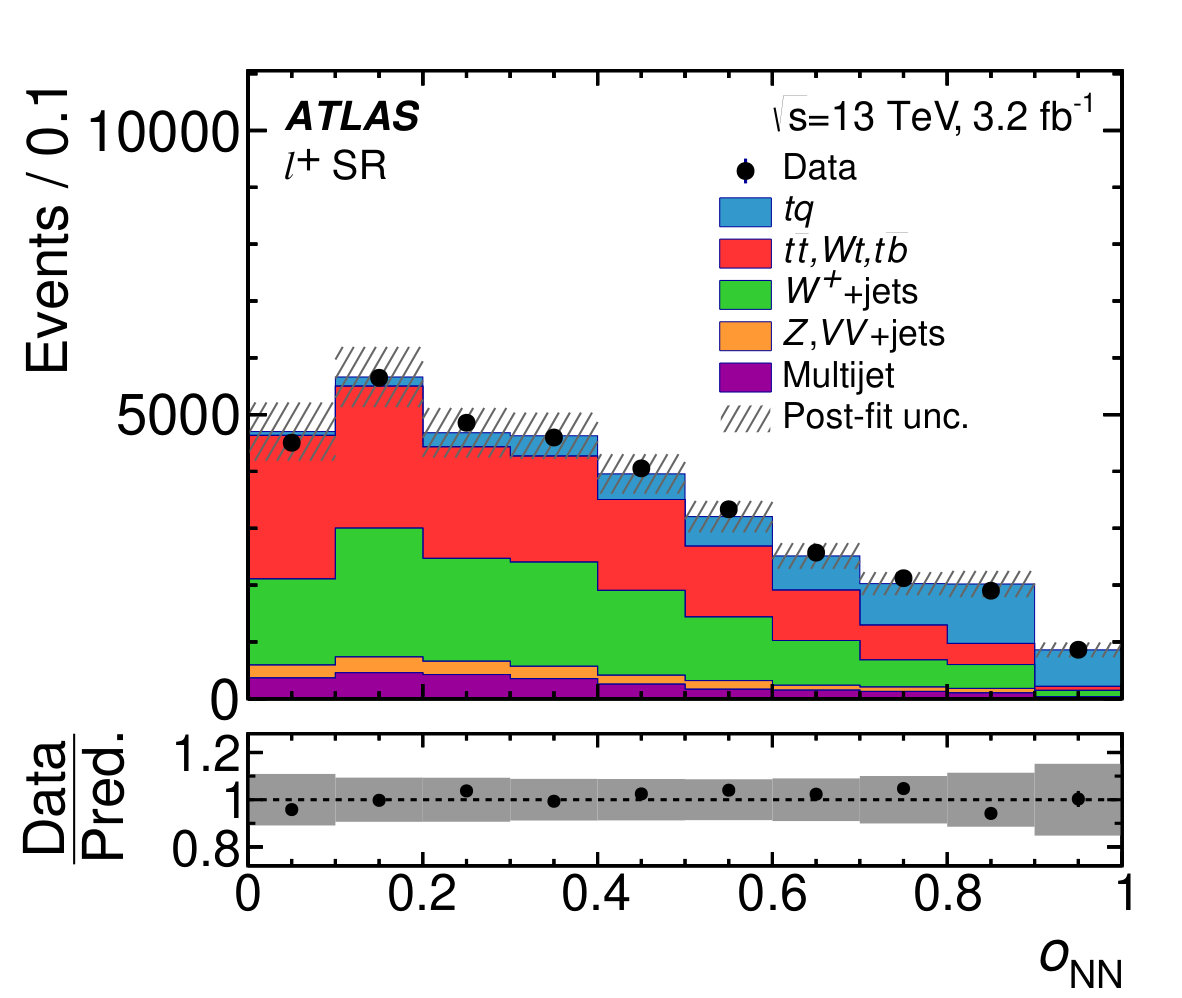 Figure 4
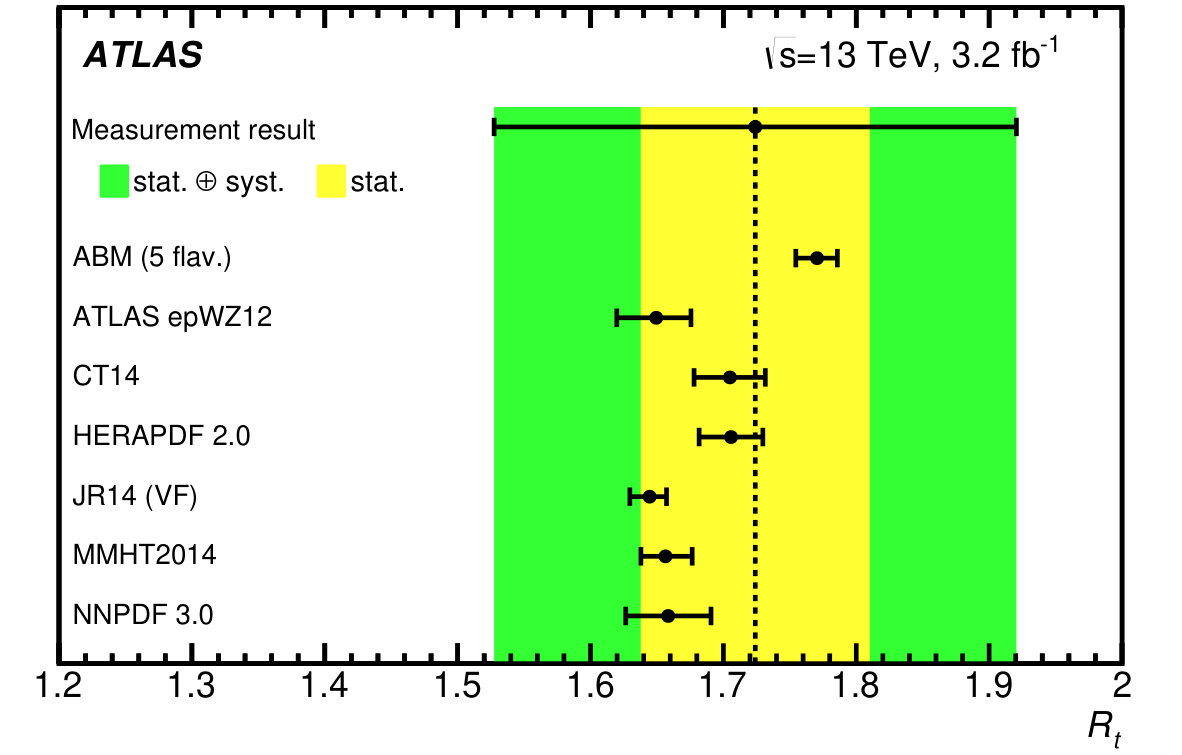 Figure 6
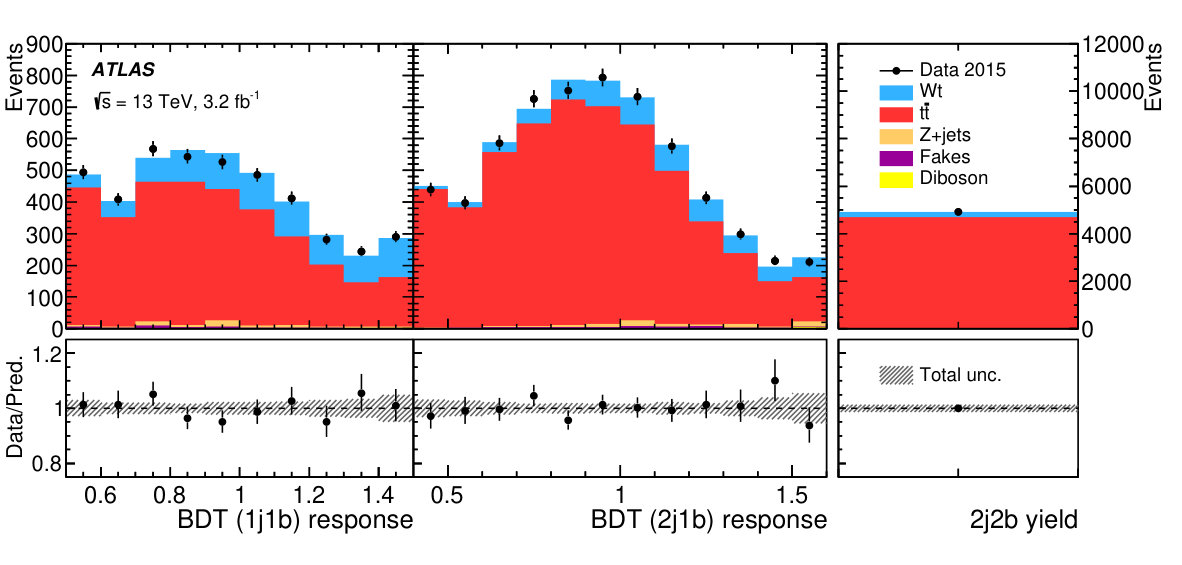 Figure 6
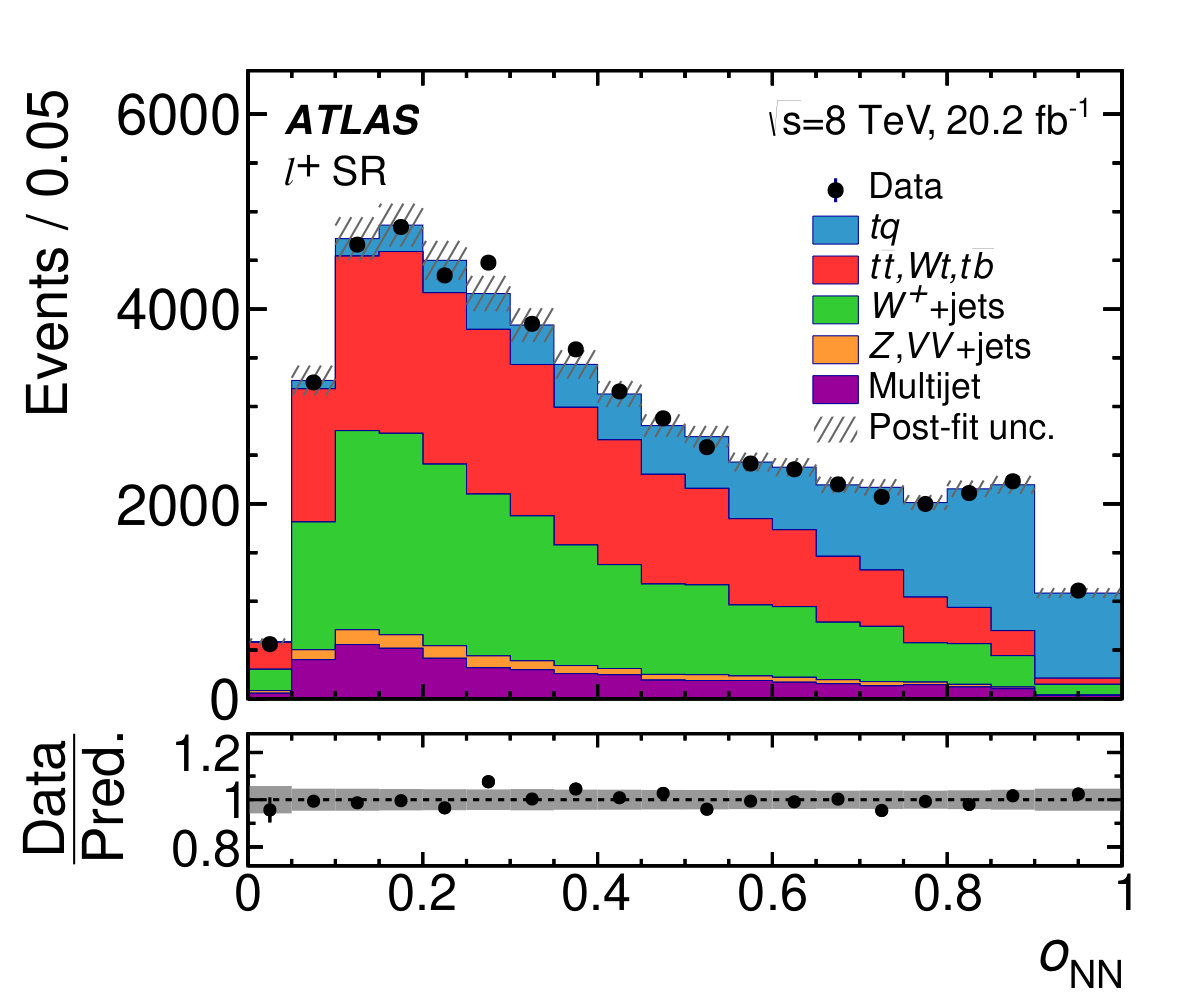 Figure 6
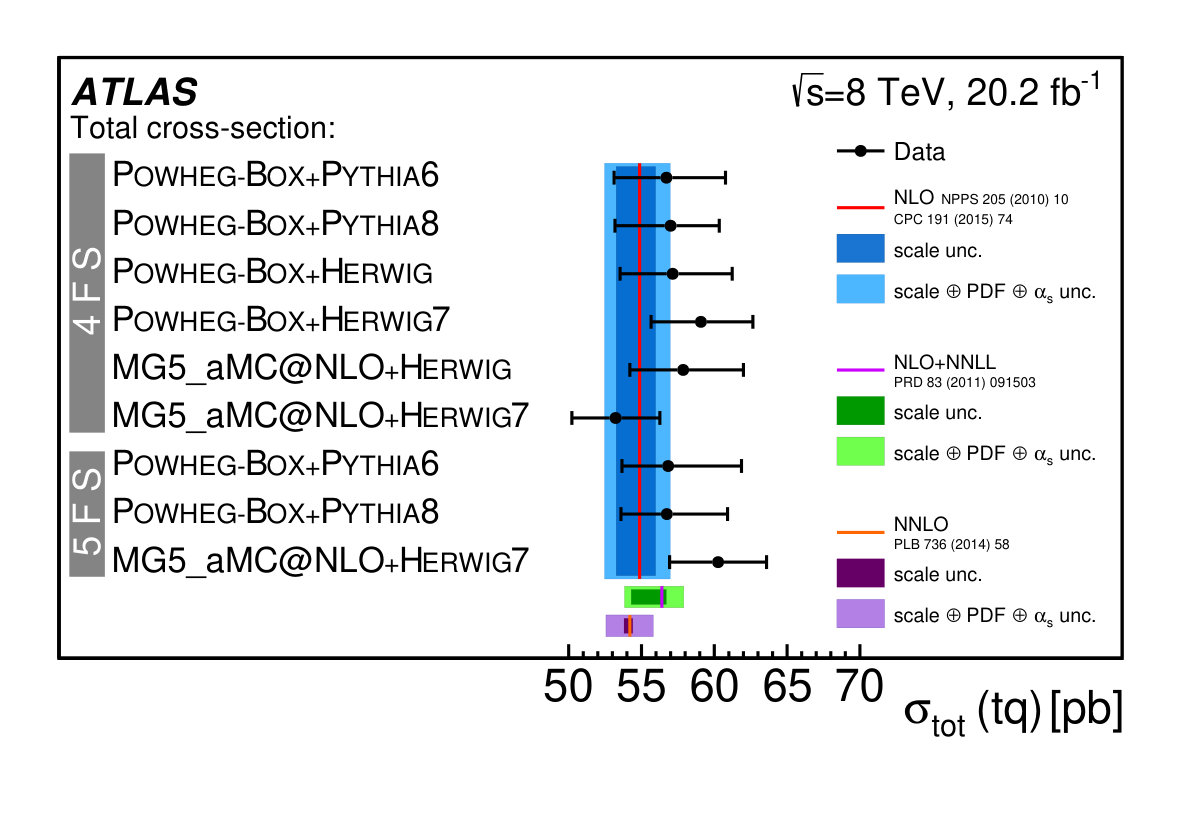 Figure 10
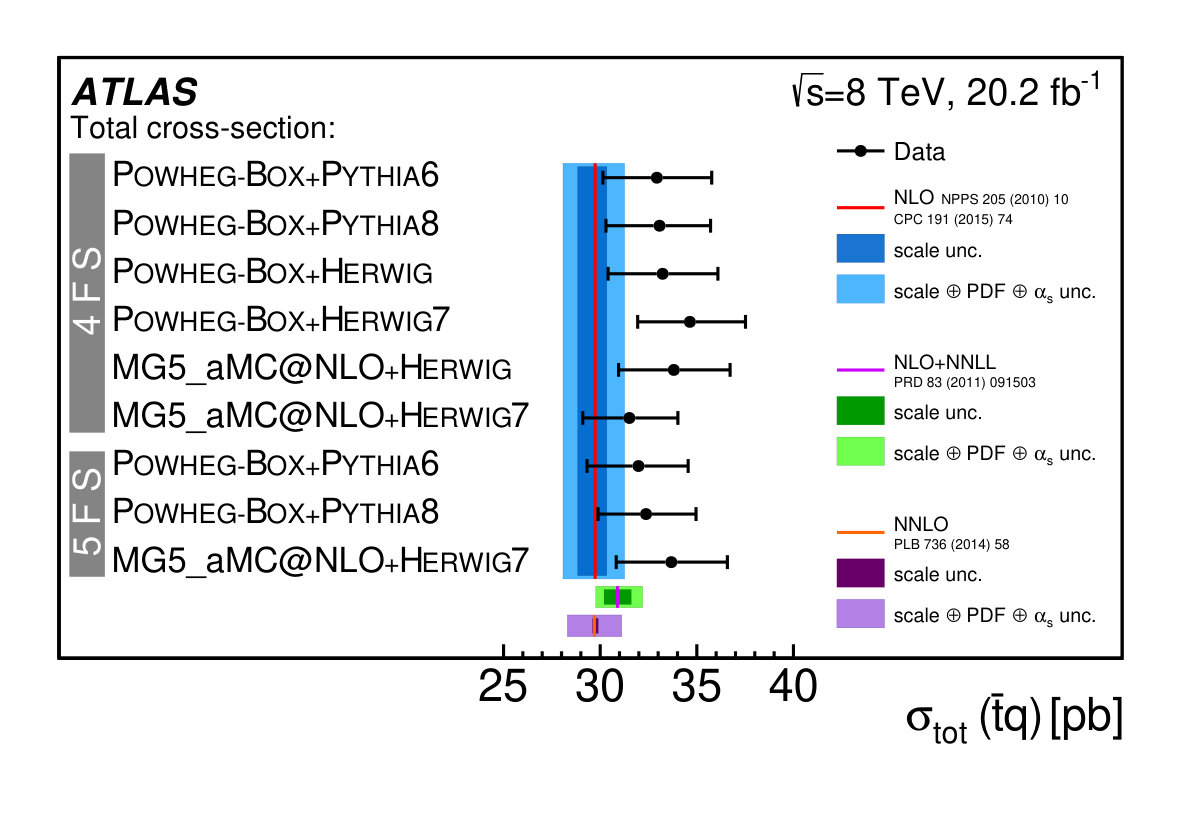 Figure 10
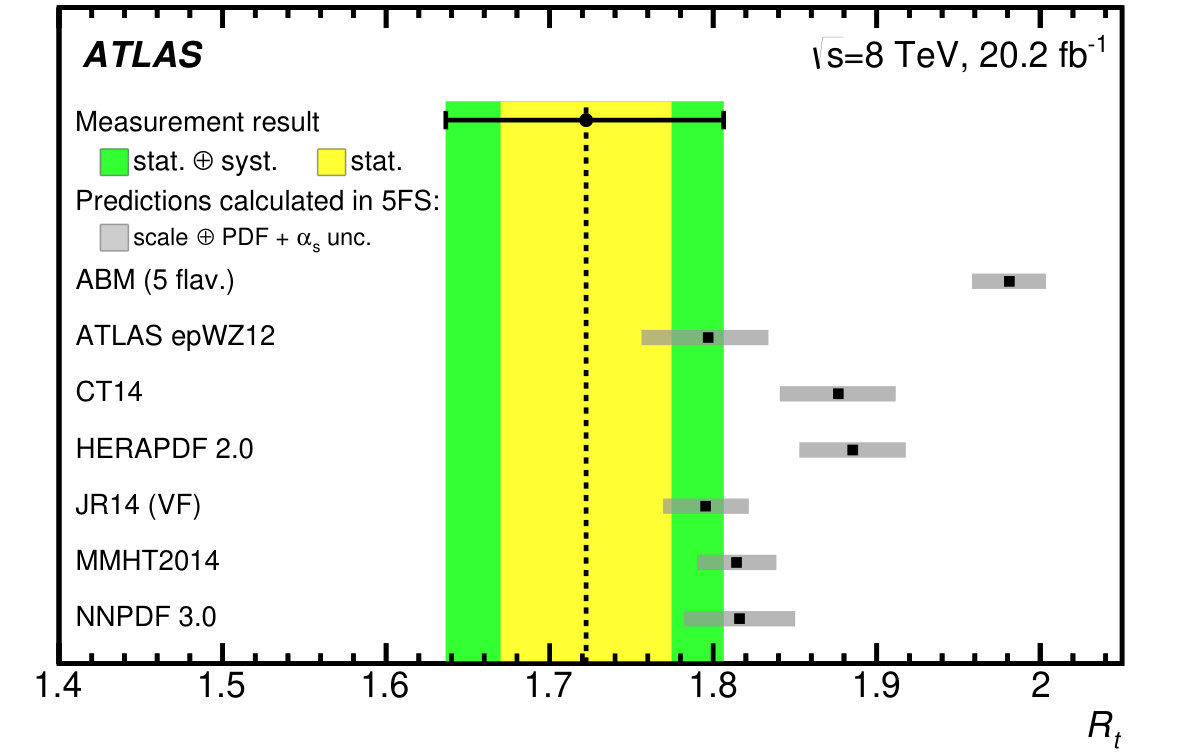 Figure 11
Peer Reviews
No public reviews on file for this paper yet. If you reviewed it on a platform where reviews are public (OpenReview, ICLR, NeurIPS, ICML), you can paste yours below so the community can read it here.
Videos
No videos yet. Explain this paper in a talk, walkthrough, or lecture? Add one.
Taxonomy
TopicsParticle physics theoretical and experimental studies · High-Energy Particle Collisions Research · Particle Detector Development and Performance
SNSN-323-63
Single-top quark cross-section measurements in ATLAS
Dominic Hirschbühl111email: [email protected]
on behalf of the ATLAS collaboration
Bergische Universität Wuppertal, 42119 Wuppertal, Germany
This article presents measurements of all three single top-quark production channels. Detailed measurements of -channel single top-quark production using data collected by the ATLAS experiment in proton–proton collisions at a centre-of-mass energy of 8 TeV are shown as well es first results using 13 TeV at the LHC. The associated production of a top quark and a boson is presented for data collected at 13 TeV, while the first evidence of single top-quark production in the -channel is shown for data collected at 8 TeV.
PRESENTED AT
International Workshop on Top Quark Physics
Olomouc, Czech Republic, September 19–23, 2016
1 Introduction
At leading order (LO) in perturbation theory, single top-quark production is described by three subprocesses that are distinguished by the virtuality of the exchanged boson. The dominant process is the -channel exchange, where a light quark from one of the colliding protons interacts with a -quark from another proton by exchanging a virtual boson. The total inclusive cross-sections of top-quark and top-antiquark production in the -channel in proton–proton collisions at a centre-of-mass energy TeV are predicted to be pb proton–proton and pb for top-antiquark production and at TeV to be pb and pb at next-to-leading order (NLO) precision in QCD [1, 2]. The second highest production cross section is predicted for the associated production of a boson and a top quark (). The cross-section of the channel at NLO with next-to-next-to-leading logarithmic soft-gluon corrections is calculated as pb [3] for TeV. The -channel production of a top quark and a -quark () for yields the smallest cross section of pb in NLO QCD [4].
In the following, measurements of all three production channels using data collected by the ATLAS experiment [6] in collisions either at TeV corresponding to an integrated luminosity of 20.2 fb*-1* or TeV at the LHC corresponding to an integrated luminosity of 3.2 fb*-1* are presented.
2 -channel single top-quark production
The analysis for -channel single top-quark production is performed using collision data at TeV. Events are selected if they have either of an electron or muon, two jets, where both have to be identified as a jet containing -hadrons (-tagged jet) and large missing transverse momentum . After the preselection, the main background are top-quark pair-production () and +jets production. In order to separate the signal from the large background contributions, a matrix element method discriminant is used, see Fig. 1. The signal is extracted from the data utilising a profile likelihood fit, which leads to a measured cross-section of pb [7]. Dominating uncertainties are Monte Carlos (MC) statistics, jet energy resolution, and the modelling of the -channel single top-quark process. The result, which is in agreement with the SM prediction, corresponds to an observed significance of 3.2 standard deviations.
3 Associated Wt production
The inclusive cross-section for the associated production of a boson and top quark is measured using dilepton events with at least one -tagged jet. Events are separated into signal and control regions based on the number of selected jets and -tagged jets, and the signal is separated from the background using a boosted decision tree (BDT) discriminant, shown in Fig. 2 The cross-section is extracted by fitting templates to the BDT output distribution, and is measured to be pb [8]. Main uncertainties are coming from the jet energy scale (JES) and the modelling of the top-quark processes.
4 -channel single top-quark production
The experimental signature of -channel single top-quark candidate events is given by one charged lepton (electron or muon), large and two jets. Exactly one of the two jets is required to be -tagged. The main background contributions are the and +jets processes. In order to separate signal from background an artificial neural network is used, shown in Fig. 3
For the TeV data; the total and fiducial cross-sections are measured for both top quark and top antiquark production. The fiducial cross-section is measured with a precision of 5.8% (top quark) and 7.8% (top antiquark), respectively [9]. A comparison with different MC generator setups is shown in Fig. 4 for the extrapolated total cross section.
In addition, the cross-section ratio of top-quark to top-antiquark production is measured, resulting in a precise value to compare with predictions, and presented in Fig. 5(left). Dominant uncertainties for these measurements are the JES and modelling of the top-quark processes. The total cross-section is used to extract the coupling: , which corresponds to at the 95% confidence level, when assuming and restricting the range of to the interval .
Requiring a high value of the neural-network discriminant leads to relatively pure -channel samples, which are used to measure differential cross-sections. Differential cross-sections as a function of the transverse momentum and absolute value of the rapidity of the top quark, the top antiquark, as well as the accompanying jet from the -channel scattering are measured at particle level and parton level. All measurements are compared to different Monte Carlo predictions as well as to fixed-order QCD calculations where these are available. The SM predictions provide good descriptions of the data.
For the TeV data; the the total cross-sections for both top quark and top antiquark production are measured to be and , respectively [10].
The cross-section ratio is found to be and compared with predictions from different PDF groups in Fig. 5 (right). The coupling at the vertex is determined to be and a lower limit on the CKM matrix element is set, giving at the 95% CL. These measurements are dominated by systematic uncertainties, from which the uncertainties connected with MC generators are the biggest ones.
The reference list from the paper itself. Each links out to its DOI / PubMed record.
- 1[1] J. M. Campbell, R. Frederix, F. Maltoni and F. Tramontano, Phys. Rev. Lett. 102 (2009) 182003
- 2[2] P. Kant, O. M. Kind, T. Kintscher, T. Lohse, T. Martini, S. M lbitz, P. Rieck and P. Uwer, Comput. Phys. Commun. 191 (2015) 74
- 3[3] N. Kidonakis, Po S DIS 2015 (2015) 170
- 4[4] T. Stelzer, Z. Sullivan and S. Willenbrock, Phys. Rev. D 58 (1998) 094021
- 5[5] G. Bordes and B. van Eijk, Nucl. Phys. B 435 (1995) 23.
- 6[6] ATLAS Collaboration, JINST 3 (2008) S 08003.
- 7[7] ATLAS Collaboration, Phys. Lett. B 756 (2016) 228
- 8[8] ATLAS Collaboration, ar Xiv:1612.07231 [hep-ex].