On Integrable Ermakov-Painlev\'{e} IV Systems
Colin Rogers, Andrew P. Bassom, Peter A. Clarkson

TL;DR
This paper introduces new integrable hybrid Ermakov-Painlevé IV systems, utilizing invariants and transformations to generate exact solutions, advancing the understanding of nonlinear integrable systems.
Contribution
The paper presents novel hybrid Ermakov-Painlevé IV systems and employs Bäcklund transformations to derive exact solutions, contributing to integrability theory.
Findings
Introduction of new hybrid Ermakov-Painlevé IV systems
Use of invariants to establish integrability
Generation of exact solutions via Bäcklund transformations
Abstract
Novel hybrid Ermakov-Painlev\'{e} IV systems are introduced and an associated Ermakov invariant is used in establishing their integrability. B\"{a}cklund transformations are then employed to generate classes of exact solutions via the linked canonical Painlev\'{e} IV equation.
Click any figure to enlarge with its caption.
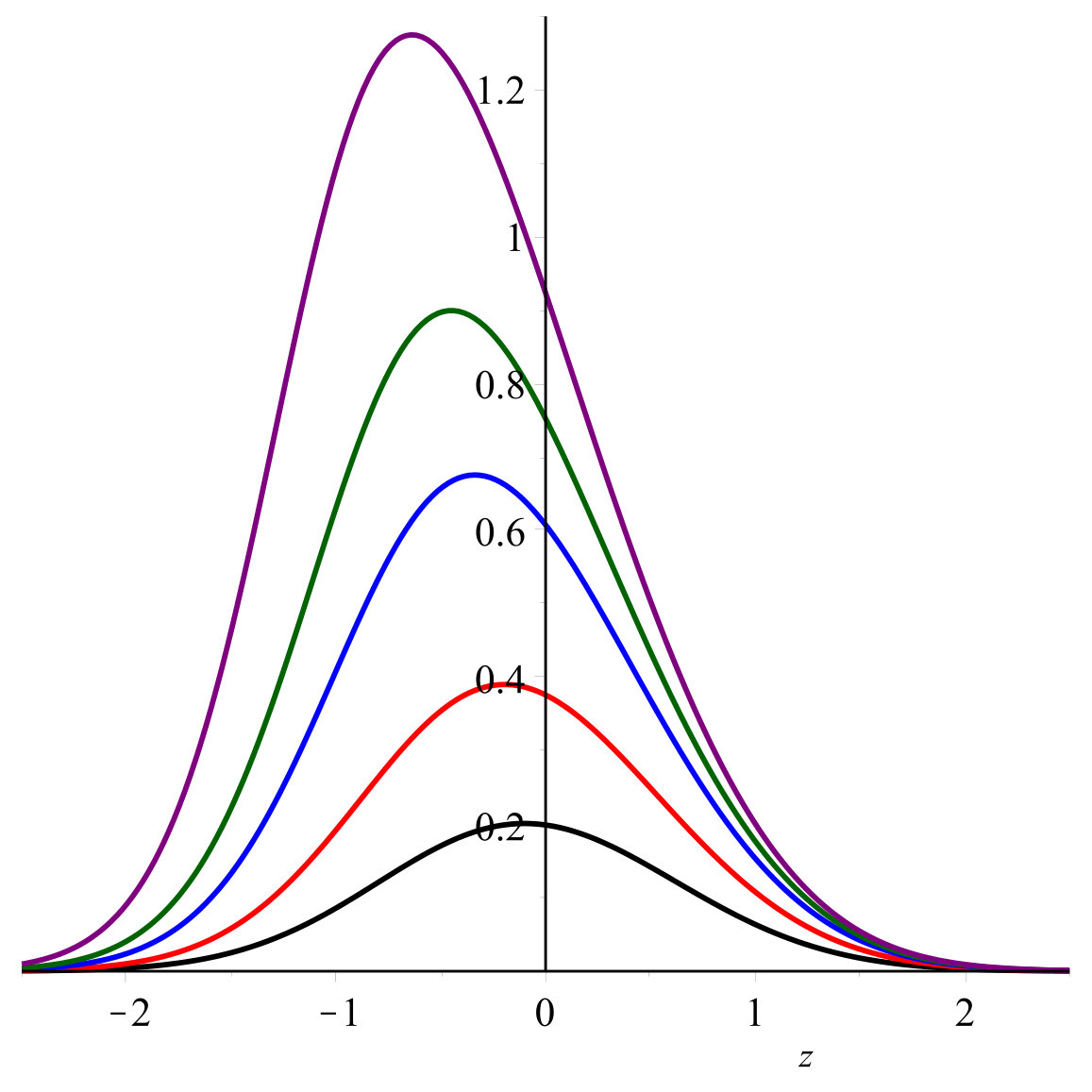 Figure 1
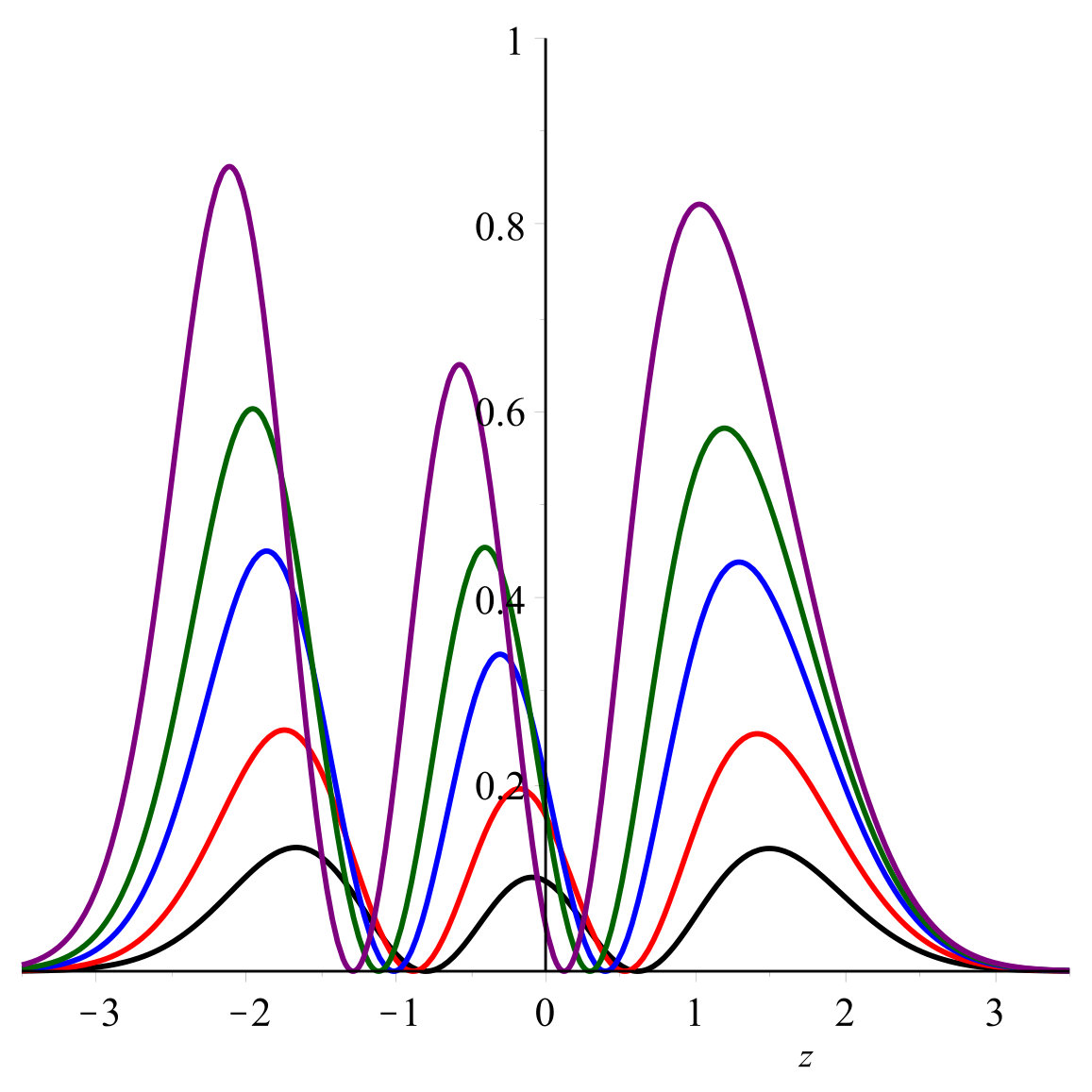 Figure 2
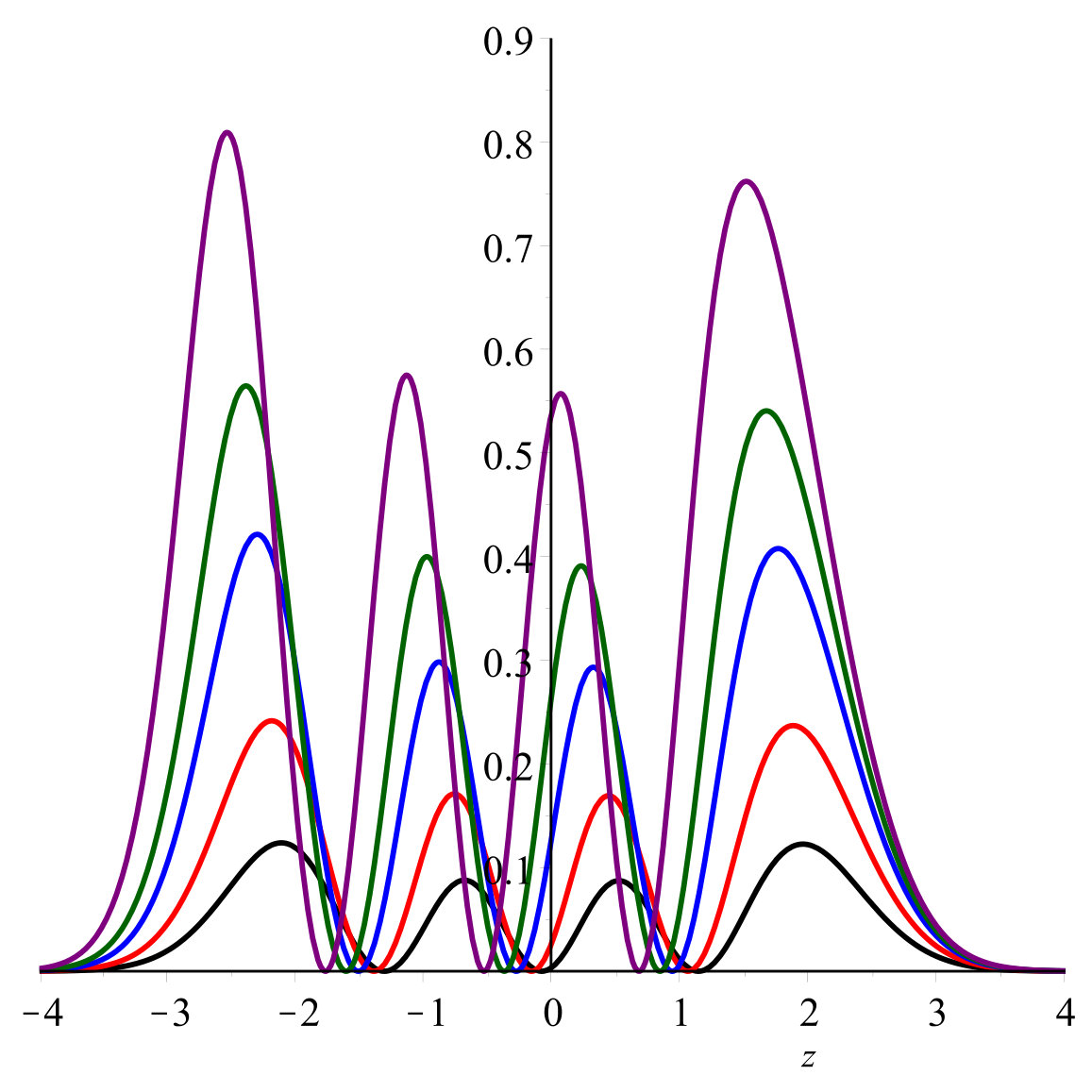 Figure 3
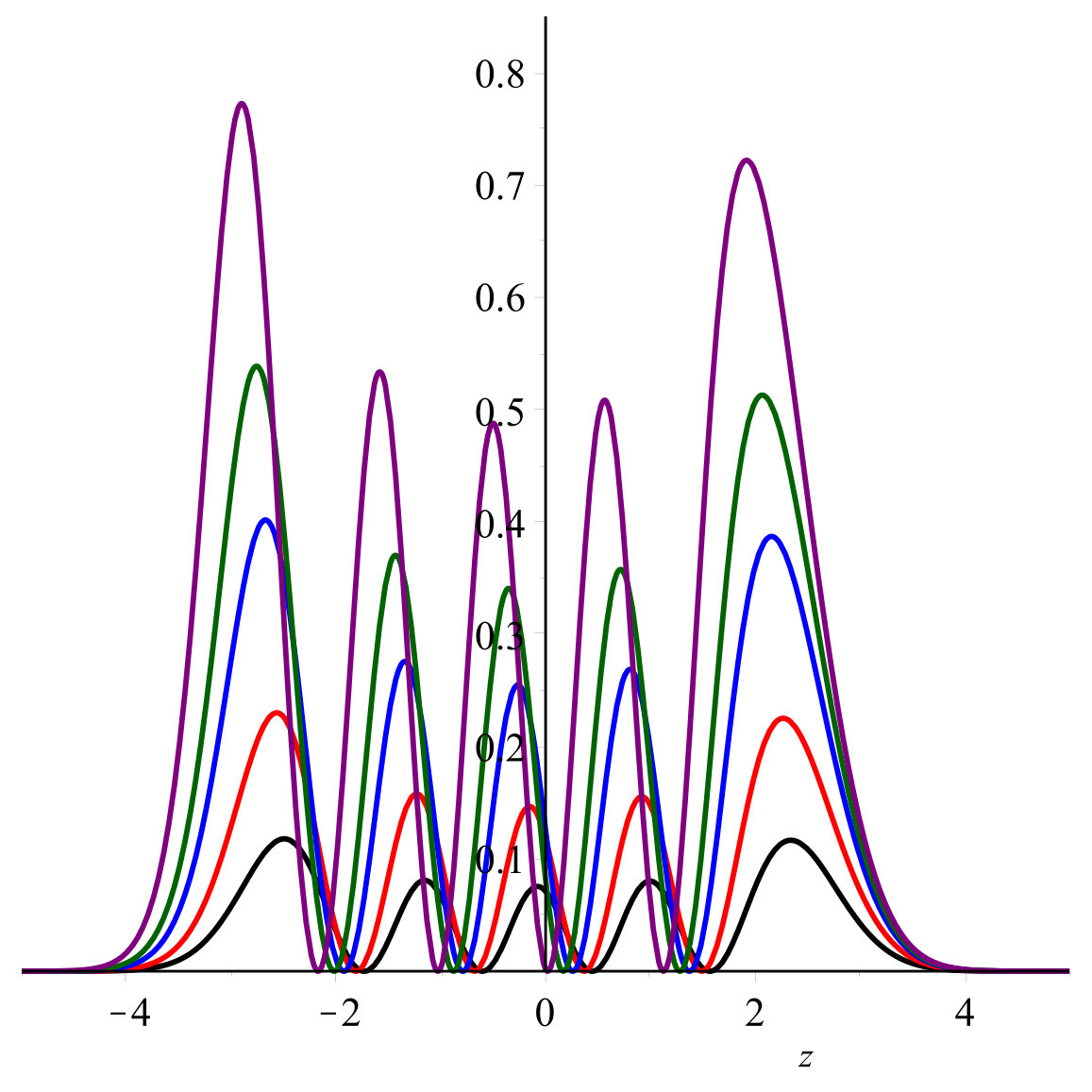 Figure 4
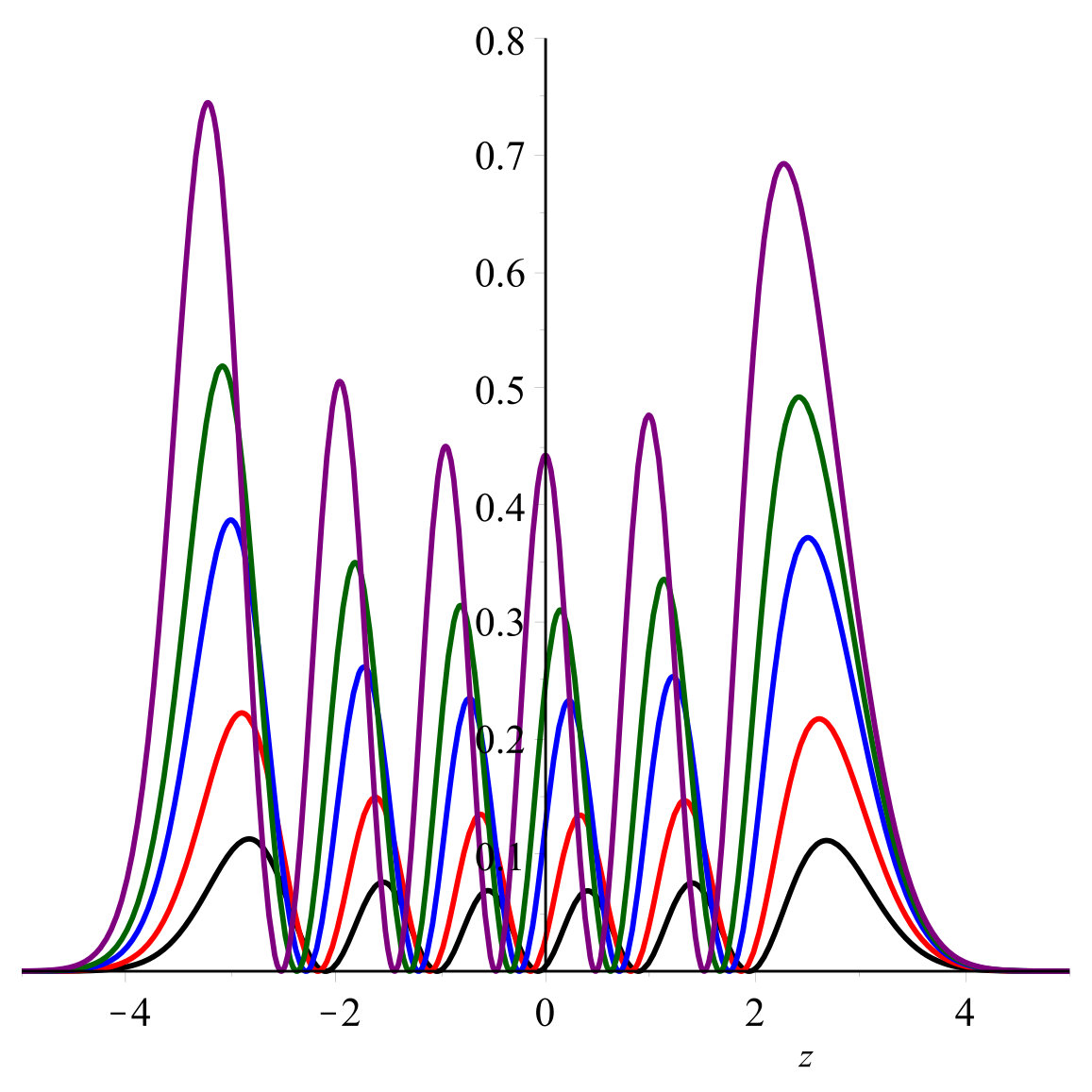 Figure 5
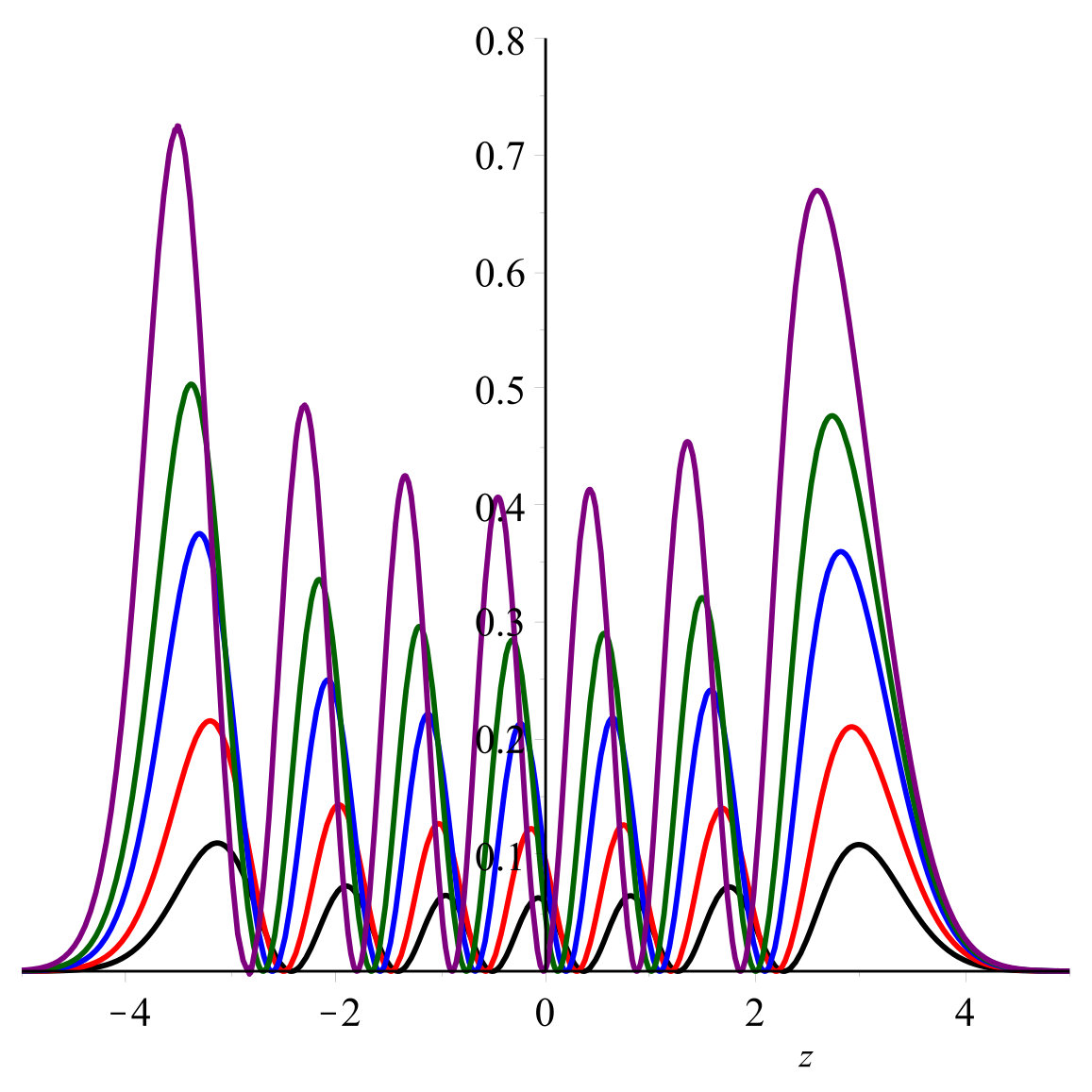 Figure 6
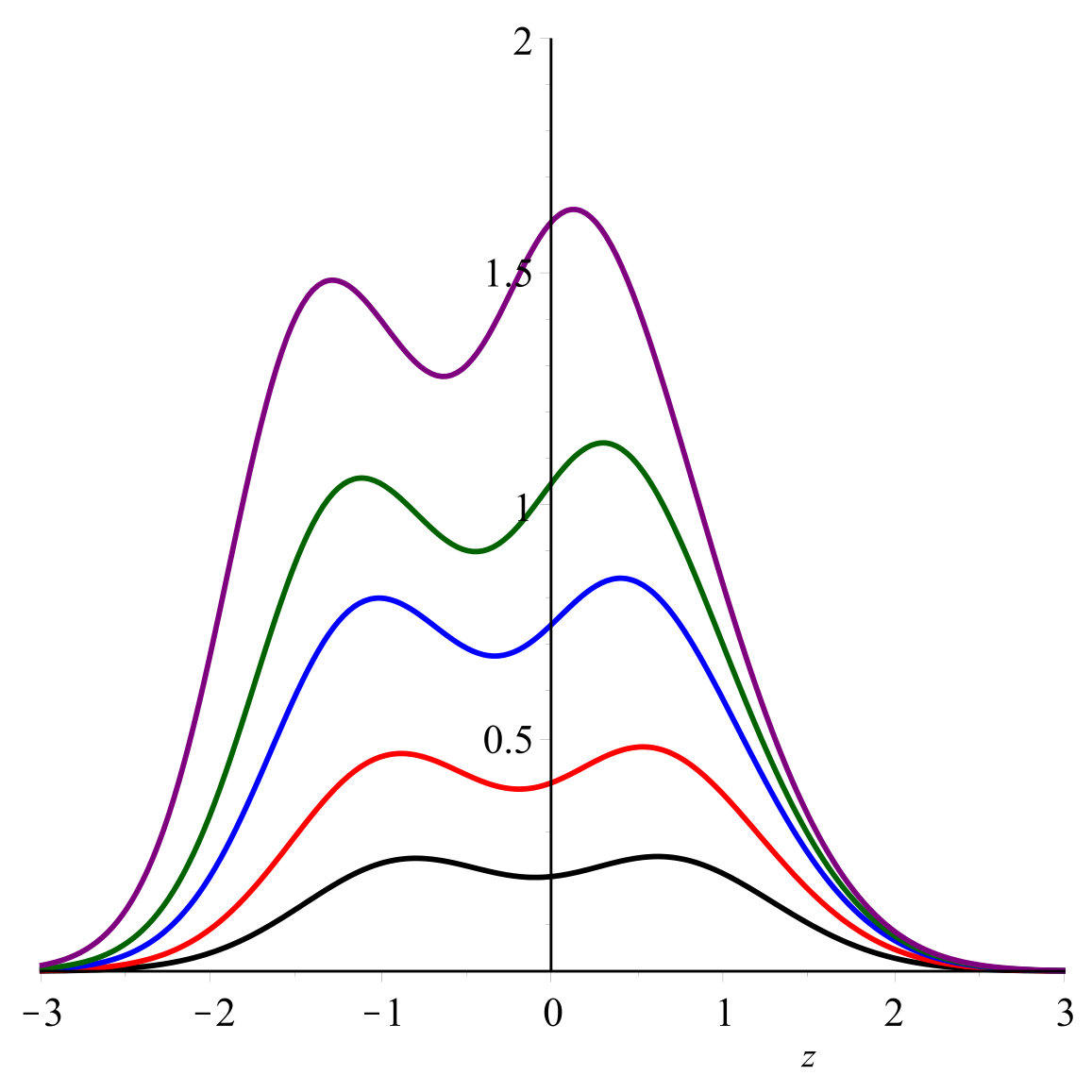 Figure 7
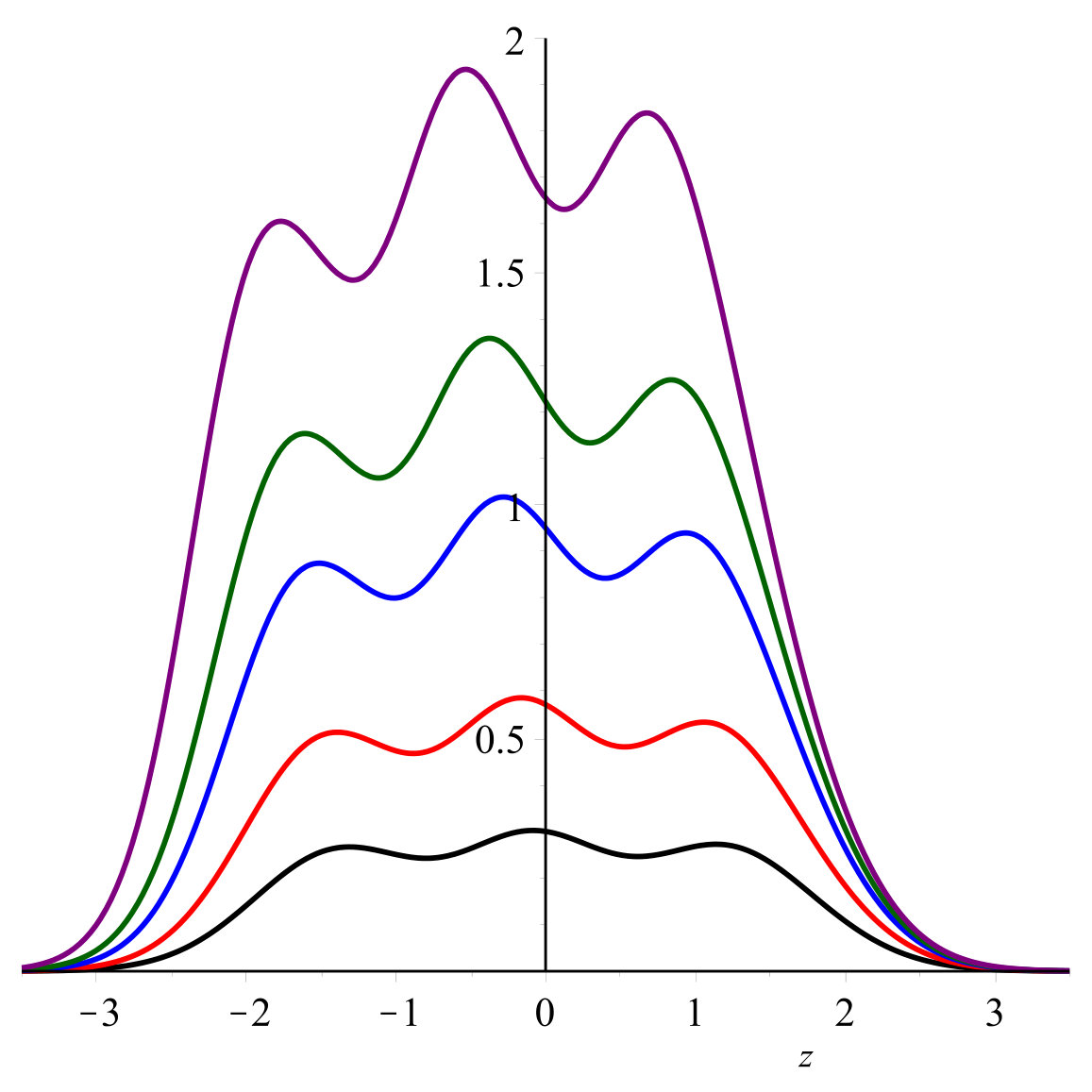 Figure 8
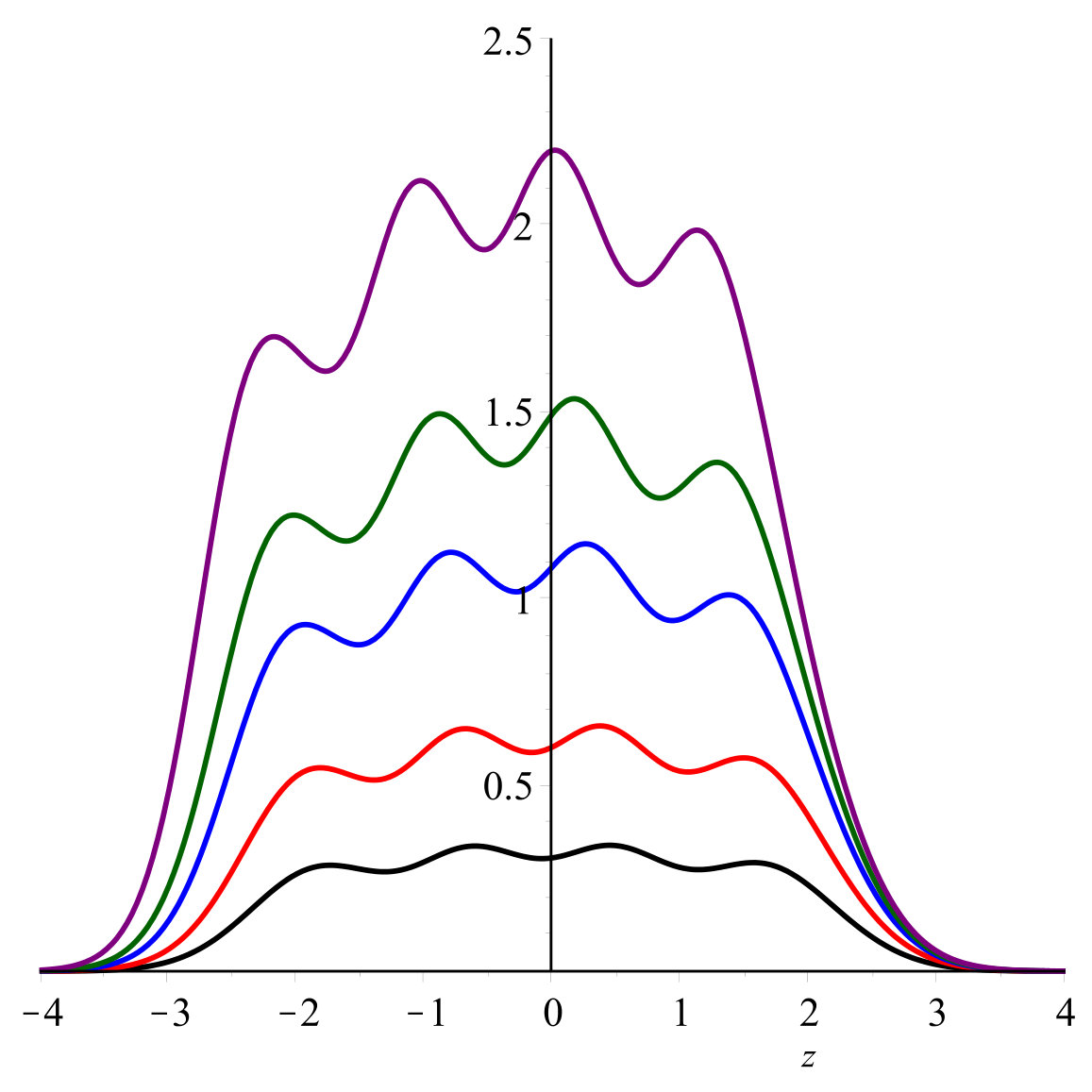 Figure 9
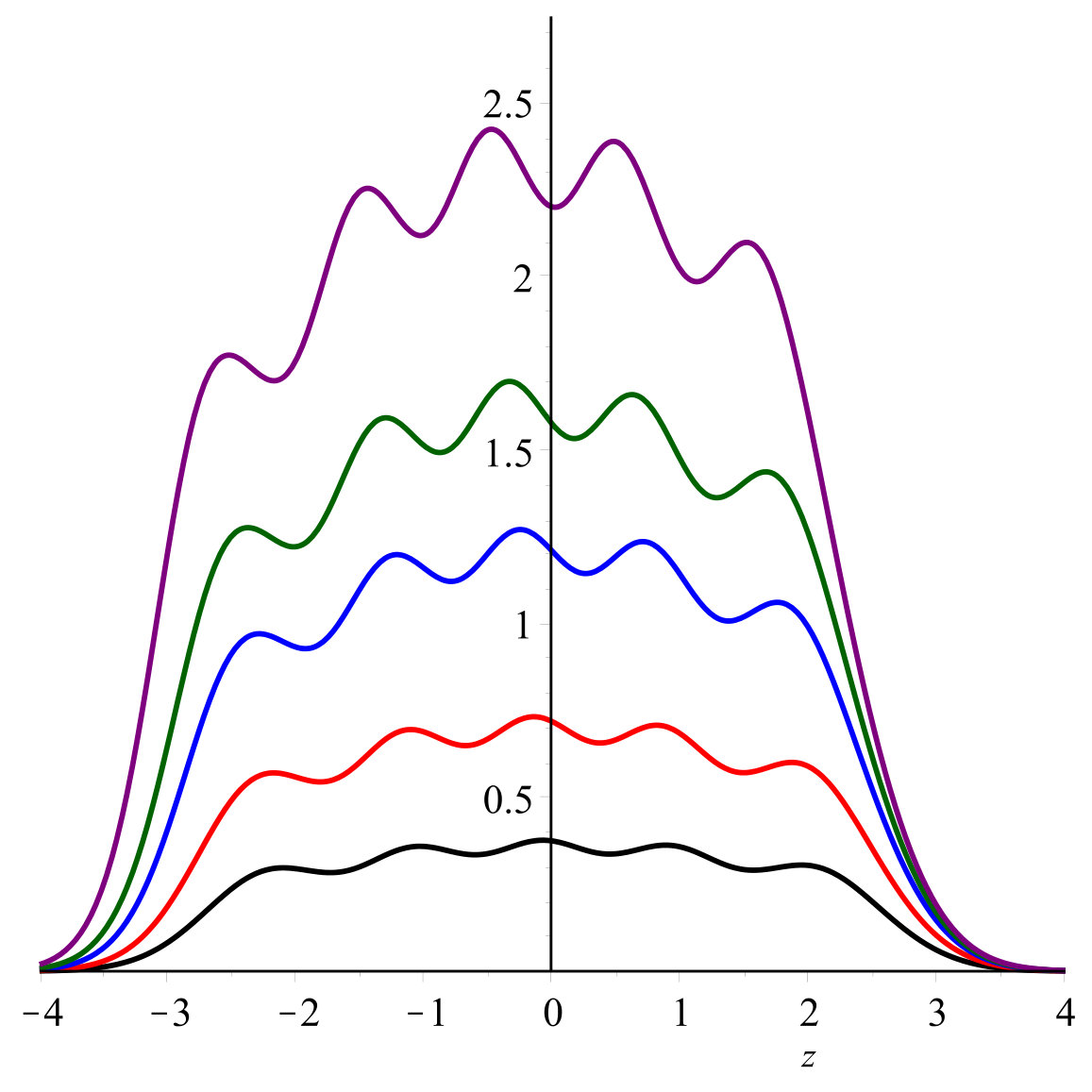 Figure 10
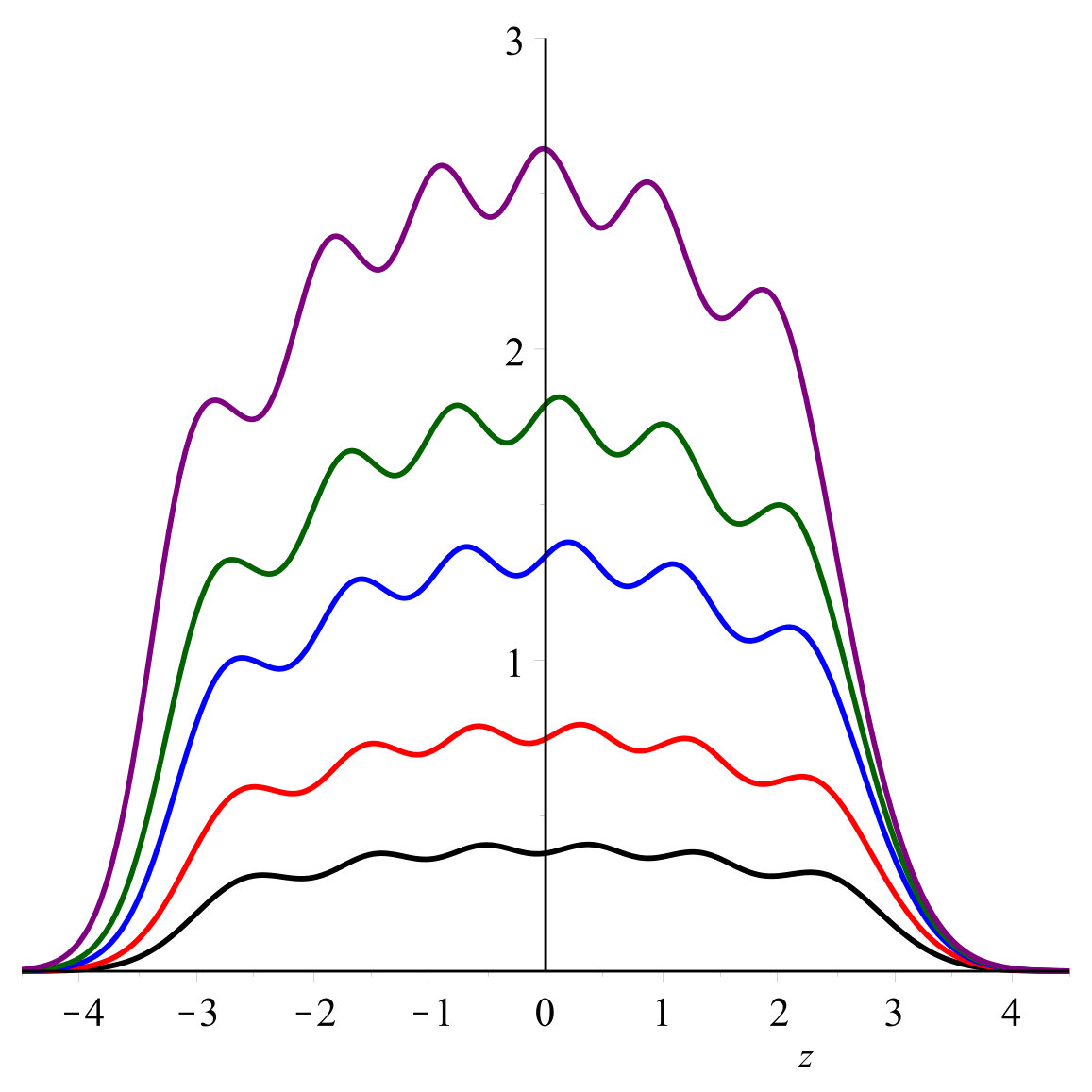 Figure 11
Peer Reviews
No public reviews on file for this paper yet. If you reviewed it on a platform where reviews are public (OpenReview, ICLR, NeurIPS, ICML), you can paste yours below so the community can read it here.
Videos
No videos yet. Explain this paper in a talk, walkthrough, or lecture? Add one.
On Integrable Ermakov-Painlevé IV Systems
Colin Rogers 1 Andrew P. Bassom2 and Peter A. Clarkson 3
1 School of Mathematics & Statistics, The University of New South Wales,
Sydney, NSW2052, Australia
2 School of Mathematics and Physics, University of Tasmania,
Private Bag 37, Hobart, Tasmania 7001, Australia
3 School of Mathematics, Statistics & Actuarial Science,
University of Kent, Canterbury, CT2 7FS, UK
Abstract
Novel hybrid Ermakov-Painlevé IV systems are introduced and an associated Ermakov invariant is used in establishing their integrability. Bäcklund transformations are then employed to generate classes of exact solutions via the linked canonical Painlevé IV equation.
1 Introduction
The six classical Painlevé equations, commonly denoted by –, arise in a wide range of physical applications and have played a fundamental role in modern soliton theory. Detailed accounts of their properties may be found in [18, 19, 24, 42] together with the literature cited therein. In particular, the fourth Painlevé equation () which is connected to the new integrable systems to be introduced here adopts the canonical form
[TABLE]
where and are in general arbitrary parameters, possibly complex. In the present context they are taken as real. This nonlinear integrable equation has been shown to have important applications such as hydrodynamics [7], nonlinear optics [28], quantum gravity theory [30, 31], supersymmetric quantum mechanics [9, 10, 11, 13, 27, 50, 53] random matrices [33, 34, 46, 62, 86], orthogonal polynomials [16, 17, 22, 23, 26], exceptional orthogonal polynomials [35, 36, 37, 51, 52] and vortex dynamics [20]. Associated with (1.1) is the second-degree, second-order -equation, usually known as (or the -equation)
[TABLE]
where and are arbitrary parameters, due to Jimbo and Miwa [45] and Okamoto [58, 59, 60], whose solutions are equivalent to those of (2.4).
Nonlinear coupled systems of Ermakov-Ray-Reid type, on the other hand, namely (see e.g. [63, 64, 72, 75, 85])
[TABLE]
with their distinctive integral of motion
[TABLE]
likewise display a diverse range of physical applications as described in [38, 71, 73, 74, 77, 78, 84].
It is well known that solitonic systems generically admit invariance under Bäcklund transformations which have associated nonlinear superposition principles, namely, permutability theorems (see e.g. [82, 76]). Bäcklund transformations generically admitted by the Painlevé equations such as set down in [41] enable the iterative generation of sequences of exact solutions of associated overarching solitonic equations. Ermakov-Ray-Reid systems likewise possess nonlinear superposition laws, albeit of another kind [63, 64]. Moreover, just as solitonic systems and their associated Painlevé symmetry reductions admit linear representations, so Ermakov-Ray-Reid systems have also been shown to possess underlying linear structure in [3]. Despite these remarkable commonalities, the studies of Painlevé and Ermakov-type systems have preceded independently until recently.
The notions of S-integrable and C-integrable nonlinear equations with their important associated universal aspects is due to Calogero (see e.g. [15] and literature cited therein). The conjugation of such S-integrable equations which are amenable to the inverse scattering transform and nonlinear C-integrable equations which may be reduced to tractable linear canonical forms, typically via Bäcklund, gauge or reciprocal transformations, constitutes a novel topic with origin in work on generalised Ermakov systems as introduced in [85]. Therein, it was established that an S-integrable 2+1-dimensional extension due to Schief [83] of the Ernst equation of general relativity, incorporates a C-integrable generalised Ermakov system. The present work has its genesis in recent developments in [65, 66], where prototype integrable hybrid Ermakov-Painlevé II and Ermakov-Painlevé IV-type systems were derived via wave packet symmetry reductions of two classes of physically important resonant nonlinear Schrödinger systems. The latter involve de Broglie-Bohm quantum potential terms and under certain circumstances they admit novel fission or fusion phenomena [47, 56, 57].
Dirichlet two-point boundary value problems for both the Ermakov-Painlevé II and Ermakov-Painlevé IV equations have been recently investigated in [1, 2]. In [1], the hybrid Ermakov-Painlevé II equation was linked to its integrable Painlevé XXXIV avatar in the context of a three-ion reduction of the classical Nernst-Planck system as derived in [25]. On setting , with , in (1.1), one obtains the hybrid Ermakov-Painlevé IV type equation
[TABLE]
which encapsulates positive solutions of (1.1). It may be derived, in particular, via symmetry reduction of derivative nonlinear Schrödinger equations of a type that arise in plasma physics, cf. [21]. The Ermakov invariant admitted by coupled pairs of nonlinear equations of the type (1.4) has been shown in [1] to allow their integration in terms of (1.1).
In the present paper a novel Ermakov-Ray-Reid type system is introduced and its integrable structure established via a Ermakov invariant relation together with a linked canonical equation.
2 Integrability of the Ermakov-Painlevé IV System
The preceding motivates the introduction here of the hybrid Ermakov-Painlevé IV system
[TABLE]
The integrability of this coupled nonlinear system is investigated when there exists such that
[TABLE]
in which case, it may be shown, as in the manner described in [71] for the standard Ermakov-Ray-Reid system, that it adopts the form
[TABLE]
where the prime denotes a derivative with respect to the argument in . This system admits the Ermakov invariant
[TABLE]
and, on use of the identity
[TABLE]
it follows that
[TABLE]
where . Hence
[TABLE]
where the system (2.1) shows that
[TABLE]
with . Accordingly, (2.3) shows that reduction is obtained to the canonical equation in , namely
[TABLE]
with .
To determine the original Ermakov variables and corresponding to a known positive solution of (2.4), one returns to the Ermakov invariant relation (2.2). Thus, on introduction of according to
[TABLE]
it is observed that
[TABLE]
whence (2.2) yields
[TABLE]
Hence, in terms of the new independent variable where
[TABLE]
invariant relation (2.6) shows that
[TABLE]
where (2.5) gives in terms of according to
[TABLE]
Thus,
[TABLE]
where and is an arbitrary constant of integration. Corresponding to positive solutions of (2.4) and as determined by (2.8) for specified , the original variables in the Ermakov-Painlevé IV system are given via the relations
[TABLE]
The class of Ermakov-Painlevé IV systems will be considered here which corresponds to as determined by the quadrature in (2.8) with
[TABLE]
In this case, (2.8) yields
[TABLE]
where is obtained by integration of the relation (2.7) for a positive solution of . Here, (2.10) shows that
[TABLE]
3 Action of Bäcklund-Type transformations
The diversity of Bäcklund and Schlesinger-type transformations admitted by (2.4) has been described in the comprehensive work of [6]. Thus, transformations due to Gromak [39, 40] Fokas, Mugan and Ablowitz [32], Lukashevich [48, 49] and Murata [55] are all detailed therein along with their conjugation and interconnections. In the present context, the concern is to exploit certain such transformations to generate sequences of exact solutions to the Ermakov-Painlevé IV system via the action on appropriate seed solutions. In [6], a multiplicity of combinations of the parameters and has been catalogued which correspond to exact solutions of (2.4) . These may involve error functions, parabolic cylinder functions or rational functions. The generation of solutions of the Ermakov-Painlevé systems corresponding to the three parameter class of as given by (2.12) is illustrated below for elementary rational seeds.
In the above connection, it is seen that (2.4) admits a seed solution
[TABLE]
where, in the present context the requirement that restricts attention to regions with . With this seed solution, (2.7) shows that, up to an additive constant,
[TABLE]
so that the Ermakov-Painlevé IV system with given by (2.12) admits the class of solutions with
[TABLE]
and appropriate choices of sign made to ensure positivity requirements.
It is interesting to observe that for both the seed solutions of (2.4)
[TABLE]
the Ermakov-Painlevé IV system (2.1) reduces to a conventional Ermakov-Ray-Reid system
[TABLE]
Theorem 3.1**.**
Let and , be solutions of (1.1) with
[TABLE]
Then
[TABLE]
valid when the denominators are non-zero, and where the upper signs or the lower signs are taken throughout each transformation.
Proof.
See Gromak [39, 40] and Lukashevich [48, 49]; also [6, 29, 42, 43, 55]. ∎
A class of Bäcklund transformations for the Painlevé equations is generated by so-called Schlesinger transformations of the associated isomonodromy problems. Fokas, Mugan and Ablowitz [32] (see also [54]), deduced the following Schlesinger transformations – for
[TABLE]
where and
[TABLE]
Fokas, Mugan and Ablowitz [32] also defined the composite transformations and given by
[TABLE]
We remark that and are the transformations and , respectively, given by Murata [55].
The application of and to the seed solution given by (3.1) generates, in turn, new positive solutions
[TABLE]
Insertion of and in (2.9) where is determined by (2.11) with delivers associated solutions of the Ermakov-Painlevé IV system (2.1) with given by (2.12).
The repeated action of the Bäcklund transformations and other Bäcklund transformations such as the quartet as constructed in [32] by the isomonodromy deformation method may be applied systematically to generate a multiplicity of exact solutions (2.9) of the Ermakov-Painlevé IV systems (2.1) which are here subject to the requirement . Thus, in particular, the repeated application of the Bäcklund transformation (3.3c) to as defined by (3.6) generates the following additional solutions of
[TABLE]
These results constitute part of the catalogue of rational solutions of PIV set down in Table 3 of [6] and some related forms have been noted in the context of supersymmetric quantum mechanics, see [50]. Thus, the class of Ermakov-Painlevé IV systems with given by (2.12) admits exact solutions , determined by the relations (2.9), where
[TABLE]
for , so that from (2.11)
[TABLE]
Lemma 3.2**.**
For the rational solutions
[TABLE]
where , with the Hermite polynomial.
Proof.
The rational solutions have the form [6]
[TABLE]
where , with the Hermite polynomial. Since satisfies the equation
[TABLE]
which follows from the differential equation satisfied by Hermite polynomials (cf. [61, §18.9]), then
[TABLE]
and so the result follows.∎
Remark 3.3**.**
The rational solutions given by (3.7) satisfy the Riccati equation
[TABLE]
4 Bound State Solutions
The preceding describes how seed solutions of (2.4) can be used to generate associated classes of exact solutions of associated hybrid Ermakov-Painlevé IV systems. The procedure is constrained, in general, by the requirement that attention be restricted to regions on which is positive. In this connection, it is remarked that the application of exact solutions of Painlevé equations to physical problems commonly requires consideration of restricted regions such as those associated with a positivity requirement. Thus, in [4] in the application of a Painlevé II model to boundary value problems in two-ion electro-diffusion, the ion concentrations, which are necessarily positive, are governed by the classical Painlevé XXXIV equation which is directly related to the single component Ermakov-Painlevé II equation [65]. In [4], regions were isolated wherein such positivity holds on half-space regions and boundary value problems were solved thereon. In related work similarity solutions of Painlevé II in terms of Yablonskii-Vorob’ev polynomials or classical Airy functions as generated by the iterated action of a Bäcklund transformation have been used recently to solve a range of moving problems for solitonic equations on regions [67, 68, 69].
Bassom et al. [8] showed that if is an odd integer and then exact solutions of (2.4) exist with the property that exponentially as . In particular, it may be verified that
[TABLE]
is a solution of (2.4) corresponding to parameters and . Here is a constant and denotes the usual complementary error function: it is evident that for , the solution (4.1) of (2.4) is positive for all real . It is now a routine matter to generate the associated class of exact solutions of the hybrid Ermakov-Painlevé IV systems. More generally, if we denote the bound state solution of (2.4) with and as , then it can be proved that the Bäcklund transformation
[TABLE]
which is a special case of (3.5a), can be applied iteratively to generate an infinite sequence of bound state solutions of (2.4) commencing with the seed solution . If we denote so that
[TABLE]
then it may be shown that the next two of members of the bound state hierarchy of (2.4) are given by
[TABLE]
with given by (4.3). Each bound state solution decays exponentially as and has distinct zeros and satisfies
[TABLE]
which is (2.4) with parameters and . These bound state solutions have regions separated by the zeros on which they are positive. Thus, it is not only the fundamental bound state solution of (2.4) that is non-negative on the whole -axis, but this property is shared by the higher members of the hierarchy. These bound-state solutions are distinguished in that they decay exponentially and while many solutions of Painlevé IV are bounded (see e.g. [9]), those such as the rational solutions do not decay as rapidly. Plots of , for various are given in Figure 4.1.
Lemma 4.1**.**
For bound state solutions of
[TABLE]
Proof.
By definition
[TABLE]
since satisfies (4.5). Further from the Bäcklund transformation (4.2) we have
[TABLE]
and so the result follows. ∎
Corollary 4.2**.**
For bound state solutions of
[TABLE]
Proof.
The result immediately follows from Lemma 4.1. ∎
Lemma 4.3**.**
For the bound state solution
[TABLE]
Proof.
From (4.1) we have
[TABLE]
since
[TABLE]
see [61, equation (7.6.2)]. Hence the result follows. ∎
Remark 4.4**.**
We remark that
[TABLE]
see [61, equation (7.7.1)], and
[TABLE]
with the Kummer function, see [61, equation (7.11.5)]. Also satisfies the equation
[TABLE]
From (4.4) and (4.6) we obtain
[TABLE]
where is defined by (4.3).
The bound state solutions of can be given in terms of Hankel determinants as described in the following theorem.
Theorem 4.5**.**
Define to be the Hankel determinant
[TABLE]
with a parameter and where is given by
[TABLE]
*with the Hermite polynomial and the complementary error function. Then *
[TABLE]
*satisfies (4.5). *
Proof.
See Forrester and Witte [34]. ∎
Remark 4.6**.**
Let be the Hankel determinant given by (4.7), then
[TABLE]
satisfies
[TABLE]
which is (1.2) with parameters and . The solutions , given by (4.9), and , given by (4.10), are related as follows
[TABLE]
Plots of , for various are given in Figure 4.2. Further given by (4.7) satisfies
[TABLE]
which is equivalent to the Toda equation.
Lemma 4.7**.**
The solutions , given by (4.9), and , given by (4.10), are positive and bounded provided that .
Remark 4.8**.**
Since the Hermite polynomial has the integral representation
[TABLE]
and the complementary error function has the integral representation
[TABLE]
then it can easily be shown that given by (4.8) has the integral representation
[TABLE]
with the Heaviside function.
These bound state solutions arise in the theory of:
- (i)
orthogonal polynomials with the discontinuous Hermite weight
[TABLE]
with the Heaviside function and a parameter, see [17]; and
- (ii)
GUE random matrices which are expressed as Hankel determinants of the function given by (4.11), see [34].
Remark 4.9**.**
The bound state solutions discussed here are members of a general family of solutions of (1.1) with and the boundary condition
[TABLE]
which have been studied by various authors [5, 8, 44, 87]
5 Conclusion
Here, integrable systems of a novel hybrid Ermakov-Painlevé IV kind have been introduced which both admit a Ermakov invariant and are connected to (2.4). In terms of applications, it is noted that particular such nonlinear coupled systems arise out of symmetry reduction of coupled derivative nonlinear Schrödinger systems [66]. Hybrid integrable Ermakov-Painlevé II systems with genesis in the context of three-ion electrodiffusion and the Nernst-Planck system have been recently developed in [79, 80]. This suggests that a comprehensive investigation be undertaken into integrable Ermakov-Painlevé systems which both possess characteristic Ermakov invariants and allow the construction of classes of exact solutions via Bäcklund transformations admitted by the canonical - equations. In most recent work [70], an integrable Ermakov-Painlevé III system has been constructed in a manner directly analogous to that used to obtain integrable hybrid Ermakov-Painlevé II and Ermakov-Painlevé IV systems. Importantly, these Ermakov-Painlevé systems may be now embedded in multi-component Ermakov-Painlevé and Ermakov-Toda lattice schemes as introduced in [81]. This method of construction of the hybrid Ermakov-Painlevé systems has potential specific application yet to be undertaken for residual Ermakov-Painlevé V and Ermakov-Painlevé VI systems.
Acknowlegement
We thank the reviewers for their helpful comments.
The reference list from the paper itself. Each links out to its DOI / PubMed record.
- 1[1] P. Amster and C. Rogers, On a Ermakov-Painlevé II reduction in three-ion electrodiffusion. A Dirichlet boundary value problem, Discrete Contin. Dyn. Syst. , 35 (2015) 3277–3292.
- 2[2] P. Amster and C. Rogers, On Dirichlet two-point boundary value problems for the Ermakov-Painlevé IV equation, J. Appl. Math. Comput. , 48 (2015) 71–81.
- 3[3] C. Athorne, C. Rogers, U. Ramgulam and A. Osbaldestin, On linearisation of the Ermakov system, Phys. Lett. A , 143 (1990) 207–212.
- 4[4] L. Bass, J.J. Nimmo, C. Rogers and W.K. Schief, Electrical structures of interfaces : a Painlevé II model, Proc. Roy. Soc. London A , 466 (2010) 2117–2136.
- 5[5] A.P. Bassom, P.A. Clarkson and A.C. Hicks, Numerical studies of the fourth Painlevé equation, IMA J. Appl. Math. , 50 (1993) 167–193.
- 6[6] A.P. Bassom, P.A. Clarkson and A.C. Hicks, Bäcklund transformations and solution hierarchies for the fourth Painlevé equation, Stud. Appl. Math. , 95 (1995) 1–71.
- 7[7] A.P. Bassom, P.A. Clarkson and A.C. Hicks, On the application of solutions of the fourth Painlevé equation to various physically motivated nonlinear partial differential equations, Adv. Differential Equations , 1 (1996) 175–198.
- 8[8] A.P. Bassom, P.A. Clarkson, A.C. Hicks and J.B. Mc Leod, Integral equations and exact solutions for the fourth Painlevé equation, Proc. Roy. Soc. London A , 437 (1992) 1–24.