Measurement of the W boson helicity using top pair events at $\sqrt{s}$ = 8 TeV with the CMS detector
Mohsen Naseri

TL;DR
This paper reports on the measurement of W boson helicity in top quark pair events at 8 TeV using CMS data, comparing results with Standard Model predictions to test the theory's accuracy.
Contribution
It provides the first detailed helicity measurement of W bosons from top pairs at 8 TeV with CMS, testing Standard Model predictions.
Findings
Results are consistent with Standard Model expectations.
Helicity fractions measured with high precision.
Supports the Standard Model's description of top quark decays.
Abstract
This document gives an overview over the recent results on helicity measurement of W boson originated from top pair events. The results are obtained using data collected by the CMS detector at a center-of-mass energy of 8 TeV. The helicity measurements are confronted with the most precise theoretical predictions of the standard model.
Click any figure to enlarge with its caption.
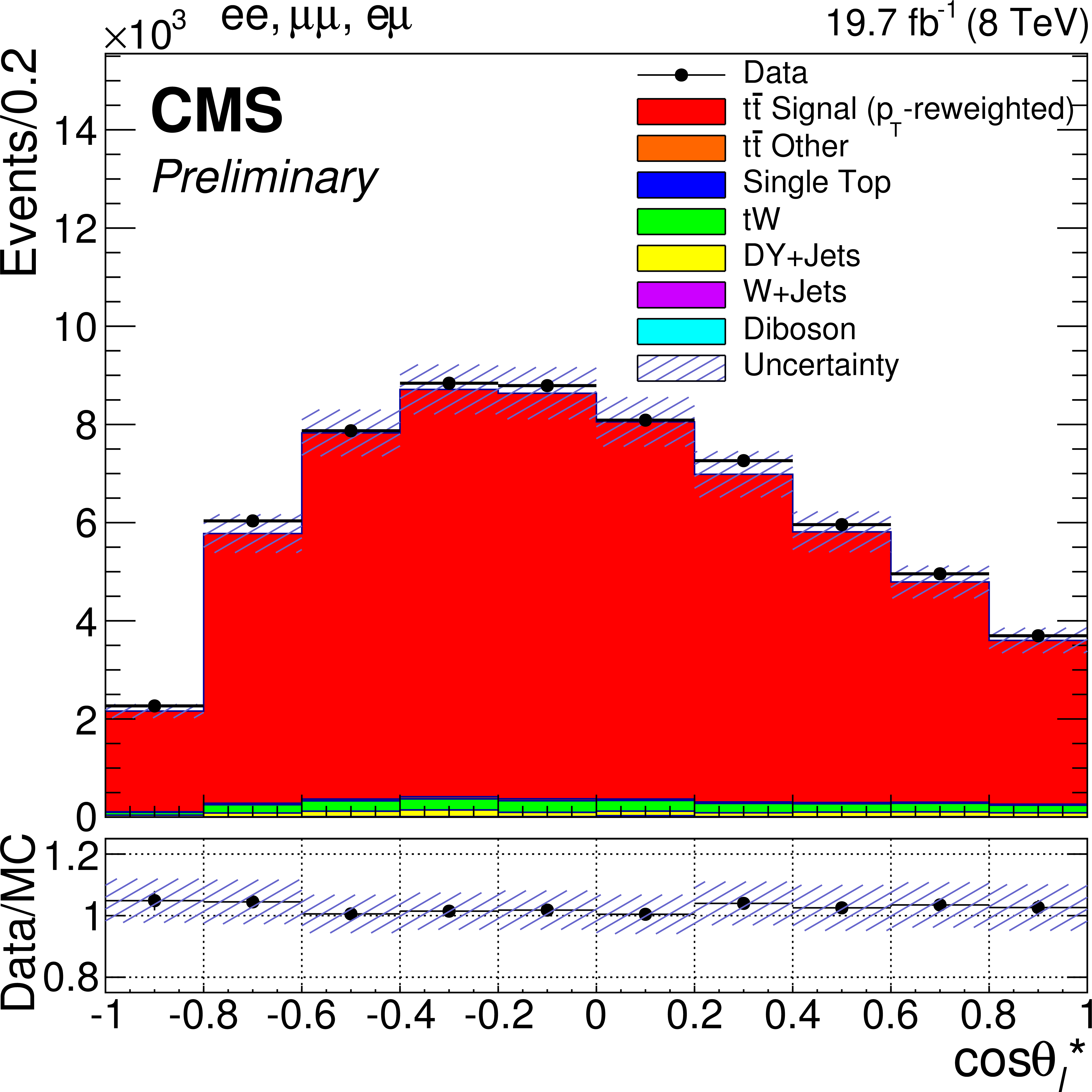 Figure 2
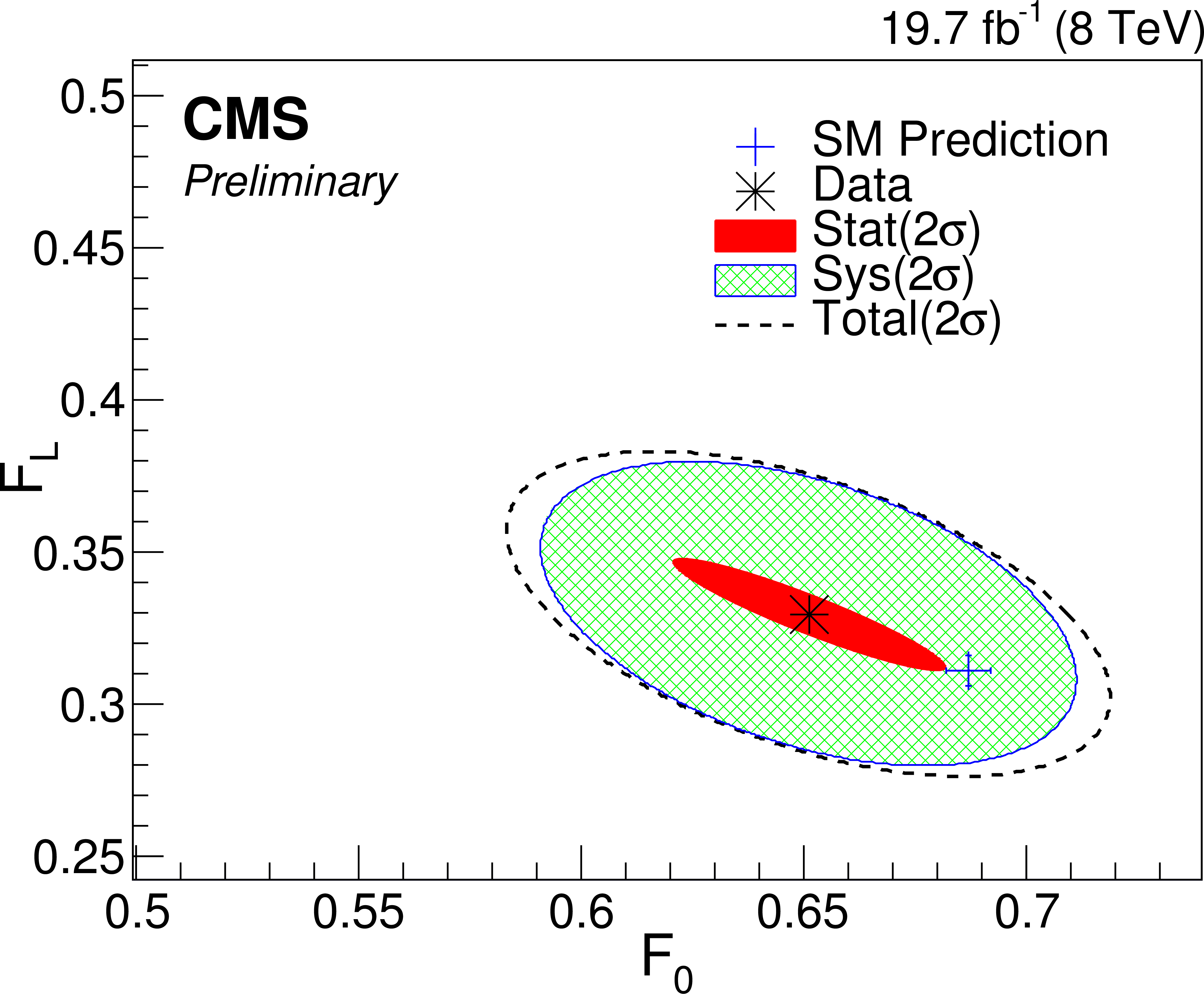 Figure 3
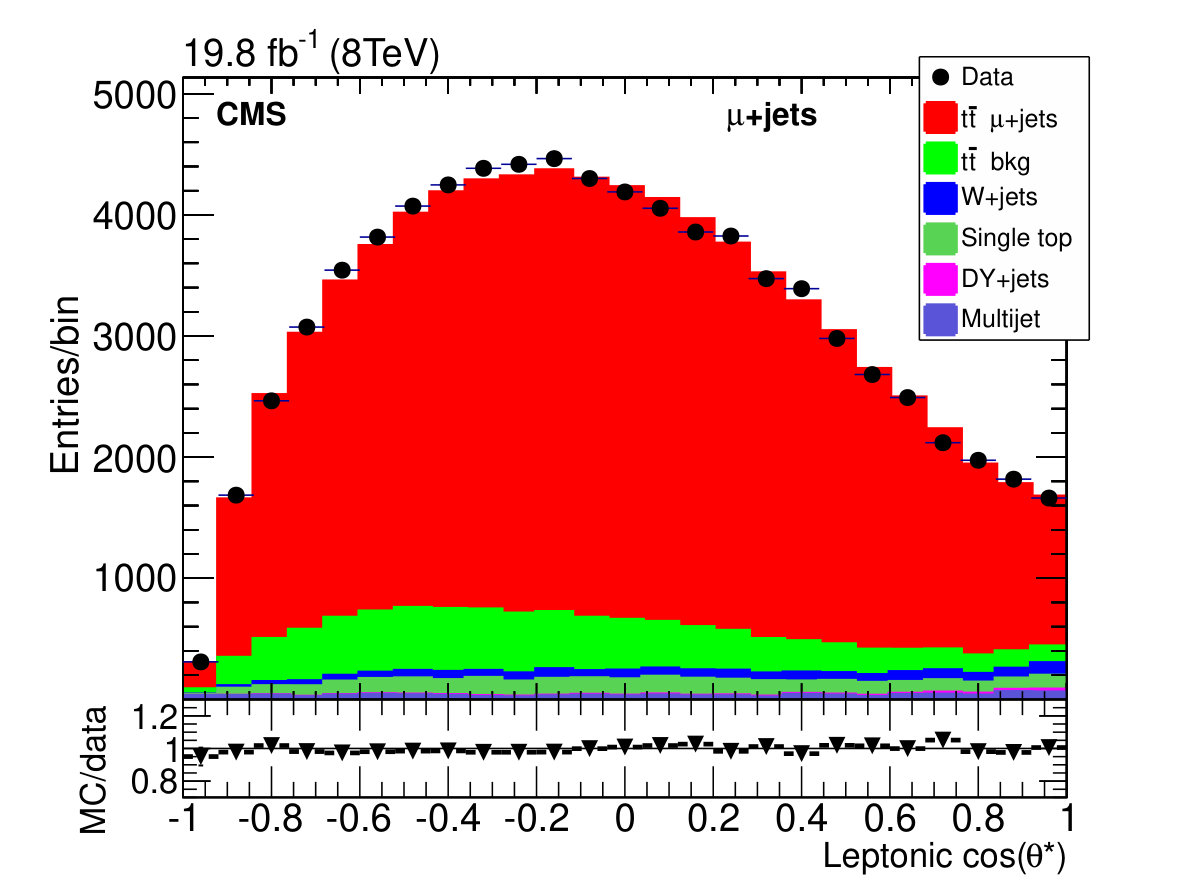 Figure 2
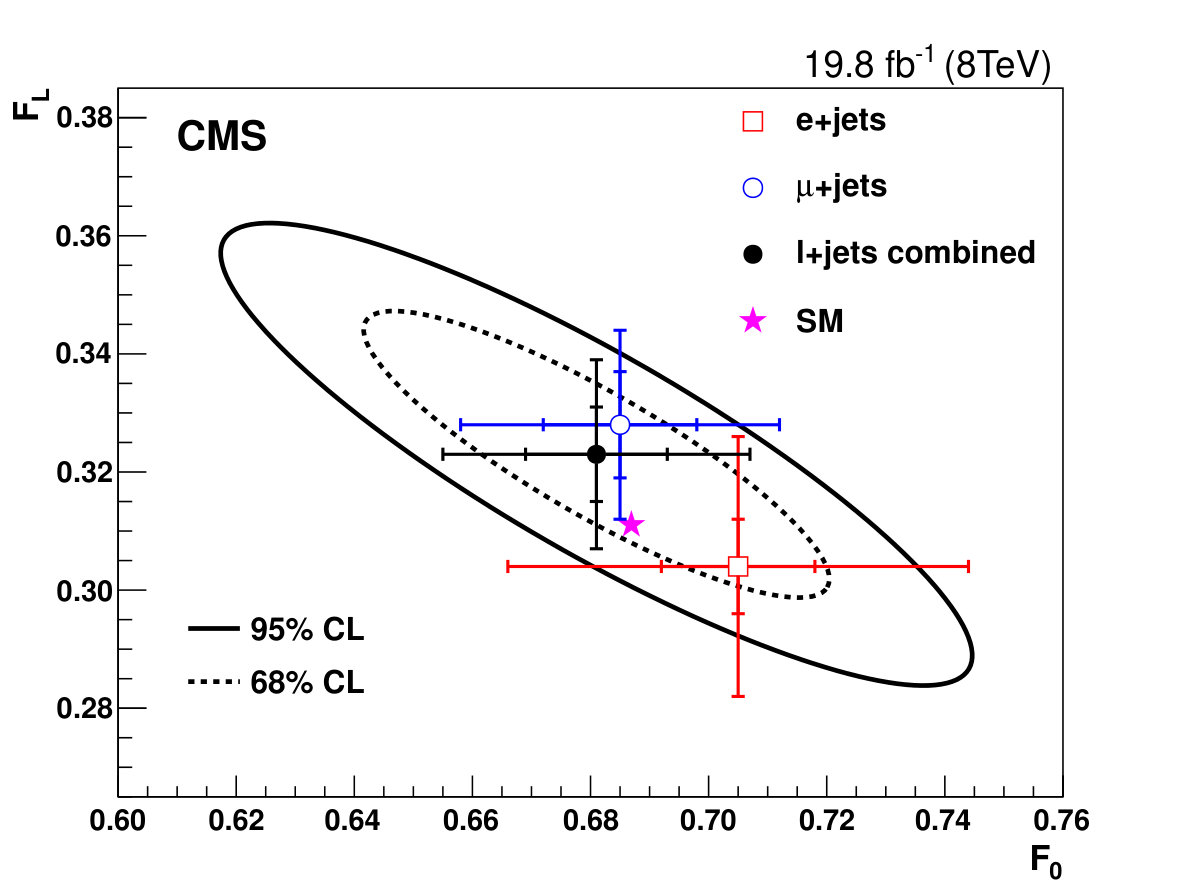 Figure 3
Peer Reviews
No public reviews on file for this paper yet. If you reviewed it on a platform where reviews are public (OpenReview, ICLR, NeurIPS, ICML), you can paste yours below so the community can read it here.
Videos
No videos yet. Explain this paper in a talk, walkthrough, or lecture? Add one.
Taxonomy
TopicsParticle physics theoretical and experimental studies · High-Energy Particle Collisions Research · Dark Matter and Cosmic Phenomena
SNSN-323-63
Measurement of the W boson helicity using top pair events at = 8 TeV with the CMS detector
Mohsen Naseri
on behalf of the CMS Collaboration
*School of Particles and Accelerators, Institute for Research in Fundamental
Sciences(IPM),
P. O. Box 19 56 83 66 81, Tehran, Iran *
This document gives an overview over the recent results on helicity measurement of W boson originated from top pair events. The results are obtained using data collected by the CMS detector at a center-of-mass energy of 8 TeV. The helicity measurements are confronted with the most precise theoretical predictions of the standard model.
PRESENTED AT
International Workshop on Top Quark Physics
Olomouc, Czech Republic, September 19–23, 2016
1 Introduction
Top quarks decay almost exclusively into a b quark and a W boson via the electroweak interaction. In particular, the measurement of the W boson polarization in the top quark decays allows to probe the tWb structure and to search for possible extensions of the standard model (SM).
In general, W bosons in the top quark decays can be produced in three states of left-handed, right-handed, and longitudinal helicity. Since the W boson couples to a b quark of left-handed chirality which translates into left-handed helicity in the massless limit of the b quark, right-handed W bosons are not expected to be produced in the top quark decays. Defining as the partial width of the top quark decaying into left-handed, right-handed, and longitudinal W boson helicities, the helicity fractions are given by .
The W boson polarization affects several kinematic variables in which can be used to measure the helicity components. Among all relevant kinematic observables which are sensitive to the W boson helicity fractions, the widely used one is the angular distributions of the top quark decay products. All following measurements employs this observable to extract the helicity fractions.
2 Measurement of the W boson helicity using events in the dilepton final state at = 8 TeV
The first analysis presented uses events with two leptons, electrons and/or muons, in the final state [2]. The analysed data sample corresponds to an integrated luminosity of 19.7 fb*-1* at a center of mass energy of 8 TeV, collected by the CMS detector [1]. Events are required to contain two charged leptons with opposite sign, missing transverse energy, and two b tagged jets. Background originating from Drell-Yan (DY) events is suppressed by requiring large missing energy in the and channels. In addition, dimuon or dielectron events in the region around the Z boson mass peak are also rejected. The contribution of DY+jets events in dimuon and dielectron is estimated from a Z boson mass window control region, and is used to normalize the simulation in the signal region. A analytical Matrix Weighting Technique (AMWT) [3] is used to reconstruct best top pair candidates. The cos() distribution, which is used to perform the measurement, is presented in Figure 1.
In order to extract the W boson helicity fractions, a reweighting technique as explained in [4] is used. In this method, the reweighted signal distribution of cos() in simulation is fitted to the observed distribution. The W boson helicity fractions, obtained from a fit to the reconstructed distributions of cos(), are FL = 0.329 0.029, F0 = 0.653 0.026, and FR = 0.018 0.027.
3 Measurement of the W boson helicity using events in the semi-leptonic final state at = 8 TeV
The CMS collaboration also reports the study of the W-boson helicity fractions in top-quark decays using a sample of events where one of the top quarks decays semileptonically and the other decays hadronically [5]. The analysis is done using the collected data in 2012 with the CMS detector at the LHC, corresponding to an integrated luminosity of 19.8 fb*-1*. The event selection requires either one muon or one electron, along with four jets in the final state in which two of them must be identified as originating from b quarks. Events with an additional soft muon or and additional soft electron are vetoed in order to reject backgrounds from dileptonic and Drell–Yan events. To reduce the QCD multijet background, the transverse mass of the leptonically decaying W boson, is required to be greater than 30 GeV/c.
A kinematic fit is used to determine the best combination of b jets, other jets, and lepton candidates to the top quark and antiquark decay hypotheses. The reconstructed helicity angle distributions are then fitted to measure the W-boson helicity fractions and to derive possible anomalous tWb couplings.
Figure 2(a) shows the distribution for the cos() of the helicity angle from the leptonic +jets branch. The measured W boson helicity fractions are found to be F0 = 0.681 0.012 (stat.) 0.023 (syst.), FL = 0.323 0.008 (stat.) 0.014 (syst.), and FR = - 0.004 0.005 (stat.) 0.014 (syst.), which are consistent with the SM expectations. Figure 2(b) shows the measured W boson helicity fractions in the (F0, FL) plane with the allowed two-dimensional 68 and 95 CL regions.
The reference list from the paper itself. Each links out to its DOI / PubMed record.
- 1[1] S. Chatrchyan et al. [CMS Collaboration], JINST 3 , S 08004 (2008). doi:10.1088/1748-0221/3/08/S 08004
- 2[2] M. Khakzad et al. [CMS Collaboration], CERN CMS-PAS-TOP-14-017 , (2015) [http://cds.cern.ch/record/2035390].
- 3[3] B. Abbott et al. [D 0 Collaboration], Phys. Rev. Lett. 80 , 2063 (1998) doi:10.1103/Phys Rev Lett.80.2063 [hep-ex/9706014].
- 4[4] S. Chatrchyan et al. [CMS Collaboration], JHEP 1310 , 167 (2013) doi:10.1007/JHEP 10(2013)167 [ar Xiv:1308.3879 [hep-ex]].
- 5[5] V. Khachatryan et al. [CMS Collaboration], Phys. Lett. B 762 , 512 (2016) doi:10.1016/j.physletb.2016.10.007 [ar Xiv:1605.09047 [hep-ex]].