Distributed Beamforming with Wirelessly Powered Relay Nodes
Muhammad Ozair Iqbal, Ammar Mahmood, Muhammad Mahboob Ur Rahman,, Qammer H. Abbasi

TL;DR
This paper analyzes distributed beamforming with relay nodes that harvest energy wirelessly, deriving approximate SNR expressions for different energy harvesting policies and comparing their performance.
Contribution
It provides analytical expressions for mean SNR in energy-harvesting relay systems under different policies, highlighting the impact of parameters and synchronization errors.
Findings
Approximate SNR expressions are accurate for small relay numbers.
Time-switching policy outperforms power-splitting by at least 3 dB.
Simulation confirms the effectiveness of the analytical models.
Abstract
This paper studies a system where a set of relay nodes harvest energy from the signal received from a source to later utilize it when forwarding the source's data to a destination node via distributed beamforming. To this end, we derive (approximate) analytical expressions for the mean SNR at destination node when relays employ: i) time-switching based energy harvesting policy, ii) power-splitting based energy harvesting policy. The obtained results facilitate the study of the interplay between the energy harvesting parameters and the synchronization error, and their combined impact on mean SNR. Simulation results indicate that i) the derived approximate expressions are very accurate even for small (e.g., ), ii) time-switching policy by the relays outperforms power-splitting policy by at least dB.
Click any figure to enlarge with its caption.
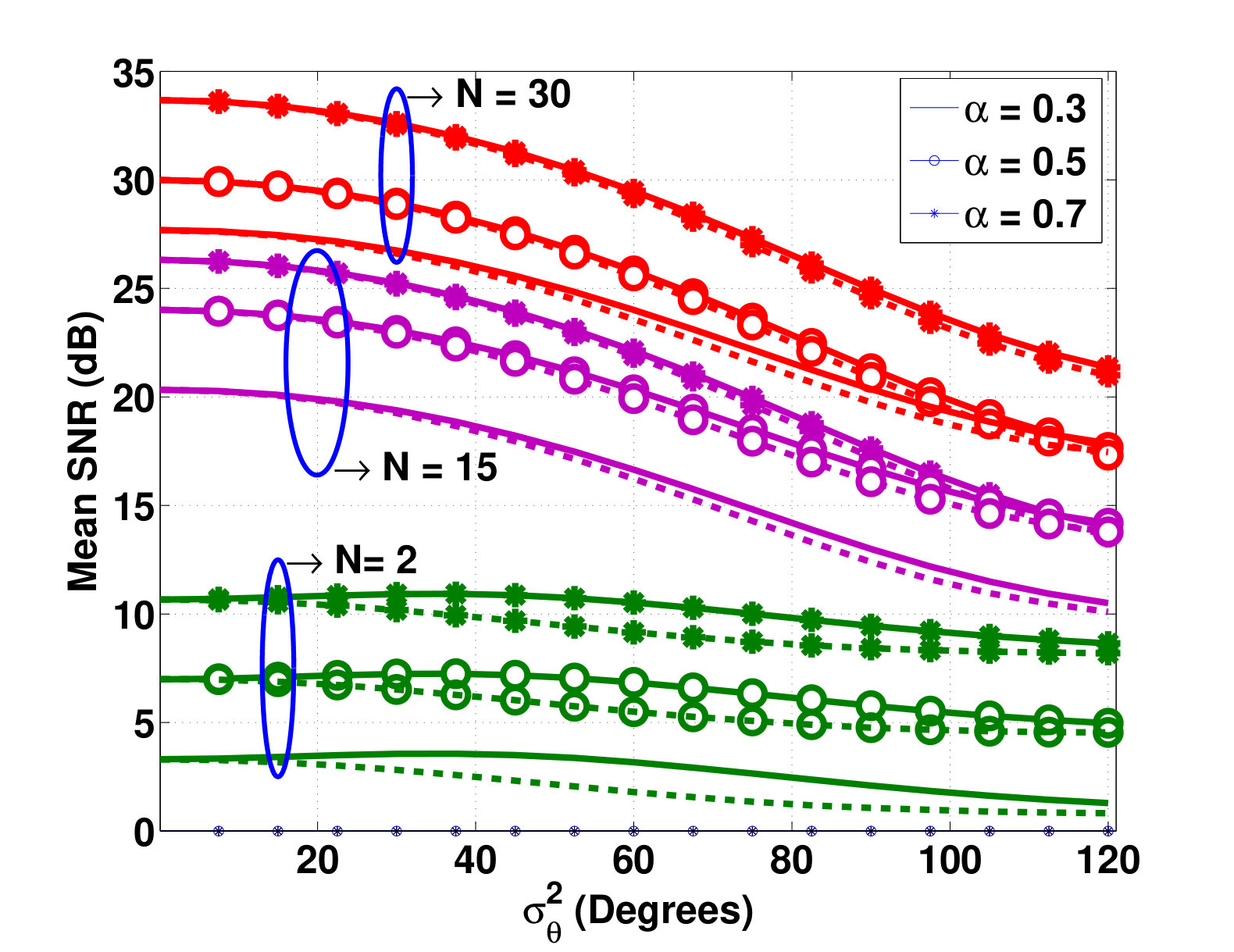 Figure 1
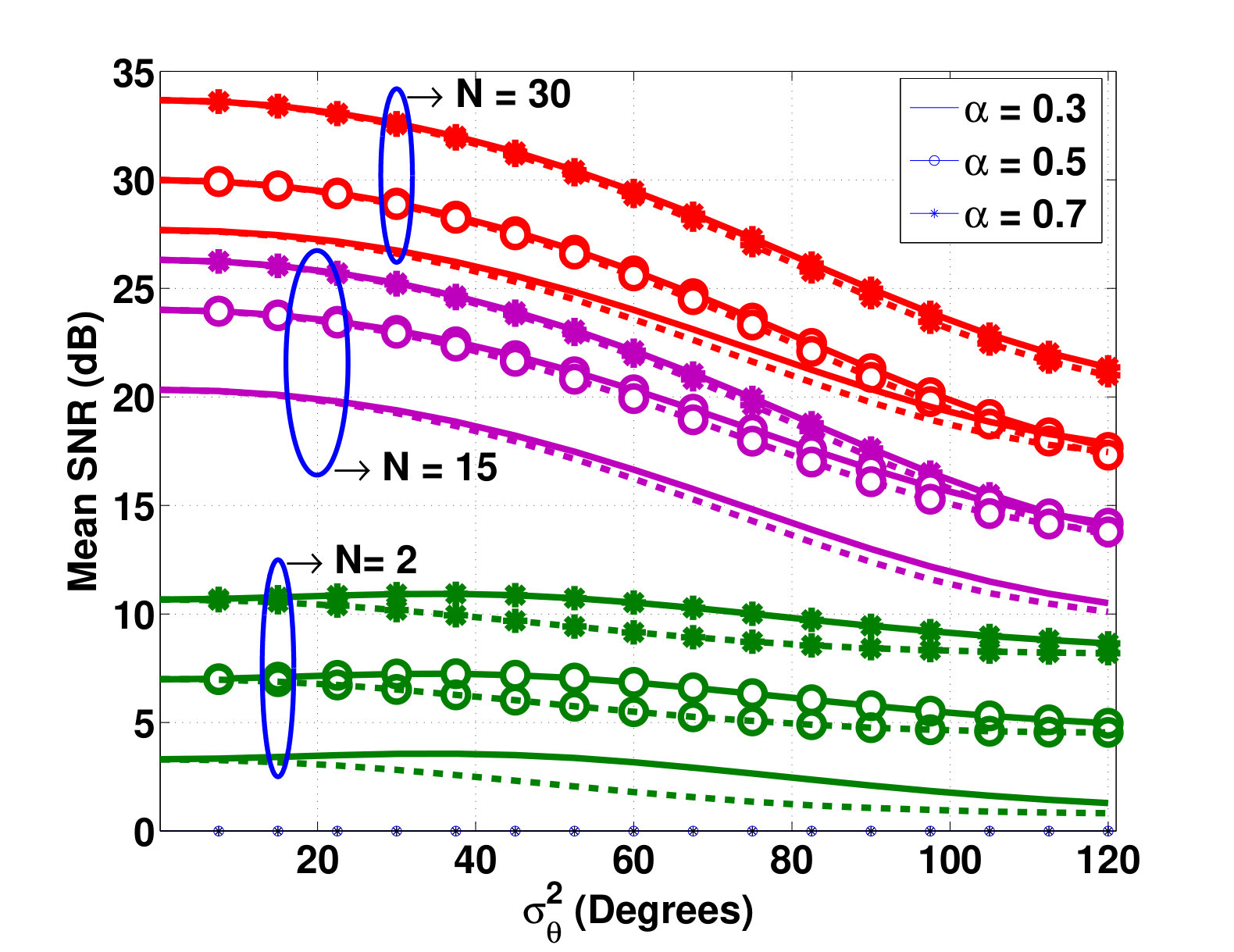 Figure 2
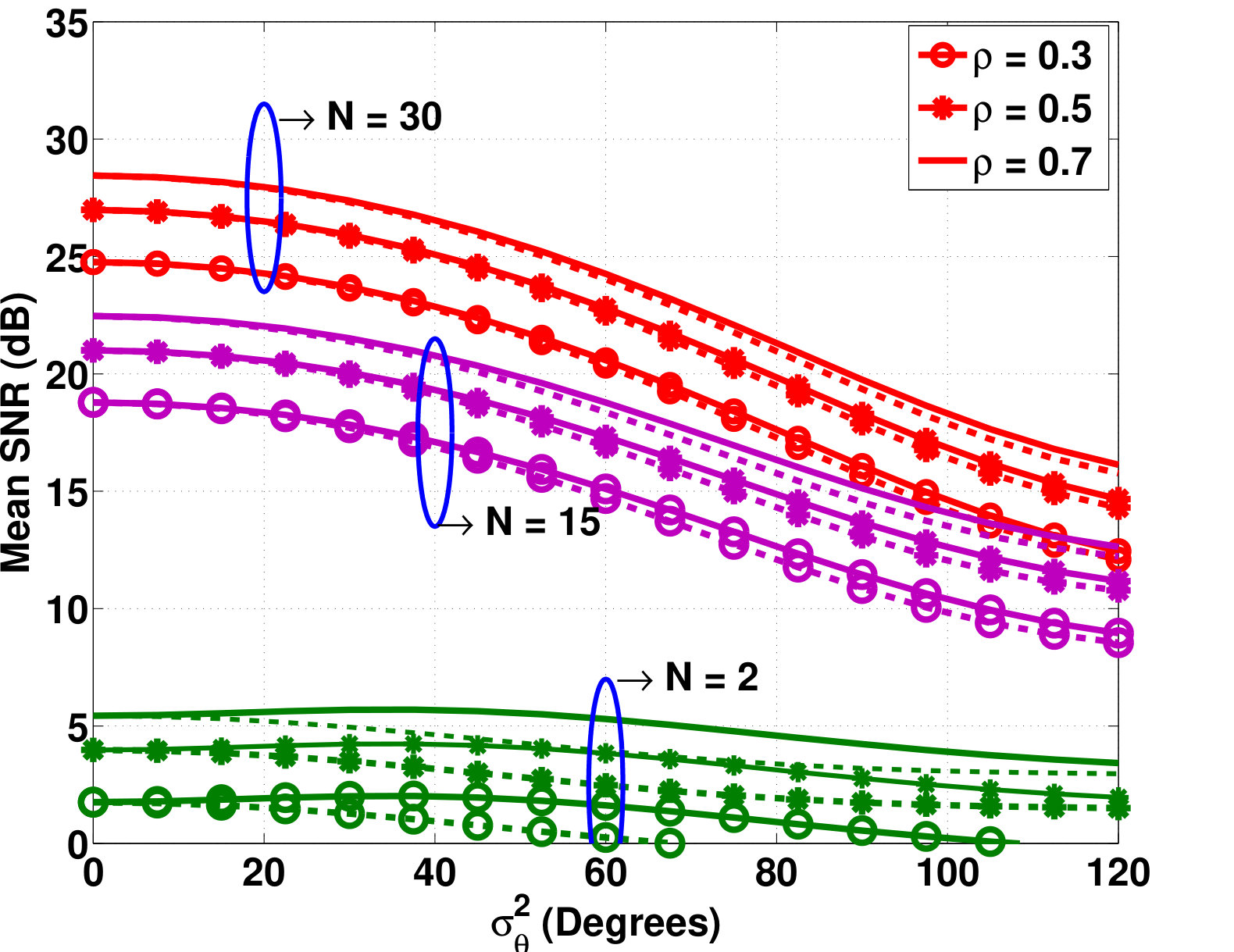 Figure 3
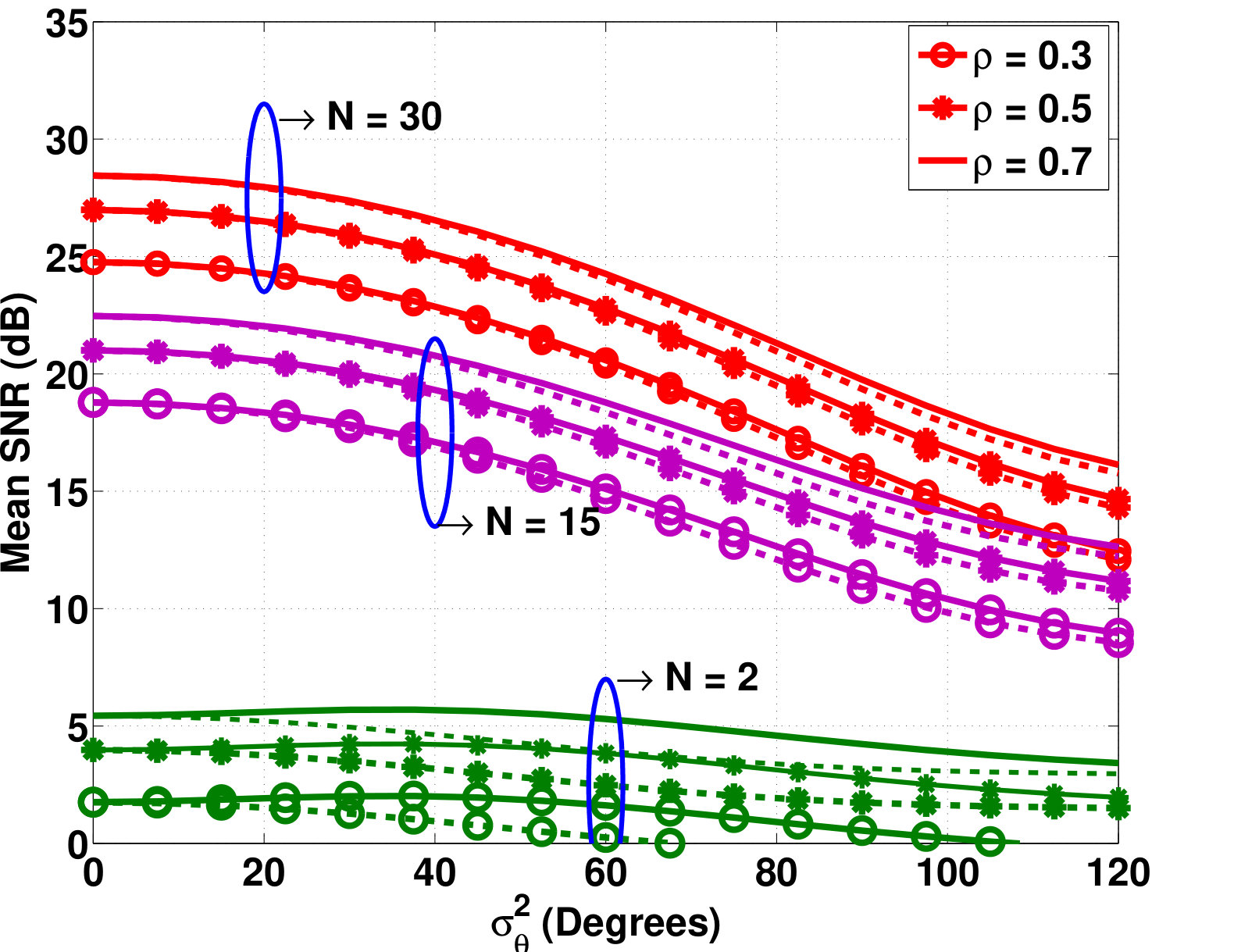 Figure 4
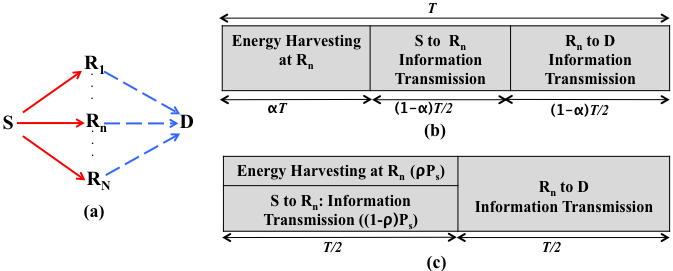 Figure 5
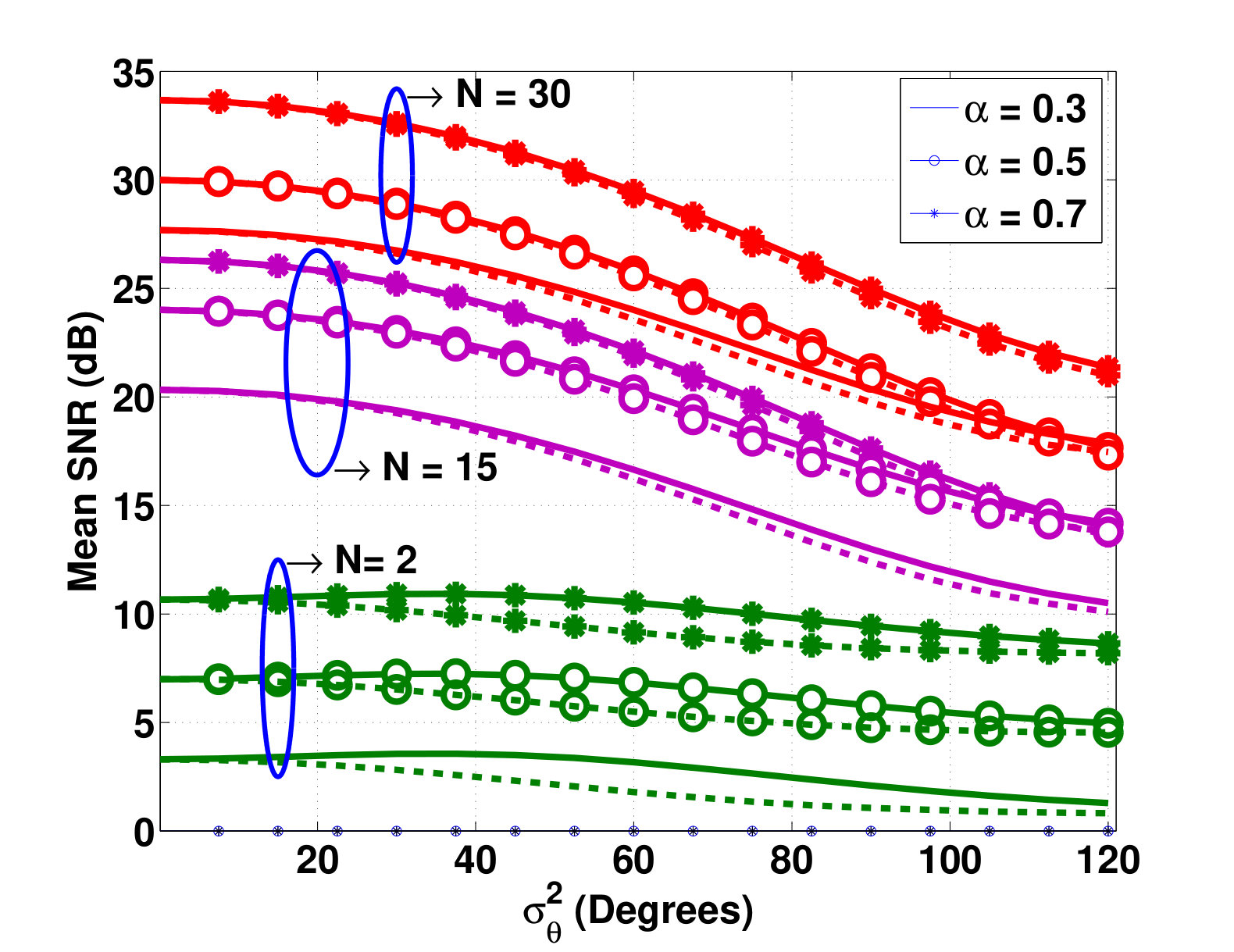 Figure 6
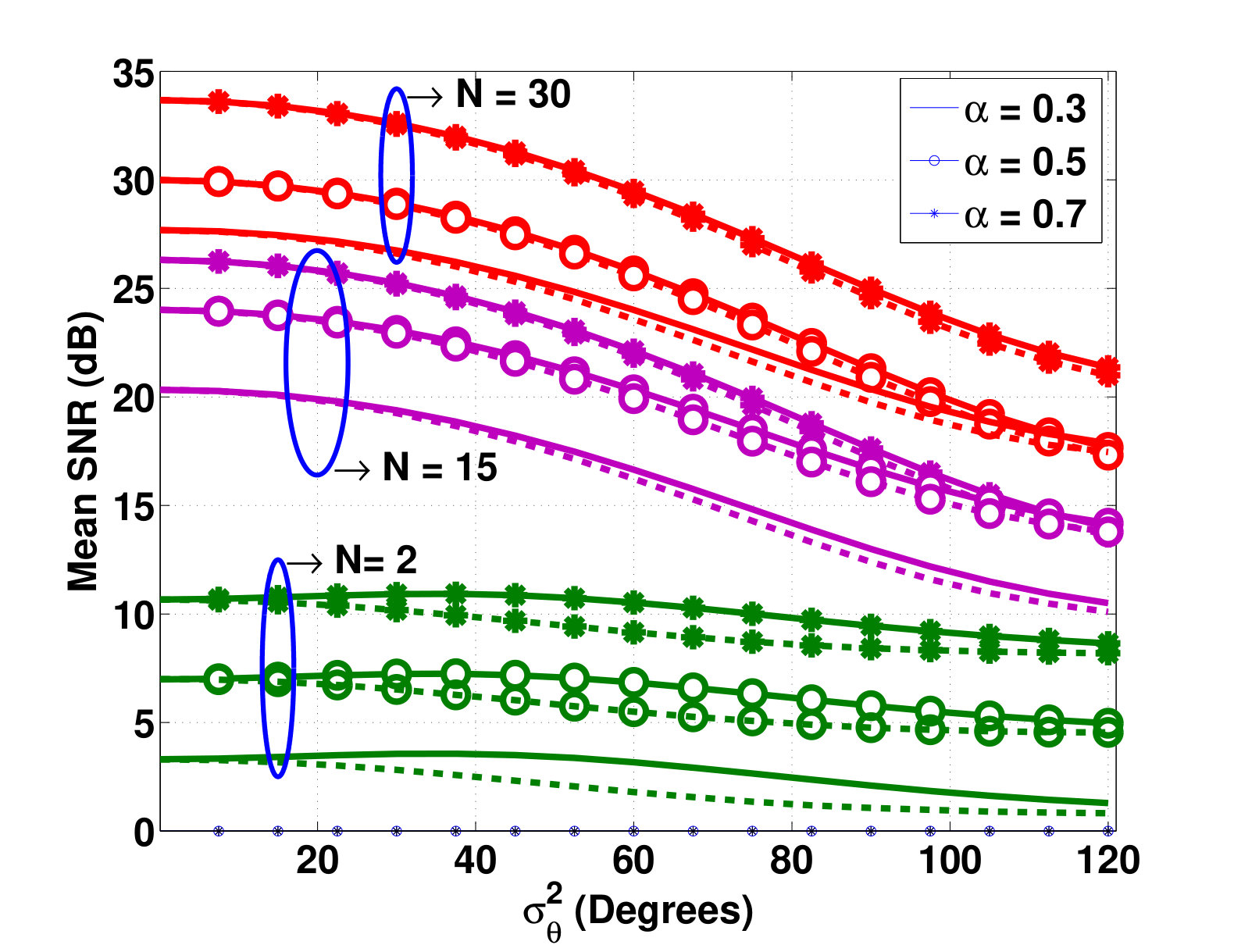 Figure 7
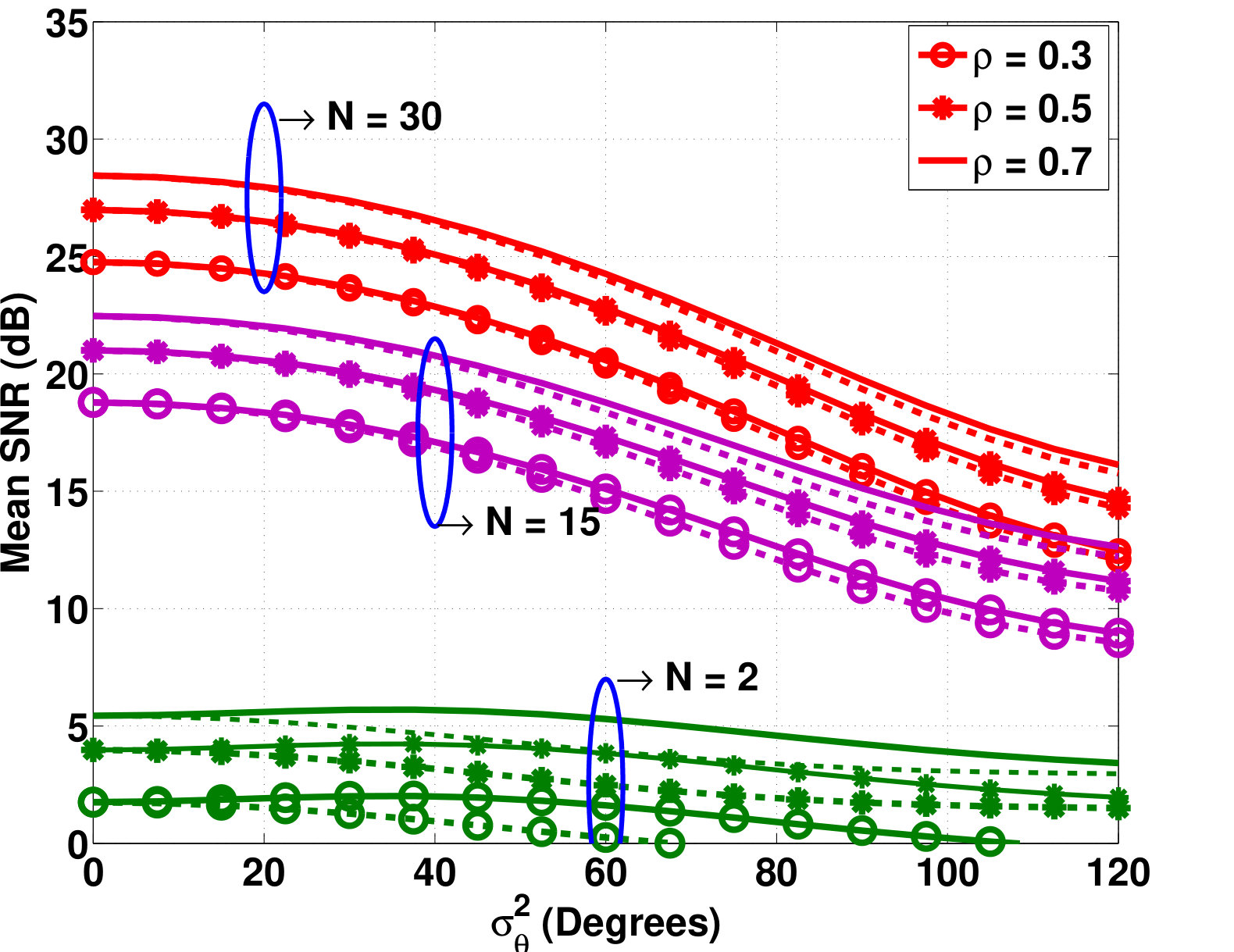 Figure 8
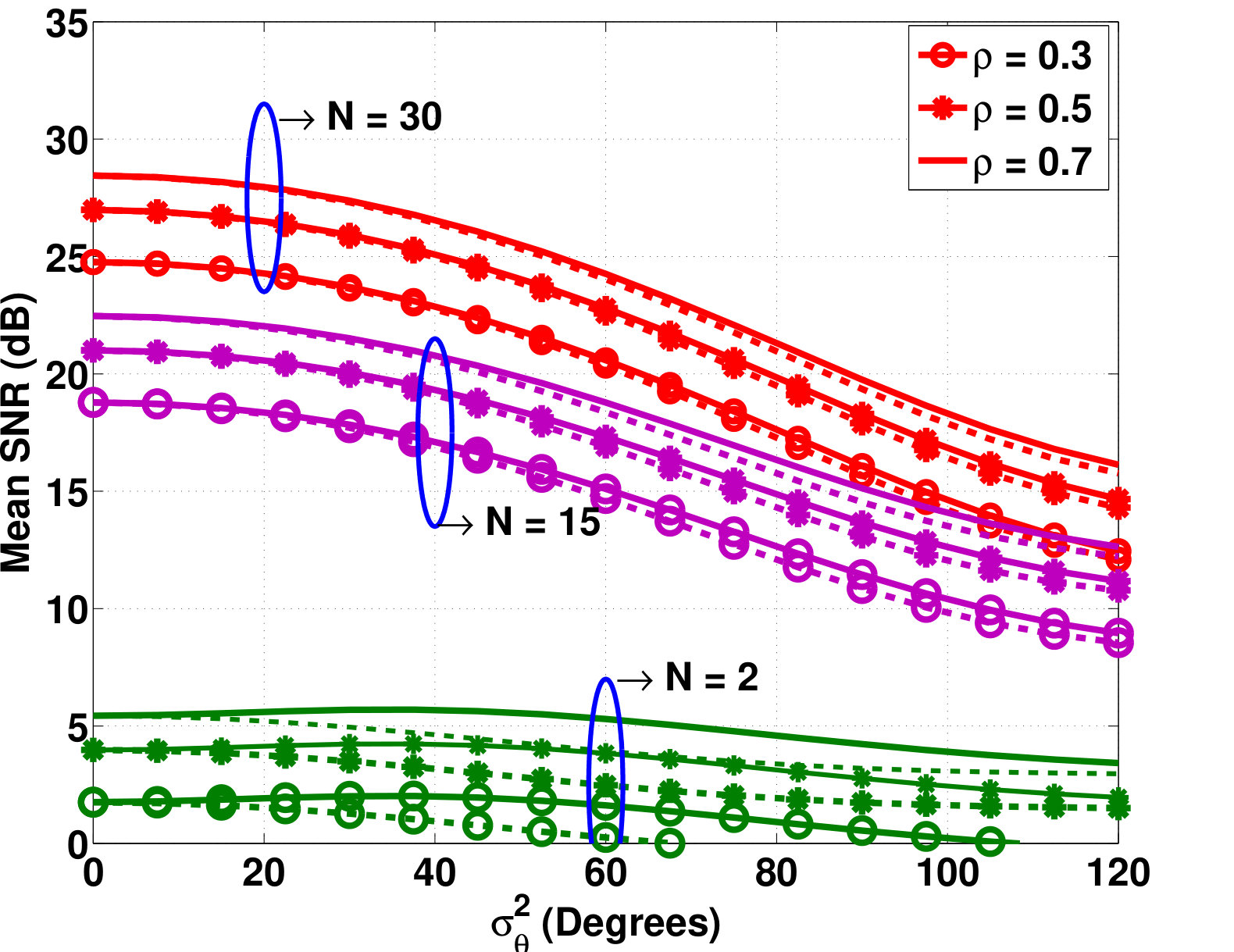 Figure 9
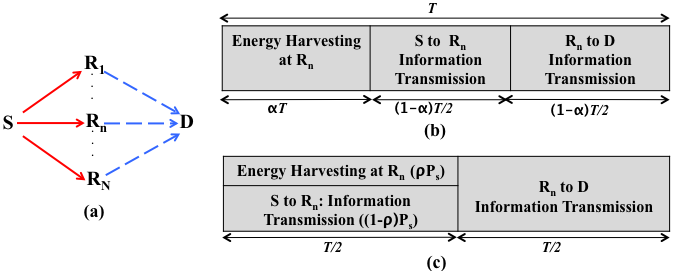 Figure 10
Peer Reviews
No public reviews on file for this paper yet. If you reviewed it on a platform where reviews are public (OpenReview, ICLR, NeurIPS, ICML), you can paste yours below so the community can read it here.
Videos
No videos yet. Explain this paper in a talk, walkthrough, or lecture? Add one.
Taxonomy
TopicsEnergy Harvesting in Wireless Networks · Advanced MIMO Systems Optimization · Full-Duplex Wireless Communications
Distributed Beamforming with Wirelessly Powered Relay Nodes
Muhammad Ozair Iqbal1, Ammar Mahmood1, Muhammad Mahboob Ur Rahman1, Qammer H. Abbasi2
1Electrical Engineering department, Information Technology University (ITU), Lahore, Pakistan
{ozair.iqbal,ammar.mahmood,mahboob.rahman}@itu.edu.pk
2Department of Electrical and Computer Engineering, Texas A&M University at Qatar
Abstract
This paper studies a system where a set of relay nodes harvest energy from the signal received from a source to later utilize it when forwarding the source’s data to a destination node via distributed beamforming. To this end, we derive (approximate) analytical expressions for the mean SNR at destination node when relays employ: i) time-switching based energy harvesting policy, ii) power-splitting based energy harvesting policy. The obtained results facilitate the study of the interplay between the energy harvesting parameters and the synchronization error, and their combined impact on mean SNR. Simulation results indicate that i) the derived approximate expressions are very accurate even for small (e.g., ), ii) time-switching policy by the relays outperforms power-splitting policy by at least dB.
I Introduction
Distributed transmit beamforming is a technique whereby multiple transmitters cooperate in a way that their signals (carrying a common message) combine coherently, over-the-air, at the intended receiver. For the unit-gain channels between the transmit nodes and the receiver, distributed beamforming leads to an -fold increase in mean SNR at the receiver (where is the number of cooperating transmitters) [1]. However, the energy-efficiency advantage of distributed beamforming comes at a cost, the carrier synchronization cost. Specifically, the individual passband signals sent from cooperating transmit nodes combine constructively at the receiver only when transmit nodes are frequency, time and phase synchronized [1].
Quite recently, wireless power transfer where a transmit node lets its receive counterpart harvest energy from the radio frequency (RF) signal it transmits, has attracted a lot of attention [2]. In the literature, two energy harvesting scenarios have been widely studied: i) time-switching (TS) based energy harvesting (EH) where the receiver spends a (time) fraction of every symbol it receives for energy harvesting, ii) power-splitting (PS) based energy harvesting where the receiver spends a fraction of the received power for energy harvesting.
This paper studies a system where a set of relay nodes harvest energy from the signal received from a source to later utilize it when forwarding the source’s data to a destination node via distributed beamforming. Specifically, the paper derives (approximate) analytical expressions for the mean SNR at destination node when relays employ: i) TS based EH scheme, ii) PS based EH scheme. The obtained results facilitate us to study the interplay between the energy harvesting parameters and the synchronization error, and their influence on mean SNR. Simulation results indicate that the derived approximate expressions are very accurate even for small (e.g., ).
The related works closest to this work are [3],[4]. [3] considers a single multi-antenna relay which harvests energy from a source (and external interferences) to later forward its data (via maximum ratio transmission) to the destination; authors of [3] then derive closed-form expressions for outage probability and ergodic capacity of the system. In [4], multiple transmit nodes do (received-assisted) distributed beamforming towards a receiver node where the receiver node harvests energy from the received sum signal; [4] then studies the trade-off between feedback rate and amount of energy harvested at the receiver. Nevertheless, to the best of authors’ knowledge, the interplay between energy harvesting parameters and synchronization error, and their collective impact on mean SNR (presented in this work) has not been studied before.
II System model
A system consisting of a source node , a destination node and relay nodes () is studied (see Fig. 1(a)). Following assumptions are in place: direct link between and is not available; the relay nodes operate in half-duplex mode and employ decode-and-forward (DF) strategy; the relays do distributed beamforming towards ; the relays are fully, wirelessly powered by the ; the channels on both hops are quasi-static (i.e., each channel stays constant for a slot duration and channel realizations are between the slots), frequency-flat, block fading with Rayleigh distribution.
III Time switching based energy harvesting at relays
Let denote the block time during which source transmits a certain amount of information to destination . Then, under time-switching (TS) based energy harvesting (EH) policy, the relays harvest energy from source’s transmission for a duration , where (see Fig. 1(b)).
Specifically, on the first hop, source transmits message (with power ) to the relays. Then, relay () receives , where is the channel between source and relay , and is the noise at relay . Then, the amount of energy harvested by is where is the (RF to DC) energy conversion efficiency. Since the relay uses all of the energy harvested to relay the (perfectly recovered) message to the destination, the transmit power of is . Next, on the second hop, each of the relays simultaneously forwards the precoded message to the destination ( is the precoding weight applied by ). The net (sum) signal received at is:
[TABLE]
where is the channel between the relay and destination , and is the noise at ; . Let , . Then, one can verify that where , and where . When relays do distributed beamforming, relay chooses (this could be achieved by running the protocols proposed in, e.g., [1],[5],[6]). Then, Eq. (1) can be rewritten as:
[TABLE]
where models the channel phase estimation error for the channel . However, we note that could very well represent the net phase difference between and , i.e., it could assimilate the effects of channel phase estimation error, frequency and phase offsets etc.). Indeed, in this work, we assume that denotes the effective phase difference between and . Moreover, we assume that are with . Next, assuming that -PSK constellation (for any ) and that , the instantaneous SNR at the destination is:
[TABLE]
Then, an (approximate) expression for mean SNR is provided in Corollary 1.
Corollary 1: Let . Then, the following holds:
[TABLE]
where
[TABLE]
[TABLE]
[TABLE]
Proof: See Appendix A.
IV Power splitting based energy harvesting at relays
Under power-splitting based energy harvesting policy, relay harvests amount of energy from source’s transmission for a duration (see Fig. 1(c)). Since the relay uses all of the energy harvested to relay the message to , the transmit power of is . In this case, where , and where . Then, one can verify that the sum signal received at and instantaneous SNR are once again given by Eq. (2) and Eq. (3) respectively. Then, an (approximate) expression for mean SNR is provided in Corollary 2.
Corollary 2: Let . Then, the following holds:
[TABLE]
where
[TABLE]
[TABLE]
[TABLE]
Proof: See Appendix A.
V Simulation results
In all plots, solid lines represent analytical predictions by Eqs. (4), (5) while dotted lines represent Monte-Carlo simulation results. Figs. 2, 3 show the following: i) the analytical approximations of Eqs. (4), (5) are indeed very accurate for as low as (while the approximations degrade for ); ii) the mean SNR degrades as the variance of the net phase error increases (due to poorer oscillators, poor synchronization protocol etc.); iii) for a given system state (of phase error variance), the mean SNR can be improved by doing more energy harvesting at the relays; iv) the TS based EH scheme outperforms PS based EH scheme by at least dB, for a given phase error variance.
VI Conclusion
This preliminary work studied a system where a set of relay nodes harvest energy from the signal received from a source to later utilize it when forwarding the source’s data to a destination node via distributed beamforming. Monte-Carlo simulation results showed that the derived approximate expressions for the mean SNR at the destination are very accurate for as low as . Last but not the least, TS based EH scheme outperformed PS based EH scheme by at least dB. Immediate future work will investigate the coupling (dependence) between energy harvesting parameters and the phase error (due to clock drift) and their combined impact on mean SNR (and Ergodic capacity) at the destination.
Appendix A An Approximate Expression for the mean SNR
We can rewrite from Eq. (3) as:
[TABLE]
Let and . Then, . Note that even though and , the distribution of each of and is not easy to obtain. However, note that both and are i.i.d; therefore, if one knows the means , and variances , of and respectively, then (for large ) one can invoke Central Limit Theorem to get a step closer towards obtaining expected value of . To this end, we have:
[TABLE]
where we have used the fact that and are independent of each other. And
[TABLE]
Similarly, we have:
[TABLE]
[TABLE]
Let and . Then, . Let . Then, according to Central Limit Theorem, the following relations hold: ; where
[TABLE]
[TABLE]
Then,
[TABLE]
Acknowledgements
This publication was made possible by NPRP grant from the Qatar National Research Fund (a member of Qatar Foundation). The statements made herein are solely the responsibility of the authors.
The reference list from the paper itself. Each links out to its DOI / PubMed record.
- 1[1] R. Mudumbai, G. Barriac, and U. Madhow, “On the feasibility of distributed beamforming in wireless networks,” Wireless Communications, IEEE Transactions on , vol. 6, no. 5, pp. 1754–1763, May 2007.
- 2[2] A. A. Nasir, X. Zhou, S. Durrani, and R. A. Kennedy, “Relaying protocols for wireless energy harvesting and information processing,” IEEE Transactions on Wireless Communications , vol. 12, no. 7, pp. 3622–3636, July 2013.
- 3[3] G. Zhu, C. Zhong, H. A. Suraweera, G. K. Karagiannidis, Z. Zhang, and T. A. Tsiftsis, “Wireless information and power transfer in relay systems with multiple antennas and interference,” IEEE Transactions on Communications , vol. 63, no. 4, pp. 1400–1418, April 2015.
- 4[4] R. Wang, R. David, and D. R. Brown, “Feedback rate optimization in receiver-coordinated distributed transmit beamforming for wireless power transfer,” in 2015 49th Annual Conference on Information Sciences and Systems (CISS) , March 2015, pp. 1–6.
- 5[5] F. Quitin, M. M. U. Rahman, R. Mudumbai, and U. Madhow, “A scalable architecture for distributed transmit beamforming with commodity radios: Design and proof of concept,” IEEE Transactions on Wireless Communications , vol. 12, no. 3, pp. 1418–1428, 2013.
- 6[6] F. Quitin, A. T. Irish, and U. Madhow, “A scalable architecture for distributed receive beamforming: Analysis and experimental demonstration,” IEEE Transactions on Wireless Communications , vol. 15, no. 3, pp. 2039–2053, March 2016.