Transverse Single Spin Asymmetry in $p+p^\uparrow \rightarrow J/\psi +X$
Rohini M. Godbole, Abhiram Kaushik, Anuradha Misra, Vaibhav Rawoot,, Bipin Sonawane

TL;DR
This paper estimates the transverse single spin asymmetry in J/psi production in polarized proton collisions using a generalized parton model, comparing results with experimental data and exploring TMD evolution effects.
Contribution
It provides the first estimates of TSSA in J/psi production within the GPM framework using the gluon Sivers function fitted from PHENIX data, including TMD evolution effects.
Findings
Results agree with PHENIX data at 200 GeV
Predictions made for 115 GeV and 500 GeV energies
TMD evolution impacts the asymmetry estimates
Abstract
We present estimates of transverse single spin asymmetry (TSSA) in within the colour evaporation model of charmonium production in a generalized parton model (GPM) framework, using the recently obtained best fit parameters for the gluon Sivers function (GSF) extracted from PHENIX data on TSSA in at midrapidity. We calculate asymmetry at GeV, and compare the results with PHENIX data on TSSA in the process . We also present estimates for asymmetry at GeV corresponding to the proposed fixed target experiment AFTER@LHC and at GeV corresponding to the higher RHIC energy. Finally, we investigate the effect of the transverse momentum dependent (TMD) evolution of the densities involved, on the asymmetry.
Click any figure to enlarge with its caption.
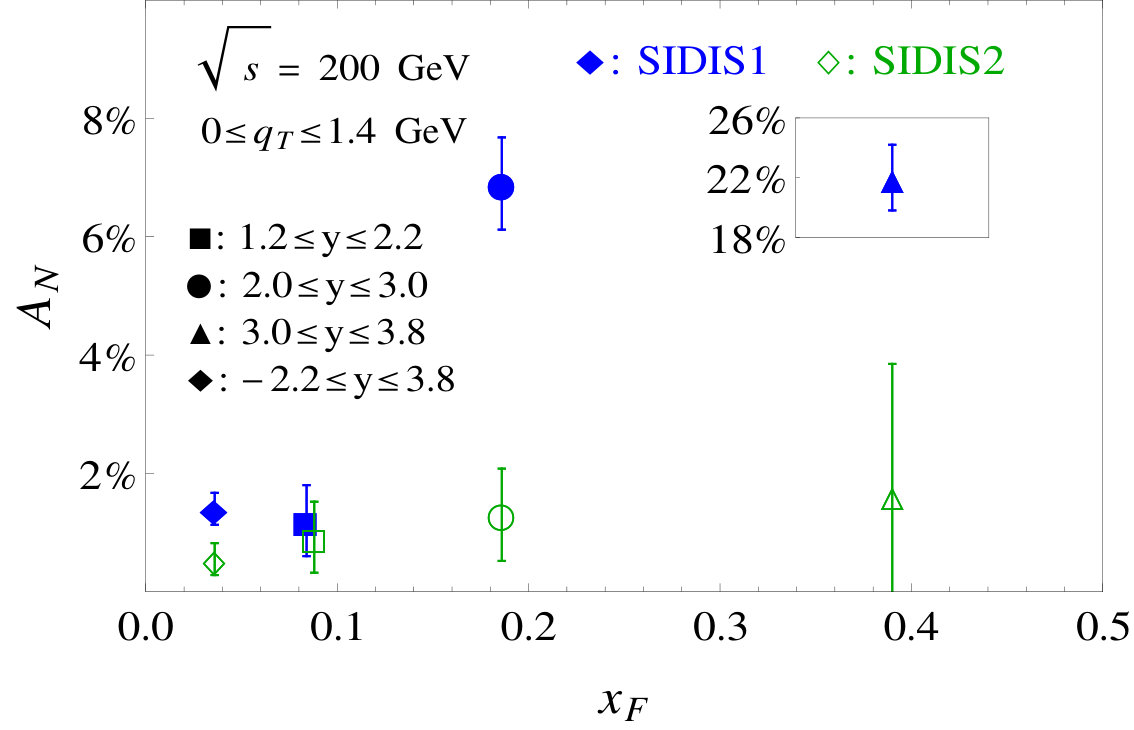 Figure 10
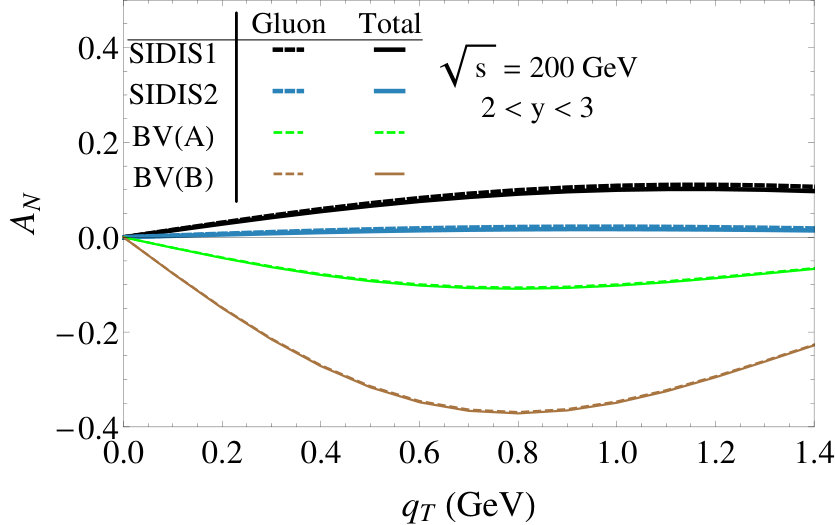 Figure 1
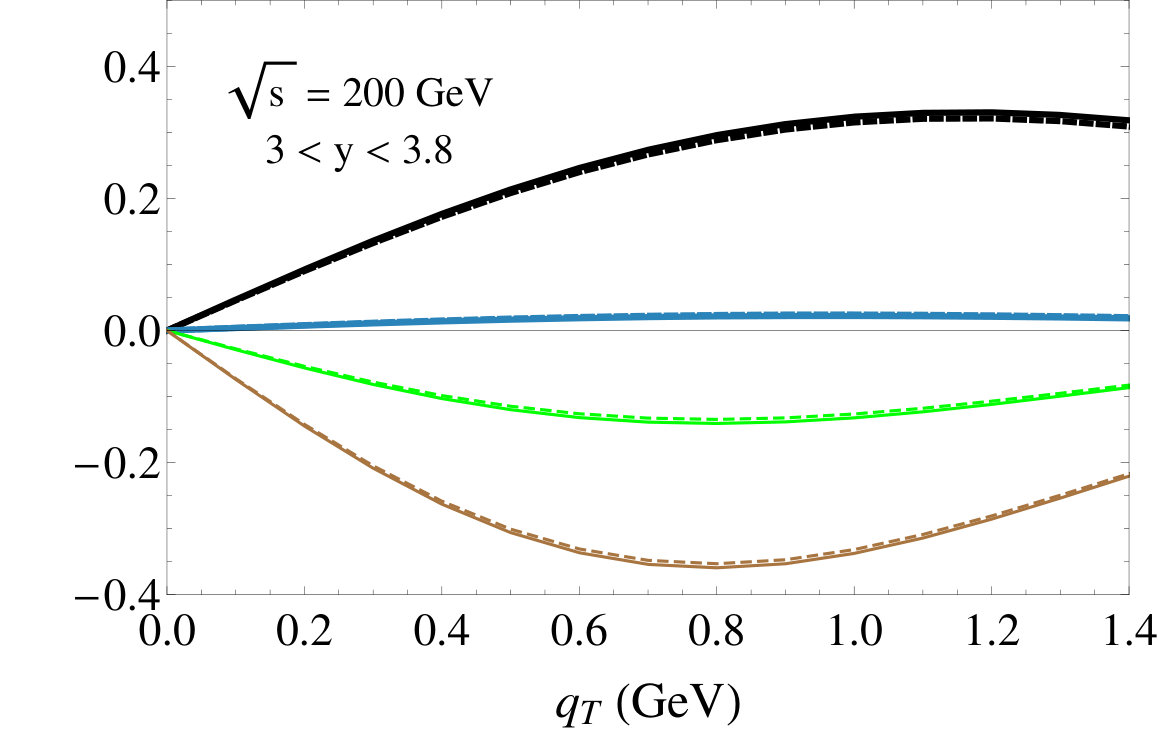 Figure 1
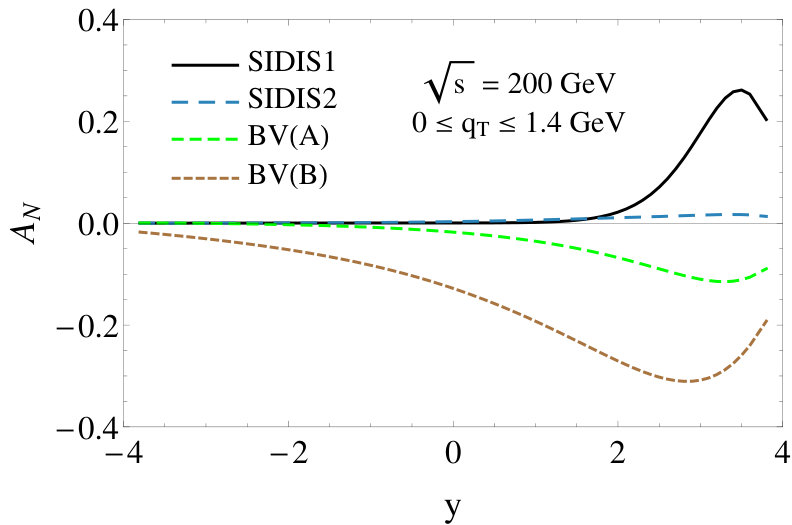 Figure 3
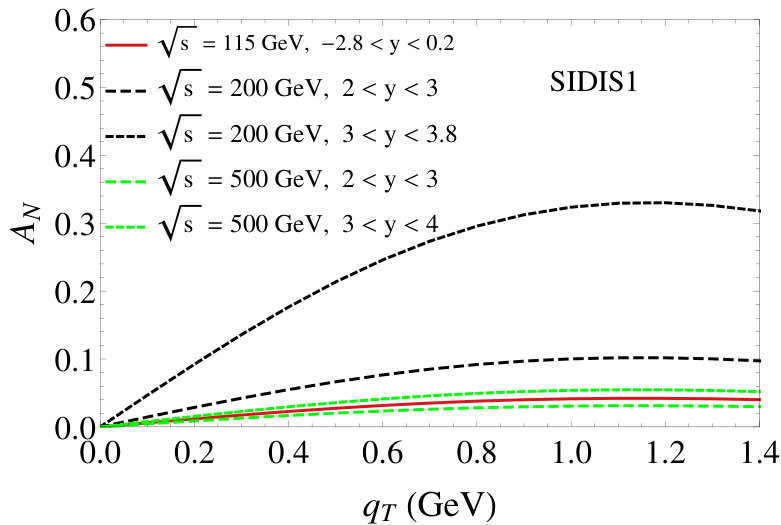 Figure 4
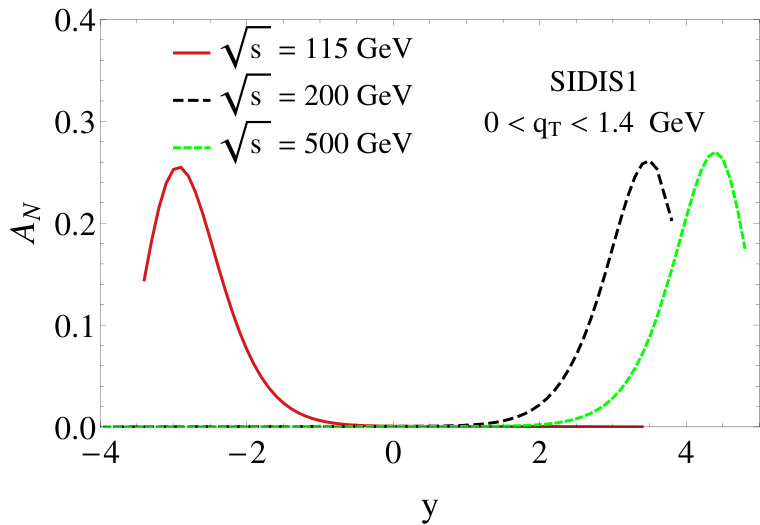 Figure 4
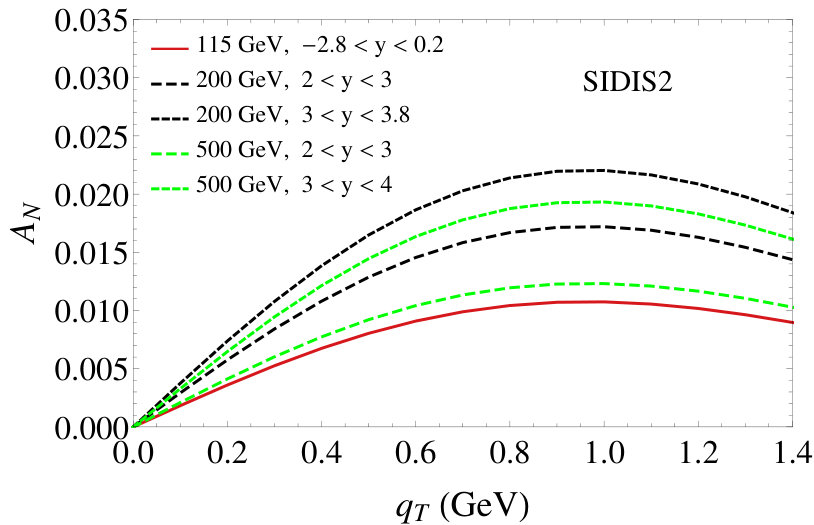 Figure 5
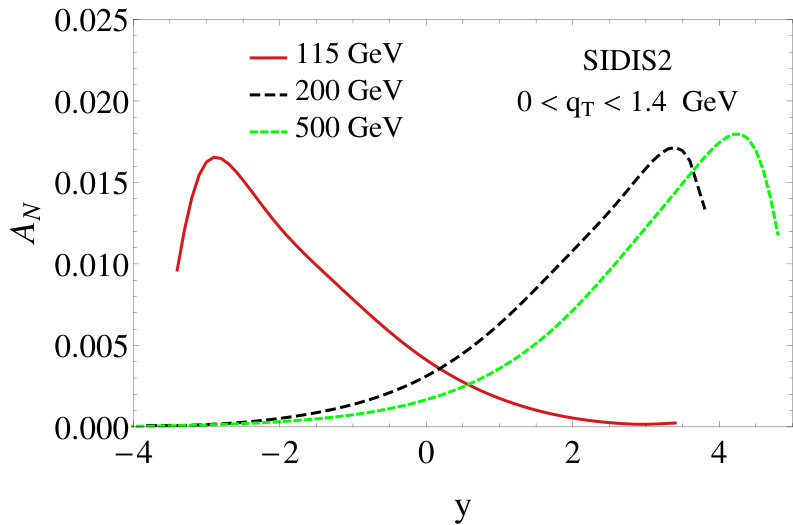 Figure 5
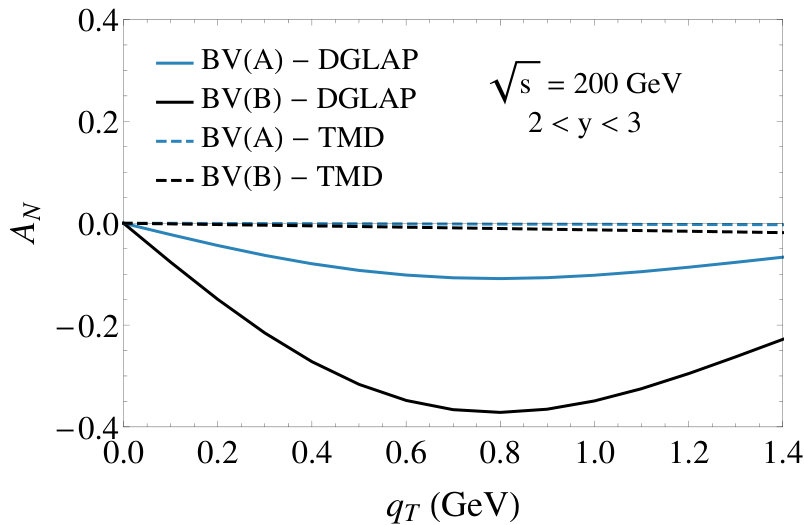 Figure 6
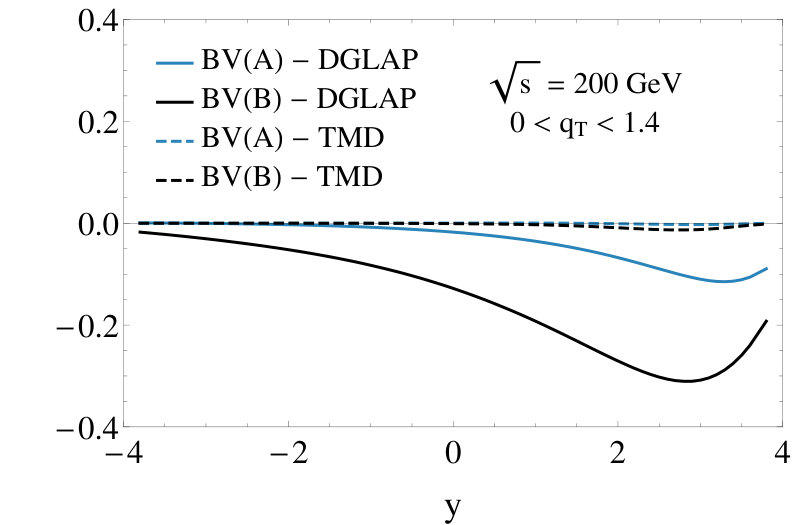 Figure 6
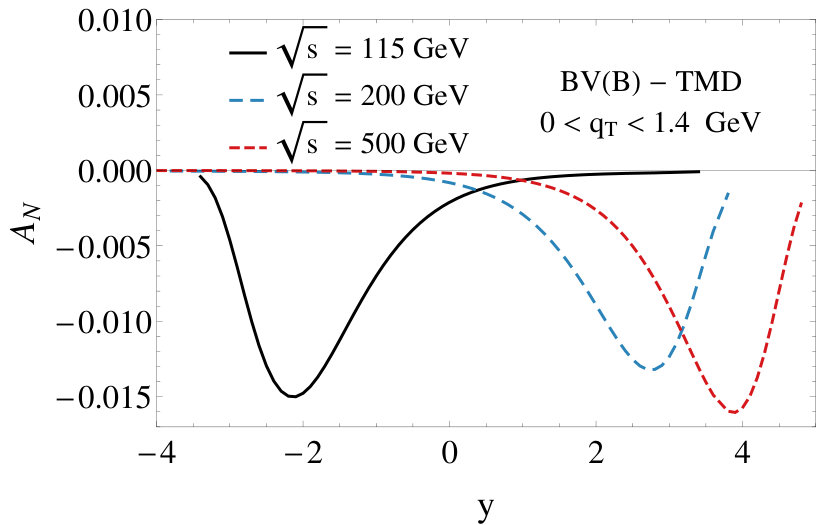 Figure 7
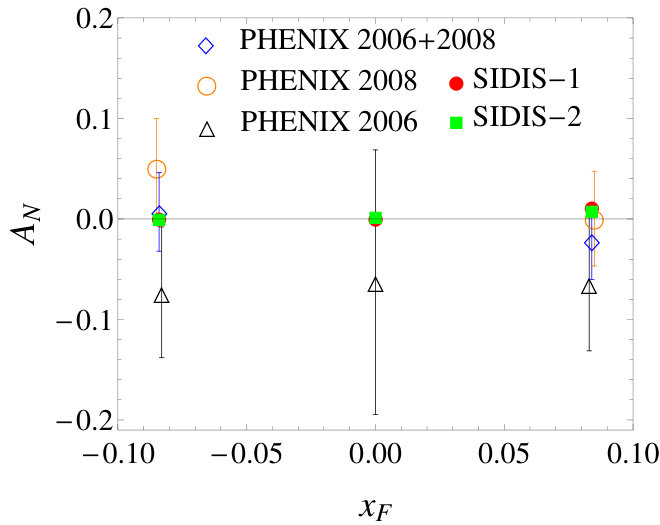 Figure 8
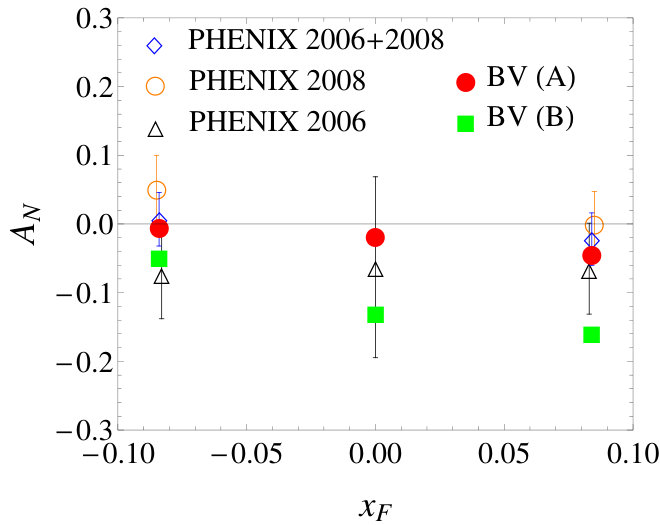 Figure 9
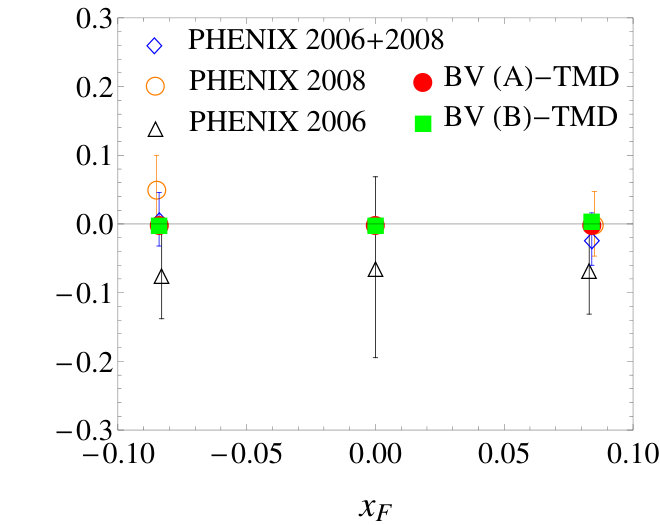 Figure 9
| SIDIS1 | |||||
| SIDIS2 |
| GeV2 | |||
| GeV2 | |||
| GeV-1 | GeV2 | ||
| GeV2 | |||
|---|---|---|---|
| Region | region | (nb) | ||||
|---|---|---|---|---|---|---|
| 0.036 | 0.002 - 0.7 | 144.0 | 0.0026 | 0.014 | 0.0055 | |
| 0.086 | 0.05 - 0.14 | 29.6 | 0.0058 | 0.012 | 0.0092 | |
| 0.186 | 0.12 - 0.32 | 18.2 | 0.0074 | 0.069 | 0.013 | |
| 0.39 | 0.32 - 0.7 | 2.45 | 0.020 | 0.22 | 0.017 |
Peer Reviews
No public reviews on file for this paper yet. If you reviewed it on a platform where reviews are public (OpenReview, ICLR, NeurIPS, ICML), you can paste yours below so the community can read it here.
Videos
No videos yet. Explain this paper in a talk, walkthrough, or lecture? Add one.
Transverse Single Spin Asymmetry in
Rohini M. Godbole
Centre for High Energy Physics, Indian Institute of Science, Bangalore, India.
Abhiram Kaushik
Centre for High Energy Physics, Indian Institute of Science, Bangalore, India.
Anuradha Misra
Department of Physics, University of Mumbai, Mumbai, India
Vaibhav Rawoot
Department of Physics, University of Mumbai, Mumbai, India.
Bipin Sonawane
Department of Physics, University of Mumbai, Mumbai, India.
Abstract
We present estimates of transverse single spin asymmetry (TSSA) in within the colour evaporation model of charmonium production in a generalized parton model (GPM) framework, using the recently obtained best fit parameters for the gluon Sivers function (GSF) extracted from PHENIX data on TSSA in at midrapidity. We calculate asymmetry at GeV, and compare the results with PHENIX data on TSSA in the process . We also present estimates for asymmetry at GeV corresponding to the proposed fixed target experiment AFTER@LHC and at GeV corresponding to the higher RHIC energy. Finally, we investigate the effect of the transverse momentum dependent (TMD) evolution of the densities involved, on the asymmetry.
††preprint: CERN-TH-2017-047
I Introduction
The role of intrinsic transverse momentum and spin distribution of partons inside the hadrons in explaining the azimuthal asymmetries arising in experiments involving polarized beams Adare et al. (2014); Klem et al. (1976); Antille et al. (1980) has been a subject of keen interest during the past decade. Transverse Single Spin Asymmetries (TSSA’s), measured in meson production in hadronic collisions as well as in semi inclusive deep inelastic scattering (SIDIS) experiments, provide useful information towards understanding the transverse dynamics of partons inside the hadrons.
It is known for long Kane et al. (1978) that the conventional QCD factorization with collinear parton distribution functions (PDFs) and fragmentation functions (FFs) is not sufficient to account for the single spin asymmetries (SSAs) observed experimentally. It is now well established that the SSAs observed in the hadroproduction of mesons and semi inclusive deep inelastic scattering (SIDIS) Airapetian et al. (2009); Alekseev et al. (2009); Adolph et al. (2012); Qian et al. (2011) can be explained in terms of orbital motion of quarks and gluons and the spin structure of nucleons. One of the two approaches towards building up a suitable framework involves generalization of the concept of collinear PDFs by including the transverse momentum and spin dependence of the partons into PDFs and FFs, which are then collectively referred to as TMDPDFs. This approach known as TMD approach has been successful in explaining the existing data in some processes, for example in inclusive pion production in collisions D’Alesio and Murgia (2004) and -boson production in and collisions Echevarria et al. (2014). In the Transverse Momentum Dependent factorization scheme Collins (2013); Ji et al. (2004, 2005); Bacchetta et al. (2008a), the hadronic cross-section is then expressed as a convolution of TMDPDFs, TMD FFs and partonic cross-section.
One of the interesting TMDPDFs, which has been a subject of a large number of studies is the Sivers Function, which can be interpreted as the number density of unpolarized quarks or gluons inside a transversely polarized proton. Information on the Sivers function can shed light on the 3-dimensional structure of nucleon and may also provide an estimate of the orbital angular momentum of quarks and gluons Boer et al. (2011); Bacchetta and Radici (2011). It was introduced by Sivers in Ref. Sivers (1990, 1991) wherein a transverse momentum dependent PDF, now known as Sivers function, was introduced for the first time to account for the large asymmetries observed in scattering Sivers (1990). Quark Sivers function, which is usually coupled to reasonably well parametrized unpolarized fragmentation functions, has been one of the first TMDs extracted from data Boer et al. (2011). All the known information on quark Sivers function has been obtained from SIDIS data and scattering in the centre of mass frame. Initial extractions of up and down quark Sivers functions, from HERMES and COMPASS data, were obtained using parameterizations that did not take into account sea quarks Anselmino et al. (2011a); Anselmino et al. (2005). Later, magnitude of asymmetry for measured at HERMES indicated the possible contribution of sea quarks and fits were obtained taking into account contributions of sea quarks also Anselmino et al. (2011a). Parametrizations of Sivers function for up and down quarks have been found to be in agreement with light-cone models Bacchetta et al. (2008b) and a quark-diquark spectator model Gamberg et al. (2008). Extractions of quark Sivers function taking into account TMD evolution have also been obtained by performing a global fitting of all data on Sivers asymmetry in SIDIS from HERMES, COMPASS and Jefferson Lab Echevarria et al. (2014) and based on these, predictions have been made for Sivers asymmetry in the DY process and -boson production. Although there are many parameterizations available for quark Sivers function, not much information is available on gluon Sivers function (GSF). Some of processes which have been proposed for obtaining information about GSF are Schmidt et al. (2005), Anselmino et al. (2004); Kang and Qiu (2008)Schmidt et al. (2005); Bacchetta et al. (2007), Schmidt et al. (2005) and Schafer and Zhou (2013).
Heavy flavour production- both open and closed- are considered to be clean probes of the GSF since heavy quarks are predominantly produced via gluon-gluon fusion and thus can be used to isolate gluon dynamics within hadrons Yuan (2008); Brodsky et al. (2002a, b); Anselmino et al. (2004); Godbole et al. (2017); D’Alesio et al. (2017). The possibility of getting information on the GSF by looking at -meson production in polarized proton-proton scattering at RHIC has been discussed by Anselmino et al. Anselmino et al. (2004) using a saturated GSF. The first phenomenological study on the gluon Sivers function has recently been performed by D’Alesio, Murgia and Pisano D’Alesio et al. (2015), wherein the gluon Sivers function has been fitted to midrapidity data on transverse SSA in measured by PHENIX collaboration at RHIC Adare et al. (2014). In our previous work, where we made predictions for TSSA in electroproduction of assuming a transverse momentum dependent factorization within colour evaporation model (CEM) of charmonium production, we had used parameterization of the gluon Sivers function suggested by Boer and Vogelsang Boer and Vogelsang (2004), in which the -dependence of the GSF was modeled on that of the and quark Sivers functions. We will call these BV parameters in the following. In our recent work on TSSA in -meson production Godbole et al. (2016), we have used the directly fitted GSF parameters of Ref. D’Alesio et al. (2015) and have compared the estimates using these with the results obtained using BV parameters.
In this work, we present predictions for TSSA in the process using recent directly fitted parameters, which we will call DMP fits D’Alesio et al. (2015). We compare these results with predictions obtained using the BV parameters, which are based on experimentally fitted quark Sivers parameters Boer and Vogelsang (2004). We then compare our results with the recent measurements of Sivers asymmetry at PHENIX experiment in production Adare et al. (2010). A similar comparison with PHENIX results has been performed recently in Ref. D’Alesio et al. (2017) using colour singlet model (CSM) and a maximized GSF, whereas in our work we use CEM and compare various parameterizations of GSF available. We also present estimates of asymmetry for future proposed experiments at AFTER@LHC which is a fixed target experiment with GeV and for GeV which will be explored at RHIC. Finally, to assess the effect of QCD evolution on asymmetry, we compare the predictions based on DGLAP and TMD evolution of the unpolarized TMDPDF and gluon Sivers function. This comparison is performed using the BV parameters because direct fits of the GSF with TMD evolution taken into account are currently not available.
II Formalism
II.1 TSSA in the process using colour evaporation model
We consider the transverse single spin asymmetry,
[TABLE]
for the process using the colour evaporation model Gay Ducati and Brenner Mariotto (1999) of production.
In the colour evaporation model, the total cross-section for the production of at leading order (LO) is proportional to the rate of production integrated over the invariant mass-squared range to , where is the mass of the charm quark and is the open charm threshold Halzen and Matsuda (1978):
[TABLE]
where .
Here, the CEM parameter is the fraction that gives the probability of production below threshold.
Here, we use a phenomenological approach referred to in literature as the Generalized Parton Model (GPM), which has been used to estimate SSAs in several processes like Anselmino et al. (2004); Godbole et al. (2016); D’Alesio et al. (2017), Schmidt et al. (2005); Bacchetta et al. (2007) and D’Alesio and Murgia (2004) for which TMD factorization has not yet been established. A rigorous treatment will require inclusion of intrinsic transverse momentum effects through a consideration of higher twist effects. However, motivated by the phenomenological successes of the GPM D’Alesio and Murgia (2008, 2004), we assume a generalization of CEM expression and include TMDPDFs thus expressing the cross section for the transversely polarized scattering process as
[TABLE]
where and the gluon and quark densities have been replaced by transverse momentum dependent gluon and quark PDFs. In Eq. 3, f_{g/p^{\uparrow(\downarrow)}}(x,\mbox{\boldmathk}_{\perp}) is the TMDPDF describing the distribution of gluons in proton which is transversely polarized w.r.t the beam axis with the polarization being upwards (downwards) with respect to the production plane. For a general value of the transverse spin \mbox{\boldmathS}_{\perp}, it is parametrised in terms of the gluon Sivers function (GSF) , as follows:
[TABLE]
Any non-zero TSSA in the process considered would primarily arise due to an azimuthal anisotropy in the distribution of gluon transverse momenta in the polarized proton. This anisotropy is parametrised by the gluon Sivers distribution.
Following Ref. Godbole et al. (2012) we can then write the numerator and denominator of Eq. 1 as,
[TABLE]
and
[TABLE]
with,
[TABLE]
Here, and are the rapidity and transverse momentum of the and we consider the plane of production of the to be perpendicular to the proton spin \mbox{\boldmathS}_{\perp}. The partonic cross-sections for production of a pair of mass are given by Gluck and Reya (1978)
[TABLE]
and
[TABLE]
where .
II.2 Parametrization of the TMDs
For the predictions with the two DMP fits D’Alesio et al. (2015), we adopt the same functional forms for the TMDs using which they were extracted. We use the standard form for the unpolarized TMDPDF with a factorized Gaussian -dependence,
[TABLE]
with = 0.25 GeV2. The Sivers function is parameterized as Anselmino et al. (2009)
[TABLE]
with,
[TABLE]
and
[TABLE]
where , , and are all parameters determined by fits to data and is Euler’s number.
As mentioned in the introduction, the two DMP extractions of the GSF, namely SIDIS1 and SIDIS2 were obtained by fitting to data on TSSA in at RHIC with quark Sivers function (QSFs) extracted earlier from SIDIS data being used to account for the quark contribution to . In obtaining the SIDIS1 fits, only the and flavour were taken into account, using the data on pion production from the HERMES experiment and positive hadron production from the COMPASS experiment. SIDIS2 parameters were obtained using flavour segregated data on pion and kaon production so here all three light flavours were taken into account. Furthermore, the QSFs used in the SIDIS1 fit were obtained with the set of fragmentation functions by Kretzer Kretzer (2000) and those of SIDIS2 were obtained with the set by de Florian, Sassot and Stratmann (DSS) de Florian et al. (2007). The values of the parameters of the two fits are given in Table 1. We give predictions for TSSA using these.
II.3 TMD Evolution
The QCD evolution formalism of the unpolarised TMD and the Sivers function has been obtained for DY and SIDIS Echevarria et al. (2014) both of which involve a color singlet photon. One expects the TMD evolution of TMDs to be different for more complicated processes. However, since is a color singlet, in this case one can assume the TMD evolution of Ref. Echevarria et al. (2014) for a preliminary assessment of the effect of evolution on asymmetries. A more rigorous approach to TMD evolution for quarkonium will be closely related to the issue of validity of TMD factorization for quarkonium which is not yet established.
The energy evolution of a TMDPDF is best described through its Fourier transform into coordinate space which is given by
[TABLE]
The evolution of -space TMDPDFs can then be written as,
[TABLE]
where, is the perturbatively calculable part of the evolution kernel, is a nonperturbative Sudakov factor and is used to stitch together the perturbative part of the kernel, which is valid for , with the nonperturbative part, which is valid for large . Following Ref. Echevarria et al. (2014), we choose an initial scale for TMD evolution. Here where is the Euler-Mascheroni constant.
Setting and , the perturbative part can be written as,
[TABLE]
where and are anomalous dimensions that can be expanded perturbatively. The expansion coefficients with the appropriate gluon anomalous dimensions at NLL are Echevarria et al. (2014)
[TABLE]
The nonperturbative part of the evolution kernel, is
[TABLE]
where, is a factor which takes the same value for all quark TMDPDFs Echevarria et al. (2014); Collins (2013) and is TMDPDF specific and is proportional to the intrinsic transverse momentum width of the particular TMDPDF at the momentum scale . In case of gluon TMDPDFs, is to be multiplied by a factor of Kang et al. (2017). Assuming a factorized Gaussian form at scale , we have
[TABLE]
Expanding the TMDPDF at the initial scale in terms of its corresponding collinear density at leading order (LO), for the unpolarized TMDPDF we get,
[TABLE]
In the case of the Sivers function, the evolution of its derivative in -space can be written in the form of Eq. 15 leading to,
[TABLE]
where, . Here the Qiu-Sterman function for parton , is obtained when expanding at LO and can be parametrized as
[TABLE]
with having the same form as in Eq. 12.
The expressions for the TMDs in -space can be obtained by Fourier transforming the -space expressions:
[TABLE]
The above expression for the Sivers function is related to through Eq. 4.
For the purpose of studying the effect of the transverse-momentum-dependent evolution of the densities on the asymmetry predictions, we need to use the BV models for the GSF since there are no available fits of the GSF that take into account TMD evolution. We therefore consider the following two models of the GSF wherein the -dependent term , is modeled on that of the quarks:
BV (A): 2. 2.
BV (B):
where both and are of the form given in Eq. 12. These models were first used in Ref. Boer and Vogelsang (2004) by Boer and Vogelsang and hence we will refer to these as the BV models.
For the predictions with TMD evolved densities using the above two models, we use the following set of parameters given in Ref. Echevarria et al. (2014),
The predictions made with the TMD evolved densities using the BV models are compared with those obtained with DGLAP evolved densities using the same models with the following set of parameters given in Anselmino et al. (2011b)
III Results
In this section, we present predictions of transverse single spin asymmetry in , obtained using the DMP fits D’Alesio et al. (2015) and the BV models Boer and Vogelsang (2004) of the GSF and corresponding best fit parameters of QSFs. The QSFs corresponding to SIDIS-1 and SIDIS-2 are given in ref. Anselmino et al. (2005) and ref. Anselmino et al. (2009) respectively. The best fits of QSF corresponding to BV models are given in ref. Anselmino et al. (2011b) for DGLAP evolved densities and in ref. Echevarria et al. (2014) for the TMD evolved ones. Our predictions of TSSA are given for three different centre of mass energies GeV (AFTER@LHC), 200 GeV (RHIC1) and 500 GeV (RHIC2). We present asymmetry predictions as a function of: (i) the transverse momentum , with the rapidity integrated over for GeV, and for GeV, and and for GeV (ii) the rapidity , with the transverse momentum integrated in the range GeV. The given rapidity ranges were chosen keeping in mind the proposed fsPHENIX Barish (2012); Aschenauer et al. (2015) upgrade which will bring the forward coverage of the detector to . For convenience, we will refer to (i) and (ii) as -asymmetry and -asymmetry respectively. We then present a comparison of asymmetries estimated using DGLAP evolved densities with those obtained using TMD-evolved densities in order to study the effect of TMD evolution. We then compare the asymmetries obtained using the aforementioned fits and models, with measurements of TSSA in at GeV, performed by the PHENIX collaboration at RHIC Adare et al. (2010). These measurements were performed in the forward (), backward () and midrapidity () regions with GeV. Finally, we consider the possibility of probing the asymmetry in the extended forward region () that will become accessible under the proposed fsPHENIX upgrade Barish (2012); Aschenauer et al. (2015).
To assess the contribution of the QSF over the GSF to the asymmetry, we have compared total asymmetry (contribution of both quarks and gluon Sivers functions) with the contribution of gluon Sivers function to the asymmetry and found the contribution of QSF to be negligible in all cases. In Fig. 1, we show this comparison for DMP fits and the BV models of the GSF, at GeV. We observe that the contribution of the QSF to the asymmetry is indeed very small as compared to contribution of GSF. This assures that the use of this process as a probe of the gluon Sivers function will not be compromised. In the remaining figures, we have considered contribution from both QSF and GSF. In Fig. 2, we show rapidity dependence of asymmetry predictions obtained using different sets of DGLAP evolved densities, i.e., the DMP fits and the BV models of the GSF, at GeV. We observe that the signs of asymmetry obtained using BV parameters and more recent directly fitted DMP parameters are opposite. This is expected as in BV models, the gluon Sivers function is modelled after quark Sivers function and the -quark Sivers parameters have a negative sign as shown in Tables II and III. Further, the magnitude of asymmetry obtained using the DMP fits is smaller than that obtained using the BV models. Of the two DMP fits, SIDIS1 gives the larger asymmetry estimates with peak values of about for the -asymmetry (with the rapidity range ), and around for the -asymmetry. SIDIS2 on the other hand gives much smaller asymmetries with peak values of about for the -asymmetry (with the rapidity range ) and for the -asymmetry. This large difference in the peak magnitudes of the asymmetry between SIDIS1 and SIDIS2 fits can be understood by looking at the -region which contributes to the peaks. For both SIDIS1 and SIDIS2, the peak occurs for which corresponds to the large- region where the two fits differ greatly in magnitude, as can be inferred from the numbers in Table 1. It must be mentioned however that the DMP fits do not constrain the GSF very well in this region.
In Figures 3 and 4, we present asymmetry predictions obtained with the DMP fits, SIDIS1 and SIDIS2, for all the three centre of mass energies considered. In both cases, we find that the -asymmetry scales with . It should be noted that in Fig. 3b and 4b, the -asymmetry peaks in negative region for AFTER@LHC c.m energy. This is due to the fact that AFTER@LHC is a fixed target experiment and we have taken to be positive in the (unpolarized) beam direction. This is in contrast to RHIC1 and RHIC2 curves, where we have used the convention followed by PHENIX experiment where rapidity is considered to be positive in the forward hemisphere of the polarized proton. The scaling of -asymmetry with is because the collinear PDFs mostly cancel out between the numerator and the denominator and the -dependence of the asymmetry is mostly determined by the remaining factor , with having a direct correspondence with (c.f. Eq. 7). This cancellation is of course not absolute, as the integration over the invariant mass dilutes the correspondence of with the rapidity and allows the collinear PDFs to affect the -dependence, but we have verified that this effect is small. It must also be mentioned that the assumption that the dependence of the TMD is factorized, helps this cancellation as the integrals over the transverse momenta of the partons do not depend on and simply produce an overall constant independent of both and . We find peak asymmetry values of about with SIDIS1 and with SIDIS2.
In the case of the -asymmetries, shown in Fig. 3a and 4a, we find that the functional form of the dependence remains the same up to an overall factor that depends on and the rapidity range. This is also a reflection of the factorized -dependence that we have assumed for the TMDPDFs. With SIDIS1, we find that peak asymmetry occurs at GeV with peak asymmetry values of 5%, 33% and 6% for (with ) , 200 (with ) and 500 (with ) GeV respectively, while for SIDIS2 we get substantially lower asymmetries with peak values of 1.1%, 2.2% and 1.9% for (with ), 200 (with ) and 500 (with ) GeV respectively at GeV.
In Figs. 5 and 6, we look at the effect of TMD evolution on the asymmetry predictions by comparing results obtained with DGLAP evolved densities with those obtained with TMD evolved densities. We do this using the BV (A) and BV (B) models of the GSF (c.f. Section II C). We find that the inclusion of TMD evolution causes the asymmetry predictions to substantially decrease for both models. Furthermore the scaling of the -asymmetry is also affected by TMD evolution as can be seen in Fig. 6, where we show the asymmetries obtained with the TMD evolved BV (B) model, for all three c.o.m energies. While the peak of the asymmetry does shift to larger rapidities with increasing , the magnitude of the peak varies. This is due to the fact that the -dependence of the TMDs is no more factorized, but is instead affected by the -dependence of the collinear PDFs through the prescription (c.f., Eq. II.3, II.3).
In Figs. 7 and 8, we compare our predictions with the asymmetry measured at the PHENIX experiment Adare et al. (2010). In Fig. 7, we compare the asymmetry predictions obtained using the DMP fits with the data and find that they lie well within the uncertainties. In the forward region, SIDIS1 and SIDIS2 give an asymmetries of about and respectively. In Fig. 8, we do the same using the DGLAP and TMD evolved BV models. With the DGLAP evolved models, BV (A) gives asymmetries which lie within the uncertainties, whereas BV (B) gives an asymmetry well outside the uncertainties for the forward region. However, the asymmetry predictions obtained with the TMD evolved BV models are substantially smaller than those given by DGLAP evolved BV models and are negligible in all rapidity regions.
Thus, although the PHENIX results for the asymmetry are compatible with zero, the errors are still large and allow for percentage level asymmetries as given by the DMP fits. Furthermore, they cover a very limited kinematic range and do not rule out larger asymmetries in more forward regions. The proposed fsPHENIX upgrade Barish (2012); Aschenauer et al. (2015) will expand the forward coverage of the detecter to the region . With this in mind, in Fig. 9, we show asymmetry predictions obtained from the DMP fits for the expanded rapidity region that will be covered by the upgrade. The expected statistical error for each point, which is given by , was calculated assuming 1 pb*-1* of data. Here , indicates the number ’s that are detected. is the integrated luminosity, which we choose to be 1 pb*-1* here and is the geometric factor accounting for the planned detector acceptance of leptons: . The cross-section was calculated using the colour evaporation model (CEM), normalised to the total cross-section given in Adare et al. (2007).
In Fig. 9, we would like to highlight the widely differing behavior of the SIDIS1 and SIDIS2 asymmetries with respect to the choice of the rapidity cuts. Note that use of these fits for GSF to make predictions for our process assumes TMD factorisation and universality of GSF. These have yet to be established . Even then these two can be used for demonstration purposes, as examples of two possible GSF, which have widely different -dependencies. Taking these as examples we demonstrate how a study of asymmetry with different choices of rapidity cuts in the forward region, can probe the -dependence of the GSF. When the whole accessible region is considered, both fits give asymmetries below 2%, which are similar to each other within of the statistical error. For the region , both fits give asymmetries which are almost indistinguishable given the errors. However for the more forward regions, the two fits give vastly different predictions, with the SIDIS1 fit being much more sensitive to the rapidity cuts. For the region , SIDIS1 gives an asymmetry of about 7%, which is almost five times of the prediction given by SIDIS2. For the region , the difference is even larger with SIDIS1 giving as asymmetry of 22%, which greater than that of SIDIS2 by a factor of 13. This difference is due to the different -dependence of the fits. The region probes the region where SIDIS1 is much larger than SIDIS2. This difference however, is not seen in the asymmetry without rapidity cuts, i.e., considering the whole region , since the cross-section drops rapidly in the large rapidity region. We therefore see that a study of the dependence of the measured asymmetries on the rapidity region over which measurement is made, can give insight into the -dependence of the gluon Sivers function. The numerical values of the cross-section, the asymmetries and their associated error are given in Table 4.
Another experiment that might help study the GSF in over kinematic regions not covered by the PHENIX study would be the proposed fixed target experiment AFTER@LHC. This would have a high enough luminosity to make precise measurements of the asymmetry Lansberg et al. (2016); Anselmino et al. (2015); Brodsky et al. (2013); Kikoła et al. (2017); Lansberg et al. (2012); Rakotozafindrabe et al. (2014). Such a fixed target experiment would have a centre of mass energy GeV with an integrated luminosity of up to 20 fb*-1* with one year of data taking. In such an experiment the centre of mass would be moving with respect to the lab frame with a rapidity , allowing large regions of the target to be probed with the coverage of the ALICE or LHCb detectors. A polarized target would, therefore, offer the possibility of probing the large () region where the DMP fits do not constrain the GSF. production rates obtained with the leading order (LO) CEM indicate that, with an integrated luminosity of 20 fb*-1*, it should be possible to measure the asymmetry with permille precision in the low- region with rapidity range (). This roughly corresponds to the region .
IV Conclusions
In this paper, we have presented predictions of TSSA in at the RHIC centre of mass energy GeV, at which TSSA in production has been measured by the PHENIX experiment as well as at GeV, corresponding to the proposed polarized scattering experiment AFTER@LHC and GeV, corresponding to the higher RHIC energy using two different parameterizations of gluon Sivers function and in different experimentally accessible kinematic regions. Measurement of TSSA in production at PHENIX experiment at RHIC has provided us an opportunity to compare our predictions with experimental results.
We have obtained predictions of TSSA using both DGLAP as well as TMD evolved densities. For the predictions with DGLAP evolved densities, we used recent extractions of GSF from TSSA measurements in , referred to here as the DMP parameter sets D’Alesio et al. (2015). These extractions of GSF were obtained without taking into account TMD evolution. Hence, we have not used these parameters of GSF to assess the effect of TMD evolution. For the comparison of asymmetries calculated using DGLAP evolved and TMD evolved densities, we have used earlier models of the GSF (referred to as BV models in this work), which express GSF in terms of and quark Sivers function and were used in our previous work.
Our results show that the asymmetry obtained using BV parameterization is negative whereas asymmetry obtained using SIDIS parameterization is positive. This can be understood considering the fact that quark Sivers function has negative sign and in BV model, GSF is written in terms of QSF. The distribution of asymmetry we obtained with BV parameterization is large in magnitude as compared to asymmetry obtained using DMP parameterizations. As far as the distribution of asymmetry is concerned, the peak magnitudes of asymmetry are similar for all c.o.m energies, with the peak shifting towards larger rapidity values with increasing c.o.m energy. Comparison of our predictions of asymmetry with PHENIX measurement gives interesting results. When DGLAP evolved TMDs are used, our results with DMP-SIDIS1, DMP-SIDIS2 and BV (A) parameterizations are in agreement with the asymmetry data in forward, backward and midrapidity regions whereas the results obtained using BV (B) parameterization are not within experimental uncertainties of data points. However, when effect of TMD evolution is taken into account, results obtained using BV (B) parameterization also fall within experimental uncertainties. It may be worthwhile to obtain fits of GSF taking into account TMD evolution and compare predictions of asymmetry obtained using those with the predictions presented here.
As mentioned earlier, since the uncertainties in data points are large, more data will be needed to constrain the GSF. The predictions made in this work are based on the first ever directly fitted parameters of gluon Sivers function and assume a generalized factorization expression within colour evaporation model of charmonium production. A more detailed analysis investigating the dependence of our results on charmonium production mechanism, which is still an open question, is under study and will be reported in future. Apart from uncertainties arising from underlying assumptions which include TMD factorization for quarkonium production, which has not yet been established, universality of GSF and choice of a particular production mechanism, another issue that is unresolved so far, there may be further limitations due to restricted region of validity of the parameter sets used. However, these studies to understand the GSF and resulting TSSA in along with studies probing GSF in open flavour production are expected to play a crucial role in constraining the gluon spin dynamics.
V ACKNOWLEDGEMENTS
We would like to thank J.P. Lansberg for his very useful comments and suggestions. A.M. and B.S. would like to thank DST, India for financial support under the project no.EMR/2014/0000486 and UGC-BSR under F.7-130/2007(BSR). A.M. would also like to thank the Theoretical Physics Department, CERN, Geneva, where part of this work was done, for their kind hospitality. R.M.G. wishes to acknowledge support from the Department of Science and Technology, India under Grant No. SR/S2/JCB-64/2007 under the J.C. Bose Fellowship scheme. A.K. would like to thank the Department of Physics, University of Mumbai, for their kind hospitality.
The reference list from the paper itself. Each links out to its DOI / PubMed record.
- 1Adare et al. (2014) A. Adare et al. (PHENIX), Phys. Rev. D 90 , 012006 (2014), eprint 1312.1995.
- 2Klem et al. (1976) R. D. Klem, J. E. Bowers, H. W. Courant, H. Kagan, M. L. Marshak, E. A. Peterson, K. Ruddick, W. H. Dragoset, and J. B. Roberts, Phys. Rev. Lett. 36 , 929 (1976).
- 3Antille et al. (1980) J. Antille, L. Dick, L. Madansky, D. Perret-Gallix, M. Werlen, A. Gonidec, K. Kuroda, and P. Kyberd, Phys. Lett. B 94 , 523 (1980).
- 4Kane et al. (1978) G. L. Kane, J. Pumplin, and W. Repko, Phys. Rev. Lett. 41 , 1689 (1978).
- 5Airapetian et al. (2009) A. Airapetian et al. (HERMES), Phys. Rev. Lett. 103 , 152002 (2009), eprint 0906.3918.
- 6Alekseev et al. (2009) M. Alekseev et al. (COMPASS), Phys. Lett. B 673 , 127 (2009), eprint 0802.2160.
- 7Adolph et al. (2012) C. Adolph et al. (COMPASS), Phys. Lett. B 717 , 383 (2012), eprint 1205.5122.
- 8Qian et al. (2011) X. Qian et al. (Jefferson Lab Hall A), Phys. Rev. Lett. 107 , 072003 (2011), eprint 1106.0363.