Some results in quasitopological homotopy groups
T. Nasri, H. Mirebrahimi, H. Torabi

TL;DR
This paper explores properties of quasitopological homotopy groups, establishing isomorphisms with loop space groups and deriving new results using exact sequences and fibrations.
Contribution
It demonstrates that the nth quasitopological homotopy group is isomorphic to the (n-1)th group of the loop space and applies exact sequences to derive new insights.
Findings
Isomorphism between nth quasitopological homotopy group and (n-1)th of loop space
Derived new results using long exact sequences and fibrations in qTop
Extended understanding of quasitopological homotopy groups
Abstract
In this paper we show that the nth quasitopological homotopy group of a topological space is isomorphic to (n-1)th quasitopological homotopy group of its loop space and by this fact we obtain some results about quasitopological homotopy groups. Finally, using the long exact sequence of a based pair and a fibration in qTop introduced by Brazas in 2013, we obtain some results in this field.
Click any figure to enlarge with its caption.
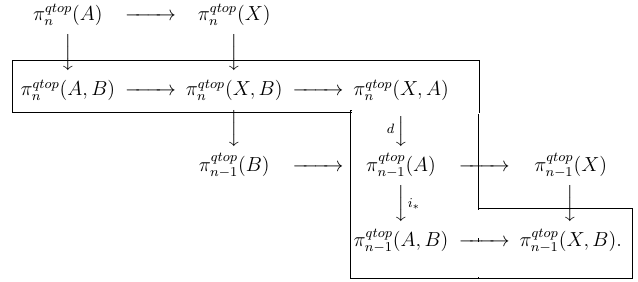 Figure 1
Peer Reviews
No public reviews on file for this paper yet. If you reviewed it on a platform where reviews are public (OpenReview, ICLR, NeurIPS, ICML), you can paste yours below so the community can read it here.
Videos
No videos yet. Explain this paper in a talk, walkthrough, or lecture? Add one.
Taxonomy
TopicsHomotopy and Cohomology in Algebraic Topology · Advanced Topology and Set Theory · Advanced Topics in Algebra
SOME RESULTS IN QUASITOPOLOGICAL HOMOTOPY GROUPS
T. NASRI
H. MIREBRAHIMI
H. TORABI
Department of Pure Mathematics, Center of Excellence in Analysis on Algebraic Structures, Ferdowsi University of Mashhad,
P.O.Box 1159-91775, Mashhad, Iran.
Department of Pure Mathematics, Faculty of Basic Sciences, University of Bojnord,
Bojnord, Iran.
Abstract
In this paper we show that the th quasitopological homotopy group of a topological space is isomorphic to th quasitopological homotopy group of its loop space and by this fact we obtain some results about quasitopological homotopy groups. Finally, using the long exact sequence of a based pair and a fibration in qTop introduced by Brazas in 2013, we obtain some results in this field.
keywords:
Homotopy group , Quasitopological group , Fibration.
MSC:
[2010] 55Q05, 54H11, 14D06.
1 **INTRODUCTION **
Endowed with the quotient topology induced by the natural surjective map , where is the th loop space of with the compact-open topology, the familiar homotopy group becomes a quasitopological group which is called the quasitopological th homotopy group of the pointed space , denoted by (see [3, 5, 4, 10]).
It was claimed by Biss [3] that is a topological group. However, Calcut and McCarthy [7] and Fabel [8] showed that there is a gap in the proof of [3, Proposition 3.1]. The misstep in the proof is repeated by Ghane et al. [10] to prove that is a topological group [10, Theorem 2.1] (see also [7]).
Calcut and McCarthy [7] showed that is a homogeneous space and more precisely, Brazas [5] mentioned that is a quasitopological group in the sense of [1].
Calcut and McCarthy [7] proved that for a path connected and locally path connected space , is a discrete topological group if and only if is semilocally 1-connected (see also [5]). Pakdaman et al. [12] showed that for a locally -connected space , is discrete if and only if is semilocally n-connected at (see also [10]). Also, they proved that the quasitopological fundamental group of every small loop space is an indiscrete topological group. We recall that a loop in X at x is called small if it is homotopic to a loop in every neighborhood U of x. Also the topological space with non trivial fundamental group is called a small loop space if every loop of is small.
In this paper, we obtain some results about quasitopological homotopy groups. One of the main results of Section 2 is as follows:
Theorem 2.1. Let be a pointed topological space. Then for all and ,
[TABLE]
where is the constant -loop in at .
By this fact we can show that some properties of a space can be transferred to its loop space. Also, we obtain several results in quasitopological homotopy groups. Moreover, we show that for a fibration with fiber , the induced map is continuous.
Brazas in his thesis [6] exhibited two long exact sequences of based pair and fibration in qTop. In Section 3, we use these sequences and obtain some results in this filed. For instance, we conclude the following results:
Proposition 3.3. If is a retraction, then there are isomorphisms in quasitopological groups, for all ,
[TABLE]
Corollary 3.7. If is a covering projection, then for all , and can be embedded in .
2 QUASITOPOLOGICAL HOMOTOPY GROUPS
It is well-known that for a pointed topological space , for all and , . In this section we extend this result for quasitopological homotopy groups and we obtain some results about them. The following theorem is one of the main results of this paper.
THEOREM 2.1**.**
Let be a pointed topological space. Then for all and ,
[TABLE]
where is the constant -loop in at .
Proof.
Consider the following commutative diagram:
[TABLE]
where given by is a homeomorphism with inverse in the sense of [13]. Since the map is a quotient map, the homomorphism is an isomorphism between quasitopological homotopy groups. ∎
The following result is a consequence of Theorem 2.1.
COROLLARY 2.2**.**
Let be a locally -connected. Then is semilocally -connected at if and only if is semilocally simply connected at , where is the constant loop in at .
Proof.
Since is a locally -connected, by [12, Theorem 6.7], is semilocally -connected at if and only if is discrete. By Theorem 2.1, . Also is discrete if and only if is semilocally simply connected at by [12, Theorem 6.7]. ∎
Note that the above result has been shown by Hidekazu Wada [17, Remark] and Authors [11, Lemma 3.1] with another methods.
COROLLARY 2.3**.**
Let be the inverse limit of an inverse system . Then for all and ,
[TABLE]
Virk [16] introduced the SG (small generated) subgroup of fundamental group , denoted by , as the subgroup generated by the following elements
[TABLE]
where is a path in with initial point and is a small loop in at . Recall that a space is said to be small generated if , also a space is said to be semilocally small generated if for every there exists an open neighborhood of such that . Torabi et al. [15] proved that if is small generated space, then is an indiscrete topological group and the quasitopological fundamental group of a semilocally small generated space is a topological group. By Theorem 2.1, we obtain several results in quasitopological homotopy groups as follows:
COROLLARY 2.4**.**
Let be a topological space such that is small generated. Then is an indiscrete topological group.
Proof.
Since is a small generated space, then is an indiscrete topological group, by [15, Remark 2.11]. Therefore implies that is an indiscrete topological group. ∎
COROLLARY 2.5**.**
Let be a topological space such that is a semilocally small generated space. Then is a topological group.
Proof.
Since is semilocally small generated, then is a topological group, by [15, Theorem 4.1]. Therefore implies that is a topological group. ∎
Fabel [8] proved that is not topological group. By considering the proof of this result it seems that if is an abelian group, then is a topological group. He [9] also showed that for each there exists a compact, path connected, metric space X such that is not a topological group. In the following example we show that there is a metric space with abelian fundamental group such that is not a topological group.
EXAMPLE 2.6**.**
Let , be the compact, path connected, metric space introduced in [9] such that is not a topological group. By Theorem 2.1 is not a topological group. Since for every , is an abelian group, hence there is a metric space with abelian fundamental group such that is not a topological group.
In [4, Proposition 3.25], it is proved that the quasitopological fundamental groups of shape injective spaces are Hausdorff. By Theorem 2.1 we have the following result.
COROLLARY 2.7**.**
Let be a topological space such that is shape injective space. Then is Hausdorff.
PROPOSITION 2.8**.**
[15]** For a pointed topological space , if is closed (or equivalently the topology of is ), then is homotopically Hausdorff.
We generalized the above proposition as follows:
PROPOSITION 2.9**.**
For a pointed topological space , if is closed (or equivalently the topology of is ), then is n-homotopically Hausdorff.
Proof.
By Theorem 2.1 since is , hence is . Therefore by previous proposition is homotopically Hausdorff which implies that is n-homotopically Hausdorff by [11, Lemma 3.5]. ∎
COROLLARY 2.10**.**
Let be a topological space such that is shape injective space. Then is n-homotopically Hausdorff.
Proof.
It follows from Corollary 2.7 and Proposition 2.9. ∎
Let be a pointed space and be a fibration with fiber . Consider its mapping fiber, . If , then the injection map given by induces a homomorphism [13].
THEOREM 2.11**.**
Let be a pointed space and be a fibration. If , then is continuous, for all .
Proof.
We consider the following commutative diagram:
[TABLE]
where is the quotient map and is the induced map of by the functor . Since is continuous and is a quotient map, is continuous. By Theorem 2.1, is isomorphic to . Therefore is continuous. ∎
3 LONG EXACT SEQUENCE OF
Brazas [6, Theorem 2.49] proved that for every based pair (X, A) with inclusion , there is a long exact sequence in the category of quasitopological groups as follows:
[TABLE]
He [6, Proposition 2.20] also showed that for every fibration of path connected spaces with fiber , there is a long exact sequence in the category of quasitopological groups as follows:
[TABLE]
In follow, we obtain some results and examples by these exact sequences.
EXAMPLE 3.1**.**
Consider the pointed pair , where is the harmonic archipelago and is the hawaiian earring. Then by [6, Theorem 2.49], there is a long exact sequence in qTop:
[TABLE]
Recall that a short exact sequence of topological abelian groups will be called an extension of topological groups if both and are continuous and open homomorphisms when considered as maps onto their images. Also, the extension is called split if and only if it is equivalent to the trivial extension [2].
THEOREM 3.2**.**
[2*, Theorem 1.2]** Let be an extension of topological abelian groups. The following are equivalent:
(1) splits.
(2)There exists a right inverse for .
(3)There exists a left inverse for .*
The above results hold for quasitopological groups, too.
PROPOSITION 3.3**.**
If is a retraction, then there are isomorphisms in quasitopological groups, for all ,
[TABLE]
Proof.
Consider the pointed pair . By [6, Theorem 2.49], there is a long exact sequence
[TABLE]
Since is a retraction and is an injection, there is a short exact sequence
[TABLE]
Moreover, this sequence is an extension. Indeed, the map and are continuous and open homomorphisms when considered as maps onto their images. Therefore
[TABLE]
∎
PROPOSITION 3.4**.**
Let be pointed spaces. Then there is a long exact sequence of the triple in qTop:
[TABLE]
Proof.
Consider the following commutative diagram and chase a long diagram as follows:
∎
The following results are immediate consequences of Sequence (3).
COROLLARY 3.5**.**
If is a fibration with contractible, then is an isomorphism in quasitopological groups for all and is an isomorphism in Set.
COROLLARY 3.6**.**
Let be a pointed topological space. Then in quasitopological groups for all , where is the constant loop in at and in Set.
Proof.
By [14, Proposition 4.3], the map is a fibration with fiber , where . By [6, Proposition 2.20], the sequence
[TABLE]
is exact in qTop. By [14, Proposition 4.4], is contractible and therefore the result holds by Corollary 3.5. ∎
COROLLARY 3.7**.**
If is a covering projection, then for all , in quasitopological groups and can be embedded in .
Proof.
This result follows by Sequence (3) and this fact that the fiber of the covering projection is discrete and therefore is trivial, for all . ∎
The reference list from the paper itself. Each links out to its DOI / PubMed record.
- 1[1] A. Arhangelskii, M. Tkachenko , Topological Groups and Related Structures , Atlantis Studies in Mathematics, 2008.
- 2[2] H.J.Belloa, M.J.Chascoa, X.Domínguezb, M.Tkachenko , Splittings and cross-sections in topological groups . J. Math. Anal. Appl. 435 (2016), 1607-1622.
- 3[3] D. Biss , The topological fundamental group and generalized covering spaces . Topology Appl. 124 (2002), 355-371.
- 4[4] J. Brazas , The fundamental group as topological group . Topology Appl. 160 (2013), 170-188.
- 5[5] J. Brazas , The topological fundamental group and free topological groups . Topology Appl. 158 (2011), 779-802.
- 6[6] J. Brazas , Homotopy mapping spaces . University of New Hampshire Ph.D. Dissertation (2011).
- 7[7] J.S. Calcut, J.D. Mc Carthy , Discreteness and homogeneity of the topological fundamental group . Topology Proc. 34 (2009), 339-349.
- 8[8] P. Fabel , Multiplication is discontinuous in the Hawaiian earring group (with the quotient topology) . Bull. Pol. Acad. Sci. Math. 59 (2011), no. 1, 77-83.