Dynamics of domain walls in weak ferromagnets
A. K. Zvezdin

TL;DR
This paper derives equations describing domain wall dynamics in weak ferromagnets, revealing a velocity-field relationship with a maximum velocity and negative differential mobility, similar to ferromagnets.
Contribution
It extends the Walker solution framework to weak ferromagnets and calculates the velocity dependence on magnetic field.
Findings
Maximum domain wall velocity ~2 x 10^6 cm/sec in YFeO3
Velocity peaks at magnetic field ~4000 Oe
Negative differential mobility observed in the velocity-field curve
Abstract
It is shown that the total set of equations, which determines the dynamics of the domain bounds (DB) in a weak ferromagnet, has the same type of specific solution as the well-known Walker's solution for ferromagnets. We calculated the functional dependence of the velocity of the DB on the magnetic field, which is described by the obtained solution. This function has a maximum at a finite field and a section of the negative differential mobility of the DB. According to the calculation, the maximum velocity cm/sec in YFeO is reached at Oe.
Click any figure to enlarge with its caption.
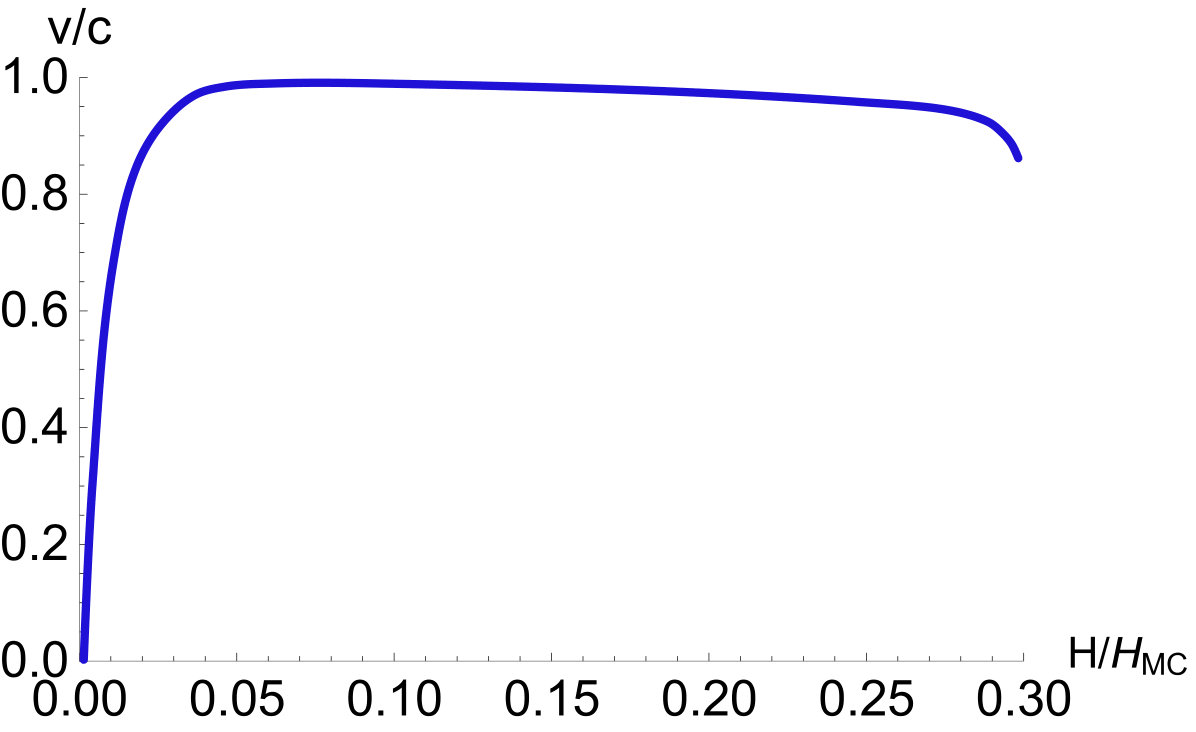 Figure 1
Peer Reviews
No public reviews on file for this paper yet. If you reviewed it on a platform where reviews are public (OpenReview, ICLR, NeurIPS, ICML), you can paste yours below so the community can read it here.
Videos
No videos yet. Explain this paper in a talk, walkthrough, or lecture? Add one.
Taxonomy
TopicsMagnetic Properties and Applications · Multiferroics and related materials · Magnetic properties of thin films
Dynamics of domain walls in weak ferromagnets
Zvezdin, A.K
Prokhorov General Physics Institute, Russian Academy of Sciences, Moscow 119991
Abstract
Pis*′*ma Zh. Exp. Teor. Fiz. 29, No. 10, 605-610 (20 May 1979)
It is shown that the total set of equations, which determines the dynamics of the domain bounds (DB) in a weak ferromagnet, has the same type of specific solution as the well-known Walker’s solution for ferromagnets. We calculated the functional dependence of the velocity of the DB on the magnetic field, which is described by the obtained solution. This function has a maximum at a finite field and a section of the negative differential mobility of the DB. According to the calculation, the maximum velocity cm/sec in YFeO3 is reached at Oe.
pacs:
75.60.Ch
I
The Landau-Lifshitz equations for a double sublattice weak ferromagnet can be represented in the form 111For definiteness, we examine a crystal of rhombic symmetry.
[TABLE]
To describe the dynamics of the domain bound, let us go over to the angular variables , , , and in which (, ):
[TABLE]
To write Eqs. (1) we use the Lagrange formalism in the variables , , , and . The Lagrange function , the dissipative function , and the corresponding Euler equations are
[TABLE]
[TABLE]
[TABLE]
II
At we have a specific solution of the nonlinear equations (5) Walker and Dillon (1963), 222It has the same meaning as the well-known Walker’s solution Walker and Dillon (1963) for ferromagnets, although its equations are more complex. : , , , and . As a result of substituting this solution in Eqs. (5), two of the equations (obtained by varying and ) become identities and the other two have the form
[TABLE]
where
[TABLE]
First, let us determine the approximate solution of Eqs. (6a) and (6b). In Eq. (6b) the terms and can be deleted in comparison to . The parameters of smallness of the deleted terms are and , where cm and is the thickness of the moving domain bound. Thus, we have from Eq. (6b)
[TABLE]
Substituting it in Eq. (6a), we obtain
[TABLE]
where . At and this equation becomes the well-known Sine-Gordon equation. Its one-dimensional solution, which satisfies the boundary con- ditions , , has the form
[TABLE]
where . This function satisfies Eq. (8) at and , but for a specific value of , satisfies the equation, , which can be easily verified by substituting Eq. (9) in Eq. (8). From the last equation using Eq. (9) we obtain Gyorgy and Hagedorn (1968),333 A similar dependence was obtained in Ref. [Gyorgy and Hagedorn, 1968], where the authors assumed that the dynamics of the weak ferromagnetic moment are described by the same equations as the dynamics of the ferromagnet and the magnetization remains constant during the motion of the domain bounds.:
[TABLE]
The physical nature of such a dependence can be described if we use the mechanical analogy of the motion of DB. If the dependence of and on is sufliciently small (the characterisitic frequencies of their variation are much smaller than ), we can obtain from Eq. (8) the following equation for the velocity of DB
[TABLE]
where
[TABLE]
All the terms in Eq. (11) have a clear mechanical meaning; is the frictional force acting on the domain bounds, is the pressure exerted on the domain bounds, etc. At Eq. (11) gives Eq. (10). Thus, the velocity of the domain bounds saturates as because of the “relativistic” dependence of the mass of the DB on its velocity. Chetkin et al. Chetkin et al. (1977); Chetkin and de La Campa (1978) observed experimentally and investigated the effect of saturation of the velocity of DB in YFeO3; they Chetkin and de La Campa (1978) as well as Bar’yakhtar et al. Baryakhtar et al. (1978) theoretically estimated the limiting velocity of the DB in orthoferrites.
III
At the deleted terms in Eq. (6b) should be taken into account. Let us analyze asymptotically Eqs. (6a) and (6b) by the method proposed and developed in Refs. [Schlömann, 1971] and [Eleonskiy and Kirova, 1975]. Let us linearize Eqs. (6a) and (6b) near the stationary points and , which correspond to the domains, and let us find solutions of the linear equations in the form at . The conditions for the existence of nontrivial solutions have the form
[TABLE]
Let us assume that there is a solution of the nonlinear equations (6a) and (6b) in the form , and that the function is symmetric; thus the equality , where and are determined by Eq. (12), gives (in the linear approximation of and ):
[TABLE]
where
[TABLE]
These equations determine the function in the parametric form. The characteristic shape of this curve is given in Fig. 1. The maximum of this curve, which has the coordinates 444This velocity coincides with that obtained in Ref. [Baryakhtar et al., 1978].: , , corresponds to and the point , corresponds to . The quantity characterizes the thickness ratio of the DB at and . The function (13) coincides with Eq. (10) at or at . The last inequality is the condition of applicability of Eqs. (8) and (10). The motion of the DB, in which rotates in the plane, is determined by more complicated equations than (6a) and (6b), but the function , which is determined by Eqs. (10), (13a), and (13b), remains valid in this case (if ). In them it must be assumed that .
IV
We give the numerical estimates. In YFeO3 erg/cm, Oe, Oe, and . The “scale” of the field H MC can be expressed in terms of the mobility when : . Hence, . According to Ref. [Uait, 1971], cm/secOe. Using these values, we obtain cm/sec, Oe, s, and Oe.
The reference list from the paper itself. Each links out to its DOI / PubMed record.
- 1Note (1) For definiteness, we examine a crystal of rhombic symmetry.
- 2Walker and Dillon (1963) L. Walker and J. Dillon, Magnetism 3 , 450 (1963).
- 3Note (2) It has the same meaning as the well-known Walker’s solution Walker and Dillon ( 1963 ) for ferromagnets, although its equations are more complex.
- 4Gyorgy and Hagedorn (1968) E. Gyorgy and F. Hagedorn, Journal of Applied Physics 39 , 88 (1968).
- 5Note (3) A similar dependence v ( H ) 𝑣 𝐻 v(H) was obtained in Ref. [ \rev@citealpnum gyorgy 1968 analysis], where the authors assumed that the dynamics of the weak ferromagnetic moment are described by the same equations as the dynamics of the ferromagnet and the magnetization remains constant during the motion of the domain bounds.
- 6Chetkin et al. (1977) M. Chetkin, A. Shalygin, and A. Kampa, Fizika Tverdogo Tela 19 , 3470 (1977).
- 7Chetkin and de La Campa (1978) M. Chetkin and A. de La Campa, JETP Letters 27 , 157 (1978).
- 8Baryakhtar et al. (1978) V. Baryakhtar, B. Ivanov, and A. Sukstanskii, Fizika Tverdogo Tela 20 , 2177 (1978).