A "Gauged" $U(1)$ Peccei-Quinn Symmetry
Hajime Fukuda, Masahiro Ibe, Motoo Suzuki, Tsutomu T. Yanagida

TL;DR
This paper proposes a simple mechanism embedding the Peccei-Quinn global symmetry into a gauged $U(1)$, providing a plausible origin for the PQ symmetry in solving the strong $CP$ problem.
Contribution
It introduces a straightforward method to derive the PQ symmetry from a gauged $U(1)$, enhancing theoretical understanding of its origin.
Findings
The mechanism can be implemented in various models with PQ symmetry.
It offers a new perspective on the origin of the PQ symmetry.
The approach simplifies the embedding of the PQ symmetry in gauge theories.
Abstract
The Peccei-Quinn (PQ) solution to the strong problem requires an anomalous global symmetry, the PQ symmetry. The origin of such a convenient global symmetry is quite puzzling from the theoretical point of view in many aspects. In this paper, we propose a simple prescription which provides an origin of the PQ symmetry. There, the global PQ symmetry is virtually embedded in a gauged PQ symmetry. Due to its simplicity, this mechanism can be implemented in many conventional models with the PQ symmetry.
Click any figure to enlarge with its caption.
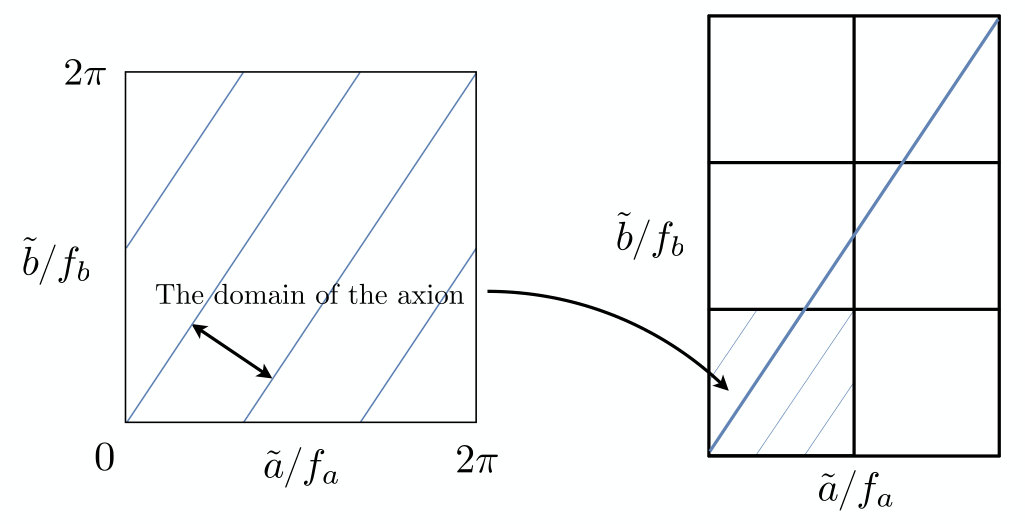 Figure 1
Peer Reviews
No public reviews on file for this paper yet. If you reviewed it on a platform where reviews are public (OpenReview, ICLR, NeurIPS, ICML), you can paste yours below so the community can read it here.
Videos
No videos yet. Explain this paper in a talk, walkthrough, or lecture? Add one.
A “Gauged” Peccei-Quinn Symmetry
Hajime Fukuda
Kavli IPMU (WPI), UTIAS, University of Tokyo, Kashiwa, Chiba 277-8583, Japan
Masahiro Ibe
ICRR, University of Tokyo, Kashiwa, Chiba 277-8582, Japan
Kavli IPMU (WPI), UTIAS, University of Tokyo, Kashiwa, Chiba 277-8583, Japan
Motoo Suzuki
ICRR, University of Tokyo, Kashiwa, Chiba 277-8582, Japan
Kavli IPMU (WPI), UTIAS, University of Tokyo, Kashiwa, Chiba 277-8583, Japan
Tsutomu T. Yanagida
Kavli IPMU (WPI), UTIAS, University of Tokyo, Kashiwa, Chiba 277-8583, Japan
Abstract
The Peccei-Quinn (PQ) solution to the strong problem requires an anomalous global symmetry, the PQ symmetry. The origin of such a convenient global symmetry is quite puzzling from the theoretical point of view in many aspects. In this paper, we propose a simple prescription which provides an origin of the PQ symmetry. There, the global PQ symmetry is virtually embedded in a gauged PQ symmetry. Due to its simplicity, this mechanism can be implemented in many conventional models with the PQ symmetry.
††preprint: IPMU 17-0040
I Introduction
The Peccei-Quinn (PQ) mechanism Peccei and Quinn (1977a, b); Weinberg (1978); Wilczek (1978) is the most successful solution to the strong problem. There, a global symmetry (the PQ symmetry) which is almost exact but broken by the axial anomaly of QCD plays a crucial role. After spontaneous breaking, the effective -angle of QCD is cancelled by the vacuum expectation value (VEV) of the associated pseudo Nambu-Goldstone boson, the axion .
The origin of such a convenient global symmetry is, however, quite puzzling from the theoretical point of view in many aspects. By definition, the PQ symmetry is not an exact symmetry. Besides, the postulation of global symmetries is not comfortable in the sense of general relativity. It is also argued that all global symmetries are broken by quantum gravity effects Hawking (1987); Lavrelashvili et al. (1987); Giddings and Strominger (1988); Coleman (1988); Gilbert (1989); Banks and Seiberg (2011).
In this paper, we address a question in which circumstances a theory admits the global PQ symmetry. If we could regard the PQ symmetry as a gauge symmetry, there would be no suspicion about the exactness and the consistency with quantum gravity. The PQ symmetry is, however, broken by the QCD anomaly, and hence, it cannot be a consistent gauge symmetry as it is.
To circumvent the dilemma, let us recall that, for example, the gauge symmetry of the Standard Model would be anomalous if it coupled only to the lepton sector. The anomalies of the gauge symmetry in the lepton sector are cancelled only when it also couples to the quark sector. In a similar manner, it seems conceivable that the anomalies of the gauged PQ symmetry, , are cancelled between the contributions from two (or more) PQ charged sectors.
To make one step forward, let us assume that the PQ charged sectors are completely decoupled with each other except for gauge interactions. In this limit, an additional accidental symmetry appears, whose charge assignment coincides with the symmetry in each sector up to relative normalizations. There, the accidental symmetry is broken only by the QCD anomaly, and hence, it plays the role of the global PQ symmetry for the PQ mechanism.
The interactions between the PQ charged sectors inevitably break the accidental symmetry. Thus, the original question about the plausibility of the global PQ symmetry is reduced to the question how well such cross-sector symmetry breaking operators are suppressed. To this question, the gauged PQ symmetry again provides an answer. The cross-sector symmetry breaking operators can be suppressed by an appropriate charge assignment of . Therefore, the origin of the anomalous global PQ symmetry can be attributed to a gauged PQ symmetry.
In the literature, there have been many attempts to achieve the PQ symmetry as an accidental symmetry resulting from (discrete) gauge symmetries Kim (1981); Georgi et al. (1981); Dimopoulos et al. (1982); Frampton (1982); Kang et al. (1982); Lazarides and Shafi (1982); Barr and Seckel (1992); Kamionkowski and March-Russell (1992); Holman et al. (1992); Dine (1992); Dias et al. (2003); Carpenter et al. (2009); Harigaya et al. (2013, 2015); Redi and Sato (2016) 111Discrete gauge symmetries are immune to quantum gravity effects Krauss and Wilczek (1989); Preskill and Krauss (1990); Preskill et al. (1991); Banks and Dine (1992). . There have also been arguments of the origin of the axion in string theory Witten (1984); Kallosh et al. (1995); Svrcek and Witten (2006) and in extra dimensional setups Cheng and Kaplan (2001); Izawa et al. (2002); Hill and Leibovich (2002); Fukunaga and Izawa (2003); Izawa et al. (2004); Choi (2004); Grzadkowski and Wudka (2008).
In this context, our prescription adds a simple field theoretical explanation of the origin of the PQ symmetry. There, the PQ symmetry is virtually embedded in a gauged PQ symmetry 222A model discussed in Cheng and Kaplan (2001) also achieve an virtual embedment of the PQ symmetry in a gauged PQ symmetry in an extra dimensional setup. . Due to its simplicity, this mechanism can be implemented in many conventional models with the PQ symmetry. We also emphatically refer Lazarides and Shafi (1982); Barr et al. (1982); Choi and Kim (1985a) which discuss the domain wall problems of axion models with similar structures we consider in the following.
II General prescription
Let us recall invisible axion models such as the KSVZ model Kim (1979); Shifman et al. (1980) or the DSFZ model Dine et al. (1981); Zhitnitsky (1980). There, the postulated anomalous global PQ symmetry is spontaneously broken with which the axion field associates. The non-perturbative effects of QCD generate the axion potential through the axial anomalies.
Now let us bring two sectors of the invisible axion models. The two PQ symmetries in each sector, and , are explicitly broken by the QCD anomalies, and the corresponding Noether currents and satisfy the anomalous ward identities,
[TABLE]
Here, the gauge field strength of QCD, the QCD coupling constant. The Lorentz indices and the color indices are suppressed. The coefficients and depend on each invisible axion model.
In the two anomalous symmetries, there is a linear combination which is free from the QCD anomaly. Hereafter, we consider that the anomaly free combination is a gauge symmetry, which we name the symmetry. Here, we assume that the is free from all anomalies 333The anomaly and the gravitational anomaly of can be cancelled by adding fermions which are singlet under the Standard Model gauge groups..
In each sector, breaking operators of the global PQ symmetries are forbidden by the symmetry. Therefore, the symmetry provides protection of the PQ symmetries in each sector.
Let us further assume that there are no interactions between the two sectors except for the gauge interactions. In this limit, the PQ symmetries in each sector are broken only by the anomalies. It should be noted that the radiative corrections generate interactions between the two sectors. Those corrections, however, do not break the PQ symmetries in each sector since they are broken only by the and the QCD anomalies. Therefore, in this limit, the theory possesses an accidental symmetry in addition to the gauge symmetry. In the following, we call this anomalous accidental symmetry, . As it has been noted, the symmetry plays the role of the PQ symmetry for the PQ mechanism.
In reality, there are interaction terms between the two sectors. In particular, there are terms which are invariant under the gauge symmetry but break the symmetry. For example, let us consider operators and which consist of fields in each sector, respectively. When these two operators have non-vanishing and opposite charges, the interaction terms
[TABLE]
explicitly break the symmetry. Here, denote the mass dimensions of the corresponding operators, and denotes the reduced Planck scale. Given the general discussion that all global symmetries are broken by quantum gravity effects, there is no principle to suppress these terms since it is consistent with gauge symmetries.
Such explicit breaking terms of the symmetry are, however, acceptable as long as the breaking effects are small enough not to spoil the PQ mechanism. In practice, the current experimental upper limit on the angle, Baker et al. (2006), can be satisfied for when the PQ symmetries are spontaneously broken at GeV Barr and Seckel (1992); Kamionkowski and March-Russell (1992); Holman et al. (1992).
The mass dimensions of the lowest dimensional symmetry breaking operator depends on the charge assignment of . In fact, as we exemplify later, there are many possible charge assignments which suppress the breaking effects down to an acceptable level.
III Decomposition of and
Before moving to explicit examples, let us discuss how to decompose the and the symmetries. For that purpose, let us consider a simple example where the invisible axion candidates in the two sectors correspond to the axial components of complex SM gauge singlet scalar fields and ,
[TABLE]
Here, are the decay constants of each sector and we keep only the axial components, and . The domains of them are given
[TABLE]
respectively.
Let us assume that the gauge charges of the complex scalars are and , respectively. In this case, the axial components are shifted by,
[TABLE]
under the symmetry. Hereafter, we take the normalization of such that and are relatively prime integers without loosing generality.
From the covariant kinetic terms of and , we obtain
[TABLE]
where, is the gauge coupling constant of . The mass of the gauge boson, , is given by,
[TABLE]
In the final expression, we redefine the axial fields by
[TABLE]
The field is the would-be Nambu-Goldstone boson, while the gauge invariant field corresponds to the PQ axion.
To extract an gauge invariant global symmetry, let us remember that a gauge orbit of winds the domain of more than once for (see Fig. 1). Then, the domain of is given by the interval of the gauge orbit in the domain since the field points connected by a gauge orbit is physically equivalent. When we take that and are relatively prime integers, we find the axion interval in the figure is given by,
[TABLE]
Thus, with a decay constant,
[TABLE]
the symmetry is realized by the shift of the axion,
[TABLE]
with ranging from [math] to 444We may extend our analysis where there is a kinetic mixing between and , although the kinetic mixing does not change our discussion..
The anomalous coupling of the axial components depends on models of the invisible axion models. In order for the symmetry is free from the anomaly, the anomalous coupling should appear in the form of
[TABLE]
Here, is a model dependent integer.
IV Examples
IV.1 Barr-Seckel Model
As the simplest example, let us discuss a model based on two KSVZ axion models Kim (1979); Shifman et al. (1980). This example corresponds to the model discussed in Barr and Seckel (1992).
In each KSVZ sector, the PQ symmetry is spontaneously broken by the VEVs of complex scalars and whose PQ charges are unity. In each sector, the scalars couple to extra vector-like quarks via
[TABLE]
and
[TABLE]
The PQ charges of the extra quarks are taken to be and in the first KSVZ sector and and in the second sector. We assume that there are and flavors of the extra quarks in each sector.
Due to the QCD anomaly, the axion candidates in each sector have anomalous coupling,
[TABLE]
Here, we define the axial components of the KSVZ scalars as in Eq. (3). From this expression, we find that a linear combination of the two PQ symmetries with the charge assignments and is free from the anomaly for
[TABLE]
As discussed in the previous section, we regard the anomaly free PQ symmetry as the gauge symmetry, where and are normalized so that they are relatively prime integers.
Under the symmetry, no explicit PQ breaking operators appear in each sector. The interaction terms between the two KSVZ sectors, on the other hand, generically break . In fact, the lowest dimensional operator which breaks the symmetry is given by,
[TABLE]
As we have seen in the previous section, the explicit breaking of the PQ symmetry is acceptable when . Once this condition is satisfied, the anomalous of an acceptable quality appears as a result of the gauge symmetry.
Let us comment here that and in our normalization are given by,
[TABLE]
when and has common divisors, . In this case, the anomalous coupling of the axion is given by,
[TABLE]
which means in Eq. (13).
IV.2 Composite Axion Model
As a second example, let us apply our prescription to the so-called composite axion model Kim (1985); Choi and Kim (1985b) 555For other attempts to obtain a high-quality PQ symmetry in the composite axion model, see e.g. Randall (1992); Redi and Sato (2016).. There, we consider an gauge theory with vector-like fermions of QCD quantum numbers,
[TABLE]
This model possesses an axial symmetry with the charge assignments,
[TABLE]
This symmetry is free from the anomaly of but broken by the QCD anomaly. We identify this symmetry with the anomalous PQ symmetry in the first sector. The anomalous PQ symmetry is spontaneously broken at the dynamical scale of , where the axion appears as an composite field 666There are light pseudo-goldstone modes associated with the chiral symmetry breaking at , which are color charged except for the axion candidate. The colored pseudo Nambu-Goldstone bosons obtain masses of where . See e.g. Izawa et al. (2002). .
According to the general prescription, we further introduce another sector of the composite composite axion where is replaced by . The PQ symmetry in this sector is also broken spontaneously at the dynamical scale of .
In this model, the anomalous couplings of the axion candidates are given by
[TABLE]
Here, the decay constants are taken so that the domains of and coincide with the domains of the axial components of the quark bilinears, and , respectively. From Eq. (32), we find an anomaly free combination is given by taking
[TABLE]
with which we identify the gauge symmetry in our general prescription. The anomalous symmetry is, on the other hand, given by Eq. (20). The axion domain wall number corresponds to the greatest common devisor of and .
Under the symmetry, there are explicit breaking terms of the symmetry,
[TABLE]
These operators does not spoil the PQ solution for . Thus, for example, a model with and provides the origin of the anomalous PQ symmetry for the successful PQ mechanism.
For or (), there are additional lower dimensional operators which break the symmetry,
[TABLE]
or
[TABLE]
Those operators are harmless for or , which can be satisfied for and for example.
V Discussions
In this paper, we made an attempt to explain an origin of the anomalous global PQ symmetry. In our prescription, the anomalous global PQ symmetry originates from the gauged symmetry where the PQ symmetry is virtually embedded in a gauged symmetry. Due to its simplicity, this mechanism can be implemented in many conventional models with the PQ symmetry.
In this prescription, the anomalous PQ symmetry appears as an approximate symmetry. Thus, it is expected that the PQ symmetry is broken not only by the QCD anomaly but by some very higher dimensional operators to some extent. Thus, the effective -angle at the vacuum of the axion field is expected to be non-vanishing completely, though its numerical value highly depends on models.
As we have seen, our prescription allows models with either or . For , the axion potential generated by the non-perturbative QCD effects has a symmetry. When the symmetry is an exact symmetry, models with causes a serious domain wall problem if spontaneous breaking of the PQ symmetry takes place after inflation 777In our prescription, however, is not an exact symmetry, and hence, the domain wall problem associated for might be avoidable by the effects of the explicit symmetry breaking Hiramatsu et al. (2011).. On top of the above arguments, there can also be a serious domain wall problem even for = 1 Barr et al. (1987).
A trivial solution to the domain wall problems is to assume that the PQ symmetry breaking takes place before the end of inflation. In this case, the Hubble constant during inflation is limited from above to avoid the so-called isocurvature problem Axenides et al. (1983); Seckel and Turner (1985); Linde (1985); Linde and Lyth (1990); Turner and Wilczek (1991); Lyth (1992).
Acknowledgements
This work is supported in part by Grants-in-Aid for Scientific Research from the Ministry of Education, Culture, Sports, Science, and Technology (MEXT) KAKENHI, Japan, No. 25105011 and No. 15H05889 (M. I.) as well as No. 26104009 (T. T. Y.); Grant-in-Aid No. 26287039 (M. I. and T. T. Y.) and No. 16H02176 (T. T. Y.) from the Japan Society for the Promotion of Science (JSPS) KAKENHI; and by the World Premier International Research Center Initiative (WPI), MEXT, Japan (M. I., and T. T. Y.). The work of H.F. is supported in part by a Research Fellowship for Young Scientists from the Japan Society for the Promotion of Science (JSPS).
The reference list from the paper itself. Each links out to its DOI / PubMed record.
- 1Peccei and Quinn (1977 a) R. D. Peccei and H. R. Quinn, Phys. Rev. Lett. 38 , 1440 (1977 a) . · doi ↗
- 2Peccei and Quinn (1977 b) R. D. Peccei and H. R. Quinn, Phys. Rev. D 16 , 1791 (1977 b) . · doi ↗
- 3Weinberg (1978) S. Weinberg, Phys. Rev. Lett. 40 , 223 (1978) . · doi ↗
- 4Wilczek (1978) F. Wilczek, Phys. Rev. Lett. 40 , 279 (1978) . · doi ↗
- 5Hawking (1987) S. W. Hawking, Moscow Quantum Grav.1987:0125 , Phys. Lett. B 195 , 337 (1987) . · doi ↗
- 6Lavrelashvili et al. (1987) G. V. Lavrelashvili, V. A. Rubakov, and P. G. Tinyakov, JETP Lett. 46 , 167 (1987), [Pisma Zh. Eksp. Teor. Fiz.46,134(1987)].
- 7Giddings and Strominger (1988) S. B. Giddings and A. Strominger, Nucl. Phys. B 307 , 854 (1988) . · doi ↗
- 8Coleman (1988) S. R. Coleman, Nucl. Phys. B 310 , 643 (1988) . · doi ↗