A splitter theorem for connected clutters
Amanda Cameron, Dillon Mayhew

TL;DR
This paper generalizes the concept of connectivity from matroids to clutters and proves a splitter theorem for connected clutters, extending known results in matroid theory.
Contribution
It introduces a connectivity notion for clutters and establishes a splitter theorem that generalizes the matroid case.
Findings
Established a connectivity concept for clutters
Proved a splitter theorem for connected clutters
Extended matroid splitter theorem to clutters
Abstract
A clutter consists of a finite set and a collection of pairwise incomparable subsets. Clutters are natural generalisations of matroids, and they have similar operations of deletion and contraction. We introduce a notion of connectivity for clutters that generalises that of connectivity for matroids. We prove a splitter theorem for connected clutters that has the splitter theorem for connected matroids as a special case: if and are connected clutters, and is a proper minor of , then there is an element in that can be deleted or contracted to produce a connected clutter with as a minor.
Click any figure to enlarge with its caption.
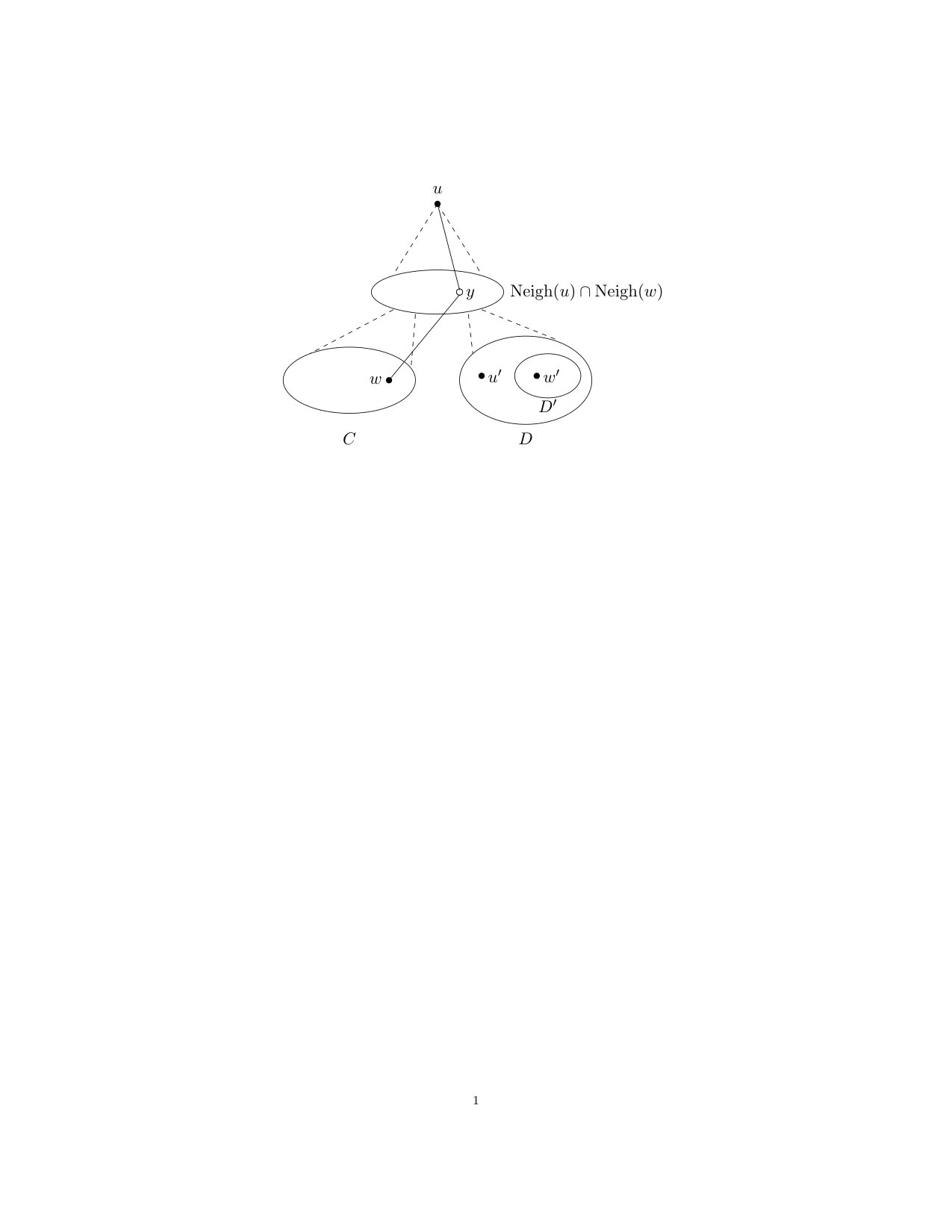 Figure 1
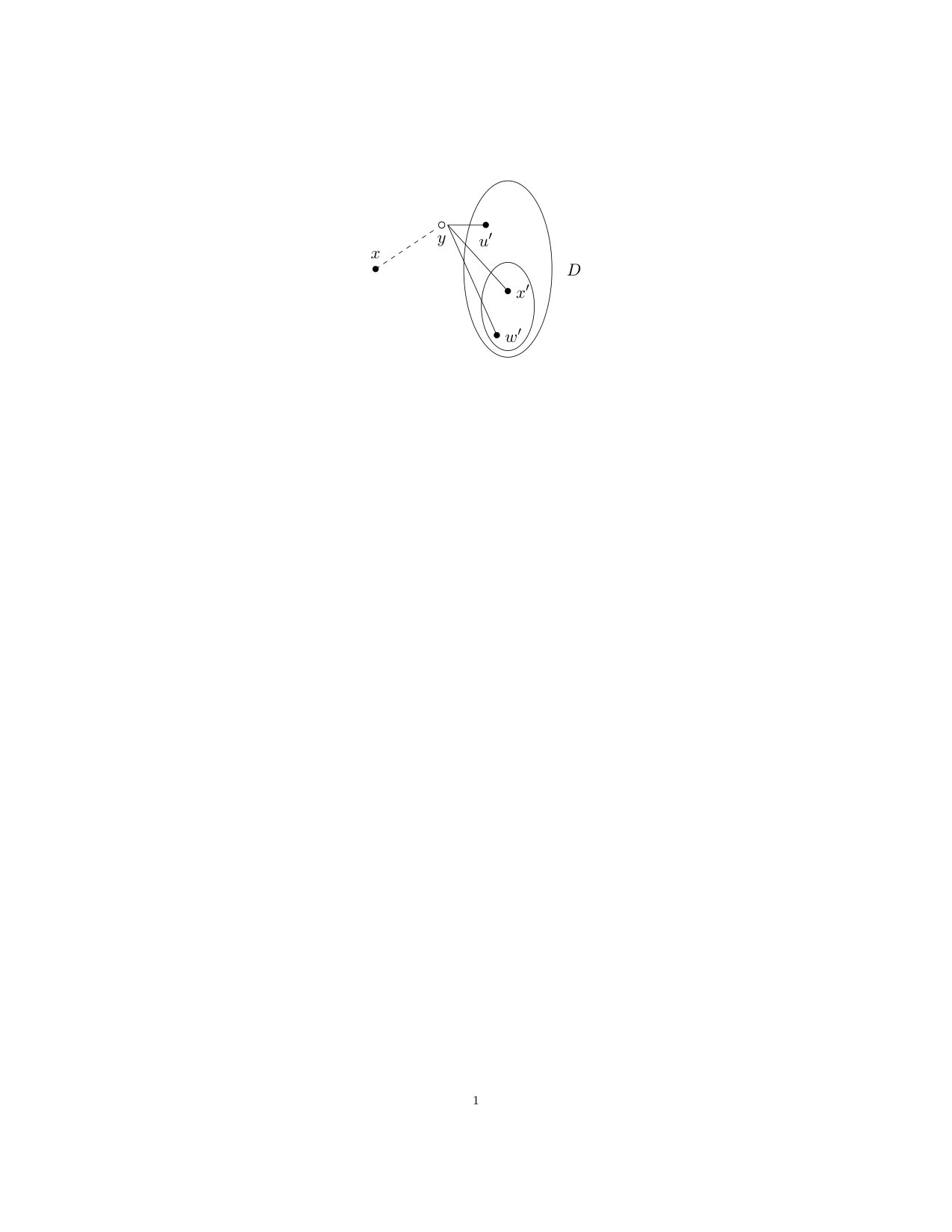 Figure 2
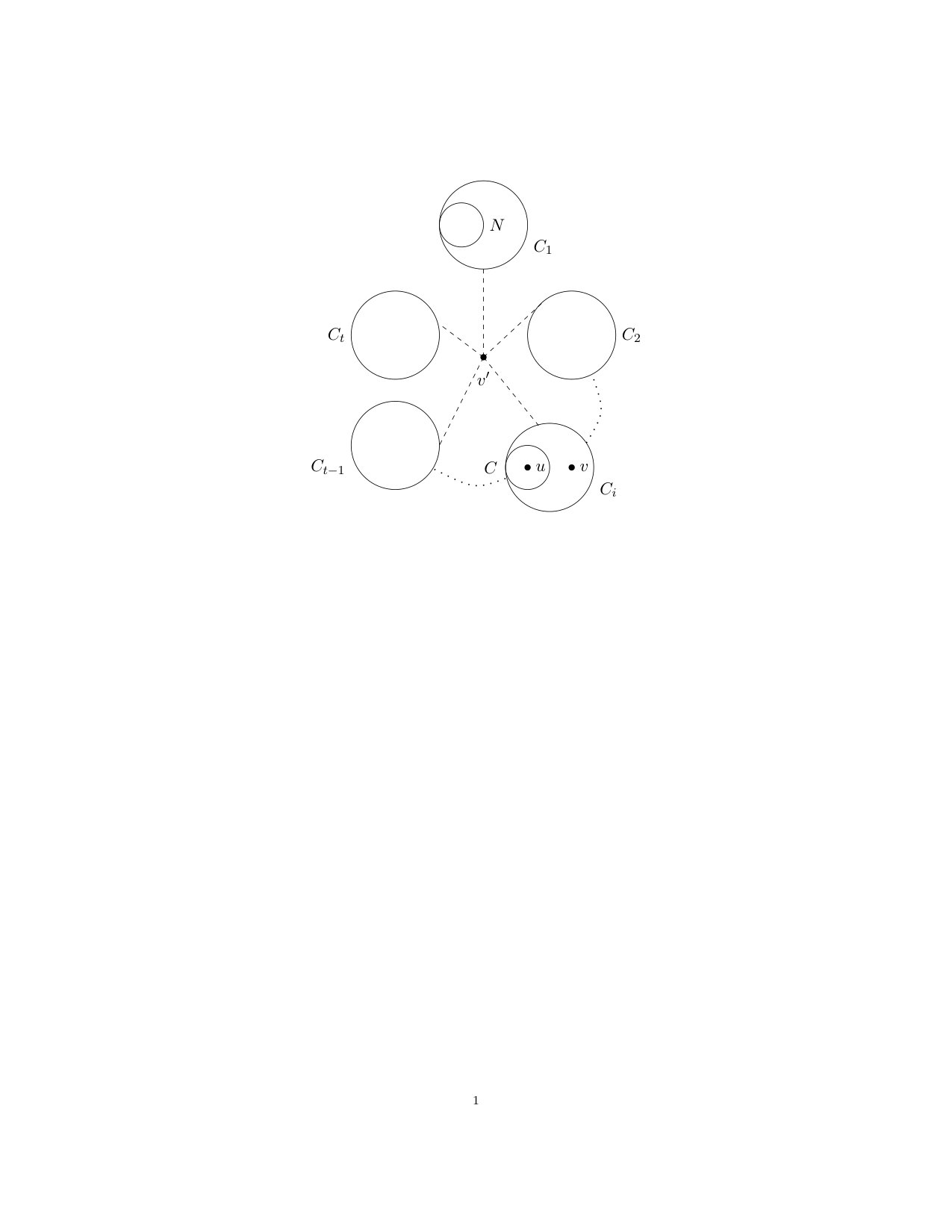 Figure 3
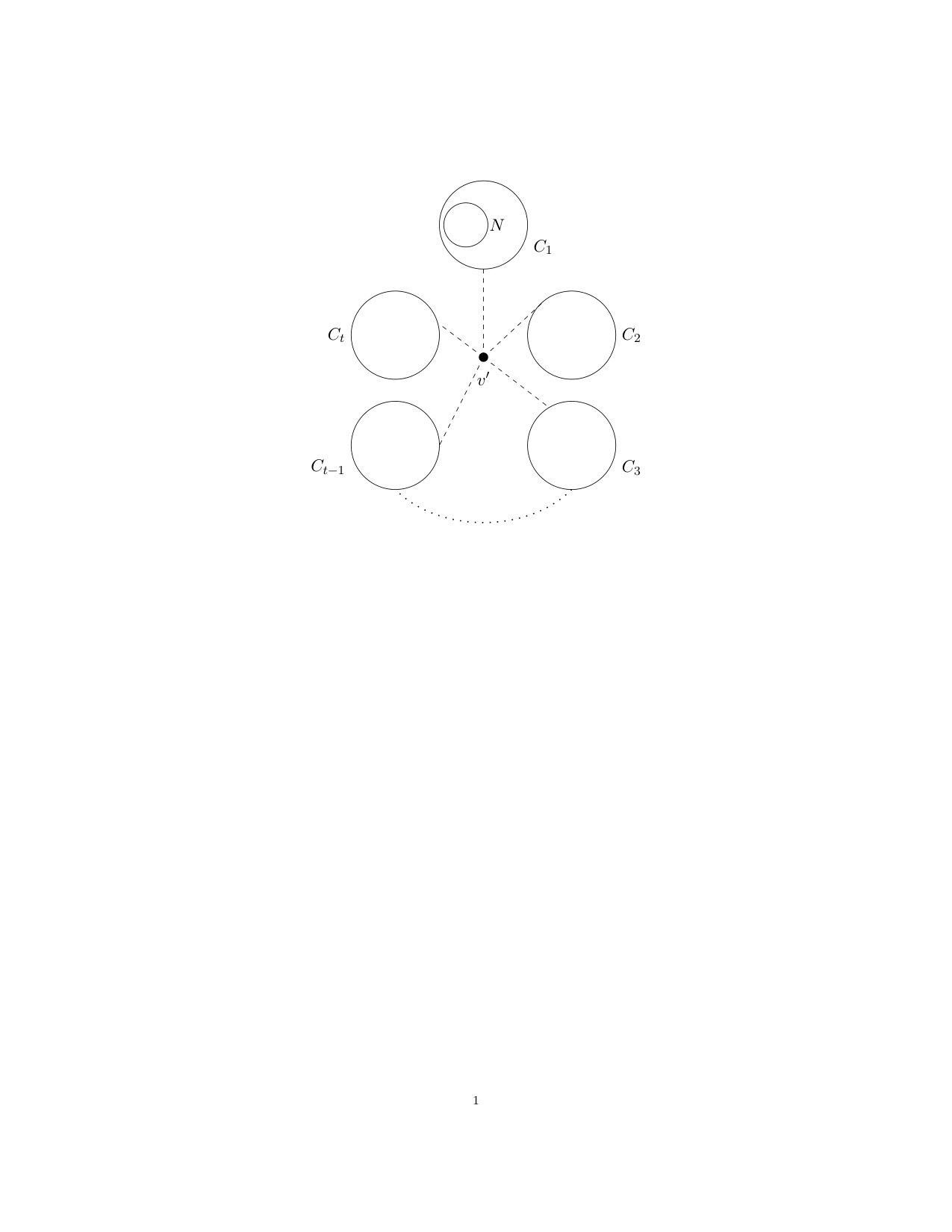 Figure 4
Peer Reviews
No public reviews on file for this paper yet. If you reviewed it on a platform where reviews are public (OpenReview, ICLR, NeurIPS, ICML), you can paste yours below so the community can read it here.
Videos
No videos yet. Explain this paper in a talk, walkthrough, or lecture? Add one.
Taxonomy
TopicsAdvanced Graph Theory Research · Complexity and Algorithms in Graphs · Optimization and Search Problems
A splitter theorem for connected clutters
Amanda Cameron111Corresponding author. Email: [email protected]
School of Mathematical Sciences, Queen Mary University of London, Mile End Road, London, United Kingdom E1 4NS
Dillon Mayhew Email: [email protected] School of Mathematics, Statistics and Operations Research, Victoria University of Wellington, PO Box 600, Wellington, New Zealand
Abstract
A clutter consists of a finite set and a collection of pairwise incomparable subsets. Clutters are natural generalisations of matroids, and they have similar operations of deletion and contraction. We introduce a notion of connectivity for clutters that generalises that of connectivity for matroids. We prove a splitter theorem for connected clutters that has the splitter theorem for connected matroids as a special case: if and are connected clutters, and is a proper minor of , then there is an element in that can be deleted or contracted to produce a connected clutter with as a minor.
1 Introduction
A clutter is a pair , where is a finite set, and is a collection of subsets of , with the property that if and are distinct members of , then . We refer to as the ground set of the clutter. We call members of rows of the clutter. In the literature, elements of the ground set are often referred to as vertices, while rows are called edges. Since we will later represent rows of a clutter by vertices in a graph, we prefer to avoid this terminology. If is a clutter, then denotes its ground set.
For an example of a clutter, we may take the rows to be the circuits of a matroid. Thus clutters are natural generalisations of matroids: they lie somewhere on the spectrum between matroids, and completely general hypergraphs. It may seem as though clutters are significantly more general objects than matroids, but there are some reasons to view them as being closer to the matroid end of the spectrum. In particular, there are notions of deletion and contraction for clutters. If is a clutter, and is an element of , we define to be the clutter
[TABLE]
and we let be the clutter on the set whose rows are the sets in that are minimal under subset-inclusion. We say that and are produced by deleting and contracting respectively. These clutter operations extend the matroidal operations: if is the clutter of circuits in the matroid , then and are the clutters of circuits in the matroids and . Any clutter produced from by a (possibly empty) sequence of deletions and contractions is a minor of . A minor produced by a non-empty sequence of deletions and contractions is a proper minor.
The following result is in [2], and shows that the order of deletion and contraction is immaterial.
Proposition 1.1**.**
Let be a clutter, and let and be elements of . Then (i) , (ii) , and (iii) .
Clutters, moreover, have a duality involution that is analogous to matroid duality. If is a clutter, then the blocker of , written , has as its ground set, and its rows are the minimal subsets of that have non-empty intersection with each row of . Edmonds and Fulkerson [3] proved that . This involution swaps deletion and contraction, just as matroid duality does. Thus and .
In this article we present evidence that pushes clutters further in the matroid direction along the matroid-hypergraph continuum. We show that some connectivity behaviour in matroids is actually just a special case of a clutter phenomenon. To do so, we must develop a notion of connectivity for clutters.
Definition 1.2**.**
Let be a clutter. A separation of is a partition of into non-empty parts, and , such that every row is contained in or . If admits no separation then it is connected.
This is a natural way to define connectivity for clutters, since it generalises connectivity for graphs and for matroids. If is a clutter and each row has cardinality two, then can be identified with a simple graph , with vertex set , whose edges are the rows of . In this case, is connected if and only if is. Similarly, if the rows of are the circuits of a matroid, , then separations of and exactly coincide. Therefore is connected if and only if is.
We would like to know which inductive properties of matroid connectivity extend to connected clutters. Our first observation is a negative one. If is a connected matroid, and is an element of its ground set, then either or is a connected matroid [5][Theorem 4.3.1]. This phenomenon does not extend to clutters. To see this, consider a clutter, , whose edges all have cardinality two, and therefore correspond to the edges of a graph, . Assume is a cut-vertex in . Then corresponds to the graph produced from by deleting and all edges incident with it. This is certainly not a connected clutter. On the other hand, is produced by removing , all rows containing , all rows containing a neighbour of in , and then adding all such neighbours as singleton rows. It is clear that this clutter will also fail to be connected.
On the other hand, our main theorem is positive. Brylawski [1] and Seymour [6] independently proved that if is a connected matroid with a connected proper minor, , then we can delete or contract an element from in such a way to preserve connectivity, and the minor . We prove that this is a special case of a clutter phenomenon.
Theorem 1.3**.**
Let and be connected clutters and assume that is a proper minor of . There exists an element, , such that either or is connected and has as a minor.
This type of theorem is known as a splitter theorem, after Seymour’s well-known splitter theorem for -connected matroids [7]. We obtain, as a corollary, a weaker type of statement, known as a chain theorem.
Corollary 1.4**.**
Let be a non-empty connected clutter. Then there is an element, , such that either or is a connected clutter.
Proof.
Since every clutter has the empty clutter as a minor, we simply apply Theorem 1.3 with equal to the empty clutter. ∎
We note that our notion of connectivity is not invariant under taking blockers. To see this, let be a clutter whose rows are the circuits of a matroid, . Assume that admits a separation, , but that the dual matroid, , has no circuits of size less than three. By an earlier observation, is also a separation of . The rows of are the bases of [4]. Assume that is a separation of , and let and be elements from and , respectively. Then no basis of contains both and , so contains a circuit of size at most two, contrary to hypothesis. Thus is a connected clutter, even though is not.
The main tool we use to prove Theorem 1.3 is the incidence graph of a clutter. Let be a clutter. We use to denote the incidence graph of . The vertex set of is . We say that vertices in are black and vertices in are white. Every edge of joins a black vertex to a white vertex, so is bipartite. The vertex is adjacent to in if and only if is contained in .
The incidence graph allows us to study clutter connectivity in graph theoretical terms.
Proposition 1.5**.**
Let be a clutter. If is connected, then is connected. If is connected, and is not the clutter with a single element and one, empty, row, then is connected.
Proof.
Assume that is not connected. We will prove that either is not connected, or is equal to the special clutter described in the statement of the proposition. Let be a partition of the vertices of into non-empty parts, such that no edge joins a vertex in to a vertex in . Assume that both and contain elements of . Then is clearly a separation of , and is not connected. Therefore we will assume that contains no element of . Thus every vertex in is white. It follows that has a white vertex that is connected to no black vertex, and that therefore has an empty row. Since is a clutter, it follows that has exactly one, empty, row, and that therefore contains a single white vertex, and no edges. Note that is non-empty, for otherwise contains a single vertex, and is therefore connected. If contains at least two elements, then we can find a separation of . Thus we assume that contains exactly one element, and deduce that is the clutter described in the proposition.
Now suppose is not connected and has a separation . White vertices corresponding to rows in are incident only with elements of ; white vertices corresponding to rows in are incident only with elements of . There are no other white vertices in , so this means that there are no paths between vertices in and vertices in . Thus must be disconnected. ∎
2 Proof of the main theorem
If is a vertex of a graph, then represents the set of neighbours of (this set excludes ). We say is the open neighbourhood of . We write for the closed neighbourhood of . That is, . In order for a bipartite graph with black and white vertices to be the incidence graph of a clutter, if and are distinct white vertices of , then cannot be a subset of .
The next result follows immediately from the definition of deletion in clutters.
Proposition 2.1**.**
If is a clutter, and is in , then .
Clutter contraction is somewhat more complicated to observe in the incidence graph. We will use only one special case of contraction. We say that the black vertices, and , are twins if .
Proposition 2.2**.**
Let be a connected clutter. If and are twin black vertices, then and is therefore connected.
Proof.
We form by removing the element from and taking the rows, with deleted, which are minimal under subset-inclusion. Suppose that has two distinct white vertices, and , such that every neighbour of is a neighbour of . This property does not hold in , so must have been adjacent to but not . As is a twin of , then is also adjacent to and not . These adjacencies remain in , and so we have . This shows that in , there is no pair of distinct white vertices, one of whose neighbourhood is contained in the other. It follows that is the incidence graph of .
Finally, it is clear that is connected as for every path using , replacing with gives a second path, and so deleting cannot increase the number of components in the graph. ∎
With this setup, we can immediately begin the proof of the main result.
Theorem 2.3**.**
Let and be connected clutters and assume that is a proper minor of . There exists an element, , such that either or is connected and has as a minor.
Proof.
Assume that and form a counterexample to the theorem. We will let stand for .
2.4**.**
There is an element such that is a minor of .
Proof.
Assume that this is not the case. Then is a minor of for some . Now is not connected, or else and would not give us a counterexample. Therefore is disconnected by Proposition 1.5. Since is connected, it follows easily that is contained in a connected component of . Choose , a component of such that does not contain . If consists of a single white vertex, then has an empty row, and this means that it has exactly one row. Hence contains a single white vertex and no edges. This means that contains at most one element, or else it is not connected. If , then is connected, and so must contain an element that is not in . Let be such an element. Then is an isolated black vertex in , so is a minor of and hence of , contrary to assumption. We must now assume that contains a black vertex, . As is a component of and does not contain any element of , we see that is a minor of and hence of , which is a contradiction. ∎
Note that if and are black vertices, then may be a subset of . Say that is a minimal black vertex if there is no black vertex, , such that properly contains .
2.5**.**
There is a minimal black vertex, , of , such that is a minor of .
Proof.
Assume the statement is false. By 2.4, we can choose a non-minimal black vertex so that is a minor of . Let have the smallest possible degree. First assume , so is connected by Proposition 1.5. Say has components , where . As is not minimal, we will choose a minimal black vertex with . Note this implies is an isolated vertex in , and so is one of the components . Then is clearly not in , so is a minor of , and hence of , as desired.
Now we consider the case that is at most . We will still assume is not minimal, so is properly contained in , for some minimal black vertex . If , then is a minor of , and hence of , for the same reasons as in the previous case. Thus , implying is a single vertex as is isolated in . If , then can be any minimal black vertex and the result follows as will be a minor of . Thus we assume that . Note that is isolated after deleting . This means is the clutter with and no rows. Choose a black vertex . Then is a minor of . If is a minimal black vertex, the result follows. So let be a minimal black vertex with . If , then is a minor of and the result also follows. If , then no neighbour of is in , but any such neighbour is also a neighbour of . It follows that all the neighbours of are also neighbours of . This means is an isolated vertex after deleting , so is a minor of . ∎
Now fix to be a minimal black vertex such that is a minor of . Let be the connected components of , where . Since is connected, we can assume that is contained in .
2.6**.**
If is a black vertex which is not in , then has no twin vertex.
Proof.
First suppose that , and let be a twin of . We know that is a minor of , and we have that is isolated in . It follows easily from Propositions 1.5 and 2.2 that is connected. Moreover, as , the only way cannot contain as a minor is if . But this would imply that does contain as a minor, and is connected, and the theorem would follow. Now let . Assume that is a black vertex in where , and assume that is a twin of . Since is contained in , a component of , and is contained in , it follows that is a minor of , and hence of . But Propositions 1.5 and 2.2 imply that is connected, a contradiction to our counterexample. ∎
If is any minimal black vertex, and is any connected component of , then we define to be a good component. Therefore are good components. The next claim shows that good components contain minimal black vertices.
2.7**.**
Let be a minimal black vertex, and assume that is not in . Let be a component of . Then contains a minimal black vertex.
Proof.
First, we prove that contains a black vertex. If not, then is a single white vertex, . Since is connected, is adjacent with a black vertex, , in . Neither nor belongs to , so and and adjacent in . Thus contains the black vertex, , contrary to hypothesis. Therefore contains at least one black vertex. Let be an arbitrary black vertex in . If is minimal, the result follows. Hence assume that there is a black vertex with . Choose so that its degree is as small as possible, implying that is minimal. If , the result follows, so say where is some connected component of other than . If is adjacent to a white vertex in , we will clearly not have . So , and is adjacent only to neighbours of . As is a minimal black vertex, we deduce that and are twin vertices, which contradicts 2.6. ∎
Note that it is possible for one good component to be contained in another. Let be a minimal black vertex. We say that a component in is minimal if the vertex set of does not properly contain the vertex set of a good component.
2.8**.**
Let be a minimal black vertex, and let be a component in that is disjoint from . Assume that is a minimal good component. If is a black vertex in , then has a common neighbour with .
Proof.
Assume there is a black vertex in that has no common neighbour with . We will prove that there is a minimal black vertex with this property. Let be an arbitrary black vertex in that has no white neighbour in common with . If is not a minimal black vertex, then we can assume that is a minimal black vertex and that . Then is joined to by a path of length , and this path does not contain a white vertex adjacent with , since does not have a neighbour in common with . This means that and are joined by a path in , so both are in . In fact, cannot have a neighbour in common with , because any such neighbour would also be a neighbour of . Thus is a minimal black vertex in having no common neighbours with .
Any white vertex not in that is adjacent to a black vertex in must also be adjacent to . It immediately follows that any white vertex not in is not adjacent to . Therefore every vertex not in is also a vertex in . This implies that the vertices not in are contained in a connected component of . Since , and is disjoint from , it follows that is a minor of . Therefore is not connected, since and form a counterexample to the theorem. It follows that is not connected. Let be a connected component in that is different from the one containing the vertices not in . Every vertex in is also in . But the vertex set of is a proper subset of the vertex set of , since it doesn’t contain . Recall that is a minimal black vertex, and thus is a good component. This contradicts the minimality of . ∎
2.9**.**
Let be a minimal black vertex, where , and let be a component in . Assume that is a minimal good component. Then contains at least two black vertices.
Proof.
By 2.7, we see that contains a minimal black vertex, . Assume that is the only black vertex in . We also assume that contains a white vertex, . Then is the only neighbour of . By 2.8, we can let be a common neighbour of and . Then , a contradiction, since is the incidence graph of a clutter. Therefore . Thus . Since is a minimal black vertex, this means that , so has a twin vertex. As , this is a contradiction to 2.6. ∎
2.10**.**
Let be a minimal black vertex that is not in . Let be a component of , and assume that is a minimal good component. If is a minimal black vertex in , then the component of that contains also contains every vertex in .
Proof.
Note that contains at least two black vertices by 2.9. Therefore contains at least one vertex. Let be an arbitrary vertex in , and let be the component of containing . There must be a vertex in that is not in , for otherwise the vertex set of is a proper subset of the vertex set of , which contradicts the minimality of . It follows that in , there is a path from to a vertex not in . Any such path must contain a neighbour of . It now follows that in there is a path from to . As was chosen arbitrarily from , we see that the component of that contains also contains every vertex in , exactly as desired. ∎
2.11**.**
At least one of the components is not minimal.
Proof.
Assume that are all minimal good components. Say a black vertex, , in one of is interesting if is in the same component as in . Assume is interesting, and chosen so that is smallest possible. We assume that is in , where . Note that is a minor of , and hence is not connected. Thus is not connected. Let be a component in not containing . Then has no vertex in common with , by 2.10. It also has no vertex in common with , since is in the same component as in . Therefore any vertex that is not in , but is adjacent to a vertex in , must be a neighbour of that is not in . Any such vertex is also a neighbour of . Hence is a connected component of . Now we can assume that , where and . Choose , a black vertex in . In order for to be disconnected from the component containing in , we must have that , implying that is interesting. Now by the choice of . Since was arbitrary, this means is disconnected from in , contradicting 2.10.
Now assume that there is no interesting vertex. Let be a vertex in that is adjacent to a vertex in . Let be an arbitrary black vertex in . Then is disconnected from in , as is not interesting by assumption, which implies . As was arbitrary, is adjacent to every black vertex in , as well as . Thus if is a white vertex in , then , a contradiction as is the incidence graph of a clutter. ∎
From now on, we assume that is a good component, but not minimal. Let be a minimal good component, and assume that the vertex set of is properly contained in the vertex set of . Let be a minimal black vertex such that is a component of .
2.12**.**
.
Proof.
If this is not the case, then any common neighbour of and a vertex in must be a common neighbour of and a vertex in . This implies that is a connected component of , which is impossible because the veretx set of is properly contained in the vertex set of a connected component of . ∎
By 2.7, we can choose a minimal black vertex, , in . Let be the component of that contains . By 2.10, also contains . Assume that we have chosen , , and , so that is as large as possible.
2.13**.**
Let be a component of not equal to . Then is a minimal good component.
Proof.
Note that is a good component, since it is disconnected when we delete and its neighbours. Assume is not minimal. Let be a minimal good component such that the vertex set of is properly contained in the vertex set of . Let be a minimal black vertex such that is a component in . Suppose . Then any neighbour of that is adjacent to a vertex in is not in , but is adjacent to a vertex in . The only such vertices are in . This means that is a component of , but this is impossible, since the vertex set of is properly contained in a the vertex set of a component of . Therefore is in .
Assume that there is vertex, , in that is adjacent to . Let be an arbitrary minimal black vertex contained in , and assume that is not a neighbour of . Let be an arbitrary vertex in . Then and are joined by a path, , in . By concatenating with the two edges and , we obtain a path joining to . Assume that this is not a path in , so that some vertex in the path is adjacent to . Such a vertex can only be a white vertex, so it is not or . Moreover, we have assumed that is not adjacent to . Therefore some vertex in is adjacent to . But is a path in that contains , and is not in , a connected component of . Therefore there can be no edge from a vertex in , such as , to a vertex in . Now we see that the component of that contains also contains . As was arbitrary, this component contains every vertex in , as well as . This violates our choice of , , and , since we could have chosen , , and instead. We conclude that is adjacent to . Since was an arbitrary minimal black vertex in , we conclude that every minimal black vertex in is adjacent to . Next we will show that every black vertex in is adjacent to .
Let be a black vertex in . If is minimal, then we are done, so assume otherwise. Then there is a black vertex, , such that . We may as well assume that is a minimal black vertex. If is in , then is adjacent to , so is adjacent to , as desired. Therefore we assume that is not in . Then . As is a minimal black vertex, we deduce that . Since is not contained in , it cannot be the case that has a twin vertex, by 2.6. Therefore and are the same vertex. But is adjacent to , and now we again conclude that , and hence , is adjacent to , as desired. Therefore every black vertex in is adjacent to . This means that if is an arbitrary white vertex in , then every neighbour of is a neighbour of , so which is a contradiction to the fact that is the incidence graph of a clutter. We must conclude that is not adjacent to any vertex in . This also means that no black vertex in can be adjacent to a vertex in , since any vertex that is not in , but is adjacent to a black vertex in , is adjacent to .
Let be a shortest-possible path between and in . First assume that there is no vertex in that is adjacent to a vertex in . Let be an arbitrary minimal black vertex in . Then is a path from to in . If is an arbitrary vertex in , then is joined by a path, , to in . Since is not adjacent to any vertex in , we see that is also a path in . By concatenating and , we obtain a path from to in . Therefore the component of that contains also contains every vertex in , and we again have a contradiction to our choice of , , and . Thus there is a vertex in that is a neighbour of a vertex in .
Note that any vertex not in that is a neighbour of a vertex in is in , as is a connected component of . Since is a shortest path from to , we see that contains exactly one vertex, , that is adjacent to a vertex in . Let be an arbitrary minimal black vertex in . If is not adjacent to , then is a path from to in . We get a contradiction to our choice of , , and , exactly as before. Therefore is adjacent to every minimal black vertex in .
We show that is adjacent to every black vertex in . Let be a black vertex in , and assume that is not adjacent to . Then is not a minimal black vertex, so let be a minimal black vertex such that . If is in , then , and we have a contradiction, so . This means that . Because is a minimal black vertex, and does not have a twin by 2.6, this implies that . But is in , so we again see that is adjacent to . Thus is adjacent to every black vertex in . If is a white vertex in , then every neighbour of is a neighbour of , which is impossible. From this final contradiction we see that must be a minimal good component. ∎
Now we can finish the proof of the main theorem. Let be a component of that is not equal to . By 2.13, we see that is a minimal good component. Any vertex not in , but adjacent to a vertex in , must be in . It therefore follows that is a component of . By 2.7 we see that contains a minimal black vertex, . Let be an arbitrary vertex in , and let be a path from to in . Assume that is not a path in . Then some vertex of is adjacent to . No vertex in is in , since is a path in containing , and is a component of that does not contain . Therefore there is a vertex in that is not in , but is adjacent to a vertex in (namely ). Any such vertex must be in . But this is impossible, because no vertex of is in . Let be the component of that contains . We have just shown that contains all the vertices of . By 2.10, we see that also contains , and 2.9 implies that this set is not empty. Thus we have contradicted our choice of , , and , because we could have chosen , , and instead. Thus there is no possible counterexample, and the result follows. ∎
This research did not receive any specific grant from funding agencies in the public, commercial, or not-for-profit sectors.
The reference list from the paper itself. Each links out to its DOI / PubMed record.
- 1[1] Brylawski, T. H. A decomposition for combinatorial geometries. Transactions of the American Mathematical Society 171 (September 1972).
- 2[2] Cornuéjols, G. Combinatorial optimization: Packing and covering, 2000.
- 3[3] Edmonds, J., and Fulkerson, D. Bottleneck extrema. Journal of Combinatorial Theory 8 , 3 (1970), 299 – 306.
- 4[4] Fulkerson, D. R. Blocking and anti-blocking pairs of polyhedra. Mathematical Programming 1 , 1 (1971), 168–194.
- 5[5] Oxley, J. Matroid theory , second ed. Oxford Graduate Texts in Mathematics. Oxford University Press, Oxford, 2011.
- 6[6] Seymour, P. A note on the production of matroid minors. Journal of Combinatorial Theory, Series B 22 , 3 (1977), 289 – 295.
- 7[7] Seymour, P. Decomposition of regular matroids. Journal of Combinatorial Theory, Series B 28 , 3 (1980), 305 – 359.