Stepwise Bose-Einstein condensation in a spinor gas
C. Frapolli, T. Zibold, A. Invernizzi, K. Jim\'enez-Garc\'ia, J., Dalibard, and F. Gerbier

TL;DR
This paper reports the observation of multi-step Bose-Einstein condensation in a spinor gas of sodium atoms, revealing how the sequence and nature of condensation depend on magnetization and quadratic Zeeman energy, with interactions significantly affecting the phase diagram.
Contribution
It provides the first detailed experimental study of stepwise BEC in a spinor gas, highlighting the effects of interactions and magnetic field parameters on the condensation sequence.
Findings
Multi-step condensation observed in sodium spinor gas.
Sequence depends on magnetization and quadratic Zeeman energy.
Interactions significantly alter phase diagram compared to ideal gas.
Abstract
We observe multi-step condensation of sodium atoms with spin , where the different Zeeman components condense sequentially as the temperature decreases. The precise sequence changes drastically depending on the magnetization and on the quadratic Zeeman energy (QZE) in an applied magnetic field. For large QZE, the overall structure of the phase diagram is the same as for an ideal spin 1 gas, although the precise locations of the phase boundaries are significantly shifted by interactions. For small QZE, antiferromagnetic interactions qualitatively change the phase diagram with respect to the ideal case, leading for instance to condensation in , a phenomenon that cannot occur for an ideal gas with .
Click any figure to enlarge with its caption.
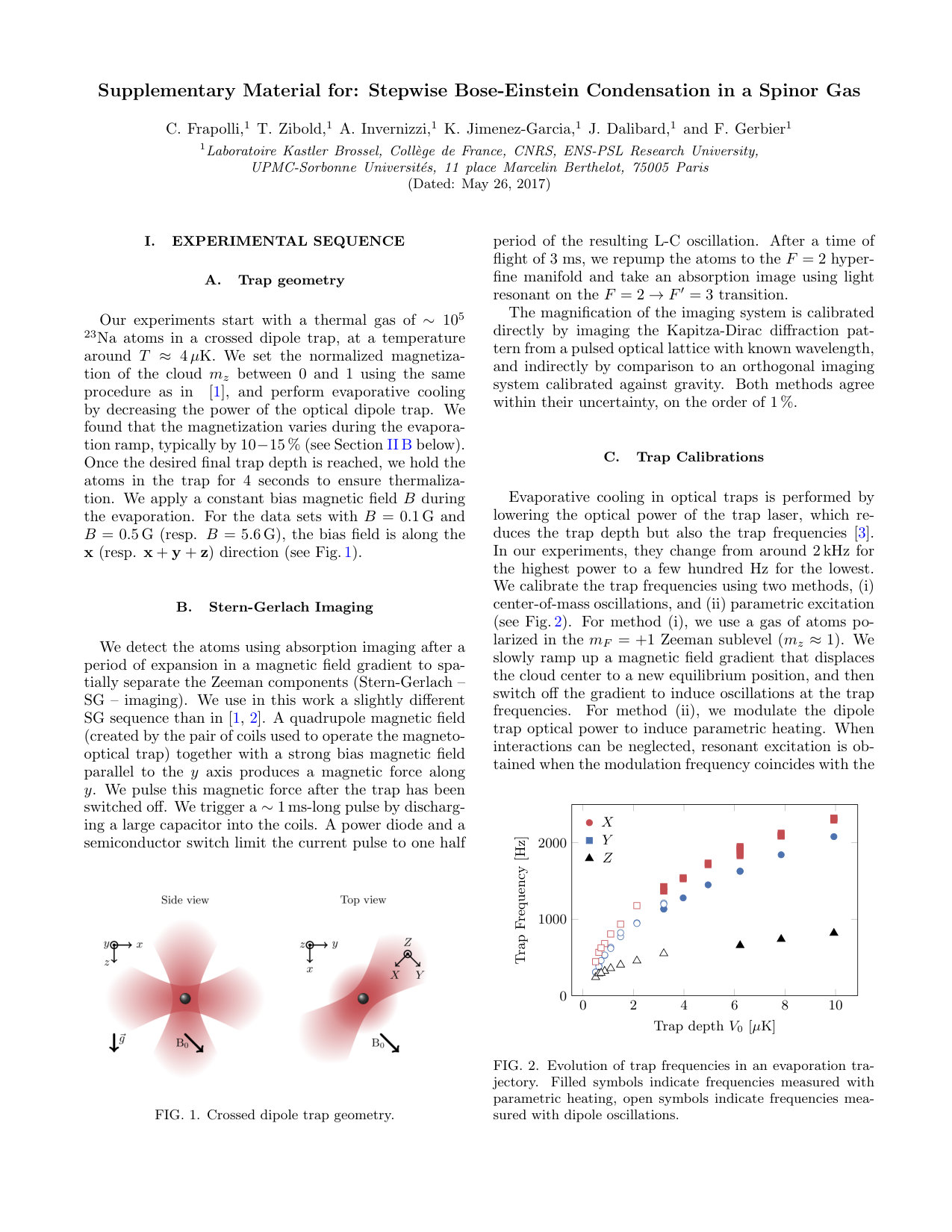 Figure 1
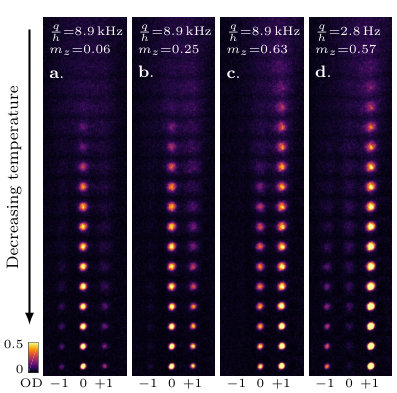 Figure 1
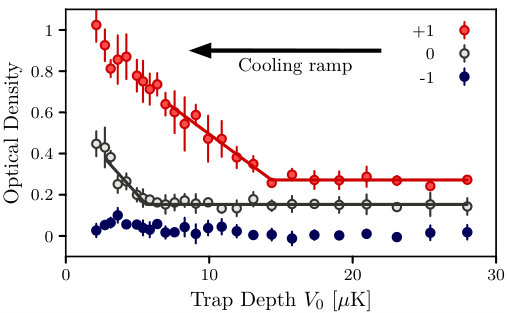 Figure 2
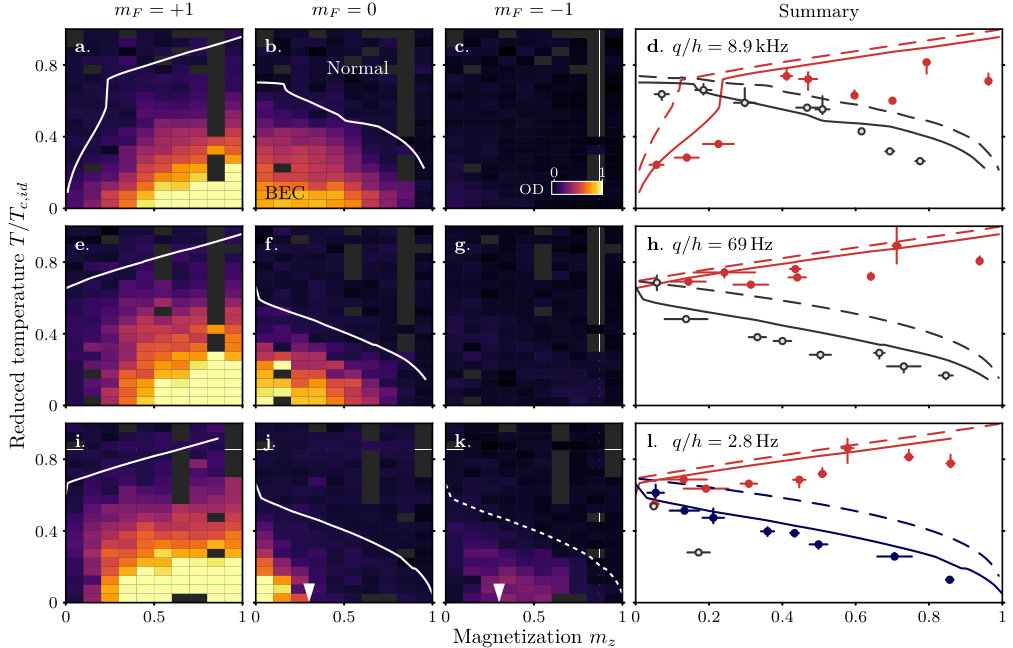 Figure 3
Peer Reviews
No public reviews on file for this paper yet. If you reviewed it on a platform where reviews are public (OpenReview, ICLR, NeurIPS, ICML), you can paste yours below so the community can read it here.
Videos
No videos yet. Explain this paper in a talk, walkthrough, or lecture? Add one.
Stepwise Bose-Einstein condensation in a spinor gas
C. Frapolli
Laboratoire Kastler Brossel, Collège de France, CNRS, ENS-PSL Research University, UPMC-Sorbonne Universités, 11 place Marcelin Berthelot, 75005 Paris, France
T. Zibold
Current address: Department of Physics, University of Basel, Klingelbergstrasse 82, 4056 Basel, Switzerland
Laboratoire Kastler Brossel, Collège de France, CNRS, ENS-PSL Research University, UPMC-Sorbonne Universités, 11 place Marcelin Berthelot, 75005 Paris, France
A. Invernizzi
Laboratoire Kastler Brossel, Collège de France, CNRS, ENS-PSL Research University, UPMC-Sorbonne Universités, 11 place Marcelin Berthelot, 75005 Paris, France
K. Jiménez-García
Laboratoire Kastler Brossel, Collège de France, CNRS, ENS-PSL Research University, UPMC-Sorbonne Universités, 11 place Marcelin Berthelot, 75005 Paris, France
J. Dalibard
Laboratoire Kastler Brossel, Collège de France, CNRS, ENS-PSL Research University, UPMC-Sorbonne Universités, 11 place Marcelin Berthelot, 75005 Paris, France
F. Gerbier
Laboratoire Kastler Brossel, Collège de France, CNRS, ENS-PSL Research University, UPMC-Sorbonne Universités, 11 place Marcelin Berthelot, 75005 Paris, France
Abstract
We observe multi-step condensation of sodium atoms with spin , where the different Zeeman components condense sequentially as the temperature decreases. The precise sequence changes drastically depending on the magnetization and on the quadratic Zeeman energy (QZE) in an applied magnetic field. For large QZE, the overall structure of the phase diagram is the same as for an ideal spin 1 gas, although the precise locations of the phase boundaries are significantly shifted by interactions. For small QZE, antiferromagnetic interactions qualitatively change the phase diagram with respect to the ideal case, leading for instance to condensation in , a phenomenon that cannot occur for an ideal gas with .
Multi-component quantum fluids described by a vector or tensor order parameter are often richer than their scalar counterparts. Examples in condensed matter are superfluid 3He Vollhardt and Wölfle (1990) or some unconventional superconductors with spin-triplet Cooper pairing Norman (2011). In atomic physics, spinor Bose-Einstein condensates (BEC) with several Zeeman components inside a given hyperfine spin manifold can display non-trivial spin order at low temperatures Ho (1998); Ohmi and Machida (1998); Stenger et al. (1998); Stamper-Kurn and Ueda (2013). The macroscopic population of the condensate enhances the role of small energy scales that are negligible for normal gases. This mechanism (sometimes termed Bose-enhanced magnetism Stamper-Kurn and Ueda (2013)) highlights the deep connection between Bose-Einstein condensation and magnetism in bosonic gases, and raises the question of the stability of spin order against temperature.
In simple cases, magnetic order appears as soon as a BEC forms. Siggia and Ruckenstein Siggia and Ruckenstein (1980) pointed out for two-component BECs Siggia and Ruckenstein (1980) that a well-defined relative phase between the two components implies a macroscopic transverse spin. BEC and ferromagnetism then occur simultaneously, provided the relative populations can adjust freely. A recent experiment confirmed this scenario for bosons with spin-orbit coupling Ji et al. (2014). This conclusion was later generalized to spin- bosons without Yamada (1982) or with spin-independent Eisenberg and Lieb (2002) interactions. These results indicate that without additional constraints, bosonic statistics favors ferromagnetism.
In atomic quantum gases with , this type of ferromagnetism competes with spin-exchange interactions, which may favor other spin orders such as spin-nematics Stamper-Kurn and Ueda (2013). Spin-exchange collisions can redistribute populations among the Zeeman states Chang et al. (2004); Schmaljohann et al. (2004); Kuwamoto et al. (2004), but are also invariant under spin rotations. The allowed redistribution processes are therefore those preserving the total spin, such as . For an isolated system driven to equilibrium only by binary collisions (in contrast with solid-state magnetic materials Levy (2000)), and where magnetic dipole-dipole interactions are negligible (in contrast with dipolar atoms Pasquiou et al. (2012)), the longitudinal magnetization is then a conserved quantity. This conservation law has deep consequences on the thermodynamic phase diagram.
The thermodynamics of spinor gases with conserved magnetization has been extensively studied theoretically using various assumptions and methods Isoshima et al. (2000); Zhang et al. (2004); Kao, Y.-M. and Jiang, T. F. (2006); Lang and Witkowska (2014); Uchino et al. (2010); Phuc et al. (2011); Kawaguchi et al. (2012). A generic conclusion is that Bose-Einstein condensation occurs in steps, where BEC occurs first in one specific component and magnetic order appears at lower temperatures when two or more components condense. Natural questions are the number of steps that can be expected, and the nature of the magnetic phases realized at different temperatures.
In this Letter, we report on the observation of multi-step condensation in an antiferromagnetic condensate of sodium atoms. Fig. 1 illustrates four situations that occur when lowering the temperature starting from a normal Bose gas. Without loss of generality, we focus in this work on the case of positive magnetization, given that the case of can be deduced by symmetry. In all cases with , we find a sequence of transitions where different Zeeman components condense at different temperatures. Depending on the applied magnetic field and on the magnetization, we find either two or three condensation temperatures. The purpose of this paper is to explore this rich landscape of transitions in a bosonic spinor system and to elucidate the role of atomic interactions.
The present work is to the best of our knowledge the first comprehensive measurement of thermodynamic properties of spinor condensates with conserved magnetization. Previous experimental works exploring finite temperatures in spinor gases mostly studied spin dynamics in thermal gases Pechkis et al. (2013); He et al. (2015); Erhard et al. (2004); Naylor et al. (2016), or demonstrated cooling of a majority Zeeman component by selective evaporation of the minority components Olf et al. (2015); Naylor et al. (2015). The realization of dipolar spinor gases with free magnetization Pasquiou et al. (2012) was limited to the study of spin-polarized condensed phases in equilibrium due to dipolar relaxation. More recently, a gas of spin excitations in a spin-polarized () ferromagnetic Bose-Einstein condensate was observed to equilibrate and even condense at sufficiently low temperatures Fang et al. (2016).
Our experiments are performed with ultracold 23Na atoms confined in a crossed optical dipole trap (ODT). The longitudinal magnetization acts as an external control parameter independent of the externally applied magnetic field . Here, is the reduced population in Zeeman state and the total atom number. We vary between unmagnetized () and fully magnetized samples () using a preparation sequence performed far above Jacob et al. (2012); SM (See Supplemental Material at [URL will be inserted by publisher]). An applied magnetic field shifts the single-atom energy by . The conservation of magnetization makes the linear Zeeman effect irrelevant in the equilibrium state. The quadratic Zeeman energy (QZE), which lowers the energy of with respect to , is the relevant term, and is given by with Hz/G2 for sodium atoms.
The depth of the ODT determines the temperature and total atom number for a given . We find that the magnetization also varies with (by up to %), a byproduct of evaporative cooling. Once a condensate forms in one of the Zeeman components, evaporation tends to eliminate preferentially atoms in the other Zeeman states. The evaporative cooling dynamics is very slow compared to the microscopic thermalization time on which the gas returns to thermal equilibrium. As a result, the kinetic equilibrium state for the quantum gases studied in this work is still determined by a magnetization-conserving Hamiltonian. Furthermore, the ODT is tight enough such that a condensate forms in the so-called single-mode regime Yi et al. (2002), where the spatial shape of the condensate wavefunction is independent of the Zeeman state. In the following, we characterize our data for a given value of by an evaporation “trajectory” , taking four experimental realizations for each point in the trajectory.
Absorption images as shown in Fig. 1 are recorded after ms of expansion in an applied magnetic field gradient SM (See Supplemental Material at [URL will be inserted by publisher]). We perform a fit to a bimodal distribution for each component to extract the temperature, the populations , and the condensed fraction per component SM (See Supplemental Material at [URL will be inserted by publisher]). We found that low condensed fractions are difficult to detect with the fit algorithm due to a combination of low signal-to-noise ratio and the complexity of fitting the three Zeeman components simultaneously. The signature of BEC, the appearance of a dense, narrow peak near the center of the atomic distribution, can instead be tracked by monitoring the peak optical density (OD) taken as a proxy for the condensed fraction Trotzky et al. (2010). This procedure avoids relying on bimodal fits or other indirect analyses with uncontrolled systematic biases.
Fig. 2 shows such a measurement for a particular evaporation trajectory. The peak OD increases sharply when Bose-Einstein condensation is reached, demonstrating in this particular example a two-step condensation where condenses first, followed by . For a given evaporation trajectory, we identify the critical trap depth where condensation is reached by a piece-wise linear fit to the data, taking the intercept point as the experimentally determined (see Fig. 2). We interpolate numerically the atom number, magnetization and temperature to obtain the critical values , , from .
Fig. 3 summarizes the results of this work. We show the peak optical density for each Zeeman component and each value of in a plane (Fig. 3 a-c, e-g and i-k). In this plot, all data taken at a given QZE are binned with respect to magnetization and temperature. The domains where condensation occurs appear in light colors. For convenience, the temperature is scaled to the critical temperature of a single-component ideal gas , with the geometric average of the trap frequencies and the Riemann zeta function Dalfovo et al. (1999). The same plot also shows the measured critical temperatures (Fig. 3 d, h, l)111In one case, when and Hz, the lowest temperature images do show a condensed component but the critical temperature could not be extracted reliably from the fitting procedure due to sparse sampling. This particular point is not reported in Fig. 3l.. The phenomenon of sequential condensation is always observed for , but the overall behavior changes drastically with .
We first discuss the cases with largest QZE, kHz (Fig. 3 a-d) and Hz (Fig. 3 e-h). For kHz and highly magnetized samples, the majority component condenses first at a critical temperature , followed by the component at a lower temperature . For low magnetizations, the condensation sequence is reversed. For Hz, we observe only one sequence, a two-step condensation with first and second.
This behavior can be understood qualitatively from ideal gas theory, taking the QZE and the conservation of magnetization into account Lang and Witkowska (2014). For ideal gases, BEC occurs when the chemical potential equals the energy of the lowest single-particle state Dalfovo et al. (1999). The same criterion holds for a spin 1 gas with and , where is a Lagrange multiplier enforcing the conservation of . For () and , the QZE lowers the energy of , which is therefore the first component to condense when . For , is positive and increases with . The energetic advantage of is in balance with the statistical trend favoring the most populated component . Eventually, this trend takes over at a “critical” value (where ). For , the component condenses first.
Coexisting and components with a well-defined phase relation correspond to a non-zero transverse spin (“transverse magnetized” phase – ). For large , the condensate is reduced to an effective two-component system with mostly spectator. The case () realizes the Siggia-Ruckenstein (S-R) scenario, where condensation and ferromagnetic behavior appear simultaneously. Away from that point, the S-R picture breaks down () and sequential condensation takes place.
Figure 3 d-h show the critical temperatures and compare them to ideal gas theory. Although the general trends in the theory are the same as in the experiment, we observe a systematic shift of and towards lower temperatures, and an experimental “critical” larger than the ideal gas prediction. The behavior for Hz (Fig. 3 e-h) is qualitatively similar to the largest case, but with a small that cannot be resolved experimentally (the ideal gas theory predicts ).
Repulsive interactions between the atoms can be expected to lower the critical temperatures as in single-component gases Giorgini et al. (1996), with an enhanced shift of due to the presence of a condensate. We use a simplified version of Hartree-Fock (HF) theory to make quantitative predictions Kawaguchi et al. (2012). Our self-consistent calculations include the trap potential in a semi-classical approximation, and treat the interactions as spin-independent. These approximations are valid only above , where at most one component condenses SM (See Supplemental Material at [URL will be inserted by publisher]). As a result, the HF model cannot make any prediction for the low-temperature behavior below . The results of the HF calculations, performed for atom numbers and trap frequencies matching the experimental values SM (See Supplemental Material at [URL will be inserted by publisher]), are shown in Figure 3. The HF model qualitatively accounts for the experimental data, explaining in particular the strong downwards shift of for all and the shift of to higher values for kHz. The residual discrepancy around % could be partially explained by finite-size and trap anharmonicity effects not included in the Hartree-Fock calculation SM (See Supplemental Material at [URL will be inserted by publisher]).
At the lowest field we studied, Hz (Fig. 3 i-l), we observe a change in the nature of . For high values of , corresponds to condensation into while remains uncondensed. This phenomenon is incompatible with ideal gas theory Isoshima et al. (2000); Lang and Witkowska (2014) and with our HF model with spin-independent interactions. It corresponds to a change of the magnetic ordering appearing below . While coexisting and components form a phase with , coexisting components correspond to a phase with but where the spin-rotational symmetry around is broken by a non-zero spin-quadrupole tensor (“quasi-spin nematic” phase -qSN). At and in the single-mode regime, the - qSN transition occurs at a critical magnetization , with the spin-dependent interaction energy Zhang et al. (2003). When , there is no phase transition and only the phase is present. This explains the qualitative difference between the data for Hz and the other two values. We estimate Hz and for a BEC without thermal fraction Jacob et al. (2012). This agrees well with the lowest temperature measurements reported in Fig. 3j-k.
In the experimental data in Fig. 3 i-l, the region of the phase diagram occupied by the phase shrinks with increasing temperature. In fact, we find that condenses at for all parameters we have explored, with condensing at a third, lower critical temperature (except for , where all components appear to condense together within the accuracy of our measurement). Finally, the dashed line in Fig. 3k shows predicted by the HF model with spin-independent interactions. Although the model incorrectly predicts that should condense below , the predicted transition closely matches the observed boundary between single-component BEC and qSN BEC. This indicates that the transition line itself (but not the magnetic order below it) is determined by the thermal component alone.
In conclusion, we have studied the finite- phase diagram of a spin- Bose gas with antiferromagnetic interactions. For condensates in the single-mode regime, we observed a sequence of transitions, two for high QZE and three for low QZE, with the lower two leading to different magnetic orders. We have found that a simplified HF model reproduces the trends observed in the variations of the critical temperatures and with magnetization and QZE. A more complete theoretical analysis accounting for all experimental features –in particular the harmonic trap, which is crucial to stabilize an antiferromagnetic condensate in a single spatial mode Yi et al. (2002)– and elucidating the exact nature of the low-temperature transitions for low QZE remains open. A natural extension of this work would be to study the critical properties of the observed finite- transitions, in particular near and between the and qSN phases at very low . Two-dimensional systems provide another intriguing direction to explore. Several Berezinskii-Kosterlitz-Thouless transitions mediated either by vortices or spin textures have been predicted Mukerjee et al. (2006); James and Lamacraft (2011). We expect that such topological features will further enrich the already complex phase diagram observed in three dimensions.
Acknowledgements.
We acknowledge stimulating discussions with B. Evrard, L. De Sarlo, E. Witkowska, J. Beugnon, L. de Forges de Parny, A. Rançon and T. Roscilde. This work has been supported by ERC (Synergy grant UQUAM). TZ acknowledges funding from the Hamburg Center for Ultrafast Imaging, and KJG from the European Union’s Horizon 2020 research and innovation programme under the Marie Skłodowska-Curie grant agreement No. 701894.
The reference list from the paper itself. Each links out to its DOI / PubMed record.
- 1Vollhardt and Wölfle (1990) D. Vollhardt and P. Wölfle, The Superfluid Phases of Helium 3 (Taylor and Francis, London, 1990).
- 2Norman (2011) Michael R. Norman, “The challenge of unconventional superconductivity,” Science 332 , 196–200 (2011) . · doi ↗
- 3Ho (1998) T.-L. Ho, “Spinor Bose condensates in optical traps,” Phys. Rev. Lett. 81 , 742–745 (1998) . · doi ↗
- 4Ohmi and Machida (1998) T. Ohmi and K. Machida, “Bose-Einstein condensation with internal degrees of freedom in alkali atom gases,” Journal of the Physical Society of Japan 67 , 1822–1825 (1998) . · doi ↗
- 5Stenger et al. (1998) J. Stenger, S. Inouye, D. Stamper-Kurn, H.-J. Miesner, A. Chikkatur, and W. Ketterle, “Spin domains in ground-state Bose-Einstein condensates,” Nature 396 , 345–348 (1998) . · doi ↗
- 6Stamper-Kurn and Ueda (2013) D. M. Stamper-Kurn and M. Ueda, “Spinor Bose gases: Symmetries, magnetism, and quantum dynamics,” Rev. Mod. Phys. 85 , 1191–1244 (2013) . · doi ↗
- 7Siggia and Ruckenstein (1980) Eric D. Siggia and Andrei E. Ruckenstein, “Bose condensation in spin-polarized atomic Hydrogen,” Phys. Rev. Lett. 44 , 1423–1426 (1980) . · doi ↗
- 8Ji et al. (2014) Si-Cong Ji, Jin-Yi Zhang, Long Zhang, Zhi-Dong Du, Wei Zheng, You-Jin Deng, Hui Zhai, Shuai Chen, and Jian-Wei Pan, “Experimental determination of the finite-temperature phase diagram of a spin-orbit coupled bose gas,” Nat Phys 10 , 314–320 (2014) . · doi ↗