Systematic Construction of Counterexamples to the Eigenstate Thermalization Hypothesis
Naoto Shiraishi, Takashi Mori

TL;DR
This paper introduces a method to embed specific states into the energy spectrum of many-body Hamiltonians, creating models that violate the eigenstate thermalization hypothesis while still exhibiting thermalization behavior.
Contribution
A novel construction technique for Hamiltonians with targeted eigenstates that violate ETH, providing analytical proofs and numerical demonstrations.
Findings
Constructed Hamiltonians with no local conserved quantities that violate ETH.
Target states are non-thermal, while other eigenstates thermalize.
Models thermalize after a quench despite ETH violation.
Abstract
We propose a general method to embed target states into the middle of the energy spectrum of a many-body Hamiltonian as its energy eigenstates. Employing this method, we construct a translationally-invariant local Hamiltonian with no local conserved quantities, which does not satisfy the eigenstate thermalization hypothesis. The absence of eigenstate thermalization for target states is analytically proved and numerically demonstrated. In addition, numerical calculations of two concrete models also show that all the energy eigenstates except for the target states have the property of eigenstate thermalization, from which we argue that our models thermalize after a quench even though they does not satisfy the eigenstate thermalization hypothesis.
Click any figure to enlarge with its caption.
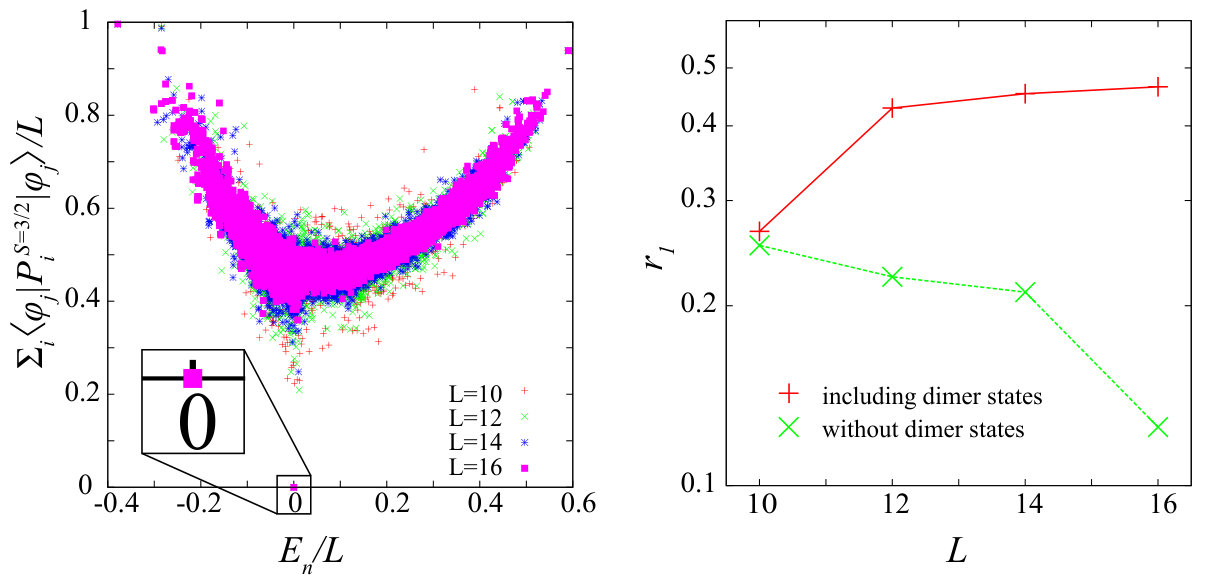 Figure 1
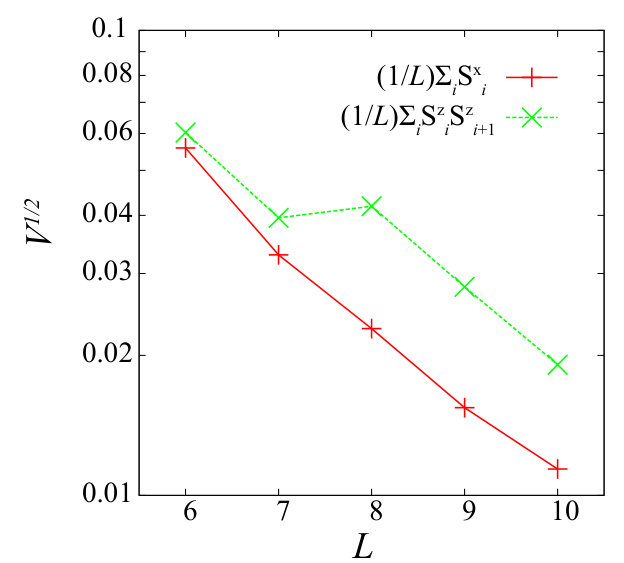 Figure 2
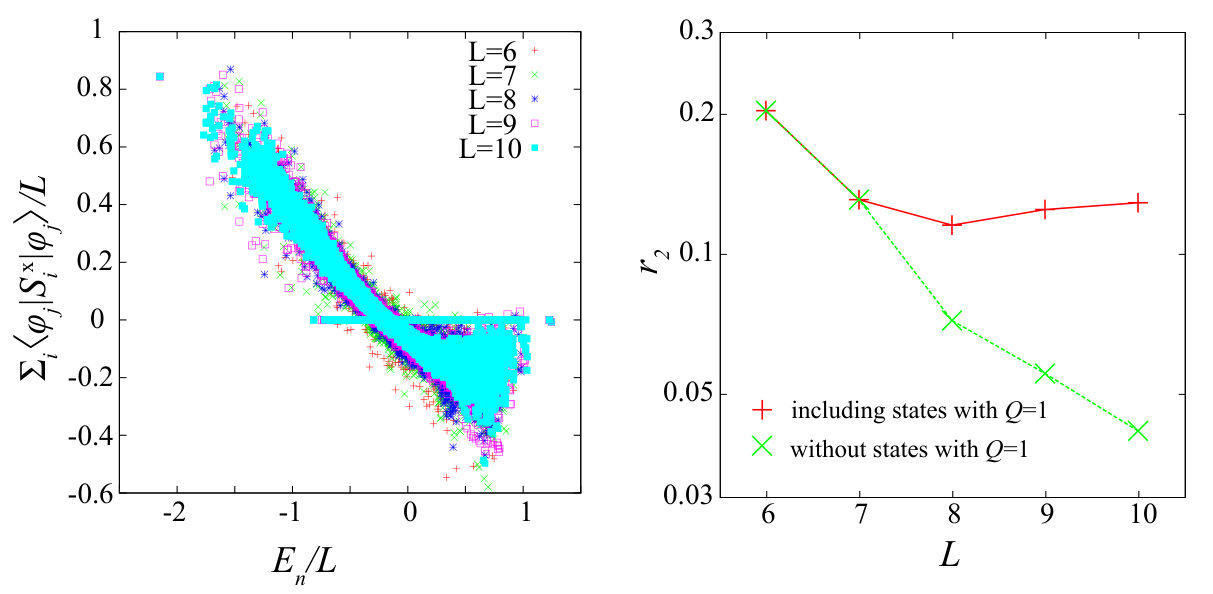 Figure 3
Peer Reviews
No public reviews on file for this paper yet. If you reviewed it on a platform where reviews are public (OpenReview, ICLR, NeurIPS, ICML), you can paste yours below so the community can read it here.
Videos
No videos yet. Explain this paper in a talk, walkthrough, or lecture? Add one.
Systematic Construction of Counterexamples to Eigenstate Thermalization Hypothesis
Naoto Shiraishi
Department of Physics, Keio University, 3-14-1 Hiyoshi, Yokohama 223-8522, Japan
Takashi Mori
Department of Physics, The University of Tokyo,7-3-1 Hongo, Bunkyo-ku, Tokyo 113-0033, Japan
Abstract
We propose a general method to embed target states into the middle of the energy spectrum of a many-body Hamiltonian as its energy eigenstates. Employing this method, we construct a translationally-invariant local Hamiltonian with no local conserved quantities, which does not satisfy the eigenstate thermalization hypothesis. The absence of eigenstate thermalization for target states is analytically proved and numerically demonstrated. In addition, numerical calculations of two concrete models also show that all the energy eigenstates except for the target states have the property of eigenstate thermalization, from which we argue that our models thermalize after a quench even though they does not satisfy the eigenstate thermalization hypothesis.
PACS numbers
05.30.-d, 05.70.Ln, 03.65.-w, 75.10.Pq
pacs:
Valid PACS appear here
††preprint: APS/123-QED
Introduction.— The emergence of the arrow of time, in particular thermalization to the equilibrium state, in macroscopic many-body systems from reversible microscopic dynamics is one of the most important and profound problems in theoretical physics. This problem has been discussed since the early days of statistical mechanics. One important observation is that almost all pure states in the energy shell of any given energy are thermal. Here, a quantum state is said to be thermal when the expectation value of any local observable in this state coincides with that obtained by the corresponding microcanonical ensemble within a certain small error vanishing in the thermodynamic limit. Fragments of this idea have already seen in Boltzmann Bol , von Neumann Neu , Tolman Tol , Khinchin Khi , and Schrödinger Sch , and now this idea is known as typicality of thermal equilibrium BL ; Llo ; PSW ; Gold ; Sug ; Rei07 . Although typicality is widely believed to provide a satisfactory characterization of thermal equilibrium, it is far from sufficient to explain thermalization Tas16 . (The precise definition of thermalization is given in SM .)
It has been well established that thermalization in an isolated quantum system can be explained under the assumption that every energy eigenstate is thermal note1 . This assumption is referred to as the eigenstate thermalization hypothesis (ETH) Neu ; Deu ; Sre ; HZB ; Tas98 ; Rig08 . (The precise definition of the ETH is given in SM .)
It is remarked that the property known as weak-ETH Bir , which states that almost all energy eigenstates are thermal, is not enough to explain thermalization. Indeed, the weak-ETH can be proved for a broad class of translationally-invariant systems regardless of their integrability Bir ; IKS ; Mor16 , while observations in experiments Gri ; Lan and numerical simulations Cra08 ; Rig09 ; Bir report that integrable systems integrable do not thermalize. Absence of thermalization in an integrable system is attributed to an important weight of the initial state to atypical nonthermal energy eigenstates Bir ; Rig16 ; Tas-priv . Thus the weak-ETH does not guarantee thermalization, and therefore the ETH has been considered to be a key ingredient for thermalization DAl ; GE16 ; Pal .
Many numerical simulations report that the ETH is valid if the Hamiltonian of a many-body quantum system satisfies the following three conditions: (i) translation invariance (in particular, no localization localization ), (ii) no local conserved quantity, and (iii) local interactions Rig08 ; Rig09 ; Bir ; SR ; KIH ; SHP ; BMH ; Sor ; Mon . Here, the word local stands for both few-body and short-range. Interestingly, all known examples not satisfying the ETH violates at least one of (i)-(iii). Integrable systems Bir ; Rig09 ; SHP ; SR and systems with local symmetries Ham violate (ii), and systems with Anderson localization HSS ; And or many-body localization BAA ; Imb violate (i). It is noteworthy that these examples do not thermalize. It may be then tempting to conjecture that the above (i)-(iii) are necessary and sufficient conditions for the validity of ETH and also for the system to thermalize.
In this Letter we construct counterexamples of this conjecture. We first propose a general method of embedding, and then, by using this method, we construct two concrete models which satisfy the three conditions (i)-(iii), but can be proved rigorously to violate the ETH SM . Moreover, we also argue that these models exhibit thermalization after a physically-plausible quench. Our findings do not only reveal the richness of quantum many-body systems, but also lead to reconsideration of the conventional beliefs on the mechanism of thermalization.
Method of embedding.— We here explain the procedure of embedding. Consider a quantum system on a discrete lattice with a set of sites with Hilbert space . Let () be arbitrary local projection operators on which do not necessarily commute with each other. We usually take , in particular . We define a subspace as a subspace spanned by the set of states satisfying
[TABLE]
for any . We assume that contains at least one non-vanishing state. The states in are target states to be embedded.
Let () be arbitrary local Hamiltonians , and let be a Hamiltonian which satisfies for . We then construct the desired Hamiltonian as
[TABLE]
Since for , we find that is invariant under the map with , and thus the Hamiltonian has energy eigenstates within . For a special case that and all the eigenvalues of are nonnegative, this Hamiltonian is regarded as a frustration-free Hamiltonian, which is seen in Ref. Cha14 . In general, the eigenenergies of the embedded states are in the middle of the energy spectrum, and this procedure can be regarded as a general method of embedding the target states into the middle of the energy spectrum of a nonintegrable local Hamiltonian.
An embedded state satisfying Eq. (1) is a highly anomalous state in the sense that a local projection operator takes exactly zero expectation value with no fluctuation, which is unexpected behavior in a thermal state. This observation leads to a crucial result that the ETH is always violated regardless of . In fact, in line with the above intuition, the violation of ETH is rigorously proven when is also written as with local terms , and both and are bounded operators SM .
In the following, we express the eigenstates of as with sorting them by energy (). We also write the number of total eigenstates and those in as and , respectively.
Model 1: two dimer states.— We now construct the first counterexample to the ETH. Consider a one-dimensional spin chain of with even length with the periodic boundary condition. The sites are labeled as , and we identify to , and to . The spin operator on the site is denoted by . We introduce the total spin operator of sites , and denoted by
[TABLE]
whose length takes or length . We then set the projection operator as that into the subspace with , which we denote by . In terms of spin operators, is expressed as
[TABLE]
The analyses on the Majumdar-Ghosh model MG , whose Hamiltonian is , tell that has two dimer states as its ground states with zero energy:
[TABLE]
where is the valence-bond (spin singlet):
[TABLE]
Because the total angular momentum of a spin-singlet is zero, the total angular momentum of three spins including a spin-singlet pair is always 1/2, which implies that these two states are ground states of : (). In addition, it is known that the ground states are only these two CEM ; AKLT .
By setting , as translation invariant local terms, and tuning the origin of properly, the Hamiltonian
[TABLE]
has two dimer states () as its energy eigenstates with zero energy, which settles in the middle of the energy spectrum. These two dimer states span the Hilbert subspace , and they do not represent a thermal state of this Hamiltonian SM . Hence, this model is a counterexample to the ETH. It is worth noting that this model in general satisfies the conditions (i)-(iii) LCQ . In particular, we emphasize that a local projection operator is not a local conserved quantity.
Numerical calculations reveal that the two dimer states are not thermal, but all the other eigenstates are thermal. We set the local Hamiltonian as
[TABLE]
with , , , , , , . Full diagonalization results of versus energy density for all energy eigenstates are depicted in the left panel of Fig. 1. The outlying point (0,0) corresponds to the two degenerate dimer states. We see that except these two states the fluctuation reduces as increasing system size, which is consistent with the claim that other energy eigenstates are thermal.
The ETH is numerically studied by considering the following indicator:
[TABLE]
where is a local observable and runs all possible energy eigenstates in some fixed range of the energy density. represents the ensemble average in the microcanonical ensemble with energy between and . If tends to zero as the system size increases, it implies that the ETH is satisfied.
Here, for the Hamiltonian and degeneracy , we compute in the energy range , which we call . The microcanonical energy width is set as . In the right panel of Fig. 1, we plot versus system size for all eigenstates (red) and all eigenstates except two dimer states (green). The former does not decrease with increase of , while the latter indeed does, which is expected behavior for thermal eigenstates. Our numerical results clearly show that the Hamiltonian has two nonthermal eigenstates () and thermal eigenstates.
Model 2: exponentially-many nonthermal states.— We can also embed exponentially-many target states (i.e., ). We demonstrate this through constructing the second counterexample to the ETH. Consider a one-dimensional spin chain of with length with the periodic boundary condition. The state of each spin is given by a linear combination of three eigenstates of expressed as , and . The label of sites is same as that in the model 1. We now introduce a projection operator to the subspace with as and its compliment as . Using this, we define a non-local operator , which takes 1 if and only if all spins are linear combinations of . We also introduce pseudo Pauli matrices between two states and defined as
[TABLE]
With noting that and are satisfied for with its support and as a function of (), we construct a Hamiltonian
[TABLE]
where we used a relation for . This Hamiltonian has eigenstates in the subspace with , and these eigenstates span the Hilbert subspace . With the same discussion for the model 1, we conclude that the model 2 also violates the ETH even though it satisfies the conditions (i)-(iii) LCQ .
Numerical calculations reveal that the eigenstates with are not thermal, while the eigenstates with are thermal. We set the local Hamiltonian and as
[TABLE]
with , , , , , , , , , , , . First, we compute the expectation value of -component of the spin per site versus energy density , which is plotted in the left panel of Fig. 2. The horizontal bar at corresponds to the embedded eigenstates with . Except these embedded states, the fluctuation reduces as increasing system size, which is consistent with the claim that all energy eigenstates with are thermal.
We also consider the indicator of the ETH defined by Eq. (9) for the Hamiltonian with , which we call . Here, in Eq. (9) runs all possible energy eigenstates with and is set to . The results are depicted in the right panel of Fig. 2 for all eigenstates (red) and all eigenstates except the embedded eigenstates with (green). These plots ensure that all eigenstates except the embedded ones are thermal, while the ETH is not satisfied. Here, we have presented the result for the special choice of , but the same conclusion is confirmed for other choices such as .
We note that although there are exponentially-many nonthermal states , the weak-ETH still holds because the fraction of the nonthermal states is exponentially-small: . The weak-ETH says that the variance of a local observable defined as
[TABLE]
converges to zero in the thermodynamic limit , where runs all possible energy eigenstates with and the number of such energy eigenstates is denoted by . Our model violating the ETH shows the exponential decay of the standard deviation of and (see Fig. 3). This means that the exponential decay of with respect to does not necessarily imply the ETH, which is contrary to the previous argument BMH .
Thermalization.— All existing models without the ETH including integrable systems and many-body localization generally do not thermalize after a quench. This is why some researchers believe that the ETH is essential for thermalization. However, we shall show a good reason to consider that our models indeed thermalize after a physically-plausible quench, which we refer to as a quench from a system with finite temperature.
We take the model 2 as an example. If all the sites are in the sector of in the initial state, the system does not thermalize. However, since all the eigenstates with are thermal, we claim that even a single defect of is enough to thermalize the system.
Consider a quench to from a thermal state of another Hamiltonian denoted by . As shown in Supplemental Material, the expectation value of in a thermal state is strictly positive, and its variance converges to zero in the thermodynamic limit. In contrast, all the embedded eigenstates always take zero with the measurement of , which implies that has quite a small weight on the nonthermal embedded states, and the system must thermalize. We, however, note that for relatively small system size, the embedded states with can have relatively large weight, and in that case the system does not thermalize.
Discussion.— We proposed a systematic procedure to construct models with the conditions (i) translation invariance, (ii) no local conserved quantity, and (iii) local-interaction, but not satisfying the ETH, contrary to the common belief. Our method enables us to embed the target states as energy eigenstates of the Hamiltonian with (i)-(iii) in the middle of energy spectrum, and these embedded states are generally nonthermal SM . One advantage of our approach lies in the fact that the violation of the ETH is analytically proven, in contrast to numerical simulations which are inevitably affected by the finite size effect (see also a series of discussion on the Ising model with both longitudinal and transverse magnetic fields KIH ; BCH ; Kim , where slowly decaying observables disturb accesses with numerical simulations).
On the basis of the numerical result that all the energy eigenstates except embedded states are thermal, we argued that the constructed models will thermalize after a physically-plausible quench. The presence of nonthermal energy eigenstates implies the existence of an initial state which fails to thermalize Pal , but we do not expect to pick up such an initial state through a finite-temperature quench for sufficiently large system sizes since even a single defect can completely recover the thermal property. Our results elucidate the fact that the role of thermal energy eigenstates in the mechanism of thermalization is not so simple than expected.
The second model contains exponentially-many nonthermal states, which is usually expected to be a property of integrable systems. Our result implies that the number of nonthermal states does not determine the fate of the presence/absence of thermalization. To understand thermalization, the property of preparable initial states (e.g., weight to nonthermal eigenstates) should also be taken into consideration.
Apart from the study on thermalization, our procedure sounds a fruitful methodology to obtain interesting Hamiltonians. Our procedure can embed any state which is a ground state of a frustration-free Hamiltonian. Both the matrix-product states (MPS) and the projected-entangled-pair states (PEPS) are known to be written as a ground state of a frustration-free Hamiltonian FNW ; SCG , and thus they can be embedded to the middle of the energy spectrum of a many-body Hamiltonian. Our method opens the way to import many brilliant achievements on the ground state of quantum systems to thermal (excited) states.
Acknowledgement.— We wish to thank Takahiro Sagawa, Hal Tasaki, Eiki Iyoda, Sho Sugiura and Masaki Oshikawa for fruitful and stimulating discussion and many constructive comments. We also thank Akira Shimizu and Ryusuke Hamazaki for helpful advice. We thank Terry Farrelly for informing us of the reference Pal . NS is supported by Grant-in-Aid for JSPS Fellows JP17J00393, and TM is supported by JSPS KAKENHI Grant No. 15K17718.
References
- (1)
M. P. Mueller, E. Adlam, L. Masanes, and N. Wiebe, Thermalization and Canonical Typicality in Translation-Invariant Quantum Lattice Systems. Comm. Math. Phys. 340, 499 (2015).
- (2)
R. E. Peierls, On a Minimum Property of the Free Energy. Phys. Rev. 54, 918 (1938).
- (3)
K. Husimi, Some Formal Properties of the Density Matrix. Proc. Phys. Math. Soc. Japan 22, 264 (1940).
- (4)
S. Golden, Lower Bounds for the Helmholtz Function. Phys. Rev. 137, B1127 (1965).
- (5)
C. J. Thompson, Inequality with Applications in Statistical Mechanics. J. Math. Phys. 6, 1812 (1965).
The reference list from the paper itself. Each links out to its DOI / PubMed record.
- 1(1)
- 2(2) L. Boltzmann, Ueber die mechanischen Analogien des zweiten Hauptsatzes der Thermodynamik . Journal für die reine und angewandte Mathematik 100 , 201 (1887).
- 3(3) J. von Neumann, Beweis des Ergodensatzes und des H-Theorems in der neuen Mechanik . Z. Phys. 57 , 30 (1929) [English version, Proof of the ergodic theorem and the H-theorem in quantum mechanics , Eur. Phys. J. H 35 , 201 (2010)] .
- 4(4) R. C. Tolman, The principles of statistical mechanics . Oxford Clarendon Press (1938).
- 5(5) A. I. Khinchin, Mathematical foundations of statistical mechanics . Dover (1949).
- 6(6) E. Schrödinger, Statistical thermodynamics : a course of seminar lectures delivered in January-March 1944 at the School of Theoretical Physics, Dublin Institute for Advanced Studies . Cambridge University Press (1952).
- 7(7) P. Bocchieri and A. Loinger, Ergodic Foundation of Quantum Statistical Mechanics . Phys. Rev. 114 , 948 (1959).
- 8(8) S. Lloyd, Black Holes, Demons, and the Loss of Coherence , Ph.D. Thesis, Rockefeller University, (1988).