Quantum critical scaling and fluctuations in Kondo lattice materials
Yi-feng Yang, David Pines, and Gilbert Lonzarich

TL;DR
This paper introduces a new phenomenological framework for Kondo lattice materials that explains distinct quantum critical scaling behaviors arising from antiferromagnetic and hybridization fluctuations, supported by experimental data.
Contribution
It presents a novel framework combining antiferromagnetic and hybridization quantum critical fluctuations to explain diverse scaling phenomena in Kondo lattice materials.
Findings
Logarithmic scaling in the density of states below T*
Unconventional power law resistivity scaling below T_QC
Experimental support from CeCoIn5 and CeRhIn5 measurements
Abstract
We propose a new phenomenological framework for three classes of Kondo lattice materials that incorporates the interplay between the fluctuations associated with the antiferromagnetic quantum critical point and those produced by the hybridization quantum critical point that marks the end of local moment behavior. We show that these fluctuations give rise to two distinct regions of quantum critical scaling: hybridization fluctuations are responsible for the logarithmic scaling in the density of states of the heavy electron Kondo liquid that emerges below the coherence temperature T*; while the unconventional power law scaling in the resistivity that emerges at lower temperatures below T_QC may reflect the combined effects of hybridization and antiferromagnetic quantum critical fluctuations. Our framework is supported by experimental measurements on CeCoIn5, CeRhIn5 and other heavy…
Click any figure to enlarge with its caption.
 Figure 1
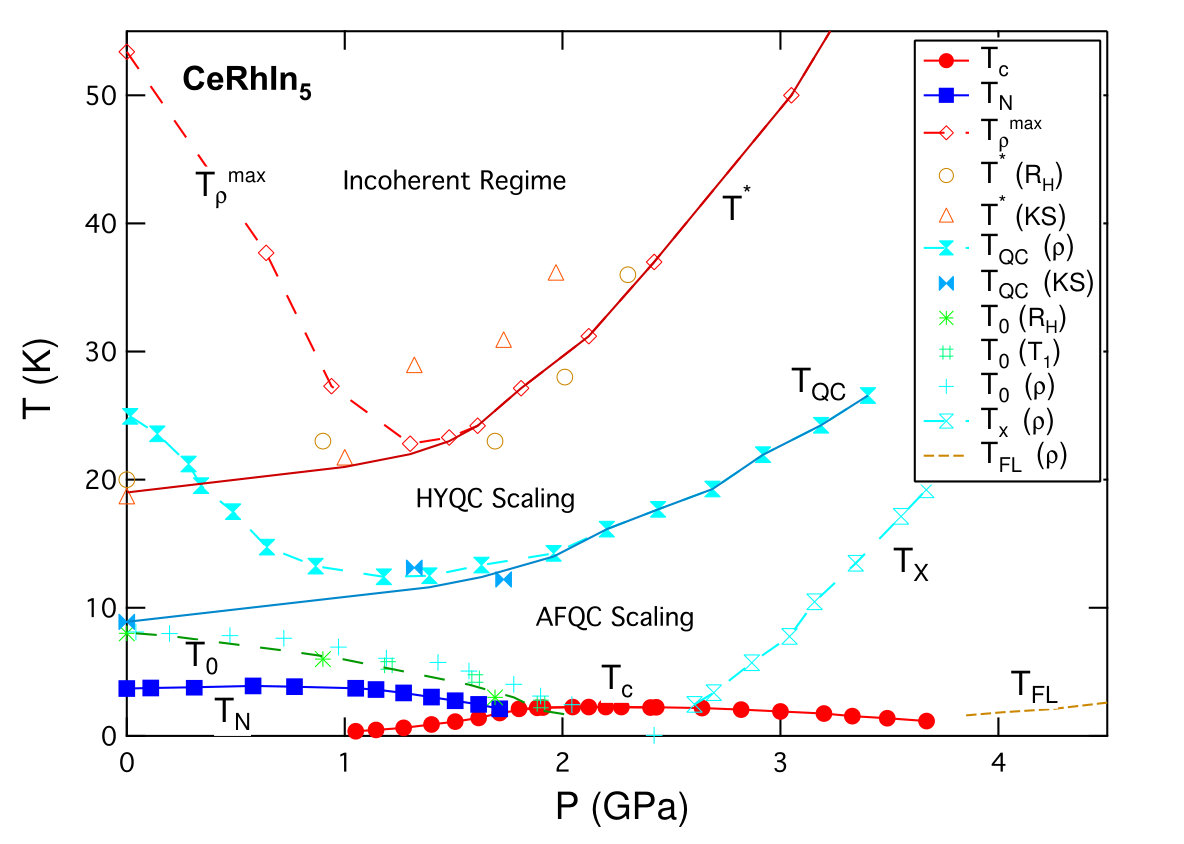 Figure 1
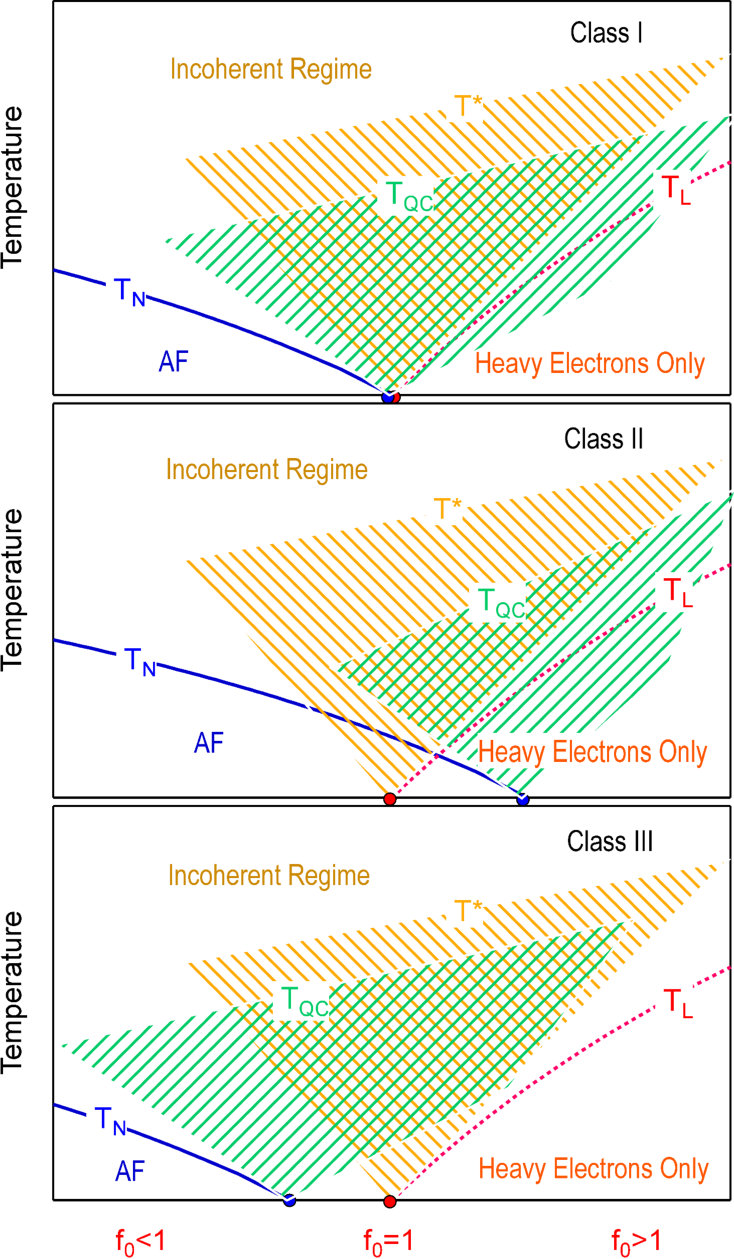 Figure 2
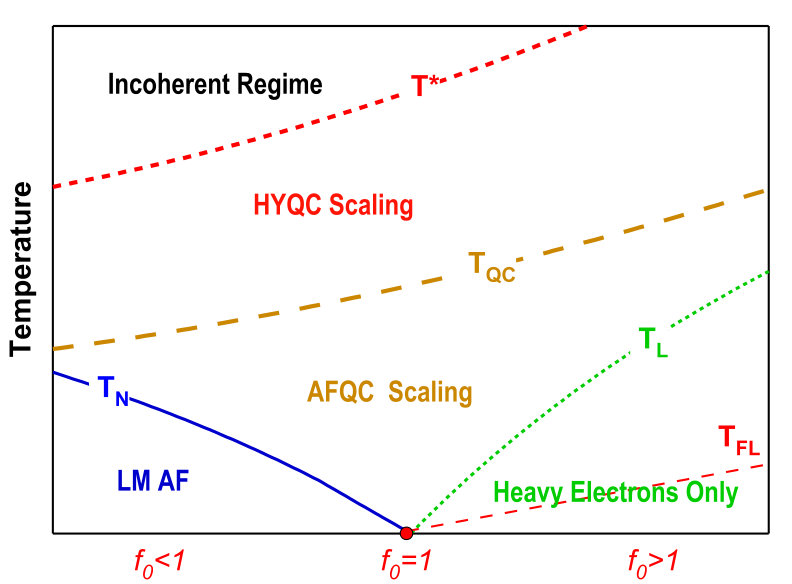 Figure 3
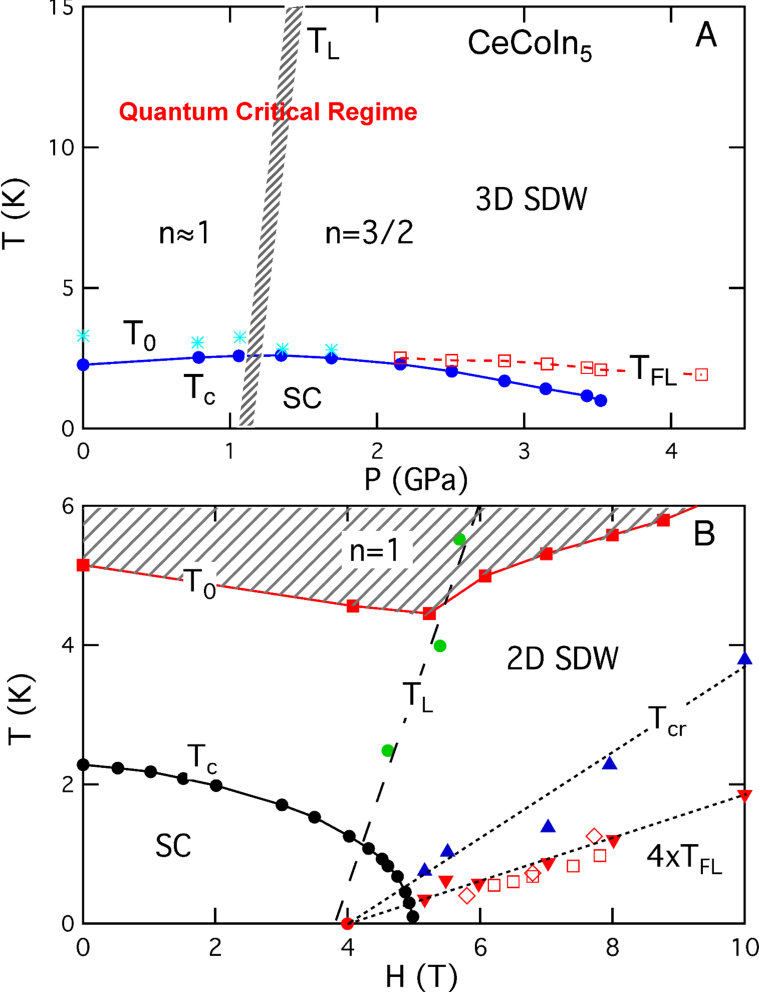 Figure 4
Peer Reviews
No public reviews on file for this paper yet. If you reviewed it on a platform where reviews are public (OpenReview, ICLR, NeurIPS, ICML), you can paste yours below so the community can read it here.
Videos
No videos yet. Explain this paper in a talk, walkthrough, or lecture? Add one.
\templatetype
pnasresearcharticle
\leadauthorYang \significancestatement Quantum critical materials contain quantum critical points (QCP) associated with continuous phase transitions between ordered states at zero temperature that give rise to strong quantum fluctuations of order parameter fields. Their coupling to conduction electrons in metals typically yields logarithmic or power law scaling in their electronic properties. Here we study a particularly interesting class of quantum critical materials, Kondo lattice materials, composed of interacting local moments and conduction electrons. We propose a phenomenological framework based on the interplay of the fluctuations associated with their antiferromagnetic and delocalization QCPs and show that it explains the many anomalous scaling properties measured in these materials. \authorcontributionsAll authors contribute to the idea and writing of the manuscript. \authordeclarationThe authors declare no conflict of interest. \correspondingauthor1,2To whom correspondence should be addressed. E-mail: [email protected]; [email protected]
Quantum critical scaling and fluctuations in Kondo lattice materials
Yi-feng Yang
Beijing National Laboratory for Condensed Matter Physics and Institute of Physics, Chinese Academy of Sciences, Beijing 100190, China
Collaborative Innovation Center of Quantum Matter, Beijing 100190, China
School of Physical Sciences, University of Chinese Academy of Sciences, Beijing 100190, China
David Pines
Santa Fe Institute, Santa Fe, NM 87501, USA
Gilbert Lonzarich
Cavendish Laboratory, Department of Physics, Cambridge University, Cambridge CB3 0HE, UK
Abstract
We propose a new phenomenological framework for three classes of Kondo lattice materials that incorporates the interplay between the fluctuations associated with the antiferromagnetic quantum critical point and those produced by the hybridization quantum critical point that marks the end of local moment behavior. We show that these fluctuations give rise to two distinct regions of quantum critical scaling: hybridization fluctuations are responsible for the logarithmic scaling in the density of states of the heavy electron Kondo liquid that emerges below the coherence temperature ; while the unconventional power law scaling in the resistivity that emerges at lower temperatures below may reflect the combined effects of hybridization and antiferromagnetic quantum critical fluctuations. Our framework is supported by experimental measurements on CeCoIn5, CeRhIn5 and other heavy electron materials.
keywords:
heavy fermion two fluid quantum criticality hybridization fluctuation
\dates
This manuscript was compiled on
\verticaladjustment
-2pt
\dropcap
Heavy electron materials stand out in the correlated electron family because of the extraordinary variety of quantum mysteries these present. In addition to exhibiting two ordered states at low temperatures, antiferromagnetism and superconductivity, that can coexist, essentially nothing about their higher temperature normal state behavior is what one finds in "normal" materials. Not only does the interaction between a lattice of localized f electron magnetic moments and background conduction electrons give rise to the emergence, at a temperature (often called the coherence temperature), of heavy electrons with masses that can become comparable to that of a muon, every other aspect of their normal state behavior produced by that interaction is anomalous.
Experiments on the best studied heavy electron material, CeRhIn5, show that as the temperature and pressure are varied, some five different temperature scales, all well below the crystal field energy levels, are needed to characterize the normal state anomalies depicted in Fig. 1 (1, 3, 2, 4):
- •
a nuclear magnetic Knight shift that does not follow the measured spin susceptibility below .
- •
a lower limit, , on the universal behavior of the heavy electron density of states that begins at .
- •
a maximum in the magnetic resistivity at .
- •
a lower limit, or depending on the pressure range in which it is studied, on the power law scaling behavior in the resistivity that begins at a temperature, .
It is widely believed that the source of these anomalies, and similar ones found in other heavy electron materials, are fluctuations associated with quantum critical points that mark transition between distinct phases of matter at . Although there exist microscopic theories of aspects of this quantum critical behavior [the Hertz-Millis-Moriya model for the spin fluctuation spectrum near an antiferromagnetic quantum critical point (AF QCP) (5, 6, 7), the Abrahams-Wölfle model of critical quasiparticles at very low temperatures for materials that are very near an AF QCP (8); the work of Coleman, Pepin, Senthil, and Si et al. on new critical excitations beyond the basic order parameter fluctuations (9, 10, 11, 12); and that of Lonzarich et al. suggesting a path forward for an improved microscopic approach to understanding the emergence of heavy electrons in Kondo lattice materials (13)], these do not explain all the above anomalies, not least because there is at present no microscopic theory of the behavior of the three components (light conduction electrons, heavy electrons, and local moments that have partially hybridized), that exist over much of the phase diagram.
We therefore turn to phenomenology in our search for an understanding of the wide range of anomalous behavior and the temperature scales over which it is found. In what follows we show that a careful analysis of the phase diagrams expected from the presence of two competing quantum critical points, one associated with the end of antiferromagnetism, the other with the hybridization-induced end of local moment behavior, together with the phenomenological two-fluid model of that hybridization [for a review see Ref. (1)], provides a framework that enables us to arrive at a more complete physical understanding of the anomalous normal state behavior of CeRhIn5, and a number of other well-studied heavy electron materials.
1 QCPs and their expected scaling signatures
In the CeMIn5 (M=Co, Rh, Ir) and similar Kondo lattice materials, we have argued that "collective" hybridization of the local moments against the background conduction electrons begins at the coherence temperature, , and is complete along a line of temperatures, (1): above we expect to find both local moments whose strength has been reduced by hybridization that can order antiferromagnetically and itinerant heavy electrons that can become superconducting; well below it we will find only heavy electrons that may superconduct. Absent superconductivity, we would then expect to find two distinct quantum critical points: an AF QCP that marks the end of local moment antiferromagnetic behavior and a hybridization quantum critical point (HY QCP) that marks the completion of collective hybridization of local moments. These QCPs can produce quantum critical local moment spin fluctuations and quantum critical heavy electron spin or charge fluctuations, and a key question is the extent to which these QCPs and the scaling behaviors to which they give rise, can be distinguished and identified experimentally.
Quite generally we may expect to find the three classes of heavy electron antiferromagnetic materials shown in Fig. 2 (14, 15). Class I materials are those in which the AF and HY QCPs appear to be identical within experimental error. Class II are those in which the HY QCP lies well within the antiferromagnetic phase; in this case, the AF QCP becomes an itinerant AF QCP associated with the magnetic instability of the itinerant heavy electrons. Class III are those in which that HY QCP lies well outside the antiferromagnetic phase; between the two QCPs there will then be a region in which a nonmagnetic non-Landau heavy electron liquid coexists with incoherent local moments.
We follow Lonzarich et al. (13) in making the assumption that in all three classes we are dealing with two order parameters (and their associated quantum critical points and fluctuations): an HY order parameter describing the build up of the emergent heavy electrons and the more familiar AF order parameter describing the build up of local moment AF order. The magnetic and hybridization quantum critical fluctuations will often not behave independently. For example, we shall see that hybridization can be suppressed and reversed at low temperatures by local moment AF order, causing relocalization of heavy electrons and a corresponding decrease in the hybridization order parameter (16). This relocalization takes place at a temperature slightly above the Néel temperature, possibly associated with thermal fluctuations of the AF order parameter. Still another possibility is that the coupling between the magnetic and hybridization quantum critical fluctuations gives rise to unconventional quantum critical scaling in their overlap regime at finite temperatures (17, 18, 19). Moreover, the magnetic quantum critical fluctuations may also penetrate into the region where all f electrons become itinerant, causing a change in the characteristics of the quantum critical scaling from an unconventional type to an itinerant spin density wave (SDW) type. The latter is clearly seen in Class II materials, but may well exist in Class I materials, while in Class III materials, one may expect changes of the scaling exponent when approaching the two separated QCPs with lowering temperature.
In making the plots of the impact of the HY quantum critical fluctuations shown in Fig. 2, we are making a key assumption about the origins of two parts of the scaling behavior seen in heavy electron liquid that have led it to be called a Kondo liquid (KL): universal scaling behavior, characterized by the energy scale, , of the effective order parameter that measures its strength (see Eq. 2); and the scaling with of the intrinsic KL state density seen in uniform magnetic susceptibility and specific heat experiments (20, 21). A central thesis of the present paper is that these two parts represent distinct scaling phenomena of distinguishable physical origins.
As first shown by Yang et al. (22), is determined by the nearest-neighbor coupling between local moments in the Kondo lattice. Their interaction produces collective hybridization below that is quite different from the single-ion Kondo hybridization (screening) found for isolated magnetic moments. In the present paper we argue that the scaling behavior seen in the KL state density is brought about by the HY QCP fluctuations (and/or their associated gauge fluctuations) whose influence is cut off above .
Our main focus in this paper will be on Class I materials; materials belonging to the other two classes are discussed only briefly. It is in fact possible that in Class I materials the localization and magnetic QCPs are never exactly identical, since the combined effects of the HY and AF quantum critical fluctuations may act to move the AF and HY QCPs to opposite directions, reflecting the way in which hybridization fluctuations interfere with long range magnetic order and spin fluctuations interfere with collective hybridization in the vicinity of the putative identical QCP.
Absent superconductivity, an analysis of a number of experiments on heavy electron materials at comparatively high temperatures (>2\K) yields the general phase diagram shown in Fig. 3, in which heavy electrons begin to emerge at a temperature of the order of as a result of collective hybridization of local moments with the background (light) conduction electrons, and behave like a new quantum state of matter, that exhibits HY quantum critical scaling between and . Below , although one continues to have coexisting local moments and heavy electrons over much of the phase diagram, the heavy electrons no longer exhibit their KL scaling behavior but potentially display a more dramatic power law divergence because of the proximity of the AF QCP.
Three other important temperature scales are shown there (3): , the Néel temperature at which hybridized local moments begin to exhibit long range magnetic order; , the temperature at which collective hybridization of the local moments is nearly complete, so that well below it one finds only heavy electrons; and , the temperature at which those heavy electrons begin to exhibit Fermi liquid behavior.
The phenomenological two-fluid model of the behavior of the coexisting KL and hybridized local moments helps one determine their relative importance for physical phenomena at any pressure or temperature in the phase diagram. For example, the spin susceptibility takes the form
[TABLE]
where and are the intrinsic susceptibility of the spin liquid (hybridized local moments) and the KL, respectively, and , the strength of the KL component, takes the form
[TABLE]
where , the temperature independent intrinsic "hybridization strength", is the pressure dependent control parameter depicted in Figs. 2 and 3.
We see that for weakly hybridizing materials, characterized by , heavy electrons coexist with hybridized local moments until one reaches , with the latter ordering antiferromagnetically at . must be unity at the HY QCP at which collective hybridization is complete. For strongly hybridizing () materials, that coexistence ends along a line of temperatures, , at which the hybridization of local moments is essentially complete. Eq. 2 yields the simple expression,
[TABLE]
Below , these heavy electrons form a quantum liquid that exhibits anomalous quantum critical behavior between and , and Landau Fermi liquid behavior below it.
Some additional comments are in order:
- •
Not shown in Fig. 3 is the possible emergence at very low temperatures of a second regime of quantum critical behavior, for which the microscopic theory developed by Abrahams and Wölfle (8) may be valid.
- •
Around (and slightly above) the HY QCP there will be a region in which some local moments may be present, but these can reasonably be assumed not to influence the quantum critical behavior of the vast majority of heavy electrons (as required by the Abrahams-Wölfle model); we arbitrarily take this upper limit to be 5%, in which case the two-fluid model tells us that this region will begin at .
- •
at we expect that well to the left of the HY QCP the Fermi surface will be "small" as it consists of those parts of light electron Fermi surface that have not hybridized with the local moments. To the right of this QCP, the Fermi surface should be "large" as local moments are no longer present. We note that it could be possible that one may observe effectively a large Fermi surface in some regions to the left of the HY QCP in which the local moment fraction is too small to preserve the small Fermi surface.
- •
It is likely that many, if not all, of the lines shown in Fig. 3 do not represent a phase transition, but are indicative of crossover behavior.
- •
To the extent that one is far from ferromagnetic order, one can neglect the influence of vertex corrections on the static spin susceptibility. Under these circumstances, in both the Kondo liquid and magnetic quantum critical regimes, the uniform magnetic susceptibility and the specific heat depend only on the heavy electron density of states, , and one expects a temperature independent Wilson ratio.
- •
For nearly all heavy electron materials existing experiments have yet to provide us with an unambiguous signature for , the temperature below which the Knight shift once again follows the spin susceptibility, since both now originate only in heavy electrons. Instead one has to rely upon suggestive experimental results such as the crossover in resistivity exponent in CeRhIn5, a maximum in the magneto-resistance in CeCoIn5, a change in the Hall coefficient in YbRh2Si2, and the phenomenological two-fluid expression that relates to the intrinsic hybridization strength, , Eq. 3 (1, 23).
2 CeRhIn5
CeRhIn5 provides an excellent test of our proposed new framework. At zero magnetic field, the QCPs are hidden by superconductivity (2). A de Haas-van Alphen (dHvA) experiment in which a strong magnetic field acts to suppress the superconductivity reveals a jump in the Fermi surface upon crossing 2.4 GPa in the high field state (24). This establishes the location of its HY QCP. Since this location is close to the AF QCP obtained by extrapolating the pressure dependence of the Néel temperature, CeRhIn5 is likely a Class I material. We now discuss in more detail the phase diagram shown in Fig. 1:
- •
Above \sim 1.5\GPa, the values of estimated from the resistivity peak (2), the Knight shift anomaly (4), and the Hall resistivity (3) are in good agreement. At ambient pressure and 1 GPa, the onset of the Knight shift anomaly and the Hall resistivity enable one to determine , but the peak in the resistivity does not provide a useful estimate of the onset of heavy electron KL scaling behavior at these or other pressures below 1.5 GPa (22). As we see below, the anomalous behavior of resistivity below 1.5 GPa originates in local moment fluctuations that, however, do not affect the Hall resistivity and the Knight shift. The increase of with pressure seen here appears to be a general characteristic of the Ce-based heavy electron materials.
- •
The upper boundary of the magnetic quantum critical regime, , is determined from the onset of power law scaling of the resistivity (2) and, when the pressure exceeds 1.5 GPa, agrees with the temperature that marks the end of the Kondo liquid scaling at high temperatures (4). Curiously, it displays a pressure dependence that is quite similar to that of ; it is roughly given by (as discussed below, the range between and is much larger in CeCoIn5 allowing us to more precisely identify in that case the KL scaling behavior). Below 1.5 GPa, the power law scaling of the resistivity is seen to begin at temperatures large compared to the end of heavy electron scaling behavior at ; indeed at pressures less than 0.3 GPa, it persists into the local moment regime. This finding, together with the quite similar anomalous behavior of the maximium in the resistivity, tells us that these have a common physical origin, and that both likely reflect local moment fluctuations brought about by the AF QCP.
- •
A third temperature scale, , marks the end of AF quantum critical behavior at pressures less than \sim 2\GPa; it is seen in the resistivity (2), in a pseudo-gap like feature in the spin-lattice relaxation rate, and in peaks in the Hall resistivity measurements (3). These behaviors have a common physical origin in the AF QCP, whose fluctuations are seen in the resistivity measurements, while the "relocalization" of heavy electrons it brings about is clearly visible in the Knight shift anomaly (16). At ambient pressure relocalization begins at , which decreases with increasing pressure, and the anomalous behavior of the Hall resistivity follows a very similar pattern. is also seen in the neutron scattering experiments as the onset of precursor magnetic fluctuations of the long-range AF phase and in the transport measurements as the temperature below which the thermal resistivity and the electrical resistivity deviate from each other (3).
- •
Another crossover temperature scale, , marks the lower boundary of the power law scaling in the resistivity at pressures greater than \sim 2.7\GPa (2). It increases with increasing pressure and extrapolates to zero at the QCP. The and lines are candidates for a quantum critical cone that describes the limits of the quantum critical region originating in the magnetic/hybridization QCP. While could mark the delocalization temperature, , below which there are no f electron local moments (3), since the two types of quantum critical fluctuations are coupled, is likely larger than, but proportional to .
- •
At high pressures, one finds that as one lowers the temperature below the resistivity of the heavy electron liquid first exhibits anomalous behavior brought about by scattering against quantum critical fluctuations; however below a crossover temperature, , it exhibits the power law behavior expected for a Fermi liquid (2). Extrapolations of the line to lower pressures suggests it approaches zero at the QCP, yielding a narrow bandwidth and a heavy effective mass for the heavy electrons (24).
The phase diagram of CeRhIn5 provides a clear illustration of the interplay between the magnetic and hybridization quantum critical fluctuations. What is not shown there is that below 1 K, a slightly different power law scaling is observed at the quantum critical point if one applies a magnetic field large enough to kill the superconductivity (25). This crossover for the critical exponent may be another indication of the coupling between the magnetic and hybridization QCPs, and is possibly described by the Abrahams-Wölfle model (8).
Some desirable further experimental investigations of CeRhIn5 include what changes when the two quantum critical points become separated by doping or other means and the measurement of quantum critical scaling in the Knight shift anomaly at low temperatures.
3 CeCoIn5
CeCoIn5 is another much studied Class I material in which one can follow the interplay between the magnetic and hybridization quantum critical fluctuations as one reaches a QCP by applying pressure or magnetic field. The experimental results for the phase diagrams showing changes in scaling behavior with pressure and applied magnetic field are shown in Fig. 4 for temperatures far below K (27, 26, 28):
- •
At pressures around 1.6 GPa, the critical exponent seen in resistivity measurements near to or below changes from to (27). Since the latter corresponds to that expected for a 3D SDW QCP (with "disorder"), we see that high pressure appears to tune the system from 2D to 3D. This crossover of the scaling exponent may correspond to the anticipated delocalization line , since 1.6 GPa is not far from the QC pressure of 1.1 GPa (23).
- •
The low-temperature cutoff of the Kondo liquid scaling at ambient pressure seems to be consistent with the onset of resistivity scaling at about 10-20\K (, not shown in Fig. 4) (21, 27). However, considering possible changes in the QCP in the field/pressure phase diagram (26), a comparison between the two may not be proper. In order to establish the interplay between two types of quantum criticality, it will be important to have measurements of Kondo liquid scaling (from the NMR Knight shift) and power law scaling (from the magnetic resistivity) over the entire temperature-pressure/magnetic field phase diagram, following the example of measurements on CeRhIn5.
- •
In Fig. 4B, scaling behavior in the resistivity is seen on both sides of the line, but its lower boundary, , shows a non-monotonic field-dependence (28). Despite the fact that both sides have the same scaling exponent, it may be argued that the right hand side is governed by itinerant 2D SDW criticality, with an onset temperature that is different for the resistivity and thermal expansion, while the left hand side is governed by the local moment quantum criticality – possibly an unconventional quantum critical scaling owing to the interplay between magnetic and hybridization quantum critical fluctuations.
- •
This change of character in the quantum critical scaling takes place at the line which is seen to pass through the point at which changes slope. It plausibly reflects a change of character of the magnetic quantum criticality due to complete hybridization, as shown in the tentative phase diagram for Class I materials in Fig. 2.
- •
At high temperatures, the interplay between the magnetic and hybridization fluctuations and its variation with field and pressure have not been well studied. It has been shown at ambient pressure that over a broad temperature region the resistivity is dominated by the scattering of light electrons from isolated local moments. As first noted by Nakatsuji et al. (20), at ambient pressure this scattering explains why, as the temperature is reduced, the resistivity first increases, reaches a maximum at , and then falls off as until one reaches a temperature . Its change in scaling behavior below this temperature reflects the emerging impact of quantum critical fluctuations on local moment behavior. It is quite possible that it is only at pressures greater than the critical pressure of \sim 1.1\GPa that resistivity measurements begin to tell us about heavy electron behavior at very low temperatures.
- •
The anomalous Knight shift has been measured at high magnetic fields and shows Kondo liquid scaling below T^{*}\sim 60\K down to T_{QC}\sim 10\K (for field along the -axis) (29, 21), behavior that we argue arises from the HY QCP. The NMR spin-lattice relaxation rate also exhibits universal scaling and points to an AF QCP at negative pressure under high magnetic field (30).
- •
In the vicinity of the magnetic-field induced QCP, the intrinsic hybridization parameter, , has a power law dependence on the magnetic field, thereby establishing the quantum critical nature of the collective hybridization (23).
4 Discussion and conclusion
Our proposed framework explains the measured scaling behavior of CeMIn5 and provides insight into that seen in a number of other well studied Kondo lattice materials (see supplementary materials). However, further experiments and analysis are required before we are able to establish more generally the materials for which it is applicable and, for those where it does not apply, understand why it does not. Here are a few open questions that could be answered in future experiments:
- •
The delocalization temperature marks the onset of static hybridization (in the mean-field approach). While indirect evidence for its existence has been obtained in a number of ways, its direct determination is crucial for establishing the range of hybridization quantum critical behavior. This could be done by Knight shift experiments that show a return to one component behavior or by direct measurements of a Fermi surface change across the line using either dHvA or ARPES at finite temperature.
- •
In many materials, HY and AF QCPs appear to be almost the same. Our framework may be best verified by tuning their relative locations. In YbRh2Si2, this has been done by replacing Rh with Co or Ir (31), and it will be interesting to check if these replacements lead to the expected change in the quantum critical scaling. Since the critical exponent for the resistivity is not universal (25), tuning the relative positions of the two QCPs may tell us if this nonuniversality is related to the interplay or competition between the two types of quantum critical fluctuations. In addition, such tuning measurements will provide information on the regions of applicability of the microscopic scaling theory of Abrahams and Wölfle as the two QCPs are separated.
- •
While the Knight shift and the resistivity probe quantum critical scaling, direct measurements of the associated quantum critical fluctuations might provide further information. Systematic studies using neutron scattering measurements in the momentum/frequency domain or pump probe technique in the time domain are desirable to establish the existence and interplay of both magnetic and hybridization quantum critical fluctuations.
Theoretically, our proposed scenario may be captured qualitatively by an effective field theory of the Kondo-Heisenberg model. The logarithmic divergence of the Kondo liquid scaling below may be ascribed to a marginal Fermi liquid state due to fluctuations of the hybridization field or an emergent gauge field arising from the Kondo-Heisenberg interaction. It might be possible to develop a physical description based on a (quantum) Ginzburg-Landau model in which the order parameter field, , the modulus of which corresponds essentially to the hybridization gap, is imagined to fluctuate in space and time, taking on a well-defined value only in the low temperature limit. We suggest that the variance of the order parameter field, suitably coarse-grained, increases gradually with decreasing temperature starting perhaps well above and grows towards saturation at temperatures of the order of or below . In the range between and the variance takes on intermediate values in keeping with the existence of regions in space and time which are strongly hybridized, forming the heavy fermion fluid, together with other regions in space and time which are weakly hybridized, forming the local-moment fluid in the two-fluid model. For a more complete understanding of , it would be necessary to include not only fluctuations of the hybridization field, but also of the emergent gauge field as discussed above (11, 12). In this more complete description, would be associated with the combined effects of the Kondo hybridization term and the Heisenberg intersite interaction term in the Kondo-Heisenberg Hamiltonian of Kondo lattice systems. This collective hybridization may be expected to lead to values of that are quite different from the conventional single-ion Kondo temperature, a prediction supported by a number of detailed studies of Kondo lattice materials (22). Below , the coupling to the spin fluctuations can lead to strong-coupling behavior in which the singularity exceeds that of the marginal Fermi liquid starting point and eventually in the vicinity of AF QCP, give rise to critical quasi-particle behavior as proposed by Abrahams and Wölfle (see supplementary materials) (8).
\acknow
Y.Y. was supported by the National Natural Science Foundation of China (grant no. 11522435), the State Key Development Program for Basic Research of China (2015CB921303), the Strategic Priority Research Program (B) of the Chinese Academy of Sciences (XDB07020200) and the Youth Innovation Promotion Association CAS. G.L. acknowledges support from the Engineering and Physical Sciences Research Council (EPSRC grant no. EP/K012894/1) and CNPq/Science without Borders Program. This work was performed in part at the Aspen Center for Physics, which is supported by National Science Foundation (NSF) grant no. PHY-1066293, and in part at the Santa Fe Institute. We thank many colleagues at the Aspen Center for Physics and elsewhere for stimulating discussions.
\showacknow
The reference list from the paper itself. Each links out to its DOI / PubMed record.
- 1(1) Yang Y-F (2016) Two-fluid model for heavy electron physics. Rep Prog Phys 79(7):074501.
- 2(2) Park T, et al. (2011) Unconventional quantum criticality in the pressure-induced heavy-fermion superconductor Ce Rh In 5 . J Phys Condens Matter 23(9):094218.
- 3(3) Yang Y-F, Pines D (2012) Emergent states in heavy-electron materials. Proc Natl Acad Sci USA 109(45):E 3060-E 3066.
- 4(4) Lin CH, et al. (2015) Evolution of hyperfine parameters across a quantum critical point in Ce Rh In 5 . Phys Rev B 92(15):155147.
- 5(5) Hertz JA (1976) Quantum critical phenomena. Phys Rev B 14(3):1165-1184.
- 6(6) Millis AJ (1993) Effect of a nonzero temperature on quantum critical points in itinerant fermion systems. Phys Rev B 48(10):7183-7196.
- 7(7) Moriya T, Takimoto T (1995) Anomalous properties around magnetic instability in heavy electron systems. J Phys Soc Jpn 64(3):960-969.
- 8(8) Abrahams E, Wölfle P (2012) Critical quasiparticle theory applied to heavy fermion metals near an antiferromagnetic quantum phase transition. Proc Natl Acad Sci USA 109(9):3238-3242