Long range mediated interactions in a mixed dimensional system
Daniel Suchet, Zhigang Wu, Fr\'ed\'eric Chevy, and Georg M. Bruun

TL;DR
This paper proposes a mixed-dimensional atomic gas system to detect mediated interactions through measurable frequency shifts in coupled fermionic clouds, providing a new experimental probe for such interactions.
Contribution
It introduces a novel mixed-dimensional setup and a strong coupling theoretical framework to systematically study mediated interactions in atomic gases.
Findings
Frequency shift of dipole oscillations is a measurable indicator of mediated interactions.
Strong interactions significantly enhance the frequency shift, making detection feasible.
The theoretical model accurately accounts for two-body mixed-dimensional scattering effects.
Abstract
We present a mixed-dimensional atomic gas system to unambiguously detect and systematically probe mediated interactions. In our scheme, fermionic atoms are confined in two parallel planes and interact via exchange of elementary excitations in a three-dimensional background gas. This interaction gives rise to a frequency shift of the out-of-phase dipole oscillations of the two clouds, which we calculate using a strong coupling theory taking the two-body mixed-dimensional scattering into account exactly. The shift is shown to be easily measurable for strong interactions and can be used as a probe for mediated interactions.
Click any figure to enlarge with its caption.
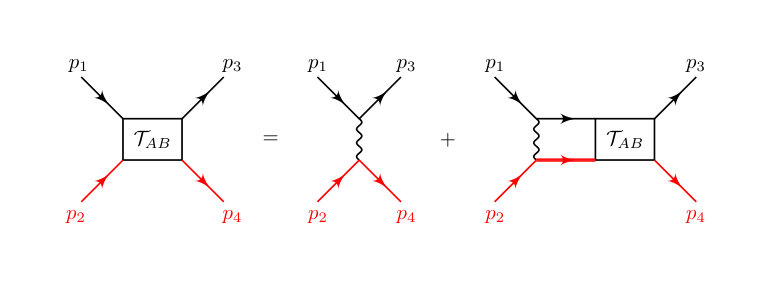 Figure 1
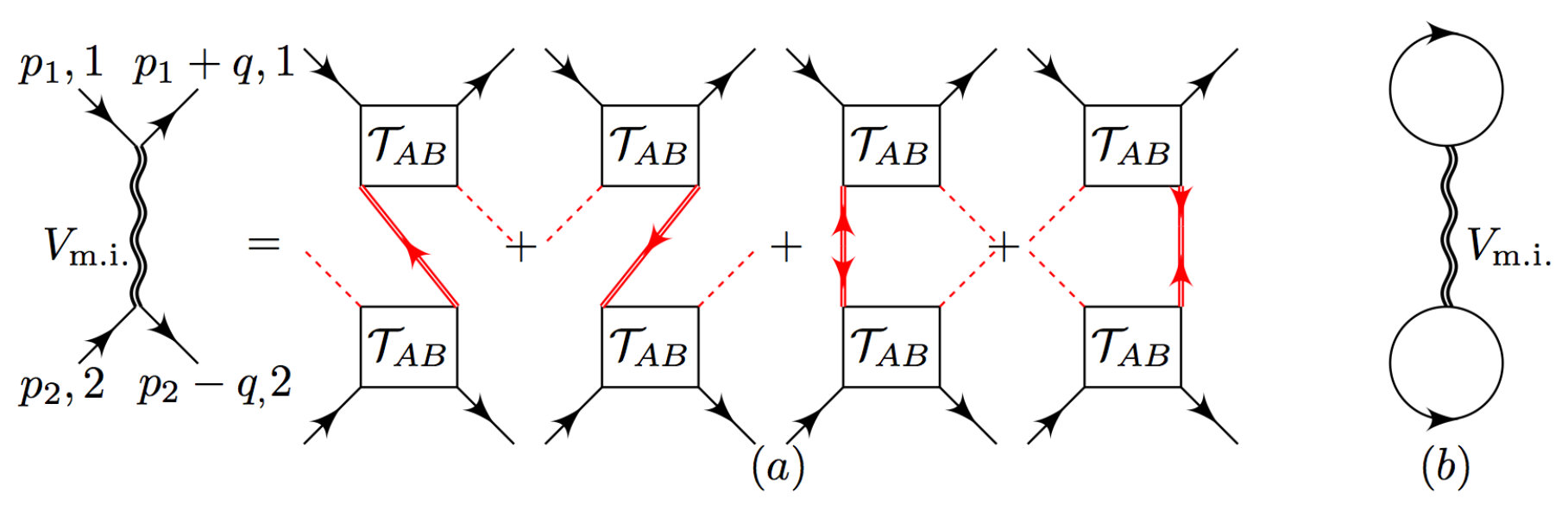 Figure 2
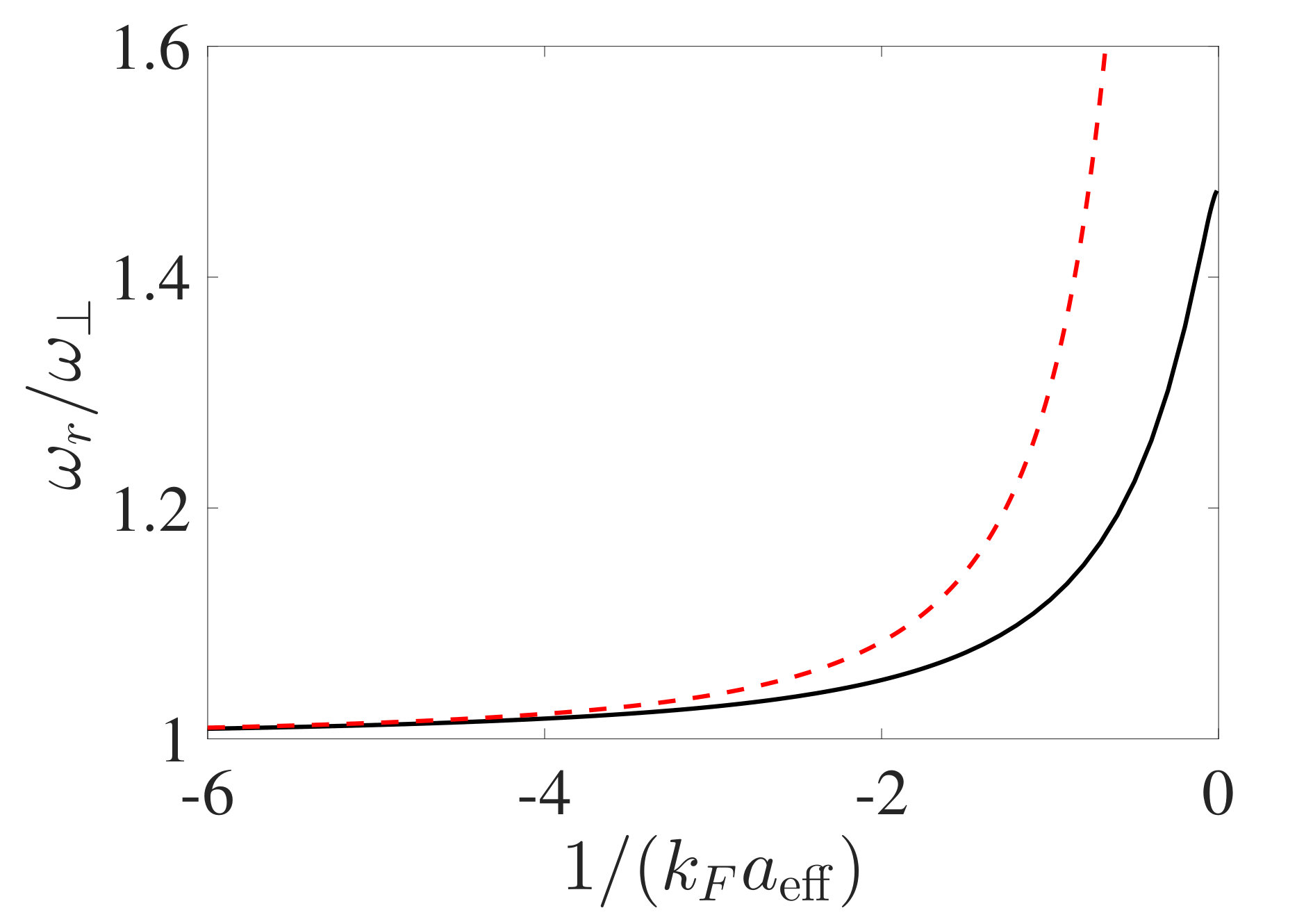 Figure 3
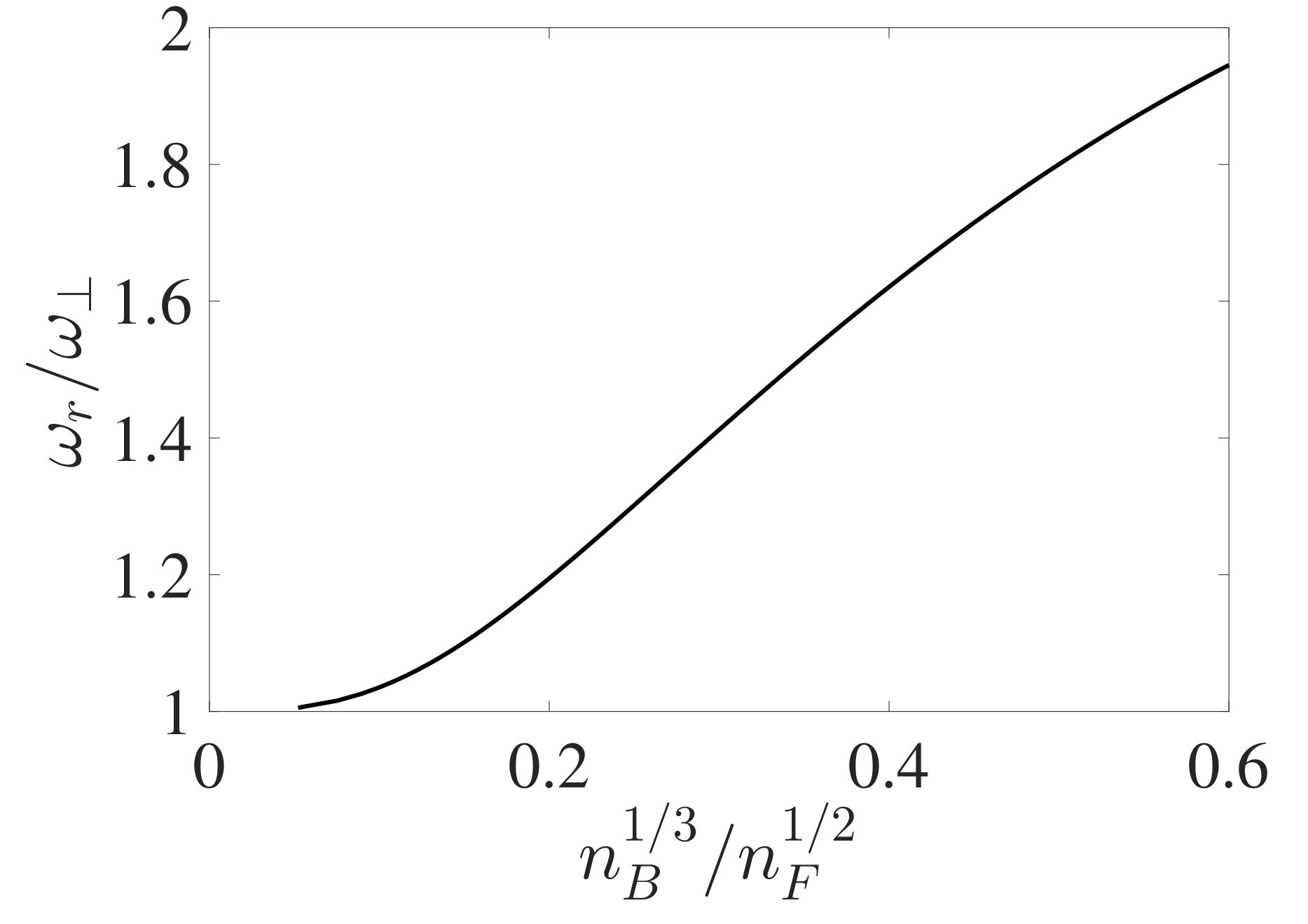 Figure 4
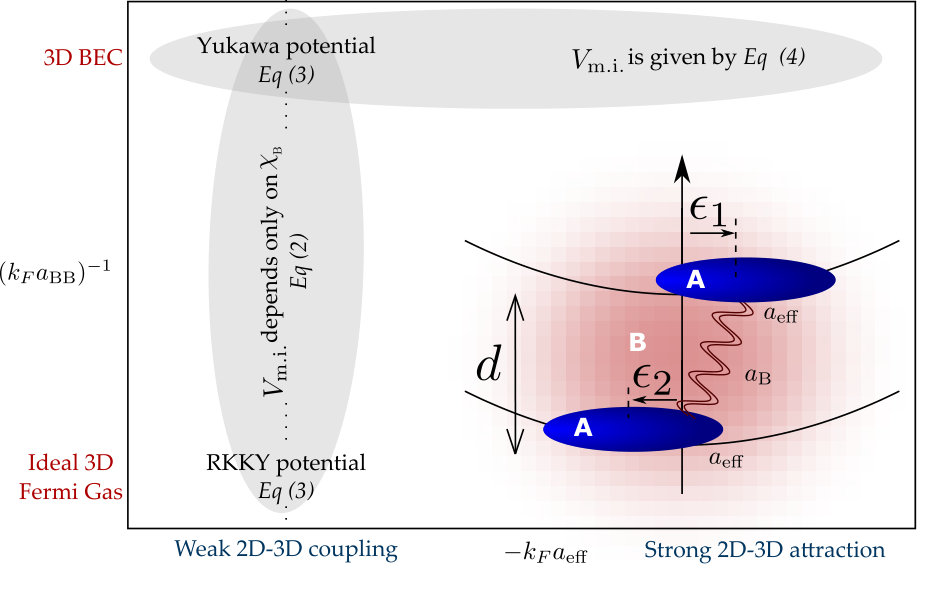 Figure 5
Peer Reviews
No public reviews on file for this paper yet. If you reviewed it on a platform where reviews are public (OpenReview, ICLR, NeurIPS, ICML), you can paste yours below so the community can read it here.
Videos
No videos yet. Explain this paper in a talk, walkthrough, or lecture? Add one.
Long range mediated interactions in a mixed dimensional system
Daniel Suchet
Laboratoire Kastler Brossel, ENS-PSL Research University,CNRS, UPMC, Collège de France, 24, rue Lhomond, 75005 Paris
Zhigang Wu
Institute for Advanced Study, Tsinghua University, Beijing, 100084, China
Frédéric Chevy
Laboratoire Kastler Brossel, ENS-PSL Research University,CNRS, UPMC, Collège de France, 24, rue Lhomond, 75005 Paris
Georg M. Bruun
Department of Physics and Astronomy, Aarhus University, DK-8000 Aarhus C, Denmark
Abstract
We present a mixed-dimensional atomic gas system to unambiguously detect and systematically probe mediated interactions. In our scheme, fermionic atoms are confined in two parallel planes and interact via exchange of elementary excitations in a three-dimensional background gas. This interaction gives rise to a frequency shift of the out-of-phase dipole oscillations of the two clouds, which we calculate using a strong coupling theory taking the two-body mixed-dimensional scattering into account exactly. The shift is shown to be easily measurable for strong interactions and can be used as a probe for mediated interactions.
Mediated interactions were originally introduced to provide a quantum-mechanical explanation for the peculiar “action at a distance” interactions like gravity and electromagnetism and they now constitute a major overarching paradigm in physics. In particle physics, exchange of gauge bosons is responsible for the propagation of fundamental interactions weinberg1995 . In condensed matter, the attraction between the electrons in BCS superconductors arises from the exchange of lattice phonons schrieffer1983 , and it is speculated that the mechanism behind high- superconductivity lies in the exchange of spin fluctuations Scalapino1995 . The concept of mediated interactions is also important in classical physics, where fluctuations of classical fields are responsible for phenomena such as the finite-temperature Casimir effect in electrodynamics milton2001casimir and in biophysics machta2012critical .
Ultracold atoms have emerged as a versatile platform for the investigation of many-body physics, and a host of schemes have been proposed to explore mediated interactions using these systems. For instance, mediated interactions lead to the formation of a -wave superfluid in spin-imbalanced fermionic systems bulgac2006ipw ; lobo2006nsp ; Mora2010Normal ; yu2010comment ; they are responsible for the formation of a topological superfluid with a high critical temperature in 2D systems Wu2016 ; Midtgaard2016 ; Caracanhas2017 , and in 1D quantum liquids they are shown to result in Casimir-like forces between impurities schecter2014phonon . In most cases, however, the mediated interaction is weak and in competition with direct interactions between atoms, making its experimental observation challenging.
In this paper, we apply the mixed-dimensional setup proposed in Nishida2010 and illustrated in Fig. 1 to study mediated interactions. Specifically we consider two parallel layers located at and , which contain an equal number of spin-polarized non-interacting fermions (A-species). The layers are immersed in a uniform 3D gas of interacting spin fermions (B species), which can be tuned through the BEC-BCS cross-over. The presence of the 3D gas induces a mediated interaction between the A-particles: one A-particle will perturb locally the surrounding B-particles thereby inducing excitations in the 3D gas, which in turn affects the dynamics of a second A-particle. If A-particles are harmonically trapped, this mediated coupling leads to a beating between oscillations in the two planes. Measuring the beating frequency between the 2D-clouds therefore gives access to the strength of mediated interaction. This scheme is similar to Coulomb drag experiments in bilayered electronic systems rojo1999electron that was recently generalized to the case of dipolar gases matveeva2011dipolar .
To analyze the dynamics of this system, we develop a systematic many-body theory for the mediated inter-plane interaction that includes the low-energy mixed-dimensional A-B scattering exactly. We then derive an expression for the associated interaction energy between the two planes and calculate the frequency of the out-of-phase dipole oscillations of the 2D clouds in the -plane. In the weak A-B interaction limit, our results recover the perturbative expression for a mediated interaction proportional to the density-density response function of the 3D gas. In the strong A-B interaction limit, however, the weak-coupling result breaks down completely. In the latter case we focus on the BEC regime of the 3D gas and show that the mediated interaction gives rise to a significant and easily detectable shift in the out-of-phase dipole oscillation frequency of the two clouds.
2D-3D scattering.– The interaction between the A and B particles is short range and can be characterised by an effective 2D-3D scattering length nishida2008universal . Solving for the scattering matrix in the many-body medium yields
[TABLE]
where , and is the reduced mass (). Here denotes the mass of an A-fermion and that of the scattering particle in the 3D gas, namely the mass of B-fermion (dimer) in the BCS (BEC) regime. is the renormalised 2D-3D pair propagator for the center-of-mass (COM) momentum in the plane, and is either a bosonic (BCS regime) or fermionic (BEC regime) Matsubara frequency. Equation (16) includes many-body effects in the ladder approximation (see the Supplemental Material), and recovers the correct low energy 2D-3D scattering matrix in a vacuum Nishida2009 . .
Mediated interaction for weak 2D-3D interaction.– Consider first the case of a weak 2D-3D interaction where is much smaller than the interparticle spacing of the A and B particles. We then have from (16), and second-order perturbation theory gives
[TABLE]
which describes the mediated interaction between two A-particles in different planes. Here are the transferred momentum and frequency and is the density-density response function of the B-cloud. The integration over the momentum comes from the fact that it is not conserved in the 2D-3D scattering. Deep in the BCS limit where the B fermions form an ideal Fermi gas, the mediated interaction (2) is of the form of a Ruderman-Kittel-Kasuya-Yosida potential RKKY1 ; RKKY2 ; RKKY3 ; Nishida2010 . When the B fermions are deep in the BEC limit where they form a weakly interacting BEC of dimers, the mediated interaction takes the form of a Yukawa potential Yukawa . At zero frequency, Fourier transforming (2) back to the real space gives
[TABLE]
where is the Fermi momentum of the 3D Fermi gas in the BCS regime, and is the density of the 3D BEC of dimers with coherence length . Here, is the scattering length between the deeply bound dimers of B fermions Petrov2004 .
Mediated interaction for strong 2D-3D interaction.– For a strong 2D-3D interaction where is comparable to or larger than the interparticle spacing, the mediated interaction between the two layers takes on a more complex form. The reason is that we need to retain the full COM momentum and frequency dependence of the 2D-3D scattering matrix given by (16).
We shall from now on concentrate on the BEC limit of the B-fermions, namely when they form a weakly interacting BEC of dimers, which can be treated within Bogoliubov theory. The mediated interaction between the A-particles is calculated including all processes where a single Bogoliubov phonon in the BEC is exchanged between the two layers. In a diagrammatic language, these processes are shown in Fig. 2 (a).
Summing up the contributions from the four terms in Fig. 2 (a) gives
[TABLE]
where , , and . Here and are Fermi and Bose Matsubara frequencies respectively, where is the inverse temperature and and are integers. In (4), the Green’s functions of the BEC are integrated over the -component of the momentum as
[TABLE]
The Green’s functions of the 3D BEC are as usual
[TABLE]
where and . We have defined , is the Bogoliubov spectrum with , and . Note that the mediated interaction (4) depends on both and as well as due to the momentum and frequency dependence of the 2D-3D scattering. In fact, in the weak interaction limit , one recovers (2) from the more general expression (4).
Thermodynamical potential.– We now derive an expression for the correction to the thermodynamic potential due to the mediated interaction between the two planes for a general strength of the 2D-3D interaction. The dominant contribution is the Hartree term illustrated in Fig. 2 (b). For a homogeneous system, this term gives the correction per unit area as(for the rest of the paper the subscript will be dropped in the vector notation and all bold face letters now denote in-plane 2D vectors)
[TABLE]
where is the Green’s function for the A-fermions in the -th layer with being the chemical potential. Using (4) together with the identity yields
[TABLE]
where
[TABLE]
We point out that the Matsubara frequency summation in the above expression can in fact be performed analytically (see supplementary material), which greatly simplifies the numerical calculation of thermodynamic potential density.
Local-density approximation.– Using the local-density approximation, we can generalize (7), which was derived assuming homogeneous system, to the case of trapped 2D Fermi clouds. This yields the total correction as
[TABLE]
where is the Fourier transform of back to real 2D space, and is given by (26) using a local chemical potential . In (10), we have allowed the two A-clouds to be rigidly displaced distances of and along the -axis in order to analyse their coupled dipole oscillations, see Fig. 1. Since already contains a Fourier transform with respect to -momentum, see (5), the bosonic Green’s functions entering (10) now simply add up to the density-density correlation function of the BEC evaluated at the 3D real space distance . Using this, we finally obtain
[TABLE]
Equation (11) can be understood as follows. Consider two area elements of the 2D gases, one located at in layer and the other at in layer . The contribution from these two elements can be approximated by the expression in (8) in which the relative distance is taken to be instead of . Equation (11) then sums up all such contributions in the two clouds.
For weak interaction, we see from (26) that , where denotes the equilibrium fermion density in layer rigidly displaced the distance along the -axis. Equation (11) then simplifies to
[TABLE]
which is the usual Hartree approximation for the interaction energy between the two planes mediated by a Yukawa interaction.
Coupled dipole oscillations.– Consider now the situation where the two clouds perform dipole oscillations around their equilibrium positions, see Fig. 1. For small displacements and , the COM velocities and the beating frequencies are small compared to the speed of sound in the 3D gas and the trapping frequencies respectively, yielding rigid and undamped oscillations of the 2D clouds Ferrier2014Mixture . The COM dynamics is then determined by the energy increase associated with the displacements of the clouds. For rigid displacements, we have , which gives
[TABLE]
where is the number of fermions in each layer. Taylor expanding to second order in , we readily see that the motion of the two clouds separates into an in-phase oscillation with frequency , and an out-of-phase oscillation with frequency
[TABLE]
where
[TABLE]
The microscopic expression for for arbitrary strength of the 2D-3D interaction in terms of (26), (11), (14), and (15) is the main result of this letter and it explicitly shows how the mediated interaction can be probed by measuring the frequency of the out-of-phase dipole oscillations of the two clouds.
Results.– We now calculate the frequency for a realistic cold-atom system consisting of atoms trapped in each plane, immersed in a 3D BEC of dimers. The transverse trapping frequency for the clouds is , the density of the BEC is , and the coherence length is . We furthermore assume that the temperature is zero. In Fig. 3, we show the frequency as a function of the 2D-3D interaction strength at a fixed interlayer distance . The frequency increases monotonically as increases. For weak interaction, it agrees with the second order result (dashed line). For stronger interaction, the full frequency/momentum dependence of the 2D-3D scattering is important, and the perturbative result deviates significantly from the full strong-coupling theory. In particular, whereas the perturbative result diverges for , the strong-coupling theory predicts a finite frequency saturating at . Importantly, the frequency shift becomes significant for , which includes a region sufficiently far from unitarity so that the predicted 3-body loss is small nishida2011liberating . This demonstrates the usefulness of our proposal to detect mediated interactions. Note that this result can only be obtained using a strong coupling theory, since the perturbative result is only accurate for weak interactions where the frequency shift is minute.
In Fig. 4, we plot as a function of the ratio of the interparticle distances (keeping fixed) with and all other physical parameters the same as for Fig. 3.a. The density of the BEC enters the mediated interaction in two ways, which is most clearly seen in the weak-coupling limit given by (3): First, the strength of the interaction is proportional to ; second, the range of the interaction is determined by the BEC coherence length . Thus, increasing the density increases the strength but reduces the range of the mediated interaction, and it is not a priori obvious what the net effect on the frequency shift will be. From Fig. 4, we see that for the chosen parameters, in fact increases monotonically with increasing BEC density 111We restricted all figures to negative values of the 2D-3D scattering length. Indeed for , a 2D fermion can form a bound-dimer state with a 3D boson. The frequency shift in this region therefore depends on whether the system forms these dimers, or whether it is on the so-called repulsive branch where the effective 2D-3D interaction is repulsive. This complicates the analysis, which will be presented in a future publication. .
Conclusions.– We demonstrated that a mixed-dimensional setup consisting of two layers of identical fermions immersed in a 3D background gas is a powerful probe to investigate mediated interactions systematically. The mediated interaction between the two layers modifies the out-of-phase dipole oscillation frequency of the 2D clouds, and we calculate this shift using a strong-coupling theory taking into account the low energy scattering between the 2D and 3D particles. Using this theory, we showed that for strong 2D-3D coupling, the resulting frequency shift is clearly measurable.
Finally we note that the advantages of our proposal are twofold. First, if the 2D trapping is realized using optical potentials, the distance between planes is a few hundred nanometres, which is much larger than the range of interatomic interactions. Any observed coupling between the two planes is therefore solely due to a mediated interaction via the 3D gas. Second, the shift of the center-of-mass oscillation frequency is a very precise spectroscopic tool that can be used as a probe of weak interactions, as demonstrated recently in Ferrier2014Mixture ; roy2016two .
Acknowledgements.
FC and DS acknowledge support from Région Ile de France (DIM IFRAF/NanoK), ANR (Grant SpiFBox) and European Union (ERC Grant ThermoDynaMix). GMB and ZW wishes to acknowledge the support of the Villum Foundation via Grant No. VKR023163. DS and ZW contributed equally to this work.
I 2D-3D scattering matrix
We provide some details on the 2D-3D scattering matrix given in Eq. (1) in the main text. In the strong 2D-3D interaction limit and in the presence of a 3D BEC background, we need the scattering amplitude in medium between the a 2D fermion and a 3D boson to determine the mediated interaction. In terms of the well-known T-matrix approximation, the scattering amplitude satisfies an integral equation represented diagrammatically in Fig. 5. Here the subscript is used to distinguish 2D plane vectors from the 3D ones. Using standard procedure the scattering matrix can be expressed in terms of the 2D-3D zero-energy scattering amplitude in vacuum , where with being the reduced mass and being the 2D-3D scattering length. In doing so, it can be shown that only depends on the total momentum and frequency and . We find
[TABLE]
Here is the renormalised pair propagation given by
[TABLE]
where , , , and and are the Bose and Fermi distribution function respectively. For weakly interacting Bosons, it is a good approximation to replace the normal Green’s function by the non-interacting Boson Green’s function in the scattering T-matrix. With this simplification, we find at
[TABLE]
where is the Fermi momentum of the A-species.
Expressed in terms of the dimensionless variables, the pair propagator is
[TABLE]
where and . Here the frequency variables are scaled in terms of the chemical potential and the momentum variables in terms of the Fermi momentum . We write
[TABLE]
where
[TABLE]
is the pair propagator in vacuum and
[TABLE]
is the medium correction. Here always denotes the root of the complex number that lies in the upper half plane.
From Eq. (21)-(22) we find (from now on we drop the sign from the 2D vectors)
[TABLE]
for . Here and in the following
[TABLE]
where . For we find
[TABLE]
where .
II Calculation of
We now determine given in Eq. (9) in the main text, which is reproduced below
[TABLE]
In terms of the dimensionless momenta and frequencies introduced earlier, we get
[TABLE]
Submitting Eq. (23) and (25) into Eq. (27), and performing the Matsubara frequency summation, we find for negative 2D-3D scattering length and in the zero temperature limit
[TABLE]
where
[TABLE]
The reference list from the paper itself. Each links out to its DOI / PubMed record.
- 1(1) S. Weinberg. The Quantum Theory of Fields . Number vb. 1 in The Quantum Theory of Fields 3 Volume Hardback Set. Cambridge University Press, 1995.
- 2(2) J.R. Schrieffer. Theory of Superconductivity . Advanced Book Program Series. Advanced Book Program, Perseus Books, 1983.
- 3(3) D.J. Scalapino. The case for dx 2 − y 2 pairing in the cuprate superconductors. Physics Reports , 250(6):329 – 365, 1995.
- 4(4) Kimball A Milton. The Casimir effect: physical manifestations of zero-point energy . World Scientific, 2001.
- 5(5) Benjamin B Machta, Sarah L Veatch, and James P Sethna. Critical casimir forces in cellular membranes. Physical review letters , 109(13):138101, 2012.
- 6(6) A. Bulgac, M.M.N. Forbes, and A. Schwenk. Induced P-Wave Superfluidity in Asymmetric Fermi Gases. Phys. Rev. Lett. , 97:020402, 2006.
- 7(7) C. Lobo, A. Recati, S. Giorgini, and S. Stringari. Normal state of a polarized Fermi gas at unitarity. Phys. Rev. Lett. , 97(20):200403, 2006.
- 8(8) C. Mora and F. Chevy. Normal phase of an imbalanced fermi gas. Phys. Rev. Lett. , 104(23):230402, Jun 2010.