Plane graphs without 4- and 5-cycles and without ext-triangular 7-cycles are 3-colorable
Ligang Jin, Yingli Kang, Michael Schubert, Yingqian Wang

TL;DR
This paper proves that certain classes of planar graphs, specifically those without 4- and 5-cycles and with restrictions on 7- and 8-cycles, are 3-colorable, advancing understanding related to Steinberg's conjecture.
Contribution
It establishes 3-colorability for plane graphs without 4- and 5-cycles under the absence of ext-triangular 7-cycles, extending known results.
Findings
Plane graphs without 4- and 5-cycles are 3-colorable if they lack ext-triangular 7-cycles.
Planar graphs without 4-, 5-, 7-cycles are 3-colorable.
Planar graphs without 4-, 5-, 8-cycles are 3-colorable.
Abstract
Listed as No. 53 among the one hundred famous unsolved problems in [J. A. Bondy, U. S. R. Murty, Graph Theory, Springer, Berlin, 2008] is Steinberg's conjecture, which states that every planar graph without 4- and 5-cycles is 3-colorable. In this paper, we show that plane graphs without 4- and 5-cycles are 3-colorable if they have no ext-triangular 7-cycles. This implies that (1) planar graphs without 4-, 5-, 7-cycles are 3-colorable, and (2) planar graphs without 4-, 5-, 8-cycles are 3-colorable, which cover a number of known results in the literature motivated by Steinberg's conjecture.
Click any figure to enlarge with its caption.
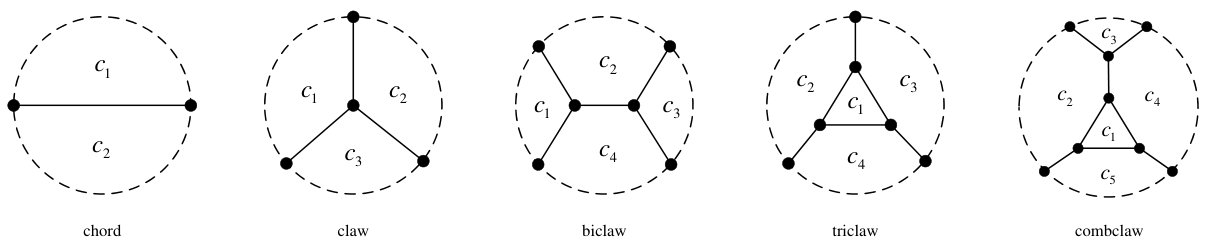 Figure 1
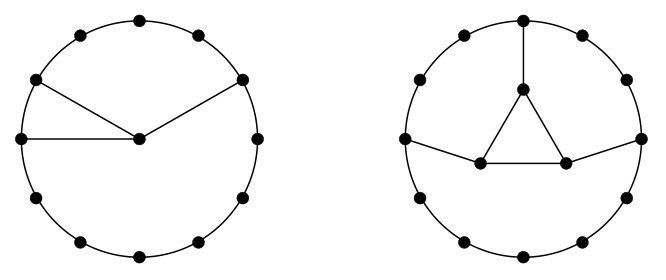 Figure 2
Peer Reviews
No public reviews on file for this paper yet. If you reviewed it on a platform where reviews are public (OpenReview, ICLR, NeurIPS, ICML), you can paste yours below so the community can read it here.
Videos
No videos yet. Explain this paper in a talk, walkthrough, or lecture? Add one.
Taxonomy
TopicsAdvanced Graph Theory Research · Computational Geometry and Mesh Generation · Limits and Structures in Graph Theory
Plane graphs without 4- and 5-cycles and without ext-triangular 7-cycles are 3-colorable
Ligang Jin111Institute of Mathematics and Paderborn Center for Advanced Studies, Paderborn University, 33102 Paderborn, Germany; [email protected] (Ligang Jin), [email protected] (Yingli Kang), [email protected] (Michael Schubert), Yingli Kang11footnotemark: 1 222Fellow of the International Graduate School ”Dynamic Intelligent Systems”, Michael Schubert11footnotemark: 1 22footnotemark: 2, Yingqian Wang333Department of Mathematics, Zhejiang Normal University, 321004 Jinhua, China; [email protected] (Yingqian Wang)
Abstract
Listed as No. 53 among the one hundred famous unsolved problems in [J. A. Bondy, U. S. R. Murty, Graph Theory, Springer, Berlin, 2008] is Steinberg’s conjecture, which states that every planar graph without 4- and 5-cycles is 3-colorable. In this paper, we show that plane graphs without 4- and 5-cycles are 3-colorable if they have no ext-triangular 7-cycles. This implies that (1) planar graphs without 4-, 5-, 7-cycles are 3-colorable, and (2) planar graphs without 4-, 5-, 8-cycles are 3-colorable, which cover a number of known results in the literature motivated by Steinberg’s conjecture.
1 Introduction
In the field of 3-colorings of planar graphs, one of the most active topics is about a conjecture proposed by Steinberg in 1976: every planar graph without cycles of length 4 and 5 is 3-colorable. There had been no progress on this conjecture for a long time, until Erdös [14] suggested a relaxation of it: does there exist a constant such that every planar graph without cycles of length from 4 to is 3-colorable? Abbott and Zhou [1] confirmed that such exists and . This result was later on improved to by Borodin [2] and, independently, by Sanders and Zhao [13], and to by Borodin, Glebov, Raspaud and Salavatipour [3].
Theorem 1.1** ([3]).**
Planar graphs without cycles of length from 4 to 7 are 3-colorable.
We remark that Steinberg’s conjecture was recently shown to be false in [6], by constructing a counterexample to the conjecture. The question whether every planar graph without cycles of length from 3 to 5 is 3-colorable is still open.
A more general problem than Steinberg’s Conjecture was formulated in [11, 9]:
Problem 1.2**.**
What is , a set of integers between 5 and 9, such that for , every planar graph with cycles of length neither 4 nor is 3-colorable?
Thus, Steinberg’s Conjecture states that . Since so far no element of has been confirmed, it seems reasonable to consider a relaxation of Problem 1.2 where more integers are forbidden to be the length of a cycle in planar graphs. Due to a famous theorem of Grötzsch that planar graphs without triangles are 3-colorable, triangles are always allowed in further sufficient conditions. Several papers together contribute to the result below:
Theorem 1.3**.**
For any three integers with , it holds true that planar graphs having no cycles of length are 3-colorable.
Later on, the sufficient conditions, concerning three integers forbidden to be the length of a cycle, were considered. The corresponding problem can be formulated as follows:
Problem 1.4**.**
What is , a set of pairs of integers with , such that planar graphs without cycles of length are 3-colorable?
It has been proved by Borodin et al. [4] and independently by Xu [17] that every planar graph having neither 5- and 7-cycles nor adjacent 3-cycles is 3-colorable. Hence, , which improves on Theorem 1.1. More elements of have been confirmed: by Wang and Chen [15], by Lu et al. [11], and by Jin et al. [9]. The result is implied in the following theorem, which reconfirms the results and .
Theorem 1.5** ([5]).**
Planar graphs without triangles adjacent to cycles of length from 4 to 7 are 3-colorable.
In this paper, we show that , which leaves four pairs of integers unconfirmed as elements of .
Recently, Mondal gave a proof of the result in [12]. Here we exhibit two couterexamples to the theorem proved in that paper which yields the result . We restated this theorem as follows. Let be a cycle of length at most 12 in a plane graph without 4-, 5- and 8-cycles. is bad if it is of length 9 or 12 and the subgraph inside has a partition into 3- and 6-cycles; otherwise, is good.
Theorem 1.6** (Theorem 2 in [12]).**
Let be a graph without 4-, 5-, and 8-cycles. If is a good cycle of , then every proper 3-coloring of can be extended to a proper 3-coloring of the whole graph .
Counterexamples to Theorem 1.6. A plane graph consisting of a cycle of length 12, say , and a vertex inside connected to all of . The graph contradicts Theorem 1.6, since any proper 3-coloring of where receive pairwise distinct colors can not be extended to . Also, a plane graph consisting of a cycle of length 12 and a triangle inside , say and , and three more edges . The graph contradicts Theorem 1.6, since any proper 3-coloring of where receive the same color can not be extended to (see Figure 1).
1.1 Notations and formulation of the main theorem
The graphs considered in this paper are finite and simple. A graph is planar if it is embeddable into the Euclidean plane. A plane graph is a planar graph together with an embedding of into the Euclidean plane, that is, is a particular drawing of in the Euclidean plane. In what follows, we will always say a plane graph instead of , which causes no confusion since no two embeddings of the same graph will be involved in.
Let be a plane graph and be a cycle of . By (or ) we denote the subgraph of induced by the vertices lying inside (or outside) . The cycle is separating if neither nor is empty. By (or ) we denote the subgraph of consisting of and its interior (or exterior). The cycle is triangular if it is adjacent to a triangle, and is ext-triangular if it is adjacent to a triangle of .
The following theorem is the main result of this paper.
Theorem 1.7**.**
Plane graphs with neither 4- and 5-cycles nor ext-triangular 7-cycles are 3-colorable.
As a consequence of Theorem 1.7, the following corollary holds true.
Corollary 1.8**.**
Planar graphs without cycles of length 4, 5, 8 are 3-colorable, that is, .
We remark that Theorem 1.7 implies the known result that as well.
Denote by the degree of a vertex , by the number of edges of a path , by the length of a cycle and by the size of a face . A -vertex (or -vertex, or -vertex) is a vertex with (or , or ). Similar notations are used for paths, cycles, faces with instead of , respectively.
Let denote the subgraph of induced by with either or . A chord of is an edge of that connects two nonconsecutive vertices on . If has a vertex with three neighbors on , then is called a claw of . If has two adjacent vertices and such that has two neighbors on and has two neighbors on , then is called a biclaw of . If has three pairwise adjacent vertices which has a neighbor on respectively, then is called a triclaw of . If has four vertices inside and four vertices on such that , then is called a combclaw of (see Figure 2).
A good cycle is an 11--cycle that has none of claws, biclaws, triclaws and combclaws. A bad cycle is an 11--cycle that is not good.
Instead of Theorem 1.7, it is easier for us to prove the following stronger one:
Theorem 1.9**.**
Let be a connected plane graph with neither 4- and 5-cycles nor ext-triangular 7-cycles. If , the boundary of the exterior face of , is a good cycle, then every proper 3-coloring of can be extended to a proper 3-coloring of .
The proof of Theorem 1.9 will be proceeded by using discharging method and is given in the next section. For more information on the discharging method, we refer readers to [7]. The rest of this section contributes to other needed notations.
Let be a cycle and be one of chords, claws, biclaws, triclaws and combclaws of . We call the graph consisting of and a bad partition of . The boundary of any one of the parts, into which is divided by , is called a cell of . Clearly, every cell is a cycle. In case of confusion, let us always order the cells of in the way as shown in Figure 2. Let be the length of . Then is further called a -chord, a -claw, a -biclaw, a -triclaw and a -combclaw, respectively.
A vertex is external if it lies on the exterior face; internal otherwise. A vertex (or an edge) is triangular if it is incident with a triangle. We say a vertex is bad if it is an internal triangular 3-vertex; good otherwise. A path is a splitting path of a cycle if it has the two end-vertices on and all other vertices inside . A -cycle with vertices in cyclic order is denoted by .
Let be a path on the boundary of a face of with internal. The vertex is -heavy if both and are triangular and , and is -Mlight if both and are triangular and , and -Vlight if neither nor is triangular and is triangular and of degree 4. A vertex is -light if it is either -Mlight or -Vlight.
Denote by the class of connected plane graphs with neither 4- and 5-cycles nor ext-triangular 7-cycles.
2 The proof of Theorem 1.9
Suppose to the contrary that Theorem 1.9 is false. From now on, let be a counterexample to Theorem 1.9 with fewest vertices. Thus, we may assume that the boundary of the exterior face of is a good cycle, and there exists a proper 3-coloring of which cannot be extended to a proper 3-coloring of . By the minimality of , we deduce that has no chord.
2.1 Structural properties of the minimal counterexample
Lemma 2.1**.**
Every internal vertex of has degree at least 3.
Proof.
Suppose to the contrary that has an internal vertex with . We can extend to by the minimality of , and then to by coloring different from its neighbors. ∎
Lemma 2.2**.**
* is 2-connected and therefore, the boundary of each face of is a cycle.*
Proof.
Otherwise, we can assume that has a pendant block with cut vertex such that does not intersect with . We first extend to , and then 3-color so that the color assigned to is unchanged. ∎
Lemma 2.3**.**
* has no separating good cycle.*
Proof.
Suppose to the contrary that has a separating good cycle . We extend to . Furthermore, since is a good cycle, the color of can be extended to its interior. ∎
By the definition of a bad cycle, one can easily conclude the lemma as follows.
Lemma 2.4**.**
If is a bad cycle of a graph in , then has length either 9 or 11. Furthermore, if , then has a (3,6,6)-claw or a (3,6,6,6)-triclaw; if , then has a (3,6,8)-claw, or a (3,6,6,6)- or (6,3,6,6)-biclaw, or a (3,6,6,8)-triclaw, or a (3,6,6,6,6)-combclaw.
Notice that all 3- and 6- and 8-cycles of are facial, thus the following statement is a consequence of the previous lemma together with the fact that .
Lemma 2.5**.**
* has neither bad cycle with a chord nor ext-triangular bad 9-cycle.*
Lemma 2.6**.**
Let be a splitting path of which divides into two cycles and . The following four statements hold true.
- (1)
If , then there is a triangle between and . 2. (2)
. 3. (3)
If , then there is a 6- or 7-cycle between and . 4. (4)
If , then there is a -cycle between and .
Proof.
Since has length at most 11, we have .
(1) Let . Suppose to the contrary that . By Lemma 2.1, has a neighbor other than and , say . It follows that is internal since otherwise is a bad cycle with a claw. Without loss of generality, let lie inside . Now is a separating cycle. By Lemma 2.3, is not good, i.e., either is bad or . Since every bad cycle has length either 9 or 11 by Lemma 2.4, we have . Recall that , thus and . Now has either a (3,6,6)-claw or a (3,6,6,6)-triclaw by Lemma 2.4, which implies that has a biclaw or a combclaw respectively, a contradiction.
(2) Suppose to the contrary that . Let . Clearly . Let and be a neighbor of and not on , respectively. If both and are external, then has a biclaw. Hence, we may assume lies inside . By Lemmas 2.3 and 2.4 and the inequality , we deduce that is a bad cycle and is a good -cycle. If is internal, then lies inside . It follows with the specific interior of a bad cycle that and has either a claw or a biclaw, which implies that has either a triclaw or a combclaw respectively, a contradiction. Hence, is external. Since every bad cycle as well as every - or 8-cycle contains no chord by Lemma 2.5, we deduce that is a (3,6)-chord of . It follows that is a bad and ext-triangular 9-cycle, contradicting Lemma 2.5.
(3) Let . Suppose to the contrary that . Since , we have . Since has no 4- and 5-cycles, if has an edge connecting two nonconsecutive vertices on , then the cycle formed by and has to be a triangle, yielding a splitting 3-path of , contradicting the statement (2). Therefore, no pair of nonconsecutive vertices on are adjacent.
Let be a neighbor of not on , respectively. The statement (2) implies that is internal. Let lie inside of . Thus is a bad 9- or 11-cycle. If is a bad 11-cycle, then is a facial 8-cycle, and thus both and lie in , which is impossible by the interior of a bad cycle. Hence, is a bad 9-cycle. By the statement (1), if , then has the triangle , which makes ext-triangular, a contradiction. Hence, . Furthermore, as a bad cycle, has no chord by Lemma 2.5, thus is internal. If lies inside , then it gives the interior of no other choices but and has a -claw, in which case this claw contains a splitting 3-path of , a contradiction. Hence, lies inside . Similarly, we can deduce that lies inside as well. Note that , thus is a bad 9-cycle but has to contain both and inside, which is impossible.
(4) Let . Suppose to the contrary that . Since , we have . By similar argument as in the proof of the statement (3), one can conclude that has no edge connecting two nonconsecutive vertices on . Let be a neighbor of not on , respectively.
The statement (2) implies that both and are internal. Let lie inside . It follows that is a bad 11-cycle and is a 10-cycle. Thus also lies inside and furthermore, and is a bad cycle with either a (3,6,8)-claw or a (3,6,6,6)-biclaw. It follows that . By the statement (1), has two triangles and , at least one of them is adjacent to a 7-cycle of , a contradiction. ∎
Lemma 2.7**.**
Let be a connected plane graph obtained from by deleting a set of internal vertices and identifying two other vertices so that at most one pair of edges are merged. If we
- ()
identify no two vertices of , and create no edge connecting two vertices of , and 2. ()
create no -cycle and ext-triangular 7-cycle,
then can be extended to .
Proof.
The item guarantees that is unchanged and bounds , and is a proper 3-coloring of . By item , the graph is simple and . Hence, to extend to by the minimality of , it remains to show that is a good cycle of .
Suppose to the contrary that has a bad partition in . Clearly, has a 6-cell such that the intersection between and is a path of length with . Since we create no 6-cycles, corresponds to a 6-cycle of the original graph . Recall that at most one pair of edges are merged during the process from to , we deduce that the intersection between and is a path of one of the forms . Thus, . If , then contains a splitting 3- or 2-path of in , yielding a contradiction by Lemma 2.6. Hence, and so . By the choice of the 6-cell , we may assume that the bad partition has either a (3,6,6,6)- or (3,6,6,8)-triclaw. Now contains three splitting 3-paths of , at least one of them does not contain the identified vertex of no matter where it is, yielding the existence of a splitting 3-path of in , contradicting Lemma 2.6. ∎
Lemma 2.8**.**
* has no edge incident with a 6-face and a 3-face such that both and are internal 3-vertices and therefore, every bad cycle of has either a (3,6,6)- or (3,6,8)-claw or a (3,6,6,6)-biclaw.*
Proof.
Suppose to the contrary that such an edge exists. Denote by and the 6-face and 3-face, respectively. Lemma 2.6 implies that not both of and are external vertices. Without loss of generality, we may assume that is internal. Let be the graph obtained from by deleting and , and identifying with so that and are merged. Clearly, is a plane graph on fewer vertices than . We will show that both the items in Lemma 2.7 are satisfied.
Since is internal, we identify no two vertices on . If we create an edge connecting two vertices on , then has a neighbor not adjacent to and both and are external. But now, Lemma 2.6 implies that is external and thus, is a triangle which makes the 7-cycle ext-triangular. Hence, the item holds.
Suppose we create a -cycle or an ext-triangular 7-cycle . Thus has a -path between and corresponding to . If , then neither nor are on since otherwise, already exists in . Hence, the paths and form two cycles, both of them has length at least 6. It follows that , a contradiction. Hence, we may assume that . The paths and form a -cycle, say . By Lemma 2.1, we may let be a neighbor of other than and . We have , since otherwise has length at least 8. Now has to contain either and or inside, which implies that is a bad 9-cycle. By Lemma 2.5, is not ext-triangular. Thus is a 7-cycle that is not ext-triangular, contradicting the supposition. Hence, the item holds.
By Lemma 2.7, the pre-coloring can be extended to . Since and receive different colors, we can properly color and , extending further to . ∎
We follow the notations of -face and -face in [3], and define weak tetrads. An -face is an 8-face containing no external vertices with boundary such that the vertices are of degree 3 and the edges are triangular. An -face is an 8-face containing no external vertices with boundary such that and are of degree 4 and other six vertices on are of degree 3, and the edges are triangular. A weak tetrad is a path on the boundary of a face such that both the edges and are triangular, all of are internal 3-vertices, and is either of degree 3 or -light.
Lemma 2.9**.**
* has no weak tetrad and therefore, every face of contains no five consecutive bad vertices.*
Proof.
Suppose to the contrary that has a weak tetrad following the notation used in the definition. Denote by the neighbor of on with . Denote by the common neighbor of and , and the common neighbor of and . If , then is an internal 2-vertex, contradicting Lemma 2.1. Hence, and similarly, . Since has no 4- or 5-cycles, . Concluding above, . Similarly, . Moreover, since otherwise is a 4-cycle. We delete and identity with , obtaining a plane graph on fewer vertices than . We will show that both the items in Lemma 2.7 are satisfied.
Suppose that we create a -cycle or an ext-triangular 7-cycle . Thus has a -path between and corresponding to . If , then the cycle formed by and has length at least 6 and the one formed by and has length at least 8, which gives , a contradiction. Hence, . The paths and form a -cycle, say . Now contains either or inside. Thus, is a bad cycle. By Lemma 2.8, has either a (3,6,6)- or (3,6,8)-claw or a (3,6,6,6)-biclaw. Note that both the two faces incident with has length at least 8, thus has a bad partition owning an 8-cell no matter which one of and lies inside . It follows that has a (3,6,8)-claw. If lies inside , then the 6-cell is adjacent to the triangle with , contradicting Lemma 2.8. Hence, lies inside . Note that is incident with the 6-cell and the 8-cell, we deduce that is not -light. By the assumption of as a weak tetrad, we may assume that . We delete together with other vertices of and repeat the argument above, yielding a contradiction. Therefore, the item holds.
Suppose we identify two vertices on or create an edge connecting two vertices on . Thus there is a splitting 4- or 5-path of containing the path . By Lemma 2.6, together with forms a -cycle which corresponds to a -cycle in . Since we create no -cycle, a contradiction follows. Hence, the item holds.
By Lemma 2.7, the pre-coloring can be extended to . We first properly color (if needed), in turn. Since and receive different colors, we can properly color and , extending further to . ∎
Lemma 2.10**.**
* has no -face.*
Proof.
Suppose to the contrary that has an -face following the notation used in the definition. For , denote by the common neighbor of and . By similar argument as in the proof of previous lemma, we deduce that the vertices are pairwise distinct and not incident with . We delete and identity with , obtaining a plane graph on fewer vertices than . We will show that both the items in Lemma 2.7 are satisfied.
Suppose that we create a -cycle or an ext-triangular 7-cycle . Thus has a -path between and corresponding to . By the symmetry of an -face, we may assume that together with the path forms a -cycle containing inside. It follows with Lemma 2.8 that is a bad cycle with a -claw. But now contains that is an 8-face, a contradiction. Therefore, the item holds.
The satisfaction of the item can be proved in a similar way as in the proof of previous lemma.
By Lemma 2.7, the pre-coloring can be extended to . Since we first color different from , both and can be properly colored. Finally, color in the same way, extending further to . ∎
Lemma 2.11**.**
* has no -face.*
Proof.
Suppose to the contrary that has an -face following the notation used in the definition. For , denote by the common neighbor of and . Similarly, we deduce that the vertices are pairwise distinct and not incident with . We delete all the vertices of and identity with , obtaining a plane graph on fewer vertices than . To extend to , it suffices to fulfill the item of Lemma 2.7, as what we did in previous lemma.
Suppose that we create a -cycle or an ext-triangular 7-cycle . Thus has a -path between and corresponding to . If , then both the cycles formed by and and by and have length at least 8, which gives , a contradiction. Hence, . The paths and form a -cycle, say . It follows that is a bad cycle containing either or inside, that is, either has a bad partition owning two -cell or contains five vertices inside, a contradiction in any case.
We further extend from to as follows. Let and be the three colors used in . First regardless the edge , we can properly color and . If and receive different colors and so do and , then and can be properly colored, we are done. Hence, we may assume without loss of generality that and receive the same color, say . Let be the color assigned to and . Thus and are colored with and is colored with . We recolor with respectively. Now and receive different colors and so do and . Again and can be properly colored, we are also done. ∎
2.2 Discharging in
Let , , and be the set of faces of . Denote by the exterior face of . Give initial charge to each element of , where , for , and for . Discharge the elements of according to the following rules:
Every internal 3-face receives from each incident vertex. 2.
Every internal -face sends to each incident 2-vertex. 3.
Every internal -face sends each incident 3-vertex charge if is triangular, and charge otherwise. 4.
Every internal -face sends to each -light vertex, and receives from each -heavy vertex. 5.
Every internal -face receives from each incident external -vertex. 6.
The exterior face sends to each incident vertex.
Let denote the final charge of each element of after discharging. On one hand, by Euler’s formula we deduce Since the sum of charges over all elements of is unchanged, it follows that On the other hand, we show that for and . Hence, this obvious contradiction completes the proof of Theorem 1.9. It remains to show that for and .
We remark that the discharging rules can be tracked back to the one used in [3].
Lemma 2.12**.**
* for .*
Proof.
First suppose that is external. Since is a cycle, . If , then since has no chord, the internal face incident with is not a triangle and sends to by . Moreover, receives from by , which gives . If , then sends charge to at most one 3-face by and thus . If , then sends at most to each incident internal face by and , yielding . Hence, we are done in any case.
It remains to suppose that is internal. By Lemma 2.1, If , then we have by and when is triangular, and by when not. If , then is incident with 3-faces with . By and , we have when , when , and when . If , then sends charge to at most two 3-faces by and to at most one -face by , which gives . Hence, we may next assume that Since sends at most to each incident face by our rules, we get ∎
Lemma 2.13**.**
.
Proof.
Recall that and . We have by . ∎
Lemma 2.14**.**
* for .*
Proof.
We distinguish cases according to the size of . Since has no 4- and 5-cycle, .
If , then receives from each incident vertices by , which gives
Let . For any incident vertex , by the rules, sends to charge if is either of degree 2 or bad, and charge at most otherwise. Since has no ext-triangular 7-cycles, is adjacent to at most one 3-face. Furthermore, by Lemma 2.8, contains at most one bad vertex. If contains a 2-vertex, say , we can deduce with Lemma 2.6 that is the unique 2-vertex of and the two neighbors of on are external -vertices which receive nothing from . It follows that Hence, we may assume that contains no 2-vertices. If has no bad vertices, then sends each incident vertex at most , which gives . Hence, we may let be a bad vertex of . Denote by the other common vertex between and the triangle adjacent to . By Lemma 2.8 again, is not a bad vertex, i.e., is either an internal -vertex or an external -vertex. By our rules, sends nothing to , yielding
Let . Since has no ext-triangular 7-cycles, contains no bad vertices. Moreover, by Lemma 2.6, we deduce that has at most two 2-vertices. Thus,
Let . On the hand, if contains precisely one external vertex, say , then and so receives from by . Furthermore, since contains no weak tetrad by Lemma 2.9, has a good vertex other than and sends at most to it. Hence, On the other hand, if contains at least two external vertices, then at least two of them are of degree more than 2. Since sends nothing to external -vertices, we have . By the two hands above, we may assume that all the vertices of are internal. We distinguish two cases.
Case 1: assume that . Denote by the number of bad vertices of . We have , provided by . Since contains no weak tetrad, . Hence, we may assume that . For , we claim that has a vertex failing to take charge from , which gives Suppose to the contrary that no such vertex exists. Thus, the bad vertices of can be paired so that any good vertex of the path of between each pair is -Mlight, contradicting the parity of . For , since again contains no five consecutive bad vertices, these six bad vertices of are divided by the two good ones into cyclically either 3+3 or 2+4. We may assume that has a good vertex that is either -light or of degree 3, since otherwise we are done with . Denote by such a good vertex and by the other one. By the drawing of and of the 3-faces adjacent to , we deduce that, for the case 3+3, is an -face, contradicting Lemma 2.10, and for the case 2+4, if is -Mlight then either is an -face or is -heavy; otherwise contains a weak tetrad. It follows with Lemmas 2.11 and 2.9 that is -heavy, which is the only possible case. Hence, receives from by , yielding .
Case 2: assume that . By Lemma 2.9, we deduce that contains at least two good vertices, each of them receives at most from . Thus, , provided by . It remains to suppose . If has at most six bad vertices, then Hence, we may assume that has precisely seven bad vertices. By the same argument as for the case and has five bad vertices above, has a vertex failing to take charge from , which gives ∎
By the previous three lemmas, the proof of Theorem 1.9 is completed.
3 Acknowledgement
The first author is supported by Deutsche Forschungsgemeinschaft (DFG) grant STE 792/2-1. The fourth author is supported by National Natural Science Foundation of China (NSFC) 11271335.
The reference list from the paper itself. Each links out to its DOI / PubMed record.
- 1[1] H. L. Abbott and B. Zhou , On small faces in 4-critical graphs, Ars Combin. 32 (1991) 203-207.
- 2[2] O. V. Borodin , Structural properties of plane graphs without adjacent triangles and an application to 3-colorings, J. Graph Theory 21 (1996) 183-186.
- 3[3] O. V. Borodin, A. N. Glebov, A. Raspaud and M. R. Salavatipour , Planar graphs without cycles of length from 4 to 7 are 3-colorable, J. Combin. Theory Ser. B 93 (2005) 303-311.
- 4[4] O. V. Borodin, A. N. Glebov, M. Montassier and A. Raspaud , Planar graphs without 5- and 7-cycles and without adjacent triangles are 3-colorable, J. Combin. Theory Ser. B 99 (2009) 668-673.
- 5[5] O. V. Borodin, A. N. Glebov and A. Raspaud , Planar graphs without triangles adjacent to cycles of length from 4 to 7 are 3-colorable, Discrete Math. 310 (2010) 2584-2594.
- 6[6] V. Cohen-Addad, M. Hebdige, D. Král’, Z. Li and E. Salgado , Steinberg’s Conjecture is false, (2016) ar Xiv: 1604.05108 v 1.
- 7[7] D. W. Cranston and D. B. West , A guide to the discharging method, (2013) ar Xiv: 1306.4434.
- 8[8] H. Grötzsch , Ein Dreifarbensatz für dreikreisfreie Netze auf der Kugel, Wiss. Z. Martin Luther Univ. Halle Wittenberg, Math.-Nat. Reihe 8 (1959) 109-120.