Giant perpendicular exchange bias with antiferromagnetic MnN
Philipp Zilske, Dominik Graulich, Mareike Dunz, Markus Meinert

TL;DR
This paper reports the discovery of a giant perpendicular exchange bias of 3600 Oe in MnN-based antiferromagnetic systems, with potential applications in stable, perpendicular spintronic devices.
Contribution
It demonstrates the realization of the largest perpendicular exchange bias and anisotropy constants in MnN-based films, advancing the understanding of exchange bias mechanisms.
Findings
Giant perpendicular exchange bias of 3600 Oe at room temperature.
Effective interfacial exchange energy estimated at 0.24 mJ/m$^2$.
Maximum perpendicular anisotropy field of 3400 Oe.
Abstract
We investigated an out-of-plane exchange bias system that is based on the antiferromagnet MnN. Polycrystalline, highly textured film stacks of Ta / MnN / CoFeB / MgO / Ta were grown on SiO by (reactive) magnetron sputtering and studied by x-ray diffraction and Kerr magnetometry. Nontrivial modifications of the exchange bias and the perpendicular magnetic anisotropy were observed both as functions of film thicknesses as well as field cooling temperatures. In optimized film stacks, a giant perpendicular exchange bias of 3600 Oe and a coercive field of 350 Oe were observed at room temperature. The effective interfacial exchange energy is estimated to be mJ/m and the effective uniaxial anisotropy constant of the antiferromagnet is kJ/m. The maximum effective perpendicular anisotropy field of the CoFeB layer is …
Click any figure to enlarge with its caption.
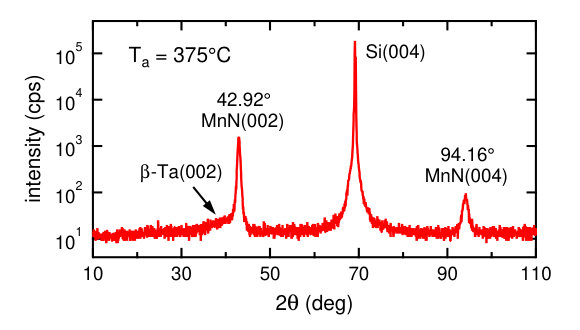 Figure 1
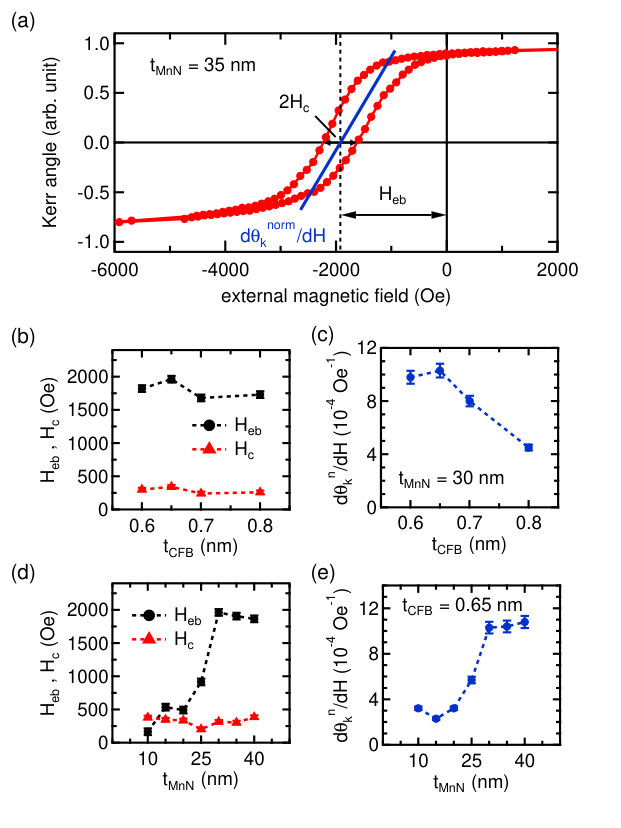 Figure 2
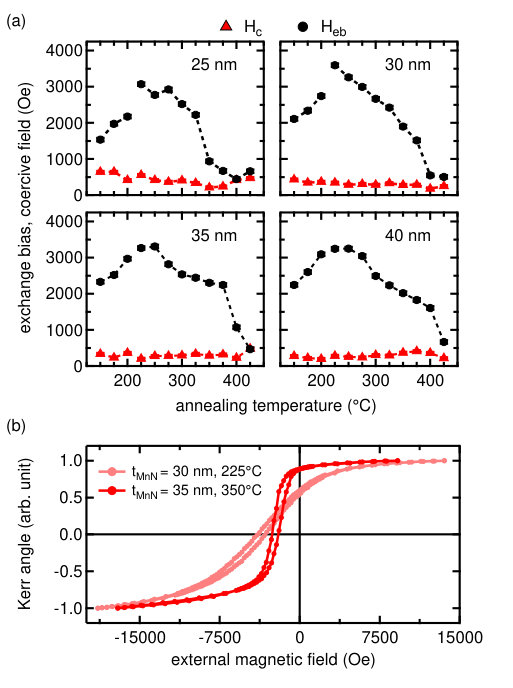 Figure 3
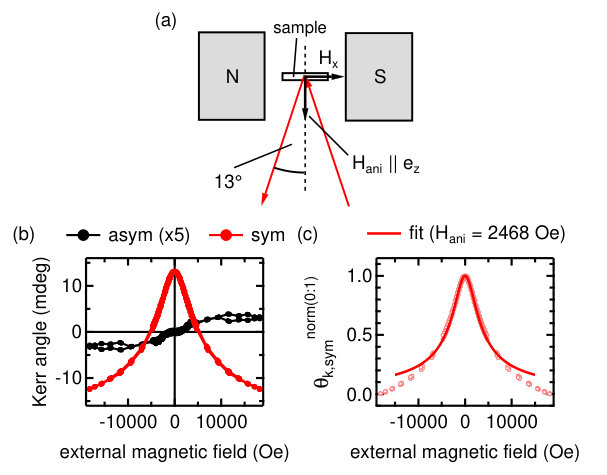 Figure 4
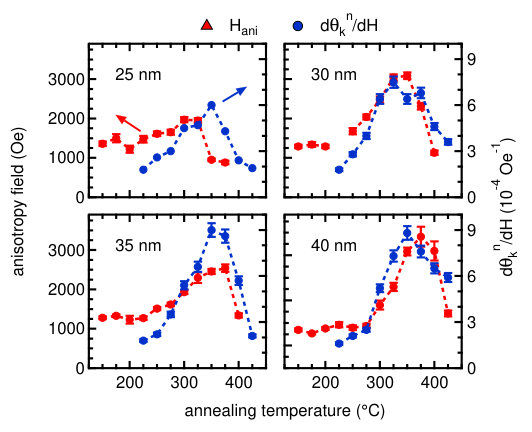 Figure 5
Peer Reviews
No public reviews on file for this paper yet. If you reviewed it on a platform where reviews are public (OpenReview, ICLR, NeurIPS, ICML), you can paste yours below so the community can read it here.
Videos
No videos yet. Explain this paper in a talk, walkthrough, or lecture? Add one.
Giant perpendicular exchange bias with antiferromagnetic MnN
P. Zilske
D. Graulich
M. Dunz
M. Meinert
Abstract
We investigated an out-of-plane exchange bias system that is based on the antiferromagnet MnN. Polycrystalline, highly textured film stacks of Ta / MnN / CoFeB / MgO / Ta were grown on SiOx by (reactive) magnetron sputtering and studied by x-ray diffraction and Kerr magnetometry. Nontrivial modifications of the exchange bias and the perpendicular magnetic anisotropy were observed both as functions of film thicknesses as well as field cooling temperatures. In optimized film stacks, a giant perpendicular exchange bias of 3600 Oe and a coercive field of 350 Oe were observed at room temperature. The effective interfacial exchange energy is estimated to be mJ/m2 and the effective uniaxial anisotropy constant of the antiferromagnet is kJ/m3. The maximum effective perpendicular anisotropy field of the CoFeB layer is Oe. These values are larger than any previously reported values. These results possibly open a route to magnetically stable, exchange biased perpendicularly magnetized spin valves.
Spin electronics allows to realize nonvolatile fast low-power computer memory and is well established in hard disk drive read heads and magnetic sensors.(Gregg2002, ; Chappert2007, ) The key component in spin electronic devices, a magnetoresistive element using either giant magnetoresistance (GMR) or tunnel magnetoresistance (TMR), is composed of two magnetic films: a free sense layer and a fixed reference layer. The magnetization of the ferromagnetic free layer follows external magnetic fields or can be switched by a current via the spin transfer torque. The reference layer has to be stable against external fields to allow for different magnetic alignments of the two layers, which give rise to the magnetoresistance. The reference layer is typically created by pinning a thin ferromagnetic (FM) film to an antiferromagnetic (AFM) film via the exchange bias (EB) effect.(Meiklejohn1957, ; Schuller1999, ; Berkowitz1999, ; Stamps2001, ; Kiwi2001, ; Ohldag2003, ; Grady2010, ) In a typical device, the magnetic hysteresis loop of the reference layer is shifted by the exchange bias to fields that are not encountered during normal device operation.
Thin films with perpendicular magnetic anisotropy (PMA) are of great interest for spintronic devices. The tunable anisotropy energy allows to enhance the thermal stability of the magnetization and lower critical current densities for the spin-transfer torque switching are achievable as compared to in-plane magnetized systems.(Nishimura2002, ; Meng2006, ; Mangin2006, ) Thus, interest in systems showing perpendicular EB (PEB) increased as well. There are several studies about (Co/Pt)n and (Co/Pd)n multilayer systems coupled with an AFM such as IrMn or FeMn.(Maat2001, ; Garcia2003, ; Sort2005, ; Ji2006, ; Liu2009, ) However, the reported perpendicular exchange bias field values are similar to the coercive field , making these systems not attractive for practical applications that require . Chen et al. investigated CoFe/IrMn bilayers with ultrathin CoFe yielding PEB values up to 1000 Oe at room temperature (RT).(Chen2014, ) Moreover, Zhang et al. observed large PEB up to 1145 Oe in CoFeB/MgO systems pinned by MnIr,(Zhang2015, ) which are the highest reported values in PEB systems up to now.
In the present article, we report on an exchange bias system that is based on antiferromagnetic MnN. It crystallizes in the -phase of the Mn-N phase diagram,(Gokcen1990, ) which crystallizes in the tetragonal variant of the NaCl structure with Å and Å at room temperature where the precise numbers depend on the N content in the material. With increasing nitrogen content, larger lattice constants are observed. (Otsuka1977, ; Suzuki2000, ; Leineweber2000, ) The Néel temperature of MnN is about 660 K; (Leineweber2000, ) the magnetic transition is accompanied by a tetragonal-to-cubic structural transformation.(Gokcen1990, ) The magnetic order of the material was investigated with neutron powder diffraction and by first-principles calculations.(Leineweber2000, ; Suzuki2001, ; Lambrecht2003, ) It was found to be collinear of AFM-I type, i.e., with the magnetic moments coupled parallel within the planes and alternating along the direction. The spin orientation is under debate; Leineweber et al. found it to be along the direction just below the Néel temperature, whereas it would tilt slightly away from the axis at a lower temperature.(Leineweber2000, ) Instead, Suzuki et al. found the spin direction to be in the planes.(Suzuki2001, ) An important difference between these experiments lies in the preparation procedures, that led to a slightly nitrogen-poor -MnN in the first case, whereas the -MnN was saturated in the second case, which is also reflected by the larger lattice constants in the latter case. We therefore propose that the data measured by Suzuki et al. reflect the intrinsic properties of the stoichiometric -MnN phase. In both cases, the Mn magnetic moments were found to be 3.3 B at room temperature.
In a recent article, we reported on in-plane exchange bias in Ta / MnN / CoFe / TaOx grown on thermally oxidized Si substrates.Meinert2015 Large exchange bias up to 1800 Oe at room temperature was observed with an effective interfacial exchange energy of mJ/m2, an effective uniaxial anisotropy constant of kJ/m3, and a median blocking temperature of 160∘C. Here, we go beyond our previous report by using ultrathin CoFeB as the ferromagnet to obtain a perpendicular magnetization and investigate the perpendicular exchange bias. We prepared film stacks of Ta 10 nm / MnN / Co40Fe40B20 / MgO 2 nm / Ta 0.5 nm / Ta2O5 2 nm on thermally oxidized Si wafers by (reactive) dc magnetron sputtering at room temperature. We followed exactly the same preparation procedure as in our previous report. The base pressure of the system was around mbar prior to the deposition runs. The MnN films were sputtered from an elemental Mn target in a mixed Ar and N2 atmosphere with various working pressures and partial pressure ratios. Optimization of the deposition parameters with respect to the exchange bias yielded a 50:50 N2:Ar mixture at mbar as the best deposition condition. The typical deposition rate of MnN was 0.1 nm/s at a source power of 50 W. Subsequent post-annealing and field cooling in a magnetic field of kOe perpendicular to the film plane was performed in a vacuum furnace. Magnetic characterization of the stacks was performed using the polar and longitudinal magneto-optical Kerr effect (MOKE) at room temperature. Structural and film thickness analyses were performed with a Philips X’Pert Pro MPD, which is equipped with a Cu source and Bragg-Brentano optics.
To verify the growth of the -phase of MnN we performed x-ray diffraction analysis of MnN films with varying film thicknesses and annealing conditions. In Figure 1 a typical x-ray diffraction spectrum of the Ta / MnN / CoFeB / MgO stacks is shown. All peaks are identified as belonging to the substrate, to the -Ta seed layer, or to the MnN film. The lattice constant of MnN after annealing is 4.21 Å, which is slightly larger than the bulk values reported in the literature. No other phases are observed, and the lattice constant is too large to identify the structure as the cubic -Mn4N or the tetragonal -M3N2 phase (Yang2002, ). The measurements revealed a polycrystalline, columnar growth of the MnN in (001) direction. A detailed structural characterization of the MnN is reported in our previous article.(Meinert2015, )
In Figure 2(a) we show a perpendicular magnetic hysteresis loop of an optimized MnN / CoFeB / MgO stack with nm and nm. The definitions of the exchange bias field and the coercive field are indicated by arrows. Additionally, the derivative of the normalized Kerr rotation at is indicated in the figure. We use this quantity as a simple and quick estimate of the PMA, which we later demonstrate to be valid. The loop shows high exchange bias and a reasonably low coercive field with . The FM is almost saturated at zero external field. In the following we discuss the variation of the film thicknesses and post-annealing conditions for the MnN/CoFeB/MgO stacks to maximize the exchange bias field as well as the derivative dd and simultaneously minimize the coercive field of the CoFeB. All denoted exchange bias values are determined under consideration of the training effect, which only occurs for small MnN thicknesses nm.
Figure 2(b) displays the variation of the exchange bias field and the coercive field with the CoFeB thickness . For the CoFeB thickness variation a weak maximum of was observed at nm. The derivative exhibits a sharp maximum for this CoFeB thickness, as can be seen in Figure 2(c). Because of that, nm was fixed for the following investigations. The variation of and with is shown in Figure 2(d). For all thicknesses nm the exchange bias field is larger than the coercive field which is important for the potential integration into magnetic devices. The coercive field lies between 250 and 400 Oe following no specific behavior. The critical thickness of the MnN for the onset of exchange bias is about 10 nm and the maximum exchange bias is found at nm. Thus, the MnN thickness dependence of resembles very closely the previously reported in-plane case with the same critical thickness and the same thickness for the maximum exchange bias. A very similar film thickness dependence can be observed for the derivative , cf. Figure 2(e). This gives direct evidence for the intimate link between exchange bias and magnetocrystalline anisotropy and demonstrates that the anisotropy of the antiferromagnet provides a significant contribution to the total PMA of the stack.Grady2010 In the following we will focus on the samples with large and large PMA, i.e., nm.
In Figure 3(a) we show the annealing temperature dependence of the exchange bias and the coercive field for MnN thicknesses nm. In all cases, the coercive field does not change significantly with the annealing temperature. In contrast, the exchange bias shows a strong dependence on the the annealing temperature. For all thicknesses, the maximum exchange bias is observed for annealing temperatures around 225∘C, yielding giant values up to 3600 Oe for nm. Exchange bias of more than 3000 Oe can be obtained for all thicknesses. For higher annealing temperatures the exchange bias decreases rapidly for thicknesses of nm. For larger film thicknesses, this decrease at high annealing temperature is less pronounced and apparently the maximum temperature which still provides exchange bias is increased at larger film thickness. This is probably related to nitrogen diffusion into the Ta buffer layer, which degrades the MnN at high annealing temperature. Two corresponding hysteresis loops are shown in Figure 3(b).
Taking the previous results together, we can estimate the maximum effective interfacial exchange coupling energy and the effective uniaxial anisotropy constant . We consider the typical saturation magnetization of CoFeB as kA/m. At nm we obtain a maximum exchange bias field of Oe, so the maximum interfacial exchange energy is mJ/m2. With the critical thickness nm the effective uniaxial anisotropy at room temperature is kJ/m3. Both of these values are smaller than the corresponding values of the in-plane magnetized system of Ta / MnN / CoFe / Ta from our previous report.Meinert2015 In comparison to other previously reported out-of-plane systems, the interfacial exchange energy is at least twice as big as the measured values of Sort et al. and Chen et al. ( mJ/m2).(Sort2005, ; Chen2014, ) Furthermore, the energy is as big as the highest reported values of Liu et al. ( mJ/m2) and Zhang et al. ( mJ/m2).(Liu2009, ; Zhang2015, )
Finally, the effective anisotropy fields were measured by longitudinal MOKE with the magnetic field in the sample plane. The symmetric component of the hysteresis loop is normalized and can be expressed for as
[TABLE]
This way, the anisotropy field can be determined by fitting the normalized, symmetric component of the longitudinal MOKE data. The corresponding MOKE setup geometry, as well as exemplary MOKE data are shown in Figure 4. The results of the analysis are depicted in Figure 5 together with the values of . For all thicknesses we observe the same trend: for annealing temperatures up to around 250∘C, the anisotropy field is around 1400 Oe. After annealing at temperatures between 325∘C and 375∘C, the anisotropy field reaches its maximum value independent of the MnN thickness. The absolute maximum is about 3400 Oe for nm at 375∘C. For higher temperatures, the anisotropy field decreases rapidly for all thicknesses. In comparison, the anisotropy field for nm is much smaller than for the other thicknesses, and also does not show a strong variation with the annealing temperature. As already mentioned, dd is directly proportional to the anisotropy field for most thicknesses and annealing temperatures.
In conclusion, we prepared Ta / MnN / CoFeB / MgO stacks with giant perpendicular exchange bias up to 3600 Oe. The optimized thicknesses are nm and nm. Combining the annealing temperature dependence of the exchange bias and the anisotropy field, we can sum up that in a range between 325∘C and 375∘C high anisotropy fields around 3000 Oe as well as high exchange bias around 2500 Oe are achieved. This makes MnN a promising candidate for integration into perpendicular magnetic tunnel junctions or perpendicular spin valves.
We acknowledge financial support by the Ministerium für Innovation, Wissenschaft und Forschung des Landes Nordrhein-Westfalen (MIWF NRW). We further thank G. Reiss for making available laboratory equipment.
The reference list from the paper itself. Each links out to its DOI / PubMed record.
- 1(1) J. F. Gregg, I. Petej, E. Jouguelet and C. Dennis, J. Phys. D: Appl. Phys. 35 , R 121 (2002).
- 2(2) C. Chappert, A. Fert and N. Van Dau, Nature Mater. 6 , 813 (2007).
- 3(3) W. H. Meiklejohn and C. P. Bean, Phys. Rev. 105 , 904 (1957).
- 4(4) J. Nogués and I. K. Schuller, J. Magn. Magn. Mater. 192 , 203 (1999).
- 5(5) A. E. Berkowitz and K. Takano, J. Magn. Magn. Mater. 200 , 552 (1999).
- 6(6) R. L. Stamps, J. Phys. D.: Appl. Phys. 34 , 444 (2001).
- 7(7) M. Kiwi, J. Magn. Magn. Mater. 234 , 584 (2001).
- 8(8) H. Ohldag, A. Scholl, F. Nolting, E. Arenholz, S. Maat, A. T. Young, M. Carey and J. Stöhr, Phys. Rev. Lett. 91 , 017203 (2003).