Robot gains Social Intelligence through Multimodal Deep Reinforcement Learning
Ahmed Hussain Qureshi, Yutaka Nakamura, Yuichiro Yoshikawa, Hiroshi, Ishiguro

TL;DR
This paper introduces a Multimodal Deep Q-Network enabling robots to learn human-like social interaction skills through trial-and-error reinforcement learning from high-dimensional sensory data.
Contribution
It presents a novel end-to-end reinforcement learning approach for robots to acquire social skills via multimodal sensory inputs.
Findings
Robot learned basic social interaction skills within 14 days
Demonstrated successful learning from high-dimensional sensory data
Showed potential for autonomous social skill acquisition
Abstract
For robots to coexist with humans in a social world like ours, it is crucial that they possess human-like social interaction skills. Programming a robot to possess such skills is a challenging task. In this paper, we propose a Multimodal Deep Q-Network (MDQN) to enable a robot to learn human-like interaction skills through a trial and error method. This paper aims to develop a robot that gathers data during its interaction with a human and learns human interaction behaviour from the high-dimensional sensory information using end-to-end reinforcement learning. This paper demonstrates that the robot was able to learn basic interaction skills successfully, after 14 days of interacting with people.
Click any figure to enlarge with its caption.
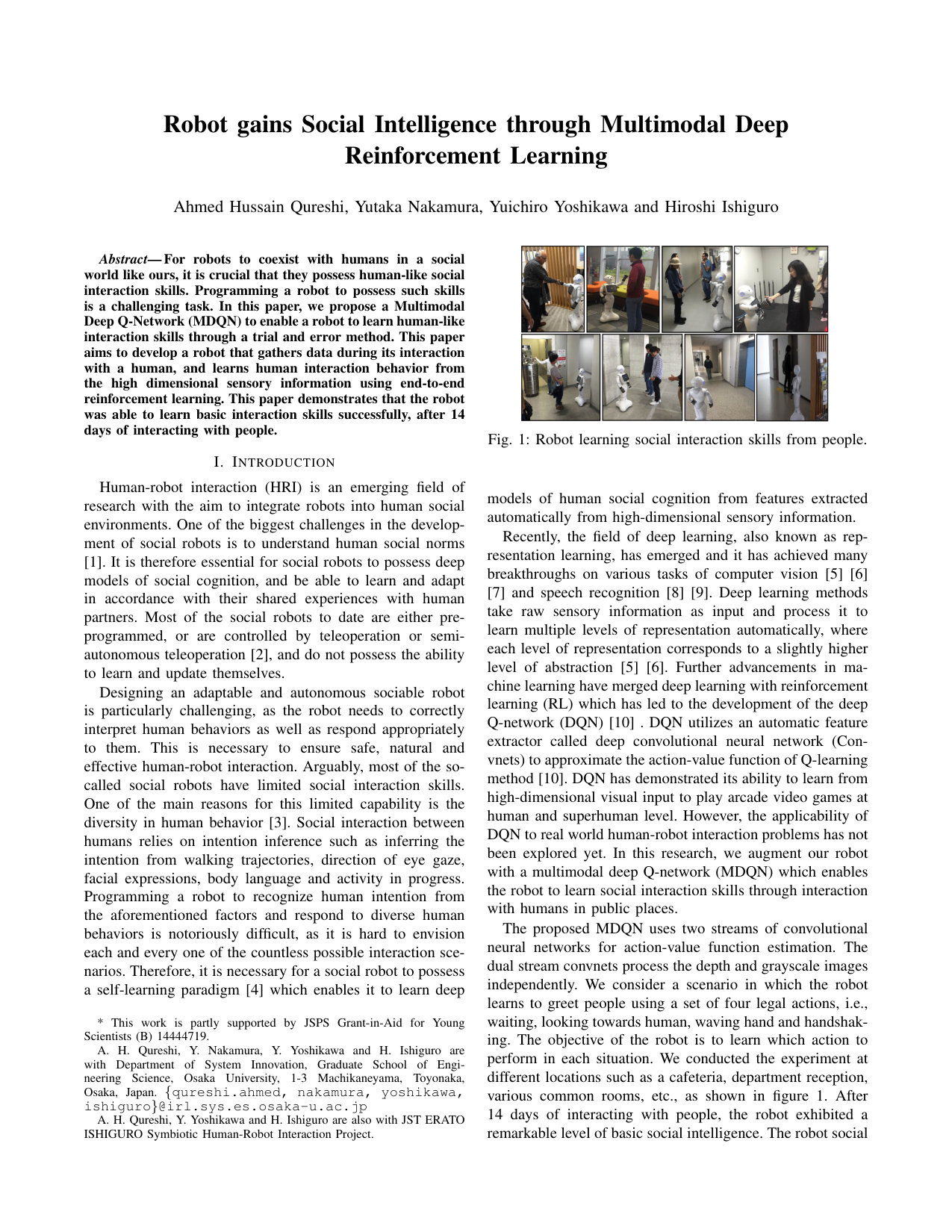 Figure 1
Peer Reviews
No public reviews on file for this paper yet. If you reviewed it on a platform where reviews are public (OpenReview, ICLR, NeurIPS, ICML), you can paste yours below so the community can read it here.
Videos
No videos yet. Explain this paper in a talk, walkthrough, or lecture? Add one.
Taxonomy
TopicsSocial Robot Interaction and HRI · Reinforcement Learning in Robotics
See pages 1-last of root.pdf