High-Dimensional Single-Photon Quantum Gates: Concepts and Experiments
Amin Babazadeh, Manuel Erhard, Feiran Wang, Mehul Malik, Rahman, Nouroozi, Mario Krenn, Anton Zeilinger

TL;DR
This paper demonstrates the experimental realization of a complete set of high-dimensional quantum gates on single photons with orbital angular momentum, advancing quantum information processing beyond qubits.
Contribution
It introduces the first experimental implementation of a four-dimensional generalization of the Pauli X-gate and its powers, completing the set of high-dimensional quantum gates.
Findings
Successfully implemented a four-dimensional X-gate on single photons.
Demonstrated the complete set of high-dimensional quantum gates experimentally.
The X-gate concept can be generalized to other quantum systems.
Abstract
Transformations on quantum states form a basic building block of every quantum information system. From photonic polarization to two-level atoms, complete sets of quantum gates for a variety of qubit systems are well known. For multi-level quantum systems beyond qubits, the situation is more challenging. The orbital angular momentum modes of photons comprise one such high-dimensional system for which generation and measurement techniques are well-studied. However, arbitrary transformations for such quantum states are not known. Here we experimentally demonstrate a four-dimensional generalization of the Pauli X-gate and all of its integer powers on single photons carrying orbital angular momentum. Together with the well-known Z-gate, this forms the first complete set of high-dimensional quantum gates implemented experimentally. The concept of the X-gate is based on independent access to…
Click any figure to enlarge with its caption.
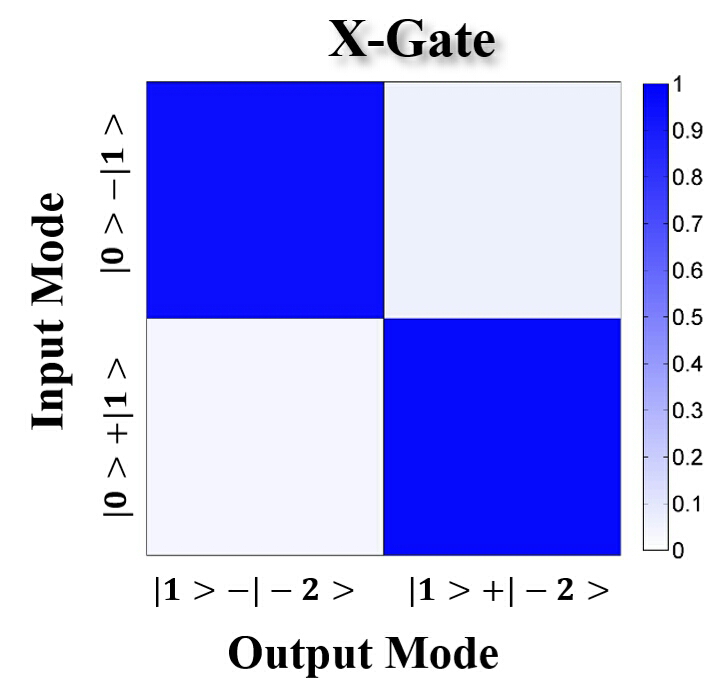 Figure 1
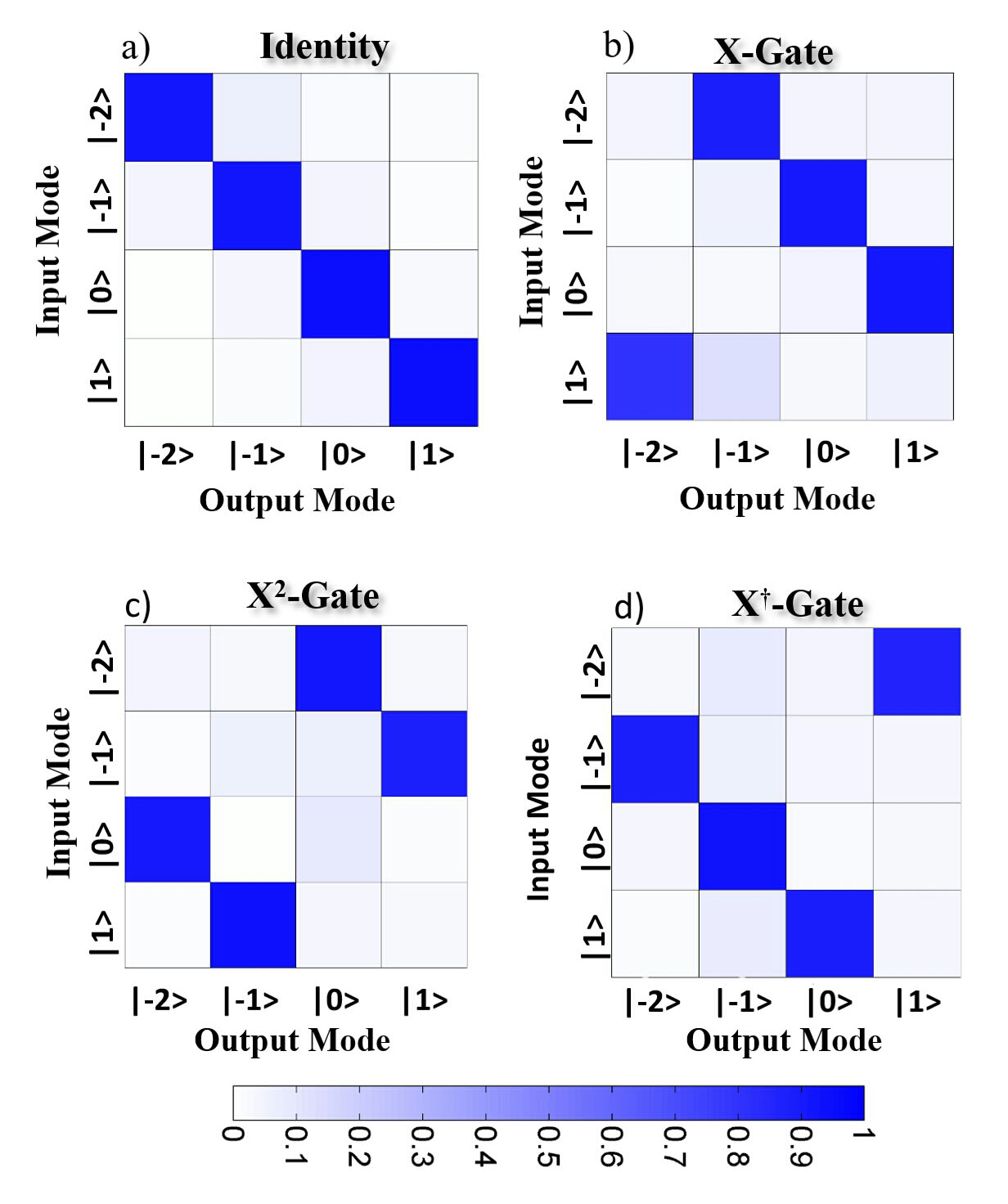 Figure 2
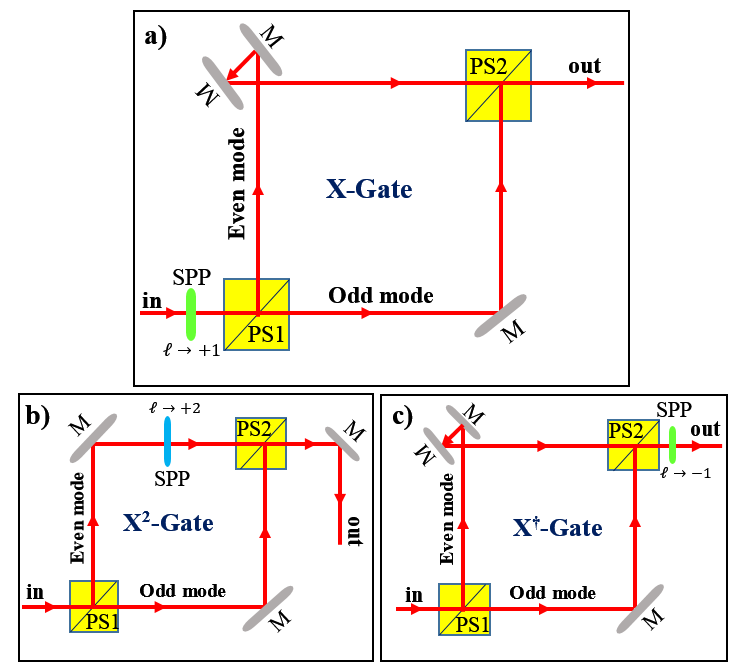 Figure 3
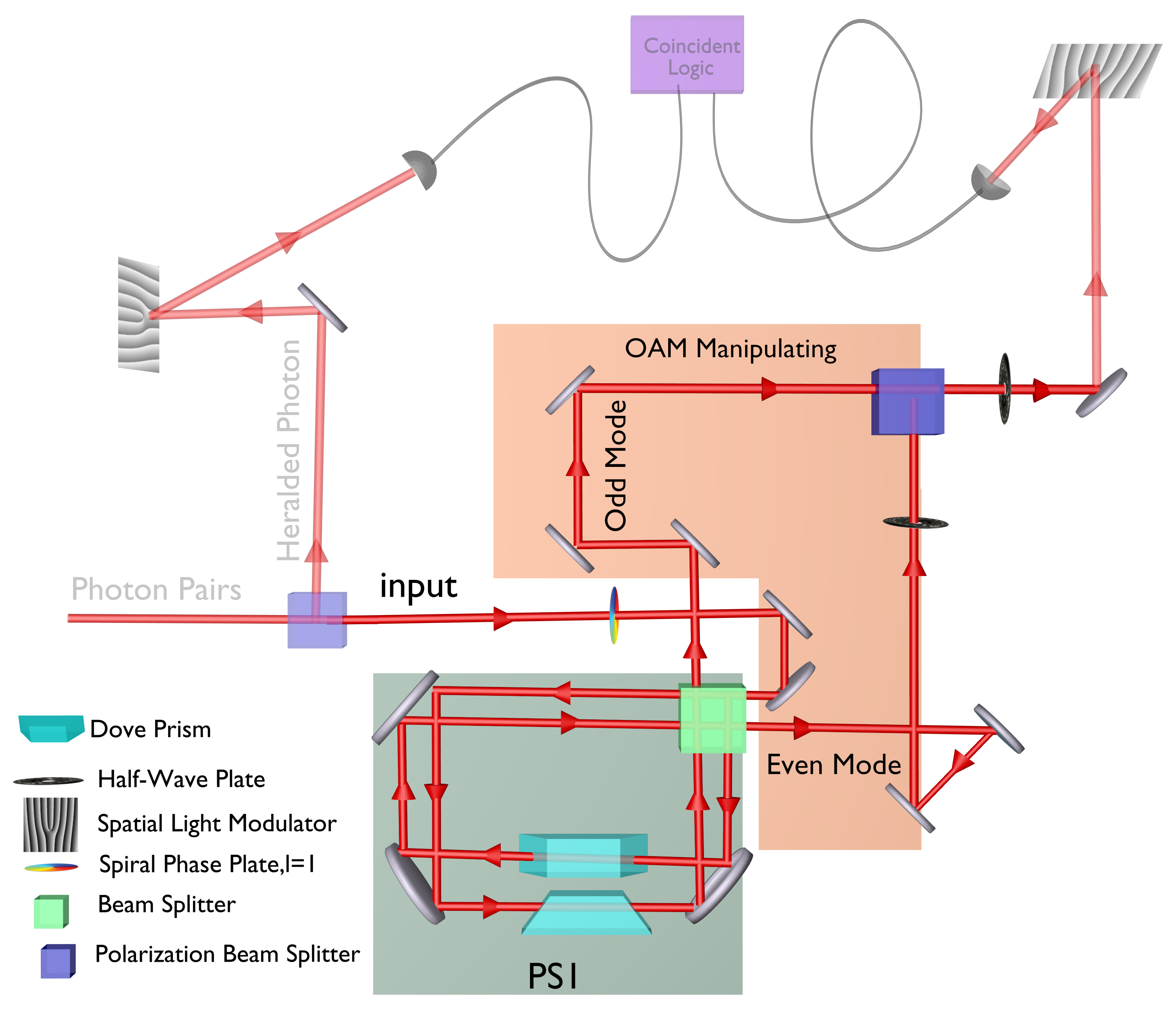 Figure 4
| Input mode | ||||
|---|---|---|---|---|
| X-Gate | ||||
| X2-Gate | ||||
| X†-Gate |
Peer Reviews
No public reviews on file for this paper yet. If you reviewed it on a platform where reviews are public (OpenReview, ICLR, NeurIPS, ICML), you can paste yours below so the community can read it here.
Videos
No videos yet. Explain this paper in a talk, walkthrough, or lecture? Add one.
High-Dimensional Single-Photon Quantum Gates: Concepts and Experiments
Amin Babazadeh
Vienna Center for Quantum Science & Technology (VCQ), Faculty of Physics, University of Vienna, Boltzmanngasse 5, 1090 Vienna, Austria.
Institute for Quantum Optics and Quantum Information (IQOQI), Austrian Academy of Sciences, Boltzmanngasse 3, 1090 Vienna, Austria.
Physics Department, Institute for Advanced Studies in Basic Sciences, Zanjan, Iran.
Manuel Erhard
Vienna Center for Quantum Science & Technology (VCQ), Faculty of Physics, University of Vienna, Boltzmanngasse 5, 1090 Vienna, Austria.
Institute for Quantum Optics and Quantum Information (IQOQI), Austrian Academy of Sciences, Boltzmanngasse 3, 1090 Vienna, Austria.
Feiran Wang
Vienna Center for Quantum Science & Technology (VCQ), Faculty of Physics, University of Vienna, Boltzmanngasse 5, 1090 Vienna, Austria.
Institute for Quantum Optics and Quantum Information (IQOQI), Austrian Academy of Sciences, Boltzmanngasse 3, 1090 Vienna, Austria.
Key Laboratory of Quantum Information and Quantum Optoelectronic Devices, Shaanxi Province, Xi an Jiaotong University, Xi an 710049, China.
Mehul Malik
Vienna Center for Quantum Science & Technology (VCQ), Faculty of Physics, University of Vienna, Boltzmanngasse 5, 1090 Vienna, Austria.
Institute for Quantum Optics and Quantum Information (IQOQI), Austrian Academy of Sciences, Boltzmanngasse 3, 1090 Vienna, Austria.
Rahman Nouroozi
Physics Department, Institute for Advanced Studies in Basic Sciences, Zanjan, Iran.
Mario Krenn
Vienna Center for Quantum Science & Technology (VCQ), Faculty of Physics, University of Vienna, Boltzmanngasse 5, 1090 Vienna, Austria.
Institute for Quantum Optics and Quantum Information (IQOQI), Austrian Academy of Sciences, Boltzmanngasse 3, 1090 Vienna, Austria.
Anton Zeilinger
Vienna Center for Quantum Science & Technology (VCQ), Faculty of Physics, University of Vienna, Boltzmanngasse 5, 1090 Vienna, Austria.
Institute for Quantum Optics and Quantum Information (IQOQI), Austrian Academy of Sciences, Boltzmanngasse 3, 1090 Vienna, Austria.
Abstract
Transformations on quantum states form a basic building block of every quantum information system. From photonic polarization to two-level atoms, complete sets of quantum gates for a variety of qubit systems are well known. For multi-level quantum systems beyond qubits, the situation is more challenging. The orbital angular momentum modes of photons comprise one such high-dimensional system for which generation and measurement techniques are well-studied. However, arbitrary transformations for such quantum states are not known. Here we experimentally demonstrate a four-dimensional generalization of the Pauli X-gate and all of its integer powers on single photons carrying orbital angular momentum. Together with the well-known Z-gate, this forms the first complete set of high-dimensional quantum gates implemented experimentally. The concept of the X-gate is based on independent access to quantum states with different parities and can thus be easily generalized to other photonic degrees-of-freedom, as well as to other quantum systems such as ions and superconducting circuits.
Introduction – High-dimensional quantum states have recently attracted increasing attention in both fundamental and applied research in quantum mechanics agnew2011tomography , romero2013tailored , krenn2014generation , zhang2016engineering , malik2016multi . The possibility of encoding vast amounts of information on a single photon makes them particularly interesting for large-alphabet quantum communication protocols groblacher2006experimental , sit2016high , Smania2016 , Lee:2016vk , as well as for investigating fundamental questions concerning local realism or quantum contextuality vaziri2002experimental , cai2016new . The temporal and spatial structure of a photon provides a natural multi-mode state space in which to encode quantum information. The orbital angular momentum (OAM) modes of light allen1992orbital comprise one such basis of spatial modes that has emerged as a popular choice for experiments on high-dimensional quantum information krenn2017orbital . While techniques for the generation and measurement of photonic quDits carrying OAM are well known mair2001entanglement , Mirhosseini:2013go , malik2014direct , efficient methods for their control and transformation remain a challenge. No general recipe is known so far, and experimentally feasible techniques are known only for special cases.
Here we experimentally demonstrate a four-dimensional X-gate and all of its integer powers with the orbital angular momentum modes of single photons. The four-dimensional X-gate is a generalization of the two-dimensional Pauli transformation and acts as a cyclic ladder operator on a four-dimensional Hilbert space. The cyclic transformation required for this gate was designed through the use of the computer algorithm MELVIN krenn2016automated and recently demonstrated with classical states of light schlederer2016cyclic . The Z-gate for OAM quDits (the generalization of the two-dimensional Pauli transformation) introduces a mode-dependent phase, which can be implemented simply with a single optical element leach2002measuring , de2005implementing . With all powers of the high-dimensional X- and Z-gate, we arrive at a complete basis of quDit gates, which in principle allows for the construction of arbitrary unitary operations in a four-dimensional state space asadian2016heisenberg (see Appendix for details).
It is interesting to compare OAM with other high-dimensional degrees of freedom that allow for the encoding of quantum information. For path-encoding in particular, it is known how arbitrary single-quDit transformations can be performed in a lossless way reck1994experimental . Such transformations have been implemented recently on integrated photonic chips for the generation and transformation of entanglement schaeff2015experimental , carolan2015universal . General unitary transformations such as these are not known for the photonic OAM degree-of-freedom. In addition to being natural modes in optical communication systems with cylindrical symmetry, photons carrying OAM offer an important advantage over path and time-bin encoding in that quantum entanglement can be generated romero2012increasing and transmitted krenn2015twisted without the need for interferometric stability. Therefore, the development of new controlled transformations for photonic OAM, as we show here, fills an important gap.
The X-gate demonstrated here uses the ability to sort even and odd parity modes as a basic building block leach2002measuring . This concept can be extended to other photonic degrees of freedom such as frequency yokoyama2013ultra , xie2015harnessing , and used in other quantum systems such as trapped ions muthukrishnan2000multivalued , klimov2003qutrit , cold atoms smith2013quantum , and superconducting circuits hofheinz2009synthesizing for constructing similar high-dimensional quantum logic gates.
High-dimensional Pauli gates – The Pauli matrix group has applications in quantum computation, quantum teleportation and other quantum protocols. This group is defined for a single quDit (a single photon with d-dimensional modes) in the following manner gottesman1999fault , lawrence2004mutually :
[TABLE]
where refers to the different modes in the d-dimensional Hilbert space and mod . The Z-gate introduces a mode-dependent phase in the form of . Furthermore, the Y-gate can be written . While the two-dimensional X-gate swaps two modes with one another, in high dimensional Hilbert spaces () it takes the form of a cyclic operation:
[TABLE]
This results in each state being transformed to its nearest neighbor in a clockwise direction, with the last state being transformed back to the first one . The Y-gate can be expressed as a combination of Z and X gates. While powers of lead to different mode-dependent phases, integer powers of X shift the modes by a larger number:
[TABLE]
The X2-gate, for example, transforms each mode to the second nearest mode. Likewise, the conjugate of X leads to a cyclic operation in the counter-clockwise direction,
[TABLE]
Experimental implementation – A Z-gate for photons carrying OAM can simply be achieved by using a Dove prism, which has been shown recently agnew2013generation , wang2015quantum , zhang2016engineering , ionicioiu2016sorting . Since the Y-gate can be achieved by a combination of Z and X gates, it is sufficient to focus on the X-gate and its powers. Fig.1a shows the schematic of the X-gate. It consists of two parity sorters (PS1 and PS2) and a Mach-Zehnder interferometer (MZI) that is implemented between them. The input photon is first incident on a spiral phase plate that adds one quantum of OAM quantum () onto the photon before it enters PS1. The parity sorter is an interferometric device which then sorts the photon according to its mode parity leach2002measuring . For the first-order cyclic transformation, the sign of the odd photon needs to be flipped after PS1. This is achieved by reflecting the odd output photon at a mirror placed in one MZI path, while even photons undergo two reflections that preserve the sign of their OAM mode (see Fig.1a). The modes are then input into PS2, which coherently recombines them into the same path.
Interestingly, the X-gate can be converted into the X2-gate and X*†-gate with only minor changes to the experimental setup (for d=4, X†=X3). For constructing the X2-gate, the is removed and an replaces the extra reflection in the even MZI path (Fig.1b). The X†*-gate is achieved by simply moving the from the input of PS1 and replacing it with an at the output of PS2 (Fig.1c). One should note that in principle, these changes can be implemented rapidly and without physically moving optical components via the use of devices such as a spatial light modulator or a digital micromirror device.
The experimental setup is depicted in Fig.2. We use heralded single photons produced via the process of Type-II spontaneous parametric down conversion process (SPDC) in a 5mm long periodically poled Potassium Titanyl Phosphate (ppKTP) crystal pumped by a 405nm diode laser. In the SPDC process, conservation of the pump angular momentum leads to the generation of photon pairs with a degenerate wavelength of =810nm that are entangled in OAM. Therefore whenever the idler photon is measured to be in mode , the signal photon is found to be in mode . Thus, by heralding the idler photon in a particular OAM mode, we can select the OAM quantum number of the signal photon that is input into the logic gate. Here, we use the OAM quantum numbers of -2,-1,0 and 1 for demonstrating our 4-dimensional quantum logic gates. By changing the mode number before and after the transformation, the X-gate can be used with every connected 4-dimensional subspace.
The parity sorter was originally proposed as an MZI with a dove prism in each arm leach2002measuring . The relative rotation angle between the two dove prisms is set at , which introduces an phase difference between the two arms. Depending on the parity of OAM mode () of the input photon, constructive or destructive interference results in even and odd modes exiting different outputs of the MZI. For long-term stability, in our case we implement this interferometer in a double-path Sagnac configuration 10.1088/2058-9565/aa5917 . Two adjacent Sagnac loops allow for the positioning of a dove prism in each loop. The outputs of this Sagnac interferometer are then directly input into the second MZI (denoted as OAM manipulating in Fig.2). In the second interferometer the sign of odd modes is flipped by reflection on an extra mirror. A trombone system in the odd arm is used to adjust the relative path difference to achieve a coherent combination of even and odd modes.
The concept of the quantum gates (discussed in Fig. 1) allows in principal for a lossless operation. For simplicity, we replace the second parity sorter with a polarization beam splitter (PBS). This allows the odd and even modes in the MZI to be recombined in a stable manner, albeit with an additional loss of 50%.
Now we explain the experimental details of the X-Gate (Fig. 1&2). A 4-dimensional subset of OAM modes is shifted by one leading to . The parity sorter separates even and odd modes. The path for the even modes experience an odd number of reflections that causes in a sign flip and results in . The coherent combination at the PBS and subsequent erasure of polarization information completes the X-gate: . The and gate work similarly, see Fig. 1. The experimental results of the gate operations are depicted in Fig. 3. The probability Pi,j to detect a photon in mode when sending in one in mode is given by . The average probability of the expected mode for the X, X2, and X† gates are 87.3%, 90.4%, and 88.4% respectively, see Table 1.
In order to demonstrate a transformation of a coherent superposition, we use as the input into the X-gate. The expected output state is given by and ideally we do not expect any photon in the orthogonal state . The probability to detect photons in these output modes is shown in Fig. 4. The average probability of detecting the expected mode is 90.9 and matches with the probabilities shown in Table 1 and Fig. 3. This clearly demonstrates that the X-gate works as a coherent quantum transformation.
Conclusion – We have shown the experimental generation of the four-dimensional X-gate and all of its unique higher orders, including the X2 and X3 gates. Together with the well known Z-gate, this forms a complete basis of transformations on a four-dimensional quantum system. This means that it can in principle be used to construct every four-dimensional unitary operation. The X-gate is a basic element required for generating large classes of entangled states, such as the set of four-dimensional Bell states Feiran or general high-dimensional multi-particle states malik2016multi . Such states can be used, for example, in tests of quantum contextuality lapkiewicz2011experimental and for Bell-like tests of local-realism in a higher-dimensional state space vaziri2002experimental , dada2011experimental .
These quantum logic gates can find application in various high-dimensional quantum protocols, such as high-dimensional quantum key distribution groblacher2006experimental , mafu2013higher , mirhosseini2015high , sit2016high where transformations between mutually unbiased bases are necessary. Other applications could include multi-party secret sharing Smania2016 or dense coding hill2016hyperdense , where transformations between orthogonal sets of entangled states are required. In quantum computing where complete sets of quantum gates are necessary, high-dimensional quantum states allow for the efficient implementation of gates ralph2007efficient , lanyon2009simplifying and offer advantages in quantum error correction bocharov2016factoring .
Interestingly, a high-dimensional generalization of the CNOT gate consists of a controlled-cyclic transformation garcia2013swap . In combination with polarization, one can immediately create a three-, six- and eight-dimensional generalization of our method krenn2016automated . An important next step is the construction of high-dimensional two-particle gates. This would allow the implementation of complex quantum algorithms such as quantum error correction in high dimensions bocharov2016factoring .
Acknowlegdements
The authors thank Marcus Huber for helpful discussions. This work was supported by the Austrian Academy of Sciences (ÖAW), by the European Research Council (SIQS Grant No. 600645 EU-FP7-ICT) and the Austrian Science Fund (FWF) with SFB F40 (FOQUS) and FWF project CoQuS No. W1210-N16. F.W. was supported by the National Natural Science Foundation of China (NSFC Grant No. 11534008).
Appendix
.1 All unitaries from X and Z
Here we briefly show that it is possible to construct every unitary transformation in four dimensions in terms of X and Z-gates, and integer powers of them. Here we follow the construction in [21]. The derivation is general for arbitrary dimensions . For the purpose of our experiment, in the end we will make .
We start by defining the operator (called Heisenberg-Weyl operators)
[TABLE]
From these operators, we can write a minimum and complete set of Hermitian operators
[TABLE]
with . With a linear superposition of the basis elements, arbitrary hermitian matrices can be constructed in the form
[TABLE]
with real coefficients , and being the dimension of the Hilbert space. Every unitary transformation can be written as the exponent of a hermitian generator, such that
[TABLE]
U has infinitely many terms which are combinations of X and Z gates, and X and Z do not commute. However, because of , one can always write
[TABLE]
with complex coefficients . For , due to and , the sum only goes from . Therefore, one arrives at
[TABLE]
with complex coefficients . This sum has 16 terms with various coefficients. That means, in principle one could apply the 16 different operations in superposition and create every arbitrary unitary transformation in a 4-dimensional space. While this is experimentally challenging, in many important cases, the formula simplifies significantly.
The reference list from the paper itself. Each links out to its DOI / PubMed record.
- 1[1] Megan Agnew, Jonathan Leach, Melanie Mc Laren, F Stef Roux, and Robert W Boyd. Tomography of the quantum state of photons entangled in high dimensions. Physical Review A , 84(6):062101, 2011.
- 2[2] Jacquiline Romero, Daniel Giovannini, DS Tasca, SM Barnett, and MJ Padgett. Tailored two-photon correlation and fair-sampling: a cautionary tale. New Journal of Physics , 15(8):083047, 2013.
- 3[3] Mario Krenn, Marcus Huber, Robert Fickler, Radek Lapkiewicz, Sven Ramelow, and Anton Zeilinger. Generation and confirmation of a (100 × \times 100)-dimensional entangled quantum system. Proceedings of the National Academy of Sciences , 111(17):6243–6247, 2014.
- 4[4] Yingwen Zhang, Filippus S Roux, Thomas Konrad, Megan Agnew, Jonathan Leach, and Andrew Forbes. Engineering two-photon high-dimensional states through quantum interference. Science advances , 2(2):e 1501165, 2016.
- 5[5] Mehul Malik, Manuel Erhard, Marcus Huber, Mario Krenn, Robert Fickler, and Anton Zeilinger. Multi-photon entanglement in high dimensions. Nature Photonics , 10(4):248–252, 2016.
- 6[6] Simon Gröblacher, Thomas Jennewein, Alipasha Vaziri, Gregor Weihs, and Anton Zeilinger. Experimental quantum cryptography with qutrits. New Journal of Physics , 8(5):75, 2006.
- 7[7] Alicia Sit, Frédéric Bouchard, Robert Fickler, Jérémie Gagnon-Bischoff, Hugo Larocque, Khabat Heshami, Dominique Elser, Christian Peuntinger, Kevin Günthner, Bettina Heim, et al. High-dimensional intra-city quantum cryptography with structured photons. ar Xiv preprint ar Xiv:1612.05195 , 2016.
- 8[8] Massimiliano Smania, Ashraf M Elhassan, Armin Tavakoli, and Mohamed Bourennane. Experimental quantum multiparty communication protocols. Npj Quantum Information , 2:16010, 2016.