Hyperbolic Center of Mass for a System of Particles on a two-dimensional Space with Constant Negative Curvature: An Application to the Curved $2$- and $3$-Body Problems
Pedro P. Ortega Palencia, Jos\'e Guadalupe Reyes Victoria

TL;DR
This paper derives a simple, intrinsic formula for the center of mass on hyperbolic surfaces, extending Euclidean concepts and applying them to curved two- and three-body problems.
Contribution
It introduces a new intrinsic expression for the center of mass in hyperbolic geometry, applicable to systems on negatively curved surfaces and related to curved celestial mechanics.
Findings
Derived an explicit formula for the hyperbolic center of mass
Extended the concept to one-dimensional hyperbolic space
Applied the formula to curved 2- and 3-body problems
Abstract
In this article is given a simple expression for the \textit{ center of mass} for a system of material points in a two-dimensional surface of constant negative Gaussian curvature. Using basic techniques of Geometry, an expression in intrinsic coordinates is obtained, and it is showed how it extends the definition for the Euclidean case. The argument is constructive and also serves for defining center of mass of a system of particles on the one-dimensional hyperbolic space . Finally, is showed some applications to the curved - and -body problems.
Click any figure to enlarge with its caption.
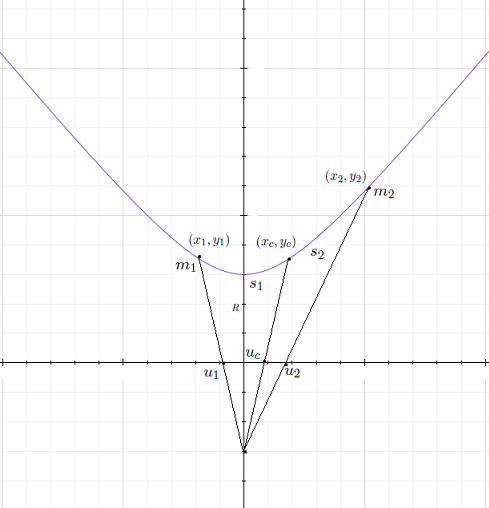 Figure 1
Peer Reviews
No public reviews on file for this paper yet. If you reviewed it on a platform where reviews are public (OpenReview, ICLR, NeurIPS, ICML), you can paste yours below so the community can read it here.
Videos
No videos yet. Explain this paper in a talk, walkthrough, or lecture? Add one.
Taxonomy
TopicsMathematics and Applications · Advanced Mathematical Theories and Applications · Spacecraft Dynamics and Control
Hyperbolic Center of Mass for a System of Particles on a two-dimensional Space with Constant Negative Curvature: An Application to the Curved - and -Body Problems
Pedro P. Ortega Palencia
Universidad de Cartagena, [email protected]
J. Guadalupe Reyes Victoria
Universidad Autónoma Metropolitana, [email protected]
Abstract
In this article is given a simple expression for the * center of mass* for a system of material points in a two-dimensional surface of constant negative Gaussian curvature. Using basic techniques of Geometry, an expression in intrinsic coordinates is obtained, and it is showed how it extends the definition for the Euclidean case. The argument is constructive and also serves for defining center of mass of a system of particles on the one-dimensional hyperbolic space . Finally, is showed some applications to the curved - and -body problems.
keywords:
Center of Masses , Conformal Metric , Geodesic , Hyperbolic Rule of the Lever.
††journal: arxiv
1 Introduction
Center of mass (center of gravity or centroid) is a fundamental concept, and its geometrical and mechanics properties are very important for the understanding of many physical phenomena. Its definition for Euclidean spaces is elemental, nevertheless a definition for curved spaces is few frequent. In [6], the author makes an extensive explanation showing the possibility of it concept can be correctly defined in more general spaces, and he signalize the difficulties to defined in spaces of non zero curvature, by lacking of linear structure of ones. While it is true that the author synthesizes the basic properties of the center of mass, in his approach appear some ones without physical meaning, such as the non conservation of total mass of system or the presence of infinities velocities under normal conditions . In [7] appear a definition of center of mass for two particles in a hyperbolic space, in the same direction to the one presented here, but the authors do not give an expression to calculate it. In [1] the author makes mention about of the difficulty for defining of center of mass in curved spaces. He provides a class of orbits in the curved -body problem for which, “no point that could play the role of the center of mass is fixed or moves uniformly along a geodesic”. This proves that the equations of motion lack center-of-mass and linear-momentum integrals. But nevertheless, he is not provide a way to calculate or determinate this element.
In this article, the problem of give a mathematical expression for computing the center of mass of a system of particles sited on the upper sheet of two-dimensional hyperbolic sphere is considered. The formula obtained here, extend of natural way the expression for Euclidean case, contrary to the opinion expressed in [3]. Through stereographic projection of upper sheet of on the Poincaré disk , endowed with the conformal metric (see [2]).
[TABLE]
with the metric (1) and with the metric of Minkowski space, have the same Gaussian curvature , and from the Minding’s Theorem, both surfaces belong to the isometric differentiable class (see[5]). Following the basic methods of the geometry, we obtain here the expression for the center of mass for a system of particles sited in the hyperbolic sphere with arbitrary.
This article is organized as follow: in section 1, are introduced some concepts relative to center of mass in the euclidean spaces. In section 2, are remembered some properties of stereographical projection and it is proceeded to deduce the expression for the center of mass, for two particles on the upper branch of hyperbola , from the “hyperbolic rule of the lever”(see [6]) extended to . Once obtained the expression for the center of mass for two particles in , it can be extended naturally to a system of particles in , and the same way, to a system of particles in . The expression obtained here, satisfies the five axioms for the “Axiomatic Centroid” established in [6].
2 One-dimensional Euclidean case
Let consider two particles with positive masses sited in the real line at the points and . The (Euclidean) center of mass of system is defined be the point
[TABLE]
A direct computing shows that (Euclidean rule of the lever). It is easy to prove that is the unique point in the segment (geodesic) joining and with this property. This definition can be extend to more dimensions, in Euclidean spaces. But nevertheless, this definition not can be extended to spaces in general, because is possible that in such spaces is not defined a linear structure. But with the “rule of the lever” in mind is possible carries this definition to Riemannian surfaces, as we shall see later.
3 Center of mass in a two-dimensional hyperbolic space
3.1 Some observations about the Stereographic Projection of Hyperbolic Sphere on the Poincaré disk
Let the stereographic projection, then for , we have where and and moreover the inverse projection is and (see [2]),
[TABLE]
the point will called south pole. transform lines through the origin in meridians (hyperbolas through the south pole and parallels to axis) and the circles with center in origin, in parallels (concentric circles on the upper sheet of hyperboloid).
If we consider the stereographic projection of the one-dimensional hyperbolic sphere on the one-dimensional Poincaré disk with the induced metric from (1), then the above equations are reduced to:
where and and moreover the inverse projection is,
[TABLE]
In this last case, the length of arc from the south pole to arbitrary point is:
[TABLE]
More general, the length of arc from the point to in the same parallel, if their stereographical projections are and , is
[TABLE]
Consider now two masses sited in the points respectively, and
let the coordinates of hyperbolic center of mass, and the length of arc from to and the length of arc from to (see Fig.1), then, from the relation (hyperbolic rule of the lever) it is follows:
[TABLE]
Therefore,
[TABLE]
This concept can be extended a particles ,,…, with masses ,,…, sited on and with stereographical projections ,,…, in the one-dimensional Poincaré disk in the following way:
[TABLE]
where,
3.2 Center of mass for a system of particles in
Now, we extend the “rule of the lever” to context more general: let a Riemannian surface and two particles with masses sited in the points , respectively, then the -center of mass is defined the point in the geodesic joining to such that is verified the following relation:
[TABLE]
where is the metric in . For the case of , geodesics are hyperbolas determined for the intersection of upper sheet of hyperboloid with the plane draw for the pair of points and the origin .
Inductively we can extend in natural way the concept of center of mass to a system of particles (see [6], Axiom 2 (induction axiom)) , and using a similar argument bellow, to obtain the next:
Proposition 1: * Let ,,….,, masses particles sited respectively in the points ,,…, on with stereographical projections ,,…, , in the Poincaré disk , and let the stereographical proyection of the hyperbolic center of mass , then it is satisfy the following equation:*
[TABLE]
where
or equivalently
[TABLE]
If in each fraction is divided their numerator and denominator for and both side rises to the power , when , it is obtained
[TABLE]
or equivalently,
[TABLE]
And this corresponds to the equation for the center of mass in the Euclidean complex plane, that is, the complex plane (or ), with Euclidean metric and zero curvature. So, we have obtained the following:
Corollary : The expressions (5) or (6) extend the concept of Euclidean center of mass , to hyperbolic spaces with constant curvature.
4 Some applications to the curved and -body problems
In [2] is studied the curved -body problem in a two-dimensional space with negative constant curvature, and is considered the model of . In particular, for the configurations called relative equilibria, for the body problem is established the next result:
Theorem 3. * Consider 2 point particles of masses moving on the Poincaré disk , whose center is the origin, [math], of the coordinate system. Then is an elliptic relative equilibrium of system (21) with , if and only if for every circle centered at [math] of radius , with , along which moves, there is a unique circle centered at [math] of radius , which satisfies and (46), along which moves, such that, at every time instant, and are on some diameter of , with [math] between them. Moreover,*
if and are given, then ;
- 2)
if and ) are given, then ;
- 3)
if and ) are given, then .
This result can be reformulated in a more precise form, using the expression for the hyperbolic center of mass, taking into account that in a configuration correspond to a relative equilibrium it is invariant with the time, because the distance and angles between particles not change, and for this reason is sufficient consider the initial configuration on the axis (same diameter of disk), and moreover correspond to the length measure over the Poincaré disk, of the projection of arc over the hyperbolic sphere , and the is the length of the projection in the disk one, of the arc over the hyperbolic sphere, then we have the next relations:
[TABLE]
and
[TABLE]
Substituting in the hyperbolic liver rule and the expression for the center of mass, we obtain:
[TABLE]
Thus it is follow from equation (6) that
[TABLE]
it is follows intermediately that and so, the center of mass is fixed for every time in the of the hyperbolic sphere and moreover, Theorem 3 can be expressed in the following form:
Theorem 3´: For every configuration of elliptic relative equilibrium for the -body problem with masses sited in the points and on the hyperbolic sphere of radius , if and are the length of arcs measure from the South Pole to the points and respectively, then it is satisfies the relation , and moreover the center of mass of the system is fixed in for every time.
A similar analysis shows, that for the configurations of the hyperbolic -body problem called Eulerian solutions and * Lagrangian solutions*, and characterized by Theorem 4, Proposition 2 and Theorem 5 in [2] the center of mass is fixed in the point of . Finally, for the configurations called hyperbolic relative equilibria in [4] , using an argument of symmetries, the center of mass is moving over the hyperbola of intersection of (in such work is used the notation instead ) with the plane , and it is a geodesic curve over the surface.
In conclusion, although the hyperbolic center of mass is not a first integral for the curved -body problem, for some types of configurations (relative equilibria, for example) it haves dynamical properties, analogues to the center of mass in the Euclidean case, under the action of Newtonian gravitational potential, this is, it is fixed or moving over a geodesic curve.
5 Funding Sources
This work was supported by the University of Cartagena, Cartagena, Colombia [Grant Number 066-2013] and the Universidad Autónoma Metropolitana, Iztapalapa, Ciudad de México, México.
6 Acknowledgment
The first author wishes to thank to Professor Joaquín Luna Torres, for his valuable suggestions.
7 References
The reference list from the paper itself. Each links out to its DOI / PubMed record.
- 1[1] Diacu, F., The non-existence of Centre-of-mass and Linear-Momentum Integrals in the Curved N-Body Problem. Libertas Math , New series 1 , 25-37, (2012).
- 2[2] Diacu, F., Pérez-Chavela, E., Reyes Victoria, J.G: An intrinsic approach in the curved n-body problem: The negative curvature case. Journal of Differential Equations , 252 , 4529-4562,(2012).
- 3[3] Diacu, F.: Relative Equilibria of the Curved n 𝑛 n -Body Problem. Atlantis Studies in Dynamical Systems, Vol I , pp. 34,(2012).
- 4[4] Diacu F. , Perez-Chavela E, Santoprete M.: The n-Body Problem in Spaces of Constant Curvature. Part I: Relative equilibria, J Nonlinear Sci , pp. 261,(2012)
- 5[5] Dubrovine, B., Fomenko, A., Novikov, P. Modern Geometry, Methods and Applications, Vol. I, Chapter 2, Springer-Verlag, 1984, 1990.
- 6[6] Galperin, G.A., A Concept of the mass Center of a System of Material Points in the Constant Curvature Spaces Communication in Mathematical Physics , 154, 63-84 Springer-Verlag, 1993. Surfaces, Prentice Hall, New Jersey, USA, 1976.
- 7[7] García-Naranjo L., Marrero J.C, Perez-Chavela E, Rodriguez-Olmos M:Classification and stability of relative equilibria for the two-body problem in the hyperbolic space of dimension 2, Journal of Differential Equations, 260 , 6375-6404,(2016).