Copula-based piecewise regression
Arturo Erdely

TL;DR
This paper introduces a copula-based piecewise regression method that decomposes complex dependence structures into simpler, ordered copulas, enabling modeling of non-monotone regression functions.
Contribution
It proposes a novel gluing copula approach to decompose copulas into totally ordered parts, allowing for non-monotone regression functions where traditional copulas fall short.
Findings
Enables modeling of non-monotone regression functions
Decomposes complex dependence structures into simpler components
Extends the applicability of copula-based regression methods
Abstract
Most common parametric families of copulas are totally ordered, and in many cases they are also positively or negatively regression dependent and therefore they lead to monotone regression functions, which makes them not suitable for dependence relationships that imply or suggest a non-monotone regression function. A gluing copula approach is proposed to decompose the underlying copula into totally ordered copulas that combined may lead to a non-monotone regression function.
Click any figure to enlarge with its caption.
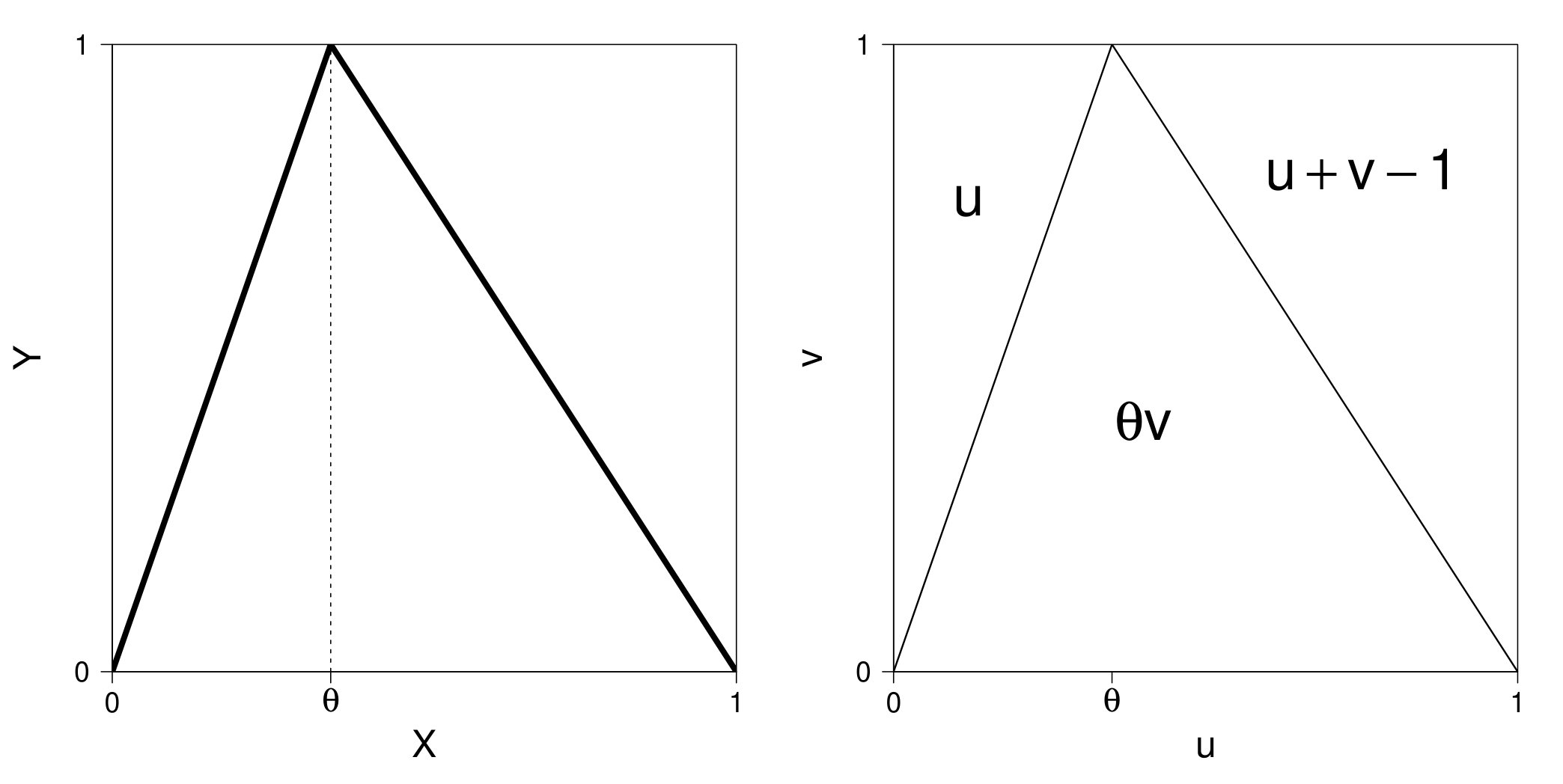 Figure 1
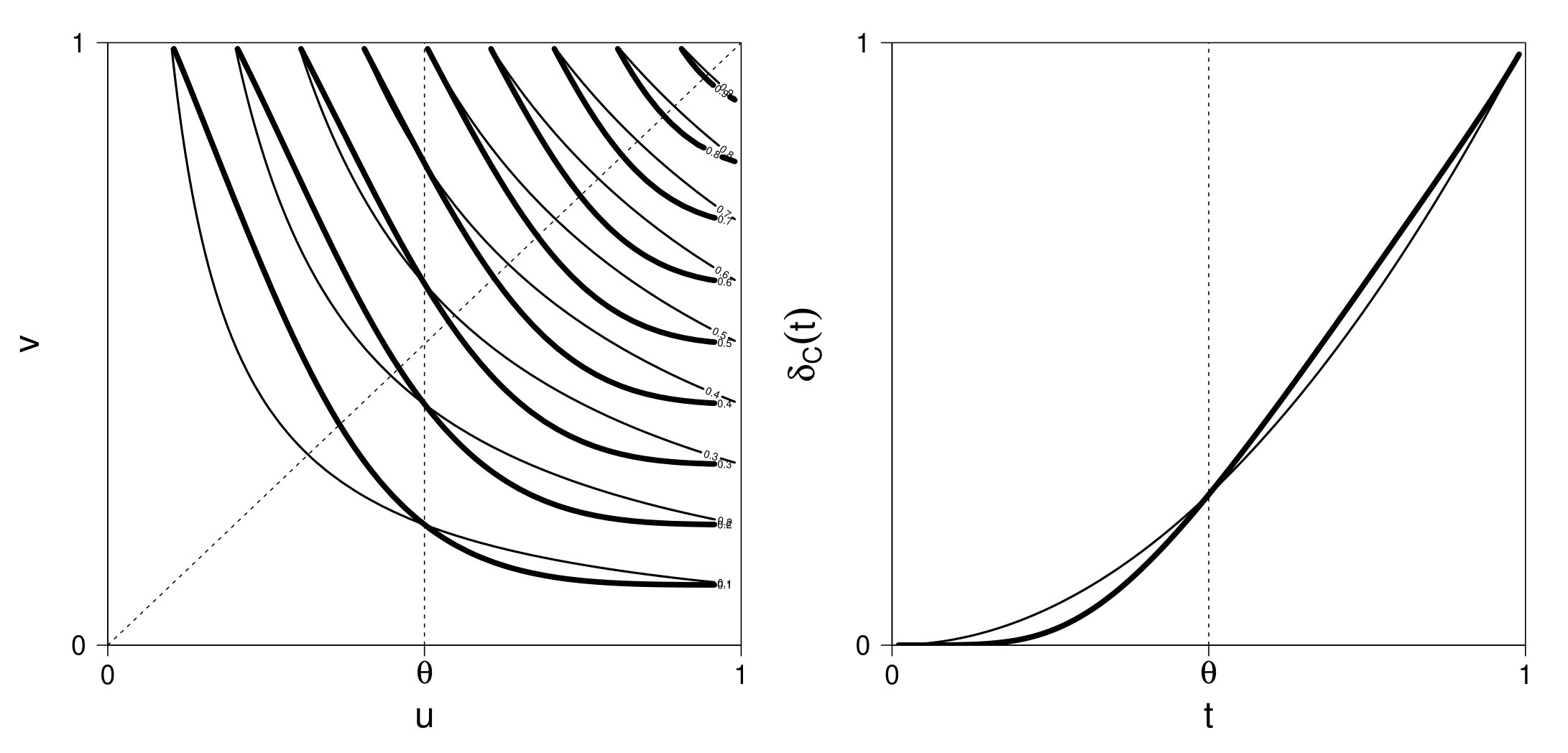 Figure 2
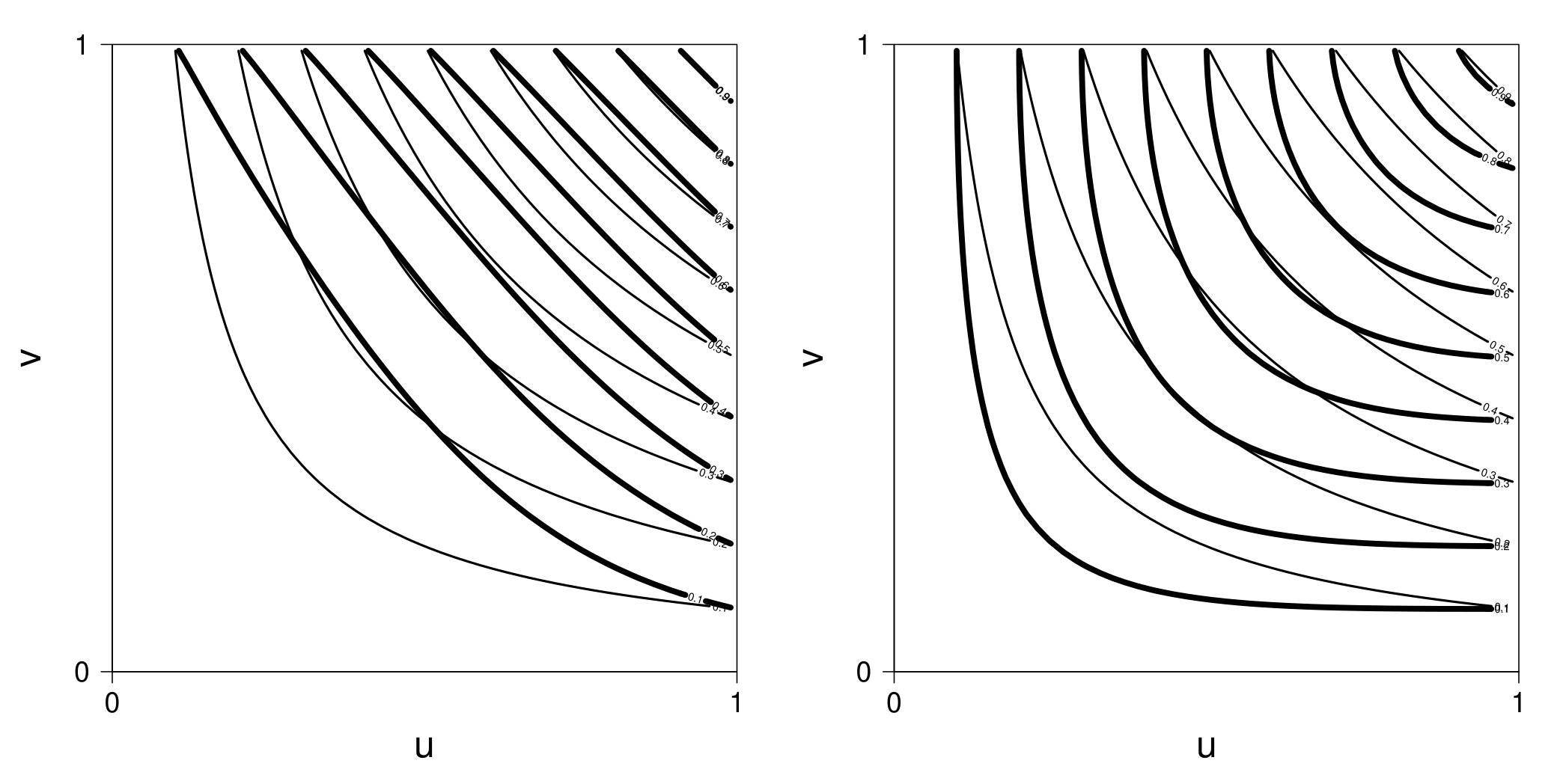 Figure 3
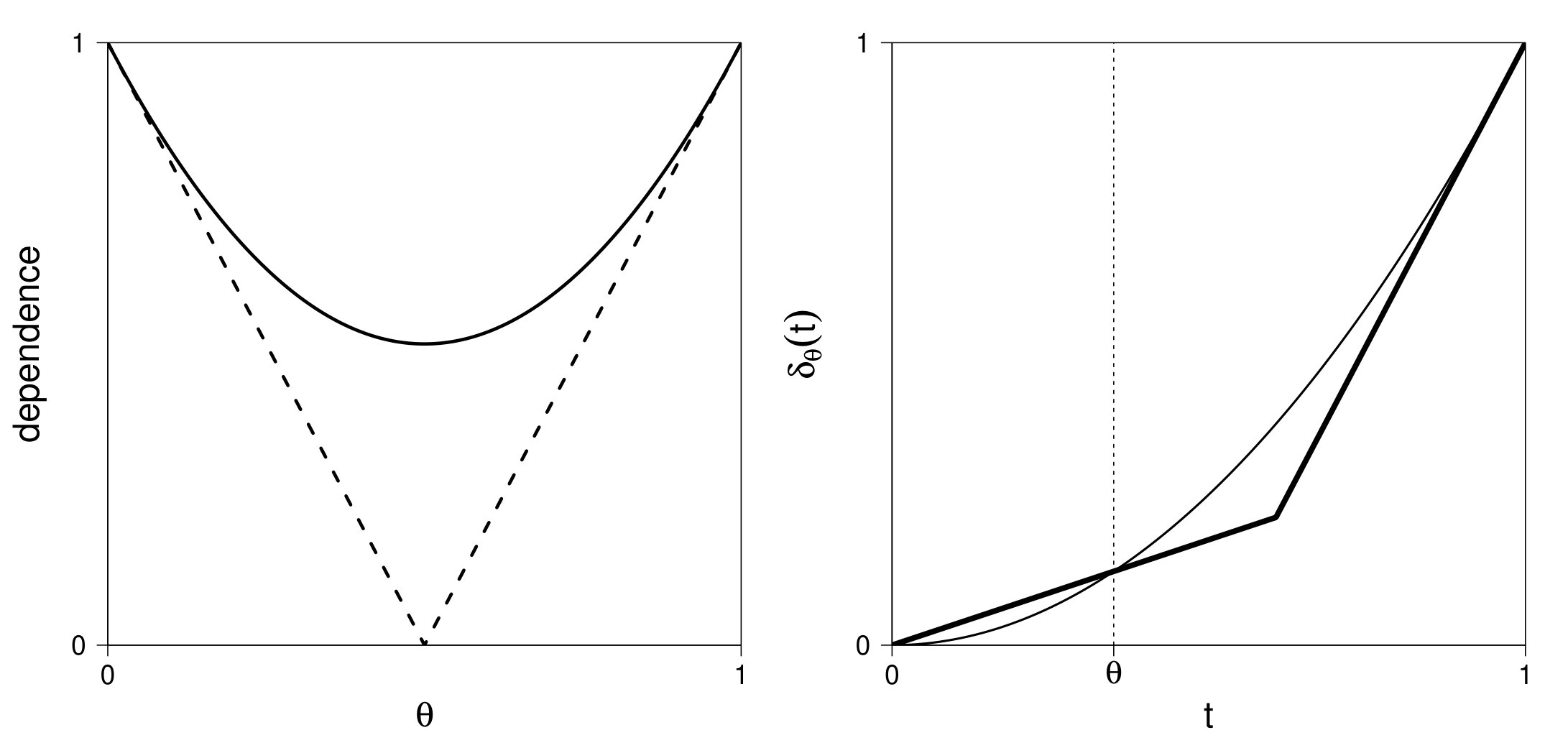 Figure 4
Peer Reviews
No public reviews on file for this paper yet. If you reviewed it on a platform where reviews are public (OpenReview, ICLR, NeurIPS, ICML), you can paste yours below so the community can read it here.
Videos
No videos yet. Explain this paper in a talk, walkthrough, or lecture? Add one.
Taxonomy
TopicsFault Detection and Control Systems · Spectroscopy and Chemometric Analyses · Neural Networks and Applications
11institutetext: Arturo Erdely 22institutetext: Universidad Nacional Autónoma de México, Facultad de Estudios Superiores Acatlán, 22email: [email protected]
Copula-based piecewise regression
Arturo Erdely
Abstract
Most common parametric families of copulas are totally ordered, and in many cases they are also positively or negatively regression dependent and therefore they lead to monotone regression functions, which makes them not suitable for dependence relationships that imply or suggest a non-monotone regression function. A gluing copula approach is proposed to decompose the underlying copula into totally ordered copulas that combined may lead to a non-monotone regression function.
1 Introduction
Given a bivariate random vector with joint probability distribution function it is possible to assess uncertainty about one of the random variables conditioning on certain values of the other, for example through the univariate conditional probability distribution of given that is As a point estimate for a future value of given we may calculate central tendency measures with such as the mean (whenever it exists) or the median (which always exists in the continuous case) which will depend on the conditioning value and therefore such point estimates depending on may be denoted by and are called regression function for given
As a consequence of Sklar’s Theorem Skl59 for continuous random variables there exists a unique copula such that the joint probability distribution function where and are the marginal probability distribution functions of and respectively. As explained in Nel06 , the conditional distribution of given can be obtained by
[TABLE]
and therefore to find the median regression function for given whenever is a continuous distribution function, we proceed as follows:
Algorithm 1
Set 2. 2.
solve for the regression function of given and obtain 3. 3.
replace by and for 4. 4.
solve for the regression function of given
[TABLE]
It is worth to notice that since and only explain the individual (marginal) probabilistic behavior of the continuous random variables and respectively, then the information about their dependence for regression purposes is contained in A survey of copula-based regression models may be found in KolPai09 and estimation/inference procedures for such purpose in NohGhoBou13 .
2 Piecewise monotone regression
In DetHecVol14 it is argued that when the regression function is non-monotone, copula-based regression estimates do not reproduce the qualitative features of the regression function under commonly used parametric copula families. This occurs because very often such parametric copulas lead to monotone regression functions, but in case there is evidence that the underlying regression function is non-monotone a piecewise regression approach may be applied in order to break up a non-monotone relationship into a piecewise monotonic one, and then seek for the best copula fit for each piece.
Piecewise (or segmented) monotone regression for given is defined by partitioning the support of into a finite number of intervals such that restricted to each one it is possible to obtain a monotone regression function. For example, instead of (1) we may obtain something like
[TABLE]
with and two different copulas, is called a break-point for explanatory variable and where and are the conditional distribution functions of given and respectively. This may be justified in terms of the gluing copula technique SibSto08 as explained in ErdDia10 for the particular case of vertical section gluing and bivariate copulas. Specifically, given two bivariate copulas and and a fixed value (gluing point), we may scale to and to and glue them into a single copula
[TABLE]
Then
[TABLE]
and by (1)
[TABLE]
since and The result obtained in (6) leads to a regression function of the form
[TABLE]
where, for example, if is an increasing function and a decreasing one, then is non-monotone.
Example 1
From example 3.3 in Nel06 if a probability mass is uniformly distributed on the line segment joining to and a probability mass is uniformly distributed on the line segment joining to see Fig. 1, the underlying copula for a random vector of continuous Uniform random variables with such non-monotone dependence is given by
[TABLE]
By construction we have that whenever and whenever which implies that the regression function of given is
[TABLE]
clearly a non-monotone function: linearly increasing for and linearly decreasing for which suggests in this case that the underlying dependence might be split by means of the gluing copula technique in terms of two copulas, with as gluing point. Indeed, let (the Fréchet-Hoeffding upper bound that represents the case when one variable is almost surely an increasing function of the other) and (the Fréchet-Hoeffding lower bound that represents the case when one variable is almost surely a decreasing function of the other), then applying (4) it is straightforward to verify that the resulting gluing copula is equal to (8).
Therefore, the same regression function obtained in (9) could be obtained in two pieces: the first one in terms of the random vector with underlying copula and where the distribution of is the conditional distribution of given which turns to be uniform and the second one in terms of the random vector with underlying copula and where the distribution of is the conditional distribution of given which turns to be uniform Applying (1) to the first piece we obtain the following:
[TABLE]
from which we get whenever and similarly from we obtain whenever as expected.
For simplicity’s sake, the case for a single break-point has been analyzed, but the analogous idea may be applied for finitely many break-points. For each interval induced in the support of the explanatory variable, the conditional distribution of given is obtained by
[TABLE]
and with it the regression function for may be calculated.
3 Dependence and regression
In this section the concepts of quadrant and regression dependence by Leh66 are recalled.
Definition 1
A bivariate random vector or its joint distribution function is positively quadrant dependent and abbreviated as if
[TABLE]
and negatively quadrant dependent if (12) holds with the inequality sign reversed.
In the particular case where both and are continuous random variables with underlying copula as an immediate consequence of Sklar’s Theorem Skl59 we have that is equivalent to for all in and with this last inequality sign reversed. From Nel06 we have the following:
Definition 2
If and are copulas, we say that is smaller than (or is larger than ), and write (or ) if for all in
This point-wise partial ordering of the set of copulas is called concordance ordering. It is a partial order rather than a total order because not every pair of copulas is comparable. However, there are families of copulas that are totally ordered. We will call a totally ordered parametric family of copulas positively ordered if whenever and negatively ordered if whenever Many of well known one-parameter families of copulas are totally ordered and include and hence have subfamilies of PQD and NQD copulas.
As mentioned in Nel06 one form to calculate Spearman’s concordance measure is
[TABLE]
and hence can be interpreted as a measure of “average” quadrant dependence (both positive and negative) for continuous random variables whose copula is Closely related to (13) is the distance between and the (sometimes called) independence copula known as Schweizer-Wolff’s dependence measure SchWol81 defined as
[TABLE]
Two main differences (among others) are that in contrast to and that if and only and are independent (that is ) while does not necessarily imply independence. Moreover, as explained in Nel06 :
Of course, it is immediate that if and are PQD, then and that if and are NQD, then Hence for many of the totally ordered families of copulas presented in earlier chapters (e.g., Plackett, Farlie-Gumbel-Morgenstern, and many families of Archimedean copulas), But for random variables and that are neither PQD nor NQD, i.e., random variables whose copulas are neither larger nor smaller than is often a better measure than […]
Definition 3
A random variable is positively regression dependent on a random variable and abbreviated as if
[TABLE]
and negatively regression dependent if (15) is non-decreasing in
From theorems 5.2.4 and 5.2.12 in Nel06 or from Lemma 4 in Leh66 we have the following:
Corollary 1
Given a bivariate random vector:
- a)
If then
- b)
If then
By arguments explained in Nel06 the reverse implications in Corollary 1 do not necessarily hold.
Corollary 2
If are continuous random variables with underlying copula then:
- a)
* if and only if for any in and for almost all is non-increasing in *
- b)
* if and only if for any in and for almost all is non-decreasing in *
In case the conditional expectation exists it is possible to obtain a mean regression function
[TABLE]
and in case is a continuous function of then it is possible to obtain a median regression function
[TABLE]
Proposition 1
Let be a mean or median regression function:
- a)
If then is non-decreasing.
- b)
If then is non-increasing.
Proof
If then for all
[TABLE]
Integration of (18) on and of (19) on and adding the results according to the inequalities it is obtained as required. Now from (18) we have and since is non-decreasing in for any so is as a function of and therefore hence \mu(x_{1})=\text{median}(Y\,|\,X=x_{1})=\,$$F_{Y|X}^{(-1)}(0.5\,|\,x_{1})\leq\,$$F_{Y|X}^{(-1)}(0.5\,|\,x_{2})=\,$$\text{median}(Y\,|\,X=x_{2})=\mu(x_{2}), as required.
But the reverse implications in this last proposition do not necessarily hold, as it can be easily verified by similar arguments.
Example 2
Continuing with Example 1, applying formulas (13) and (14) it is straightforward to verify that Spearman’s and Schweizer-Wolff’s and since then and therefore neither we have PQD nor NQD, and neither PRD nor NRD. Moreover, if then but this does not imply independence since (its minimum possible value, by the way). See Fig. 2 (left).
4 Change-point detection
The ideas explained in the previous sections may be useful in tackling the concerns raised by DetHecVol14 when the dependence relationship between random variables implies a non-monotone regression function, considering that the most common families of parametric copulas lead to monotone regression functions, and a possible solution might be to break up such dependence into pieces such that within each one the dependence implies a piecewise monotone regression function, and possibly one of the common families of parametric copulas may have an acceptable fit for each piece. In pursuing this objective, when dealing with data from which the dependence has to be estimated, a methodology to find break-point candidates, that is change-point detection, becomes necessary.
Definition 4
The diagonal section of a copula is a function given by
Since every copula is bounded by the Fréchet-Hoeffding bounds then If (independence copula) then If is a random vector of continuous random variables with underlying copula and or then or respectively, for all in and therefore or respectively, for all in Hence, if there exist in such that and then neither nor and consequently this would imply that neither nor In case of this last scenario, this would not necessarily imply that a mean or median regression function is non-monotone since Proposition 1 is a one-way implication, but at least raises the question and leads to propose and analyze break-point candidates. The following result is straightforward:
Proposition 2
Let and be two copulas such that and for all and let Then the diagonal section of the resulting gluing copula as in (4) satisfies
[TABLE]
Since the diagonal section of any copula is a continuous function, see Nel06 , we may choose and analyze as possible break-point candidates those where crossings between and take place.
Example 3
Continuing with Example 1, from formula (8) the corresponding diagonal section is:
[TABLE]
If then if and only if If then Since then and therefore we conclude that if and only if and if and only if Hence, we would propose as break-point candidate, as expected. See Fig. 2 (right).
Example 4
This is one of the examples used in DetHecVol14 to raise concerns about the use of copulas when the dependence relationship between random variables implies a non-monotone regression function. Let be a Normal random variable, a constant and a Uniform random variable independent from Now define the random variable:
[TABLE]
Then the conditional distribution of given is Normal\big{(}(x-0.5)^{2},k^{2}\big{)} and therefore the corresponding mean regression function is given by:
[TABLE]
clearly a non-monotone regression function (decreasing when increasing when Since the joint probability density of is given by then:
[TABLE]
where is the distribution function for a Normal random variable. From (24) it is possible obtain the following expression for the marginal distribution function of
[TABLE]
Hence, by Sklar’s Corollary 2.3.7 in Nel06 it is possible to obtain the following expression for the underlying copula of
[TABLE]
and consequently the diagonal section of such copula is given by:
[TABLE]
In Fig. 3 (left) we may notice crossings between copula (26) level curves (thick style) and the product (or independence) copula level curves (thin style), with the following interpretation: thick curve below thin curve implies and thick curve above thin curve implies In Fig. 3 (right) the graph of the diagonal section (27) is compared to the graph of the diagonal section of from where we get as gluing point candidate
Then we proceed to a gluing copula decomposition by means of (4) where For we get and if we let then:
[TABLE]
and therefore:
[TABLE]
where clearly (29) is a non-decreasing function of which by Corollary 2 implies NRD for copula and consequently NQD by Corollary 1. Also, by Proposition 1 we get that a regression function based on will lead to a non-increasing function of See Fig. 4 (left) for the level curves of (thick style) versus the level curves (thin lines) of where all the level curves of are above the corresponding ones to implying that as expected.
Similarly, for we get and if we let then:
[TABLE]
and therefore:
[TABLE]
where clearly (31) is a non-increasing function of which by Corollary 2 implies PRD for copula and consequently PQD by Corollary 1. Also, by Proposition 1 we get that a regression function based on will lead to a non-decreasing function of See Fig. 4 (right) for the level curves of (thick style) versus the level curves (thin lines) of where all the level curves of are below the corresponding ones to implying that as expected.
In summary, the dependence between and induced by (22), which by construction has a regression function that is non-monotone, has an underlying copula given by (26) with a diagonal section given by (27) that gives as gluing point candidate leading to a gluing copula decomposition as in (4) where is NQD and NRD and therefore leads to a non-increasing regression function and where is PQD and PRD and therefore leads to a non-decreasing regression function that is:
[TABLE]
In this example it was possible to obtain a gluing copula decomposition as in (4) of the underlying copula into and being these last two copulas NQD and PQD, respectively, and therefore candidates to be approximated by well known totally ordered families of copulas.
5 Final remarks
If is a bivariate random vector of continuous random variables with an underlying copula such that then is neither PQD nor NQD and therefore neither PRD nor NRD. Many of well known parametric families of copulas are totally ordered (that is, PQD and/or NQD) and in such case they have to be discarded as admissible copulas for To face this challenge, in the present work it has been proposed a gluing copula decomposition of into totally ordered copulas that combined may lead to a non-monotone regression function.
Acknowledgements.
The present work was partially supported by project IN115817 from Programa de Apoyo a Proyectos de Investigación e Innovación Tecnológica (PAPIIT) at Universidad Nacional Autónoma de México.
The reference list from the paper itself. Each links out to its DOI / PubMed record.
- 1(1) Dette, H., Van Hecke, R., Volgushev, S.: Some comments on copula-based regression. J. Amer. Statist. Assoc. 109 (507), 1319–1324 (2014)
- 2(2) Erdely, A., Diaz-Viera, M.: Nonparametric and semiparametric bivariate modeling of petrophysical porosity-permeability dependence from well log data. In: P. Jaworski, F. Durante, W. Härdle, T. Rychlik (eds.) Copula Theory and Its Applications, pp. 267–278. Springer, Berlin (2010)
- 3(3) Kolev, N., Paiva, D.: Copula-based regression models: A survey. J. Statist. Plan. Inference 139 , 3847–3856 (2009)
- 4(4) Lehmann, E.: Some concepts of dependence. Ann. Math. Statist. 37 , 1137–1153 (1966)
- 5(5) Nelsen, R.B.: An Introduction to Copulas, second edn. Springer Series in Statistics. Springer, New York (2006)
- 6(6) Noh, H., El Ghouch, A., Bouezmarni, T.: Copula-based regression estimation and inference. J. Amer. Statist. Assoc. 108 (502), 676–688 (2013)
- 7(7) Schweizer, B., Wolff, E.: On nonparametric measures of dependence for random variables. Ann. Statist. 9 , 879–885 (1981)
- 8(8) Siburg, K., Stoimenov, P.: Gluing copulas. Commun. Statist. Theory Methods 37 (19), 3124–3134 (2008)