The influence of topological phase transition on the superfluid density of overdoped copper oxides
V.R. Shaginyan, V.A. Stephanovich, A.Z. Msezane, G.S. Japaridze, K.G., Popov

TL;DR
This paper links a topological quantum phase transition to the unusual superconducting properties of overdoped copper oxides, explaining experimental phenomena with a new theoretical framework that diverges from traditional BCS theory.
Contribution
It introduces a topological phase transition as the key factor behind the exotic behavior of overdoped cuprates, providing a new theoretical explanation aligned with recent experiments.
Findings
Superfluid density is much smaller than total electron density at T=0.
Critical temperature T_c is linearly related to superfluid density n_s.
Resistivity transitions from linear T dependence to T^2 in the normal overdoped region.
Abstract
We show that a topological quantum phase transition, generating flat bands and altering Fermi surface topology, is a primary reason for the exotic behavior of the overdoped high-temperature superconductors represented by , whose superconductivity features differ from what is described by the classical Bardeen-Cooper-Schrieffer theory [J.I. Bo\^zovi\'c, X. He, J. Wu, and A. T. Bollinger, Nature 536, 309 (2016)]. We demonstrate that 1) at temperature , the superfluid density turns out to be considerably smaller than the total electron density; 2) the critical temperature is controlled by rather than by doping, and is a linear function of the ; 3) at the resistivity varies linearly with temperature, , where diminishes with , while in the normal overdoped (non superconducting)…
Click any figure to enlarge with its caption.
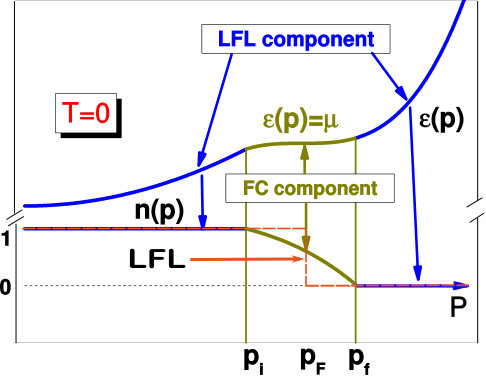 Figure 1
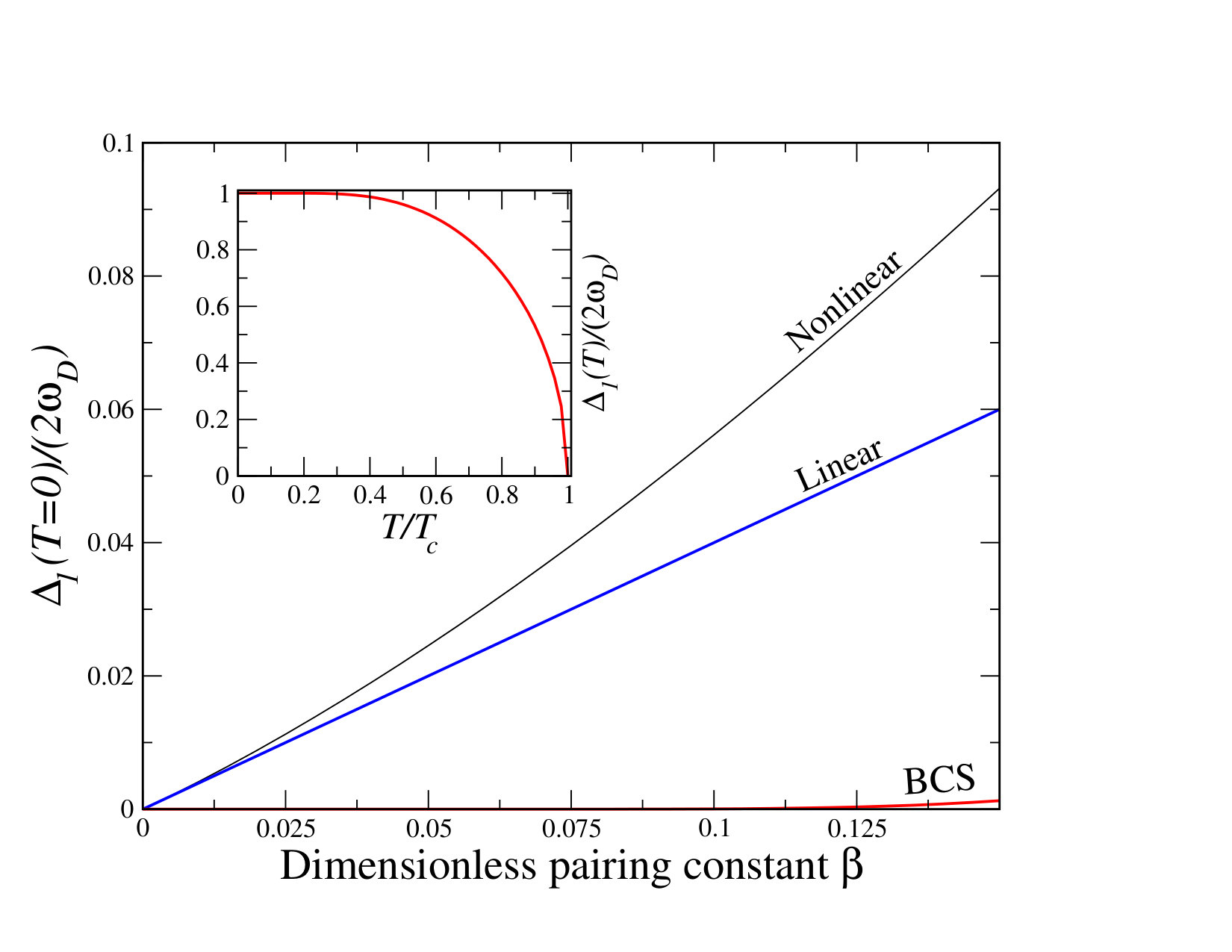 Figure 2
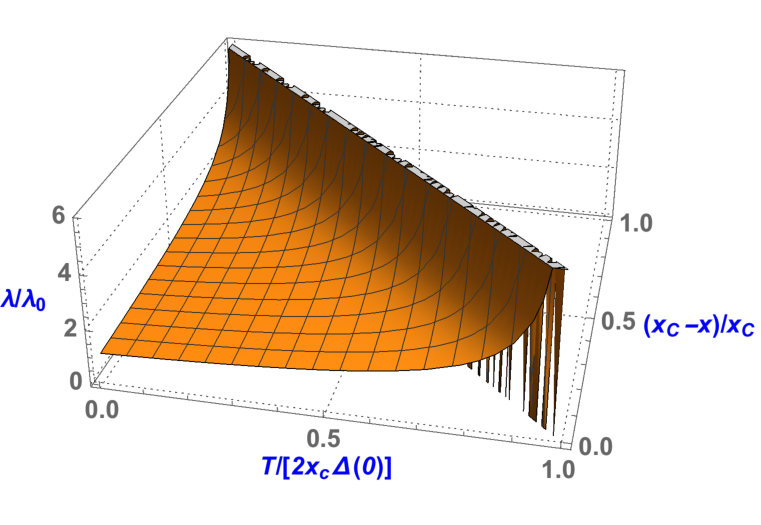 Figure 3
Peer Reviews
No public reviews on file for this paper yet. If you reviewed it on a platform where reviews are public (OpenReview, ICLR, NeurIPS, ICML), you can paste yours below so the community can read it here.
Videos
No videos yet. Explain this paper in a talk, walkthrough, or lecture? Add one.
The influence of topological phase transition
on the superfluid density of overdoped copper oxides
V. R. Shaginyan
Petersburg Nuclear Physics Institute, NRC ”Kurchatov Institute”, Gatchina, 188300, Russia
Clark Atlanta University, Atlanta, GA 30314, USA
V. A. Stephanovich
Institute of Physics, Opole University, Opole, 45-052, Poland
A. Z. Msezane
Clark Atlanta University, Atlanta, GA 30314, USA
G. S. Japaridze
Clark Atlanta University, Atlanta, GA 30314, USA
K. G. Popov
Komi Science Center, Ural Division, RAS, Syktyvkar, 167982, Russia
Abstract
We show that a topological quantum phase transition, generating flat bands and altering Fermi surface topology, is a primary reason for the exotic behavior of the overdoped high-temperature superconductors represented by , whose superconductivity features differ from what is described by the classical Bardeen-Cooper-Schrieffer theory [J.I. Boẑović, X. He, J. Wu, and A. T. Bollinger, Nature 536, 309 (2016)]. We demonstrate that 1) at temperature , the superfluid density turns out to be considerably smaller than the total electron density; 2) the critical temperature is controlled by rather than by doping, and is a linear function of the ; 3) at the resistivity varies linearly with temperature, , where diminishes with , while in the normal overdoped (non superconducting) region with , the resistivity becomes . The theoretical results presented are in good agreement with recent experimental observations, closing the colossal gap between these empirical findings and Bardeen-Cooper-Schrieffer-like theories.
pacs:
71.27.+a, 43.35.+d, 71.10.Hf
I Introduction
By now, overdoped copper oxides are realized as simple HTSC, whose strongly correlated physics can be captured by the conventional Bardeen Cooper Schrieffer theory (BCS), while recent experimental studies of overdoped high- superconductors (HTSC) discovered strong deviations of their physical properties from those predicted by BCS theory bosovic ; zaanen . These deviations were surprisingly similar for numerous HTSC samples bosovic ; zaanen ; uemura ; uem_n ; bern ; rour . The measurements of the absolute values of the magnetic penetration depth and the phase stiffness were carried out on thousands of perfect two dimensional (2D) samples of (LSCO) as a function of the doping and temperature . Here where is the film thickness, is Boltzmann constant, and is the electron charge. It has been observed that the dependence of zero-temperature superfluid density (the density of superconductive electrons) ( is the electron effective mass), is proportional to the critical temperature over a wide doping range. This dependence coincides with pervious measurements, and is incompatible with the standard BCS description. Moreover, turns out to be considerably smaller than the BCS density of superconductive electrons bosovic ; zaanen ; uemura ; uem_n ; bern ; rour , which is approximately equal to the total electron density bardeen . These observations representing the intrinsic LSCO properties provide unique opportunities for checking and expanding our understanding of the physical mechanisms responsible for high- superconductivity. We note, that that knowing the responsible mechanism can open avenue for chemical preparation of high- materials with as high as room temperature khs ; amusia:2015 ; volovik:91 ; volovik ; volovik:2015 .
Here we show that the physical mechanism, responsible for above non-BCS behavior of overdoped LSCO, stems from the topological fermion condensation quantum phase transition (FCQPT) accompanied by so-called fermion condensation (FC) phenomenon generating flat bands amusia:2015 ; khs ; volovik:91 ; volovik ; volovik:2015 ; khodel:1994 ; shagrep . We note that flat bands and extended saddle point singularity play important role in the theory of HTSC, see e.g. Refs. volovik:2015 ; khodel:1994 ; shagrep ; abrikosov ; abrikosov1 .
In order to make our analysis of overdoped LSCO obvious, we use the model of homogeneous heavy-electron liquid shagrep ; amusia:2015 . The main experimental facts of Refs. bosovic ; zaanen represent vivid qualitative deviations from those predicted by the classical BCS theory, therefore as a first step, we can confine ourself to obtaining transparent analytical results describing quantitatively experimental facts. Our analysis shows that despite drastic microscopic diversity of strongly correlated Fermi systems, they exhibit similar behavior close to FC quantum phase transition point. This is actually related to the altering of Fermi surface topology during FCQPT. We emphasize that the quantum physics of all seemingly different strongly correlated Fermi systems (and overdoped HTSC among them) is universal and emerges regardless of their underlying microscopic details like the symmetries of their crystal lattices. Because we deal effectively with momenta transfers that are small compared to those of the order of the reciprocal lattice length (Brillouin zone boundaries), whose contributions have no effect on the topological properties of the systems under consideration shagrep ; amusia:2015 ; volovik:91 ; volovik ; volovik:2015 . Note that despite the highly anisotropic electronic band dispersion in overdoped cuprate HTSC and hence their Fermi surface, our theory still applies for this case. The point here is that after FCQPT the Fermi surface, regardless its initial anisotropy, changes its topological class, thus generating all aforementioned salient experimentally observed features, inherent in the fermion condensation state. In other words, any initially (highly) anisotropic Fermi surface is still homotopic to simply spherical one as they can be reduced to each other by continuous deformation dnf ; vm77 . In the superconducting state, to the first approximation different regions with the maximal absolute value of the -wave superconducting order parameter are disconnected. Therefore, the order parameter can be either even, or odd with respect to a rotation in the ab-plane abrikosov ; abrikosov1 . Thus, as a first step, we also neglect the d-wave symmetry of the superconducting order parameter and use the s-wave one.
In our paper, using formalism accounting for the FCQPT, we investigate overdoped LSCO and show that as soon as the doping reaches its FCQPT critical value , the features of the emergent superconductivity begin to differ from those of BCS theory, as it is predicted long before the experimental observations are obtained bosovic ; zaanen ; qp2 . We demonstrate that: i) at , the superfluid density turns out to be a small fraction of the total density of electrons; ii) the critical temperature is controlled by rather than by doping, and is a linear function of the . Since FCQPT generates flat electronic bands amusia:2015 ; khs ; volovik:91 ; volovik ; volovik:2015 , the system under consideration exhibits non-Fermi liquid (NFL) behavior and the resistivity varies linearly with temperature, . Since at diminishes with decreasing, the system exhibits Landau Fermi liquid (LFL) behavior at and at low temperatures. These results are in good agreement with recent experimental observations bosovic ; zaanen ; pagl .
II Two-component system
An important problem for the condensed matter theory is the explanation of the NFL behavior observed in HTSC beyond critical point where the low-temperature density of states diverges which can generate flat bands without breaking any ground state symmetry, see e.g. Refs. bosovic ; volovik:2015 ; khodel:1994 ; shagrep ; pagl ; khod:2015 ; lifshitz . In a homogeneous matter, such a divergence is associated with the onset of a topological transition at signaled by the emergence of an inflection point at khodel:1994 ; shagrep ; ybalb
[TABLE]
at which the electron effective mass diverges as , where is the single - electron energy spectrum, is a momentum, is Fermi momentum and is the chemical potential. Accordingly, at the density of states diverges
[TABLE]
As a result, both FC state and the corresponding flat bands emerge beyond the topological FCQPT khod:2015 ; khodel:1994 ; shagrep ; amusia:2015 , while the critical temperature turns out to be abrikosov ; abrikosov1 . These results are consistent with the experimental data bosovic . The detailed consideration of this case will be published elsewhere.
At , the onset of FC in homogeneous matter is attributed to a nontrivial solution of the variational equation khs
[TABLE]
where is a ground state energy functional (its variation gives a single - electron spectrum ) and , stand for initial and final momenta, where the solution of Eq. (3) exists, see Refs. amusia:2015 ; shagrep ; khs for details.To be more specific, Eq. (3) describes a flat band pinned to the Fermi surface and related to FC.
To explain emergent superconductivity at , we retain the consequences of flattening of single-particle excitation spectra (i.e. flat bands appearance) in strongly correlated Fermi systems, see Refs. shagrep ; volovik:2015 ; amusia:2015 for recent reviews. At , the ground state of a system with a flat band is degenerate, and the occupation numbers of single-particle states belonging to the flat band are continuous functions of momentum , in contrast to standard LFL ”step” from 0 to 1 at , as it is seen from Fig. 1. Thus at the superconducting order parameter in the region occupied by FC khodel:1994 ; shagrep ; amusia:2015 ; qp1 ; qp2 . This property is in a stark contrast to standard LFL picture, where at and the order parameter is necessarily zero, see Fig. 1. Due to the fundamental difference between the FC single-particle spectrum and that of the remainder of the Fermi liquid, a system having FC is, in fact, a two-component system, separated from ordinary Fermi liquid by the topological phase transition volovik ; khodel:1994 ; volovik:2015 . The range of momentum space adjacent to where FC resides is given by , see Fig. 1.
III Green functions and superfluid density
To analyze the above emergent superconductivity quantitatively, it is convenient to use the formalism of Gor’kov equations for Green’s functions of a superconductor shagrep ; landau9 ; gorkov . For the 2D case of interest, the solutions of Gor’kov equations shagrep ; landau9 ; gorkov determine the Green’s functions and of a superconductor:
[TABLE]
Here the single-particle spectrum is determined by Eq. (3), and
[TABLE]
with . The gap and the function are given by
[TABLE]
Here is the superconducting coupling constant. We remember that the function has the meaning of the wave function of Cooper pairs and is the wave function of the motion of these pairs as a whole. Taking Eqs. (5) and (6) into account, we can rewrite Eqs. (4) as
[TABLE]
In the case , the gap , but and remain finite if the spectrum becomes flat, , and in the interval Eqs. (7) become amusia:2015 ; shagrep ; shagstep
[TABLE]
The parameters and are the coefficients of corresponding Bogolubov transformation landau9 ; gorkov , , . They are determined by the condition that the spectrum should be flat: . It follows from Eqs. (5) and (6) that
[TABLE]
where is the density of superconducting electrons, forming the FC component, see Fig. 1.
We construct the functions and in the case where the constant is finite but small, such that and can be found from the FC solutions of Eq. (3). Then , and are given by Eqs. (9), (6) and (5), respectively. Substituting the functions constructed in this manner into (7), we obtain and . We note that Eqs. (6) and (9) imply that the gap is a linear function of both and . Since , we conclude that . Note that since we consider the overdoped HTSC case and FCQPT takes place at , with qp1 ; qp2 ; shagrep ; therefore
[TABLE]
Increasing causes to become finite, leading to a finite value of the effective mass in the FC state shagrep :
[TABLE]
An important fact is to be noted here. Namely, it have been shown in Refs amusia:2015 ; shagrep , that in the FC formalism, the BCS relations remain valid if we use the spectrum given be Eq. (11). Thus, we can use the standard BCS approximation with the momentum independence of superconducting coupling constant in the region so that the interaction is supposed to be zero outside this region. Here is a characteristic energy, proportional to the Debye temperature. Under these suppositions, the superconducting gap depends only on temperature and is determined by the equation amusia:2015 ; khodel:1994 ; shagrep
[TABLE]
where and is a characteristic energy scale. Also, and ( is the effective mass of electron of the LFL component, see Fig. 1) are the densities of states of FC and non-FC electrons respectively. In the opposite case , as usual, and the remaining integrals can be evaluated exactly. This yields following equation relating the value with superconducting coupling constant
[TABLE]
where is dimensionless coupling constant, and . It is seen that parameter depends on the width of FC interval so that at () system is out of FC and hence is in a pure BCS state. In this case the solution of (13) has standard BCS form , while at small and we obtain the linear relation between coupling constant and gap , which not only differs drastically from the BCS result, but provides much higher , which is directly proportional to (in the FC case ) amusia:2015 . In the case of , Fig. 2 portrays the solutions of equation (13) for and even smaller . It is seen that already linear regime provides much higher than BSC case, while nonlinear one comprising the complete numerical solution of Eq. (13) yields even higher . This means that FC approach is well capable to explain the high- superconductivity. Inset to Fig. 2 reports the dependence (12) in dimensionless units. This dependence is not peculiar to FC approach as it is qualitatively similar to BCS case. In this case, the variation of ”FC-parameter” (and even putting ) does not change the situation qualitatively.
Now we analyze the superfluid density for finite . As seen from Eqs. (9) and (8), emerges when , and occupies the region , so that we denote , where is the electron density in FC phase. As a result, we have that in latter phase , with and being, respectively, the total density of electrons and that out of FC phase. Note that the result does not only follow from BCS theory of superconductivity, but is much deeper and is pertinent to almost any superfluid system, being the result of the Leggett theorem leg . The short statement of latter theorem leg is that at in any superfluid liquid , here denotes the number density of the liquid particles. For this theorem to be true, however, the system should be - invariant, where relates to time reversal. Since FC state, being highly topologically nontrivial amusia:2015 ; baras ; tun , violates primarily the time reversal symmetry (actually it also violates the invariance, where is charge conjugation and is translation invariance, see Refs. amusia:2015 ; shagrep ; baras for more details), the inequality is inherent in it, as it is seen from Eqs. (9) and (10). This implies that the main contribution to the above superconductivity comes from the FC state. We conclude that in the FC case the emerging two-component system violates the BCS condition that .
IV Penetration depth and general properties
Now we find out if our superconductor belongs to the London type. For that, we write down London’s electrodynamics equations: and , where is a superconducting current. These equations imply that the penetration depth
[TABLE]
Comparing the penetration depth (14) with the coherence length , we conclude that as the FC quasiparticle effective mass is huge amusia:2015 . Thus, the superconductors are indeed of the London type.
It turns out that in FC phase, the penetration depth is a function not only of temperature but also of doping degree . Then, it follows from Ginzburg-Landau theory, that the density of superconducting electrons . On the other hand, as it has been discussed in the paper bosovic , the pressure enhances , i.e. the density of charge carriers is important. Also, it has been shown (see, e.g. Refs. amusia:2015 ; shagrep ) that in superconducting phase with FC . This permits to use the relation (14) to plot the penetration depth as a function of temperature and doping in the form
[TABLE]
where , and combines all proportionality coefficients entering the problem. The dependence (15) is depicted in Fig. 3. Very good qualitative agreement with experimental data (Fig. 2a from Ref. bosovic ) is seen. Namely, doping dependent penetration depth becomes infinite at the superconducting phase transition temperature. At zero temperature the divergence of occurs at , corresponding to FC phase emergence, i.e. at both superconductivity and FC phase arise. At the same time, at higher temperatures, diverges in the region , i.e. deeply inside the FC phase. This shows the ”traces” of FC at finite temperatures. This demonstrates, in turn, that our approach, based on a concept of topological FC quantum phase transition, describes all the essential and puzzling features of overdoped HTSC. The main input of our model is that in two component system with FC, occupying a small fraction of the Fermi sphere, is much less than the total density of the electrons. The latter also allows to verify the validity of the well-known Uemura’s law uemura in our case. Indeed, since , we get from Eqs. (11) and (14)
[TABLE]
Taking into account that , we see that Eq. (16) reproduces the main results of our paper, being in good agreement with experimental data bosovic ; zaanen . It is seen that the dependence of on is linear, representing the observed scaling law, while is primary controlled by bosovic . We note that the results for underdoped HTSC uemura ; uem_n are similar to those for overdoped HTSC, thus being suggestive for underdoped vs overdoped symmetry bosovic . As a result, we observe good agreement with the Uemura’s law in overdoped LSCO as well bosovic .
We observe that at the doping levels , where FCQPT does not yet occur, the system is in LFL phase with resistivity , which is ”more metallic” than that exhibited in the FC phase bosovic ; pagl ; khod:2015 ; jetp2003 ; arch . In the latter phase, the superconductivity appears since FC strongly facilitates the superconducting state. In the normal phase, , FC causes the linear dependence of resistivity, khod:2015 ; arch ; qp1 ; qp2 , which is in good qualitative agreement with the experimental data on LSCO and bosovic ; pagl . We note that in the transition region one observes with pagl ; khod:2015 ; arch .
V Conclusions
In summary, we have shown that the main physical mechanism, responsible for the unusual properties of the overdoped , is the topological quantum phase transition with the emergence of the fermion condensation. This observation can open avenue for chemical preparation of high- materials with up to room temperatures. We have concluded our study of exemplifications of the new state of matter reached by fermion condensation with an exploration of high- superconductors as potential hosts of fermion condensates. In fact, we have shown that the underlying physical mechanism responsible for the unusual properties of the overdoped compound (LSCO) observed recently bosovic ; zaanen may very well involve a topological quantum phase transition that induces fermion condensation. Since the topological FC state violates time-reversal symmetry, the Leggett theorem no longer applies. Instead, we have demonstrated explicitly that the superfluid number density turns out to be small compared to the total number density of electrons. We have also shown that the critical temperature is a linear function of , while . Pairing with such unusual properties is as a shadow of fermion condensation – a situation foretold by an exactly solvable model qp2 long before the experimental observations were obtained by Boẑović et al. bosovic and demonstrating that both the gap and the order parameter exist only in the region occupied by fermion condensate. Thus, the experimental observations bosovic can be viewed as a direct experimental manifestation of FC. Additionally, we have demonstrated that at the resistivity varies linearly with temperature, while for it exhibits metallic behavior, . Thus, pursuit of a superconductivity formalism adapted to the presence of a fermion condensate captures all the essential physics of overdoped LSCO and successfully explains its most puzzling experimental features, thereby allowing us to close the colossal gap existing between the experiments and Bardeen-Cooper-Schrieffer-like theories. Indeed, these findings are applicable not only to LSCO but also for any overdoped high-temperature superconductor.
Acknowledgements.
We are grateful to V.A. Khodel for valuable discussions. This work was partly supported by U.S. DOE, Division of Chemical Sciences, Office of Basic Energy Sciences, Office of Energy Research.
The reference list from the paper itself. Each links out to its DOI / PubMed record.
- 1(1) J.I. Boẑović, X. He, J. Wu, and A. T. Bollinger, Nature 536 , 309 (2016).
- 2(2) J. Zaanen, Nature 536 , 282 (2016).
- 3(3) Y. J. Uemura et al. , Phys. Rev. Lett. 62 , 2317 (1989).
- 4(4) Y. J. Uemura et al. , Nature 364, 605 (1993).
- 5(5) C. Bernhard, Ch. Niedermayer, U. Binninger, A. Hofer, Ch. Wenger, J. L. Tallon, G. V. M. Williams, E. J. Ansaldo, J. I. Budnick, C. E. Stronach, D. R. Noakes, and M. A. Blankson-Mills, Phys. Rev. B 52 , 10488 (1995).
- 6(6) P. Rourke et al. , Nat. Phys. 7 , 455 (2011).
- 7(7) J. Bardeen, L. N. Cooper, and J. R. Schrieffer, Phys. Rev. 106 , 162 (1957).
- 8(8) V. A. Khodel and V. R. Shaginyan, JETP Lett. 51 , 553 (1990).