Width of the confinement-induced resonance in a quasi-one-dimensional trap with transverse anisotropy
Fang Qin, Jian-Song Pan, Su Wang, and Guang-Can Guo

TL;DR
This paper investigates how the width of the s-wave confinement-induced resonance in quasi-one-dimensional atomic gases can be controlled by transverse anisotropy, with implications for experimental probing of interaction energies.
Contribution
It provides a theoretical analysis showing that transverse anisotropy can tune the CIR width, a novel insight for controlling atomic interactions in quasi-1D systems.
Findings
CIR width is tunable via transverse anisotropy.
Changes in CIR width affect the interaction energy discontinuity.
Theoretical predictions can be tested experimentally.
Abstract
We theoretically study the width of the s-wave confinement-induced resonance (CIR) in quasi-one-dimensional atomic gases under tunable transversely anisotropic confinement. We find that the width of the CIR can be tuned by varying the transverse anisotropy. The change in the width of the CIR can manifest itself in the position of the discontinuity in the interaction energy density, which can be probed experimentally.
Click any figure to enlarge with its caption.
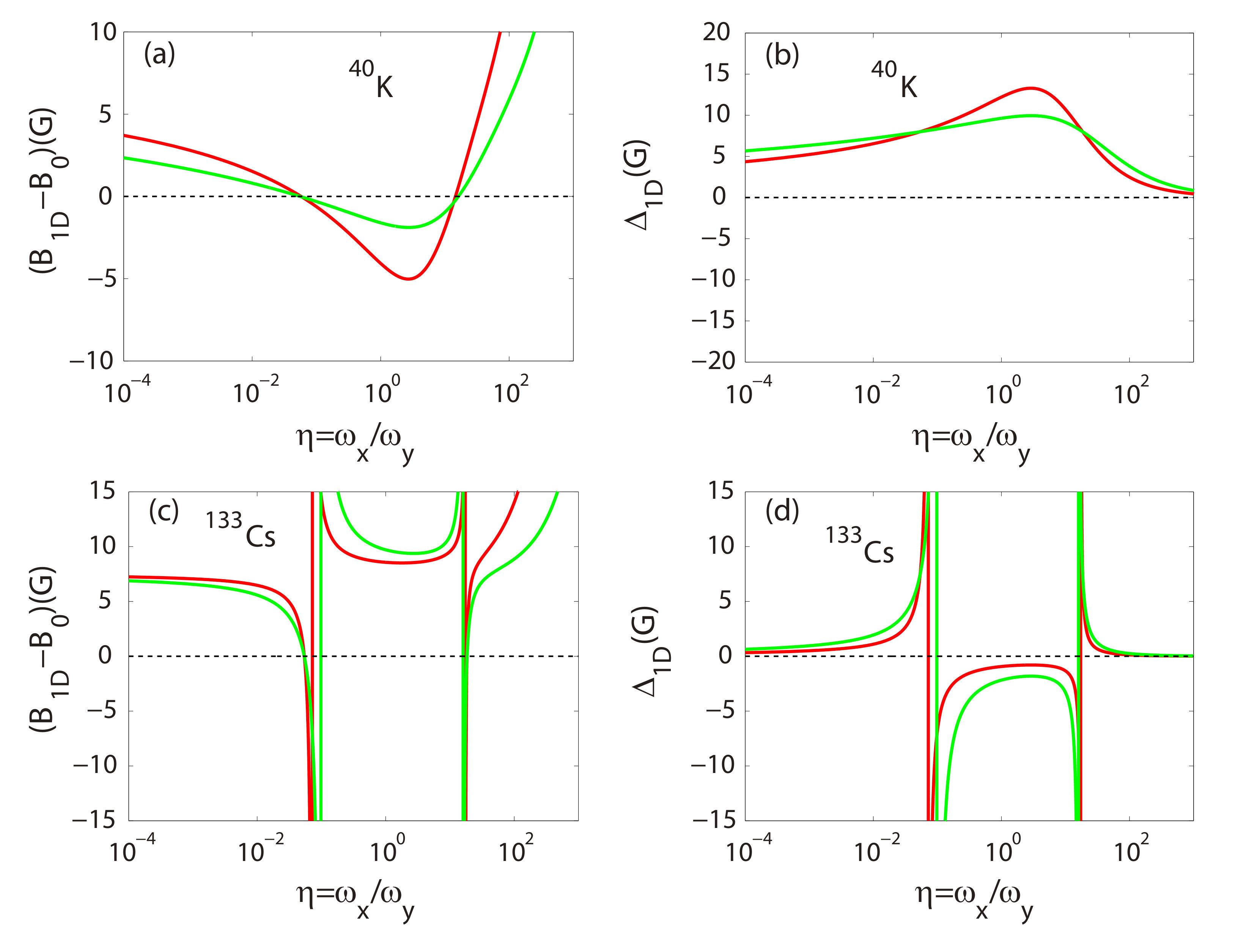 Figure 1
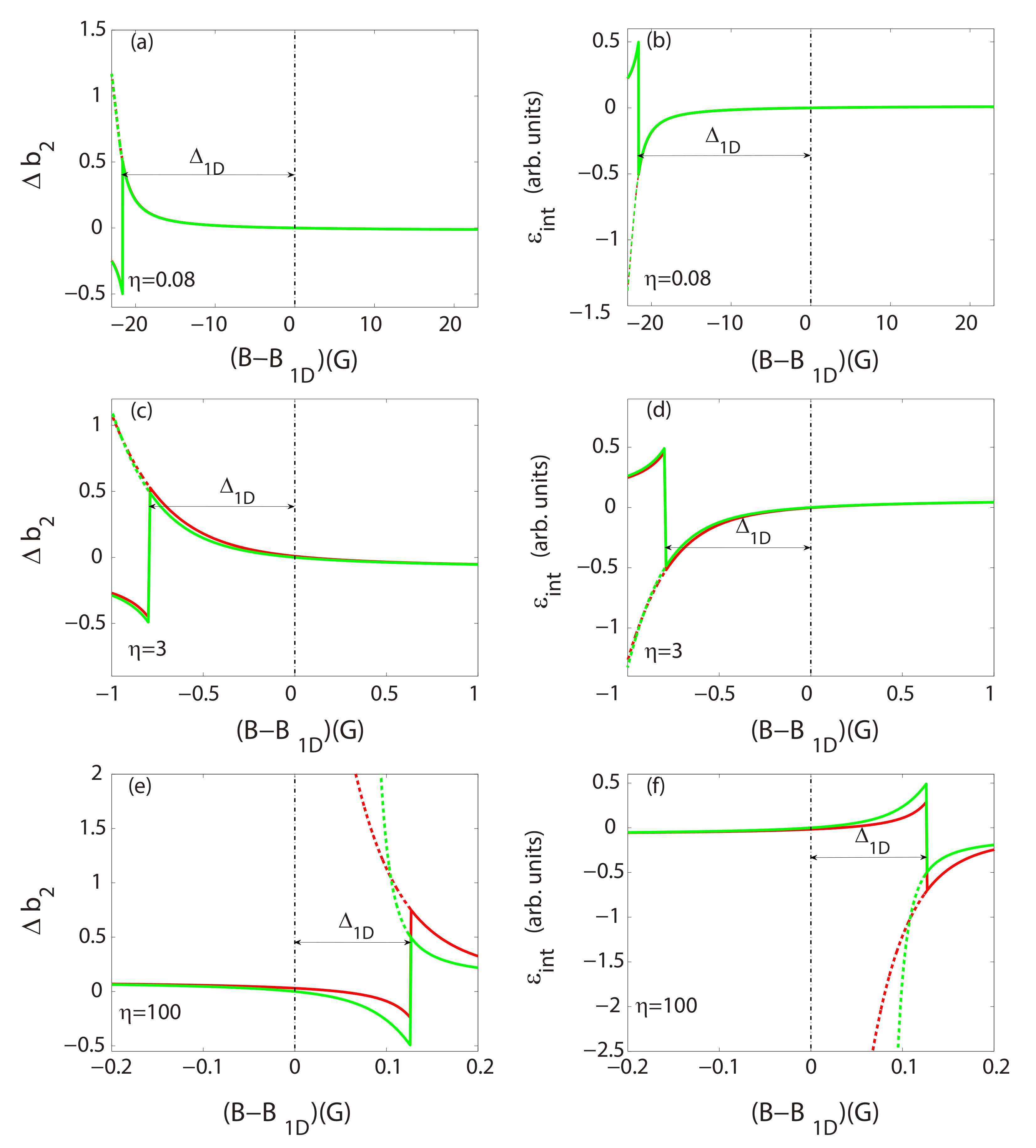 Figure 2
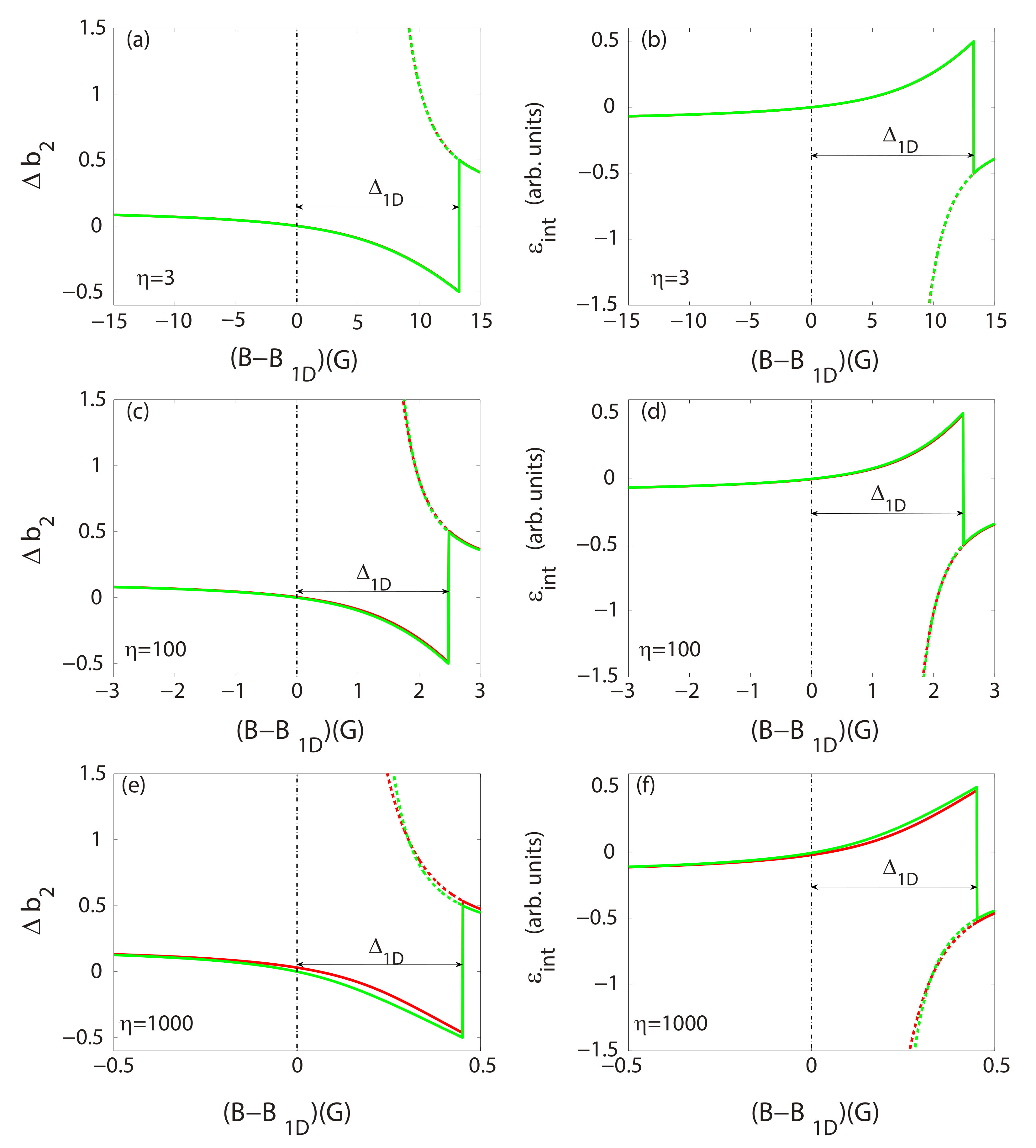 Figure 3
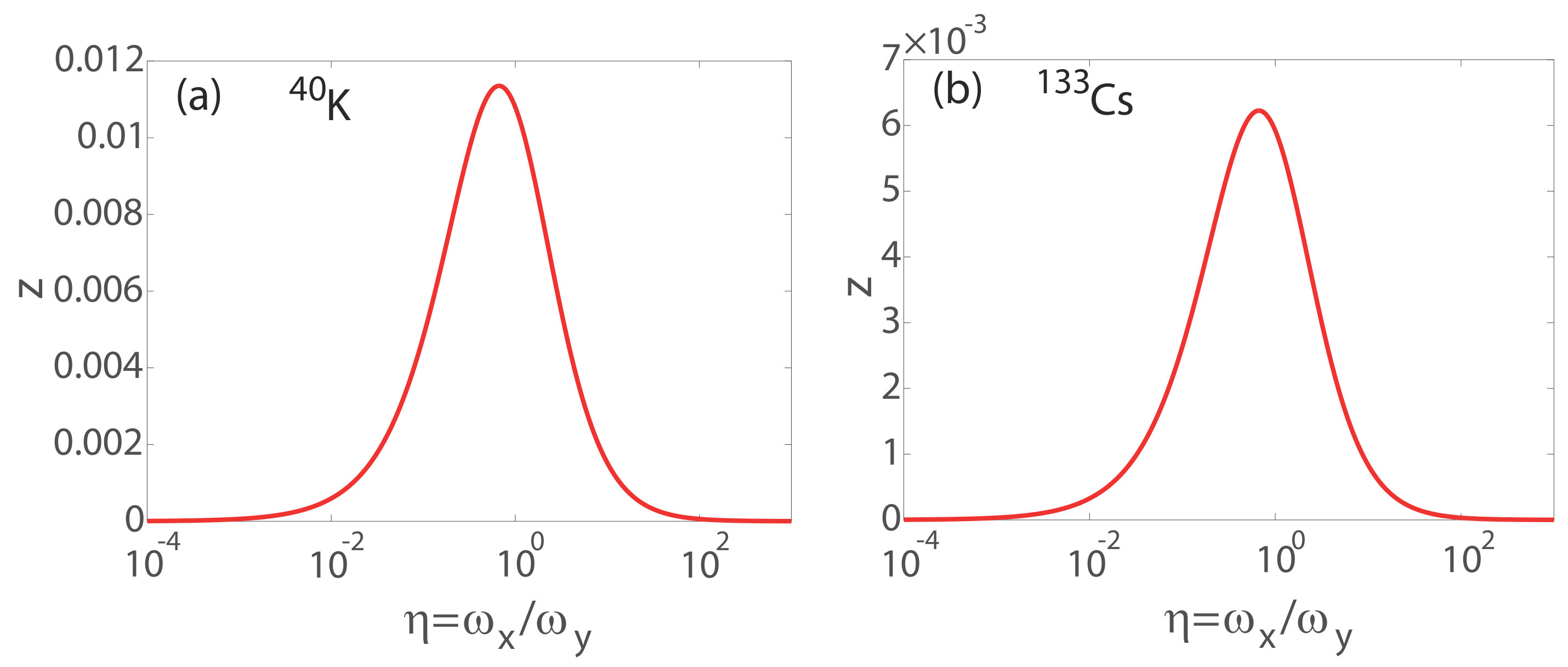 Figure 4
Peer Reviews
No public reviews on file for this paper yet. If you reviewed it on a platform where reviews are public (OpenReview, ICLR, NeurIPS, ICML), you can paste yours below so the community can read it here.
Videos
No videos yet. Explain this paper in a talk, walkthrough, or lecture? Add one.
Width of the confinement-induced resonance in a quasi-one-dimensional trap with transverse anisotropy
Fang Qin
Key Laboratory of Quantum Information, University of Science and Technology of China, Chinese Academy of Sciences, Hefei, Anhui 230026, P.R. China
Synergetic Innovation Center of Quantum Information and Quantum Physics, University of Science and Technology of China, Hefei, Anhui 230026, P.R. China
Jian-Song Pan
Key Laboratory of Quantum Information, University of Science and Technology of China, Chinese Academy of Sciences, Hefei, Anhui 230026, P.R. China
Synergetic Innovation Center of Quantum Information and Quantum Physics, University of Science and Technology of China, Hefei, Anhui 230026, P.R. China
Wilczek Quantum Center, School of Physics and Astronomy and T. D. Lee Institute, Shanghai Jiao Tong University, Shanghai 200240, P.R. China
Su Wang
Key Laboratory of Quantum Information, University of Science and Technology of China, Chinese Academy of Sciences, Hefei, Anhui 230026, P.R. China
Synergetic Innovation Center of Quantum Information and Quantum Physics, University of Science and Technology of China, Hefei, Anhui 230026, P.R. China
Guang-Can Guo
Key Laboratory of Quantum Information, University of Science and Technology of China, Chinese Academy of Sciences, Hefei, Anhui 230026, P.R. China
Synergetic Innovation Center of Quantum Information and Quantum Physics, University of Science and Technology of China, Hefei, Anhui 230026, P.R. China
Abstract
We theoretically study the width of the -wave confinement-induced resonance (CIR) in quasi-one-dimensional atomic gases under tunable transversely anisotropic confinement. We find that the width of the CIR can be tuned by varying the transverse anisotropy. The change in the width of the CIR can manifest itself in the position of the discontinuity in the interaction energy density, which can be probed experimentally.
pacs:
03.75.Hh, 34.50.-s, 03.65.Nk
I Introduction
Low-dimensional quantum gas has attracted more and more attentions since its experimental realization CIR2010experiment ; CIR2010review ; Q2Dexp2010 ; Q2Dexp2011 ; Q2Dexp2014 ; Q2Dexp2015 . Experimentally, quasi-low-dimensional quantum gases can be realized by introducing tight confinements with optical lattices to freeze one or two spatial degrees of freedom. Besides, the interactions between two atoms can be tuned by a Feshbach resonance. Based on these experimental techniques, the quasi-low-dimensional quantum gases can provide an ideal platform to study the fundamental many-body physics which is very different from that of three-dimensional gases.
The quasi-one-dimensional (quasi-1D) quantum gases can be realized by introducing a two-dimensional deep optical lattice in the transverse plane. In this situation, the kinetic energy of the particles is too weak to drive them to the transversal excited energy levels. When the two-body interaction cannot support a bound state, the transverse confinement can be used to modify scattering along the unconfined direction by providing an additional structure of the transverse energy levels. Varying the trapping frequencies, the effective one-dimensional scattering length even becomes divergent, which is the so-called confinement-induced resonance (CIR) Olshanii1998 ; Olshanii2003 ; Naidon2007 ; Peng2010 ; Zhang2011 ; Cui2012 ; kmatrix2004 ; kmatrixlwave2012 ; kmatrixlwave2014 ; kmatrixlwave2015 ; kmatrixlwave2016 ; kmatrixMelezhik2016 ; dipolarCIR2013 ; dipolarCIR20141 ; dipolarCIR20142 ; Lange2009 ; Melezhik2012 ; Melezhik2015 ; Melezhik2008 ; Melezhik2011 ; dwave2011 ; dwave2012 ; Peng2011 ; Qi2013 .
The transverse anisotropy is a basic tunable parameter for a quasi-1D quantum gas. The CIR for an ultracold quasi-1D gas has been observed by measuring the atom loss and heating rate with respect to different transversely anisotropic confinements CIR2010experiment . The corresponding resonance position of the CIR has been theoretically studied using the zero-energy -wave-scattering pseudopotential approach Peng2010 ; Zhang2011 ; Cui2012 . With the -matrix approach kmatrix2004 ; kmatrixlwave2012 ; kmatrixlwave2014 ; kmatrixlwave2015 , the positions of -wave CIRs in both isotropic and anisotropic harmonic waveguides have been calculated kmatrixlwave2016 ; kmatrixMelezhik2016 . Moreover, the positions of dipolar CIRs have been discussed in Refs. dipolarCIR2013 ; dipolarCIR20141 ; dipolarCIR20142 . As one basic quantity to describe a Feshbach resonance, the width of a CIR also attracts many attentions. For example, with the two-channel model of Lange et al. Lange2009 , the shifts and widths of - and -wave CIRs in quasi- isotropic traps have been studied Melezhik2012 ; Melezhik2015 . With the general grid method suggested in Ref. Melezhik2008 , the impact of multichannel scattering on the positions and widths of CIRs under isotropic transversal confinement has been investigated Melezhik2011 .
In this work, we study the width of the -wave CIR in quasi-1D gases under tunable transversely anisotropic confinement using the Fermi-Huang pseudopotential approach Olshanii1998 . We propose to tune the width of the CIR with the transverse frequency ratio. Furthermore, we carefully study the thermodynamics of this system and find the change of the CIR width can manifest itself in the position of the discontinuity in the interaction energy density. At first, we analytically calculate the resonance position and width of the CIR. We find that both and can be tuned by varying the ratio between the two transverse trapping frequencies. Typically, we find that, for quasi-1D 133Cs Bose gases, diverges at two critical frequency ratios and , while there is no divergence in the CIR width for 40K atoms. Furthermore, we study the normal-state thermodynamics of the quasi-1D atomic gases across the CIRs using the quantum virial expansions. Interestingly, the scattering branch of the interaction energy shows an abrupt discontinuity at the magnetic field , which can be detected in experiment.
This paper is organized as follows. In Sec. II, we present the model Hamiltonian. We derive the resonance width and position of the -wave CIRs as functions of the transverse anisotropy. In Sec. III, we discuss the corresponding normal-state thermodynamics of the quasi-1D atomic gases using the quantum virial expansions. Finally, we give a summary in Sec. IV.
II CIR with transverse anisotropy
II.1 General formalism
We consider two interacting atoms in a harmonic trap with tight confinements in the transverse plane and a weak confinement in the axial -direction. The transverse confinements are anisotropic, i.e., with transverse trapping frequency ratio , where is the trapping frequency in axis. Near an -wave Feshbach resonance, the interaction between the atoms is dominated by the -wave scattering, and the Hamiltonian for the relative atomic motion can be written as
[TABLE]
where
[TABLE]
Here, is the three-dimensional coupling rate, is the reduced Planck constant, is the three-dimensional -wave scattering length, and is the reduced mass for the relative motion with atom mass .
Following the standard renormalization procedure Cui2012 ; renormalization2002 ; renormalization2005 , we write the energy-dependent (or -dependent) three-dimensional -wave scattering length as
[TABLE]
where , is the background scattering length, is the magnetic-field strength, is the position of the Feshbach resonance, is the three-dimensional resonance width, and is the magnetic-moment difference between the atom state and the closed-channel molecular state. The expression of energy-dependent scattering length in Eq. (3) is applicable for both wide and narrow Feshbach resonances.
The quasi-1D scattering amplitude can be written as review2015 ; review2008 ; ps1990
[TABLE]
Here, the phase shift is given by
[TABLE]
where and
[TABLE]
The effective 1D coupling rate is given by Olshanii1998 ; Olshanii2003 ; Peng2010 . Using Eqs. (3) and (4), we derive
[TABLE]
where is the background effective 1D coupling strength,
[TABLE]
and
[TABLE]
Here, corresponds to the wide CIR limit, and corresponds to the narrow CIR limit Cui2012 .
Near CIR () and for , one has
[TABLE]
where
[TABLE]
is the 1D effective range characterizing -dependence in , and the zero-energy coupling strength is
[TABLE]
which diverges at . Therefore, the is called the resonance position of a CIR, and is called the resonance width of a CIR. We will show in the next subsection that the width of the CIR can be tuned from wide to narrow by varying .
II.2 Numerical calculations
In Fig. 1, we plot the CIR position and width as functions of for 40K and 133Cs atoms, respectively.
For 133Cs atoms with kHz, the CIR width diverges at and , near which the CIR is wide. However, as changes, the condition for a wide CIR may not hold. For example, with , , which is on the same order of .
The divergent or nonmonotonic behavior of 133Cs is connected to the transformation from the quasi-1D geometry to the quasi-2D geometry by continuously changing the transverse anisotropy Peng2010 ; Zhang2011 . Therefore, the divergent point is the point where the quasi-1D system goes into the quasi-2D system.
As shown in Fig. 1, the width and resonance position of the CIR for 133Cs diverge at the same critical value of . Physically, the divergences of the width and resonance position mean that 133Cs has no resonance position at the critical .
On the other hand, while there is no divergence in the CIR width for 40K atoms, the condition for the wide CIR typically holds, except for unrealistically large ’s. As we will show in the following sections, these changes in the character of the CIR would manifest themselves in the normal-state many-body properties of the quasi-1D atomic gases, when the transverse anisotropy is tuned.
The divergence in the width of the CIR is system dependent. Comparing 40K with 133Cs as shown in Fig. 1, it is found that the divergence in the widths of the CIR is system dependent. The condition for this divergence is
[TABLE]
i.e., the denominator of Eq. (9) equals zero. The atomic system with specific value of and atom mass which satisfy Eq. (13) can have divergent width, otherwise there is no divergence in the width. For 133Cs, which is easy to satisfy the divergent condition. However, for 40K, which is much smaller than the one of 133Cs and it cannot satisfy the divergent condition. Therefore, the system with large can reach the divergent condition more easily.
III Thermodynamics in normal state
In this section, we study the normal-state properties of quasi-1D atomic gases using the quantum virial expansions. For consistency, we assume that the temperature is high enough for the gases to be in the normal state, but not too high to make the excited states in the transverse directions are not thermally populated, i.e., , where is the system temperature and is the Boltzmann constant. Here, we mainly focus on the behavior of the interaction energy density, which can be measured in experiment.
III.1 Fermions
Based on the local density approximation, the thermodynamic potential of a non-interacting two-component Fermi gas with equal spin populations in our quasi-1D geometry takes the form
[TABLE]
where is the system size in the axial direction, is the fugacity, is the corresponding chemical potential, , is the thermal de Broglie wavelength, and is the standard Fermi-Dirac integral with the gamma function Pathria1996 .
Accordingly, we can rewrite the thermodynamic potential of a strongly interacting Fermi gas as (up to the second order) liureview2013 ; qin2016 ; PengPLA2011 ; PengPRA2011
[TABLE]
where is the second virial coefficient. Therefore, the particle number density of atoms is given by
[TABLE]
where we use Pathria1996
[TABLE]
at high temperatures. Then we can derive the specific expression for fugacity:
[TABLE]
The logarithm of the grand canonical partition function can be represented by
[TABLE]
Based on the above equations, we derive the internal energy density
[TABLE]
where .
Finally, we can obtain the dimensionless interaction energy density Ho2004s ; Ho2004p :
[TABLE]
III.2 Bosons
Following the similar derivations, the internal energy density for the quasi-1D bosons is given by
[TABLE]
Therefore, we have the dimensionless interaction energy density:
[TABLE]
III.3 Fugacity
In order to justify the condition of the virial expansion, we calculate the fugacity at as below.
Substituting into Eq. (18), we have
[TABLE]
For the typical experimental parameter, the particle number density is m*-1* density20041 ; density20042 . Therefore, with kHz, we have for 40K fermions, and for 133Cs bosons.
Keeping up to the term of Eq. (24), we have
[TABLE]
As shown in Fig. 2, we calculate the fugacity as a function of at numerically. It is found that the fugacities always satisfy for both 40K and 133Cs atoms, i.e., the virial expansion might be used even when the temperature is much lower than the zero-point energy.
III.4 Second virial coefficients
To calculate the interaction energies in Eqs. (21, 23), we need to evaluate the second virial coefficients at first. They can be expressed in terms of the phase shifts of the corresponding two-body scattering problem. The second virial coefficient for the repulsive scattering branch takes the form Ho2004s ; Ho2004p
[TABLE]
For the attractive branch, is given by
[TABLE]
For wide CIR, the binding energy () for the quasi-1D system is determined by Peng2010 ; Zhang2011 ; review2008 ; Taylor1972
[TABLE]
where the corresponding is -independent, i.e., .
When the condition for the wide CIR is not satisfied, the binding energy of a shallow bound state can be obtained from
[TABLE]
where the -dependent is
[TABLE]
III.5 Numerical calculations
Following the above analytical expressions, we numerically calculate the second virial coefficients and the interaction energy densities using the typical experimental parameters for 40K and 133Cs atoms, respectively.
In Fig. 3, we plot and for two-species 40K fermions across CIR with different . The solid and dashed lines are respectively for scattering and attractive branches shown in Figs. 3 and 4. The dashed line denotes the molecular state which includes the two-body binding energy in the interaction energy and second virial coefficient, while the solid line dose not include the binding energy. It shows that the scattering branch goes through an abrupt discontinuity, the position of which is given by Cui2012 . Physically, the discontinuity point in the scattering branch of the interaction energy density is where the binding energy goes beyond its threshold for the existence of the molecular state, i.e., the two-body bound state transforms to a scattering state leads to the discontinuity in the scattering branch of the interaction energy density narrow2012 .
From to , we find that and exhibit different features along a wide CIR to a narrow CIR. For example, from a wide CIR to a narrow CIR, the change of the CIR width dramatically shifts the position of the discontinuity point of and curves. Therefore, the tunability of the CIR width can leave detectable signatures in the normal-state properties of the many-body system.
In Fig. 4, we show and for 133Cs atoms across a CIR with different . While the general conclusions are similar to the cases of 40K, the tunability of the CIR is even more obvious.
Why there are different features in the interaction energy densities for the wide and narrow CIRs? The wide (narrow) CIR corresponds to () narrow2012 . From Eq. (11), it is found that the resonance width is proportional to , so that is a very important interaction parameter to describe the wide and narrow CIRs. Since , the two-body effective 1D coupling strength for the narrow CIR is -dependent (Eq. (10)), i.e., it must be described by two interaction parameters: -independent effective 1D coupling strength (Eq. (12)) and , while the effective 1D coupling strength for the wide CIR is -independent (Eq. (12)), because the effective range is too small compared to across a wide resonance: narrow2012 . Therefore, the two-body effective 1D coupling strengths for the narrow and wide CIRs have completely different features. Furthermore, the interaction energy is directly connected to the two-body effective 1D coupling strength or the interaction parameters. Therefore, the interaction energy across a narrow CIR must be described by two interaction parameters: -independent and , while the interaction energy across a wide CIR can be described by only one interaction parameter , because the effective range compared to is too small to contribute to the interaction energy across a wide resonance narrow2012 ; narrow2014 .
Futhermore, we compare the -dependent (or energy-dependent) curve with the corresponding -independent curve in Figs. 3 and 4. It is found that the two curves almost coincide with each other for a wide CIR. However, for a narrow CIR, the two curves deviate from each other. Therefore, the -dependent result is more accurate for a narrow CIR than the -independent one, while for a wide CIR, both of them are valid.
III.6 Addition
Refs. PengPLA2011 ; PengPRA2011 give another way to calculate the normal-state thermodynamics for the interacting Fermi gases in a three-dimensional anisotropic trap. They start from the Hamiltonian for the relative atomic motion PengPLA2011 ; PengPRA2011
[TABLE]
where is the relative coordinate, , , and . Different from Eq. (31), in our model (Eq. (1)), we ignore the confinement in the axial -direction, i.e., , and the particle can move freely in the axial -direction.
By solving the corresponding Schrödinger equation, one can obtain the second virial coefficient PengPLA2011 ; PengPRA2011 . Furthermore, the corresponding normal-state thermodynamic potential for interacting Fermi gases can be calculated.
From the thermodynamic potential in Eq. (26) of Ref. PengPLA2011 , it is found that the thermodynamic potential is proportional to , where the trapping frequency is given by . Therefore, for an extremely anisotropic trap with , the thermodynamic potential , which is an unphysical result. Therefore, the method in Refs. PengPLA2011 ; PengPRA2011 cannot be applied to the trap which is extremely anisotropic with . However, the thermodynamic potential (Eq. (15)) in our work can be used for the extremely anisotropic trap with .
IV Summary
In this work, we have presented a theoretical study on the width of the -wave CIR in a quasi-1D atomic gas under tunable transversely anisotropic confinement. We find that the width of the CIR can be tuned by varying the transverse anisotropy. Typically, we calculate the resonance position and width of the CIR for 40K and 133Cs atoms. Furthermore, we investigate the normal-state thermodynamics of the quasi-1D atomic gases. As two typical examples, we also calculate the interaction energy densities of 40K and 133Cs atomic gases across both the wide and narrow CIRs with different transverse anisotropy. We find that the change in the width of the CIR can manifest itself in the position of the discontinuity in the interaction energy density, which can be probed experimentally InteractionEnergy .
Acknowledgements
We thank Wei Yi, Wei Zhang, Xiaoling Cui, Ming Gong, Lijun Yang, Jingbo Wang, V. S. Melezhik, and P. Schmelcher for helpful discussions. We also thank the referees for improving the quality of this manuscript. This work is supported by the National Key R&D Program (Grant No. 2016YFA0301700), the National Natural Science Foundation of China (Grant No. 11404106), and the “Strategic Priority Research Program(B)” of the Chinese Academy of Sciences (Grant No. XDB01030200). F.Q. acknowledges support from the Project funded by China Postdoctoral Science Foundation (Grant No. 2016M602011). J.-S.P. acknowledges support from National Postdoctoral Program for Innovative Talents of China (Grant No. BX201700156).
The reference list from the paper itself. Each links out to its DOI / PubMed record.
- 1(1) E. Haller, M. J. Mark, R. Hart, J. G. Danzl, L. Reichsollner, V. Melezhik, P. Schmelcher, and H.-C. Nägerl, Phys. Rev. Lett. 104 , 153203 (2010).
- 2(2) C. Chin, R. Grimm, P. Julienne, and E. Tiesinga, Rev. Mod. Phys. 82 , 1225 (2010).
- 3(3) K. Martiyanov, V. Makhalov, and A. Turlapov, Phys. Rev. Lett. 105 , 030404 (2010).
- 4(4) B. Fröhlich, M. Feld, E. Vogt, M. Koschorreck, W. Zwerger, and M. Köhl, Phys. Rev. Lett. 106 , 105301 (2011).
- 5(5) V. Makhalov, K. Martiyanov, and A. Turlapov, Phys. Rev. Lett. 112 , 045301 (2014).
- 6(6) M. G. Ries, A. N. Wenz, G. Zürn, L. Bayha, I. Boettcher, D. Kedar, P. A. Murthy, M. Neidig, T. Lompe, and S. Jochim, Phys. Rev. Lett. 114 , 230401 (2015).
- 7(7) M. Olshanii, Phys. Rev. Lett. 81 , 938 (1998);
- 8(8) T. Bergeman, M. G. Moore, and M. Olshanii, Rev. Lett. 91 , 163201 (2003).