Light Higgsinos, Heavy Gluino and $b-\tau$ Quasi-Yukawa Unification: Will the LHC find the Gluino?
Aditya Hebbar, Qaisar Shafi, Cem Salih Un

TL;DR
This paper investigates supersymmetric models predicting b-$ au$ quasi-Yukawa unification with light Higgsinos and heavy gluinos, analyzing the LHC's potential to detect gluinos in the 2-4 TeV range.
Contribution
It explores parameter space in a supersymmetric SU(4)×SU(2)$_L$×SU(2)$_R$ model consistent with b-$ au$ unification and light Higgsinos, estimating gluino masses relevant for LHC searches.
Findings
Gluino mass estimated between 2-4 TeV.
Higgsinos are the lightest supersymmetric particles, below 1 TeV.
First two family squarks are significantly heavier, up to 10 TeV.
Abstract
A wide variety of unified models predict asymptotic relations at between the b quark and lepton Yukawa couplings. Within the framework of supersymmetric SU(4) SU(2) SU(2), we explore regions of the parameter space that are compatible with b- quasi-Yukawa unification and the higgsinos being the lightest supersymmetric particles ( 1 TeV). Among the colored sparticles, the stop weighs more than 1.5 TeV or so, whereas the squarks of the first two families are signifcantly heavier, approaching 10 TeV in some cases. The gluino mass is estimated to lie in the 2-4 TeV range which raises the important question: Will the LHC find the gluino?
Click any figure to enlarge with its caption.
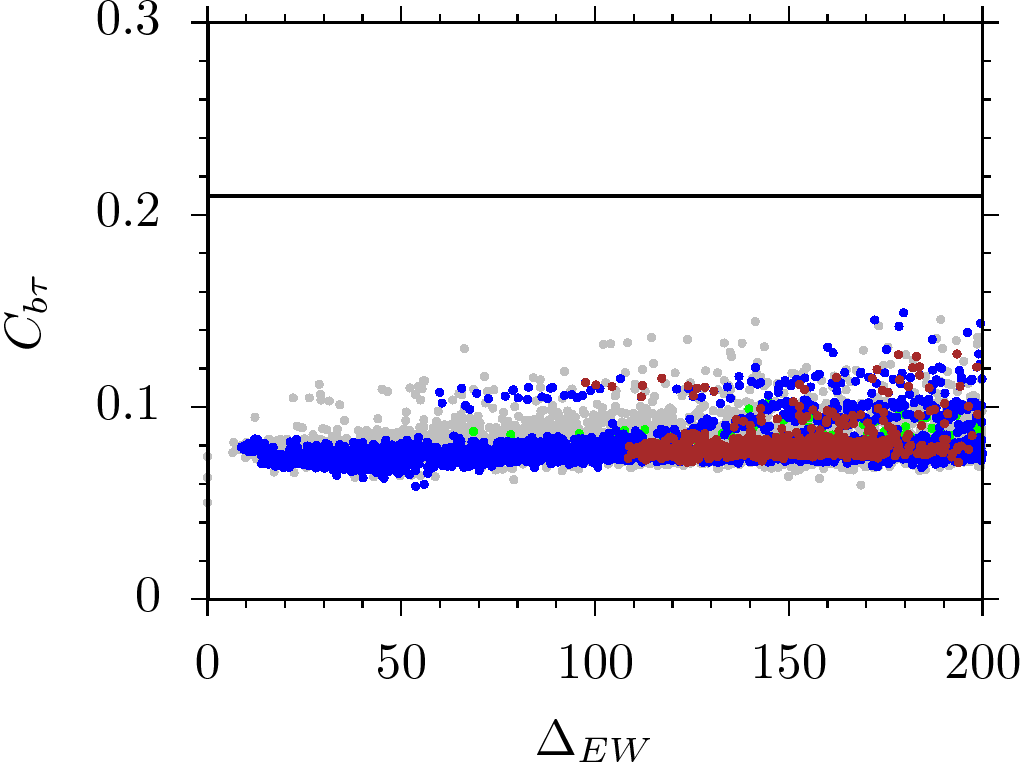 Figure 1
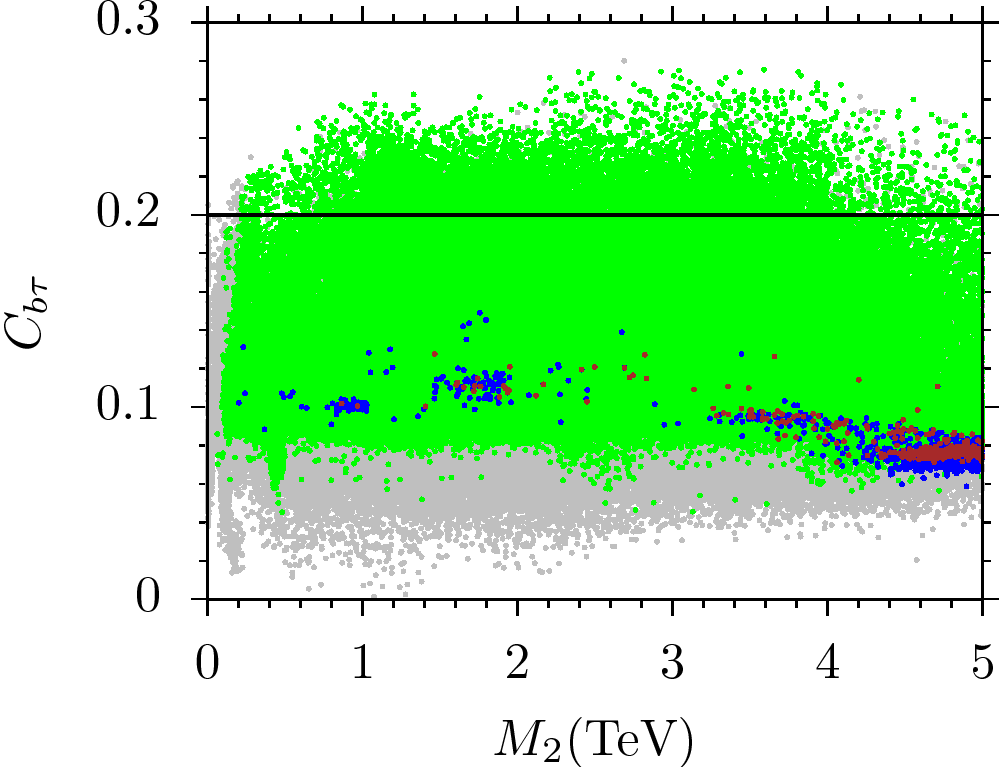 Figure 2
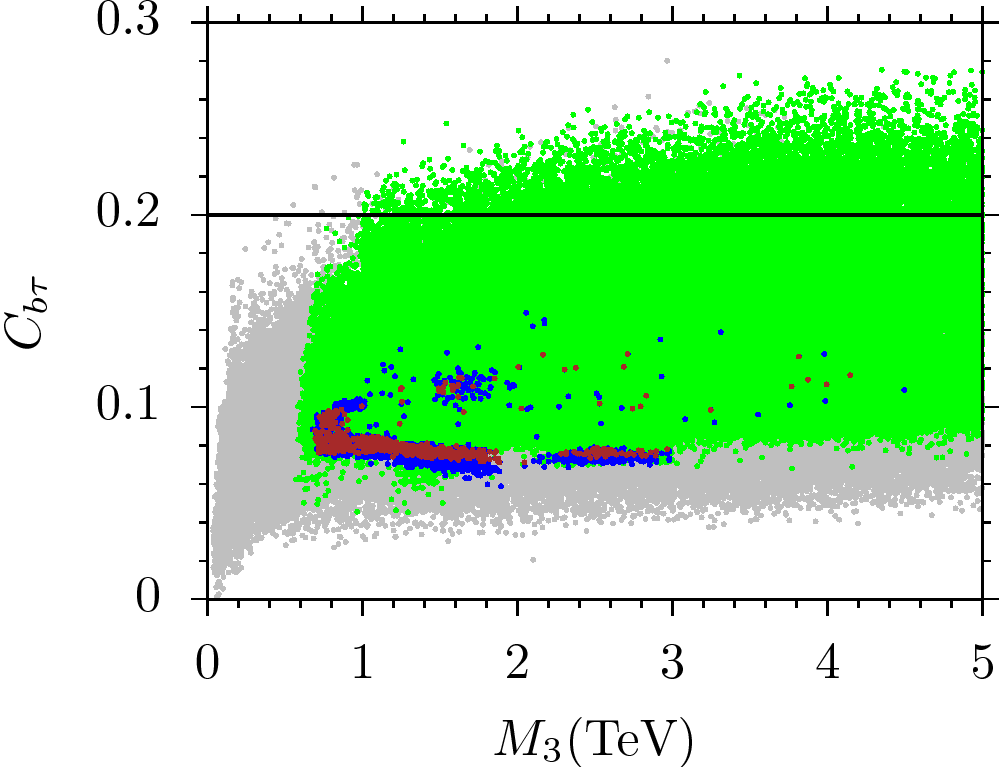 Figure 3
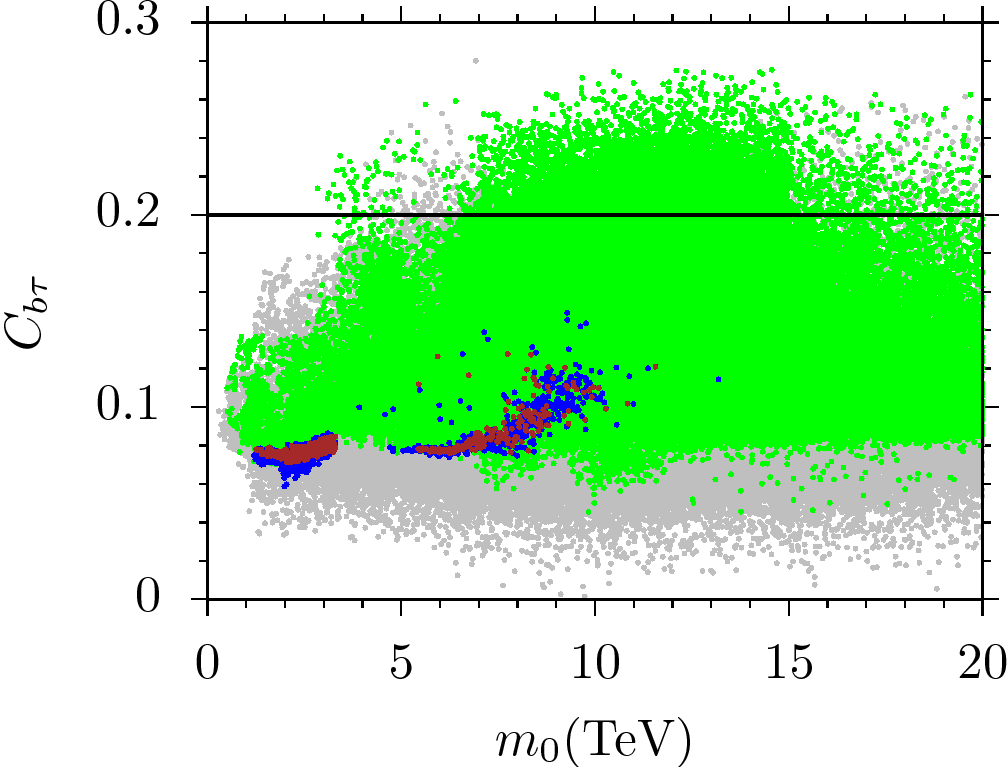 Figure 4
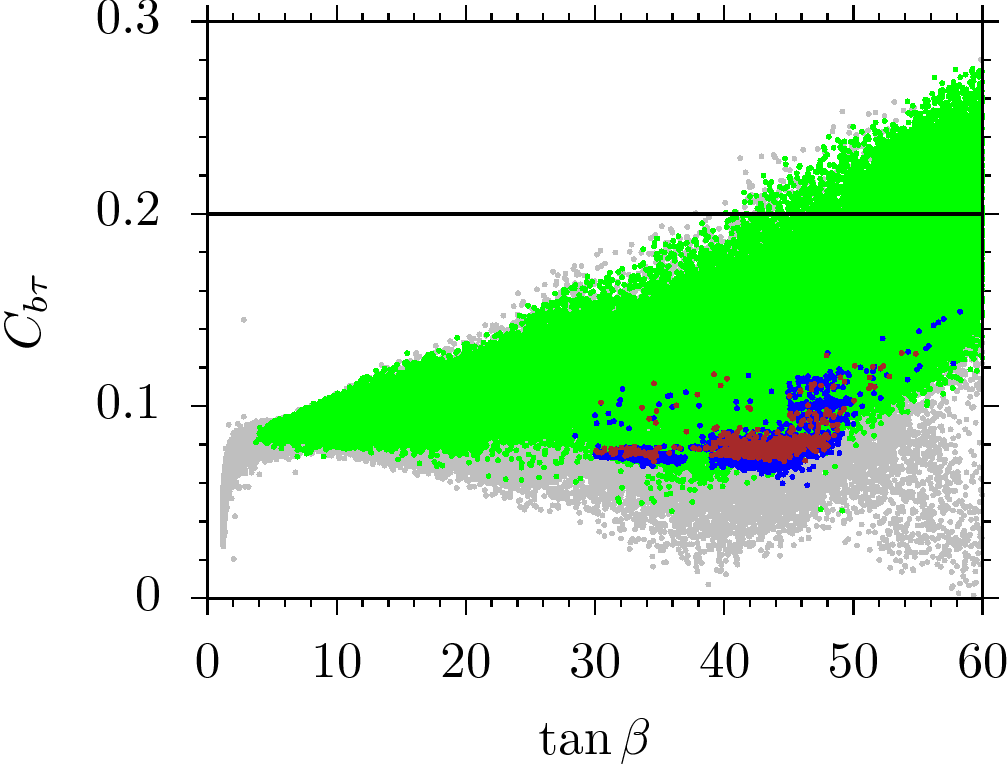 Figure 5
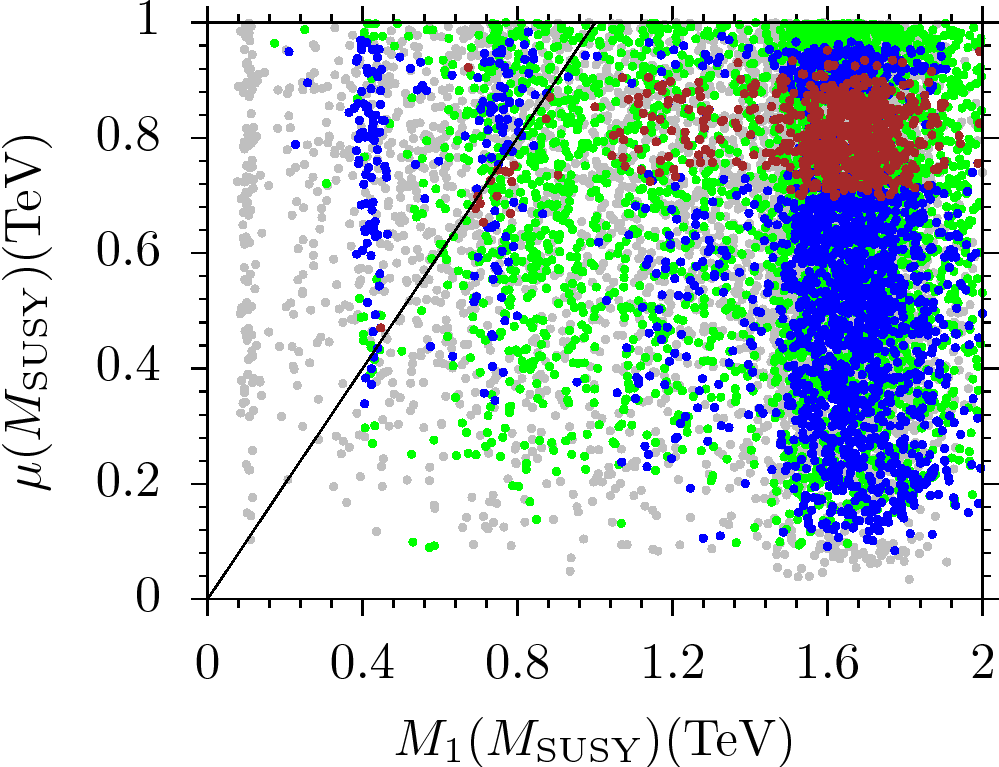 Figure 6
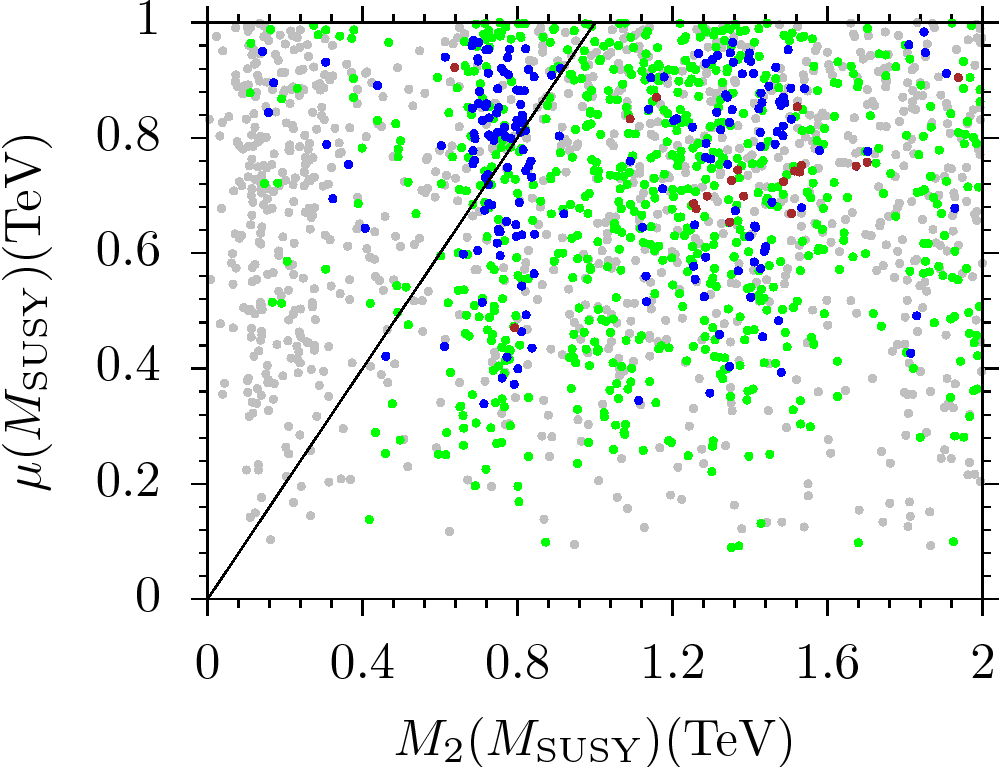 Figure 7
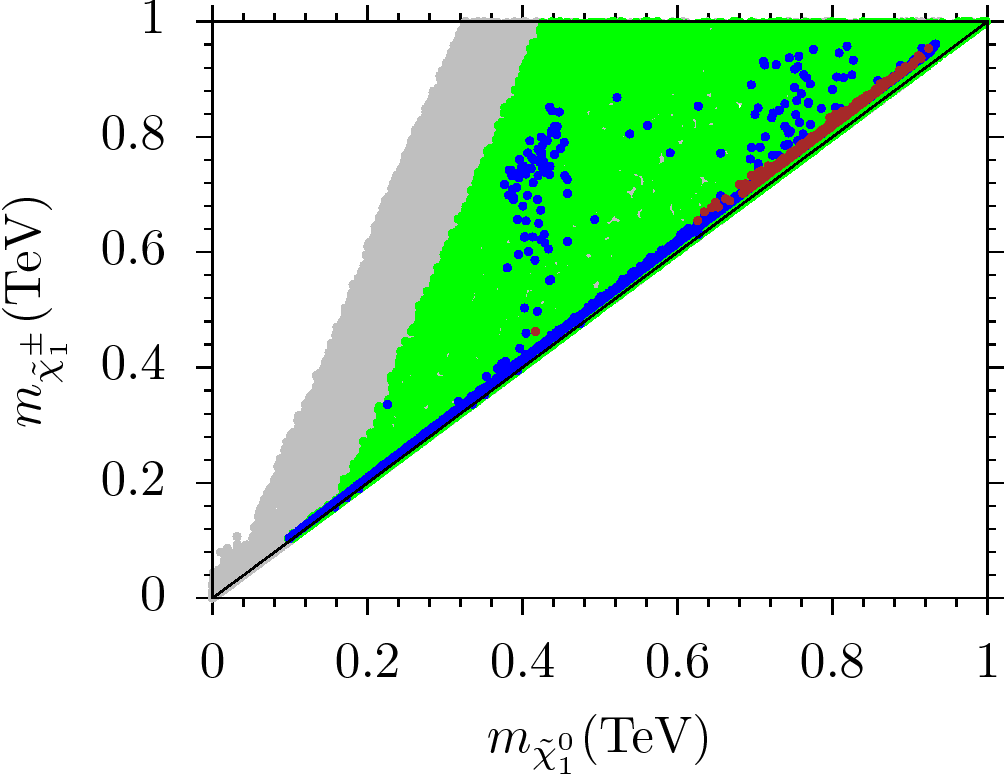 Figure 8
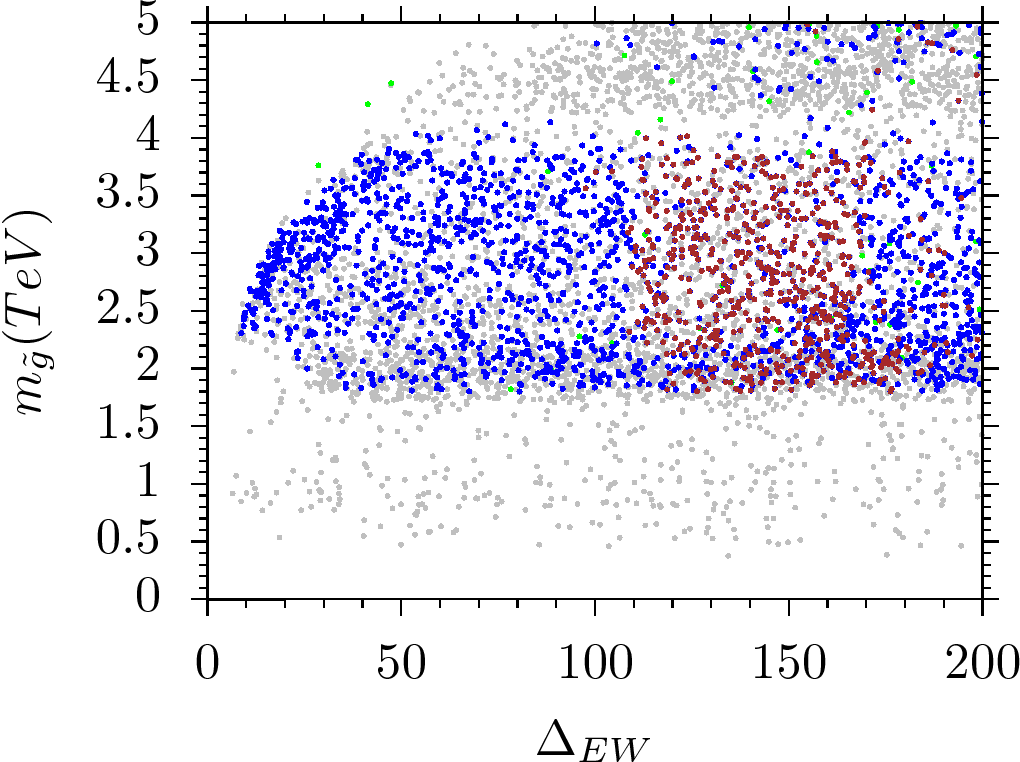 Figure 9
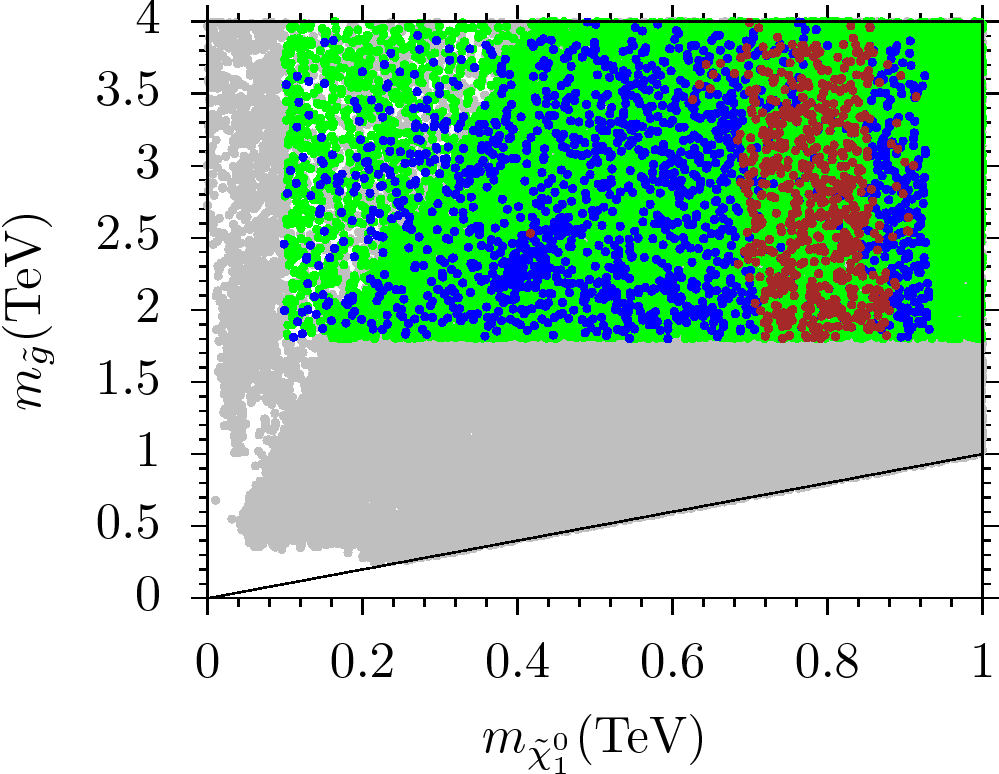 Figure 10
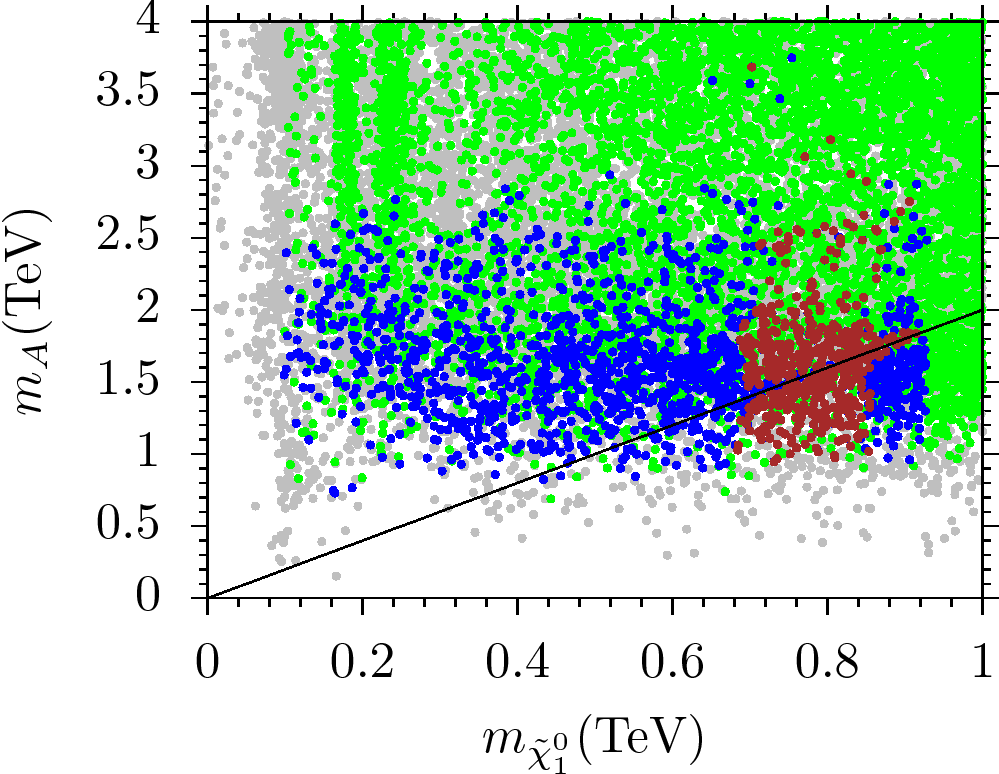 Figure 11
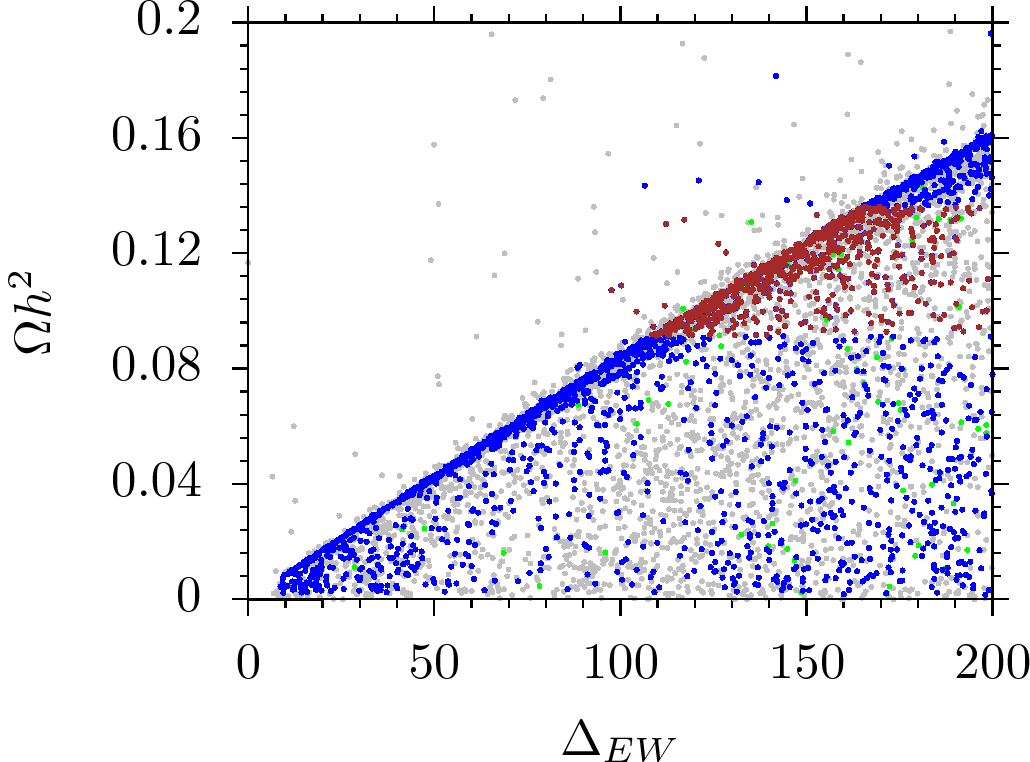 Figure 12
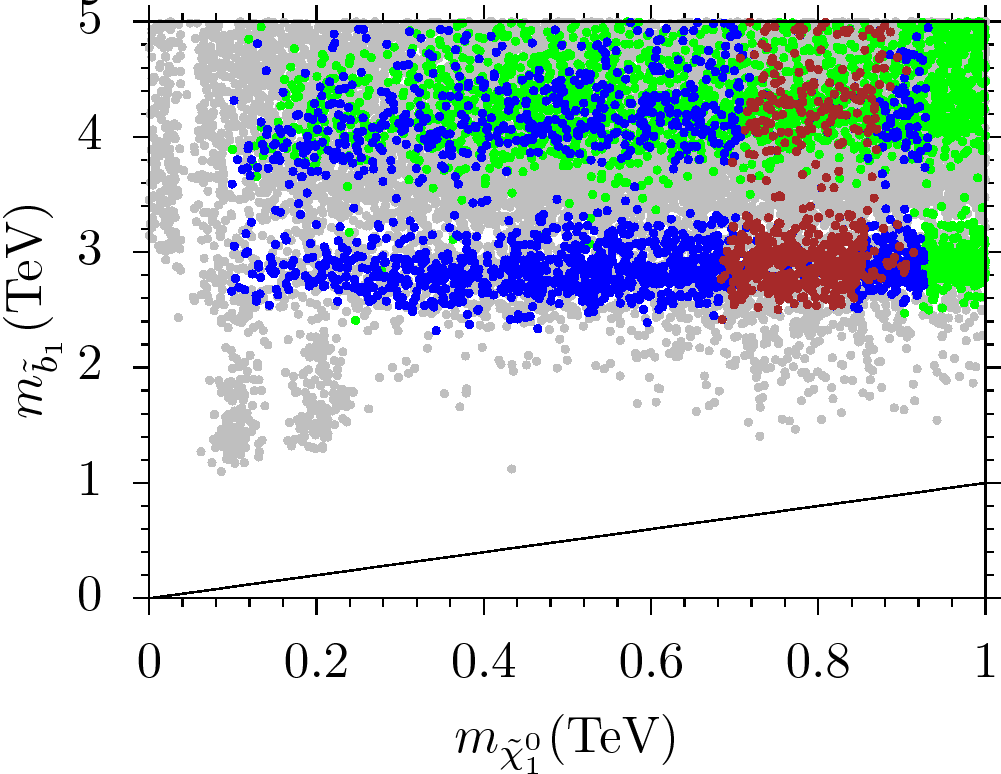 Figure 13
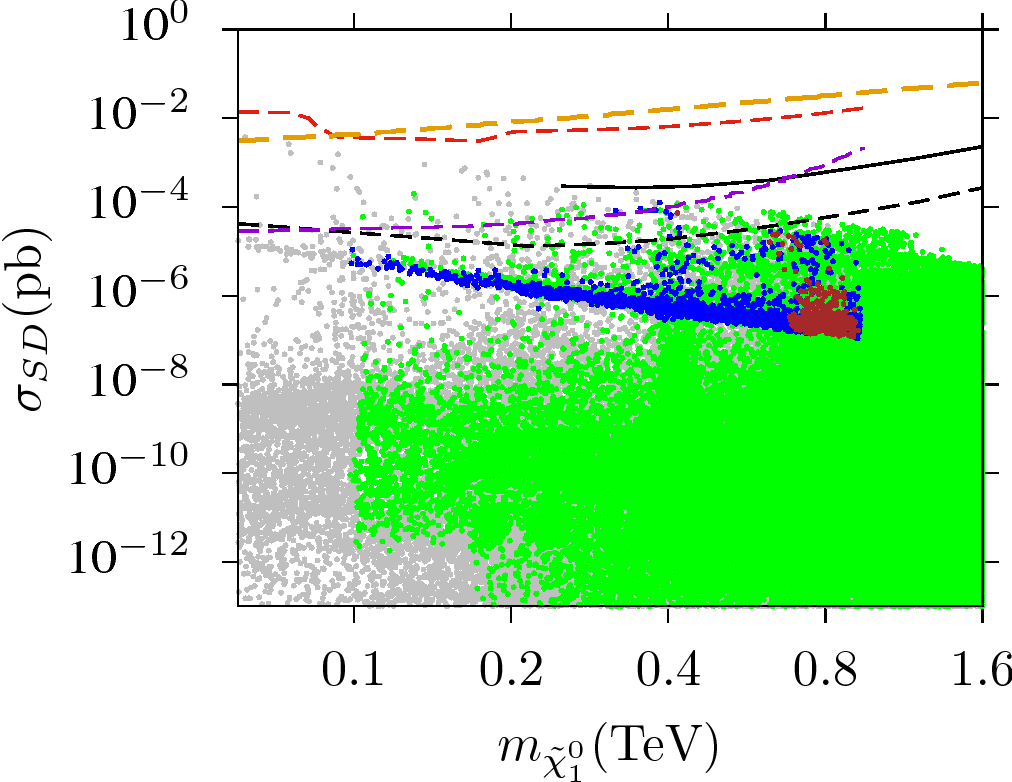 Figure 14
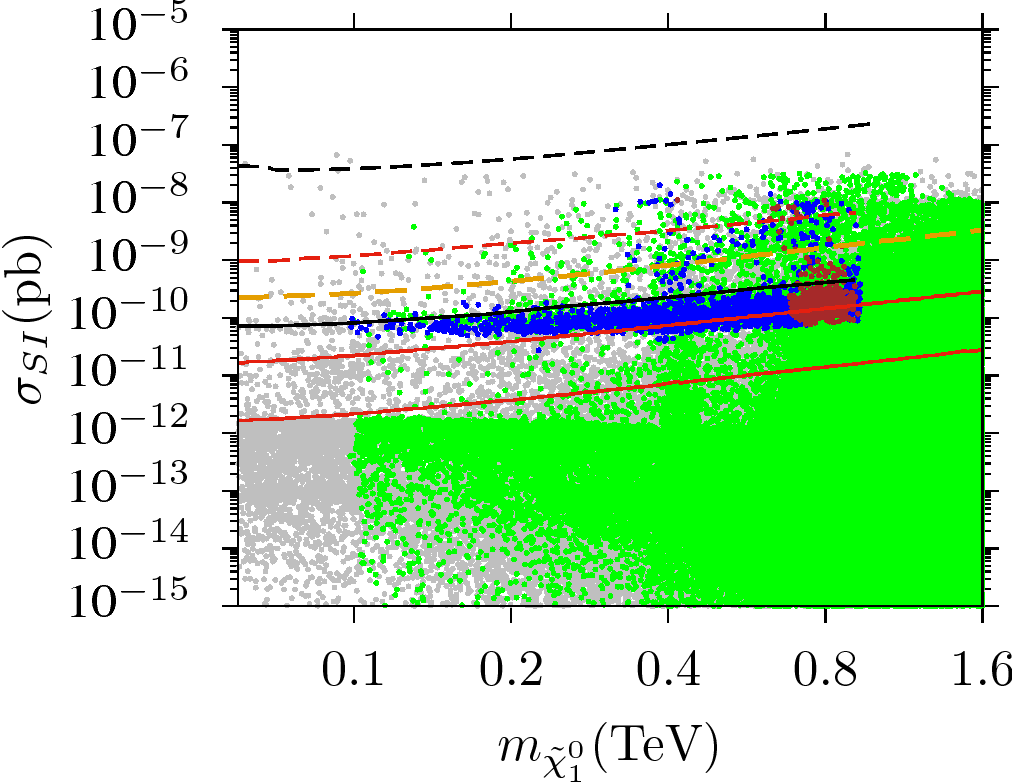 Figure 15
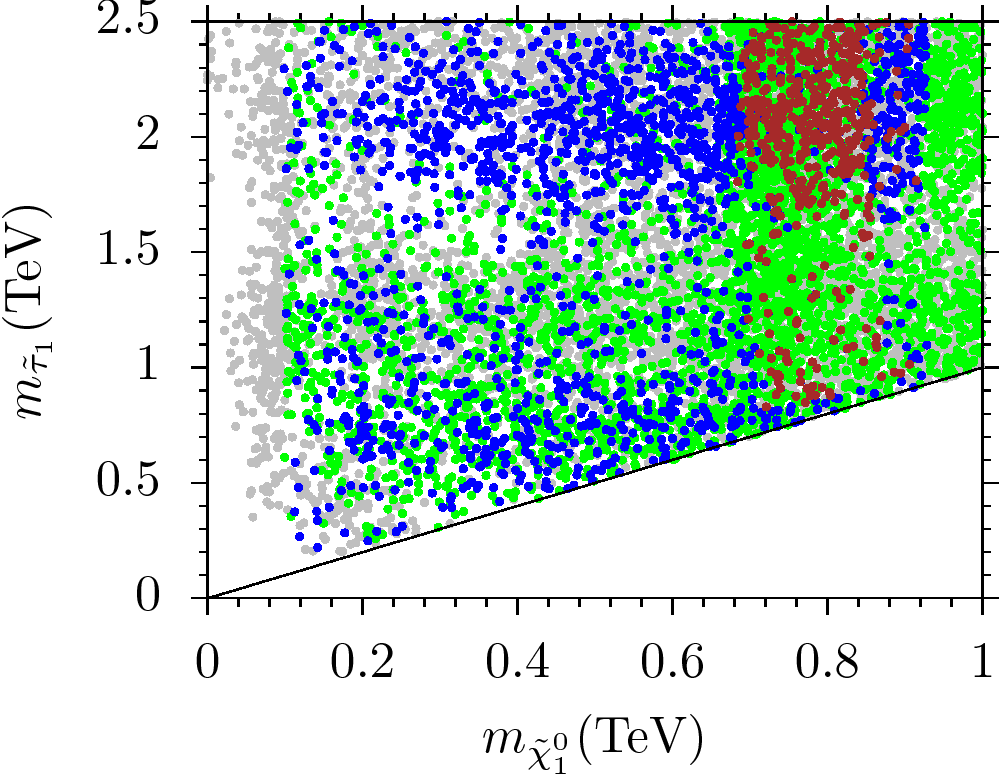 Figure 16
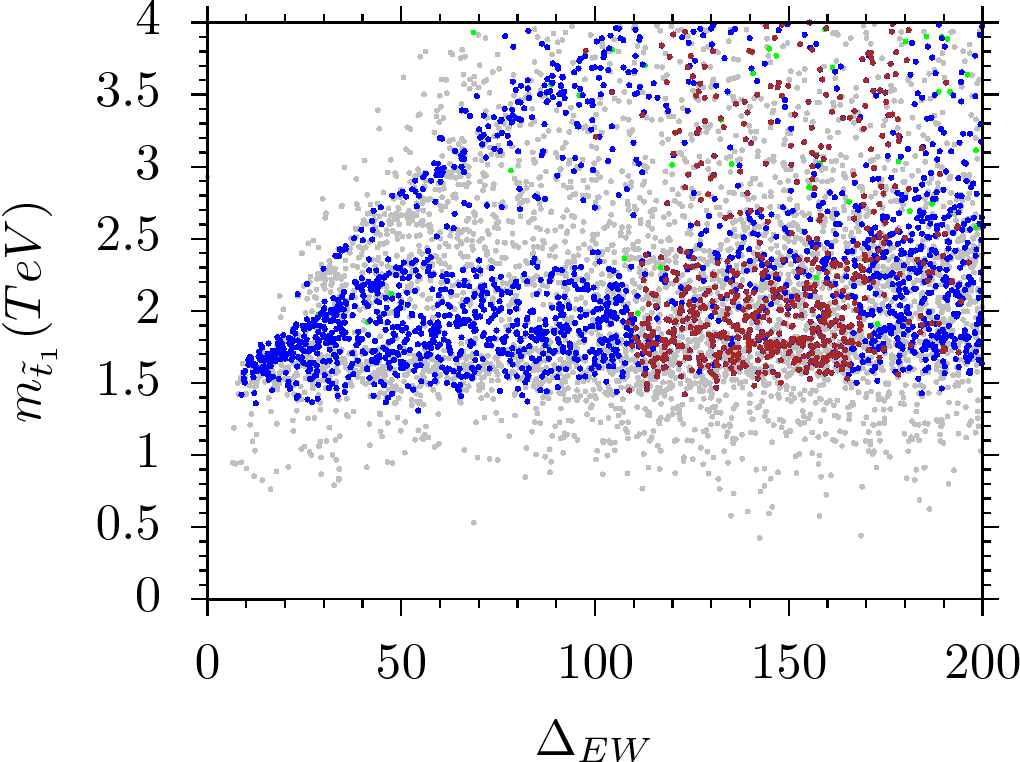 Figure 17
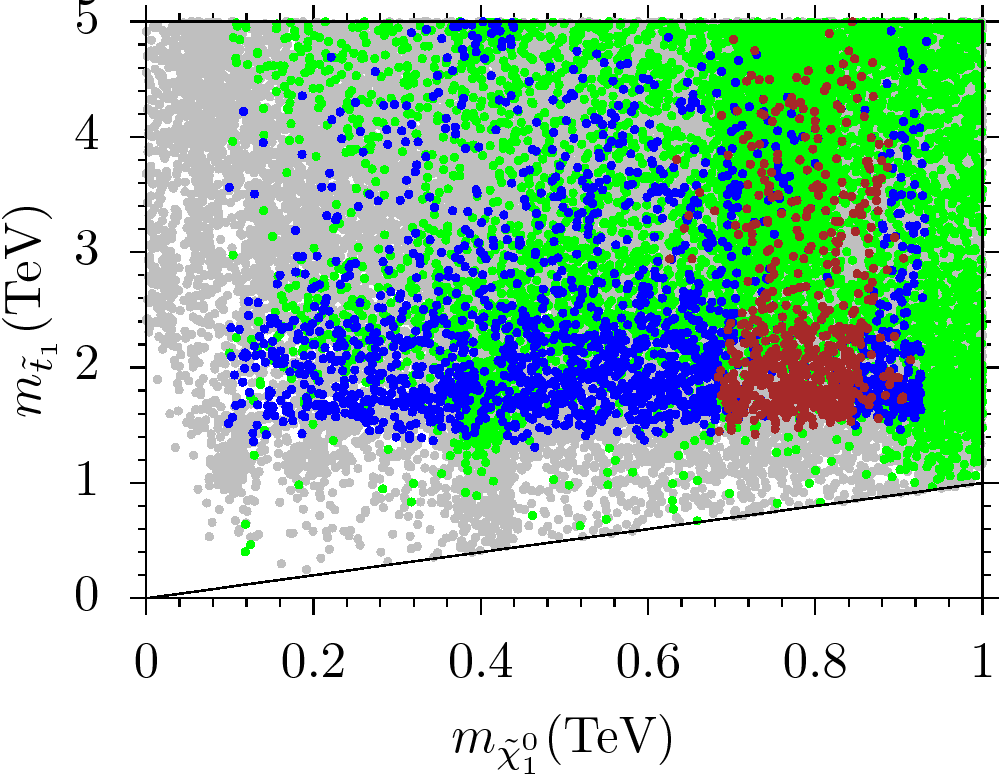 Figure 18
| Point 1 | Point 2 | Point 3 | Point 4 | Point 5 | |
| 3074 | 2375 | 2057 | 2745 | 2133 | |
| 3941 | 3607 | 3350 | 3557 | 3387 | |
| 5845 | 5009 | 4536 | 5069 | 4545 | |
| 1084 | 1504 | 1571 | 1289 | 1654 | |
| 615 | 725 | 800 | 609 | 752 | |
| 1759 | 2025 | 2054 | 2152 | 2121 | |
| 44.7 | 42.9 | 40.5 | 44.3 | 42.3 | |
| -0.57 | -0.62 | -0.66 | -0.72 | -0.65 | |
| 212.3 | 333.9 | 472 | 699 | 786 | |
| 9.8 | 27.4 | 48.8 | 109.6 | 137.5 | |
| 123.2 | 123.5 | 123.3 | 123.6 | 123.4 | |
| 1895 | 1586 | 1639 | 1244 | 1447 | |
| 1883 | 1576 | 1629 | 1236 | 1437 | |
| 1897 | 1588 | 1642 | 1248 | 1450 | |
| 207.3, 209.4 | 326.8, 329.3 | 460.7, 463.6 | 688.1, 690.8 | 769.7, 772.9 | |
| 1792, 4856 | 1629, 4138 | 1509, 3739 | 1614, 4206 | 1529, 3749 | |
| 215.7, 4845 | 338.2, 4120 | 475.1, 3720 | 706.2, 4189 | 789.5, 3728 | |
| 2487 | 3291 | 3407 | 2884 | 3571 | |
| 5099, 3754 | 4719, 3713 | 4460, 3604 | 4740, 3706 | 4585, 3762 | |
| 1584, 4189 | 1939, 3910 | 2002, 3728 | 1760, 3845 | 2171, 3823 | |
| 5100, 3646 | 4720, 3616 | 4460, 3513 | 4740, 3606 | 4585, 3672 | |
| 2788, 4231 | 2901, 3936 | 2923, 3748 | 2795, 3871 | 3031, 3838 | |
| 4843 | 4005 | 3579 | 4262 | 3627 | |
| 4582 | 3798 | 3407 | 4008 | 3432 | |
| 4838, 3373 | 4002, 2684 | 3578, 2357 | 4258, 3002 | 3626, 2427 | |
| 2447, 4560 | 1941, 3784 | 1744, 3397 | 2131, 3992 | 1742, 3423 | |
| 0.008 | 0.02 | 0.041 | 0.0914 | 0.113 | |
| 0.55, 0.30, 0.41 | 0.54, 0.30, 0.39 | 0.54, 0.28, 0.36 | 0.55, 0.32, 0.42 | 0.54, 0.30, 0.39 | |
| 0.08 | 0.07 | 0.07 | 0.08 | 0.08 |
Peer Reviews
No public reviews on file for this paper yet. If you reviewed it on a platform where reviews are public (OpenReview, ICLR, NeurIPS, ICML), you can paste yours below so the community can read it here.
Videos
No videos yet. Explain this paper in a talk, walkthrough, or lecture? Add one.
**Light Higgsinos, Heavy Gluino and Quasi-Yukawa Unification:
Will the LHC find the Gluino?
** **Aditya Hebbar*a,*111E-mail: [email protected], Qaisar Shafi a,222E-mail: [email protected] and Cem Salih n333E-mail: [email protected]
*a**Bartol Research Institute, Department of Physics and Astronomy,
University of Delaware, Newark, DE 19716, USA
bDepartment of Physics, Uludag̃ University, TR16059 Bursa, Turkey *
A wide variety of unified models predict asymptotic relations at between the b quark and lepton Yukawa couplings. Within the framework of supersymmetric SU(4) SU(2) SU(2)R, we explore regions of the parameter space that are compatible with b- quasi-Yukawa unification and the higgsinos being the lightest supersymmetric particles ( 1 TeV). Among the colored sparticles, the stop weighs more than 1.5 TeV or so, whereas the squarks of the first two families are signifcantly heavier, approaching 10 TeV in some cases. The gluino mass is estimated to lie in the 2-4 TeV range which raises the important question: Will the LHC find the gluino?
1 Introduction
Low scale supersymmetry (SUSY) remains an attractive extension of the Standard Model despite the apparent absence thus far of any direct experimental signature for its existence, or any new physics for that matter, at the LHC [1]. A supersymmetric scenario consisting of relatively light ( 1 TeV higgsinos) has attracted some attention in recent years [2, 3] . It has been emphasized that this domain of supersymmetry may be more readily accessible at the much discussed ILC rather than at the LHC. The parameter space in this case has been referred to as ‘natural’ SUSY [3], where the Minimally Supersymmetric Standard Model (MSSM) parameter and related parameters associated with radiative electroweak symmetry breaking (REWSB) are restricted to be comparable in magnitude to the Z-boson mass.
Our motivation in this paper is to realize a supersymmetric scenario with light higgsinos within the framework of unified models that also displays approximate third family Yukawa coupling unification (YU). Well-known examples include approximate t-b- Yukawa unification [4, 5] in SO(10)[6] and SU(4) SU(2)L SU(2)R (4-2-2)[7], and b- Yukawa unification which can occur in SO(10), 4-2-2 and SU(5) models. t-b- YU requires that the two MSSM Higgs doublets (Hd and Hu) reside in the 10 - plet of SO(10). However, to incorporate fermion masses and mixings, it is necessary to extend the Higgs sector by introducing additional Higgs fields in the (15,1,3) and/or the (15,1,1) representations of 4-2-2. This breaks exact Yukawa unification, but the deviation from Yukawa unification can be restricted to within 20%, and such a modified scheme is often referred to as Quasi-Yukawa Unification (QYU)[8, 9]. If Higgs fields from the above two (and possibly other) representations are present, then the top quark Yukawa coupling, in particular, may receive large corrections and therefore no longer unify with the b- Yukawa couplings. This particular scenario, called b- QYU, will be the focus of our study in this work. Note that TeV scale supersymmetry plays a critical role via radiative corrections [10] in implementing approximate Yukawa unification at MGUT. This may be considered additional evidence in support of supersymmetric Grand Unified Theories (GUTs) versus their non-supersymmetric counterparts which do not possess such threshold corrections.
The supersymmetric 4-2-2 with left-right symmetry naturally allows for non-universality in the MSSM gaugino sector. Thus, we can write
[TABLE]
which is implied by LR symmetry and hypercharge composition:
[TABLE]
where , and are the asymptotic soft supersymmetric breaking (SSB) gaugino masses for , and . For the scalar sector we work with the so-called Non-Universal Higgs Model 2 (NUMH 2) structure in which the soft scalar masses associated with the sfermions and the two MSSM Higgs doublets are treated as independent parameters.
In order to explore the parameter space compatible with quasi b- QYU and light higgsino, we employ the the fine-tuning parameter defined in [3]
[TABLE]
where , and , along with analogous definitions for and . We further constrain the parameter space by requiring that 200. Note that this condition is compatible with the light higgsino condition TeV.
If the neutralino is required to be the lightest supersymmetric particle (LSP), then the range of we have considered here will result in mostly higgsino-like LSP. For smaller values of , say of order 25-50, a second dark matter component, such as an axion, is needed to satisfy the dark matter abundance reported by WMAP [11]. Values close to the upper limit (where 1 TeV) yield solutions in which the higgsino alone satisfies the observed dark matter relic abundance in the universe.
In our discussion, following previous work [9], we express QYU as follows:
[TABLE]
where measures deviation in , while measures the deviation of and . The factor of 3 in Eq.(4) has its origin in the Clebsch-Gordon coefficient associated with the 15-dimensional SU(4)C representation [8, 12]. Note that does not have to be related to . For definiteness, we restrict 0.2 and 2.
The rest of the paper is organized as follows: In Section 2 we describe our scanning procedure and summarize the experimental constraints employed in our analysis. In section 3 we discuss the regions in the fundamental parameter space which are compatible with QYU and the light higgsino conditions. In Section 4 we present the sparticle mass spectrum and its implications for fine-tuning and DM. Section 5 focuses on the implications for dark matter (DM) based on current results from direct detection experiments. Our conclusions are summarized in 6.
2 Scanning Procedure and Experimental Constraints
We employ the ISAJET 7.84 package [13] to perform random scans over the parameter space given below. In this package, the weak scale values of gauge and third generation Yukawa couplings are evolved to via the MSSM renormalization group equations (RGEs) in the regularization scheme. We do not strictly enforce the unification condition at , since a few percent deviation from unification can be assigned to unknown GUT-scale threshold corrections [14]. With the boundary conditions given at , all the SSB parameters, along with the gauge and Yukawa couplings, are evolved back to the weak scale .
In evaluating Yukawa couplings, the SUSY threshold corrections [15] are taken into account at the common scale . The entire parameter set is iteratively run between and using the full 2-loop RGEs until a stable solution is obtained. To better account for leading-log corrections, one-loop step-beta functions are adopted for gauge and Yukawa couplings, and the SSB parameters are extracted from RGEs at appropriate scales . The RGE-improved 1-loop effective potential is minimized at an optimized scale , which effectively accounts for the leading 2-loop corrections. Full 1-loop radiative corrections are incorporated for all sparticle masses.
The requirement of radiative electroweak symmetry breaking (REWSB) [16] puts an important theoretical constraint on the parameter space. Another important constraint comes from limits on the cosmological abundance of stable charged particles [17]. This excludes regions in the parameter space where charged SUSY particles, such as or , become the LSP.
We have performed random scans for the following parameter space:
[TABLE]
with and [18]. Note that our results are not too sensitive to one or two sigma variation in the value of [10]. We use GeV which is hard-coded into ISAJET.
In scanning the parameter space, we employ the Metropolis-Hastings algorithm as described in [19]. The data points collected all satisfy the requirement of REWSB, with the neutralino being the LSP in each case. After collecting the data, we impose the mass bounds on all the particles [17] and use the IsaTools package to implement the following phenomenological constraints [20, 21, 22]:
[TABLE]
We emphasize the mass bounds on the Higgs boson [23, 24], and the gluino [25], since the experiments at the Large Hadron Collider (LHC) have had a strong impact on the bounds on these particles. The rare meson decays have a strong impact on the parameter space, since the SM predictions are already in good agreement with the experimental results. We have applied the constraints from [26] and [27] within uncertainty, while the MSSM predictions on are limited to within uncertainty [28].
Another strict constraint comes from the DM observables. Since the LSP is proposed as a candidate for DM, the regions in the fundamental parameter space which yield charged sparticles as LSP are excluded. Thus, we accept only those solutions for which one of the neutralinos is the lightest supersymmetric particle (LSP) without necessarily saturating the dark matter relic abundance bound observed by WMAP9. This is due to the fact that we are primarily motivated by ‘natural’ SUSY which we interpret to mean MSSM parameter 1 TeV. The LSP higgsino in this case does not necessarily saturate the DM abundance. The impact of direct detection on the parameter space is discussed in Section 5.
Finally, as far as the muon anomalous magnetic moment is concerned, we require that the solutions must be at least as consistent with the data as the Standard Model ( [29]).
3 Parameter Space compatible with Quasi-Yukawa Unification
In this section we present the fundamental parameter space of QYU and discuss its impact on the low scale. Figure 1 displays vs. the fundamental parameters with plots in , , and planes. All points are compatible with REWSB and neutralino LSP. Green points satisfy all experimental constraints. Blue points form a subset which is compatible with 1 TeV and . Brown points are a subset of blue and represent solutions consistent with the WMAP bound on the relic abundance of the LSP neutralino. We do not apply , but instead indicate this bound with a horizontal line. As seen from the , and plots, most of the solutions are below the horizontal line at = 0.2 and hence, QYU is not a strong constraint on these parameters. The plots show that while cannot be lower than about 2 TeV or heavier than 10 TeV, and can be as low as about 800 GeV. However, we note that all the solutions with have TeV and TeV. The plot shows that the fine-tuning condition requires .
We continue discussing the fundamental parameters in Figure 2 with plots in , planes, which represent the low scale values of these parameters. The color coding is the same as Figure 1, except that the blue points now satisfy in addition to TeV and . These parameters simply show the masses of neutralinos at the low scale, since and are the SSB mass terms for bino and wino respectively, while determines masses of the higgsinos. Except for a few points near the line in the two plots which indicate a higgsino-bino or higgsino-wino mixture dark matter, we see that for much of the parameter space, the dark matter is composed mainly of higgsinos.
We next discuss fine-tuning through the and the plots in Figure 3. The color coding is the same as Figure 2. If dark matter is to be solely composed of Higgsinos, then the WMAP bound imposes a lower bound of 100 on , as seen from the plot. However, if we allow for multi-component dark matter, then solutions with as low as about 10 can also be found.
4 Sparticle Mass Spectrum and Fine-Tuning
In this section, we discuss the mass spectrum compatible with the QYU. Figure 4 displays plots in the , , and planes. The color coding is the same as in Figure 2. The lines depict the regions where the sparticle and the LSP are nearly degenerate in mass. We see that the mass of the stop squarks is TeV, while the gluino mass is bounded below by the current LHC lower bound of TeV. The sbottom is heavier with mass 2.5 TeV. We also show a plot of vs , from which we note that there exist solutions with NNLSP stau of mass as low as 200-250 GeV.
We display plots between the lightest two colored supersymmetric particles, the stop and the gluino, and the fine-tuning parameter . The color coding is the same as in Figure 2. We note that it is possible to have a gluino with mass 2-4 TeV for as low as 30 or so [31]. We further observe that the stop mass can be as low as 1.5 TeV for the entire range of that we consider. In order to be consistent with the measured mass of the Higgs boson at the LHC, we require either a heavy stop, or large SSB trilinear scalar coupling or a suitable combination of the two. Large SSB trilinear scalar coupling, however, leads to higher fine-tuning [32].
5 Higgsino Dark Matter and Direct Detection
This section discusses the DM implications of QYU in the light of current and expected future results from the direct detection experiments. Figure 6 shows the results with plots in the and planes. The color coding is the same as in Figure 2. In the plane, the dashed (solid) black line represents the current (future) results from the SuperCDMS experiment [33], and dashed (solid) red line(s) shows the current (future) results from the Xenon experiment [34]. The brown solid line is the latest result from the LUX experiment [35]. In the plane, the current upper bounds are set by Super-K [36] (red dashed line) and the IceCube DeepCore indicated by black dashed (solid) line for its current(future) results. In addition, the purple dashed line is the limit set by the CMS analyses [37], while the brown dashed line represents the latest result from the LUX experiment[38].
As can be seen from the plane, the DM scattering rate on nuclei yields relatively large cross-sections ( pb). These solutions involve higgsino-like DM, and the large cross-section comes from the Yukawa interactions between the higgsinos and quarks in nuclei. Although some of these solutions are excluded by the current results from the LUX experiment, they will be further tested by the SuperCDMS experiment. The penultimate solid red line represents the future results from Xenon 1T, which according to present plans, will be reached in 2017. The last solid red line is the projected result from the Xenon experiment over the next 20 years. The spin-dependent scattering results are shown in the plane, and all solutions are allowed by the current and future reaches of the experiments.
Finally, we present a table of six benchmark points, which exemplify our findings. The points chosen are consistent with the experimental constraints in 2. The lowest value of that we found was 9.6 , with a LSP mass of 207 GeV, displayed in Point 1. Note that since the relic LSP density is about 10 % of the desired DM abundance, we posit that an additional DM component such as axion is also present. Points 2, 3 and 4 have progressively heavier LSPs which form a larger component of DM, but they require higher fine-tuning as measured by . Point 4 with an LSP mass of 688 GeV is the lightest higgsino DM compatible with the WMAP bound and we do not need any other dark matter component in this case. This point also corresponds to the lowest value of compatible with the WMAP bound for higgsino DM. Point 5 displays a pure higgsino DM solution with the central value of relic density ( = 0.113).
6 Conclusion
We have explored how light ( 1 TeV) higgsinos can arise in supersymmetric SU(4) SU(2) SU(2)R models which exhibit quasi b- Yukawa unification. We also require that the electroweak fine tuning measure 200. In the colored sector the stop mass is greater than 1.5 TeV or so. The first two family squarks are considerably heavier approaching 10 TeV in some cases. The gluino mass is estimated to lie in the 2-4 TeV range, which poses the important question: Will the LHC find the gluino?
Acknowledgments This work is supported in part by the DOE Grant DE-SC0013880 (A.H. and Q.S.), and the Scientific and Technological Research Council of Turkey (TUBITAK) Grant no. MFAG-114F461 (C.S.Ü.). This work used the Extreme Science and Engineering Discovery Environment (XSEDE), which is supported by the National Science Foundation grant number OCI-1053575. Part of the numerical calculations reported in this paper were performed at the National Academic Network and Information Center (ULAKBIM) of TUBITAK, High Performance and Grid Computing Center (TRUBA Resources).
The reference list from the paper itself. Each links out to its DOI / PubMed record.
- 1[1] G. Aad et al. [ATLAS Collaboration], JINST 3 , S 08003 (2008). S. Chatrchyan et al. [CMS Collaboration], JINST 3 , S 08004 (2008).
- 2[2] M. Drees, M. M. Nojiri, D. P. Roy and Y. Yamada, Phys. Rev. D 56 , 276 (1997) Erratum: [Phys. Rev. D 64 , 039901 (2001)], hep-ph/9701219; K. Kowalska, L. Roszkowski, E. M. Sessolo and S. Trojanowski, JHEP 1404 , 166 (2014) ar Xiv:1402.1328 [hep-ph]; A. Mustafayev and X. Tata, Indian J. Phys. 88 , 991 (2014) ar Xiv:1404.1386 [hep-ph].
- 3[3] H. Baer, V. Barger, P. Huang, A. Mustafayev and X. Tata, Phys. Rev. Lett. 109 , 161802 (2012) ar Xiv:1207.3343 [hep-ph]; H. Baer, V. Barger, P. Huang, D. Mickelson, A. Mustafayev and X. Tata, Phys. Rev. D 87 , no. 3, 035017 (2013) ar Xiv:1210.3019 [hep-ph]; H. Baer, V. Barger, P. Huang, D. Mickelson, A. Mustafayev and X. Tata, Phys. Rev. D 87 , no. 11, 115028 (2013) ar Xiv:1212.2655 [hep-ph].
- 4[4] B. Ananthanarayan, G. Lazarides and Q. Shafi, Phys. Rev. D 44 , 1613 (1991; Phys. Lett. B 300 , 24 (1993)5; Q. Shafi and B. Ananthanarayan, Trieste HEP Cosmol.1991:233-244;
- 5[5] L. J. Hall, R. Rattazzi and U. Sarid, Phys. Rev. D 50 , 7048 (1994); B. Ananthanarayan, Q. Shafi and X. Wang, Phys. Rev. D 50 , 5980 (1994); R. Rattazzi and U. Sarid, Phys. Rev. D 53 , 1553 (1996); T. Blazek, M. Carena, S. Raby and C. Wagner, Phys. Rev. D 56 , 6919 (1997); J. L. Chkareuli and I. G. Gogoladze, Phys. Rev. D 58 , 055011 (1998); T. Blazek, S. Raby and K. Tobe, Phys. Rev. D 62 , 055001 (2000); H. Baer, M. Brhlik, M. Diaz, J. Ferrandis, P. Mercadante, P. Quintana and X.
- 6[6] H. Georgi. 1974. in Proceedings of the American Institue of Physics, C. Carlson (eds.). H. Fritzsch and P. Minkowski, Annals Phys. 93 , 193 (1975). doi:10.1016/0003-4916(75)90211-0
- 7[7] J. C. Pati and A. Salam, Phys. Rev. D 10 , 275 (1974).
- 8[8] M. E. Gomez, G. Lazarides and C. Pallis, Nucl. Phys. B 638 , 165 (2002) [hep-ph/0203131].