Radiation Pressure on a Two-Level Atom: an Exact Analytical Approach
L. Podlecki, R. Glover, J. Martin, T. Bastin

TL;DR
This paper derives an exact analytical expression for the mean force exerted by light on a two-level atom under multiple laser fields, enabling precise control in cold atom experiments.
Contribution
It introduces a novel analytical method to compute the mean force on a two-level atom exposed to arbitrary laser configurations, surpassing previous numerical approaches.
Findings
Provides a simple analytical expression for the mean force.
Applicable to multiple lasers with arbitrary parameters.
Facilitates precise engineering of light-atom interactions.
Abstract
The mechanical action of light on atoms is nowadays a tool used ubiquitously in cold atom physics. In the semiclassical regime where the atomic motion is treated classically, the computation of the mean force acting on a two-level atom requires in the most general case numerical approaches. Here we show that this problem can be tackled in a pure analytical way. We provide an analytical yet simple expression of the mean force that holds in the most general case where the atom is simultaneously exposed to an arbitrary number of lasers with arbitrary intensities, wave vectors, and phases. This yields a novel tool for engineering the mechanical action of light on single atoms.
Click any figure to enlarge with its caption.
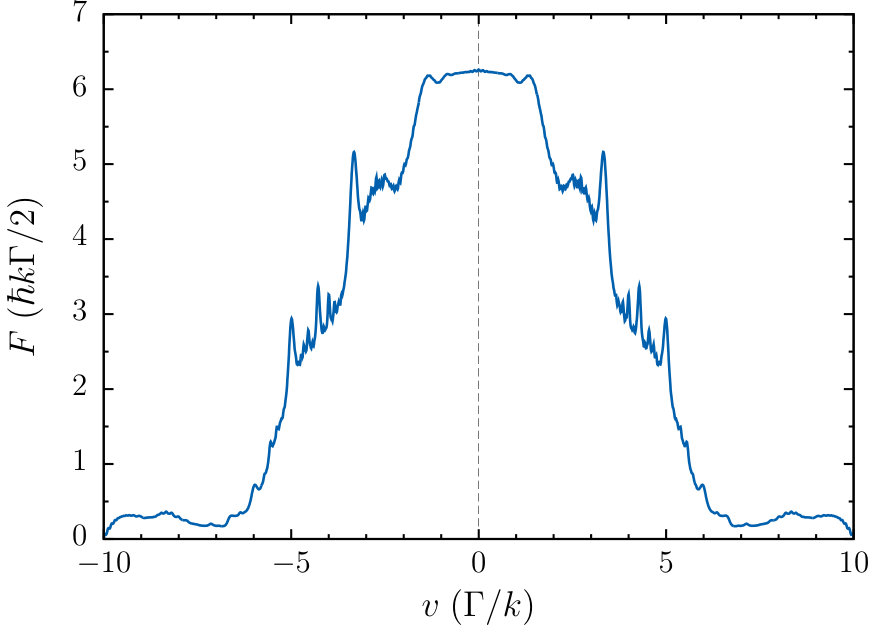 Figure 1
Peer Reviews
No public reviews on file for this paper yet. If you reviewed it on a platform where reviews are public (OpenReview, ICLR, NeurIPS, ICML), you can paste yours below so the community can read it here.
Videos
No videos yet. Explain this paper in a talk, walkthrough, or lecture? Add one.
Radiation Pressure on a Two-Level Atom: an Exact Analytical Approach
L. Podlecki
Institut de Physique Nucléaire, Atomique et de Spectroscopie,
CESAM, University of Liege, Bât. B15, Sart Tilman, Liège 4000, Belgium
R. Glover
Institut de Physique Nucléaire, Atomique et de Spectroscopie,
CESAM, University of Liege, Bât. B15, Sart Tilman, Liège 4000, Belgium
Centre for Quantum Dynamics, Griffith University, Nathan, QLD 4111, Australia
J. Martin
Institut de Physique Nucléaire, Atomique et de Spectroscopie,
CESAM, University of Liege, Bât. B15, Sart Tilman, Liège 4000, Belgium
T. Bastin
Institut de Physique Nucléaire, Atomique et de Spectroscopie,
CESAM, University of Liege, Bât. B15, Sart Tilman, Liège 4000, Belgium
(February 17, 2017)
Abstract
The mechanical action of light on atoms is nowadays a tool used ubiquitously in cold atom physics. In the semiclassical regime where the atomic motion is treated classically, the computation of the mean force acting on a two-level atom requires in the most general case numerical approaches. Here we show that this problem can be tackled in a pure analytical way. We provide an analytical yet simple expression of the mean force that holds in the most general case where the atom is simultaneously exposed to an arbitrary number of lasers with arbitrary intensities, wave vectors, and phases. This yields a novel tool for engineering the mechanical action of light on single atoms.
With the advent of lasers, the mechanical action of light has become an extraordinary tool for controlling the motion of atoms. The first evidence of this control with laser light was demonstrated in the early seventies with the deflection of an atomic beam by resonant laser radiation pressure Sch72 . One of the most remarkable achievements was made a decade later when the first cold atomic cloud in a magneto-optical trap was observed Chu86 . These initial experiments gave birth to the vast array of cold atom physics experiments with each more spectacular than the last. Regimes that were thought to forever remain in the realm of Gedankenexperiments became reality in labs, for example Bose-Einstein condensation And95 .
As long as the atomic motion can be treated classically, i.e., in regimes where the atomic wavepackets are sufficiently localized in space, the resonant laser radiation acts mechanically as a force on the atomic center-of-mass. In a standard two-level approximation and modeling the laser electromagnetic field as a plane wave, the mean force exerted by a single laser, averaged over its optical period, reaches shortly after establishment of the laser action a stationary regime where it takes the well-known simple expression Cook79
[TABLE]
Here, is the rate of spontaneous decay from the upper level of the transition, is the laser photon momentum, and is the saturation parameter, where is the Rabi frequency and is the detuning between the laser and the atomic transition angular frequencies, and , respectively. The maximal force the laser can exert on the atom is .
The question naturally arises of how Eq. (1) generalizes when several lasers of arbitrary intensities, wave vectors and phases are acting simultaneously on the atom. Surprisingly, to date no general exact analytical expression of the resulting force can be found in the scientific literature and one is often reduced to using numerical approaches Sod97 ; bichr ; numof . In the low intensity regime a generalized version of Eq. (1) provides an approximation of the incoherent action of each laser field. Each individual laser ( with the total number of lasers) is characterized by an individual detuning , a photon momentum , a Rabi frequency , and an individual saturation parameter . When all are much smaller than 1, the mean resulting force exerted incoherently by all lasers on the atom can be approximated by , where
[TABLE]
is the mean force exerted by each individual laser and Min87 . For larger values of , Eq. (2) loses validity as it is derived in a rate-equation approximation Min87 . It also neglects any coherent action of the lasers. Coherence effects can lead to huge forces that vastly exceed the maximal value of per laser, as is observed with the stimulated bichromatic force Sod97 . An exact expression of the force including coherent effects and that holds at high intensity can be found in the particular case of a pair of counterpropagating lasers of same intensity Min79 .
In this Letter, we solve analytically the most general case and provide an expression for the force exerted by an arbitrary number of lasers with arbitrary intensities, phases, detunings and directions acting on the same individual two-level atom. We show that the force can still be written in strict generality in the form of Eq. (2), even including coherent effects, provided a generalized definition of the saturation parameter is given. We thus provide a unified formalism that holds in any configuration of lasers and enables the engineering of the mechanical action of light on individual atoms.
To this end, we consider a two-level atom with levels and of energy and , respectively (). We denote the atomic transition angular frequency by . The atom interacts with a classical electromagnetic field resulting from the superposition of arbitrary plane waves: , with Here, , and are the angular frequency, the wave vector and the phase of the -th plane wave, respectively, and , with and the normalized polarisation vector of the corresponding wave. The quasi-resonance condition is fulfilled for each plane wave: , where is the detuning. We define the weighted mean frequency and detuning of the plane waves by and , respectively, with a set of weighting factors ( and ) that can be taken a priori arbitrarily.
In the electric-dipole approximation and considering spontaneous emission in the master equation approach Aga74 , the atomic density operator obeys
[TABLE]
with and , where is the atomic electric dipole operator, is the atom position in the electric field, is the spontaneous deexcitation rate of the excited state , and and are the atomic lowering and raising operators, respectively.
The hermiticity and the unit trace of the density operator make all four matrix elements , , , and , with for dependent variables. We consider here the vector of real independent variables , with , , and , where . In the rotating wave approximation (RWA) the time evolution of resulting from Eq. (3) obeys
[TABLE]
with and
[TABLE]
where , with () the complex Rabi frequencies
[TABLE]
where , denotes the modulus of , and its phase. Without loss of generality, the global phases of the atomic states and can always be chosen so as to have one Rabi frequency real and positive. This is usually considered in all studies where a single plane wave interacts with the atom. However, with arbitrary plane waves, we cannot assume without loss of generality that all Rabi frequencies are real and their phases cannot be ignored.
Equation (4) constitutes the so-called Optical Bloch Equations (OBE’s) adapted to the present studied case. Here, because of the time dependence of , the solution cannot be expressed analytically and the equation must be integrated numerically. However, within an arbitrary accuracy, we can always assume that the frequency differences are commensurable, i.e., that all ratios , , are rational numbers. Within this assumption, and are periodic in time with a period , where , with LCM denoting the least common multiple conventionally taken as positive. It also follows that the numbers , hereafter denoted by , are integer, foot1 . In the particular case where all frequencies are identical, is constant in time, or equivalently periodic with an arbitrary value of , and all integer numbers vanish.
Within the commensurability assumption where is -periodic and given initial conditions , the OBE’s admit the unique solution (Floquet’s theorem, see, e.g., Ref. Adr95 )
[TABLE]
where is a logarithm of the OBE monodromy matrix divided by foot2 , is an invertible -periodic matrix equal to for , with the matriciant of the OBE’s foot2 , and is an arbitrary particular solution of the OBE’s. The real parts of the eigenvalues of the matrix , the so-called Floquet exponents, belong to the interval with and the minimal and maximal eigenvalues of the matrix , respectively Iak75 . Here, this matrix reads and the real parts of the Floquet exponents are thus necessarily comprised between and , hence strictly negative. This implies first that the matrix tends to zero with a characteristic time not shorter than and not longer than . At long times () . Second, the OBE’s are ensured to admit a unique -periodic solution Adr95 , that the particular solution can be set to. This certifies that at long times the solution of the OBE’s is necessarily periodic (periodic regime).
The unique -periodic solution of the OBE’s can be expressed using the Fourier expansion
[TABLE]
with the Fourier components of . Since is real, , and since it is continuous and differentiable, . Inserting Eq. (8) into the OBE’s yields an infinite system of equations connecting all , and components. The system can be rearranged so as to express all and as a function of the components. Proceeding in this way yields, ,
[TABLE]
with and
[TABLE]
Here, denotes the Kronecker symbol, is the set of all distinct nonzero integers (), (), with and , and , with
[TABLE]
We have , , , and .
If we define the vector of all components for ranging from to , , and the infinite matrix of elements ( ranging from to ), Eq. (10) yields the complex inhomogeneous infinite system of equations
[TABLE]
with the infinite identity matrix and the infinite vector of elements . is an infinite centrohermitian band-diagonal matrix with as many bands as the cardinality of . Its main diagonal is zero. Since the OBE’s admit a unique -periodic solution, the infinite system admits a unique solution with the property . In these conditions and observing that and that the series is absolutely convergent whatever the values of the Rabi frequencies , the detunings , and the deexcitation rate , the infinite system (12) can be solved via finite larger and larger truncations, whose solutions are ensured to converge in all cases to the unique sought solution Rie13 . This solution is necessarily such that , otherwise all other coefficients would solve an homogeneous system of equations and vanish, in which case the equation for could not be satisfied. This allows us to define the ratios , . In particular and the reality condition yields . We have (Cramer’s rule)
[TABLE]
with the determinant of the matrix truncated to the lines and columns and where the -indexed column is replaced by the vector correspondingly truncated. As here-above argued, the limit is ensured to exist in all cases foot3 . Inserting in Eq. (10) for allows for expressing in the form
[TABLE]
where , with newly defined parameters as
[TABLE]
According to Ehrenfest theorem, the mean power absorbed by the atom from the -th plane wave, , with the mean number of photons absorbed per unit of time by the atom from that wave, is given by . Similarly, the mean force exerted by the -th plane wave on the atom reads , with and the -th components () of and , respectively (see, e.g., Ref. Coh80 ). Of course each plane wave does not act independently of each other on the atom since the mean value of the atomic electric dipole moment is at any time determined by the atomic state , which in turn is fully determined by the simultaneous action of all plane waves through the OBE’s (4). The total mean power absorbed from all plane waves and the net force exerted on the atom are then given by and , respectively. In the RWA approximation where one neglects the fast oscillating terms, we immediately get and , with
[TABLE]
It also follows that . In the quasi-resonance condition where , , we can clearly consider .
Within the commensurability assumption, , . In the periodic regime, and are in addition -periodic and thus so are , and . In this regime the Fourier components of are easily obtained by inserting the Fourier expansion (8) into Eq. (16). By using further Eq. (9) and with as of Eq. (14), we get
[TABLE]
with , where
[TABLE]
In particular, the temporal mean value of in the periodic regime is given by the Fourier component and observing that is nothing but the parameter of Eq. (15), we get . The Fourier components of the force in the periodic regime are then given by foot4 and the mean force in this regime reads consequently
[TABLE]
in support of our introductory claim. Here nevertheless, in contrast to the saturation parameter of Eq. (2), the newly defined parameter in Eq. (15) can be negative depending on the different phases of with respect to . This accounts for two important physical effects. First, it can make negative, in which case the atom acts as a net mean photon emitter in the -th plane wave (stimulated emission) and the force exerted by that wave is directed oppositely to (the atom is pushed in the direction opposite to the direction of the incident photons). Second, the ratio can exceed and the force exerted by the individual laser can exceed the maximal spontaneous force , as is expected for coherent forces such as the stimulated bichromatic force Sod97 .
At low intensity, i.e., for , we have and , . It implies that the resolvent identifies to and the solution of the infinite system (12) is such that and , . Hence, for , and it follows that . If all plane waves have different frequencies, the sum over in Eq. (11) only contains the single term and thus
[TABLE]
If in contrast some plane waves have identical frequencies, coherent effects can be observed. However, if we are only interested in the incoherent action of the plane waves, an average over all phase differences must be performed. In the low intensity regime, the statistical delta method delMeth yields . Since the average is simply the of Eq. (20), we get again with as of Eq. (20). In all cases, the incoherent and low intensity limit of our newly defined parameter in Eq. (15) reduces to the standard expression (20) known to hold in this regime Min87 .
In the particular case where all plane waves have the same frequency, , and , . It follows that and is not time dependent, or equivalently is -periodic with an arbitrary value of . The periodic regime corresponds in this case to a stationary regime where , and are constant and determined by the zero component of their Fourier expansion. Since for any pairs of integers and , the parameters (15) simplify to . For , this reduces to the standard expression (20) of the saturation parameter. For 2 counterpropagating plane waves, the mean net resulting force acting on the atom reads . If both plane waves have identical intensity and polarization, the mean force reduces to the well known phase dependent dipole force in a stationary monochromatic wave , with , Cook79 .
Very generally, in a configuration with 2 plane waves of different frequencies, the required solution of the infinite system (12) can be obtained in a continued fraction approach (see also Ref. Min79 for the particular case of 2 waves of identical intensity and polarization in a counterpropagating configuration). For and , the commensurability assumption implies that , with and two positive coprime integers. It follows that , , , and , with . The infinite system (10) reads in this case, ,
[TABLE]
The system only couples together the Fourier components with (). All other components are totally decoupled from these former and thus vanish since they satisfy an homogeneous system. Hence, the only a priori non-vanishing ratios and Fourier components and are for these specific values of and the periodic regime is rather characterized by the period . For , Eq. (21) implies . Applying recursively this relation for yields r_{n_{s}}=-\mathcal{W}_{-n_{s},n_{s}}^{*}/[1+\operatornamewithlimits{\mathchoice{\vbox{\hbox{\huge\mathcal{K}}}}{\vbox{\hbox{\Large\mathcal{K}}}}{\mathrm{\mathcal{K}}}{\mathrm{\mathcal{K}}}}_{k=1}^{\infty}(p_{k}/1)], with and where \operatornamewithlimits{\mathchoice{\vbox{\hbox{\huge\mathcal{K}}}}{\vbox{\hbox{\Large\mathcal{K}}}}{\mathrm{\mathcal{K}}}{\mathrm{\mathcal{K}}}} stands for the continued fraction
[TABLE]
Dividing further Eq. (21) for () by yields the recurrence relation that allows for computing all remaining with , and hence along with all nonzero Fourier components and ().
Finally, we illustrate our formalism with the calculation of the stimulated bichromatic force in a standard four traveling wave configuration Sod97 . This subtle force is complex since it relies on both coherent and high intensity effects. Except for some rough approximations, it has so far only been modeled numerically bichr . We considered a detuning , a Rabi frequency amplitude of and a phase shift of for one of the waves. We show in Fig. 1 the amplitude of the resulting bichromatic force acting on a moving atom as a function of its velocity . As expected, the peak value of the bichromatic force is of the order of (in units of ) and spans a velocity range of the order of (in units of ) Cas03 . A direct numerical integration of the OBE’s completed with a numerical average of in Eq. (16) in the periodic regime produces identical results.
In conclusion, we have provided a unified and exact formalism to calculate the mechanical action of a set of arbitrary plane waves acting simultaneously on a single two-level atom. We have shown that the light forces can still be written in strict generality in the form of Eq. (2), including coherent and high intensity effects, provided the generalized definition (15) of the parameter is given. These results provide a novel tool for engineering the mechanical action of lasers on individual atoms.
T.B. acknowledges financial support of the Belgian FRS-FNRS through IISN grant 4.4512.08 and, with R.G., of the Interuniversity Attraction Poles Programme initiated by the Belgian Science Policy Office (BriX network P7/12). L.P. acknowledges an FNRS grant and the Belgian FRS-FNRS for financial support.
The reference list from the paper itself. Each links out to its DOI / PubMed record.
- 1(1) R. Schieder, H. Walther, and L. Wöste, Opt. Comm. 5 , 337 (1972); P. Jacquinot, S. Liberman, J. L. Picqué, and J. Pinard, Opt. Comm. 8 , 163 (1973).
- 2(2) S. Chu, J. E. Bjorkholm, A. Ashkin, and A. Cable, Phys. Rev. Lett. 57 , 314 (1986).
- 3(3) M. H. Anderson, J. R. Enshner, M. R. Mathews, C. E. Wieman, and E. A. Cornell, Science 269 , 198 (1995).
- 4(4) R. J. Cook, Phys. Rev. A 20 , 224 (1979).
- 5(5) J. Söding, R. Grimm, Yu. B. Ovchinnikov, Ph. Bouyer, and Ch. Salomon, Phys. Rev. Lett. 78 , 1420 (1997).
- 6(6) M. R. Williams, F. Chi, M. T. Cashen, and H. Metcalf, Phys. Rev. A 60 , R 1763 (1999); M. R. Williams, F. Chi, M. T. Cashen, and H. Metcalf, Phys. Rev. A 61 , 023408 (2000); S. E. Galica, L. Aldridge, and E. E. Eyler, Phys. Rev. A 88 , 043418 (2013); C. Corder, B. Arnold, X. Hua, and H. Metcalf, J. Opt. Soc. Am. B 32 , B 75 (2015); C. Corder, B. Arnold, and H. Metcalf, Phys. Rev. Lett. 114 , 043002 (2015); X. Hua, C. Corder, and H. Metcalf, Phys. Rev. A 93 , 063410 (2016).
- 7(7) D. Stack, J. Elgin, P. M. Anisimov, and H. Metcalf, Phys. Rev. A 84 , 013420 (2011).
- 8(8) V. G. Minogin and V. S. Letokhov, Laser Light Pressure on Atoms (Gordon & Breach, New York, 1987).