Exploring the Universe with Neutrinos: Recent Results from IceCube
Donglian Xu (for the IceCube Collaboration)

TL;DR
IceCube has confirmed a diffuse astrophysical neutrino flux above 60 TeV with high significance over 6 years, but no specific sources have been identified yet, and future detectors aim to enhance detection capabilities.
Contribution
This paper reviews IceCube's recent findings on astrophysical neutrinos, discusses the search for point sources, and outlines the design and potential of the upcoming IceCube-Gen2.
Findings
Confirmed diffuse astrophysical neutrino flux with >6σ significance
No significant neutrino point sources identified
Null result in tau neutrino search
Abstract
In 2013, the IceCube Neutrino Observatory located at the geographic South Pole detected evidence for a diffuse astrophysical neutrino flux above ~60 TeV. To this day, IceCube has operated with full detector configuration for more than 6 years. The observed astrophysical neutrino flux has been confirmed with > 6 significance with both events starting within the detector (all flavor) and events traversing through the Earth ( charged-current). Somewhat equal flavor ratio of astrophysical neutrinos is expected at Earth assuming standard thorough oscillation. A search for tau neutrinos has been carried out but yielded null result. No neutrino sources have been found to contribute significantly to the diffuse flux at this point. In this paper, we will review the current status of the astrophysical neutrino flux, discuss the quest for neutrino point sources and overview the…
Click any figure to enlarge with its caption.
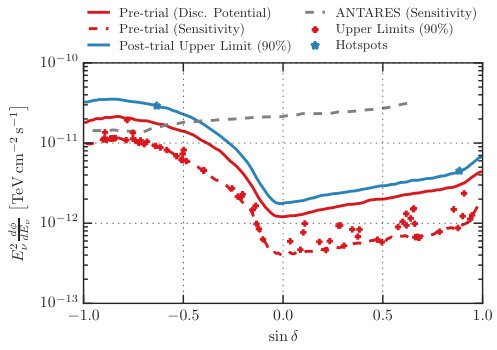 Figure 1
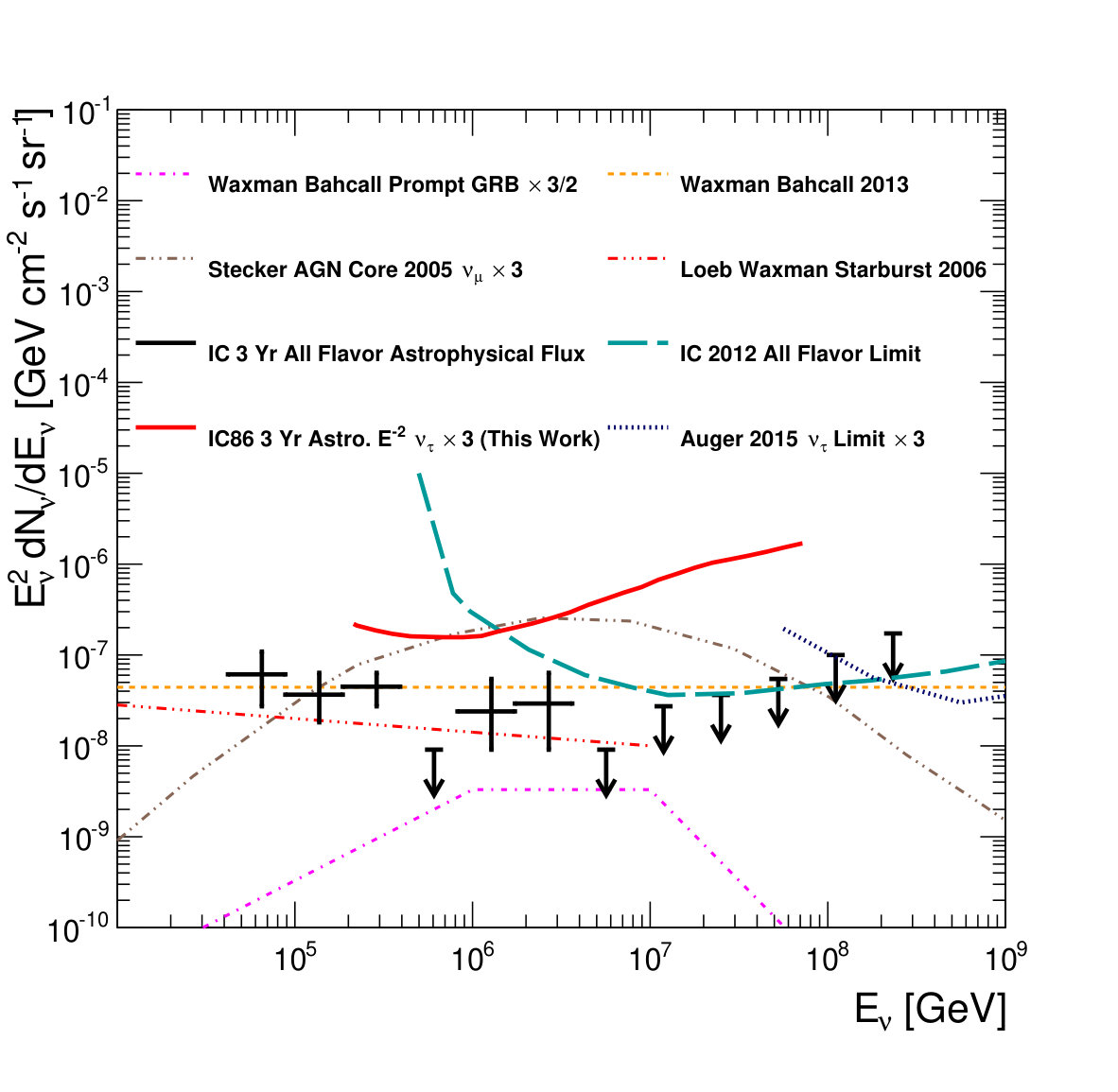 Figure 2
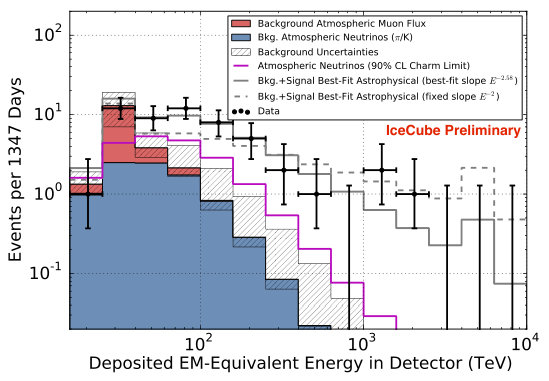 Figure 3
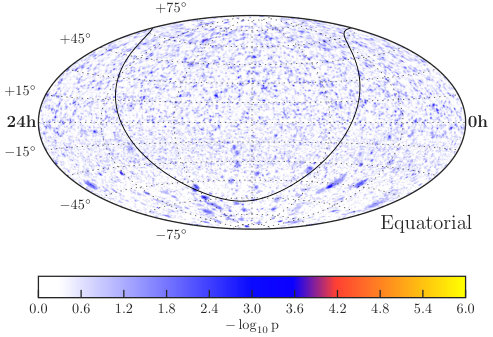 Figure 4
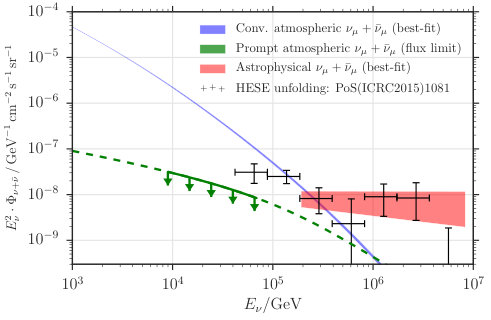 Figure 5
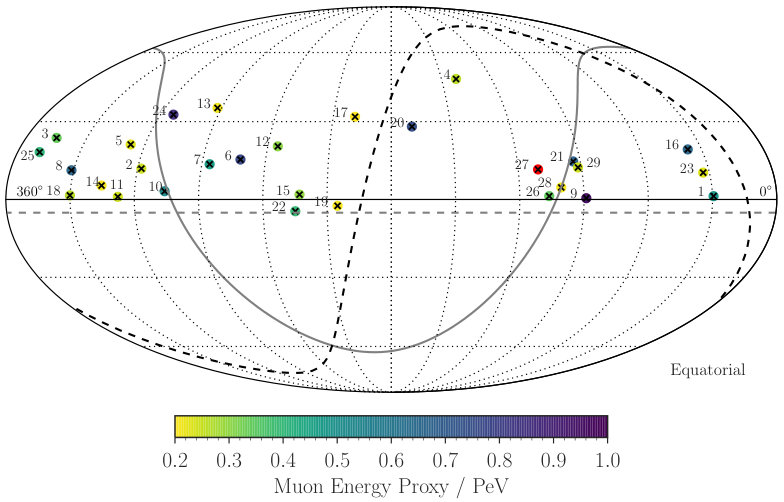 Figure 6
Peer Reviews
No public reviews on file for this paper yet. If you reviewed it on a platform where reviews are public (OpenReview, ICLR, NeurIPS, ICML), you can paste yours below so the community can read it here.
Videos
No videos yet. Explain this paper in a talk, walkthrough, or lecture? Add one.
Taxonomy
TopicsAstrophysics and Cosmic Phenomena · Neutrino Physics Research · Dark Matter and Cosmic Phenomena
Exploring the Universe with Neutrinos:
Recent Results from IceCube
Donglian Xu for the IceCube Collaboration111http://icecube.wisc.edu/
Wisconsin Particle Astrophysics Center, 222 West Washington Ave., Suite 500 Madison, WI 53703, USA
Department of Physics, University of Wisconsin-Madison, 1150 University Avenue Madison, WI 53706, USA
Abstract
In 2013, the IceCube Neutrino Observatory located at the geographic South Pole detected evidence for a diffuse astrophysical neutrino flux above 60 TeV. To this day, IceCube has operated with full detector configuration for more than 6 years. The observed astrophysical neutrino flux has been confirmed with significance with both events starting within the detector (all flavor) and events traversing through the Earth ( charged-current). Somewhat equal flavor ratio of astrophysical neutrinos is expected at Earth assuming standard thorough oscillation. A search for tau neutrinos has been carried out but yielded null result. No neutrino sources have been found to contribute significantly to the diffuse flux at this point. In this paper, we will review the current status of the astrophysical neutrino flux, discuss the quest for neutrino point sources and overview the proposed design and physics potentials of the future IceCube-Gen2.
keywords:
IceCube, astrophysical neutrinos, neutrino astronomy
1 Cosmic Rays, Cosmic Neutrinos and IceCube
Charged particles from space known as cosmic rays are constantly bombarding the Earth’s atmosphere, fragmenting air nuclei and producing copious hadrons which subsequently decay into -rays, muons and neutrinos. The energy spectrum of the cosmic rays detected at Earth spans greater than 10 orders of magnitude, and follows an almost featureless power law of from 109 eV to beyond eV. Even after a century since their discovery, the origin of cosmic rays are largely still unknown. It is expected that the ultra-high-energy ( eV) cosmic rays (UHECRs) are accelerated by extremely energetic engines and events such as active galactic nuclei (AGN) and gamma ray bursts (GRBs). Within the acceleration sites, -rays and neutrinos are produced from protons interacting with the ambient materials via the and hadronic processes. Not only are UHECRs deflected by magnetic fields, which make it difficult to relate back to their origin, but they also can interact with the cosmic microwave background (CMB) via the process, confining them to a horizon 50 Mpc. High energy (PeV) photons, produced in distant cosmic ray acceleration sites interact with the extragalactic background light, which also limits the visibility to those potential accelerators in the channel. Neutrinos, on the other hand, have no charge and interact only weakly. They can traverse astronomical distances without being absorbed and point back to their origin once detected on Earth. They are a direct diagnostics of hadronic processes. Therefore, detection of high energy neutrino sources will be smoking gun evidence for UHECRs accelerators.
The IceCube Neutrino Observatory is a cubic-kilometer neutrino detector located at the geographic South Pole. It was built to be sensitive to astrophysical neutrinos in the TeV to PeV energies. The construction of IceCube started in 2004 and completed in December 2010. IceCube consists of an array of 5160 digital optical modules (DOMs) deployed in the Antarctic glacial ice cap at depths between 1450 m and 2450 m from the surface, a straight overburden of 1.5 km of ice to shield the down-going atmospheric muons. There are 86 cables called strings, each of which has 60 DOMs. The inter-string distance is 125 m, and the vertical distance between two DOMs is 17 m. A more densely (inter-string 60-70 m, inter-DOM 7 m) instrumented sub-array called DeepCore is located at the bottom center of IceCube, which lowers the detection energy threshold to 10 GeV and opens a window for atmospheric neutrino oscillation physics and new physics at these energies.
Neutrinos cannot be detected directly. In IceCube, neutrinos are detected via the Cherenkov photons emitted by the relativistic secondary particles from neutrino interacting with the ice nuclei. It relies on the precise reconstruction of such interactions based on the timing and charge information collected by each DOM during an event readout. There are two main categories of event topologies in IceCube: tracks and cascades. A track is made by a (-induced) muon traveling through the detector and emitting Cherenkov radiation along its trajectory. A cascade can be made by neutral current (NC) interactions of all neutrino flavors, charged current (CC) interactions and low energy CC interactions. During these interactions, relativistic hadrons and electrons are created, then decay or interact, producing a shower of subsequent particles. Angular resolution for tracks is and for cascades is 15*∘* above 100 TeV. Energy resolution for tracks is about a factor of 2, while for cascades is 10% [1]. A third type of event topology called double cascade (not yet observed) can be made by high energy undergoing CC interaction, producing one cascade, and the outgoing lepton decays subsequently into hadrons or electrons, producing a second cascade.
2 Diffuse Astrophysical Neutrino Flux
The IceCube detector is triggered by down-going atmospheric muons at a rate of 3 kHz. There is roughly one atmospheric neutrino in a million cosmic-ray induced muons, while this number for astrophysical neutrinos is one in a billion. It is, therefore, challenging to separate the astrophysical neutrinos from the enormous atmospheric backgrounds. Two PeV cascade events were first discovered in an analysis optimized for extremely high energy (EHE) GZK neutrino search, hinting astrophysical neutrinos at 2.8 significance above atmospheric backgrounds [3]. Currently, two strategies are employed to sufficiently select astrophysical neutrinos. One is using a thin outer layer of the detector as an active veto to reject incoming muons, and keeping only events starting within the detector fiducial volume. This method is very efficient to select high energy neutrino events as most high energy muons will leave light along their trajectory when passing through the detector, while neutrinos only produce light when their interactions with ice nuclei occur. This veto method is sensitive to neutrinos of all flavors from the whole sky. With an event-wise charge cut of 6000 photoelectrons, an active veto method was rapidly developed to find more high energy starting events (HESE) after the two PeV cascades were found. With the veto method, a diffuse astrophysical neutrino flux has been observed at 6 significance above 60 TeV [2, 4, 5]. A total of 54 events were detected in 1347 days from May 2010 to May 2014 (Fig. 1), with expected atmospheric muons and atmospheric neutrinos. The best fit all-flavor flux assuming an unbroken power law is GeV*-1* cm*-2* s*-1* sr*-1* [2]. An adaptive veto which expands as energy lowers (more veto volume is needed to tag dimmer muons) was developed to find even more starting events above 1 TeV, resulted in consistent results [6].
Another strategy is to use the Earth as a filter for atmospheric muons, leaving only up-going track-like events. These are predominantly CC events and a small fraction of CC events with the lepton decaying into muons. This search measured an astrophysical flux at 3.8 in two years of IceCube data from 2010 to 2012 [8]. To date, 6 years of data has been analyzed and the significance has reached 5.6. The unbroken power law best fit of the astrophysical flux is GeV*-1* cm*-2* sr*-1* s*-1*, consistent with the all-sky all flavor flux measured from starting events, as shown in left panel of Fig. 2. Among the total 352,294 events, there are 29 events with reconstructed muon energy proxy greater than 200 TeV, with the highest at PeV. Their arrival directions are projected onto the sky as shown in the right panel of Fig. 2. No spatial or timing clustering was found among these events, neither did they correlate with any gamma ray source catalogs considered [7].
Astrophysical neutrinos at Earth are expected to have somewhat equal flavor ratios due to standard thorough oscillation. Therefore, there should be a large number of tau neutrinos in the observed flux. At energies below PeV, the double cascade topology from CC interactions is very difficult to distinguish from single cascades, given that the separation distance scales as ( m) with being the energy of the outgoing lepton. The double cascade process could, however, manifest itself in the time-stamped waveforms as double pulse. A search for astrophysical tau neutrino double pulse signature in the waveforms was carried out with three years of IceCube data. Zero events were found, consistent with Monte Carlo expectation of double pulse events in 3 years. For the first time, a differential upper limit for astrophysical tau neutrinos is set around the PeV energy region as shown in Fig. 3 [9]. A maximum likelihood analysis of the astrophysical neutrino flux combining both starting events and through-going track events returned the best fit astrophysical neutrino flavor ratio to be consistent with equal mixing [10, 11].
3 Search for Neutrino Point Sources
Event selections optimized for point source sensitivity and discovery potentials usually result in looser cuts and larger event samples than those targeted at diffuse astrophysical flux studies. Point source analyses in IceCube have better sensitivity in the northern sky using through-going track-like events which are predominantly atmospheric muon neutrinos with angular resolution . A search for all sky time-independent clustering of astrophysical neutrinos, using 7 years of data from 2008 to 2015 with over 700,000 track-like events, did not find any significant steady point like emission. Both untriggered fine grid full sky scan (suffers from high trial factor penalty) and correlating to 74 -ray sources (trial factor significantly reduced) were performed. Results are consistent with background and stringent upper limits on steady astrophysical point source flux are set on the level of TeV cm*-2* s*-1* (Fig. 4) [12]. Other searches correlate neutrinos to a same category of sources use a stacked maximum likelihood method to probe the scenario of distributed weak sources. Such analyses include a recent search for steady astrophysical neutrino emission from 862 blazars detected in GeV -rays [13], and searches for prompt time-correlated neutrinos with 1028 GRBs [14, 15]. No significant correlation was found, constraining that less than 20% and 1% of the diffuse flux could have come from blazars and GRBs, respectively. Complementary to the dedicated multi-messenger searches, the currently operating realtime alert system sends high significance alert to partnership observatories within (min) latency, enabling realtime multi-messenger follow-ups in the electromagnetic counterparts and gravitational waves.
4 Conclusion and Outlook
The IceCube Neutrino Observatory has detected a diffuse astrophysical neutrino flux, marking the dawn of neutrino astronomy. Among this flux, a flux has been observed, while the component has yet to be identified. No TeV neutrino point sources have been found at this point. More sophisticated algorithms are under development to continue the hunt for sources as more data are collected. A future generation detector in planning, called IceCube-Gen2, aims to increase the detector volume by a factor of 10 [16] and make the bottom center sub-array even denser [17]. This will improve the sensitivity by up to an order of magnitude for both high and low energy neutrinos.
The Universe is opaque to the highest energy photons and cosmic rays, but entirely transparent to neutrinos and gravitational waves. Multi-messenger astronomy with electromagnetic signals, cosmic rays, gravitational waves, and neutrinos will provide unprecedented opportunities to explore the cosmos.
The reference list from the paper itself. Each links out to its DOI / PubMed record.
- 1[1] M. G. Aartsen, et al., JINST 9 (2014) P 03009.
- 2[2] C. Kopper, W. Giang, N. Kurahashi, Po S ICRC 2015 (2016) 1081.
- 3[3] M. G. Aartsen, et al., Phys. Rev. Lett. 111 (2013) 021103.
- 4[4] M. G. Aartsen, et al., Science 342 (2013) 1242856.
- 5[5] M. G. Aartsen, et al., Phys. Rev. Lett. 113 (2014) 101101.
- 6[6] M. G. Aartsen, et al., Phys. Rev. D 91 (2) (2015) 022001.
- 7[7] M. G. Aartsen, et al., Astrophys. J. 833 (1) (2016) 3.
- 8[8] M. G. Aartsen, et al., Phys. Rev. Lett. 115 (8) (2015) 081102.