Calibrating damping rates with LEGACY linewidths
G\"unter Houdek

TL;DR
This paper presents a method to calibrate stellar damping rates by combining nonadiabatic stability analysis with 3D simulation data, improving the modeling of stellar oscillations.
Contribution
It introduces a calibration approach for damping rates using LEGACY linewidths and 3D simulation insights within a nonlocal convection model.
Findings
Calibrated mixing-length parameter to match convection zone depth.
Adjusted nonlocal convection parameters based on linewidth measurements.
Integrated 3D simulation data to refine atmospheric and turbulence modeling.
Abstract
Linear damping rates of radial oscillation modes in selected stars are estimated with the help of a nonadiabatic stability analysis. The convective fluxes are obtained from a nonlocal, time-dependent convection model. The mixing-length parameter is calibrated to the surface-convection-zone depth of a stellar model obtained from fitting adiabatic frequencies to the LEGACY observations, and two of the three nonlocal convection parameters are calibrated to the corresponding LEGACY linewidth measurements. The atmospheric structure in the 1D stability analysis adopts a temperature-optical-depth relation derived from 3D hydrodynamical simulations. Results from 3D simulations are also used to calibrate the turbulent pressure and to guide the functional form of the depth-dependence of the anisotropy of the turbulent velocity field in the 1D stability computations.
Click any figure to enlarge with its caption.
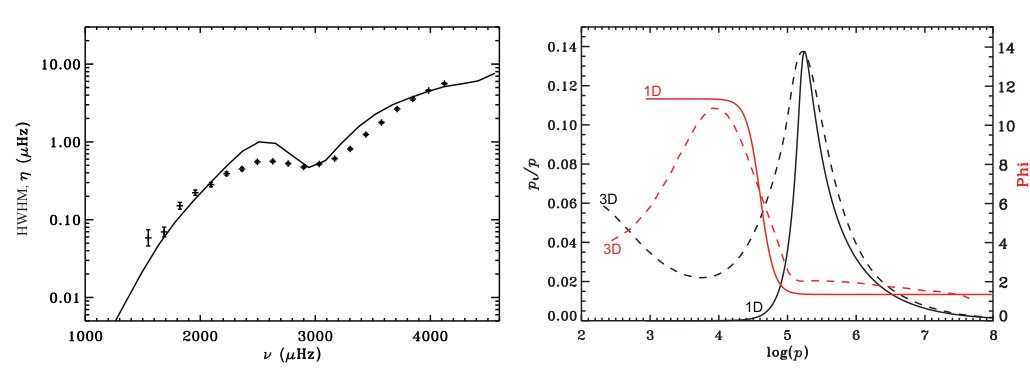 Figure 1
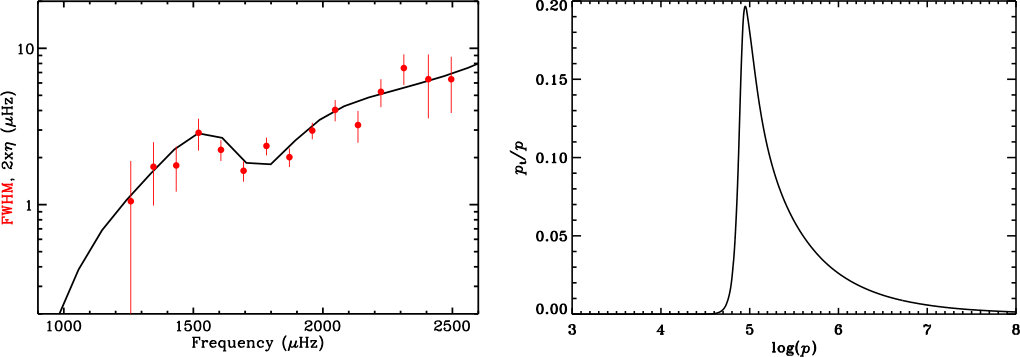 Figure 2
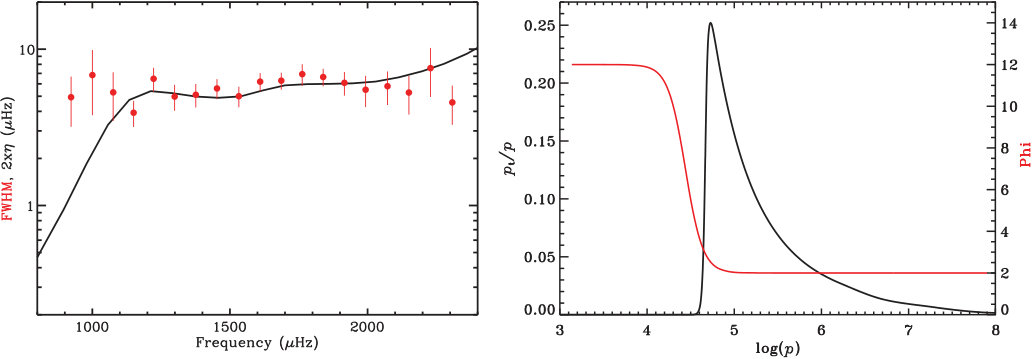 Figure 3
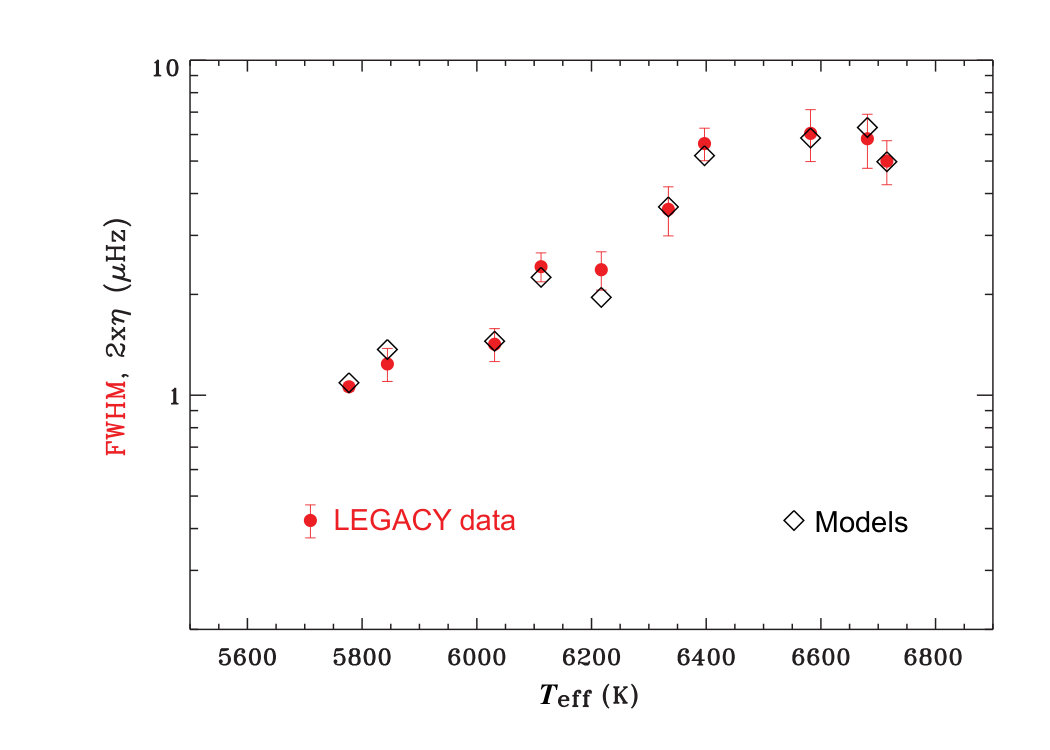 Figure 4
Peer Reviews
No public reviews on file for this paper yet. If you reviewed it on a platform where reviews are public (OpenReview, ICLR, NeurIPS, ICML), you can paste yours below so the community can read it here.
Videos
No videos yet. Explain this paper in a talk, walkthrough, or lecture? Add one.
\wocname
epj \woctitleSeismology of the Sun and the Distant Stars 2016
11institutetext: Stellar Astrophysics Centre, Aarhus University, DK-8000 Aarhus C, Denmark
Calibrating damping rates with LEGACY††thanks: data provided by Mikkel N. Lund (e-mail: [email protected]) linewidths
\firstnameGÃnter \lastnameHoudek\fnsep 11 [email protected]
Abstract
Linear damping rates of radial oscillation modes in selected stars are estimated with the help of a nonadiabatic stability analysis. The convective fluxes are obtained from a nonlocal, time-dependent convection model. The mixing-length parameter is calibrated to the surface-convection-zone depth of a stellar model obtained from fitting adiabatic frequencies to the LEGACY⋆ observations, and two of the three nonlocal convection parameters are calibrated to the corresponding LEGACY⋆ linewidth measurements. The atmospheric structure in the 1D stability analysis adopts a temperature-optical-depth relation derived from 3D hydrodynamical simulations. Results from 3D simulations are also used to calibrate the turbulent pressure and to guide the functional form of the depth-dependence of the anisotropy of the turbulent velocity field in the 1D stability computations.
1 Introduction
We use LEGACY LundEtal16 linewidths and frequencies of selected solar-type stars, together with 3D hydrodynamical simulation results Trampedach et al. (2013); Trampedach et al. (2014a), for calibrating the global stellar and nonlocal convection parameters in 1D stability computations. Additionally to exploiting the seismic diagnostic of observed oscillation frequencies, linewidth measurements provide further diagnostic information about the physical processes prevailing in the outer superadiabatic boundary layers where convective transport becomes inefficient. It is in these outer stellar layers where solar-like oscillations are excited stochastically to the observed oscillation amplitudes and damped by various processes including the interaction between oscillations and convection. Therefore, a time-dependent convection model is required for describing these physical processes, including the pulsationally perturbations to both the convective heat (enthalpy) and momentum (turbulent pressure) fluxes. A consistent inclusion of turbulent pressure in the equilibrium structure is, however, only possible within the framework of a nonlocal formulation of convection Gough (1977a). Such a convection model is adopted here Gough (1977b, a). Within the generally assumed approximations for constructing a 1D convection model, such as the Boussinesq approximation Spiegel and Veronis (1960) (for a recent review see Houdek & Dupret (2015)), the turbulent fluxes are consistently estimated in both the equilibrium and nonadiabatic pulsation calculations. A nonlocal convection formulation typically has additional (nonlocal) parameters which need calibration. Here we use results from 3D hydrodynamical simulations and linewidth measurements from data for calibrating these additional (three) nonlocal convection parameters. We also include an analytical description for the variation of the anisotropy of the turbulent velocity field, the functional form of which being guided by 3D simulations Trampedach et al. (2013).
2 Model computations
The 1D nonlocal model calculations are carried out essentially in the manner described by Houdek et al. (1999) and Chaplin et al. (2005) but include, in addition, a description for the variation of the turbulent velocity anisotropy with stellar depth, and a temperature-optical-depth () relation derived from 3D simulations Trampedach et al. (2014a). The convective heat flux and turbulent pressure are obtained from a nonlocal generalization of the mixing-length formulation Gough (1977b, a). In this generalization three more (nonlocal) parameters, and , are introduced which control the spatial coherence of the ensemble of eddies contributing to the total convective heat flux () and turbulent pressure (), and the degree to which the turbulent fluxes are coupled to the local stratification (). The effects of varying these nonlocal parameters on the solar structure and oscillation properties were discussed in detail by Balmforth (1992).
The nonlocal parameter is calibrated such as to have the maximum value of the turbulent pressure, max(), in the 1D nonlocal model to agree with the 3D simulation result by Trampedach et al. (2013). The depth-dependence of the anisotropy of the convective velocity field (an overbar denotes an ensemble average) is described by an analytical function, guided by 3D simulation results Trampedach et al. (2013). The remaining nonlocal parameters and cannot be easily obtained from the 3D simulations and are therefore calibrated such as to have a good agreement between calculated damping rates and LEGACY linewidths over the whole measured frequency range. The mixing length is calibrated such as to obtain the surface-convection depth of the frequency-calibrated evolutionary model calculated with ASTEC JCD08a . The ASTEC evolutionary model is obtained by minimizing the differences between observed (LEGACY) and adiabatically computed (ADIPLS JCD08b ) oscillation frequencies, including corrections for surface effects according to JCD12 .
Both the nonlocal envelope and pulsation calculations of the stability analyses assume the generalized Eddington approximation to radiative transfer Unno & Spiegel (1966). The temperature gradient in the plane-parallel atmosphere is corrected by using a radially varying Eddington factor fitted to relations obtained from 3D simulation results Trampedach et al. (2014a). The abundances by mass of hydrogen and heavy elements are adopted from the frequency-calibrated evolutionary calculations. The opacities are obtained from the OPAL tables Iglesias & Rogers (1996), supplemented at low temperature by tables from Kurucz (1991). The equation of state includes a detailed treatment of the ionization of C, N, and O, and a treatment of the first ionization of the next seven most abundant elements Christensen-Dalsgaard (1982). The integration of stellar-structure equations starts at an optical depth of and ends at a radius fraction R.
The linear nonadiabatic pulsation calculations are carried out using the same nonlocal convection formulation with the assumption that all eddies in the cascade respond to the pulsation in phase with the dominant large eddies. A simple thermal outer boundary condition is adopted at the temperature minimum where for the mechanical boundary condition the solutions are matched smoothly onto those of a plane-parallel isothermal atmosphere. At the base of the model envelope the conditions of adiabaticity and vanishing of the displacement eigenfunction are imposed. Only radial p modes are considered.
3 Results
We first tested the stability analysis against solar data provided by the BiSON group Chaplin et al. (2005) (see also (Houdek et al.2017)). The results are illustrated in Figure 1. The left panel compares radial damping-rate estimates , in units of cyclic frequency, with half-width-at-half-maximum (HWHM) measurements of the spectral peaks in the acoustic power spectrum. The power spectrum was obtained from a BiSON time-series collected over an epoch of 3456 days Chaplin et al. (2005). The right panel compares the profiles of turbulent pressure and convective velocity anisotropy as functions of the logarithm of the total pressure in the outer stellar layers between a 3D solar simulation Trampedach et al. (2013) and a calibrated 1D model. Only the maximum value of ( is density) in the 1D model was calibrated to the 3D simulation results by adjusting the nonlocal convection parameter . The agreement between the model and simulation is particularly satisfactorily in the deeper stellar layers where the modes are propagating. Note that in the outer layers with the modes are evanescent (e.g. (Houdek et al.2017)). The increasing difference in between simulation (dashed curve) and model (solid curve) with decreasing total pressure is predominantly a consequence of neglecting in a Boussinesq fluid the acoustic flux (H.-G. Ludwig, personal communication), generated by the convective fluctuations. These differences in stellar stratification have, however, little effect on the acoustic oscillation properties, for these differences are confined in the evanescent layers (see also (Houdek et al.2017)).
Next we estimated damping rates in 9 solar-type stars with effective temperatures 5844 K K. Results for the frequency-dependence of the estimated damping rates and profiles of turbulent pressure of the corresponding 1D stellar stratifications are illustrated in Figures 2 and 3 for two models with different effective temperatures. As in the solar case, max() in the 1D model was calibrated such as to match max() in the 3D simulations Trampedach et al. (2013).
Figure 4 compares LEGACY linewidths LundEtal16 (red, filled circles with error bars) with estimated damping rates (black, open diamonds) for 9 selected stars and for the Sun. Results are plotted at the frequency of maximum oscillation amplitude, determined from the scaling relation ( being surface gravity) and assuming a solar Hz. The agreement between observations and models is very satisfactorily. Moreover, all 1D models have global stellar parameters determined from minimizing the differences between observed and adiabatically computed oscillation frequencies LundEtal16 , calibrated max() values, depth-dependent functional forms of the turbulent-velocity anisotropy and relations as suggested by 3D simulations Trampedach et al. (2013); Trampedach et al. (2014a).
4 Acknowledgements
We thank Mikkel N. Lund for providing the LEGACY linewidths and Jørgen Christensen-Dalsgaard for the global stellar parameters of the frequency-calibrated ASTEC evolutionary models. Funding for the Stellar Astrophysics Centre is provided by The Danish National Research Foundation (Grant DNRF106).
The reference list from the paper itself. Each links out to its DOI / PubMed record.
- 1Balmforth (1992) Balmforth N. J., MNRAS 255 , 603 (1992)
- 2Chaplin et al. (2005) Chaplin W. J., Houdek G., Elsworth Y., Gough D. O., Isaak G. R., New R., MNRAS 360 , 859 (2005)
- 3Christensen-Dalsgaard (1982) Christensen-Dalsgaard J., MNRAS 199 , 735 (1982)
- 4(4) Christensen-Dalsgaard J., Ap&SS 316 , 13 (2008)
- 5(5) Christensen-Dalsgaard J., Ap&SS 316 , 113 (2008)
- 6(6) Christensen-Dalsgaard J., ESF Conference: “The Modern Era of Helio- and Asteroseismology” (M. Roth ed., Obergurgel), Astron. Nachr. 333 , 914 (2012)
- 7Gough (1977 a) Gough D. O., Lecture Notes in Physics 71 , (Spiegel E. A., Zahn J.-P., eds, Springer, New York), 15 (1977 a)
- 8Gough (1977 b) Gough D. O., Ap J 214 , 196 (1977 b)