\contourlength
1.5pt
Representations of regular trees and invariants of AR-components for generalized Kronecker quivers
Daniel Bissinger
Christian-Albrechts-Universität zu Kiel, Ludewig-Meyn-Str. 4, 24098 Kiel, Germany
[email protected]
Abstract.
We investigate the generalized Kronecker algebra Kr=kΓr with r≥3 arrows. Given a regular component C of the Auslander-Reiten quiver of Kr, we show that the quasi-rank rk(C)∈Z≤1 can be described almost exactly as the distance W(C)∈N0 between two non-intersecting cones in C, given by modules with the equal images and the equal kernels property; more precisley, we show that the two numbers are linked by the inequality
[TABLE]
Utilizing covering theory, we construct for each n∈N0 a bijection φn between the field k and {C∣C regular component, W(C)=n}. As a consequence, we get new results about the number of regular components of a fixed quasi-rank.
Partly supported by the D.F.G. priority program SPP 1388 “Darstellungstheorie”
00footnotetext: 2010 Mathematics Subject Classification: 16G20, 16G6000footnotetext: Keywords: Kronecker algebra, Auslander-Reiten theory, Covering theory
Introduction
Let k be an algebraically closed field of arbitrary characteristic. The finite-dimensional algebra Kr is defined as the path algebra of the quiver Γr with vertices 1,2, r∈N arrows γ1,…,γr:1→2 and called the generalized Kronecker algebra. We denote by modKr the category of finite-dimensional left-modules of Kr.
It is well known that for r≥3 the hereditary algebra Kr is of wild representation type [Ker3, 1.3,1.5], every regular component in the Auslander-Reiten quiver of Kr is of type ZA∞ [Ri3] and there is a bijection between the regular components and the ground field k [Assem3, XVIII 1.8]. Therefore, the problem of completely understanding the category modKr or all regular components is considered hopeless and it is desirable to find invariants which give more specific information about the regular components.
One important invariant (for any wild hereditary algebra), introduced in [Ker1], is the quasi-rank rk(C)∈Z of a regular component C. For a quasi-simple module X in C, rk(C) is defined as
[TABLE]
where rad(X,Y) is the space of non-invertible homomorphisms from X to Y.
Another interesting invariant W(C)∈N0 was recently introduced in [Wor1]. Motivated by the representation theory of group algebras of p-elementary abelian groups of characteristic p>0, the author defines the category EKP of modules with the equal kernels property and the category EIP of modules with the equal images property in the framework of Kr.
She shows the existence of uniquely determined quasi-simple modules MC and WC in C such that
the cone (MC→) of all successors of MC satisfies (MC→)=EKP∩C and the cone (→WC) of all predecessors of WC satisfies
(→WC)=EIP∩C. The width W(C) of C is defined as the unique number W(C)∈N0 such that τW(C)+1MC=WC, i.e. the distance between the two cones.
Utilizing homological descriptions of EKP and EIP from [Wor1] involving a family of elementary modules, we show that the two invariants rk(C) and W(C) are linked by the inequality
[TABLE]
Motivated by this connection, we construct for each n∈N a regular component C with W(C)=n. In order to do so, we consider representations over the universal covering Cr of Γr.
We define classes Inj,Surj of representations over Cr such that M∈rep(Cr) is in Inj (resp. Surj) if and only if for each arrow δ:x→y of Cr the linear map M(δ):Mx→My is injective (resp. surjective).
Let πλ:rep(Cr)→rep(Γr) be the push-down functor [Gab3, 2.7] and M∈rep(Cr) be indecomposable. We prove that M is in Inj (resp. Surj) if and only if πλ(M) is in EKP (resp. EIP). Since a component D of the Auslander-Reiten quiver of Cr which is taken to a regular component C:=πλ(D) is also of type ZA∞, we can lift the definition of W(C) to D. We define WC(D)∈N0 as the distance between the cones Surj∩D and Inj∩D and show that WC(D)=W(C).
For X∈D, we denote by ql(X) its quasi-length. If X has certain properties, we show how to construct a short exact sequence δX=0→Y→E→X→0 with indecomposable middle term E in a component E such that
[TABLE]
The construction of δX relies on the fact that Cr is an infinite r-regular tree with bipartite orientation. Using (∗), we construct for each n∈N a component Dn with WC(Dn)=n.
In conjunction with a natural action of GLr(k) on rep(Γr), we arrive at our main theorem:
Theorem**.**
Let n∈N0. There is a bijection k→{C∣C regular component of Γr,W(C)=n}.
As an immediate consequence we get the following statements, which are generalizations of results by Kerner and Lukas [KerLuk2, 3.1], [KerLuk2, 5.2] for the Kronecker algebra.
Corollary**.**
Let r≥3, then for each n∈N there are exactly ∣k∣ regular components with quasi-rank in {−n,−n+1,−n+2,−n+3}.
Corollary**.**
Assume that k is uncountable and q∈N. The set of components of quasi-rank ≤−q is uncountable.
1. Preliminaries and Motivation
1.1. Notations and basic results
Throughout this article let k be an algebraically closed field of arbitrary characteristic.
For a quiver Q=(Q0,Q1,s,t), x∈Q0 let
[TABLE]
Moreover let n(x):=x+∪x−. If α:x→y, then by definition s(α)=x and t(α)=y. We say that α starts in s(α) and ends in t(α).
A quiver Q is called
- (a)
locally finite if n(x) is finite for each x∈Q0,
2. (b)
of bounded length if for each x∈Q0 there is Nx∈N such that each path in Q which starts or ends in x is of length ≤Nx,
3. (c)
locally bounded if Q is locally finite and of bounded length.
From now on we assume that Q is locally bounded. Note that this implies that Q is acyclic. Moreover, we assume that Q is connected.
A finite dimensional representation M=((Mx)x∈Q0,(M(α))α∈Q1) over Q consists of vector spaces Mx and linear maps M(α):Ms(α)→Mt(α) such that dimkM:=∑x∈Q0dimkMx is finite. A morphism f:M→N between representations is a collection of linear maps (fz)z∈Q0 such for each arrow α:x→y there is a commutative diagram
[TABLE]
The category of finite dimensional representations over Q is denoted by rep(Q). The path category k(Q) has Q0 as set of objects and Homk(Q)(x,y) is the vector space with basis given by the paths from x to y. The trivial arrow in x is denoted by ϵx. Since Q is locally bounded, the category k(Q) is locally bounded in the sense of [Gab2, 2.1]. A finite-dimensional module over a locally bounded category A is a functor F:A→modk such that ∑x∈AdimkF(x) is finite. The category modA has Auslander-Reiten sequences (see [Gab2, 2.2]). Since a finite dimensional module over k(Q) is the same as a representation of Q, the category rep(Q) has Auslander-Reiten sequences.
If moreover Q0 is a finite set, we denote with kQ the path algebra of Q with idempotents ex,x∈Q0. In this case kQ is a finite dimensional, associative, basic and connected k-algebra. We denote by modkQ the class of finite-dimensional kQ left modules. Given M∈modkQ we let Mx:=exM. The categories modkQ and rep(Q) are equivalent (see for example [Assem1, III 1.6]). We will therefore switch freely between representations of Q and modules of kQ, if one of the approaches seems more convenient for us.
We assume that the reader is familiar with Auslander-Reiten theory and basic results on wild hereditary algebras. For a well written survey on the subjects we refer to [Assem1], [Ker2] and [Ker3].
Recall the definition of the dimension function
[TABLE]
If 0→A→B→C→0 is an exact sequence, then dimA+dimC=dimB. A finite quiver Q defines a (non-symmetric) bilinear form
⟨−,−⟩:ZQ0×ZQ0→Z,
given by ((xi),(yj))↦∑i∈Q0xiyi−∑α∈Q1xs(α)yt(α), which coincides with the Euler-Ringel form [Ri4] on the Grothendieck group K0(kQ)≅ZQ0, i.e. for M,N∈modkQ we have
[TABLE]
1.2. The Kronecker algebra and ZA∞ components
We always assume that r≥3. Denote by Γr the r-Kronecker quiver, which is given by two vertices 1,2 and arrows γ1,…,γr:1→2.
We set Kr:=kΓr and P1:=Kre2, P2:=Kre1. The modules P1 and P2 are the indecomposable projective modules of modKr, dimkHom(P1,P2)=r and dimkHom(P2,P1)=0. As Figure 1 suggests, we write dimM=(dimkM1,dimkM2). For example dimP1=(0,1) and dimP2=(1,r).
Figure 2 shows the notation we use for the components P,I in the Auslander-Reiten quiver of Kr which contain the indecomposable projective modules P1,P2 and indecomposable injective modules I1,I2. The set of all other components is denoted by R.
Ringel has proven [Ri3, 2.3] that every component in R is of type ZA∞. A module in such a component is called regular and the class of all regular indecomposable modules is denoted by indR. An irreducible morphism in a component of type ZA∞ (for any algebra) is injective if the corresponding arrow is uprising and surjective otherwise. A representation M in a ZA∞ component is called quasi-simple if the AR sequence terminating in M has an indecomposable middle term. These modules are the modules in the bottom layer of the component. If M is quasi-simple in a component C of type ZA∞, then there is an infinite chain (ray) of irreducible monomorphisms (resp. epimorphisms)
[TABLE]
[TABLE]
and for each indecomposable module X in C there are unique quasi-simple modules N,M and l∈N with (l)M=X=N[l]. The number ql(X):=l is called the quasi-length of X.
The indecomposable modules in P are called preprojective modules and the modules in I are called preinjective modules. Moreover we call an arbitrary module preprojective (resp. preinjective, regular) if all its indecomposable direct summands are preprojective (res. preinjective, regular). We have P in P (I in I) if and only if there is l∈N0 with τlP=Pi (τ−lI=Ii) for i∈{1,2}.
Let modpfKr be the subcategory of all modules without non-zero projective direct summands and modifKr the subcategory of all modules without non-zero injective summands. Since Kr is a hereditary algebra, the Auslander-Reiten translation τ:modKr→modKr induces an equivalence from modpfKr to modifKr, that will be often used later on without further notice.
1.3. The connection between rk(C) and W(C)
Let us start by recalling the definitions of rk(C) and W(C).
Let A=kQ be a wild hereditary algebra and C be a regular component with a quasi-simple module X in C, then
[TABLE]
It was shown in [Ker1], that t(A):=max{rk(C)∣C regular component} is finite and t(Kr)=1. In other words, there are lots of morphisms in τ-direction. Also in τ−1-direction one finds a lot of morphisms since
t(A):=inf{rk(C)∣C regular component}=−∞ (see [KerLuk2, 3.1]).
Another invariant that can be attached to a regular component C of the Kronecker algebra is defined in [Wor1] and denoted by W(C). In order to define W(C), we first recall the definitions of EKP and EIP. For α∈kr∖{0} and M∈rep(Γr) we consider the k-linear map Mα:=∑i=1rαiM(γi):M1→M2 and let Xα∈rep(Γ) be the cokernel of the embedding (0,ι2):P1→P2 where ι2:k→kr, x↦xα.
[Wor1, 2.1] We define the classes of representations with the equal kernels property and with the equal images property as
- (1)
EKP:={M∈rep(Γr)∣∀α∈kr:Mα is injective} and
2. (2)
EIP:={M∈rep(Γr)∣∀α∈kr:Mα is surjective}.
Given a regular component C, there exist uniquely determined quasi-simple representations MC and WC in C such that
(MC→)=EKP∩C and (→WC)=EIP∩C (see [Wor1, 3.3]). Now W(C) is defined as the unique integer with τW(C)+1MC=WC. Since EKP∩EIP={0} it follows W(C)≥0.
Proposition 1.3.1**.**
Let C be a regular component, then −W(C)≤rk(C)≤−W(C)+3.
Proof.
On the one hand let M:=τ−1WC, then there is α∈kr∖{0} with 0=Ext(Xα,M) [Wor1, 2.5]. The Auslander-Reiten formula [Ker3, 2.3] yields 0=Hom(τ−1M,Xα). On the other hand let N:=τMC, then there is β∈kr∖{0} with 0=Hom(Xβ,N)≅Hom(τXβ,τN) [Wor1, 2.5]. By the Euler-Ringel form we have
[TABLE]
Hence 0=dimkExt(Xβ,Xα)=dimkHom(τ−1Xα,Xβ)=dimkHom(Xα,τXβ). Since Xα and τXβ are elementary [Bi1, 2.1.4], we get a non-zero morphism by [Bi1, 2.1.1]
[TABLE]
[TABLE]
Hence rad(WC,τ−W(C)+3WC)=0, since [Wor1, 4.10] together with W(C)=3 implies that WC is not a brick. By [Ker1, 1.7] it follows that rk(C)≤−W(C)+3. The second inequality follows from the proof of [Wor1, 3.1.3].
∎
In [Wor1], the inequality −W(C)≤rk(C) in conjunction with t(Kr)=−∞ was used to prove that sup{W(D)∣D∈R}=∞. We choose a different approach and study the number W(C) to draw conclusions for rk(C).
There are regular components with rk(Ci)=1 and W(Ci)=i for 0≤i≤2 [Wor1, 3.3.1] and a component D with rk(D)=0 and W(D)=0 [Bi1, 3.3.3].
2. Covering Theory
2.1. General Theory
We follow [Ri6] and [Ri7] and consider the universal cover Cr of the quiver Γr. The underlying graph of Cr is an r-regular tree and Cr has bipartite orientation. That means each vertex x∈(Cr)0 is a sink or a source and ∣n(x)∣=r. In the following we recall the construction of Cr.
For a quiver Q=(Q0,Q1,s,t) with arrow set Q1 we write (Q1)−1:={α−1∣α∈Q1} for the formal inverses of Q1. Moreover we extend the functions s and t to (Q1)−1 by defining
s(α−1):=t(α) and t(α−1):=s(α).
A walk w in Q1 is a formal sequence w=αnεn⋯α1ε1 with αi∈Q1, ε∈{1,−1} such that s(αi+1εi+1)=t(αiεi) for all i<n, where α1:=α for all α∈Q1. We set t(w):=t(αnεn) and s(w):=s(α1ε1).
Let ∼ be the equivalence relation on the set of walks W of Γr generated by
[TABLE]
Let −1:W→W be the involution on W given by (αnεn⋯α1ε1)−1:=α1−ε1⋯αn−εn.
Now consider the fundamental group π(Γr) of Γr in the point 1, i.e. the elements of π(Γr) are the equivalence classes of unoriented paths starting and ending in 1, with multiplication given by concatenation of paths, inverse elements [w]−1:=[w−1] and identity element [ϵ1]. Note that π(Γr) is a free group in the r−1 generators {[γj−1γ1]∣2≤j≤r} and in particular torsionfree.
The quiver Cr is given by the following data:
- (a)
(Cr)0 is the set of equivalence classes of paths starting in 1.
2. (b)
There is an arrow from [w] to [w′] whenever w′∼γiw for some i∈{1,…,r}.
Let π:Cr→Γr be the quiver morphism given by [w]↦t(w) and ([w]→[γiw])↦γi. The morphisms π is a G-Galois cover for G=π(Γr), where the action of G on Cr is given by concatenation of paths:
if g=[w]∈π(Γr) and [v],[u]∈(Cr)0 with arrow [u]→[γiu] then
[TABLE]
[TABLE]
We define Cr+:=π−1({1}), Cr−:=π−1({2}) and get an induced action on rep(Cr) by shifting the support of representations via G=π(Γr): Given M∈rep(Cr) and g∈G we define Mg:=(((Mg)x)x∈(Cr)0,(Mg(α))α∈(Cr)1), where
[TABLE]
By identifying the orbit quiver Cr/G with Γr we define the push-down functor πλ:rep(Cr)→rep(Γr) on the objects via
πλ(M):=(πλ(M)1,πλ(M)2;(πλ(M)(γi))1≤i≤r), where
[TABLE]
[TABLE]
If f=(fx)x∈(Cr)0:M→N is a morphism in rep(Cr) then πλ(f)=(gπ(x))x∈(Cr)0=(g1,g2) with
[TABLE]
By [Gab2, 3.2] πλ is an exact functor.
Theorem 2.1.1**.**
[Gab3, 3.6]**, [Ri7, 6.2,6.3]
The following statements hold.
- (a)
πλ* sends indecomposable representations in rep(Cr) to indecomposable representations in rep(Γr).*
2. (b)
If M∈rep(Cr) is indecomposable then πλ(M)≅πλ(N) if and only if Mg≅N for some g∈G.
3. (c)
πλ* sends AR sequences to AR sequences and πλ commutes with the Auslander-Reiten translates, i.e. τ∘πλ=πλ∘τCr.*
4. (d)
If M∈rep(Cr) is indecomposable in a component D with πλ(M) in a component C, then πλ induces a covering D→C of translation quivers.
Let M∈rep(Cr) be indecomposable. M is called regular if πλ(M) is regular. A component D of rep(Cr) is called regular if it contains a regular representation M. In this case we denote by πλ(D) the component containing πλ(M). Moreover we let R(Cr) be the set of all regular components of the Auslander-Reiten quiver of rep(Cr).
Corollary 2.1.2**.**
Let D be regular component, then the covering D→πλ(D) is an isomorphism of translation quivers. In particular, D is of type ZA∞. Moreover a component E is regular if and only if E is of type ZA∞.
Proof.
By [Gab2, 1.7] πλ(D)≅ZA∞ is a simply connected translation quiver. By [Gab2, 1.6],[Ried1, 1.7] the quiver morphism D→πλ(D) is an isomorphism. If πλ(E)∈{I,P} then there exists a vertex x with r≥3 successors (see Figure \refFig:AuslanderReitenquiver), since a covering is surjective on arrows. Hence E is not of type ZA∞.
∎
2.2. Duality
Recall [Wor1, 2.2] that the duality D:rep(Γr)→rep(Γr) is defined by setting (DM)x:=(Mψ(x))∗ and (DM)(γi):=(M(γi))∗, where ψ:{1,2}→{1,2} is the involution with ψ(1)=2.
We define an involution φ0:(Cr)0→(Cr)0 via [w]↦[wγ1], where ϵ1:=ϵ2, ϵ2:=ϵ1
and αnεn⋯α1ε1:=αn−εn⋯α1−ε1. This induces a quiver anti-morphism φ:Cr→Cr in the following way.
If [w]→[γiw] is an arrow of Cr, then by definition there is a unique arrow φ([w]→[γiw]) starting in φ0([γiw])=[γi−1wγ1] and ending in φ0([w])=[wγ1], since γiγi−1wγ1∼wγ1. Note that φ(Cr+) = Cr−, φ(Cr−)=Cr+ and π(φ(α))=π(α).
We define a duality DCr:rep(Cr)→rep(Cr) by setting
DCrM:=((DCrM)x∈(Cr)0,(DCrM(α))α∈Q1) where (DCrM)x:=(Mφ(x))∗ and DCrM(α):=(M(φ(α)))∗. By construction we have πλ∘DCr=D∘πλ.
3. Lifting EKP and EIP to rep(Cr)
In the following we give a characterization of the equal images and equal kernels property for indecomposable representations of the form πλ(M). Let ˉ :(Cr)1→{1,…,r} be the unique map with γβ=π(β) for all β∈(Cr)1. Note that if x∈(Cr)+(or x∈Cr−) then the restriction of \ \bar{}\ to {α∈(Cr)1∣s(α)=x} (resp. {α∈(Cr)1∣t(α)=x}) is a bijective map to {1,…,r}.
Let ∅=X⊆(Cr)0 be a set of vertices and T⊆Cr be a tree.
- (a)
The unique minimal tree containing X is denoted by T(X).
2. (b)
A vertex x∈T0 is called a leaf of T, if ∣n(x)∩T0∣≤1.
Let x∈(Cr)0 and M be a representation of Cr.
- (a)
The set supp(M):={y∈(Cr)0∣My=0} is called the support of M.
2. (b)
For V⊆supp(M) we let MV be the induced representation with supp(MV)=V.
3. (c)
The vertex x is a leaf of M if x is a leaf of T(M):=T(supp(M)).
4. (d)
M is called balanced provided that M is indecomposable and M has leaves in Cr+ and Cr−.
Observe that if M is indecomposable we have T(M)0=supp(M).
We define
[TABLE]
[TABLE]
Theorem 3.1**.**
Let M∈rep(Cr) be an indecomposable representation. The following statements are equivalent:
- (a)
N:=πλ(M)* has the equal kernels property.*
2. (b)
N(γi)* is injective for all i∈{1,…,r}.*
3. (c)
M∈Inj.
Proof.
(a)⇒(b): Clear from the definition of EKP.
(b)⇒(c): Let α:x→y and mx∈kerM(α). Denote by ιx:Mx→⨁z∈Cr+Mz the natural embedding and let ιy:My→⨁z∈Cr−Mz. We conclude
[TABLE]
Hence ιx(mx)∈kerN(γα)={0} and mx=0.
(c)⇒(a): Let α∈kr∖{0}, f:=∑i=1rαiN(γi):N1→N2 and m∈kerf. We assume w.l.o.g that α1=0. Write m=(mz)z∈Cr+. We have to show that mz=0 for all z∈Cr+.
Let S:={z∈(Cr)0∣mz=0}⊆Cr+ and suppose that S=∅. Let T(S) be the minimal tree that contains S. Since T(S)0⊆supp(M) every leaf belongs to Cr+∩S, by the minimality of T(S). Fix a leaf x in T(S) and let γ:x→y be the unique arrow with π(γ)=γ1. Then
[TABLE]
By the injectivity of M(γ) there is δ:z→y∈(Cr)1∖{γ} with t(δ)=y and 0=αδM(δ)(mz). It follows mz=0 and z,x∈S. Since Cr is a tree we get y∈T(S)0.
Since δ=γ=1, we assume without loss of generality that δ=2, so that α2=0.
Let η:x→a be the unique arrow with η=2. Then
[TABLE]
Hence there is ζ:b→a∈(Cr)1∖{η} with 0=αζM(ζ)(mb) and a,b are in T(S)0. We have shown that a and y are in T(S)0. This is a contradiction since x is a leaf.
∎
Corollary 3.2**.**
Let M∈rep(Cr) be an indecomposable representation. The following statements are equivalent.
- (a)
N:=πλ(M)* has the equal images property.*
2. (b)
N(γi)* is surjective for all i∈{1,…,r}.*
3. (c)
M∈Surj.
Proof.
(c)⇒(a): Let M(α) be surjective for each α∈(Cr)1, then (DCrM)(α) is injective for each α∈(Cr)1. By 3.1, the representation πλ(DCrM)≅Dπλ(M) has the equal kernels property. Therefore πλ(M) has the equal images property, since D(EKP)=EIP.
∎
Corollary 3.3**.**
Let D∈R(Cr) and C:=πλ(D). Then there exist uniquely determined quasi-simple representations ID and SD in D such that
- (a)
πλ(ID)=MC* and πλ(SD)=WC.*
2. (b)
Surj∩D=(→SD)* and Inj∩D=(ID→).*
3. (c)
The unique integer WC(D) with τCrWC(D)+1(ID)=SD is given by WC(D)=W(C)∈N0.
Corollary 3.4**.**
Assume that M∈rep(Cr) is balanced, then M is regular.
Proof.
If an indecomposable representation X∈rep(Cr) is in Inj (respectively Surj), then all leaves of X are in Cr+ (resp. Cr−). Hence πλ(M)∈/EIP∪EKP by 3.1. By [Wor1, 2.7] the representations of the components P and I are contained in EKP∪EIP.∎
From now on we write x0:=[ϵ1]∈(Cr)0 for the vertex in (Cr)0 given by the trivial walk starting in the vertex 1.
For i∈{1,…,r}, we let βi∈(Cr)1 be the unique arrow with s(βi)=x0 and π(βi)=γi. Moreover let zi:=t(βi). We define an indecomposable representation Xi in rep(Cr) via:
[TABLE]
and Xi(βj):=idk for all j=i. By definition we have dimπλ(Xi)=(1,r−1) and πλ(Xi)≅Xei.
In view of [Wor1, 2.5], [Gab3, 3.6(c)] 2.1.1 and 3.1 we conclude the following.
Corollary 3.5**.**
Let M∈rep(Cr) be an indecomposable representation. The following statements are equivalent:
- (a)
N:=πλ(M)* has the equal kernels property.*
2. (b)
Hom(πλ(Xi),N)=0* for all i∈{1,…,r}.*
3. (c)
Hom((Xi)g,M)=0* for all i∈{1,…,r} and all g∈G.*
The following Lemma will be needed later on.
Lemma 3.6**.**
Let n∈N, M be regular indecomposable, i∈{1,…,r} and g∈G=π(Γr).
- (a)
For n≥2, the linear map (τCrnXi)g(α) is surjective for all α∈(Cr)1.
2. (b)
If n≥1 and f=(fx)x∈(Cr)0:(τCrnXi)g→M is a non-zero morphism, then each fx is injective.
3. (c)
If n≥2, x∈supp((τCrnXi)g)∩Cr− and 0=f:(τCrnXi)g→M, then supp(M)∩n(x)=supp(M)∩x−=x−. This means ∣supp(M)∩x−∣=r.
Proof.
(a) For n≥2, we have πλ((τCrnXi)g)=πλ(τCrnXi)=τnXei∈EIP (see [Wor1, 3.3]).
(b) For n≥1, it is known that each proper factor of τnXei is preinjective, see for example [Bi1, 2.1.4]. Let 0=f∈Hom((τCrnXi)g,M), then 0=πλ(f)=(gi)1≤i≤2:τnXe1→πλ(M) is injective, where
[TABLE]
So each fx is injective, since π−1({1,2})=(Cr)0.
(c) Let x∈supp((τCrnXi)g)∩Cr− and z∈n(x). Since x is a sink, there is α:z→x and by (a), (τCrnXi)(α) is surjective. Hence ((τCrnXi)g)z=0. By (b), we get Mz=0 and z∈supp(M)∩x−.
∎
4. Considerations in the universal covering
Let us recall what we have shown so far. Given a component D in R(Cr), the natural number WC(D) is the distance between the two non-empty, non-intersecting cones Inj∩D and Surj∩D. Moreover we know that W(πλ(D))=WC(D).
Let now X∈D be indecomposable. Then there exists an integer l∈Z such that τCrlX∈Surj, since Surj∩D is non-empty. We also find n≥1 with τCr−nX∈Surj.
Since Surj∩D is closed under τCr we conclude −n≤l. Therefore the following minima exist.
Let X∈rep(Cr) be a regular indecomposable representation. We define
[TABLE]
Note that ∣d−(X)∣∈N0 is the distance of X to the border of the cone Inj∩D.
Lemma 4.1**.**
Let X∈rep(Cr) be indecomposable in a regular component D. Then
[TABLE]
Proof.
Since the equality is obvious for X quasi-simple we assume l:=ql(X)>1. Let Z be the unique quasi-simple representation with X=Z[l]. By induction we get WC(D)=d+(Z[l−1])+d−(Z[l−1])−(l−1). Now observe that d+(Z[l−1])+1=d+(Z[l]) and d−(Z[l−1])=d−(Z[l]). Hence WC(D)=d+(Z[l])−1+d−(Z[l])−(l−1)=d+(X)+d−(X)−ql(X).
∎
We show in the following how to modify a regular representation X⇝X′ such that the obtained representation X′ is regular, d+(X)=d+(X′), d−(X)=d−(X′) and ql(X′)=1.
4.1. Indecomposable representations arising from extensions
In this section, we show how to construct non-split exact sequences with indecomposable middle term in rep(Cr).
Let M,N∈rep(Cr) be indecomposable. The pair
(N,M) is called leaf-connected if there is α:x→y∈(Cr)1 s.t.
- (a)
x is a leaf of M, y is a leaf of N and
2. (b)
supp(M)∩supp(N)=∅.
Note that the assumption M and N being indecomposable together with properties (a) and (b) already implies the uniqueness of α. If (N,M) is leaf-connected, α is called the connecting arrow and (M,N) is not leaf-connected.
Let (N,M) be leaf-connected with connecting arrow α:x→y and f:Mx→Ny a non-zero linear map. We define a representation N∗fM∈rep(Cr) by setting
[TABLE]
with (N∗fM)supp(X)=X for X∈{M,N} and (N∗fM)(α):=f:Mx→Ny.
Moreover we denote by ιf:N→N∗fM and πf:N∗fM→M the natural morphisms of quiver representations. The k-linear map along the connecting arrow is called a connecting map for (N,M).
Note that N∗fM is just an extension of M by N with corresponding exact sequence
δf:0→N→ιfN∗fM→πfM→0. The next lemma shows that M∗fN is indecomposable. In particular, δf does not split. One can also show that the map
[TABLE]
is an isomorphism of vector spaces, where [δ0] is the neutral element in the abelian group Ext(M,N) with respect to the Baer sum.
Lemma 4.1.1**.**
Let (N,M) be leaf-connected.
- (a)
The representation N∗fM is indecomposable.
2. (b)
If M and N are regular, then N∗fM is regular.
Proof.
(a) Let U1,U2∈rep(Cr) with N∗fM=U1⊕U2. Hence we get
[TABLE]
Since M∈rep(Cr) is indecomposable, there is a unique i∈{1,2} with (Ui)supp(M)=M. We assume i=1. By the same token there is a unique j with (Uj)supp(N)=N. Since (M∗fN)(α)=f=0, it follows that j=i=1. Hence U2=(0) and N∗fM is indecomposable.
(b) By construction N is a subrepresentation of M∗fN and M a factor representation. Since πλ(N∗fM) is indecomposable with regular factor representation πλ(M), it is regular itself or preprojective. By the same token πλ(N∗fM) is regular or preinjective.
∎
Lemma 4.1.2**.**
Let M,N∈rep(Cr) be indecomposable and assume x∈Cr+ is a leaf of M and y∈Cr− is a leaf of N. Then there exists g∈G such that (Ng,M) is leaf-connected with connecting arrow x→g.y.
Proof.
Since x,y are leaves, we find at most one arrow δM:x→x1 and at most one arrow δN:y1→y with x1∈supp(M) and y1∈supp(N). Since r≥3 we find an arrow α:x→z with π(δM)=π(α)=π(δN). In particular α=δM and x1=z.
Now let g∈π(Γr) be the unique element with g.z=y. Then z∈n(x) is a leaf of Ng. By construction, we have π(g.α)=π(α)=π(δN) and conclude x∈/supp(Ng). It follows that supp(M)∩supp(Ng)=∅. Hence (Ng,M) is leaf-connected with connecting arrow α.
∎
Let n≥2 and M1,…,Mn∈rep(Cr) be indecomposable. The tuple (Mn,…,M1) is called leaf-connected, provided that (Mi+1,Mi) is leaf-connected for all 1≤i<n. A tuple (fn−1,…,f1) of k-linear maps is called a connecting map for (Mn,…,M1) if fi is a connecting map for (Mi+1,Mi) for all 1≤i<n.
Let (M,L) and (L,N) be leaf-connected with connecting maps f and g, then supp(M)∩supp(N)=∅, since Cr is a tree. Hence supp(M∗fL)∩supp(N)=∅ and (M∗fL,N) is connected. Therefore the next definition is well-defined.
Let n≥2, (Mn,…,M1) be leaf-connected with connecting map (fn−1,…,f1). Then we define inductively Mn∗fn−1Mn−1∗fn−2⋯∗fiMi:=(Mn∗fn−1Mn−1∗⋯∗fi+1Mi+1)∗fiMi for all 2≤i<n.
From now on, we assume that (Mn,…,M1) is leaf-connected with connecting map (fn−1,…,f1). For 1≤i≤n, we define ∗j≥iMj:=Mn∗fn−1Mn−1∗⋯∗fiMi and ∗j≤iMj:=Mi∗fi−1Mi−1∗⋯∗f1M1. Moreover, we set ∗j≥nMj=Mn and ∗j≤1Mj=M1.
Lemma 4.1.3**.**
Let n≥2, (Mn,…,M1) be leaf-connected and 1≤i<n.
- (a)
The representation ∗j≥iMj is indecomposable.
2. (b)
There is a short exact sequence 0→∗j≥i+1Mj→∗j≥iMj→Mi→0.
3. (c)
If Mn,M1 are regular, then ∗j≥iMj is regular.
Proof.
For (c), just note that Mi is balanced for 2≤i≤n−1, hence Mi is regular.
∎
Lemma 4.1.4**.**
Let X,Y∈rep(Cr) be regular indecomposable. Then the following statments are equivalent.
- (a)
There is g∈G such that Hom(Xg,Y)=0.
2. (b)
There is h∈G such that Hom(τCrXh,τCrY).
3. (c)
There is l∈G such that Hom(τCr−1Xl,τCr−1Y).
Proof.
We only show (a)⇒(b).
Let g∈G, such that 0=Hom(Xg,Y). Then
[TABLE]
Hence we find h∈G such that 0=Hom((τCrX)h,τCrY)≅Hom(τCrXh,τCrY).
∎
Proposition 4.1.5**.**
Let n≥2, (Mn,…,M1) be leaf-connected and M1,Mn regular, then
- (a)
max{d−(∗j≥iMj)∣1≤i≤n}≤d−(∗j≥1Mj)≤max{d−(Mi)∣1≤i≤n}.
2. (b)
max{d+(∗j≤iMj)∣1≤i≤n}≤d+(∗j≥1Mj)≤max{d+(Mi)∣1≤i≤n}.
Proof.
Note that we have a filtration of ∗j≥1Mj by regular subrepresentations
[TABLE]
with ∗j≥iMj/∗j≥i+1Mj≅Mi regular for all 1≤i≤n, where ∗j≥n+1Mj:=0.
(a) Let i∈{1,…,n} and Z:=∗j≥iMi. Consider the short exact sequence
[TABLE]
Now l∈Z such that τCr−lZ∈/Inj. Then there exists i∈{1,…,r} and g∈G such that Hom((Xi)g,τCr−lZ)=0. Hence we find h∈G with Hom((τCrlXi)h,Z) for some h∈G. Left-exactness of Hom((τCrlXi)h,−) ensures that 0=Hom((τCrlXi)h,∗j≥1Mj) and therefore we find g∈G with 0=Hom(Xil,τCr−l(∗j≥1Mj)). Hence τCr−l(∗j≥1Mj)∈/Inj and therefore d−(X)≤d−(∗j≥1Mj).
If Hom((Xi)g,τCr−l(∗j≥1Mj))=0 for some g∈G and i∈{1,…,r}, then we get find h∈G with 0=Hom(τCrl(Xi)h,∗j≥1Mj).
By [Ker3, 1.9] we find 1≤p≤n with 0=Hom(τCrl(Xi)h,Mp). Hence there is g∈G with 0=Hom((Xi)g,τCr−lMp). Hence d−(∗j≥1Mj)≤d−(Mp).
(b) Note for i≥2 that ∗j≥1Mj/∗j≥iMj≅∗j<iMj. Hence DCr(∗j≥1Mj) has a filtration
[TABLE]
Now apply (a) and note that d+(X)=d−(DCrX) for each regular indecomposable representation X.
∎
4.2. Small representations and trees
A balanced representation N is called small if 1≤d−(N),d+(N)≤2.
Note that N being balanced always implies d−(N)≥1 and d+(N)≥1.
Denote with Cr the underlying graph of Cr. Then ((Cr)0,d) obtains the structure of a metric space, where d(x,y)∈N0 denotes the length of the unique path in Cr connecting vertices x and y.
Let T⊆Cr be a finite subtree. T is called small if
- (a)
T has leaves in Cr+ and Cr−,
2. (b)
for all x∈T0, we have ∣T0∩n(x)∣≤3,
3. (c)
if ∣T0∩n(x)∣=3=∣T0∩n(y)∣ then x=y or d(x,y)≥3.
Let l∈N and n∈2N with n≥4l. We denote with Al,n⊆Cr a (small) subtree of the following form:
\bullet$$a_{1}$$\bullet$$a_{2}$$\bullet$$a_{3}$$\bullet$$a_{4}$$\bullet$$a_{5}$$\bullet$$a_{6}$$\bullet$$a_{7}$$\bullet$$a_{8}$$\bullet$$a_{9}$$\bullet$$\bullet$$\bullet$$t_{1}$$t_{2}$$t_{l}$$a_{4l-2}$$a_{4l-1}$$a_{n}…\bullet$$\bullet$$\bullet$$\bullet…\bullet$$\bullet$$\bullet$$\bullet
Lemma 4.2.1**.**
Assume L is an indecomposable representation with small tree T(L). Then L is small.
Proof.
Since T(L) is small with T(L)0=supp(L), L is balanced and therefore regular.
Let l∈Z be such that τCr−lL∈/Inj. By 3.5 and 4.1.4 we find i∈{1,…,r} and g∈G with 0=Hom((τCrlXi)g,L). Fix h:(τCrlXi)g→L non-zero.
We assume that l≥2. By 3.6, h is a monomorphism and supp((τCrlXi)g)⊆supp(L). Let s be a sink of (τCrlXi)g. By 3.6, we have ∣supp(L)∩n(s)∣=r.
Since T(L) is small we get 3≤r=∣supp(L)∩n(s)∣≤3. Hence
[TABLE]
Now let t1,t2∈supp((τCrlXi)g) be sinks. Then (∗) yields
[TABLE]
Since T(L) is small we get t1=t2 or d(t1,t2)≥3. Since Cr has bipartite orientation and supp((τCrlXi)g) is connected, it follows t1=t2. Hence supp((τCrlXi)g) contains exactly one sink s. Write n(s)={a,b,c}. Since l≥2, \refLemmaInjective(a) implies supp((τCrlXi)g)={s,a,b,c}.
Hence Z:=(τCrlXi)g can be considered as a representation of the Dynkin diagram D4 with unique sink s such that all linear maps are surjective. It follows that Zx=1 for all x∈{s,a,b,c}. Hence dimπλ(Z)=(3,1) and πλ(Z) is indecomposable. But the only indecomposable representation I∈rep(Γ3) with dimension vector (3,1) is injective. This is a contradiction since Z is regular.
Therefore l≤1 and d−(L)≤2. For the other inequality note that T(L) is small if and only if T(DCrL) is small and d+(L)=d−(DCrL)≤2.
∎
5. The main theorem
Lemma 5.1**.**
Let M∈rep(Γr) be an indecomposable representation with dimension vector dimM=(a+1,a), a≥1. Then M is a regular and quasi-simple representation.
Proof.
That M is regular follows immediatly from [BoChen1, 2.1].
By [BoChen1, 3.4] it suffices to show that At is not a common divisor of a+1 and a for all t≥2, where dimPi=(Ai−1,Ai) is the dimension vector of the preprojective indecomposable representation Pi (see Figure \refFig:AuslanderReitenquiver). But this is trivial since gcd(a+1,a)=1.
∎
Theorem 5.2**.**
Let M∈rep(Cr) be balanced in the regular component D and 2≤d+(M),d−(M). There is n0∈N such that for each n≥n0 there is a regular component Dn with
[TABLE]
Moreover Dn contains a balanced quasi-simple representation Fn with dimπλ(Fn)=(n+1,n) or dimπλ(Fn)=(n,n+1) and Di=Dj for i=j≥n0.
Proof.
Write dimπλ(M)=(a,b). After dualising M we can assume a≤b. Set l:=2(b−a)+1≥1 and p0:=4l. Now let p≥p0 with p∈2N. Consider an indecomposable and thin representation L (i.e. dimkLx≤1 for all x∈(Cr)0 such that (L,M) is leaf-connected and T(L)=T(supp(L)) is of type Al,p. Let g∈G be such that (Mg,L) is leaf-connected. We conclude for n:=2b+21p∈N, n0:=2b+21p0, and Fn:=Mg∗L∗M that
[TABLE]
By 4.1.3 Fn is a regular indecomposable representation and by 5.1 πλ(Fn) is quasi-simple. Therefore Fn is quasi-simple in a regular component Dn. We conclude with 4.1.5
[TABLE]
i.e. d−(M)=d−(Fn). By the same token we have d+(M)=d+(Fn) and conclude
[TABLE]
It follows immediatly from the construction that the regular components are pairwise distinct, since Fi, Fj are non-isomorphic and satisfy ql(Fi)=ql(Fj) and d−(Fi)=d−(Fj) for i=j≥n0.
∎
Corollary 5.3**.**
Let M∈D be balanced and 2≤d+(M),d−(M). Then there exists a balanced and quasi-simple representation F in a regular component E such that WC(E)=WC(D)+ql(M)−1. Moreover there is a leaf x∈Cr+ with dimkFx=1=dimkFy for the unique element y∈x+∩supp(F).
Proof.
Fix n≥n0 in the proof of the theorem and set F:=Fn=Mg∗L∗M. The last claim follows since L is a thin representation of type Al,p which has l+1≥2 leaves in Cr+ (see Figure \refFig:ExampleSupport).
∎
6. Applications
6.1. Regular components for every width
The aim of this section is to construct for each n∈N a regular component D with WC(D)=n.
Although each indecomposable representation has a leaf, it is in general not true that a regular representation has leaves in Cr+ and Cr−. For example if M is indecomposable in Inj, then each leaf of M is a sink by 3.1.
The next results shows that self-dual representations have leaves in Cr+ and Cr−.
Lemma 6.1.1**.**
Let M∈rep(Cr) be indecomposable such that Dπλ(M)≅πλ(M), then M is balanced.
Proof.
Since supp(M) is finite there exists a leaf x of M. Without loss of generality we assume that x∈Cr+. We get πλ(M)≅Dπλ(M)≅πλ(DCrM). Therefore we find h∈G such that M≅(DCrM)h. Since h−1.φ(x)∈Cr− (see \refDuality) is a leaf of (DCrM)h the claim follows.∎
We denote with σCr the quiver obtained by changing the orientation of all arrows in Cr. Note that σ2Cr=Cr and σCr≅Cr. We denote by Φ+ the composition of the Bernstein-Gelfand-Ponomarev reflection functors [Assem1, VII 5.5.] for all the sources of Cr. Φ+ is a well-defined functor Φ+:rep(Cr)→rep(σCr) (see [Ri6, 2.3]). By the same token we have a functor Φ−:rep(σCr)→rep(Cr) given by the composition of the reflection functors for all the sources of σCr. Then F:=Φ−∘Φ+:rep(Cr)→rep(Cr) satisfies F(M)≅τCr−1M for M∈rep(Cr) indecomposable and non-injective [Ri6, 2.3],[Assem1, VII 5.8.]. Therefore statements (a) and (b) of the next Lemma follow immediately from the definition of the reflection functors.
Lemma 6.1.2**.**
Let M be in rep(Cr) indecomposable and not injective.
- (a)
For each x∈Cr+ we have dimk(τCr−1M)x=(∑y∈x+dimkMy)−dimkMx.
2. (b)
For each y∈Cr− we have dimk(τCr−1M)y=(∑x∈y−dimk(τCr−1M)x)−dimkMy.
3. (c)
Let 0→A→B→C→0 be an almost split sequence with B indecomposable. If a∈Cr− is a leaf of A, then B has a leaf in Cr−.
4. (d)
Let 0→A→B→C→0 be an almost split sequence with B indecomposable. If a∈Cr+ is a leaf of A and b∈a+ satisfies dimkAb=dimkAa, then a is a leaf of B.
Proof.
(c) Consider a path a←b→c such that b,c are not in supp(A) as illustrated in Figure 6. Since b is in Cr+ we get with (a) that
[TABLE]
Now let d∈n(c)∖{b}. Then dimkCd=(∑y∈d+dimkAy)−dimkAd=0. Hence we get that
dimkCc=dimk(τCr−1A)c=(b)(∑x∈c−dimk(τCr−1A)x)−dimkAc=dimkCb−dimkAc=dimkCb=0.
Hence c∈supp(C) is a leaf of C and since supp(B)=supp(A)∪supp(C) we conclude that c∈Cr− is a leaf of B.
(d) Application of (a) yields (see Figure \refFig:ProofFigure2)
[TABLE]
Now fix c∈a+∖{b}, then c∈Cr−. Let d∈c−∖{a} then dimkAf=0 for all f∈d+∪{d}, since f∈/supp(A).
Hence we get
[TABLE]
We conclude
[TABLE]
We have shown that (a+∖{b})∩(supp(A)∪supp(C))=∅. Since
supp(A)∪supp(C)=supp(B) we get ∣supp(B)∩n(a)∣=∣(supp(A)∪supp(C))∩n(a)∣≤∣{b}∣=1. Since a∈supp(A)⊆supp(B) the vertex a∈Cr+ is a leaf of T(supp(B)). Since B is indecomposable we have T(B)=T(supp(B)).
∎
Let M1∈rep(Cr) be regular with dimkM1=2. We define inductively a sequence of indecomposable representations in the regular component D of M1. The representation M1 is quasi-simple. Assume that Mn is already defined. If n is odd, then Mn+1 is the unique indecomposable
representation with irreducible epimorphism Mn+1→Mn; if n is even, then Mn+1 is the unique
indecomposable representation with irreducible monomorphism Mn→Mn+1. The component D is shown in Figure 8. We have WC(D)=W(πλ(D))=1 [Wor1, Example 3.3].
Theorem 6.1.3**.**
Let r≥3.
- (a)
For each m≥1 there is n0≥1 and a family (Dn)n≥n0 of regular components with WC(Dn)=m and Dn contains a quasi-simple representation En with dimπλ(En)=(n+1,n).
2. (b)
N⊆{WC(E)∣E∈R(Cr)}⊆N0.
3. (c)
{W(C)∣C∈R}=N0.
Proof.
Recall that WC(D)=1 and WC(E)=2 for the regular component E containing X1. Fix l≥1. Then we have Dπλ(M2l+1)≅πλ(M2l+1) by [Wor1, Example 3.3]. By 6.1.1 M2l+1 is balanced. Moreover we have d−(M2l+1),d+(M2l+1)≥2. Hence 5.2 yields n0∈N and an infinite family of components (Dn)n≥n0 of width WC(Dn)=WC(D)+ql(M2l+1)−1=2l+1. By Corollary 5.3 we find a balanced and quasi-simple representation A∈Dn that satisfies the assumption of \refLemmaLeavesExistence(d). Consider the AR sequence 0→A→B→C→0. Then B is balanced by \refLemmaLeavesExistence(c),(d), 2≤d+(B),d−(B) and ql(B)=2. By 5.2 we get an infinite family of components of width WC(Dn)+ql(B)−1=(2l+1)+2−1=2l+2. This proves (a) and (b). For (c) observe that there exist regular components C∈R with W(C)=0 [Wor1, 3.3].
∎
6.2. Counting regular components of fixed width
This section is motivated by the following result by Kerner and Lukas.
Proposition**.**
[Ker2, 5.2]* Assume that k is uncountable and A is a wild hereditary algebra with n>2 simple modules. Then the number of regular component of A with quasi-rank −1 is uncountable. Moreover the set of components of quasi-rank ≤−1 for the Kronecker algebra is uncountable.*
The proof of the second statement uses the first statement for the path algebra A of the wild quiver 1→2⇉3 with n(A)=3 simple modules and the existence of a regular tilting module Tr in modA that induces a bijection
[TABLE]
with rk(φ(C))≤rk(C) for all C∈{D∣D regular component of A}. To generalize the arguments from ≤−1 to ≤−p for p∈N one would need the existence of bricks of arbitrary quasi-length. Unfortunately for each hereditary algebra there is a finite upper bound for the quasi-length of regular bricks given by the number of simple modules −1, which is in our case n(A)−1=2. We show how to circumvent this obstacle by considering an action of the general linear group GLr(k) on rep(Γr).
[CFP1, 3.6]
Denote with GLr(k) the group of invertible r×r-matrices with coefficients in k which acts on ⨁i=1rkγi via A.γj=∑i=1raijγi for 1≤j≤r, A∈GLr(k). For A∈GLr(k), let φA:Kr→Kr the algebra homomorphism with φA(e1)=e1, φA(e2)=e2 and φA(γi)=A.γi, 1≤i≤r. For a Kr-module M denote the pullback of M along φA−1 by A.M. The module M is called GLr(k)-stable if A.M≅M for all g∈GLr(k), in other words if GLr=GLr(k)M:={A∈GLr(k)∣A.M≅M}.
- (a)
The simple representations of Γr are GLr(k)-stable and by [Far1, 2.2] every preinjective and every preprojective representation is GLr(k)-stable.
2. (b)
There are GLr(k)-stable representations that are regular [Wor1, 1.2]. In this case all representations in the same component are also GLr(k)-stable.
3. (c)
Recall that the preinjective representation I3=τI1 has dimension vector (3r−1,r). Let M be in rep(Cr) with πλ(M)≅I3. The support of M for r=3 is shown in Figure 9. Let c∈T(M)0 be the vertex dimkMc=2.
The underlying tree of supp(M) is symmetric in the following sense. The quiver T(M)∖{c} is not connected and consists of r=3 isomorphic trees T1,T2,T3. Moreover for n∈{1,2} the sum dimkMx for x∈(Ti)0 with distance d(c,x)=n is independent of i∈{1,2,3}. We will prove that this is not a coincidence. We show that every representation M such that πλ(M) is GLr(k)-stable, has a central point.
6.2.1. Sr-stability
Denote by Sr the symmetric group on {1,…,r}.
Then each for each σ∈Sr there is an induced bijection on {1,…,r}→(Γr)1 given by i↦γσ(i) which extends in a natural way to the set of equivalence classes of walks in Γr. By abuse of notation we denote by σ:Cr→Cr the induced quiver automorphism.
Let α:[w]→[γiw] be an arrow in Cr, then by definition σ(α) is the unique arrow
σ(α):σ([w])→[γσ(i)]σ([w]). Note that π(α)=γi and π(σ(α))=γσ(i).
Now let M∈rep(Cr) be an indecomposable representation. We define σ(M) to be the indecomposable representation with
[TABLE]
We say that M is Sr-stable if for each σ∈Sr there is gσ with M≅σ(M)gσ.
This definition is motivated by the following obvious result:
Corollary 6.2.1**.**
Let M∈rep(Cr) be an indecomposable representation. If πλ(M) is GLr(k)-stable then M is Sr-stable.
Proof.
We let I(σ) be the permutation matrix given by σ, i.e.
I(σ)ij=1 if and only if σ(i)=j and I(σ)ij=0 otherwise.
Now we assume that πλ(M) is GLr(k)-stable. Then we get for each σ∈Sr that
[TABLE]
Hence we find gσ∈G such that
[TABLE]
∎
Note that σ([ϵ1])=[ϵ1] and since G acts freely Cr, the element gσ is uniquely determined. In the following we study the quiver automorphisms σ∘gσ:Cr→Cr.
6.2.2. Automorphisms of trees
A group G is said to have property FA [Se1, I.6.1] if every action of G on a tree T by graph automorphisms (which do not invert an edge) has a global fixed point z∈T0, i.e. gz=z for all g∈G. It is known [Se1, I.6.3.1] that all finitely generated torsion groups have the property FA. In particular, for every group action of a finite group acting on a quiver which underlying graph is a tree, there is a global fixed point.
For x∈Cr+ and 1≤i≤r denote by T(x,i) the connected component of Cr∖{x} containing t(αi), where αi:x→t(αi) is the unique arrow with π(αi)=γi.
Let M in rep(Cr) be indecomposable and x∈supp(M), then we define T(x,i,M):=T(M)∩T(x,i).
Note that supp(M)={x}∪⋃i=1rT(x,i,M)0.
Proposition 6.2.2**.**
Let M∈rep(Cr) be Sr-stable. Then there is c∈supp(M) such that
- (a)
σ∘gσ(c)=c* for all σ∈Sr.*
2. (b)
For each n∈N the number r divides D(n,c):=∑x∈supp(M),d(x,c)=nMx.
Proof.
Since M≅σ(M)gσ, we have
[TABLE]
We assume that dimkM=1, otherwise there is nothing to show. Let T⊆Cr be the finite subtree T:=T(M). Then σ∘gσ:T→T is a quiver automorphism of T. Since T is finite, Aut(T) is finite and there exists a vertex c∈T0 with φ(c)=c for all φ∈Aut(T). We assume that c∈Cr+.
For 1≤i≤r we let βi:c→t(βi) be the unique arrow with π(βi)=γi and set Ti:=T(c,i,M). Since dimkM=1 and M is indecomposable, we can assume w.l.o.g. that e:=t(β1)∈supp(M). Since every automorphism of Cr respects the metric (see \refDefinitionMetric) we get
[TABLE]
In particular, σ∘gσ(β1)∈{β1,…,βr}. Now fix j∈{1,…,r}∖{1} and σ:=(1 j)∈Sr. Then we have π(σ(β1))=γj. Since π∘g=π for all g∈G, we get σ∘gσ(β1)=βj and conclude σ∘gσ(T1)=Tj. Hence T1,…,Tr are non-empty isomorphic quivers. For each n∈N and i∈{1,…,r} we define dn,i,c:={x∈(Ti)0∣d(x,c)=n}. Let now x∈dn,1,c, then we have σ∘gσ(x)∈dn,j,c since σ∘gσ(x)∈Tj and
[TABLE]
Moreover we have Mx=(σ(M)gσ)x=Mσ∘gσ(x).
It follows ∑y∈dn,1,cdimkMy=∑y∈dn,j,cdimkMy and we conclude
[TABLE]
∎
Corollary 6.2.3**.**
Assume that M is Sr-stable. If dimπλ(M)=(a,b) then r divides a or b.
Proof.
Let c∈supp(M) be as in 6.2.2. Then we have
[TABLE]
If c∈Cr+, then b=∑n∈2N−1D(n,c) and a=∑n∈2N−1D(n,c) otherwise. Hence r divides b or a.
∎
As an application we get the following result for components of the Kronecker quiver Γr.
Corollary 6.2.4**.**
Let m∈N, then there exists a regular component C with W(C)=m and no representation in C is GLr(k)-stable.
Proof.
Let m≥1. By 5.2 there exists n0∈N such that for each n≥n0 there is a regular component Dn with W(Dn)=m and Dm contains a quasi-simple representation En=πλ(Fn) with Fn∈rep(Cr) and dimEn=(n+1,n). Since r≥3, we find l≥n0 (even infinitely many) such that r does not divide l and l+1. Hence Fl is not Sr-stable and El not GLr(k)-stable. Therefore no representation in Dl is GLr(k)-stable by [Far1, 2.2].
∎
6.2.3. The number of regular components in rep(Γr)
A locally closed set is an open subset of a closed set. A constructible set is a finite union of locally closed sets.
Lemma 6.2.5**.**
Let M∈rep(Γr) with GLr(k)M=GLr(k). There is an injection ι:k→GLr(k)/GLr(k)M.
Proof.
By [Far1, 2.1] GLr(k)M is a closed subgroup of GLr(k) and by [Mall, 5.5] an GLr(k)/GLr(k)M an algebraic variety. Hence we find an affine variety V⊆GLr(k)/GLr(k)M with d:=dimV=dimGLr(k)/GLr(k)M. Since GLr(k) is irreducible we have dimGLr(k)/GLr(k)M=dimGLr(k)−dimGLr(k)M≥1. Let k[t1,…,td]→k[V] be a Noether-normalization and φ∗:V→Ad be the comorphism. Then φ∗ is dominant. Hence there is a dominant morphism f:V→A1. By Chevalley’s Theorem f(V) is constructible and hence finite or cofinite. Since f(V) is dense in A, f(V) is not finite and therefore cofinite. That means ∣k∖C∣ is finite. Since k is infinite we have ∣f(V)∣=∣k∣. It follows
∣k∣=∣A∣=∣f(V)∣≤∣V∣≤∣GLr(M)/GLr(k)M∣.
∎
Theorem 6.2.6**.**
Let m∈N. There is a bijection {C∈R∣W(C)=m}→k.
Proof.
It is well known that ∣R∣=∣k∣, see [Assem3, XVIII 1.8]. In particular there is an injection
[TABLE]
By 6.2.4 there is a regular component C with W(C)=m∈N such that no representation in C is GLr(k)-stable. For E in C the map
[TABLE]
is well defined and injective. Since the number of representations in a regular component with given dimension vector (a,b) is ≤1 [Assem3, XIII.1.7] and GLr(k) acts via auto equivalances we get with 6.2.5 an injection
[TABLE]
By the Schröder-Bernstein Theorem we get the desired bijection.
∎
Note that we restrict ourselves to components of width ≥1, since we dont know whether components in rep(Cr) of width [math] exist. Also the examples [Wor1, 3.3] of components of width [math] in rep(Γr) are GLr(k)-stable. For the case n=0 we argue as follows.
Lemma 6.2.7**.**
Let r≥3, then there exists an bijection k→{C∈R∣W(C)=0}.
Proof.
The proof of [Bi1, 3.3.3] yields an injective map φ:indE(X)→{C∈R∣W(C)=0}, where indE(X) are the indecomposable objects in a category E(X) equivalent to the category of finite dimensional modules over the power-series ring k⟨⟨X1,…,Xt⟩⟩ in non-commuting variables X1,…,Xt and t≥2. Now let λ∈k∖{0} and consider the indecomposable module Mλ=k2 given by X1.(a,b)=(λb,0), X2.(a,b)=(b,0) and Xi.(a,b)=0 for i>2. Then Mλ≅Mμ for λ=μ and we have an injection k→indE(X). The claim follows as in 6.2.6.
∎
Corollary 6.2.8**.**
Let r≥3, then for each n∈N there are exactly ∣k∣ regular components such that rk(C)∈[−n,−n+3].
Corollary 6.2.9**.**
Assume that k is uncountable and p∈N. The set of components of quasi-rank ≤−p in R is uncountable.
Acknowledgement
The results of this article are part of my doctoral thesis, which I am currently
writing at the University of Kiel. I would like to thank my advisor Rolf Farnsteiner for his continuous support and helpful comments.
I also would like to thank the whole research team for the very pleasant working atmosphere and the encouragement throughout my studies. In particular, I thank Christian Drenkhahn for proofreading.
Furthermore, I thank Claus Michael Ringel for fruitful discussions during my visits in Bielefeld.
References

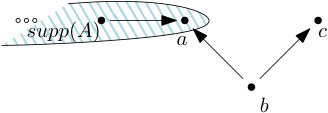 Figure 1
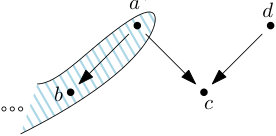 Figure 2
 Figure 3
 Figure 4
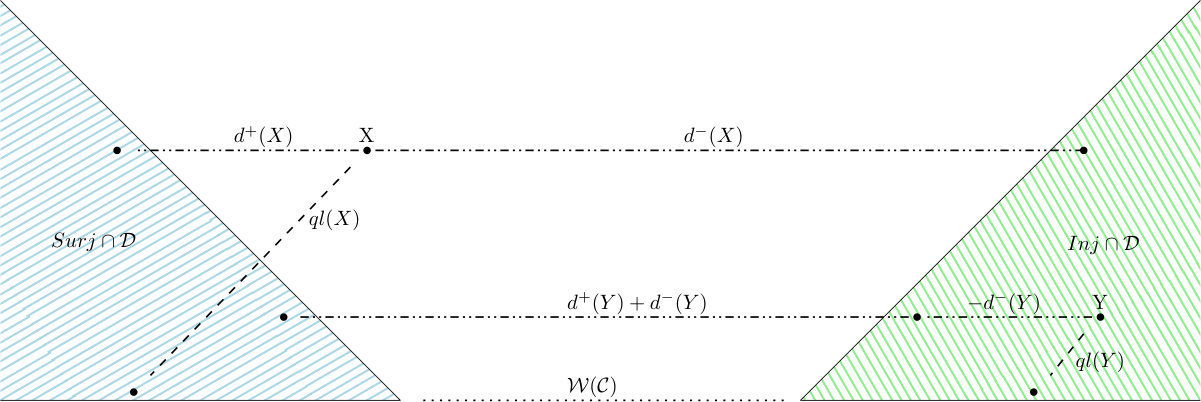 Figure 5
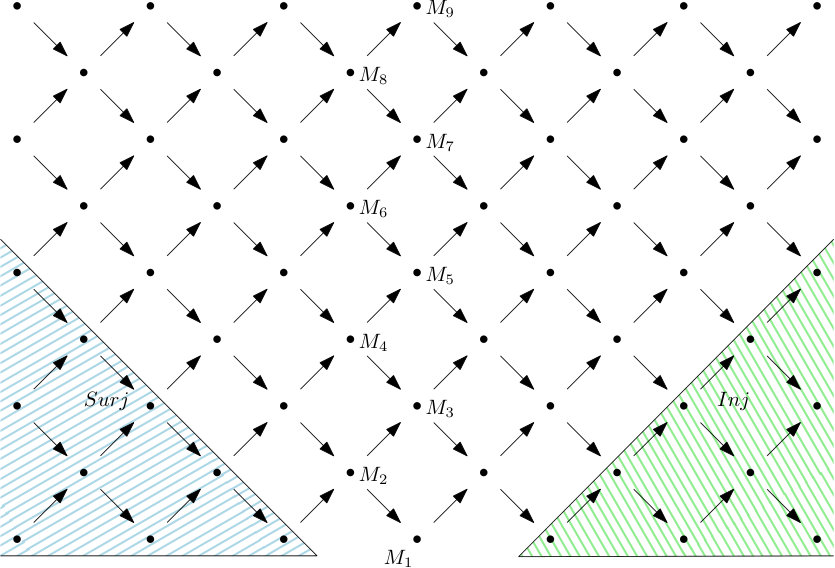 Figure 6