Homological and monodromy representations of framed braid groups
Akishi Ikeda

TL;DR
This paper introduces two new classes of representations for framed braid groups, one homological and one monodromic, and explores a conjectural equivalence between them, advancing understanding of their algebraic and geometric structures.
Contribution
It presents novel homological and monodromy representations of framed braid groups and proposes a conjectural link between these two classes.
Findings
Construction of homological representations via mapping class group actions
Development of monodromy representations from confluent KZ equations
Proposed conjectural equivalence between the two representation classes
Abstract
In this paper, we introduce two new classes of representations of the framed braid groups. One is the homological representation constructed as the action of a mapping class group on a certain homology group. The other is the monodromy representation of the confluent KZ equation, which is a generalization of the KZ equation to have irregular singularities. We also give a conjectural equivalence between these two classes of representations.
Click any figure to enlarge with its caption.
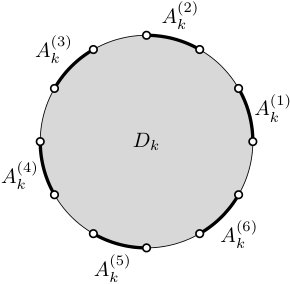 Figure 1
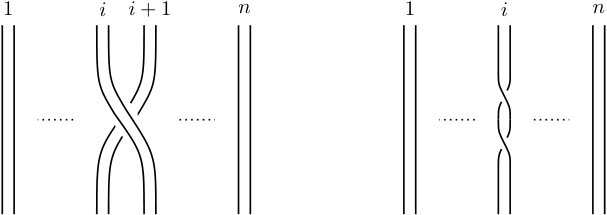 Figure 2
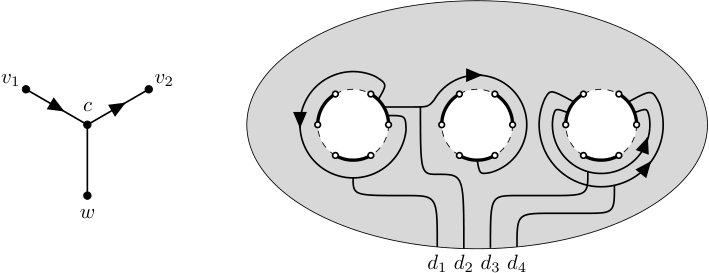 Figure 3
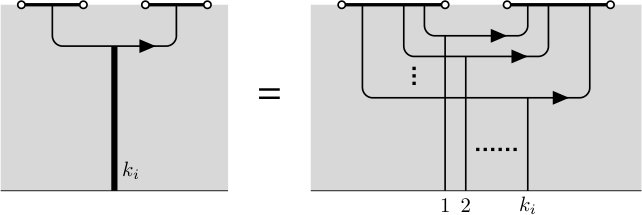 Figure 4
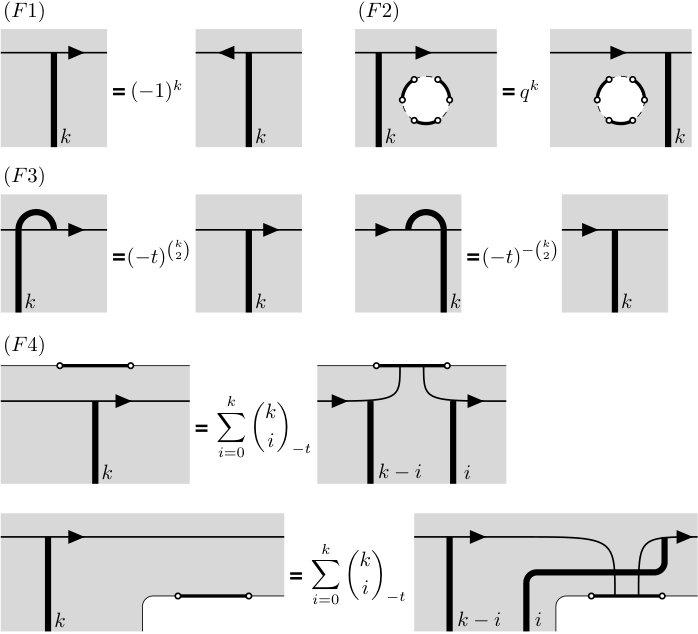 Figure 5
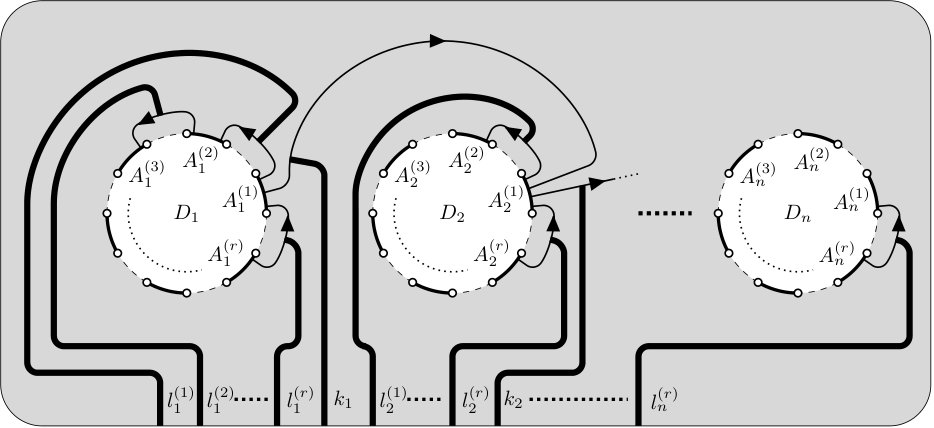 Figure 6
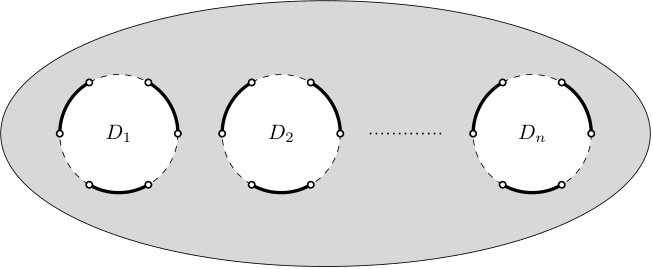 Figure 7
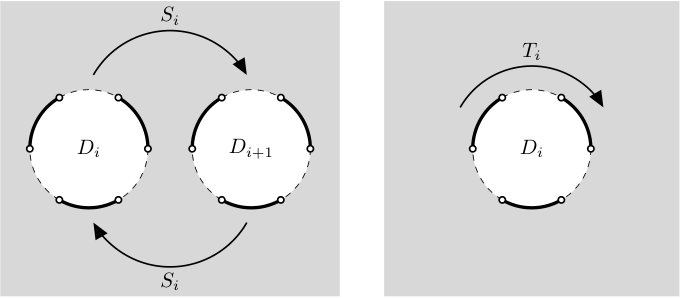 Figure 8
Peer Reviews
No public reviews on file for this paper yet. If you reviewed it on a platform where reviews are public (OpenReview, ICLR, NeurIPS, ICML), you can paste yours below so the community can read it here.
Videos
No videos yet. Explain this paper in a talk, walkthrough, or lecture? Add one.
Homological and monodromy representations of framed braid groups
Akishi Ikeda
Kavli Institute for the Physics and Mathematics of the Universe (WPI), UTIAS, The University of Tokyo, Kashiwa, Chiba 277-8583, Japan
Abstract.
In this paper, we introduce two new classes of representations of the framed braid groups. One is the homological representation constructed as the action of a mapping class group on a certain homology group. The other is the monodromy representation of the confluent KZ equation, which is a generalization of the KZ equation to have irregular singularities. We also give a conjectural equivalence between these two classes of representations.
2010 Mathematics Subject Classification:
20F36 (Primary); 34M35, 57M07, 81T40 (Secondary).
1. Introduction
The framed braid group [KS92] is the semi-direct product where the braid group acts on as permutations of components through the projection on the symmetric group of degree . Similar to the diagrammatic description of the braid group by using strings, the framed braid group can be described graphically by using ribbons. The component describes crossings of ribbons and the component describes the number of twists of each ribbon. In particular, the plat closure of an element of gives a framed link. Whereas there are many studies of representations of the braid groups, representations of the framed braid groups are less known.
The purpose of this paper is to introduce two new classes of representations of the framed braid groups. (These are also new classes as representations of the braid groups.) One is the homological representation constructed as the action of a mapping class on a certain homology group. This construction generalizes the homological representation of the braid group introduced by Lawrence [Law90]. The original Lawrence representation appears as the quotient of our representation. As special cases, our representations contain natural extensions of the reduced Burau representation [Bur36] and the Lawrence-Krammer-Bigelow representation [Big01, Kra00, Kra02] to the framed braid groups.
The other is the monodromy representation of the confluent KZ equation [JNS08], which is a generalization of the KZ equation [KZ84] to have irregular singularities. The confluent KZ equation also appears in two dimensional conformal field theory as the differential equation for irregular conformal blocks of the Wess-Zumino-Witten (WZW) model [GLP]. Thus our representation also describes the monodromy of irregular conformal blocks.
In [Koh12], Kohno showed that the Lawrence homological representation of the braid group is equivalent to the monodromy representation of the KZ equation on the space of singular vectors. Following his result, we also give a conjectural equivalence between the homological representation and the monodromy representation of the framed braid group.
1.1. Homological representations
We summarize the construction of the homological representations of the framed braid groups from Section 3. For a positive integer , let be the framed group of ribbons (see Definition 2.1). Set . The homological representation
[TABLE]
is parametrized by positive integers where is a certain relative homology group constructed as follows. Let be a closed disk and take disjoint closed disks from the interior of . An open interval is called a marked arc. Take disjoint marked arcs from each boundary and denote by the set of such marked arcs (Figure 2). Define the surface (Figure 3) by
[TABLE]
Let be the configuration space of unordered distinct points in :
[TABLE]
Then there is a group homomorphism from the fundamental group of to a free abelian group of rank two
[TABLE]
where the generator corresponds to the loop around the cylinders for and the generator corresponds to the loop around the hyperplanes for . Let the covering space corresponding to . Introduce the subset by
[TABLE]
and its inverse image . The homological representation is constructed on the relative homology group
[TABLE]
We note that has an -module structure coming from the action of the deck transformation group . The mapping class group is defined to be the group of isotopy classes of orientation preserving diffeomorphisms on which fix the boundary pointwise. Then naturally acts on . In addition, there is an isomorphism by Proposition 2.5. Our main result about the homological representation is the following.
Theorem 1.1**.**
For positive integers , there is a representation of the framed braid group
[TABLE]
which is constructed as the action of the mapping class group on the relative homology group . This representation has the following properties:
- (1)
There is a subrepresentation which is a free -module of rank
[TABLE]
spanned by certain homology classes, called the standard multifork classes.
- (2)
We have an equality
[TABLE]
over the field . In particular, the standard multifork classes form a basis of over .
Details are given in Section 3. The original Lawrence representation [Law90] appears as follow. In , there is a natural subrepresentation of rank
[TABLE]
and the quotient representation is equivalent to the Lawrence representation [Law90] (also see a nice review of the Lawrence representation [Ito16, Section 3.1]). In this construction, the factor of acts on trivially, and hence has only information about the representation of the braid group . As special cases, is the reduced Burau representation [Bur36] and is the Lawrence-Krammer-Bigelow representation [Big01, Kra00, Kra02]. The faithfulness of the representation of for by [Big01, Kra02, Zhe] implies that the representation of is also faithful for (see Corollary 3.10). The polynomial invariants of framed links associated with the reduced Burau representations will be discussed in [Ike] (see Remark 3.19).
1.2. Monodromy representations
We see the construction of the monodromy representations of the framed braid groups. Before going to the confluent KZ equation, we first recall some facts about the KZ equation and its monodromy representations. The Knizhnik-Zamolodchikov (KZ) equation was introduced in [KZ84] as the differential equation which is satisfied by correlation functions (conformal blocks) of the WZW model. Let be a semi-simple Lie algebra and be a -module. The KZ equation is an integrable differential equation for a -valued function on the configuration space
[TABLE]
with regular singularities along the divisors . In addition, it is invariant under the action of . Therefore we can associate a representation of the braid group as the monodromy representation. The Kohno-Drinfeld theorem [Dri89, Koh87] describes the monodromy representation of the KZ equation as an -matrix representation of the quantum group . (The case with vector representations was studied in [TK88].)
Extensions of the KZ equation to have irregular singularities were studied in [BK98, FMTV00, JNS08]. In [BK98, FMTV00], the KZ equation with an irregular singularity of Poincaré rank at was introduced. In [JNS08], they defined the confluent KZ equation which has irregular singularities of arbitrary Poincaré rank on each divisor and at in the case . The confluent KZ equation is written by using Gaudin Hamiltonians with irregular singularities. The Gaudin model with irregular singularities was studied in [FFTL10]. In two dimensional conformal field theory, the confluent KZ equation appears as the differential equation for irregular conformal blocks of the WZW model [GLP].
We briefly review the confluent KZ equation [JNS08]. Details are given in Section 4. In the rest of this section, we assume with the standard basis . For a positive integer , introduce the truncated current Lie algebra where is a Lie algebra with the bracket . Write . Then we can define the confluent Verma module from the highest weight vector
[TABLE]
where is a weight of and with are weights of . We call movable weights. In the definition of the confluent KZ equation, movable weights are regarded as variables of the equation. So we consider the space of movable weights . For and , consider the confluent Verma module bundle
[TABLE]
whose fiber over a point is the tensor product of the confluent Verma modules . Then there is an integrable connection on depending on a complex parameter , called the confluent KZ connection. The confluent KZ connection has irregular singularities along the divisors and . In the case and , the action of the symmetric group on both the total space and the base space is well-defined. In addition, the confluent KZ connection is -invariant in this setting. Hence, the confluent KZ connection descends to an integrable connection on the quotient vector bundle
[TABLE]
By Proposition 2.2, the fundamental group of the base space is isomorphic to the framed braid group . Hence we obtain a representation of as the monodromy representation of the confluent KZ connection. Since the rank of is infinite, we consider the restriction of the confluent KZ connection on some finite rank subbundles. For a positive integer , there is a finite rank subbundle
[TABLE]
consisting of singular vectors of weight such that the restriction of the confluent KZ connection on is well-defined. Our main result about the monodromy representation is the following.
Theorem 1.2**.**
For positive integers and complex parameters , there is a representation of the framed braid group
[TABLE]
which is constructed as the monodromy representation of the confluent KZ connection on the vector bundle where is a complex vector space given by the fiber over a point . The dimension of the representation is given by
[TABLE]
A new feature of this construction is that the confluent KZ connection has a non-trivial monodromy along the weight of , and this monodromy action changes framings, i.e. it gives the action of the factor of . In Section 4, we reformulate the confluent KZ equation [JNS08] in more geometric language and give a detailed study of it.
1.3. Conjectural equivalences
In [Koh12], Kohno established the equivalence between the Lawrence homological representation of the braid group and the monodromy representation of the KZ equation. We expect the following generalization of his result to the framed braid group.
Conjecture 1.3**.**
There is an open dense subset such that if , then the monodromy representation of on the complex vector space is equivalent to the homological representation of on the complex vector space under the specialization
[TABLE]
of variables of .
Note that our sign convention of exponent is opposite to the convention in [Koh12]. This is due to the choice of the positive direction of and for our fork rules in Figure 8. Kohno’s proof in [Koh12] is based on
- •
integral representations of solutions of the KZ equation by hypergeometic integrals over homology cycles with local system coefficients [DJMM90, SV90],
- •
linear independence of hypergeometric integral solutions by the determinant formula [Var91],
- •
identification of the homological representation with the above homology group to construct hypergeometric integral solutions [Koh12].
To show Conjecture 1.3 similarly, we need to develop integral representations of solutions of the confluent KZ equation and the determinant formula. Integral representations of solutions were studied in [JNS08, NS10]. They represented the solution of the confluent KZ equation as an integral of variables of the function where
[TABLE]
and is some function only depending on and (for details, see [JNS08, NS10]). Actually, the definition of the homological representation is motivated by the construction of appropriate homology cycles to integrate variables of the function . For convergence of the integration, we need to choose the direction in which approaches to carefully. Depending on the positive integer , we can find sectors in where decays exponentially as . These sectors essentially correspond to marked arcs in the construction of the homological representation. In two dimensional conformal field theory, the problem of the choice of this direction relates to a free field realization of irregular vertex operators (confluent primary fields) by using screening charges. For details, see [GT12, NS10]. Our construction of the surface with marked arcs also motivated by the work [HKK] which treats quadratic differentials with exponential singularities, and the name “marked arc” is taken from [HKK]. Indeed in the case , the function can be identified with the (multi-valued) quadratic differential on with exponential singularities at . Finally also in the case , the hypergeometric solution of the confluent KZ equation is equivalent to the hypergeometric function which was extensively studied by Haraoka in [Har97]. In this case, he constructed appropriate integration cycles and also gave the determinant formula.
Acknowledgements
This paper was written while the author was visiting Perimeter Institute for Theoretical Physics by JSPS Program for Advancing Strategic International Networks to Accelerate the Circulation of Talented Researchers. The author is grateful to host researcher Kevin Costello and stimulating research environment in Perimeter Institute. This work is supported by World Premier International Research Center Initiative (WPI initiative), MEXT, Japan and JSPS KAKENHI Grant Number JP16K17588.
2. Framed braid groups
2.1. Definition of framed braid groups
Fix a positive integer . Following [KS92], we introduce the framed braid group as follows.
Definition 2.1**.**
The framed braid group is a group generated by and with the relations
[TABLE]
Graphically generators of the framed braid group can be described by using ribbons as in Figure 1. The generator represents a crossing of the -th and the -st ribbons (left of Figure 1), and the generator represents a twisting of the -th ribbon (right of Figure 1).
The subgroup of generated by becomes the braid group . On the other hand, generators form a free abelian group of rank given by
[TABLE]
Let be the symmetric group of degree and be a surjective group homomorphism sending to the transposition . The kernel of is called the pure braid group and denoted by . The braid group acts on through the map . We write this action as instead of . Then the framed braid group is isomorphic to the semi-direct product where acts on by
[TABLE]
The group homomorphism can be extended to a group homomorphism by sending to the identity. We call the kernel of the pure framed braid group and denote by . It is easy to see that .
2.2. Description as fundamental groups
Let be the configuration space of ordered distinct points in , i.e.
[TABLE]
It is well-known that the fundamental group of is isomorphic to the pure braid group . The quotient is the configuration space of unordered distinct points in and its fundamental group is isomorphic to the braid group . We give a similar description of the framed braid group. Let be the -dimensional torus. Then it is clear that the fundamental group of the direct product is isomorphic to the pure framed braid group . Define the action of on by
[TABLE]
for and . In [KS92], they showed the following.
Proposition 2.2** ([KS92], Proposition on page 2).**
The quotient space
[TABLE]
is a space. Hence, its fundamental group is isomorphic to the framed braid group .
This result is used to construct the monodromy representations of the framed braid groups in Section 4.
2.3. Surfaces with marked arcs
Fix a positive integer . Let be disjoint closed disks in with centers and the radius , i.e.
[TABLE]
Take a sufficiently large closed disk which contains in the interior. We define marked arcs on by
[TABLE]
for and (see Figure 2).
Denote by the set of these marked arcs:
[TABLE]
Definition 2.3**.**
For positive integers and , we define the surfaces and by
[TABLE]
and
[TABLE]
See Figure 3.
The surface is a connected oriented two dimensional smooth manifold with boundary
[TABLE]
and non-compact. We call the outer boundary.
2.4. Description as mapping class groups
Let be the surface with marked arcs constructed in the previous section. Denote by the group of orientation preserving diffeomorphisms on which fix the outer boundary pointwise. The subgroup of consisting of diffeomorphisms which are isotopic to the identity is denoted by .
Definition 2.4**.**
The *mapping class group * is the quotient group defined by
[TABLE]
In the following, we see that the mapping class group is isomorphic to the framed braid group . We construct two classes of elements and as follows.
- (1)
The element is a clockwise half twist between and which keeps the angle of circles and , and hence interchanges arcs and (see the left of Figure 4).
- (2)
The element is a clockwise rotation of the boundary which maps to (see the right of Figure 4).
Proposition 2.5**.**
There is an isomorphism of groups
[TABLE]
given by
[TABLE]
**Proof. **Let be the group of isotopy classes of orientation preserving diffeomorphisms on which fix pointwise. Note that is also well-defined on . It is well-known that the correspondence
[TABLE]
gives an isomorphism between the braid group and the mapping class group . There is a natural surjection and it is easy to see that is generated by . Hence we obtain a short exact sequence
[TABLE]
and the group is isomorphic to .
This result is used to construct the homological representations of the framed braid groups in the next section.
3. Homological representations
3.1. Configuration spaces and certain subsets
Fix a positive integer . Let be the surface with marked arcs in Definition 2.3. Denote by the configuration space of unordered distinct points in , i.e.
[TABLE]
where is the symmetric group of degree . Write for simplicity. We use the notation to represent unordered points.
Definition 3.1**.**
The codimension one subset is defined as a set of unordered distinct points in such that at least one of points stays in some marked arc in , i.e.
[TABLE]
We introduce a specified base point in as follows.
Definition 3.2**.**
Let be distinct points in the outer boundary and assume that they lie in the lower half plane with the order from left to right (see Figure 5). We define the base point by .
3.2. Relative homology groups
In this section, we introduce certain relative homology groups on which our homological representations are constructed. Assume that . Then the first homology group of is given by
[TABLE]
where the first components correspond to the loops around the cylinders for , and the last component corresponds to the loop around the union of the hyperplanes for . Let be a free abelian group of rank two with multiplicative generators and . Define the group homomorphism
[TABLE]
by composing the map
[TABLE]
and the abelianization map . Let
[TABLE]
the covering space corresponding to the normal subgroup . Define the subset
[TABLE]
The group acts on and as deck transformations. Our homological representations are constructed on the following homology groups. Set .
Definition 3.3**.**
An -module is defined to be the relative homology group
[TABLE]
where the -module structure is induced from the action of the deck transformation group .
Remark 3.4**.**
In the case , since , the above constructions are considered by using the group homomorphism instead. In the following sections, we always work over in the case .
3.3. Construction of homological representations
In this section, we define the action of the mapping class group on . Recall from Section 2.4 that the group consists of orientation preserving diffeomorphisms which fix pointwise. A diffeomorphism induces a new diffeomorphism defined by
[TABLE]
for . The base point is fixed by since fixes pointwise. There is a unique lift of which fixes each point in and commutes with the action of . In addition, preserves the subset since preserves marked arcs . Hence induces an -linear map
[TABLE]
on the relative homology group . It is clear that if is isotopic to the identity, then the induced linear map is the identity. This implies that the action of the mapping class group on is well-defined. Thus we obtain the following definition.
Definition 3.5**.**
Under the identification in Proposition 2.5, the homological representation of the framed group
[TABLE]
is defined by for .
3.4. Multiforks
We recall the notion of forks from [Big01, Kra00] and multiforks from [Ito16, Zhe05]. We borrow the notation from [Ito16, Section 3]. Let be the base point in Definition 3.2.
Definition 3.6**.**
Let be a graph consisting of four vertices and three edges as in the left of Figure 5. We orient edges and as in Figure 5. A fork based on is the image of an embedding satisfying the followings:
- •
lies in the interior of ,
- •
,
- •
and for some ,
- •
for , the closed arc is not homotopic to a closed subinterval of some .
The image is called the handle of and denoted by . The image is called the tine edge of and denoted by .
Definition 3.7**.**
A multifork is a family of forks satisfying the followings:
- •
is a fork based on ,
- •
for ,
- •
for .
The right of Figure 5 is an example of a multifork. For a multifork , let be the path corresponding to the handle with . Since all handles of are disjoint, the path
[TABLE]
is well-defined. Note that . For the covering , fix a lift of the base point . Then we can take a unique lift satisfying . For a given multifork , define the dimensional submanifold of by
[TABLE]
By definition, the boundary of is contained in . Let be the connected component of containing the point . Since the boundary of is contained in , it defines a homology class , called the multifork class. We denote it by instead of . Introduce the set
[TABLE]
where
[TABLE]
For , we define the standard multifork as in Figure 6.
In Figure 6, a fork with a thick handle equipped with an integer or represents parallel or forks connecting and , or and as in Figure 7.
By definition, the standard multifork classes are linearly independent in . In the relative homology group , multifork classes satisfy the diagrammatic formulas, called the fork rules as in Figure 8. In Figure 8, we use the -binomial coefficient defined by
[TABLE]
where
[TABLE]
By using these formulas, we can compute the action of on multifork classes explicitly. In particular, any multifork class can be written as a linear combination of the standard multifork classes over . Hence we have the following.
Proposition 3.8**.**
Let be a free -module of rank
[TABLE]
spanned by the standard multifork classes . Then is a representation of over .
We also call the homological representation. In Section 3.6, we show that coincides with over the field , and therefore the standard multifork classes form a basis of over .
3.5. Lawrence representations as quotients
In this section, we see that the Lawrence representation [Law90] appears as the quotient of our homological representation. Define the set by
[TABLE]
and regard as a subset of . Let be the free -submodule of rank
[TABLE]
spanned by the subset of the standard multifork classes. Then we can check that is closed under the action of by using the fork rules in Figure 8. Hence the quotient representation is well-defined.
Proposition 3.9**.**
The quotient is a free -module of rank
[TABLE]
spanned by . The action of the factor on the quotient representation is trivial. As a representation of , the quotient representation is equivalent to the Lawrence representation.
**Proof. **By the fork rules in Figure 8, it is easy to check that acts trivially on modulo . The basis and the action of on it modulo precisely correspond to the description of the Lawrence representation in [Ito16, Zhe05] by using multiforks.
Corollary 3.10**.**
If , then the homological representation
[TABLE]
is faithful.
**Proof. **By definition, it is easy to see that the factor acts faithfully on . On the other hand, the factor acts faithfully on the quotient representation by [Big01, Kra02] in the case and by [Zhe] in the case .
3.6. Dimension of homological representations
Let be the quotient field of . In this section, we compute the dimension of the relative homology group over . In particular, we recall the definition
[TABLE]
Theorem 3.11**.**
The dimension of the relative homology group is given by
[TABLE]
and
[TABLE]
for .
In order to show Theorem 3.11, we begin by preparing some notations. For a topological space , we denote by the configuration space of unordered distinct points in :
[TABLE]
Define a sequence of subsets
[TABLE]
by
[TABLE]
In other words, at least points of lie in some arcs of .
Remark 3.12**.**
The space
[TABLE]
has a structure of a -dimensional smooth manifold with corners induced from the smooth structure on . Codimension corners of are given by , i.e. for any point , there is an open subset and a smooth map on an open subset such that is a diffeomorphism and . Since is homeomorphic to for , if we forget the smooth structure on and only consider the topological structure, then is a -dimensional topological manifold with boundary . In the following, our computation only depends on the topological structure on .
We note that the pair is homotopy equivalent to the pair since is homotopy equivalent to .
For a subspace , denote by its inverse image via the covering map . Then the pair is also homotopy equivalent to the pair . Therefore it is sufficient to compute the dimension of the relative homology group
[TABLE]
In the following of this section, we consider all homology groups over and write instead of for simplicity.
Lemma 3.13**.**
The space is an -dimensional (smooth) manifold without boundary. The dimension of the homology group is given by
[TABLE]
and
[TABLE]
for .
**Proof. **Set
[TABLE]
The space is an one dimensional manifold consisting of disjoint open intervals. By definition, there is an isomorphism
[TABLE]
and hence is an -dimensional manifold without boundary. Since the covering map is a local homeomorphism, is also an -dimensional manifold without boundary. Let be a set
[TABLE]
and for , define a subset by
[TABLE]
Namely, the space consists of configurations in which satisfy that points of lie in . Then is decomposed into connected components
[TABLE]
and each is contractible by definition. On the other hand, it is known that
[TABLE]
and for since it is the dimension of the Lawrence representation (see [Koh12, Section 2 and 3]). Since
[TABLE]
and
[TABLE]
the result follows.
In the following computation, we use the cohomology with compact support, and Poincaré and Lefschetz dualities for non-compact manifolds. For these materials, we refer to [Hat02, Section 3.3] and [Ive86, Section III]. For a (locally compact) space , we denote by the singular cohomology with compact support. Since our spaces always admit the action of , we work over and write instead of .
Lemma 3.14**.**
We have the equations of dimensions
[TABLE]
and
[TABLE]
for .
**Proof. **Since is an -dimensional manifold without boundary by Lemma 3.13, we have an isomorphism by Poincaré duality ([Hat02, Theorem 3.35]). Again by Lemma 3.13, if and only if . Since is an open subset of and , we have a long exact sequence of cohomology with compact support ([Ive86, Section III.7])
[TABLE]
We show the result by induction for . First we consider the case . By the long exact sequence, if and , then . By Lemma 3.13, and for and . Inductively, we have for and . In the case , since and , the long exact sequence implies the result.
**Proof of Theorem 3.11. **First we note that the space is a -dimensional topological manifold with boundary (see Remark 3.12). By Lefschetz duality ([Hat02, Theorem 3.43 and Exercises 35]), we have
[TABLE]
Hence for by Lemma 3.14. In the case , again by Lemma 3.14, we have
[TABLE]
By Poincaré duality and Lemma 3.13, the dimension of is given by
[TABLE]
Finally, by Vandermonde’s identity for multi-set coefficients, we have
[TABLE]
and this implies the result.
Corollary 3.15**.**
We have an equality of -vector spaces
[TABLE]
In particular, the standard multifork classes form a basis of the homological representation over .
**Proof. **It immediately follows from Proposition 3.8 and Theorem 3.11.
Remark 3.16**.**
In this paper, we don’s discuss the problem whether coincides with over . For details of this problem, we refer to [Big03, PP02].
3.7. Framed Burau representations
In this section, we introduce the framed Burau representation of the framed braid group, which contains the Burau representation of the braid group as the quotient representation. We also show that the reduced framed Burau representation coincides with the homological representation in the case .
Let be a free -module of rank spanned by the basis
[TABLE]
Define the action of on by
[TABLE]
Proposition 3.17**.**
The above action is well-defined. Hence it gives a representation of on .
**Proof. **By direct computation, we can easily check that the above action of on satisfies the relations in Definition 2.1.
We call the framed Burau representation of the framed braid group . Let be the submodule spanned by . Then is a subrepresentation of . If we restrict the representation on the subgroup , then it becomes the direct sum of the standard representations of the braid group in [TYM96, Sys01]. Thus our homological representation gives the homological interpretation of the standard representations of the braid groups. On the other hand, the quotient representation becomes the Burau representation of the braid group [Bur36] (see also [KT08, Section 3.1]).
Set for and consider the submodule of rank spanned by
[TABLE]
Then it is easy to check that is closed under the action of . We call the reduced framed Burau representation of the framed braid group . Note that also contains as a subrepresentation. Further, the quotient representation is isomorphic to the reduced Burau representation of the braid group (see [KT08, Section 3.3]).
Proposition 3.18**.**
The reduced framed Burau representation is equivalent to the homological representation .
**Proof. **Define and by
[TABLE]
Then we can check that the action of on fork classes and coincides with the action on and respectively by using the fork rules in Figure 8. Hence the correspondence
[TABLE]
gives an isomorphism of representations .
Remark 3.19**.**
Let be the reduced Burau representation of the braid group . Then it is well-know that the quantity
[TABLE]
for is the Alexander polynomial of the link which is the plat closure of (see [KT08, section 3.4]). Similarly, let be the reduced framed Burau representation of the framed braid group and consider the quantity
[TABLE]
for . Then it gives a polynomial invariant of the framed link . Details of this topic will be discussed in [Ike].
4. Monodromy representations
In this section, we give a detailed study of the confluent KZ equations introduced in [JNS08] and construct representations of the framed braid groups as the monodromy representations of the confluent KZ equations.
4.1. Confluent Verma module bundles
Consider the Lie algebra over with the standard basis satisfying
[TABLE]
Define a truncated current Lie algebra by
[TABLE]
where is a Lie algebra with the bracket
[TABLE]
Set for and . The Lie algebra has the triangular decomposition
[TABLE]
Take complex numbers with and set . A highest weight vector is defined by the conditions
[TABLE]
for . We call a weight and movable weights. Later, movable weights are regarded as variables of the confluent KZ equation.
Definition 4.1**.**
A confluent Verma module of a weight , movable weights and P-rank is defined to be the induced module
[TABLE]
where is the one dimensional representation of the Borel subalgebra , and and are universal enveloping algebras of and .
Later, we will see that the P-rank controls the Poincaré ranks of irregular singularities of the confluent KZ equation. It is known that is irreducible if (see [Wil11]). Let be non-negative integers. For , write
[TABLE]
Then the set forms a basis of , and hence we have
[TABLE]
As mentioned above, to treat movable weights as variables, we introduce the space of movable weights by
[TABLE]
Consider the family of confluent Verma modules over as follows.
Definition 4.2**.**
A confluent Verma module bundle of a weight and P-rank is defined by
[TABLE]
where a fiber over is the confluent Verma module .
4.2. Connections on confluent Verma module bundles
As in the previous section, we use the coordinate for the space of movable weights . Introduce the holomorphic vector fields on by
[TABLE]
Denote by the space of holomorphic functions on .
Lemma 4.3**.**
The vector fields form a basis of the space of holomorphic vector fields on as an -module, i.e. any holomorphic vector filed on can be uniquely written as
[TABLE]
with .
**Proof. **First we note that is a basis of the space of holomorphic vector fields on . Consider the base change between and . The base change matrix
[TABLE]
is given by the upper triangular matrix
[TABLE]
Since and it is nonzero on , we can write as
[TABLE]
with . Hence the result follows.
Let be a trivial bundle and be its holomorphic sections.
Definition 4.4**.**
For the vector fields , the connection
[TABLE]
is defined by
[TABLE]
where and for .
Lemma 4.5**.**
The connection is integrable.
**Proof. **By direct computation, we have
[TABLE]
and
[TABLE]
This implies the integrability
[TABLE]
The computation in the proof of Lemma 4.3 implies that the connection is a meromorphic connection on with a pole along . It is a regular singularity if and an irregular singularity if . This connection can be extended to a connection on
[TABLE]
by defining
[TABLE]
for . It is well-defined since preserves the relations in , i.e.
[TABLE]
for . As a result, we can also extend the connection on confluent Verma module bundles compatible with the action of . Let be a confluent Verma module bundle. Denote by the global section of defined by gathering highest weight vectors from each fiber . Since the rank of is infinite, we consider the space of holomorphic sections of as
[TABLE]
Then the connection on induces a connection on as follows.
Definition 4.6**.**
For the vector fields , the connection
[TABLE]
is defined by
[TABLE]
where .
By Lemma 4.5, the connection is integrable.
4.3. Spaces of singular vectors
Fix positive integers . Let be confluent Verma modules of weights and movable weights for . Set , and , and consider the tensor product
[TABLE]
Then the direct sum of truncated current Lie algebras naturally acts on . The original Lie algebra acts on through the diagonal embedding of into . In other words, an element acts on as
[TABLE]
Definition 4.7**.**
Set . For , define the space of vectors of weight by
[TABLE]
and the space of singular vectors of weight by
[TABLE]
Let be the tensor product of highest weight vectors. Set . For , write
[TABLE]
Then the space has the basis
[TABLE]
where . Thus the dimension of is given by
[TABLE]
where .
Proposition 4.8**.**
The dimension of is given by
[TABLE]
**Proof. **For simplicity, we write
[TABLE]
and . Set and consider the subspace spanned by . Then
[TABLE]
Define the operators and acting on by
[TABLE]
and . We show that the linear map defined by
[TABLE]
for is well-defined and induces an isomorphism of subspaces . By direct computation, we can check that and . Since
[TABLE]
and , we have for . Hence is well-defined. Next we show that if and only if . Since , the condition implies that
[TABLE]
for all and . We show it by induction. Note that if and only if . For ,
[TABLE]
by . For general ,
[TABLE]
again by . By induction hypothesis,
[TABLE]
Thus maps into . Clearly, is invertible.
4.4. Confluent KZ equations
Let be confluent Verma module bundles of weights and P-rank for . Consider the external tensor product
[TABLE]
where and . As the notation of coordinates on the base space , we use
[TABLE]
Define the elements by
[TABLE]
for and . We also denote by the induced bundle map through the action of on -th and -th components of . Let be the configuration space. We can extend the vector bundle trivially on the direct product by the pullback of the projection . By abuse of notation, we also write the resulting vector bundle as . The following operators were introduced in [JNS08].
Definition 4.9**.**
The operators
[TABLE]
called the (generalized) Gaudin Hamiltonians, are defined by
[TABLE]
Define the space of holomorphic sections of by
[TABLE]
where . Then the action of Gaudin Hamiltonians on is well-defined. As in Section 4.2, we introduce vector fields for and on by
[TABLE]
Set . Then
[TABLE]
forms a basis of the space of vector fields on . We extend the connection in Definition 4.6 as follows.
Definition 4.10**.**
The connection on is defined by
[TABLE]
and
[TABLE]
where .
By Lemma 4.5, is integrable. Now we introduce the confluent KZ equation as follows.
Definition 4.11**.**
Fix a nonzero complex number . The cofluent Knizhnik-Zamolodchikov (KZ) equation for a holomorphic section is a system of differential equations
[TABLE]
for and where is the function given by
[TABLE]
By the definition of Gaudin Hamiltonians, it has poles of order along the divisors for . In addition, by the computation in Lemma 4.3, it has poles of order along the divisors . Thus the confluent KZ equation has irregular singularities and their Poincaré ranks are determined by P-ranks . In [JNS08], they showed the integrability of the confluent KZ equation.
Proposition 4.12** ([JNS08], Proposition 4.1).**
Define the confluent KZ connection by
[TABLE]
for and . Then is integrable.
Consider the restriction of the confluent KZ equation on finite rank subbundles of . We note the following property of the confluent KZ connection.
Lemma 4.13**.**
The action of the Lie algebra on commutes with the action of the confluent KZ connection on .
**Proof. **It is easy to check that for . In addition, by the definition of . Hence .
Let be the finite rank subbundle of whose fiber over is the space of singular vectors . Lemma 4.13 implies that the restriction of the confluent KZ equation on the subbundle is well-defined.
4.5. Monodromy representations
In this section, we construct the monodromy representations of the framed braid groups from the confluent KZ connections. We first note that the space of movable weights is homotopic to the circle . Hence, the space is homotopic to the -dimensional torus and the direct product is homotopic to . Thus the fundamental group is isomorphic to the pure framed braid group (see Section 2.2).
Recall from the previous section that the confluent KZ connection is an integrable connection on the vector bundle . Consider the restriction of the confluent KZ connection on the finite rank subbundle . Then we obtain the monodromy representation of the pure framed braid group
[TABLE]
where is the fiber over the base point . The dimension of the representation is given by Proposition 4.8.
Consider the case and . In this case, the action of the symmetric group on is well-defined since . In addition, implies that the action of lifts on . Hence we obtain the quotient vector bundle
[TABLE]
Further, the confluent KZ connection is -invariant in the case . Thus the connection descends to an integrable connection on the quotient vector bundle . By Proposition 2.2, the fundamental group is isomorphic to the framed braid group . Therefore we obtain the following monodromy representation.
Proposition 4.14**.**
For positive integers and complex parameters , there is a representation of the framed braid group
[TABLE]
constructed as the monodromy representation of the confluent KZ connection on the vector bundle
[TABLE]
The dimension of this representation is given by Proposition 4.8.
The reference list from the paper itself. Each links out to its DOI / PubMed record.
- 1[Big 01] S. Bigelow. Braid groups are linear. J. Amer. Math. Soc. , 14(2):471–486, 2001.
- 2[Big 03] S. Bigelow. The Lawrence-Krammer representation. In Topology and geometry of manifolds (Athens, GA, 2001) , volume 71 of Proc. Sympos. Pure Math. , pages 51–68. Amer. Math. Soc., Providence, RI, 2003.
- 3[BK 98] H. M. Babujian and A. V. Kitaev. Generalized Knizhnik-Zamolodchikov equations and isomonodromy quantization of the equations integrable via the inverse scattering transform: Maxwell-Bloch system with pumping. J. Math. Phys. , 39(5):2499–2506, 1998.
- 4[Bur 36] W. Burau. über Zopfgruppen und gleichsinnig verdrillte Verkettungen. Abh. Math. Sem. Univ. Hamburg , 11(1):179–186, 1936.
- 5[DJMM 90] E. Date, M. Jimbo, A. Matsuo, and T. Miwa. Hypergeometric-type integrals and the 𝔰 𝔩 2 𝔰 subscript 𝔩 2 \mathfrak{sl}_{2} Knizhnik-Zamolodchikov equation. In Proceedings of the Conference on Yang-Baxter Equations, Conformal Invariance and Integrability in Statistical Mechanics and Field Theory , volume 4, pages 1049–1057, 1990.
- 6[Dri 89] V. G. Drinfeld. Quasi-Hopf algebras. Algebra i Analiz , 1(6):114–148, 1989.
- 7[FFTL 10] B. Feigin, E. Frenkel, and V. Toledano Laredo. Gaudin models with irregular singularities. Adv. Math. , 223(3):873–948, 2010.
- 8[FMTV 00] G. Felder, Y. Markov, V. Tarasov, and A. Varchenko. Differential equations compatible with KZ equations. Math. Phys. Anal. Geom. , 3(2):139–177, 2000.